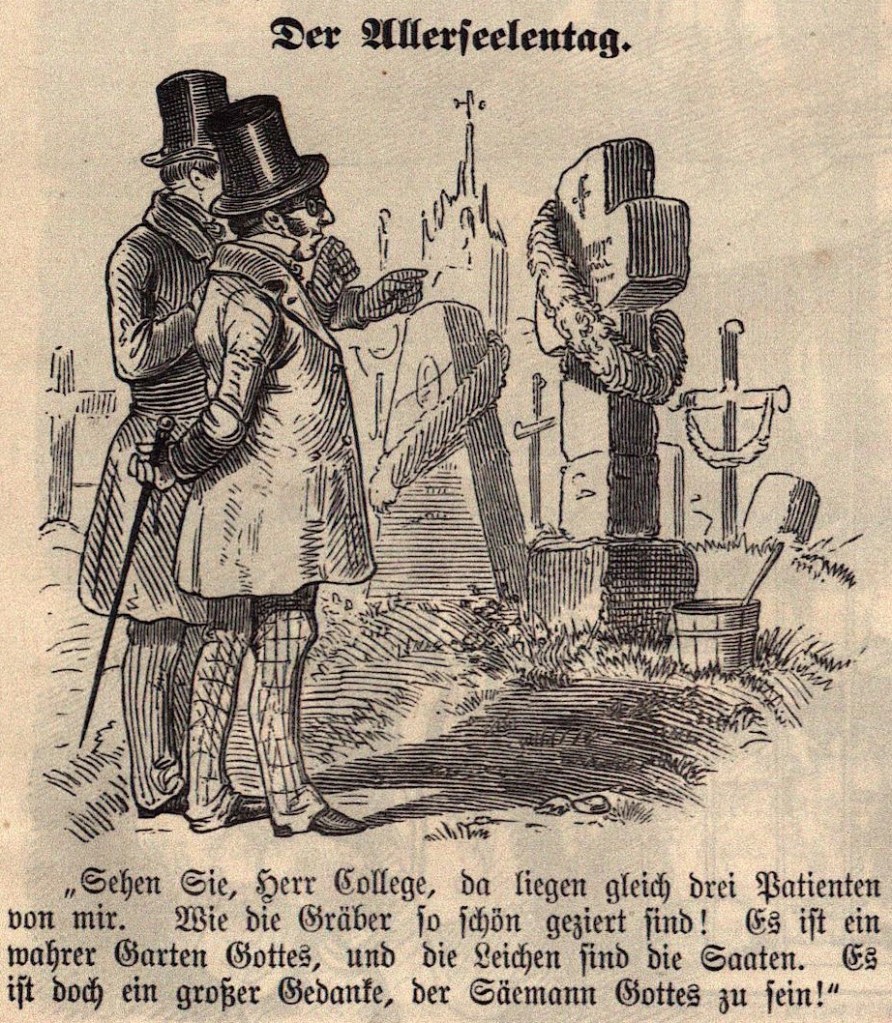
“You see, dear colleague, over there lie three patients of mine. How nicely adorned the graves are! It is truly a divine garden, and the bodies are the seeds. It’s a grand thought, to be the divine sower!”
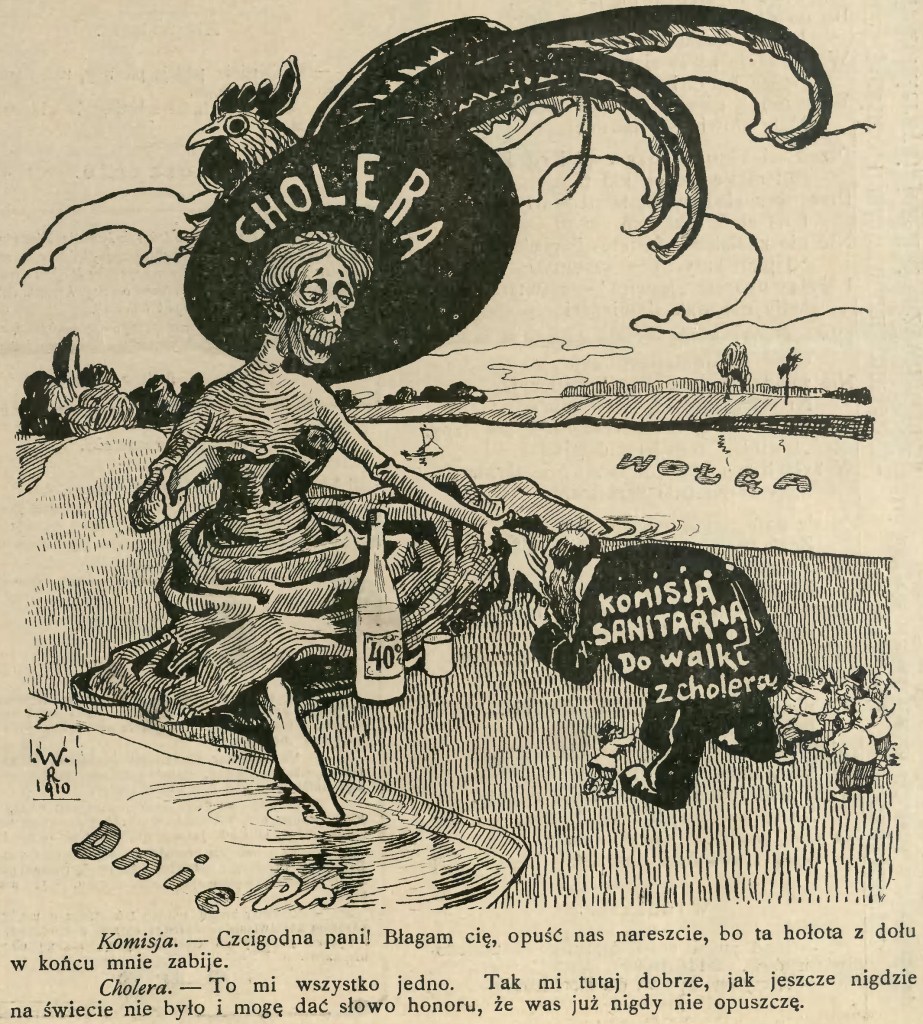
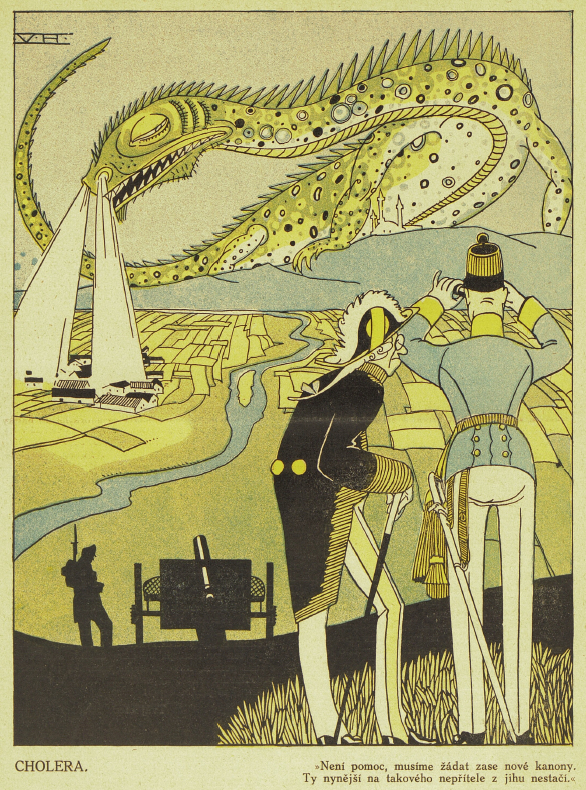
Public Health Commission: “Honorable lady! I am begging you, leave us at long last, because this rabble is going to kill me in the end.” Cholera: “It make no difference to me. It’s better for me here than it’s ever been anywhere in the world, and I can give my word of honor that I will never leave you again.”
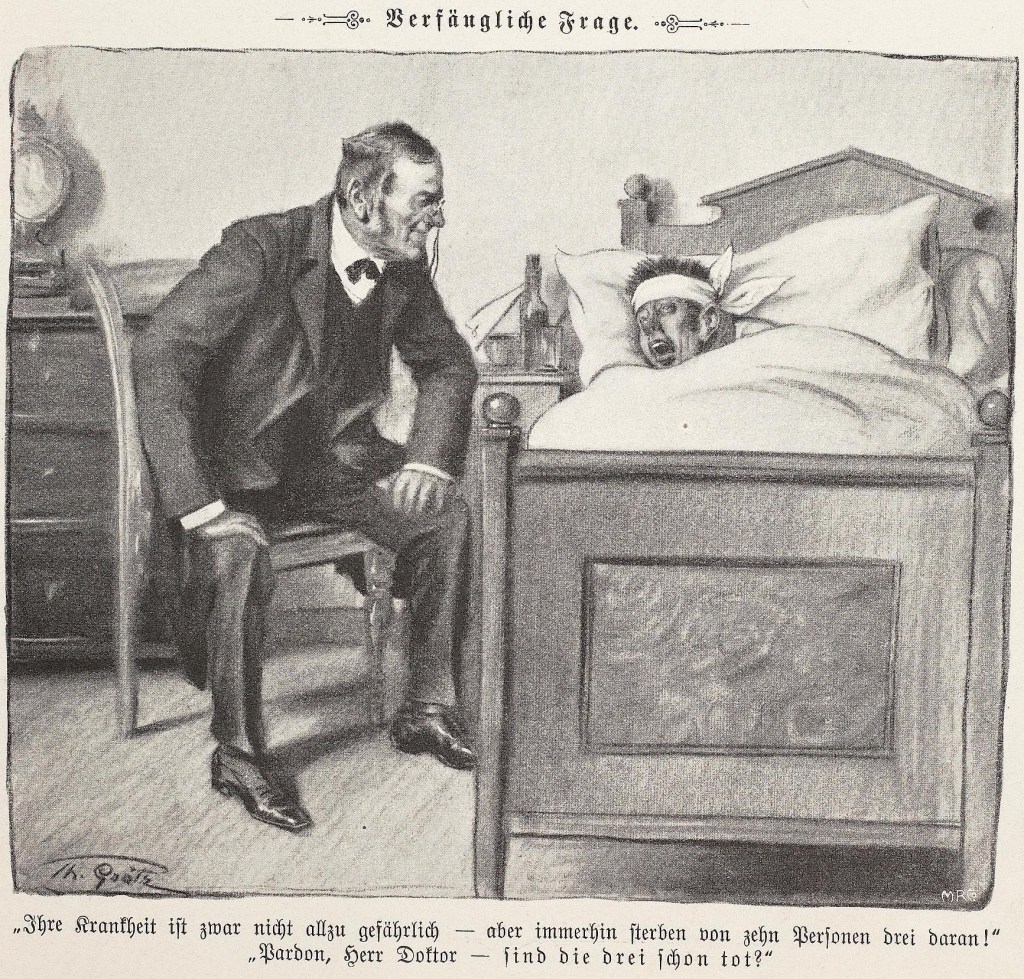
Doctor: “Your ailment isn’t really all that dangerous — but three out of every ten people still die from it!” Patient: “Pardon, Doctor, are the three already dead?”
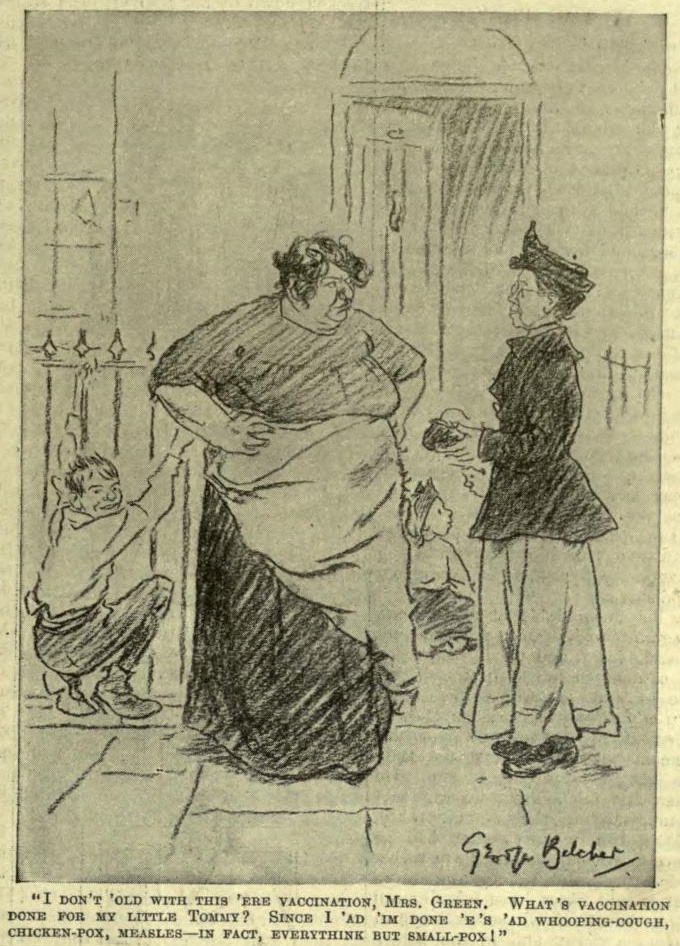
“I don’t ‘old with this ‘ere vaccination, Mrs. Green. What’s vaccination done for my little Tommy? Since I ‘ad ‘im done ‘e’s ‘ad whooping cough, chicken-pox, measles–in fact, everythink but small-pox!” (Punch, London, 1915)
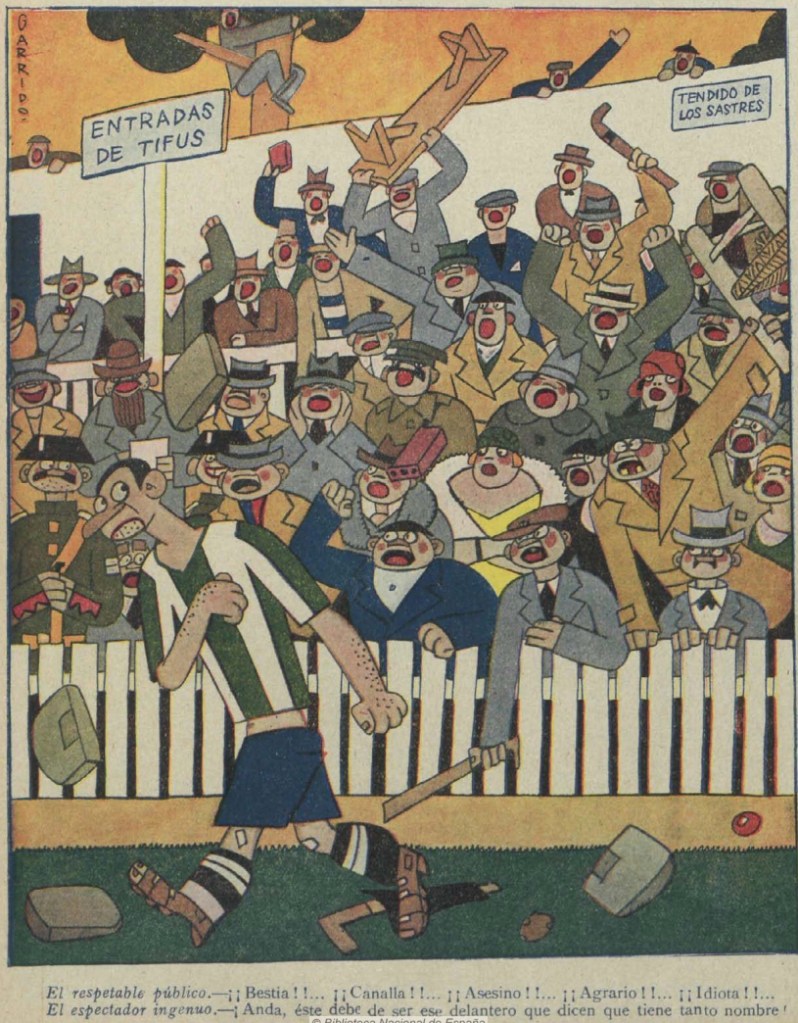
(Only an indirect connection to pandemics, but the section of the soccer stadium reserved for those suspected of typhus speaks to the social status theme.) The respectable public: “Beast! Scoundrel! Assassin! Agrarian! Moron!” The naive spectator: “Well now, this must be that striker they say has such a reputation!” (Buen Humor, Madrid, 1931)
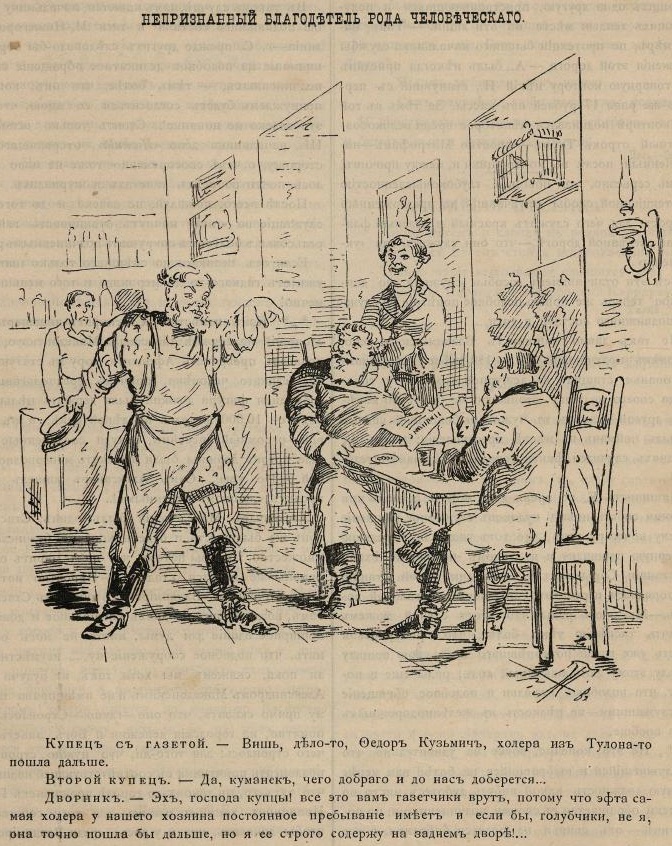
Merchant with newspaper: “Didya see the business, Fedor Kuzmich, about cholera going beyond that Toulon thing.” Second merchant: “Yes, kinsman, what good thing ever makes its way to us…” Yardman: “Hey, mister merchants! The newspaper types are all lying to us, because the same cholera is constantly here at our owner’s place and if it weren’t for me, duckies, it would have gone further, but I keep it strictly in the back yard!” (Razvlechenie, Moscow, 1884)
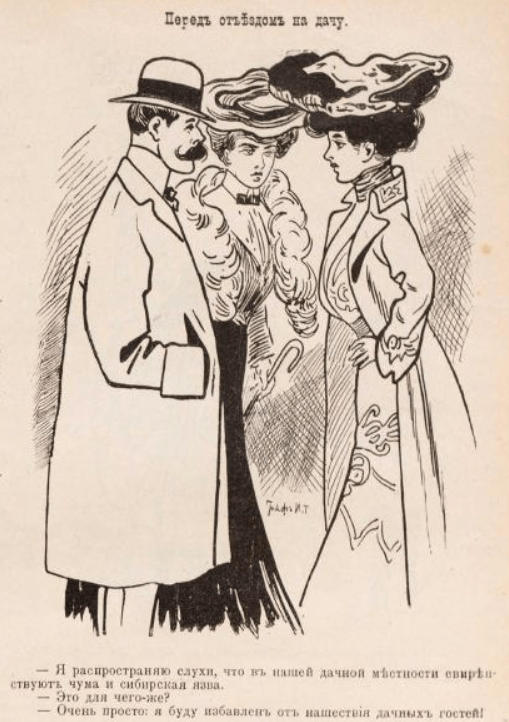
“I’m spreading rumors that plague and anthrax are raging in the vicinity of our dacha.” “What in the world for?” “It’s very simple: I’ll be spared the onslaught of dacha guests!” (Razvlechenie, Moscow, 1907)
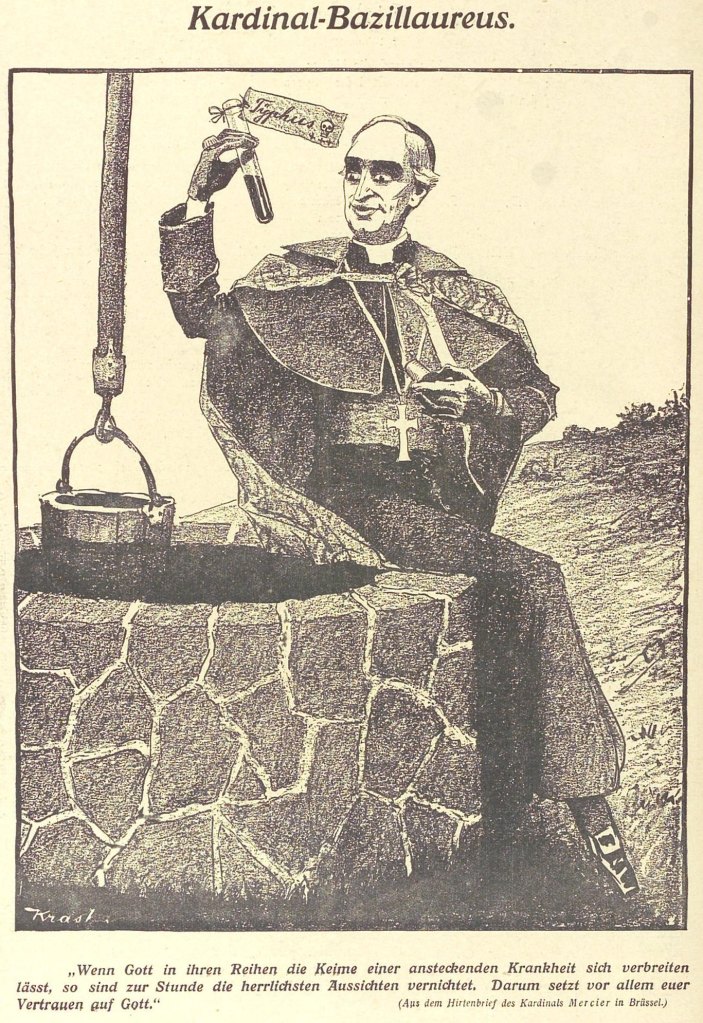
From the pastoral letter of Cardinal Mercier in Brussels: “If God allows the germs of a contagious disease to spread among your ranks, the most glorious prospects are destroyed for the moment. Therefore, above all, place your trust in God.” (Ulk, Berlin, 1916) (How’s that for an odd bit of wartime propaganda?)
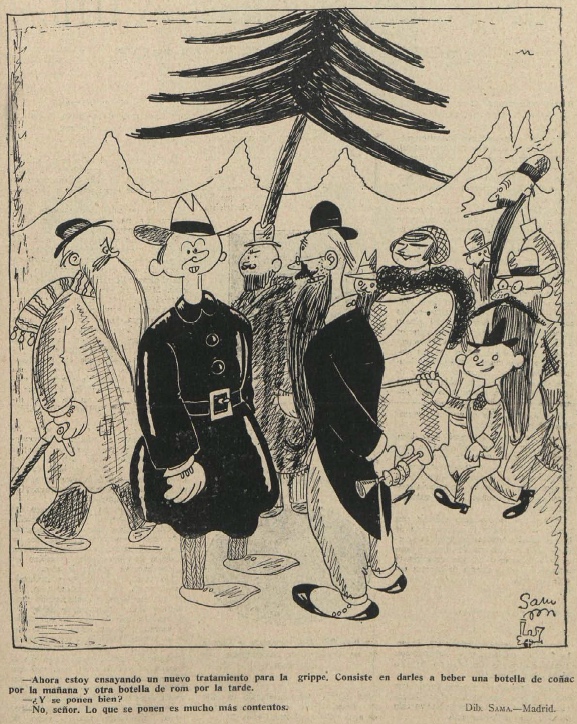
“Now I am trying a new treatment for the flu. It consists of giving them a bottle of cognac to drink in the morning and another bottle of rum in the afternoon.” “And they get better?” “No, sir. What they get is much happier.” (Buen Humor, Madrid, 1931) (Compare this Finnish version.)
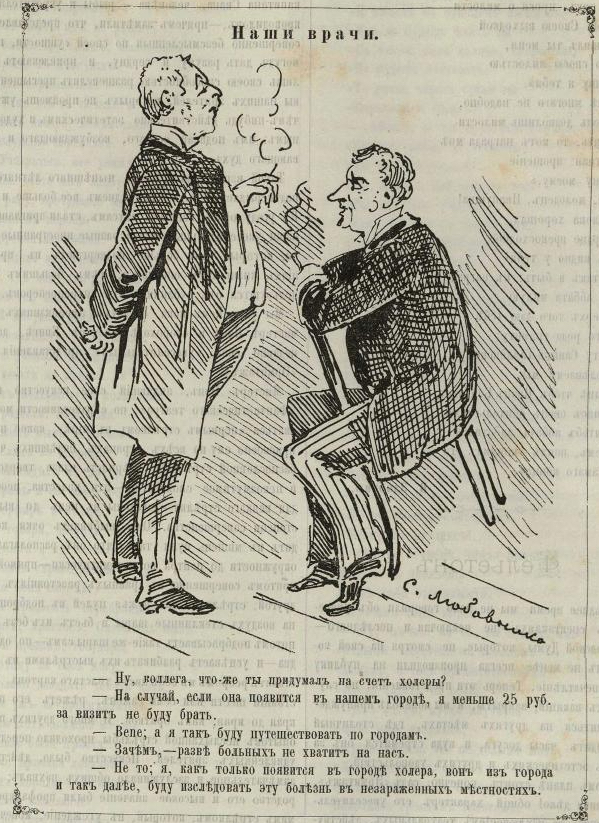
“So, colleague, what have you come up with regarding cholera?” “In case it appears in our city, I won’t take less than 25 rubles for a visit.” “Bene; and that’s how I’ll travel around the cities.” “What for, won’t there be enough patients for both of us.” “It’s not that. As soon as cholera appears in the city, I’ll skip town and keep studying this disease in uninfected locales.” (Razvlechenie, Moscow, 1883)
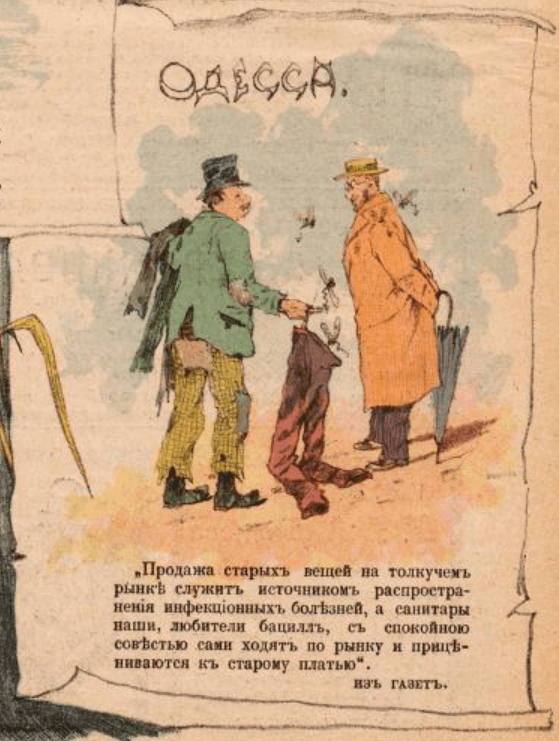
From the newspapers: “The sale of old items at the flea market is a source of the spread of infectious diseases, yet our public health workers, these lovers of bacilli, themselves frequent the market with clean conscience and ask about the price of old clothes.” (Razvlechenie, Moscow, 1897)
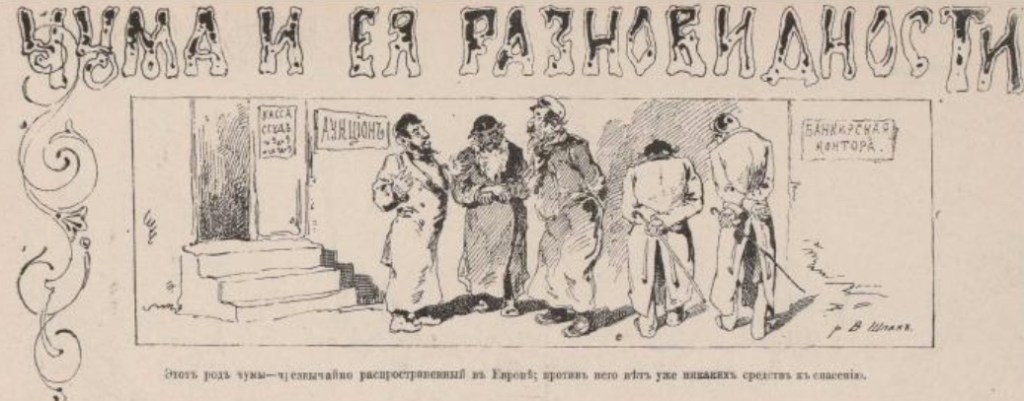
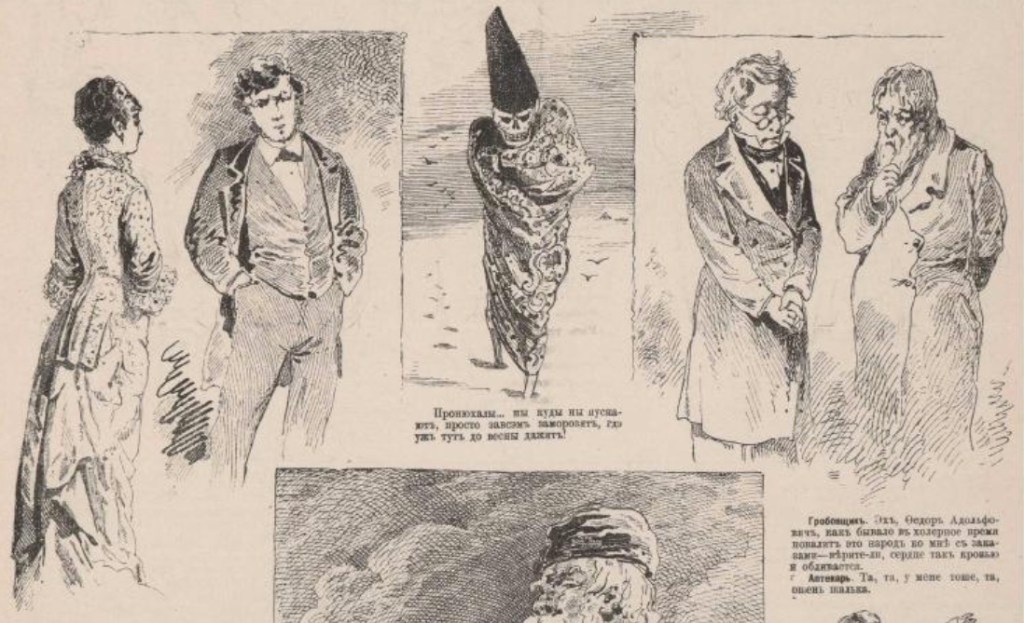
(Strekoza, St. Petersburg, 1879) (Some very unpleasant metaphors on display here.)
(Auction; bank offices) This kind of plague is widely dispersed in Europe; there are not yet any remedies against it.
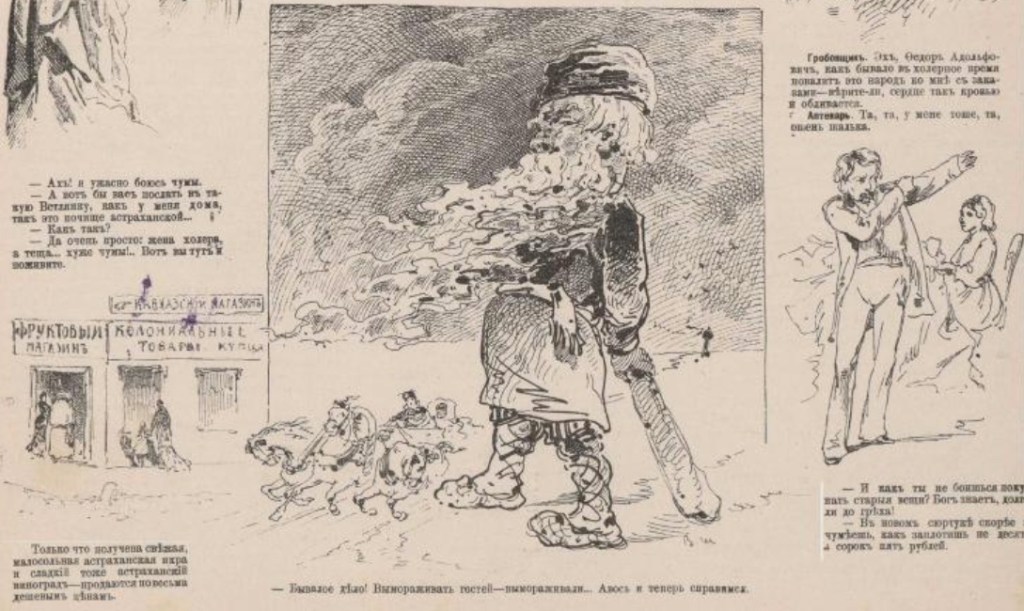
Left: “Oh! I’m terribly afraid of plague!” “We ought to send you to some kind of Vetlianka [in the Astrakhan region, where the plague outbreak originated in 1878] like I have at home, it would be cleaner than the Astrakhan one…” “How’s that?” “It’s very simple: a wife is cholera, a mother-in-law is worse than plague! You’ll get along fine there.”
Center: “They sniffed us out… they don’t let us anywhere, just completely freeze us, where to live until spring!”
Right: Undertaker: “Eh, Fedor Adolfovich, just like when there was cholera, people are overwhelming me with orders, believe me, my heart is just overflowing.” Pharmacist [of German heritage]: “Ja, ja, same with me, ja, ist a pity.”
Russian plague cartoon
Left: (Fresh groceries, imported goods) “We’ve just gotten in fresh, low-salt Astrakhan caviar and sweet Astrakhan grapes, now being sold at extremely low prices!”
Center: “It’s happened! Freeze the guests — now they’re freezing… Maybe now we can handle it.”
Right: “How are you not afraid of buying old things? Who knows how long until they spoil!” “In a new frock coat you will sooner get sick [“get the plague”] dropping not ten, but forty-five rubles.”
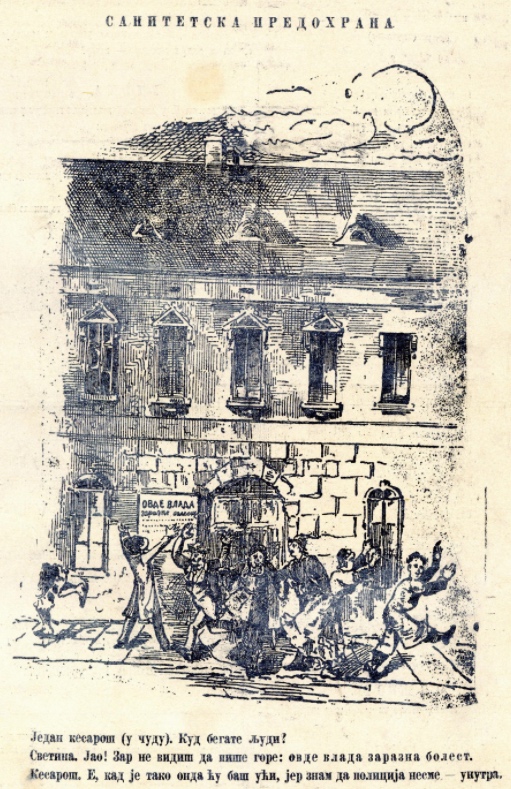
A pickpocket (in wonder): “Where are people running?” Crowd: “Alas! Can’t you see it says above: a contagious disease reigns here.” Pickpocket: “Well, if that’s the case, then I’ll just go in, because I know the police can’t go inside.” (Telefon, Belgrade, 1883)
 Sic Transit Pestilentia