“It’s true in comparison to that smell, nothing smells worse!”
(Le Charivari, Paris, 1849)
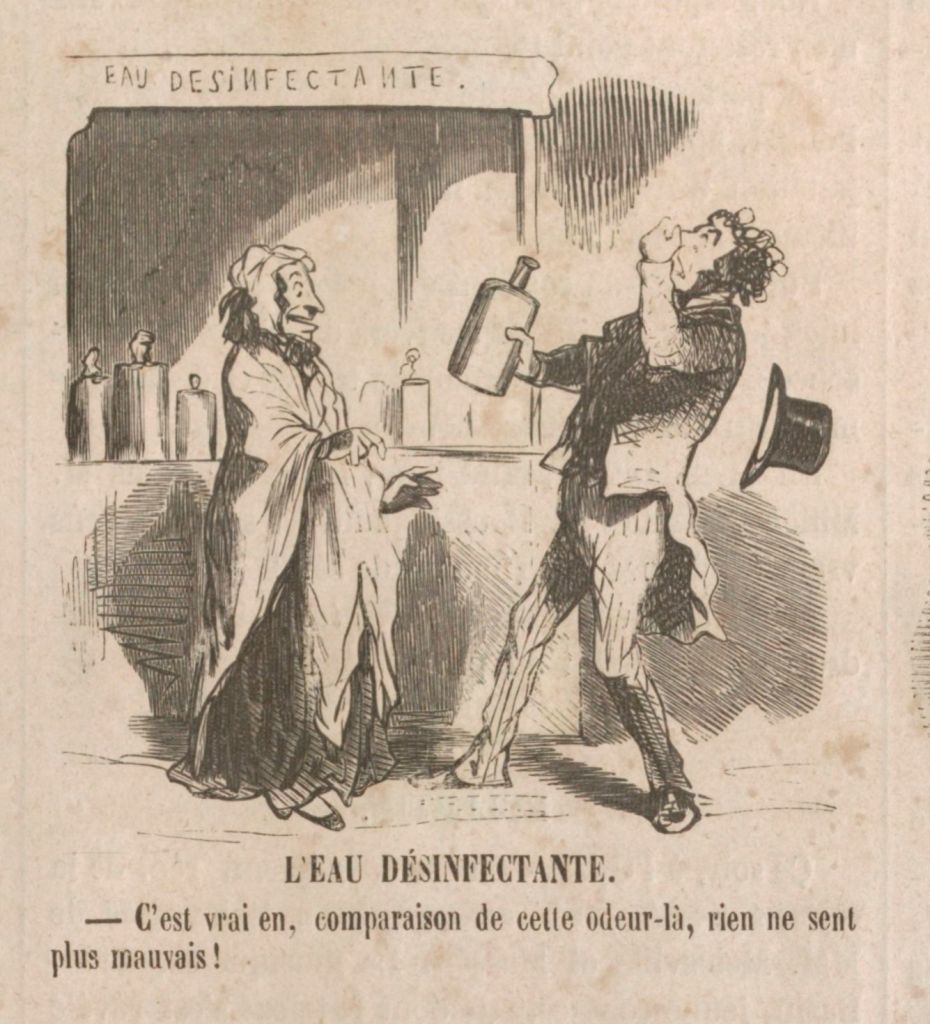
“It’s true in comparison to that smell, nothing smells worse!”
(Le Charivari, Paris, 1849)
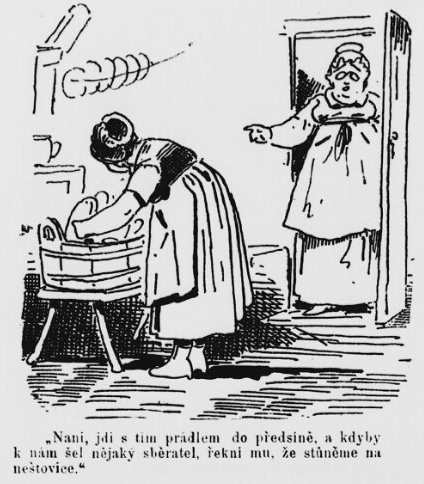
“Nani, go into the entryway with that laundry, and if a collector comes to us, tell him we’ve got smallpox.”
(Humoristické listy, Prague, 1880)
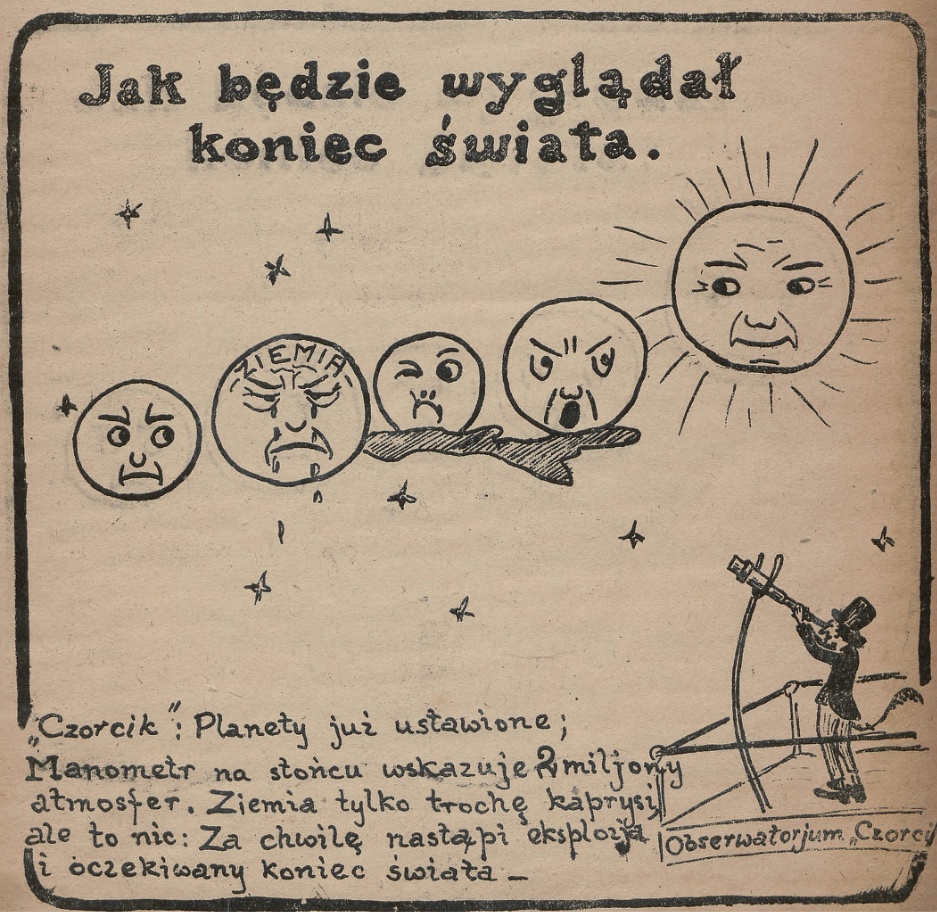
(A sniffly planet earth, as seen from the “Little Devil” Observatory during the second wave of the great flu pandemic.)
The planets are already aligned; the solar pressure gauge shows 2 million atmospheres. The earth is just a little capricious, but that’s nothing: In a moment there will be an explosion and the expected end of the world.
(Czorcik, Piotrków Trybunalski, 1919)
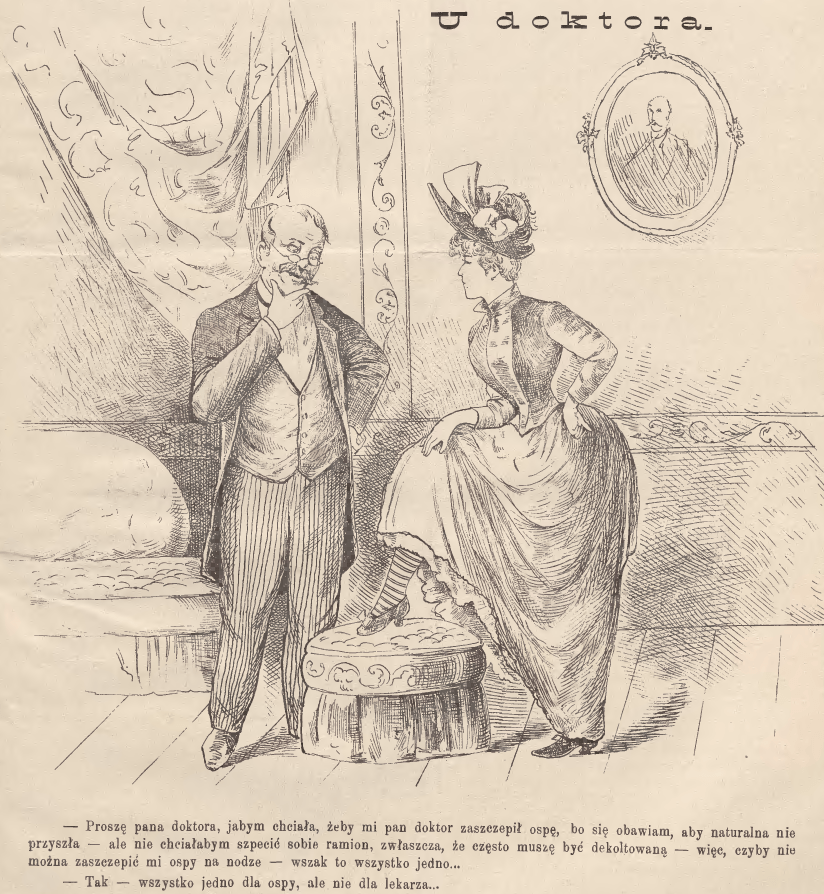
“Please, doctor, I would like you to inoculate me with [attenuated] smallpox, because I am afraid of getting the real thing. But I wouldn’t want to disfigure my shoulders [with a vaccination scar], especially since I often have to show décolletage. So can’t I be inoculated for smallpox on my leg? After all, it is all the same thing…”
“Yes, it’s all the same for the smallpox, but not for the doctor…”
(Goniec i iskra, Lwów, 1891)
And a similar cartoon some years later:
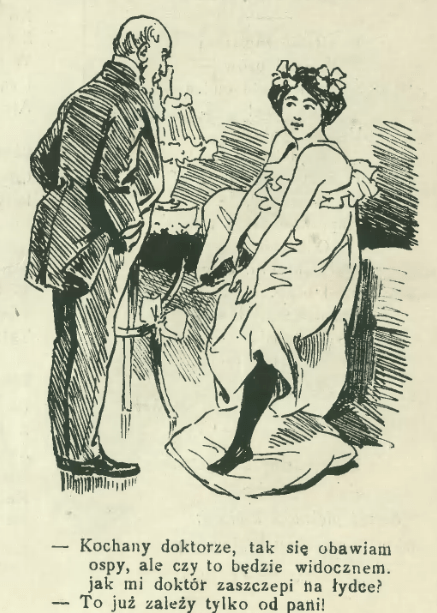
“Dear doctor, I am so afraid of smallpox, but will it be visible when you inoculate on my calf?”
“It only depends on you!”
(Kolce, Warsaw, 1908)
In the same sexist vein, a Hungarian cartoon:
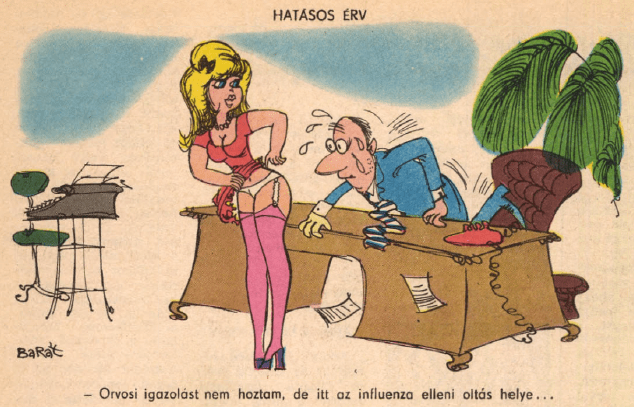
Effective argument
“I didn’t bring the medical certificate, but here is the location for the flu vaccination…”
(Ludas Matyi, Budapest, 1974)
Or another twist:
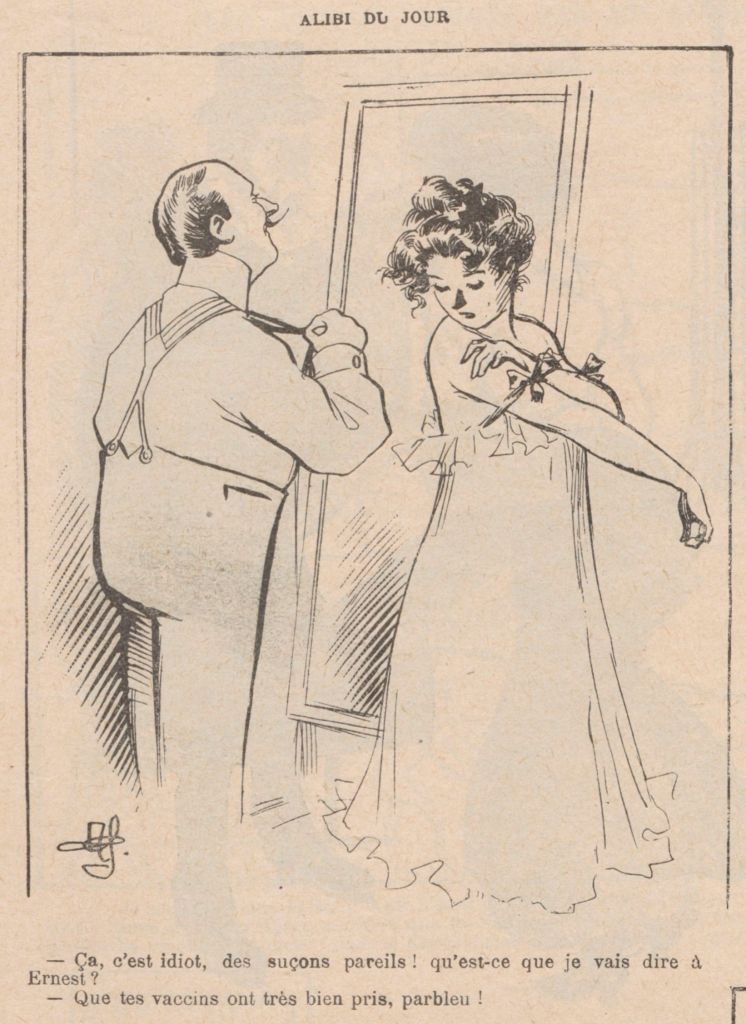
Alibi ju jour
“This is silly, hickeys like that! What am I going to tell Ernest?”
“That your vaccines have taken very well, by Jove!”
(Le Rire, Paris, 1907) (Another French cartoon with related themes. And another from 1920.)
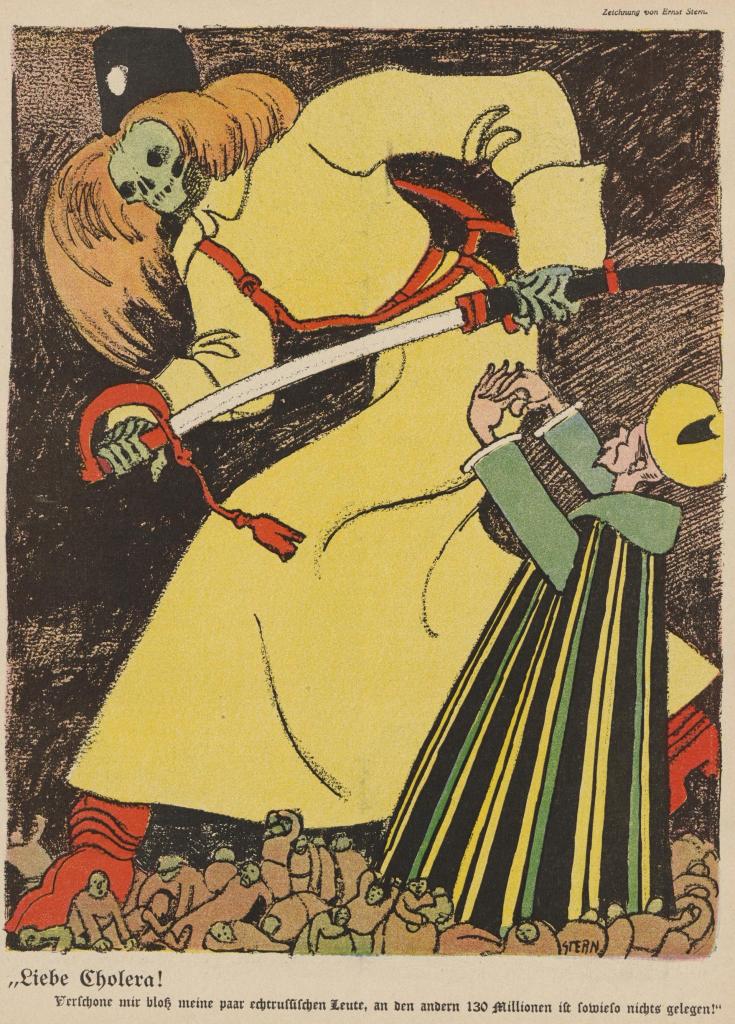
“Just spare my few really Russian people, the others are not important anyway!”
(By the fall of 1908 the last wave of cholera was widespread in the Russian Empire and to a lesser degree in the Ottoman Empire as well. Russia’s entanglements along its southern borders, including a Russian colonel leading a Persian Cossack siege of the Majlis in Teheran in June, but especially the declaration of independence of its client state Bulgaria in October, were cause for concern amid the turmoil of Ottoman politics–when this cartoon appeared, the Young Turks, many from military backgrounds, had upended the Ottoman court. That said, I’m insufficiently informed about the iconography at work here.)
(Lustige Blätter, Berlin, 1908)
“Please, just hold out your hand!”
(Ulk, Berlin, 1929)

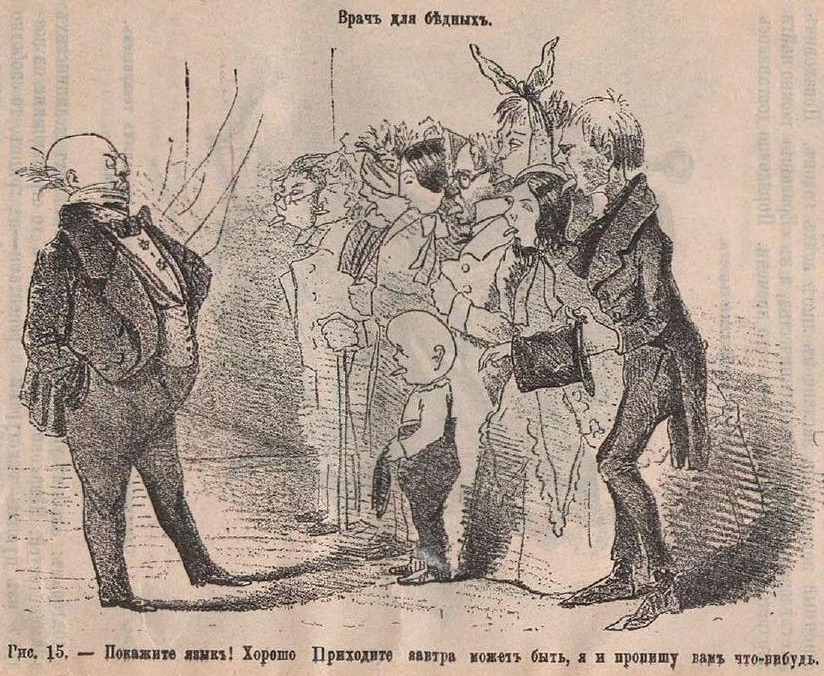
“Stick out your tongue! Fine. Come tomorrow, perhaps I’ll prescribe something for you.”
(Both influenza and cholera were present in St. Petersburg when this was published in one of Russia’s first illustrated satirical journals.)
Mikhail Nevakhovich in Yeralash, c. 1848.
(Reprinted in Aleksandr Shvyrov’s Illustrated History of Caricature, 1903)
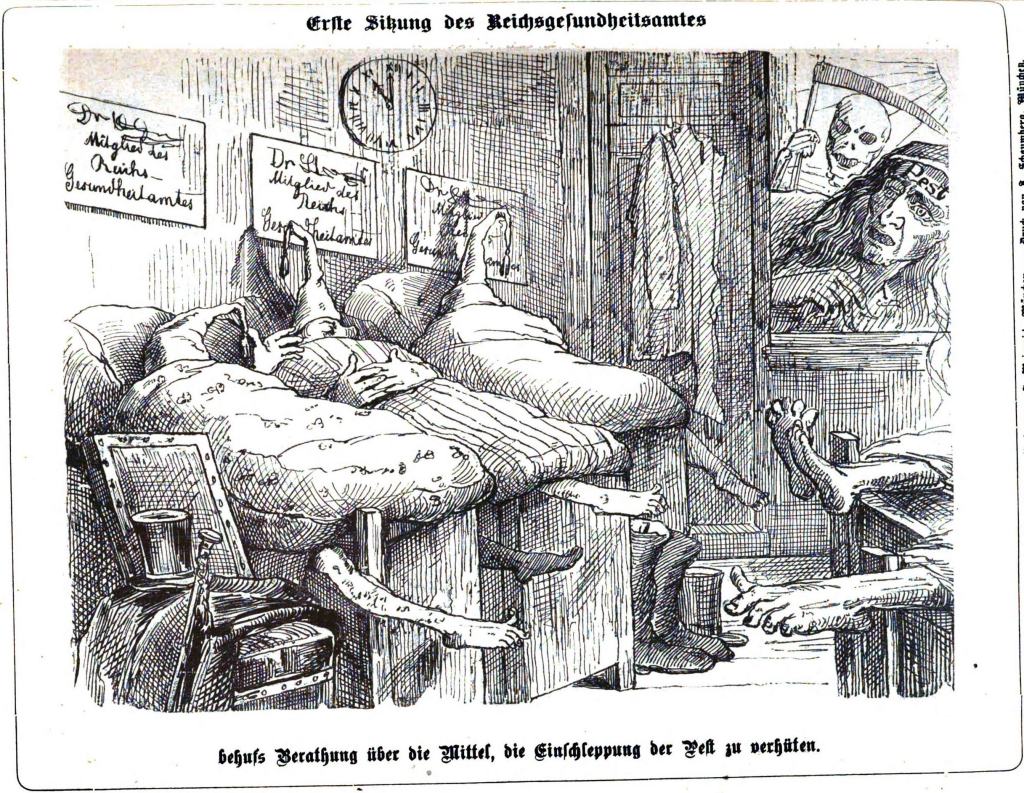
… for consultation about the means for preventing the introduction of the plague.
Das Narrenschiff (Munich, 1877)
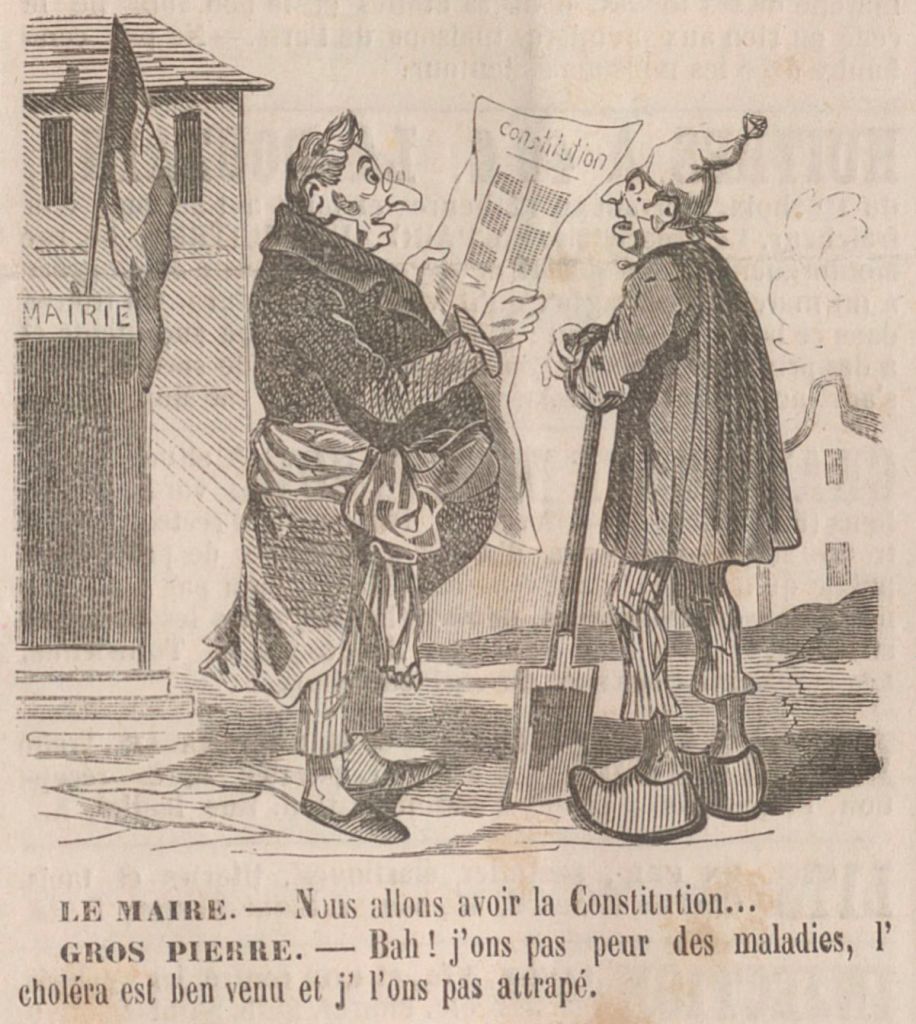
(Following months of revolutionary activities throughout France and Europe, the National Assembly adopted a constitution in November 1848. Scarcely three years later, Napoleon Bonaparte’s coup d’état was soon followed by another constitution establishing the Second Empire.)
The Mayor: “We will have the Constitution…”
Big Pierre: “Bah! I’m not afraid of such maladies, cholera has come along and I haven’t caught it.”
(Le Charivari, Paris, 1848)
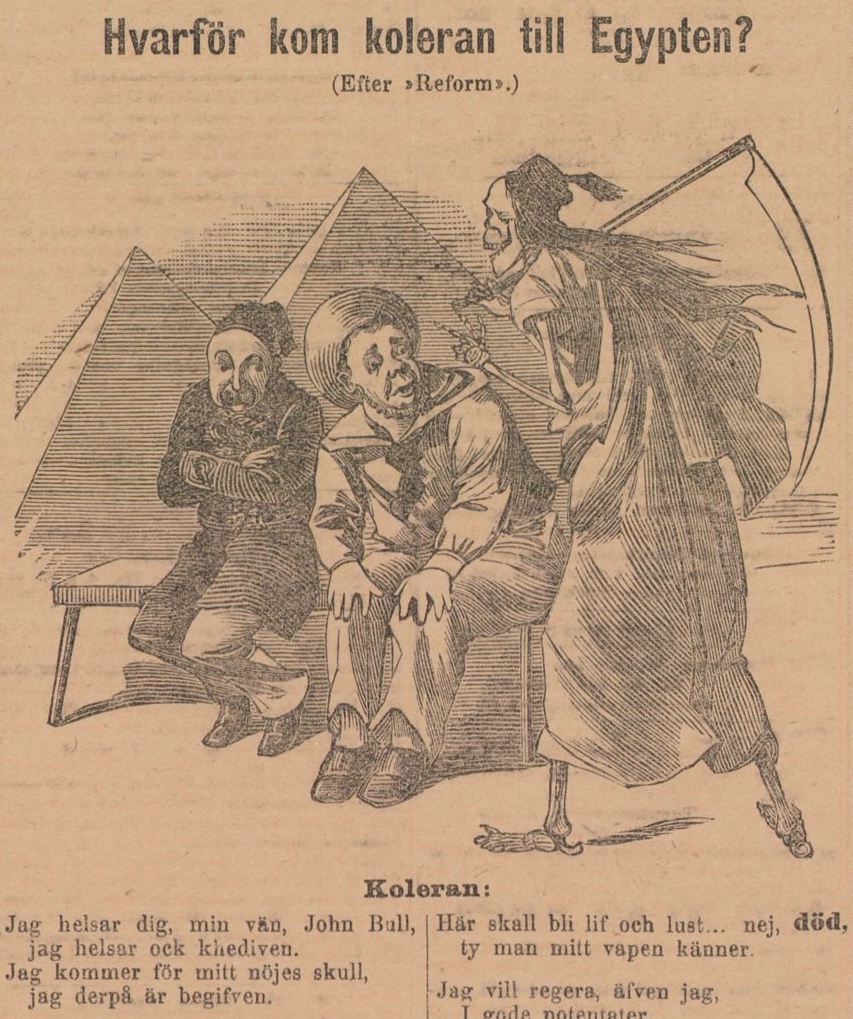
Cholera: I greet you, my friend, John Bull, and I greet the khedive.
I come for my pleasure, I am then besotted.
I think you’re sitting here and still just bored.
Today I have therefore come so we may be together.
None of you invited me here, I invite myself, friends.
There will be life and desire here… no, death, for you know my weapon.
I want to rule, even I, in good potentates.
When I strike, I strike powerful blows, then proud states tremble.
I have an irresistible power, and here, so bright and sunny,
we must now dance to the beat and have so much fun.
(Fäderneslandet, Stockholm, 1883)
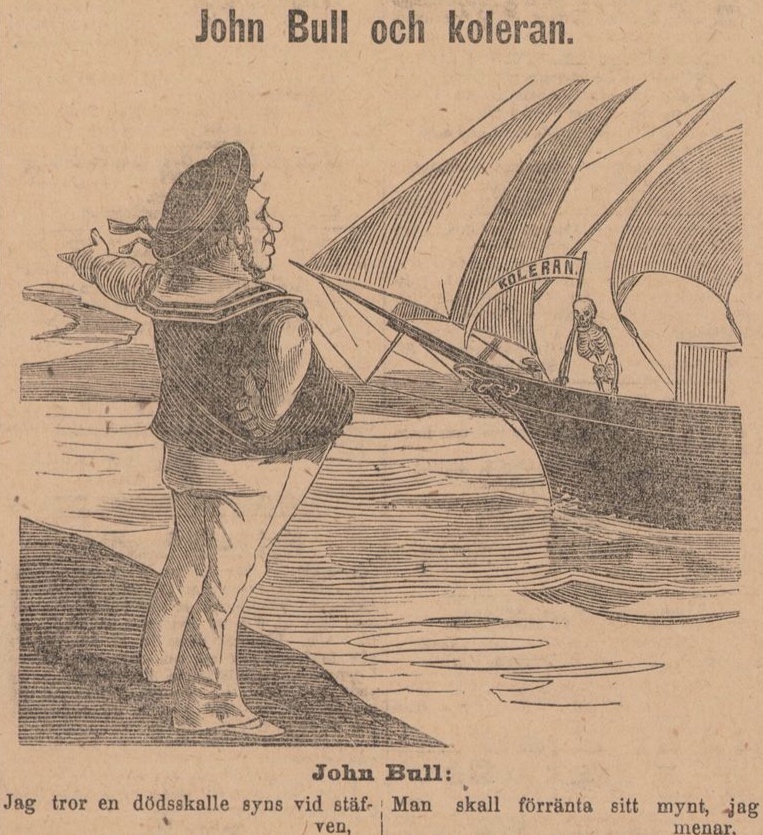
I think a skull is visible at the bow,
a passenger with respect.
But the ship has expensive cargo, too,
and that aroused my desire to shop.
Cholera will never bother me,
whenever it comes to a good deal,
and therefore the ship may pass freely,
even if it carries the infection inside.
You should earn interest on your coin, I mean,
but not salted away in quarantine.
Yes, so long as I earn money,
I’ll steer it to the hometown of cholera.
I do not regret my illness,
no, in my slaked lime I feel so good.
Here we have healthy and sound stomachs,
and gold is everything for a shopkeeper’s soul.
(Fäderneslandet, Stockholm, 1883)
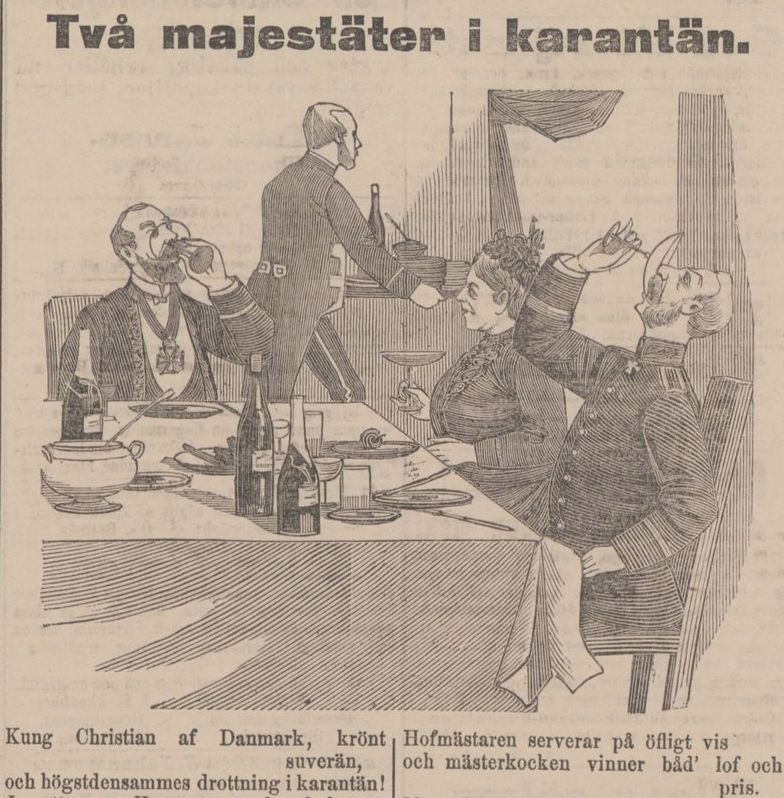
King Christian of Denmark, crowned sovereign,
and equally exalted queen in quarantine!
Yea, that the “Lord’s anointed” be placed there,
is not a breach of majesty the same?
It is believed that the purple itself, which the couple wears,
is now loaded with cholera bacteria,
and shall it be sulphurized, smoked,
shall the king and his consort be soaked with carbolic acid?!
Oh, their majesties feel pretty good,
though it’s not as fun as in a castle.
Delicious dishes and sparkling wine are common here,
but not a single sign of cholera.
The court master serves in the usual way
and the master chef wins both praise and award.
But of Mr. Koch’s bacteria, at the king’s throne,
not even a portion is served here.
There sits the adjutant with champagne glasses,
which must always be in good company.
And now you sound most gracious. Good year, yes, cheers!
You eat and you drink everything you can tolerate.
You can probably be quarantined,
then so you can enjoy there, oh sovereign!
With glass in hand, a roast fowl on fork,
it is, on the whole, like a game.
(Fäderneslandet, Stockholm, 1892) (with apologies for the sloppy translation)
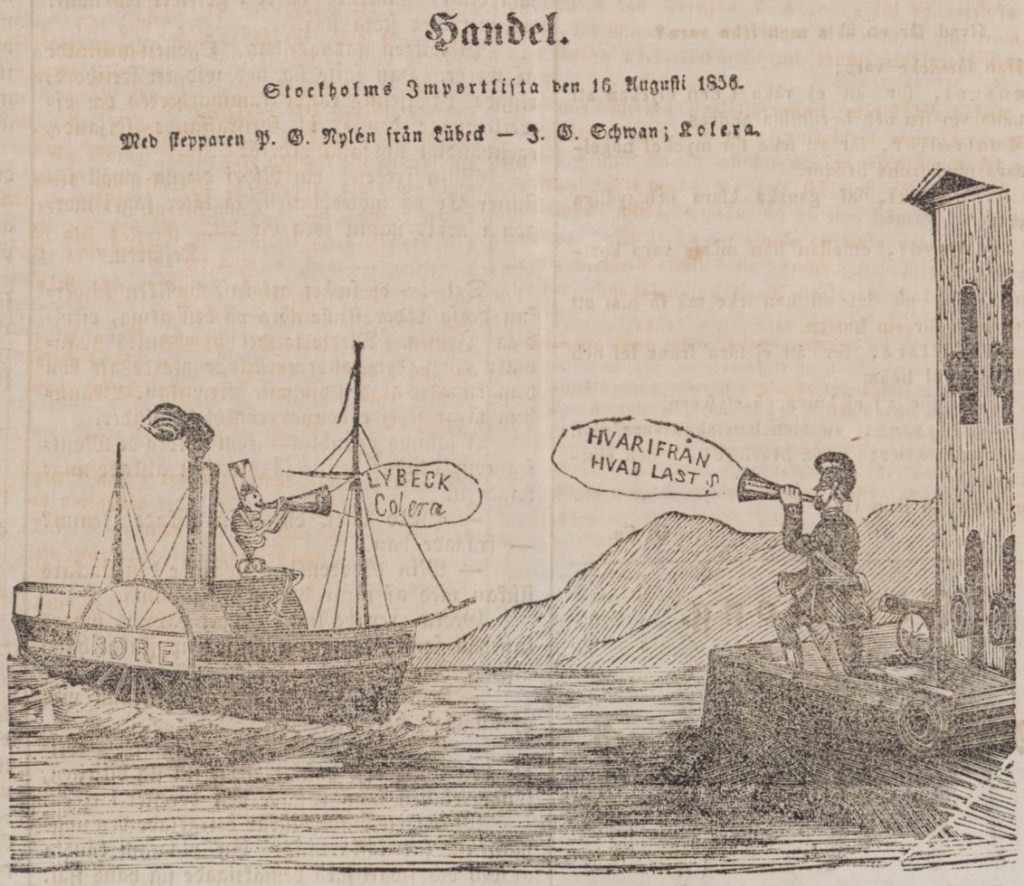
Stockholms import list, 16 August 1856.
With skipper P. G. Nylén from Lübeck — J. G. Schwan; cholera.
(The man on shore is calling out, “Where are you from? What is your cargo?”)
(Fäderneslandet, Stockholm, 1856)
(Skåne is the southern country in Sweden on the eastern side of the Øresund Strait from Copenhagen. The specter of Cholera is reaching out from France.)
(accompanied by some playful verse which I cannot render in full, but here’s one pair of couplets)
But look into the distance! What do we get to see?
It is the cholera that is seen to prevail,
She, who explains all gaiety and caressing,
should she interfere with our play?!
(Fäderneslandet, Stockholm, 1884)

(I’ll only venture the first and last couplets that accompany this image.)
Mr. Sörensen! I have blocked the road for you.
You must not bring cholera to me.
…………
Yes, dear captain, turn on your engine
and sail so the sea trolls get the cholera!
(Fäderneslandet, Stockholm, 1892)

 Sic Transit Pestilentia