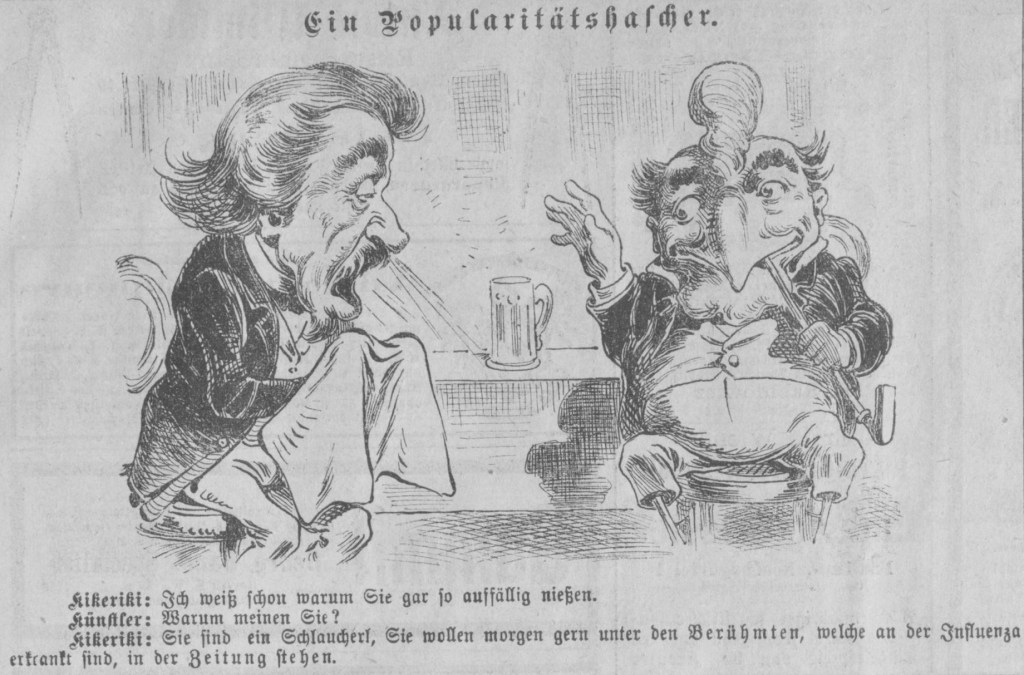
Kikeriki: “I know just why you’re sneezing so conspicuously.” Artist: “What do you mean?” Kikeriki: “You’re one of these clever types who would like to find themselves in the newspaper tomorrow among the famous people who are ill with influenza.” (Kikeriki, Vienna, 1890)
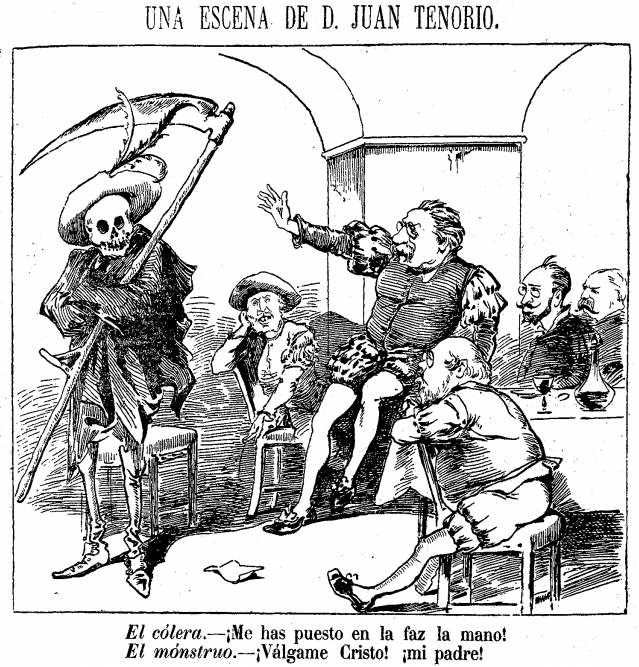
Don Juan Tenorio (the Seducer) was a 1844 play by José Zorrilla that retold the Don Juan legend for modern Spanish audiences. The object of satire here is prime minister Antonio Cánovas del Costillo, sometimes referred to as “the monster” for his curious combination of intellectual hauteur and political brutality. Cholera: “You have slapped me in the face!” [i.e., “I demand satisfaction!”] The monster: “Christ almighty! My father!” (El Busilis, Barcelona, 1884)
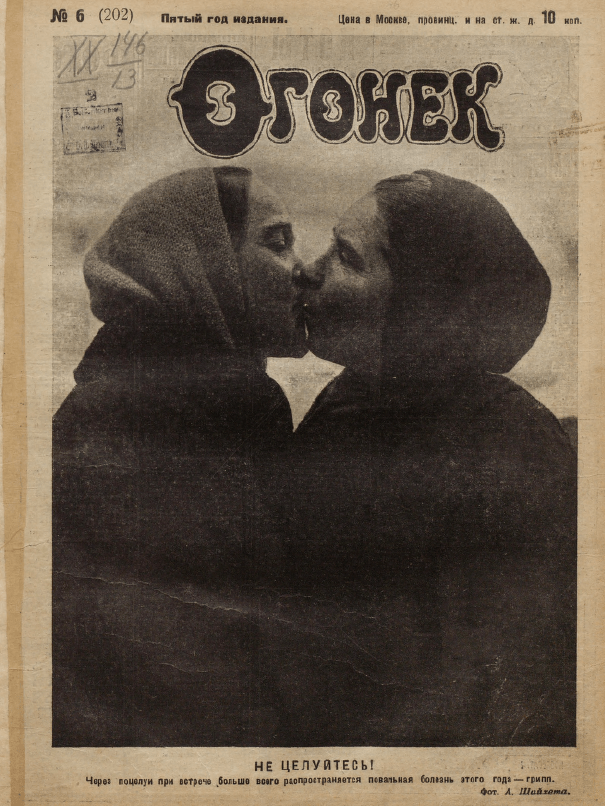
The infectious disease of the year, the flu, is transmitted most of all via kissing when greeting each other. (Ogonek no. 6, Moscow, 1927) (Though I took the image from another source, I owe this to the Soviet Visuals page on Facebook.)
(This is not a freestanding cartoon, but one of several small illustrations that accompany an essay by this title. A rather rough translation of a bit of the surrounding text follows. I’m including this item because it is the earliest available Spanish example I have located so far.)
The recent carnival in Madrid has been bountiful in amorous intrigues, very weighty puns, and acts of honor.
As if revolutions, wars, typhus, influenza, morbid cholera, national pneumonia, and doctors who take death as their lackey were not enough, there are men who have such little esteem for their lives, that I must get away from all that chaff pretending to be skewered like veal on a spit. This would be dreadful if, fortunately, there were not charitable souls in the world who would try to convert the fiery impetus of the Matachines [carnivalesque dance troupes] into healthy prudence… [A metaphor or Aesopian tag for revolutionary factions, which did not win the day in 1848? I am out of my depth here.] (La Linterna mágica, Madrid, 1849)
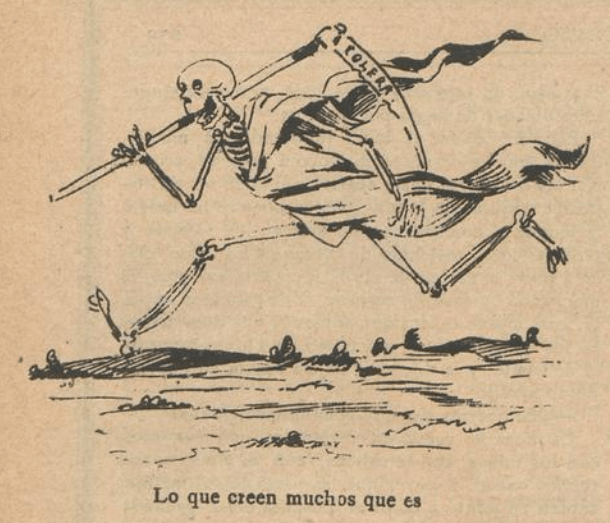
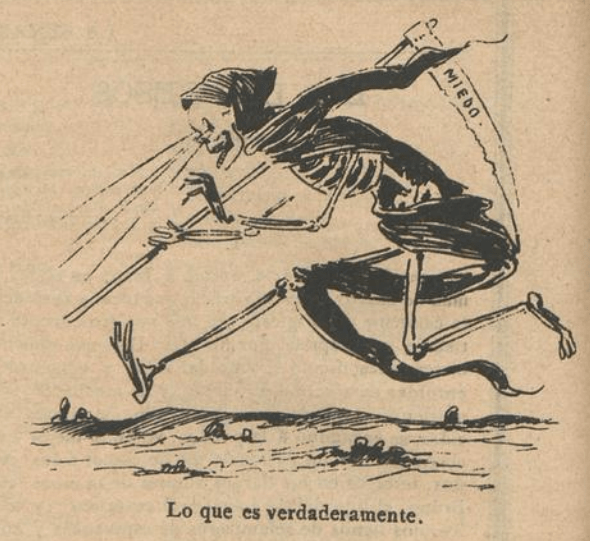
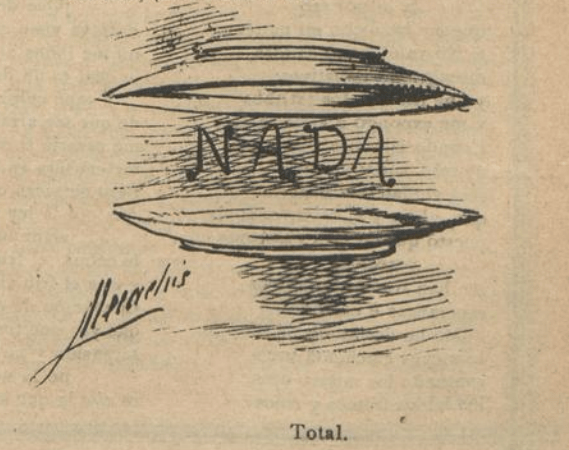
A multi-panel narrative by Mecachis (the pen name of Eduardo S. Hermua) in La Semana Cómico, Barcelona, 1890.
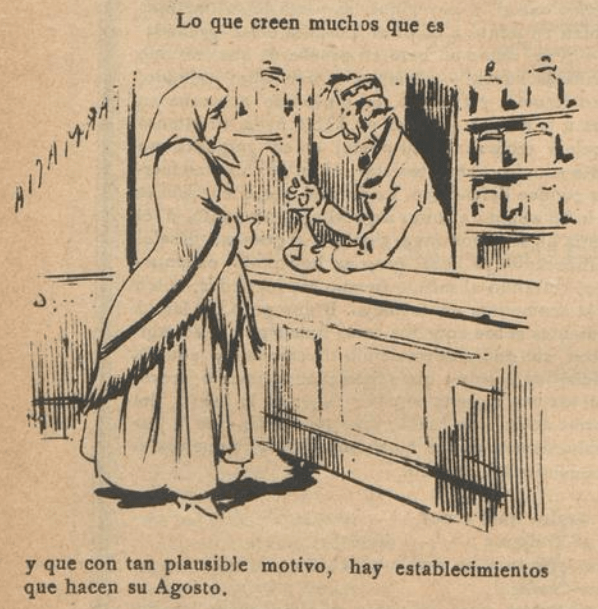
What many believe it to be
Spanish cholera cartoon
What it is in actuality.
Of course, between what is said and what is feared, there are people who find cases even in the soup;
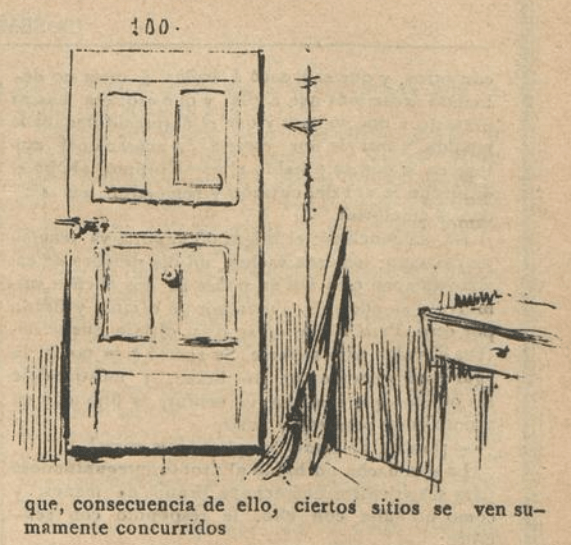
so that, as a consequence, certain sites are extremely crowded
and that with such plausible motive, there are establishments that make their August [profit].
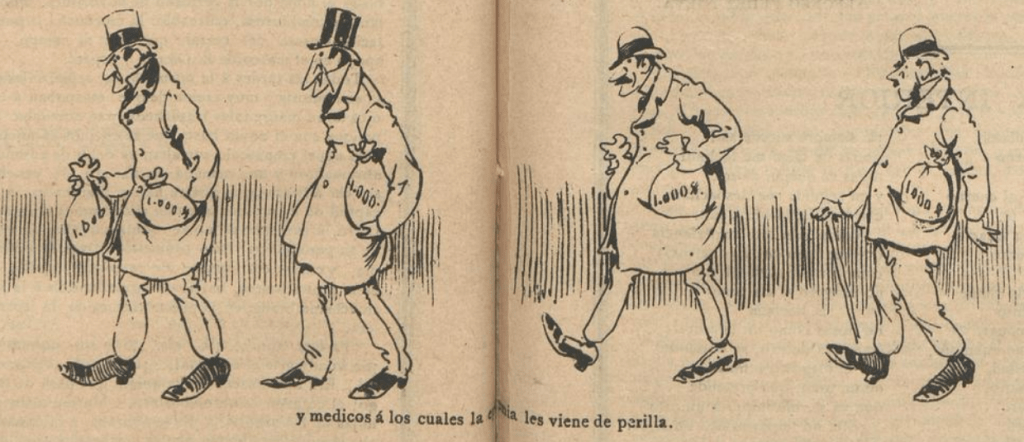
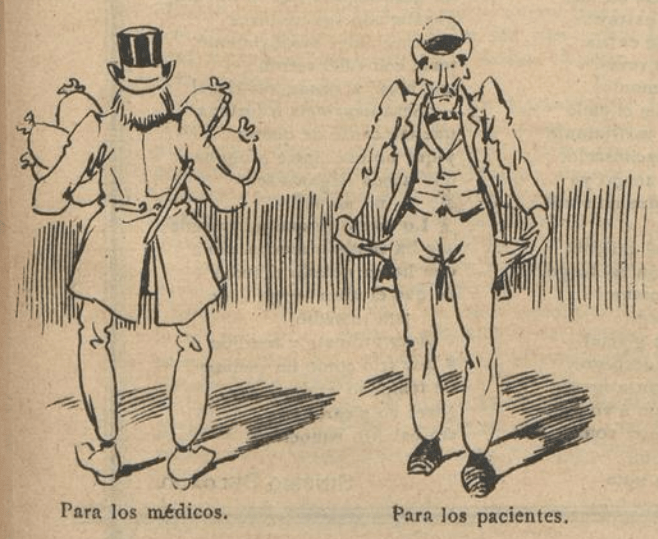
and doctors whom the epidemic thoroughly suits.
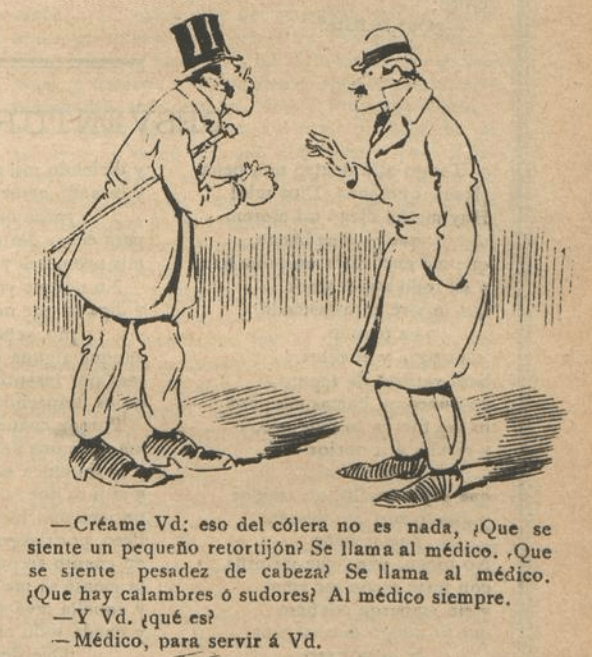
“Believe me: this cholera is nothing. Do you feel a little wooziness? Call the doctor. Headache? Call the doctor. Cramps or sweats? Always to the doctor.” “And what are you?” “A doctor, to serve you.”
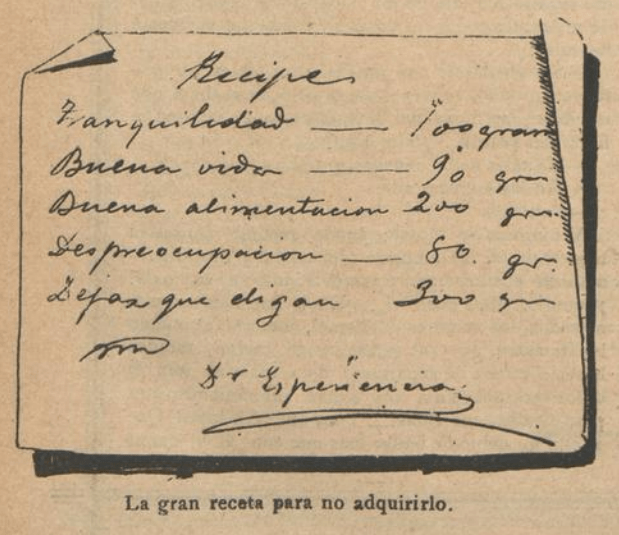
The big prescription you can’t get [rest, the good life, good nutrition, etc.].
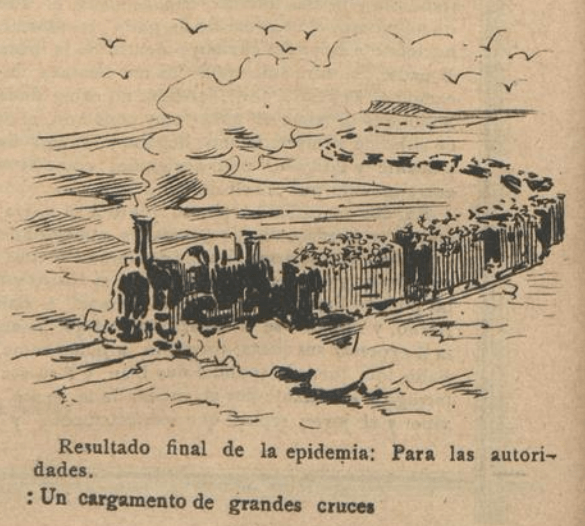
Final result of the epidemic: For the authorities: A shipment of large crosses
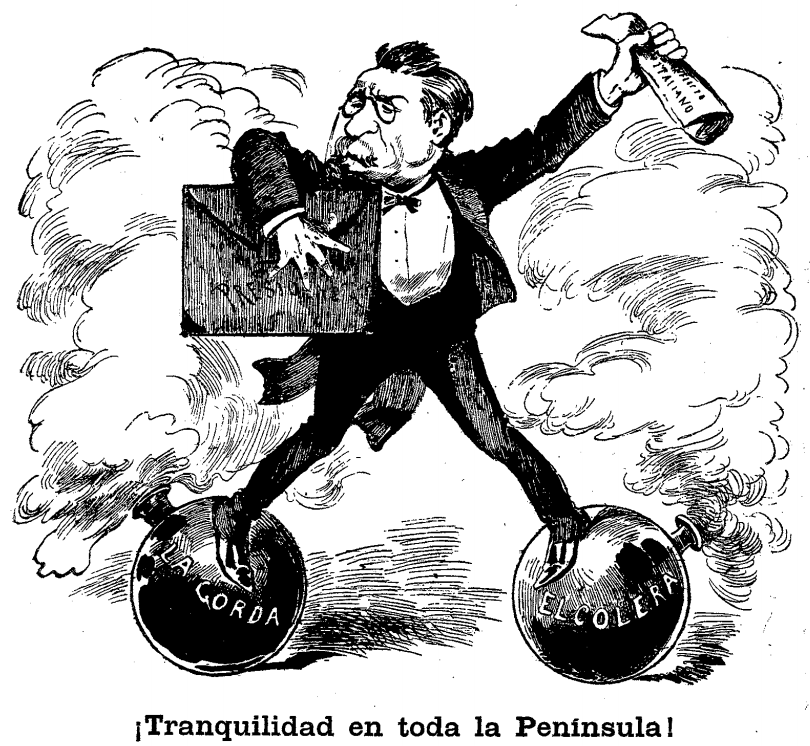
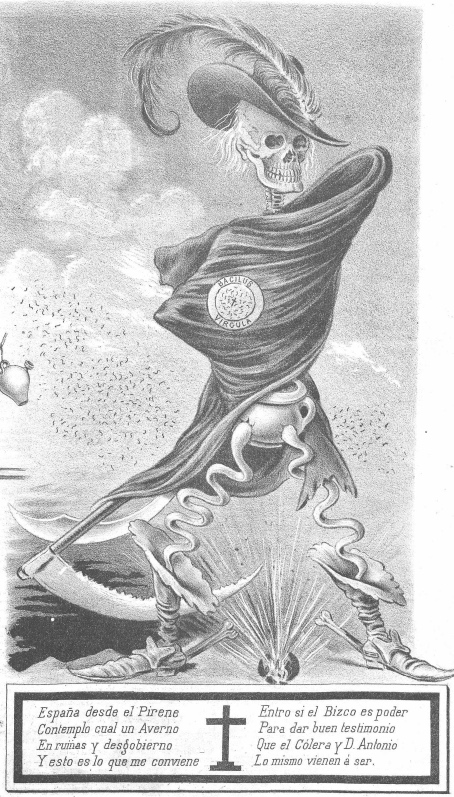
Spain from the Pyrenees on down I contemplate what an inferno In ruins and misrule And this is what suits me I enter if the Squint-eye lets me To give good testimony That the Cholera and Don Antonio [Cánovas del Costillo, prime minister who was forced from office by the end of that year] Are coming to be one and the same. (Don Quijote, Madrid, 1892)
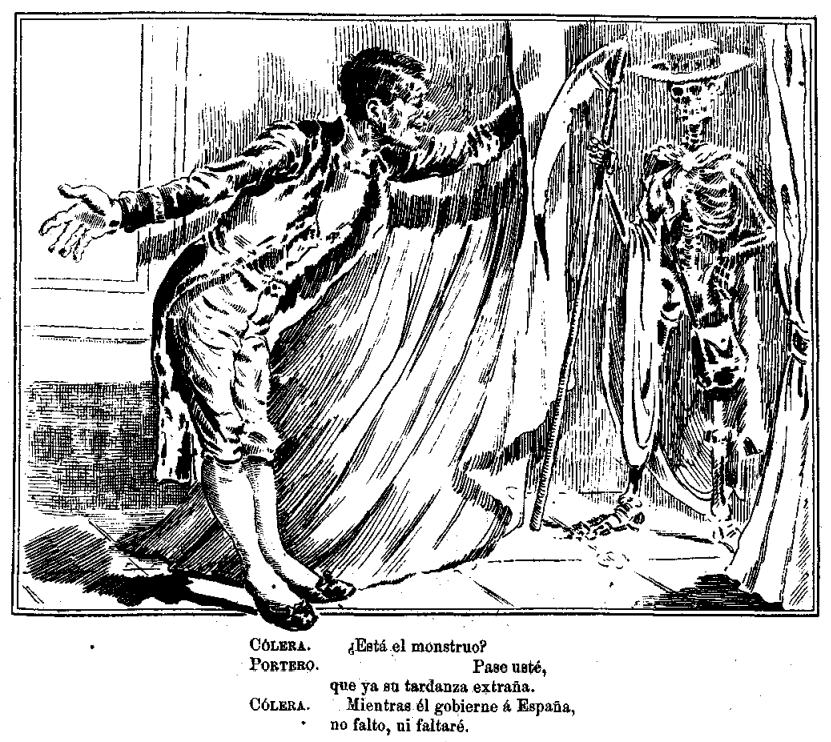
Cholera: “Is the monster in?” Porter: “Do come in, your delay is strange.” Cholera: “While he governs Spain, you don’t need me, nor shall you.” (Don Quijote, Madrid, 1892) (Prime minister Antonio Cánovas del Castillo was sometimes referred to as “el Monstruo,” as seen in this image from El Motin.)
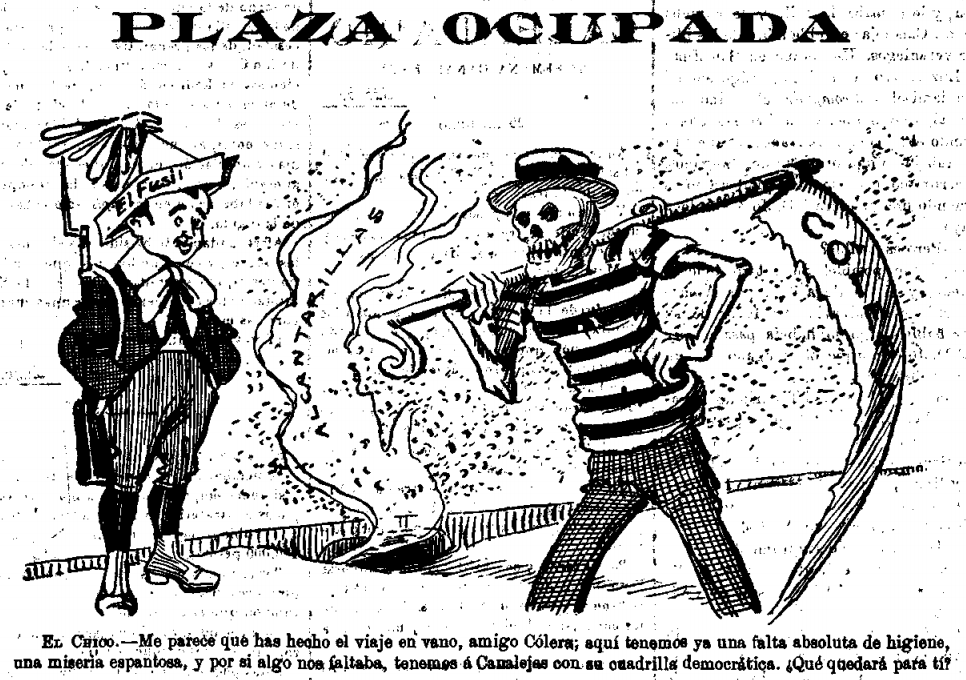
(Sewers belching miasma) Boy: “It seems to me that you have made the trip in vain, friend Cholera; here we already have an absolute lack of hygiene, dreadful misery, and in case something was missing, we have [prime minister José] Canalejas with his democratic squad. What will be left for you?” (El Fusil, Madrid, 1911)
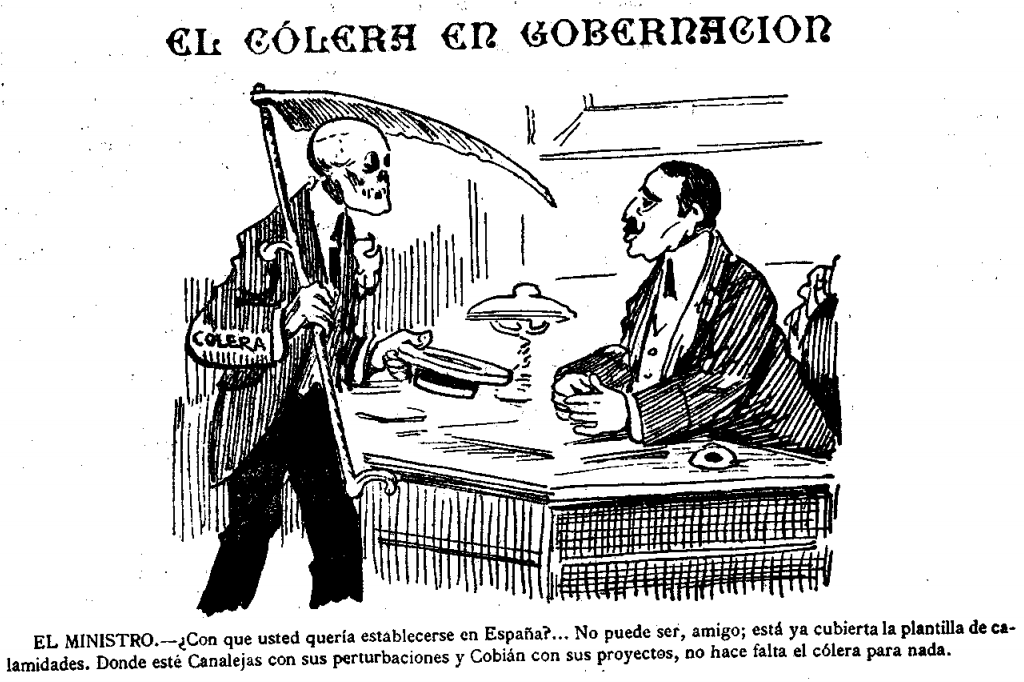
Minister: “What did you want to settle in Spain with?… It cannot be, my friend; emergency scenarios are already covered. Wherever there is [prime minister José] Canalejas with his disturbances and [Liberal Party politician and member of the Council of Ministers Eduardo] Cobián with his [tax reform] projects, there is no need for cholera at all.” (El Fusil, Madrid, 1910)
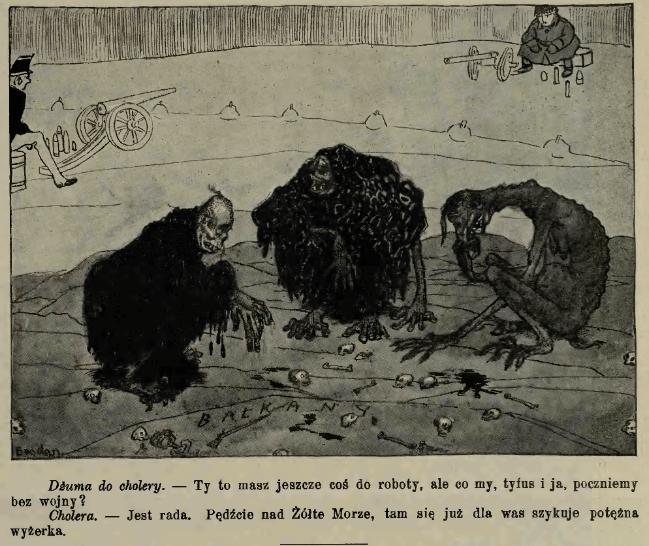
Plague to cholera: “You have something else to do, but what will we, typhus and I, do without war?” Cholera: “Here’s some advice. Rush to the Yellow Sea, there is already a mighty battle preparing for you.” (Mucha, Warsaw, 1913)
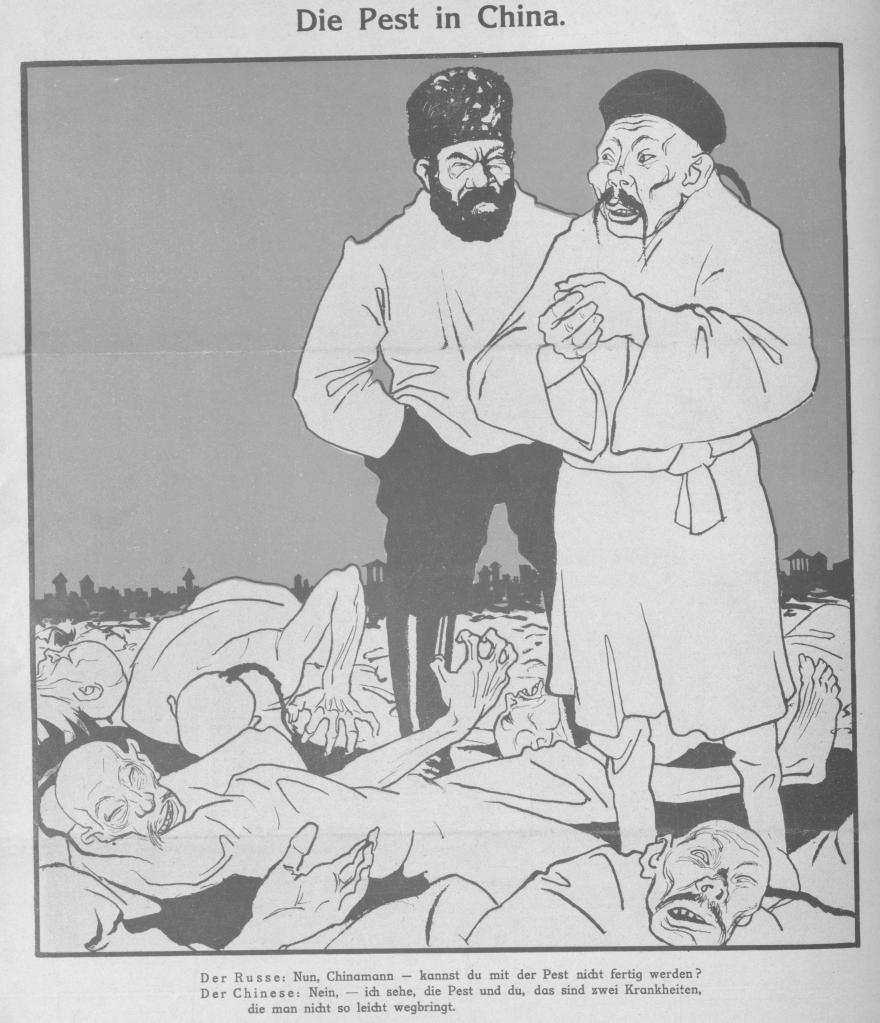
Russian: “Now, Chinaman, can’t you be done with the plague?” Chinese: “No, I see the plague and you, and those are two ailments that one cannot easily get rid of .” (Wiener Caricaturen, Vienna, 1911)
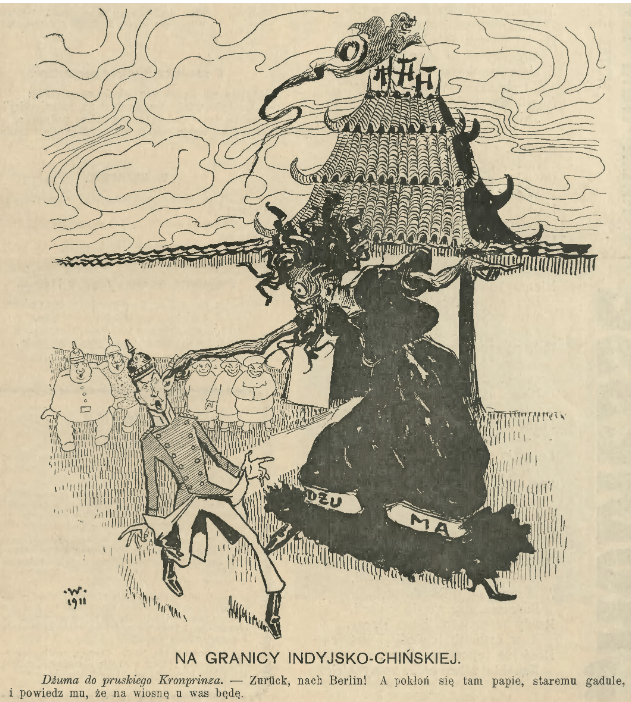
Plague, to the Prussian crown prince: “Back to Berlin! And bow to your papa, the old chatterbox, and tell him that I will be there in the spring.” (Mucha, Warsaw, 1911) (Crown prince Wilhelm, though lacking in foreign diplomatic experience, won approval to embark on a lengthy journey to Asia in November 1910, ostensibly to learn more about German interests in the far east. After much wining and dining with British colonial officials in India, Wilhelm cut short his trip late in February 1911. Originally slated to include Siam, Dutch Indonesia, China, and Japan, it was interrupted by news of an outbreak of plague in Calcutta, as well as reports of bouts in China that were already crossing the Russian border.)


 Sic Transit Pestilentia