Influenza, obstruction, This situation is already appalling! Our nose grew like a tower, We are failing, abbiony! (Bolond Istók, Budapest, 1889) (I hesitate to post this one, since I don’t grasp the context adequately, e.g., the figures blowing wind, or the term “abbiony,” which is not in any dictionary, but shows up multiple times in this journal. It might actually be an informal acronym for its readers.)
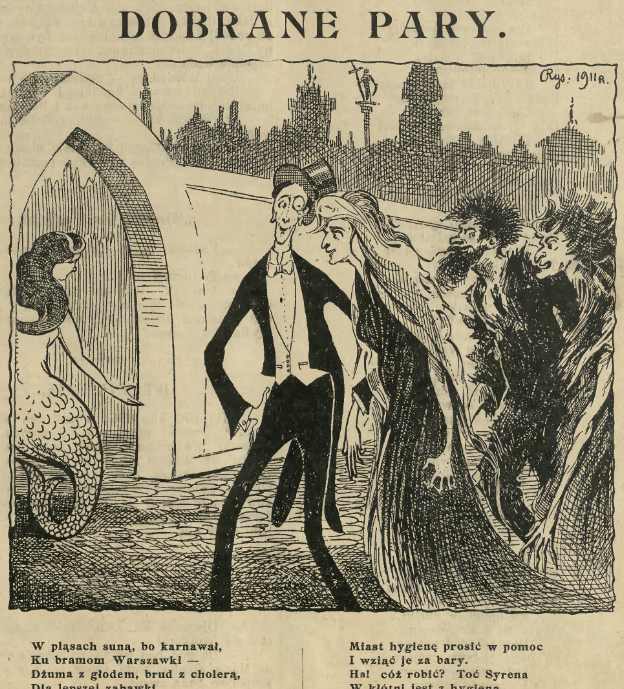
They glide in festive dance, for it is carnival, Towards the gates of Warsaw Plague with hunger, dirt with cholera, For better entertainment. And out of hospitality the Siren Is inviting these couples To ask cities for help with hygiene And take them for bars. Ha! what to do? This Siren Is in a quarrel with hygiene, No wonder she wants to show off Luck as hospitality. (Kogut, Warsaw, 1911) (translation wants improvement)
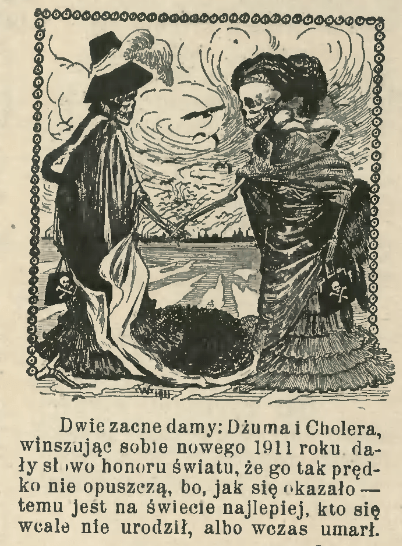
Two respectable ladies: Plague and Cholera, congratulating themselves on the New Year, gave their word of honor to the world that each would not leave it so quickly, because, as it has been said, “he is at his best, who has not even been born or has died on time.” (Mucha, Warsaw, 1912)
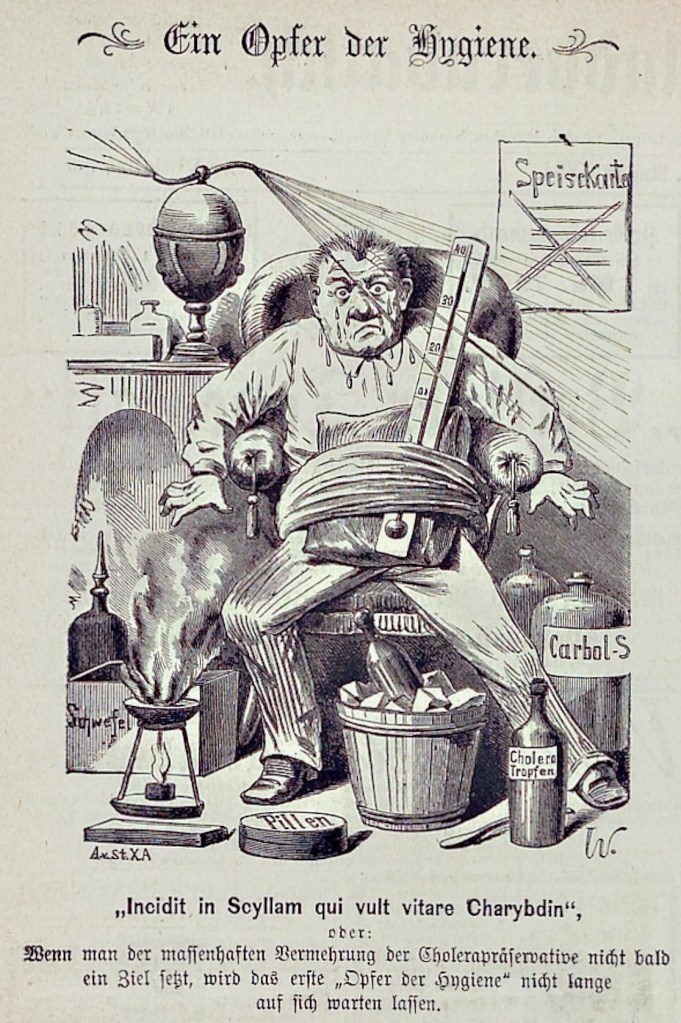
(in Latin) He wants to avoid falling into Scylla or Charybdis, or: Unless a guideline is set soon for the massive increase in cholera-prevention remedies, the first victim of hygiene will not be long in coming. (Kladderadatsch, Berlin, 1884)
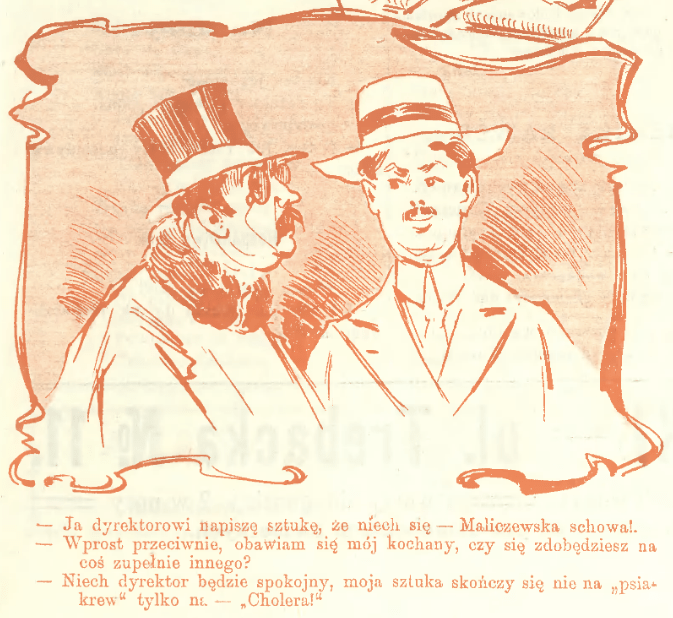
Gabriela Zapolska (b. 1857) was an actor and prolific playwright whose Miss Maliczewskaenjoyed its premier while she was living in Lwów in 1910. Drawn in part on her itinerant life as an aspiring actor after breaking from her gentry family, the play was a conventional moral tale about an impoverished and beautiful young woman named Stefka Maliczewska seeking an acting career, but falling under the malign influence of the lecherous old lawyer Daum, who becomes her patron. After various betrayals, ethical compromises, and debt-ridden dilemmas, the play ends with Stefka stymied and cursing her lot in life. (Her term of choice was “psia krew!” intimating dog’s blood but meaning “damn!”) Though not exactly scandalous in 1910, with one reviewer welcoming the “merciless truth” of her Zolaesque naturalism, such unrefined language from the mouth of a young female character did invite disapproval in some circles, which in turn drew the attention of the satirist.
The caption: “I will write a play for the [female] director so that she lets Maliczewska abscond!” “Quite the contrary, my dear, I am afraid that you will do something completely different?” “Let the director be at ease, my play will end not on ‘damn’ but on ‘cholera!'”
In keeping with its old-fashioned “choleric” association with anger, “cholera” is sometimes employed as a curse (roughly, “damn”). At a time when the last cholera pandemic was gradually coming to an end, this trivial pun would have been especially resonant.
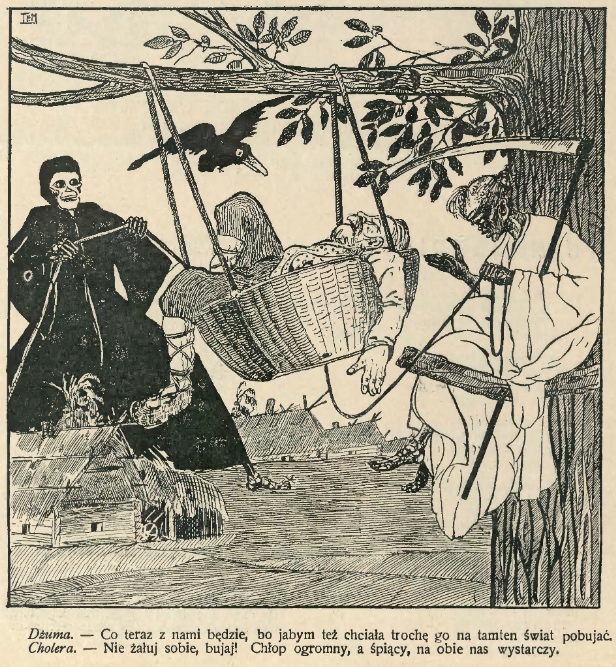
Plague: “What will happen with us now, because I would also like to nudge him a bit to the netherworld.” Cholera: “Don’t feel sorry for yourself, get to it! A huge and sleepy peasant, enough for both of us.” (Mucha, Warsaw, 1910, p. 4)
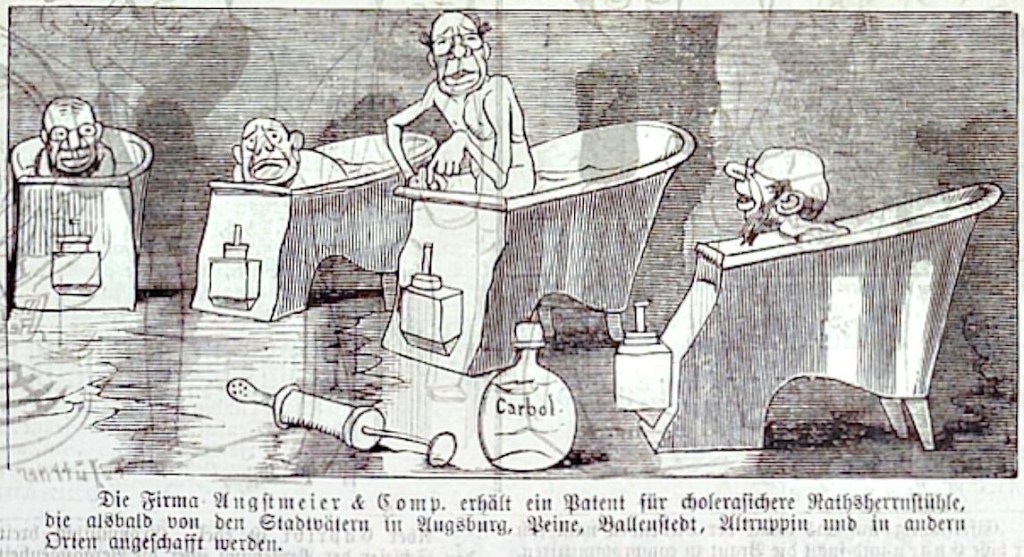
The firm Angstmeier & Co. holds a patent for cholera-safe aldermen’s chairs that will shortly be purchased by the city fathers in Augsburg, Peine, Ballenstedt, Altruppin, and in other locales. (Kladderadatsch, Berlin, 1892) (Note the familiar clystère theme.)
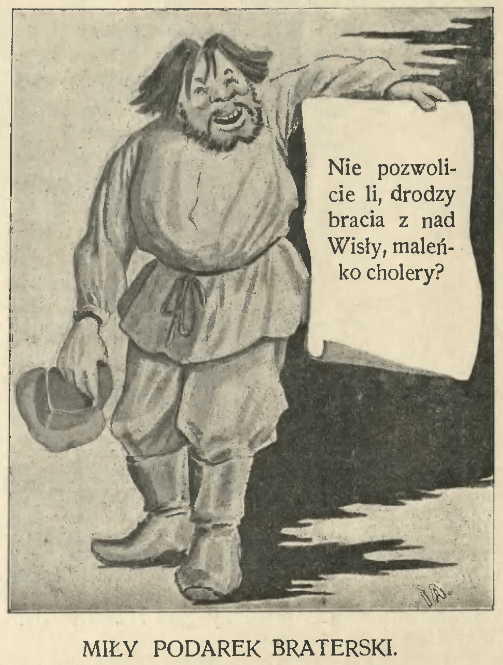
“Won’t you permit me, dear brothers from across the Vistula, a little cholera?” (Mucha, Warsaw, 1908)
Polish cholera cartoon
Some rhyming couplets on the same page offer counsels for Warsaw residents during a cholera epidemic:
Whoever doesn’t want to be infected with the cholera bacillus, Let him not remember that there is martial law.
In these choleric times things are not headed in a healthy direction Think about Filevich or Menshikov. [Russian monarchists hostile to Polish separatist sentiments]
The best epidemic fostered among humans, Where people get irritated by what Rossiya writes. [monarchist newspaper]
Don’t worry about the Swabs in Łódź either, For you will definitely grab the spare hospital.
The nicest thought is still that whether you are a Belgian or a Turk, And you will be healthy, even though you ate a raw cucumber.
For the worst thought in the world is That you bear the heavy lot of the Pole on your neck.
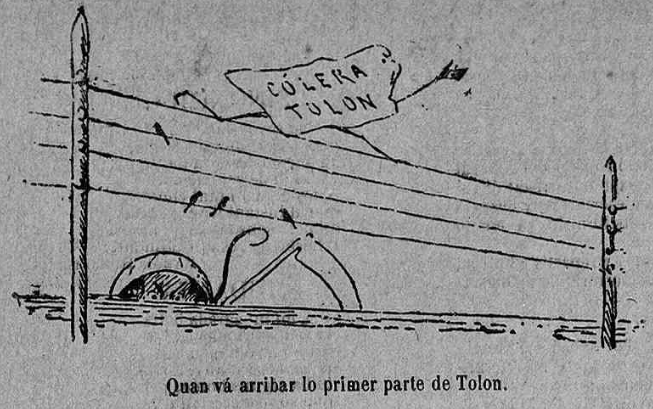
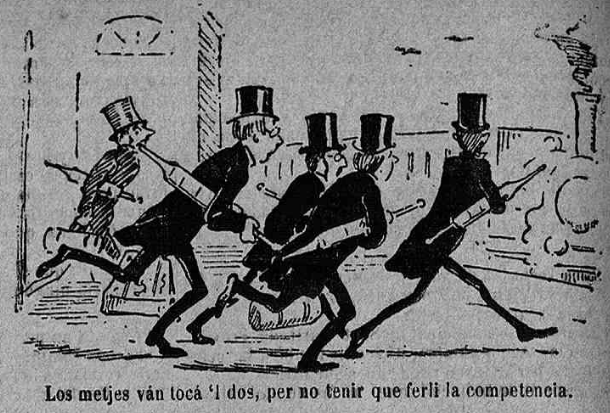
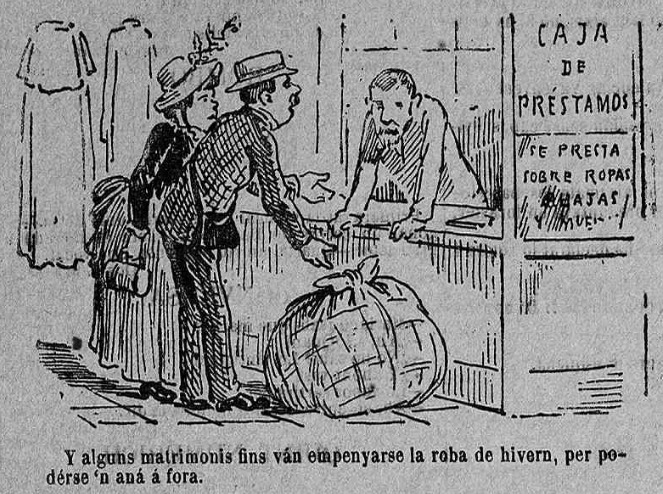
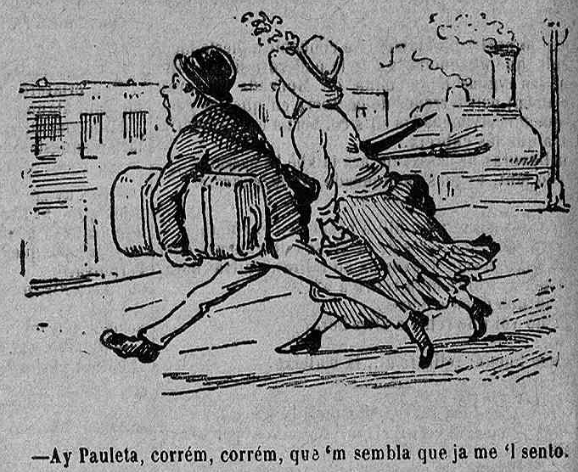
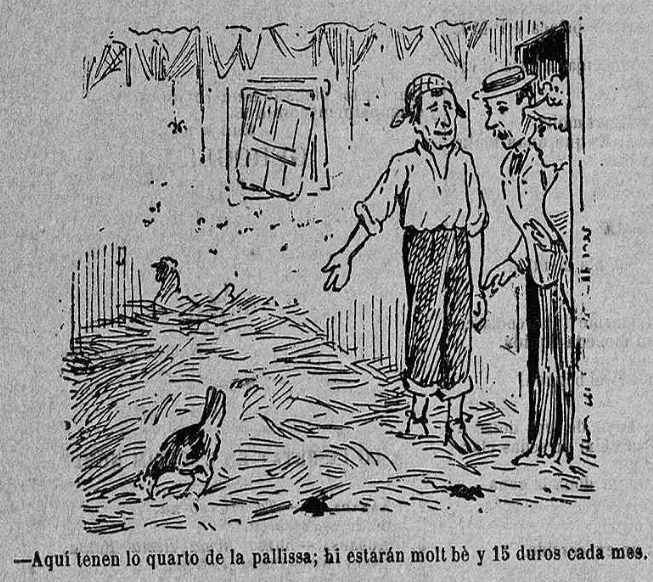
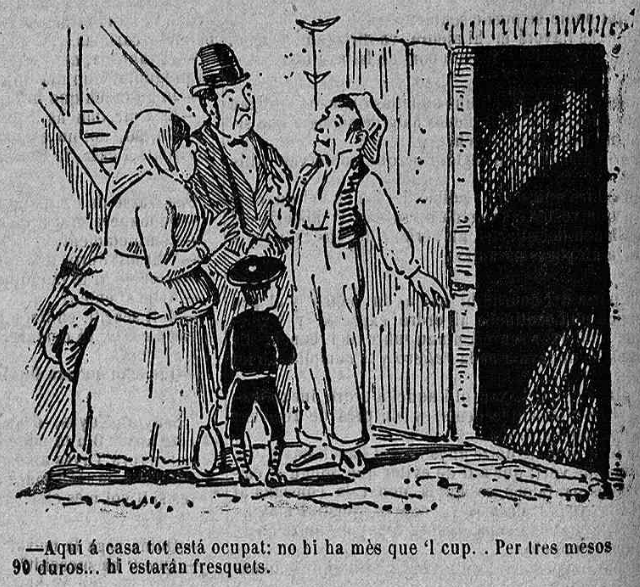
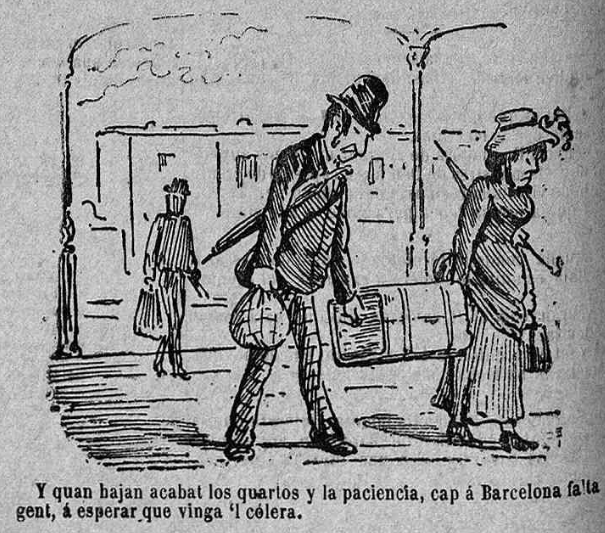
Marfuga is an olive oil producing region in Perugia, but I have no idea what the title signals. The individual panels in this cholera cartoon are amusing, however, mocking the urge to flee Barcelona for the countryside when news arrives of cholera in the French port of Toulon. (Apologies for the inept translations.) (La Esquella de la torratxa, Barcelona, 1884)
When the leading role arrived from Toulon.
Catalan cholera cartoon
The doctors will play the secondary role, so as not to have to demonstrate expertise.
And some couples even pawned their winter clothes, to be able to go outside the city.
Oh Pauleta, run, run, it seems to me that I’ll be sorry.
Here you have the quarter of the hayloft; it will be very nice and 15 duros per month.
Here at home everything is occupied: there is nothing but the winepress… It’s 90 duros for three months… it will be cool.
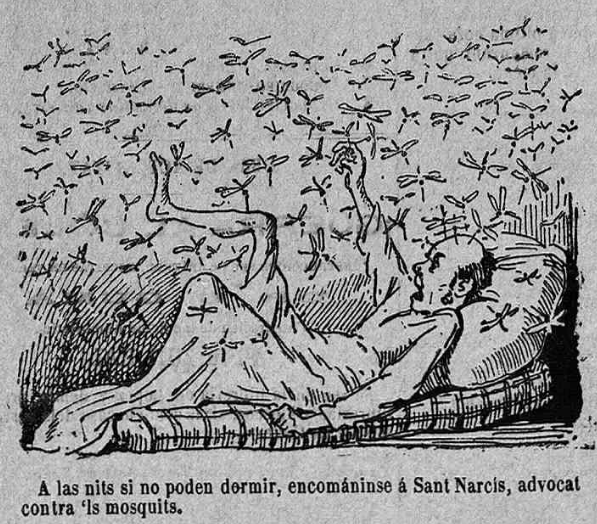
At night, if you can’t sleep, entrust yourself to St. Narcissus, a lawyer against mosquitos.
And when the quarters and patience are exhausted, the people missing out in Barcelona wait for the cholera to come.
(Newspapers are reporting that with cases of yellow fever on board a steamer coming from Bahia to Rio Grande do Sul, the former mosquito-killer brigade service was partially restored.) Mosquito killer: “What!… Are you here again?!” Yellow fever: “I’m just passing through, to kill… I miss you… But if you want, I can do you a favor…” Mosquito killer: “A favor!… What?…” Yellow fever: “Staying in Rio de Janeiro for a while, in order to give you and your companions a farewell to the brigade… The health authorities only remember me when I am present, and after all you also need to kill… hunger! I have a good heart and I can come here from time to time to keep the “sacred fire” of prevention!…” (O Malho, Rio de Janeiro, 1912)
“It’s strange how such a tiny bacillus can keep such a big guy like me in a constant state of agitation…” (Kladderadatsch, Berlin, 1892) (My first instinct is that this supposed to be a Russian peasant, but when you look at the “comma bacilli” of cholera, it’s not entirely clear who is being represented. In any event I wouldn’t wager that the figures with crowns are Tsar Nicholas II, and some have top hats.)
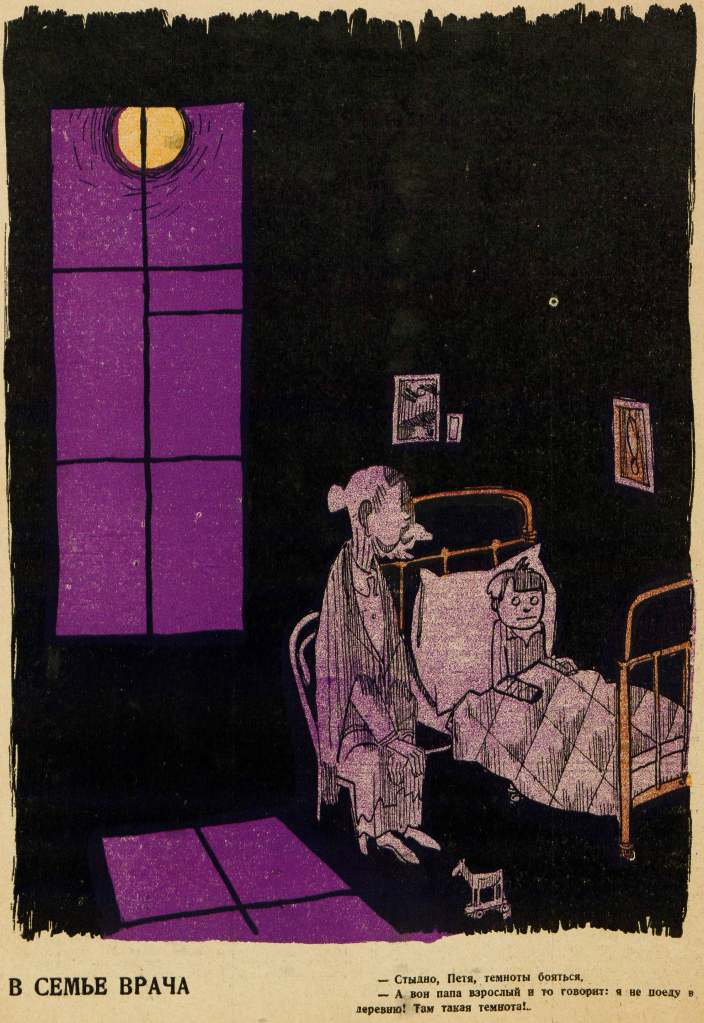
“You should be ashamed to be afraid of the dark, Pete!” “But papa’s a grownup and he says he won’t go to the countryside! There’s such darkness there!” (Chudak, Moscow, 1929)
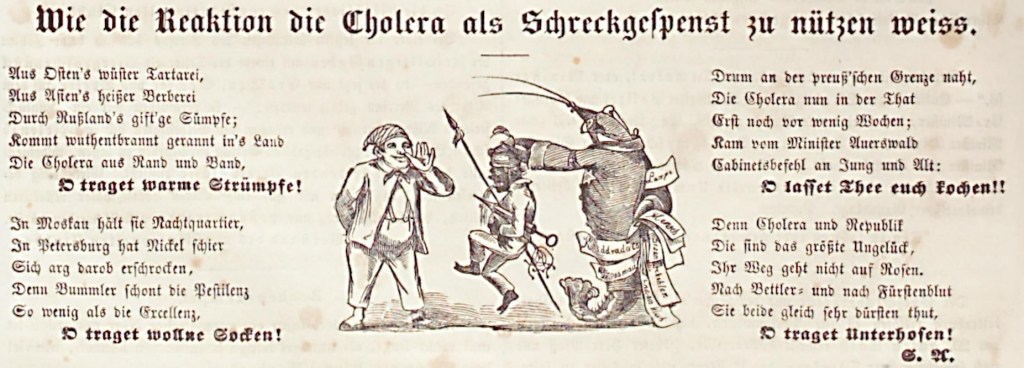
From desert Tartary to the east From sweltering Berbers of Asia Through Russia’s poisonous swamps; Cholera from the wild margin Comes wrathful into the country, O wear warm stockings!
In Moscow it has night quarters In Petersburg, the swampman has nearly To be hopelessly terrified Because the pestilence spares drifters As little as their betters, O wear woolly socks!
Thence is cholera indeed Just a few weeks ago Nearing the Prussian border; From Minister Auerswald came To young and old the cabinet order: O let tea be brewed for you!!
Because cholera and republic They are the greatest misfortune Yours is not the primrose path. Beggarly and princely blood alike You both feel very thirsty O wear underpants!



 Sic Transit Pestilentia