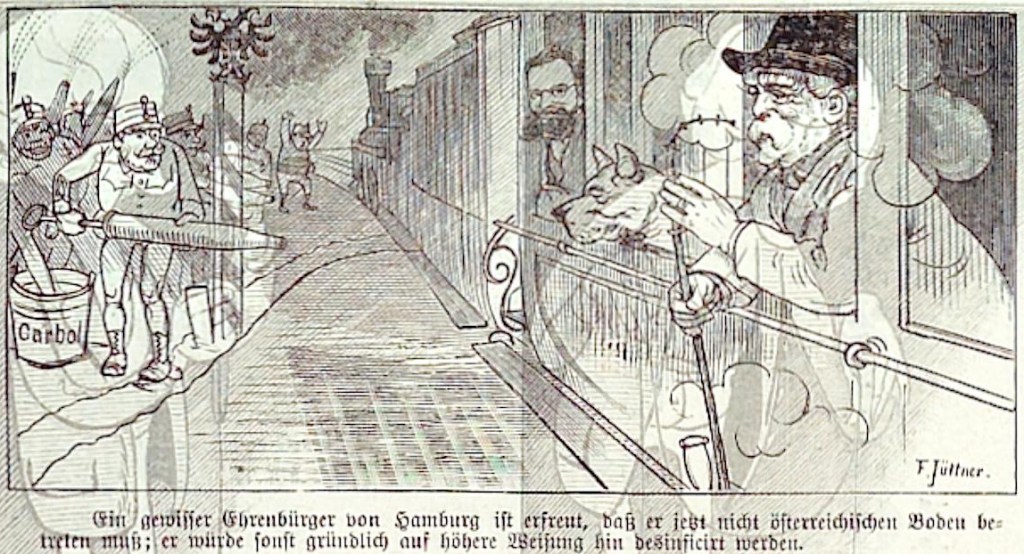
A certain honorary citizen from Hamburg [site of the last major cholera outbreak in Germany] is gratified that he now does not have to set foot on Austrian soil; otherwise he would have been thoroughly disinfected upon instructions from higher up. (Kladderadatsch, Berlin, 1892)
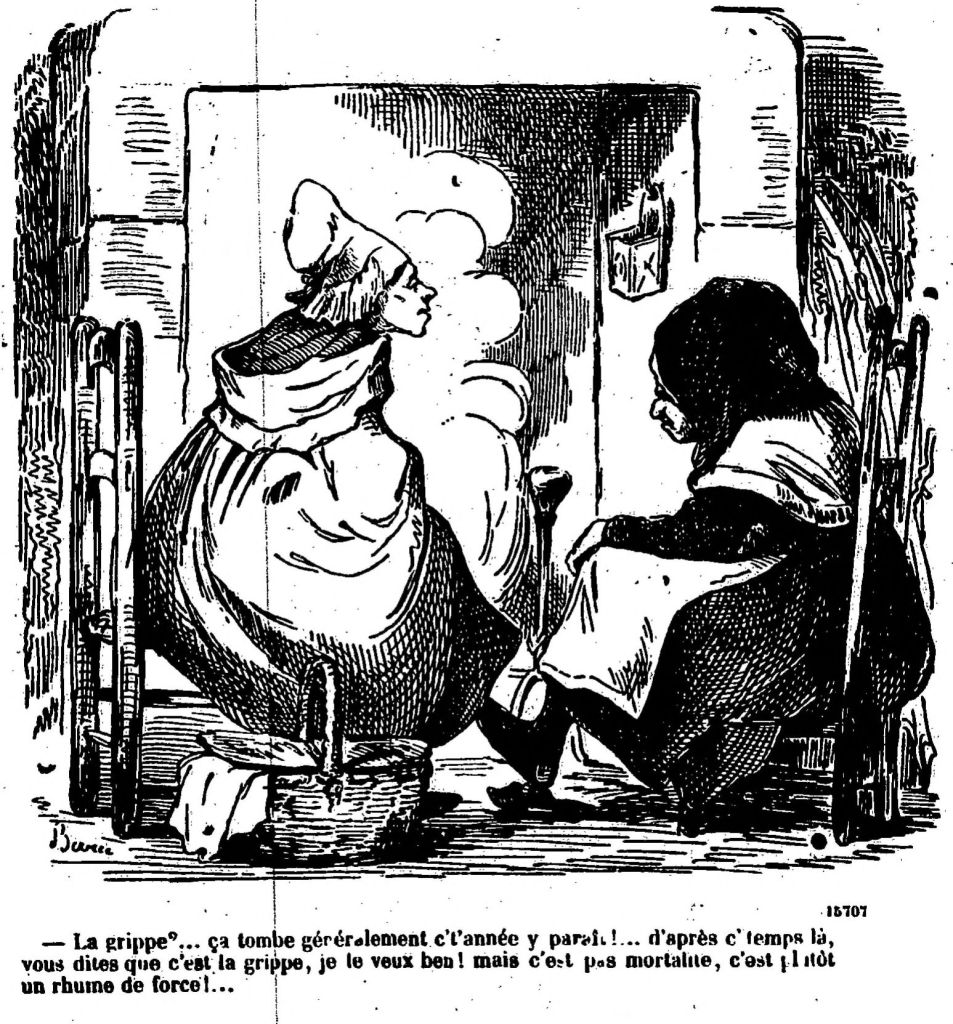
“The flu?… it seems to be getting out of control this year!… after that time, you say it’s the flu, I don’t mind! but it’s not fatal, it’s rather a powerful cold!…” (Le Journal amusant, Paris, 1859) (Clearly I could use help with the idiom.)
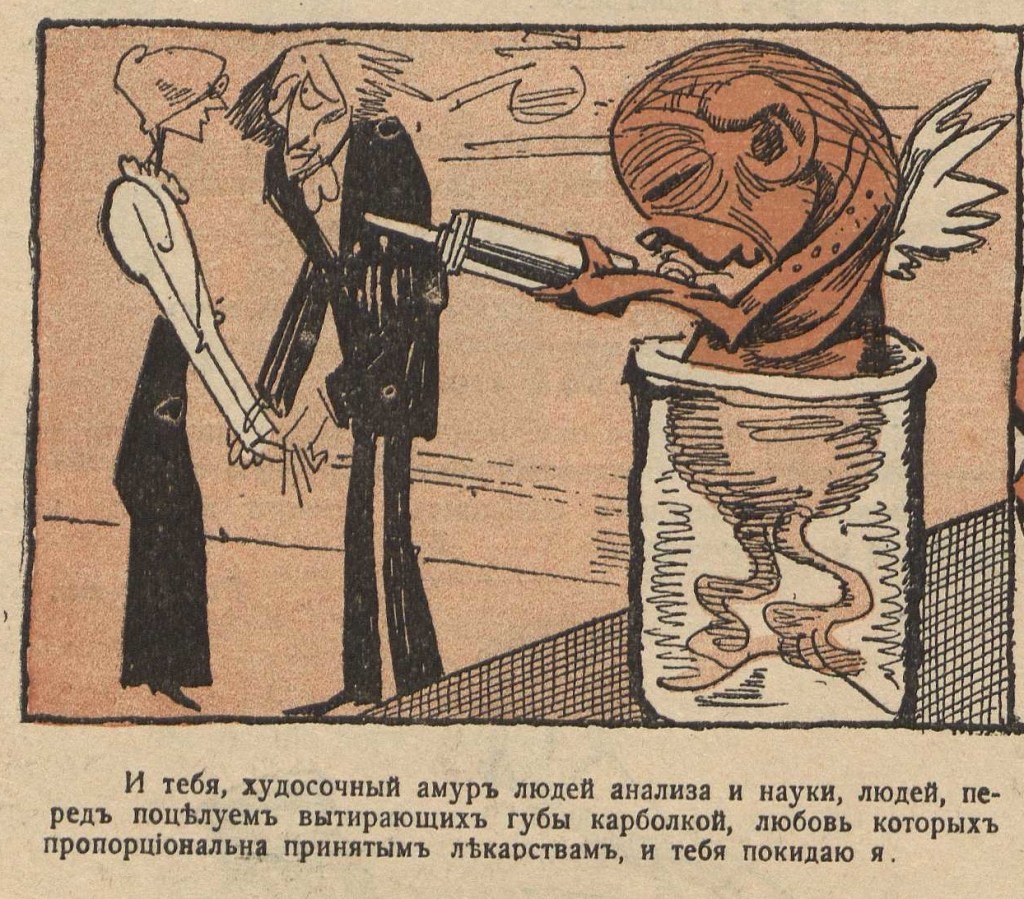
This delightfully bizarre cartoon is one panel of six celebrating the arrival of spring and the renewed efforts of Cupid. Unfortunately, Cupid has various rivals and false pretenders with agendas of their own during the long winter. In this case, our favorite clystère theme is featured. Unfortunately, the anxieties mocked in this image are very much present for us today.
“And you, the disease-wasted cupid of people of analysis and science, people who, before a kiss, wipe their lips with carbolic acid, whose love is proportional to the drugs taken, I take leave of you as well.” (Novyi Satirikon, Petrograd, 1915)
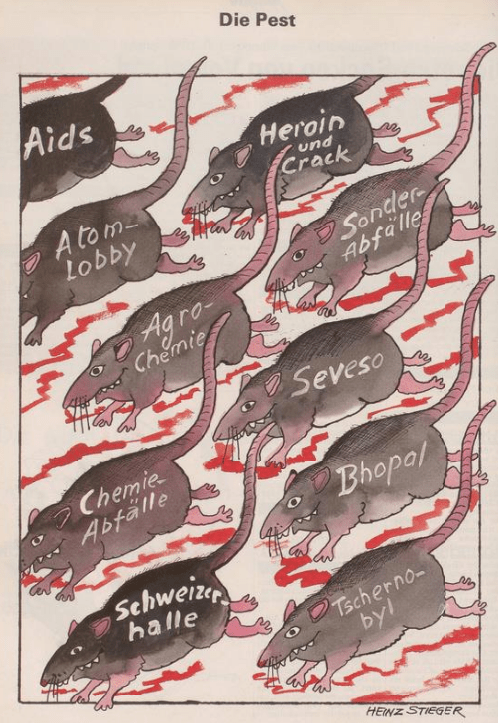
This is a visually striking cartoon by Heinz Stieger, but I think the epidemic metaphor is overworked, encompassing a host of modern ills, so to speak. With the passage of time, folding AIDS into a plague metaphor should also sit less comfortably with us. (Nebelspalter, Zurich, 1987)
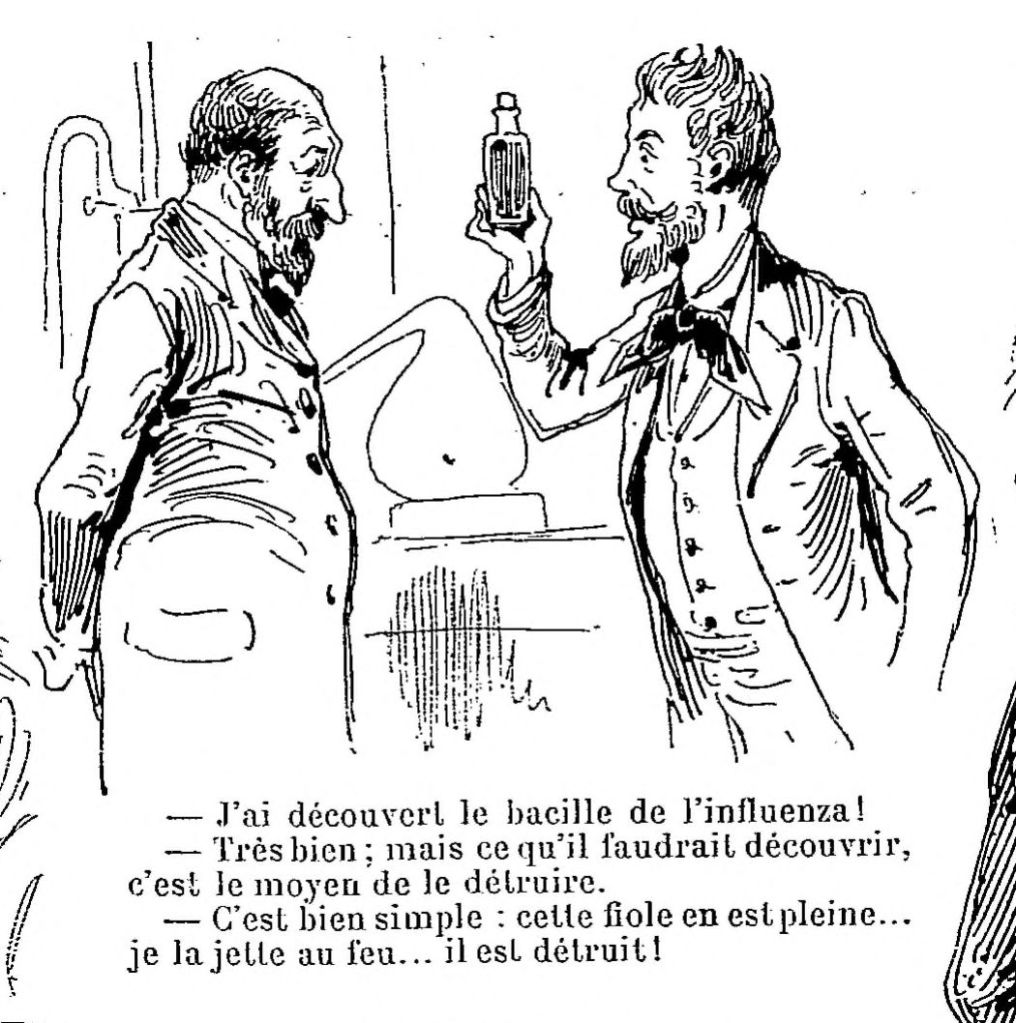
“I’ve discovered the influenza bacillus!” “Very good; but what needed to be discovered is the means to destroy it.” “It’s very simple: this vial is full… I throw it into the fire… it is destroyed!” (Le Journal amusant, Paris, 1892)
This one takes some unpacking, but it is a marvelous example of epidemic disease fueling conspiracy theories that in turn invite the satirist’s attention. In the spring of 1854 the imperial Russian general Prince Mikhail Gorchakov led troops over the Ottoman frontier at Silistra (present-day northeastern Bulgaria), accelerating the Crimean War. The Russian siege did not go well, and in late April Prince Ivan Paskevich (Paskiewicz), the Ukrainian-Cossack military figure notorious for crushing the Polish rebellion in 1831 and presiding at the surrender of the Hungarians during the 1848 revolution, took charge. In early July following a battlefield mishap he was in turn replaced by Prince Gorchakov, though Paskevich remained the active senior commander. Several weeks later Paskevich ordered general withdrawal, not least under diplomatic pressure from Austria, which threatened to join the conflict. The talented diplomat Prince Alexander Gorchakov, who would become Foreign Minister several years later and was a distant cousin of the general, had been dispatched as ambassador to the Habsburg Court only weeks before this cartoon was published.
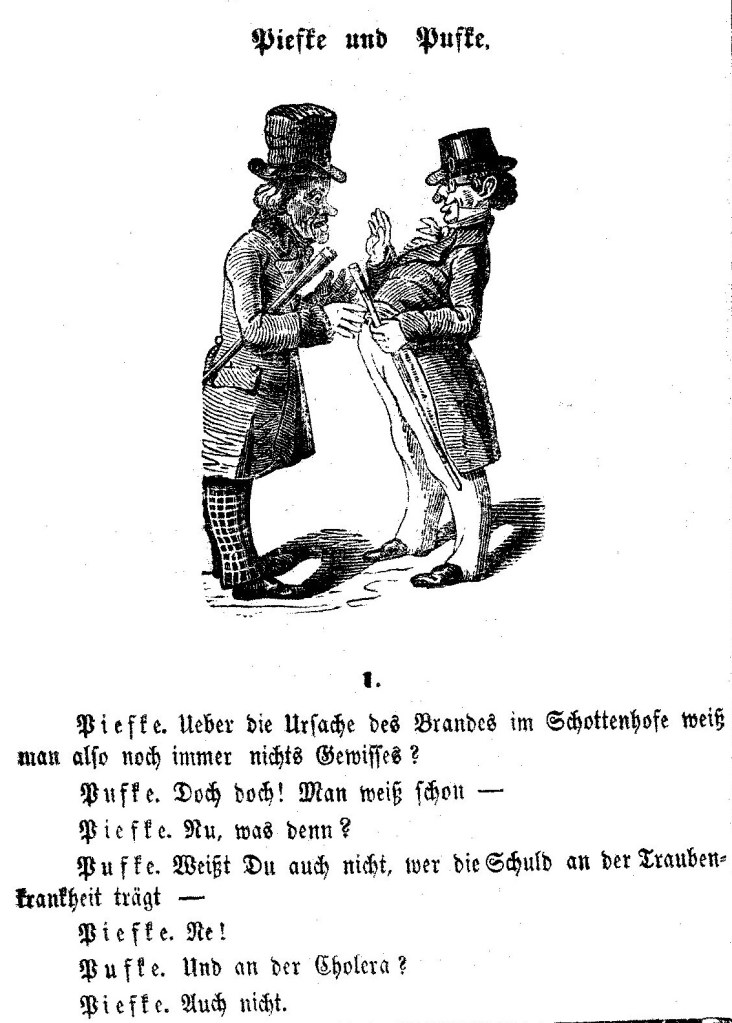
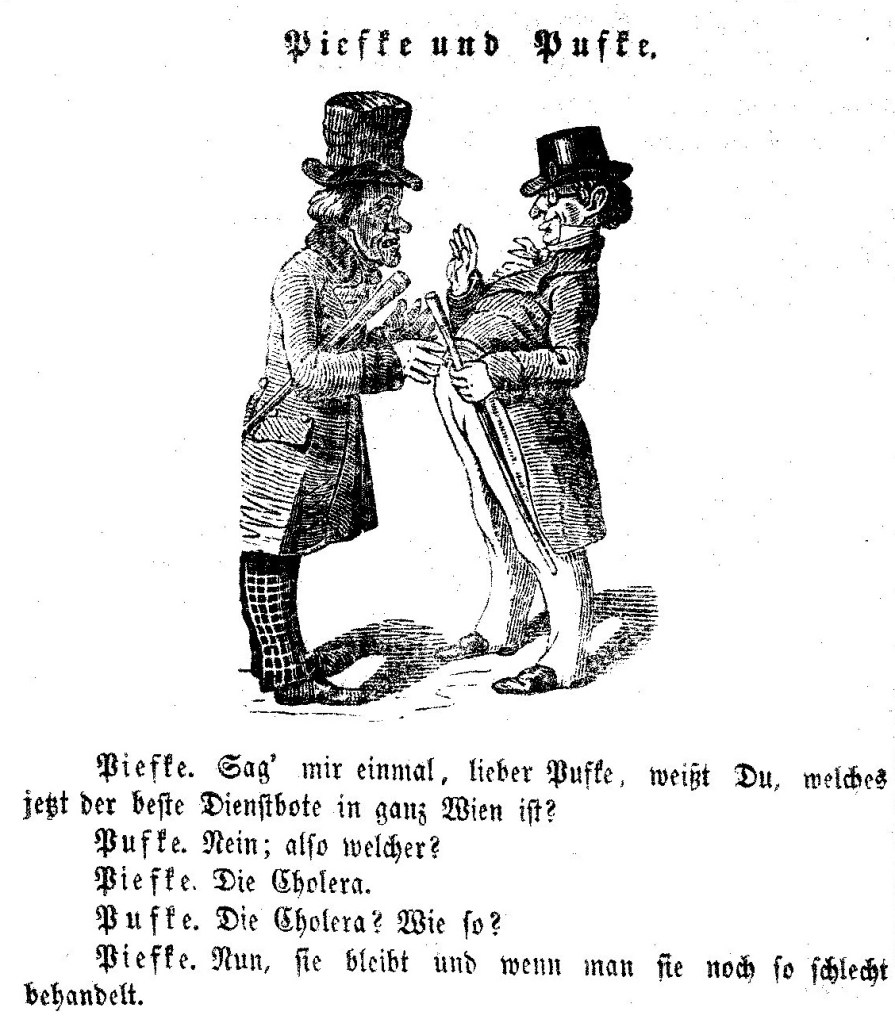
“Piefke” was a mildly derogatory Austrian term for Prussians. Here we find two self-important Berliners in conversation, clearly animated by events related to the Crimean War. The image itself was recycled whenever the two characters were featured in conversation about current events.
Piefke: “So we still don’t know for sure about the cause of the fire in Schottenhof?” (One week earlier the massive Schottenhof complex in the northwest corner of the inner city had been badly damaged by a fire on the roof, an event that warranted a visit by the emperor.) Pufke: “Yes, yes! You already know –“ Piefke: “Well, what?” Pufke: “Don’t you know who is to blame for the grapevine disease –” (A Styrian observer took this to be Uncinula necator, a powdery mildew first identified by British gardener Tucker in 1845. The Phylloxera blight noticed in French vineyards in 1853 was then spreading rapidly. The definitive cause had not yet been identified; hence the generic name for the disease.) Piefke: “No!” Pufke: “And what about cholera?” (In the midst of the third cholera pandemic, this was the year physician John Snow famously identified the water-borne source of the outbreak on Broad Street in London.) Piefke: “Not that either.” Pufke: “Listen, Piefke! You are terribly ignorant. Now you see, Prince Gorchakov has the grapevine sickness on his conscience; for he turned the grapes at Kalafat and Silistra sour. Prince Paskevich unleashed cholera on the world; for when he did not succeed in taking Silistra by a coup de main, he was full of anger [recall the misleading “choleric” association of the disease], and since then a general fury has raged through the lower intestines of Europe. Wasn’t it the Russians who tried to ignite the blaze of hatred and discord in the courts of Europe and Asia? But what they did at all the courts: they certainly did at the Schottenhof as well.”
This is one of the earliest readily available Austrian cholera cartoons. Founded in 1837 by the polymath Austrian Jewish journalist Moritz Gottlieb Saphir, Der Humorist only rarely featured cartoons in its early years. In any event, a cursory search did not turn up any cholera images from its recurrence during the 1848 revolution. With the appearance of Figaro in 1857 and Kikeriki in 1861 Der Humorist gradually increased the frequency of cartoons on its pages. In subsequent months there were indeed several more cholera cartoons in the Piefke and Pufke series.
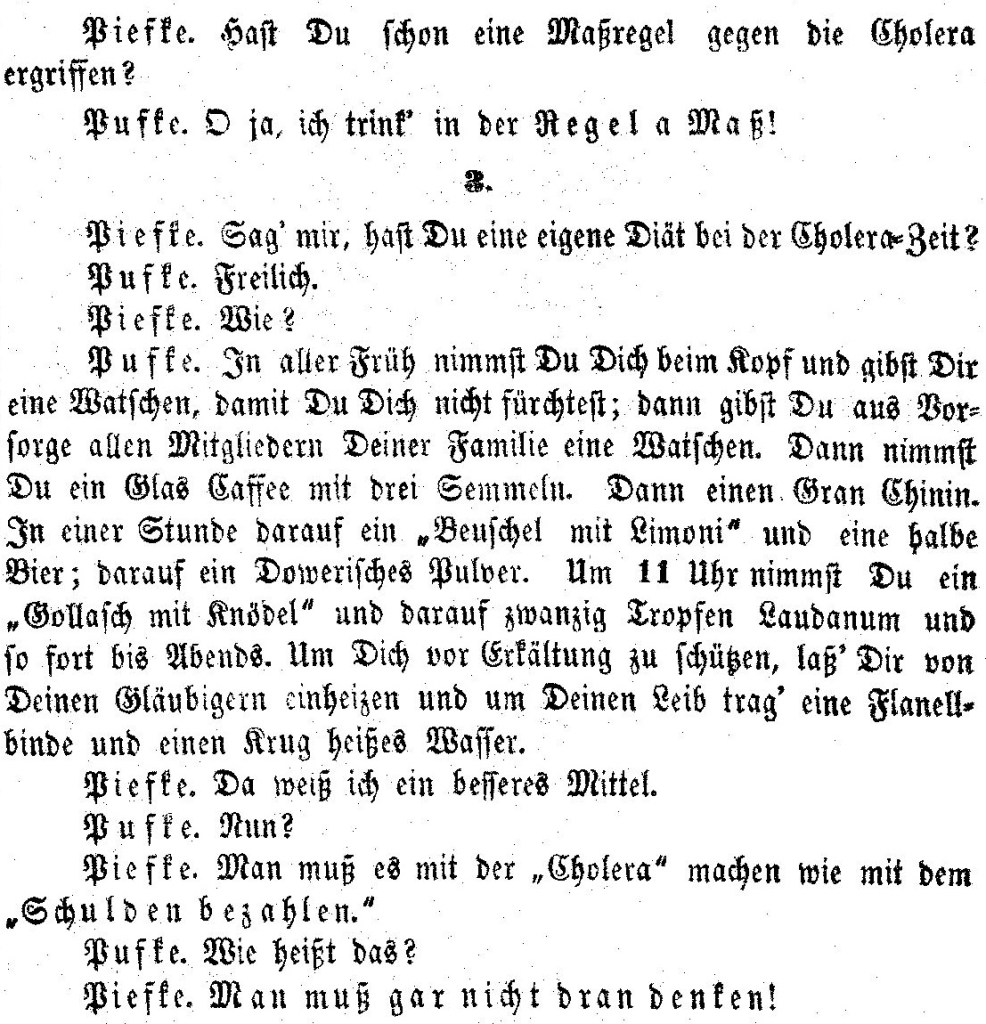
Piefke: “Have you already taken a measure against cholera?” Pufke: “Oh yes, as a rule I drink great amounts!” [punning on Massregel]
Piefke: “Tell me, do you keep your own diet during the cholera?” Purke: “Of course.” Piefke: “How?” Pufke: “First thing in the morning grab your head and give yourself a slap on the face, so that you’re not afraid; then as a precaution slap all the members of your family. Then have a cup of coffee with three rolls. Then a dose of quinine. An hour later a fluffy pastry with Limoni and half a beer; then a Dover’s Powder. At 11am have goulash with dumplings with twenty drops of laudanum on top and so on until evening. To protect yourself from chills, have yourself warmed up by your creditors and wear a flannel bandage around your torso and a hot-water bottle.” Piefke: “I know a better way.” Pufke: “And?” Piefke: “You have to deal with cholera like you do with paying debts.” Pufke: “What does that mean?” Piefke: “Don’t think about it at all!”
Piefke: “Tell me, dear Pufke, do you know which is the best servant in all of Vienna right now?” Pufke: “No, which one?” Piefke: “Cholera.” Pufke: “Cholera? How so?” Piefke: “Well, it stays around even if you keep treating it badly.”
Same image a week later for this text:
Piefke: “If it’s true that copper makes the best prevention against cholera: then who is the most protected?” Pufke: “How can you ask? Obviously the publisher of our broadsheets; for they soak up almost entirely copper money.”
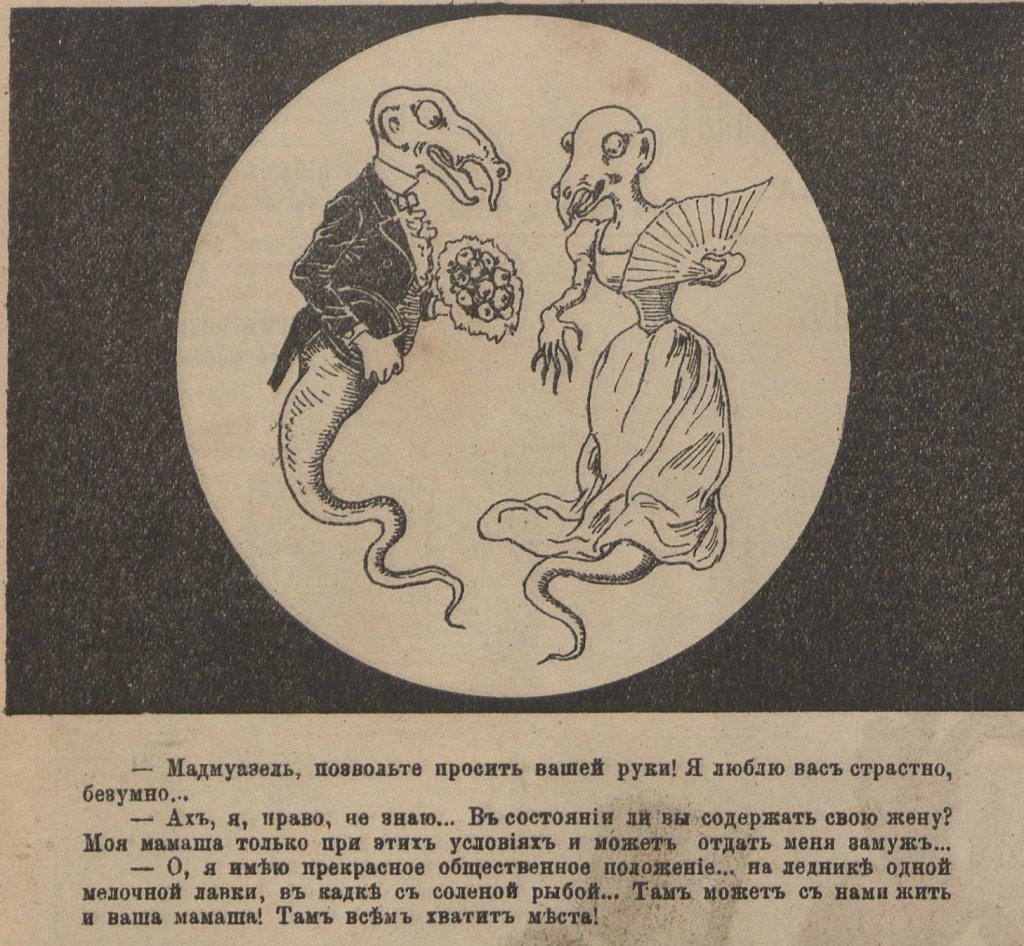
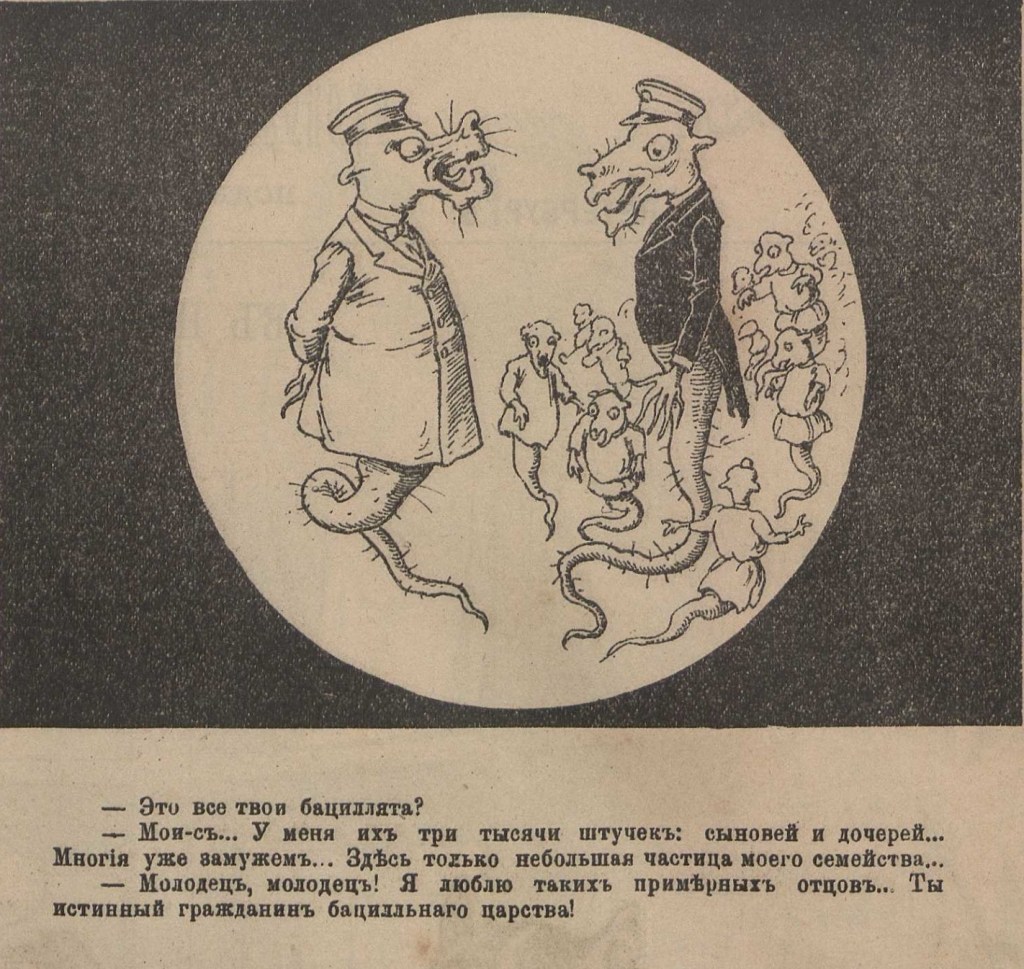
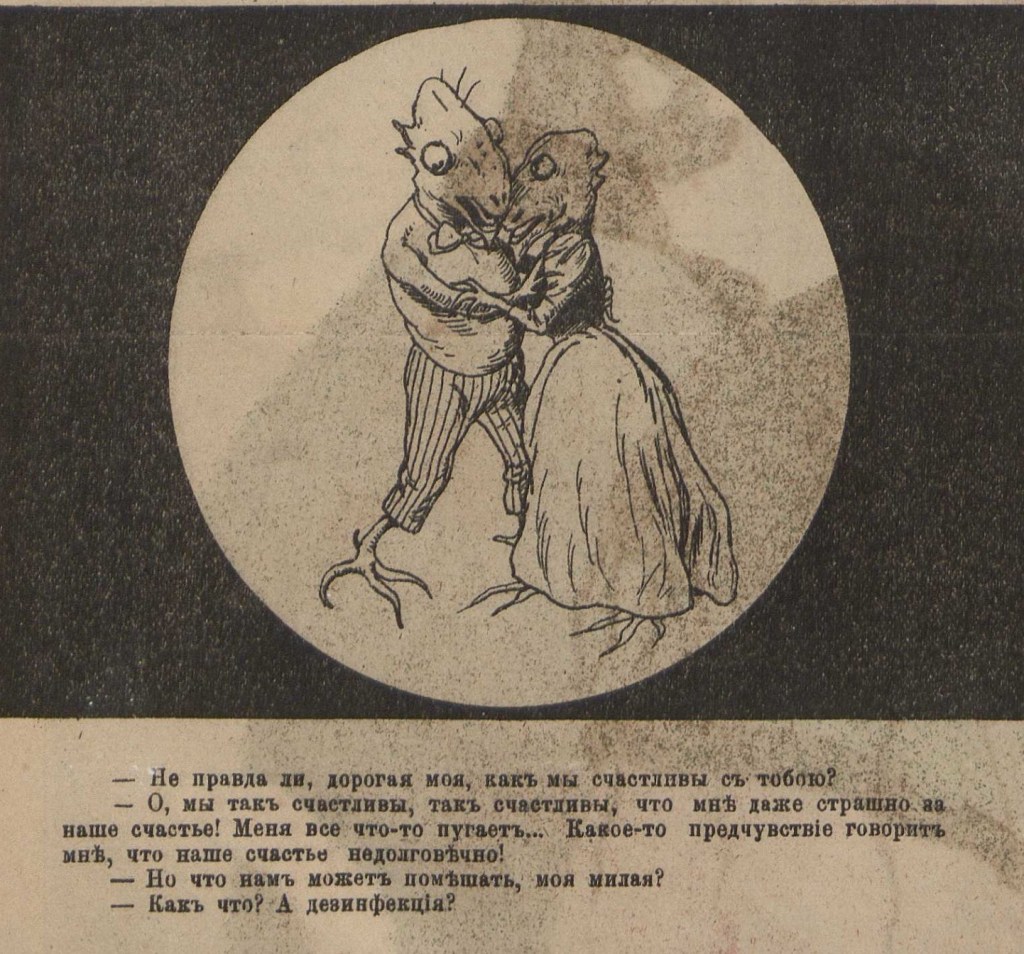
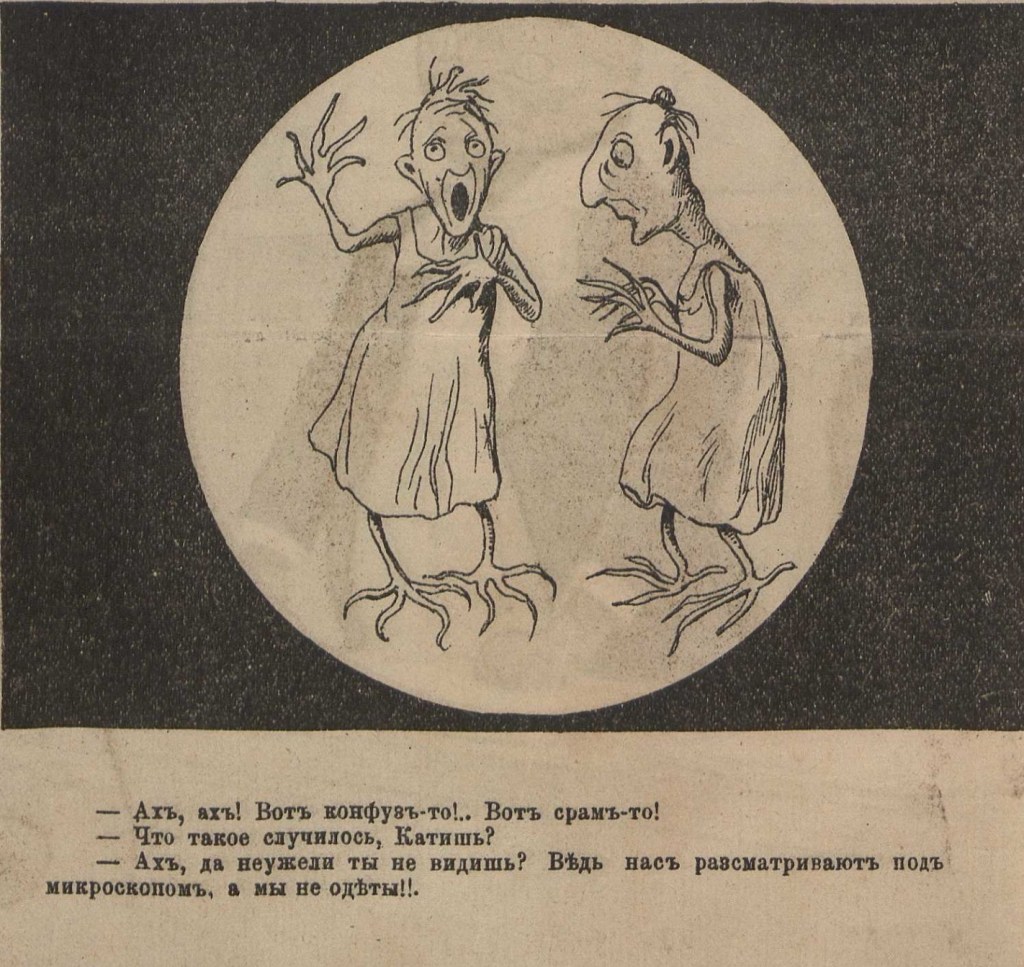
“Photographed under a microscope.” (Oskolki, St. Petersburg, 1898)
“Mademoiselle, may I take your hand in marriage! I love you passionately, madly…” “Oh my, I’m not sure… Are you in a position to keep your wife? My mommy can only let me get married under these conditions…” “Oh, I have a terrific social position… in the cooler of a small shop, in a vat with salted fish… We can live there with your mom as well! There’s room for everyone!”
“Are these all your little bacilli?” “Yes, I have three thousand of them: sons and daughters… Many are already married… This is only a small portion of my family…” “Excellent, excellent! I love such exemplary fathers… You are a true citizen of the bacillus realm!”
“My dear, aren’t we so very happy together?” “Oh, we are so happy, so happy that I’m even scared of our happiness! It all frightens me… Some sort of premonition tells me that our happiness will not last long!” “But what could interfere with us, my darling?” “What? Disinfection!”
“Oh my, oh my! This is so embarrassing!… This is so shameful!” “What happened, Katie?” “Oh my, do you mean to say you can’t see? We’re being looked at under a microscope, and we’re not dressed!”
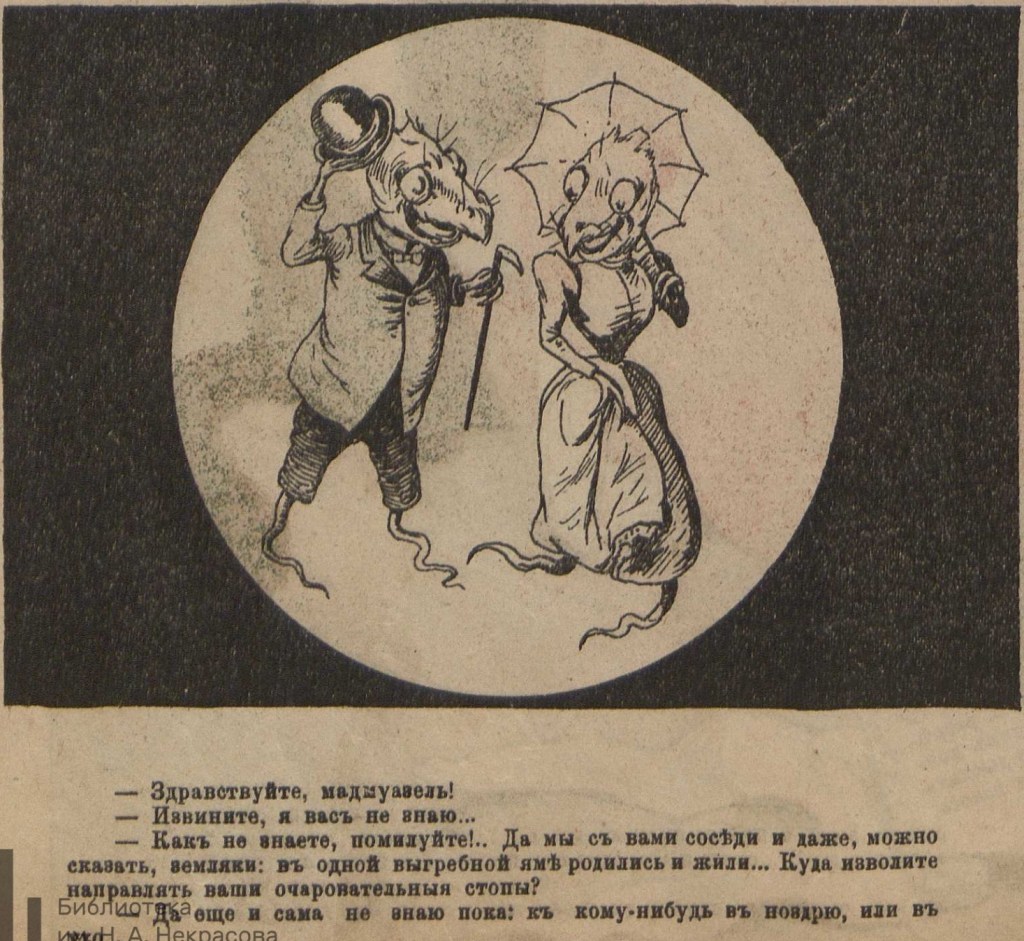
“Greetings, mademoiselle!” “Excuse me, I don’t know you…” “What do you mean, you don’t know me!… We’re neighbors and you might even say countrymen: we were born and raised in the same cesspool… Where would you like to direct your charming feet?” “I still don’t even know myself: to someone’s nose or ear.”
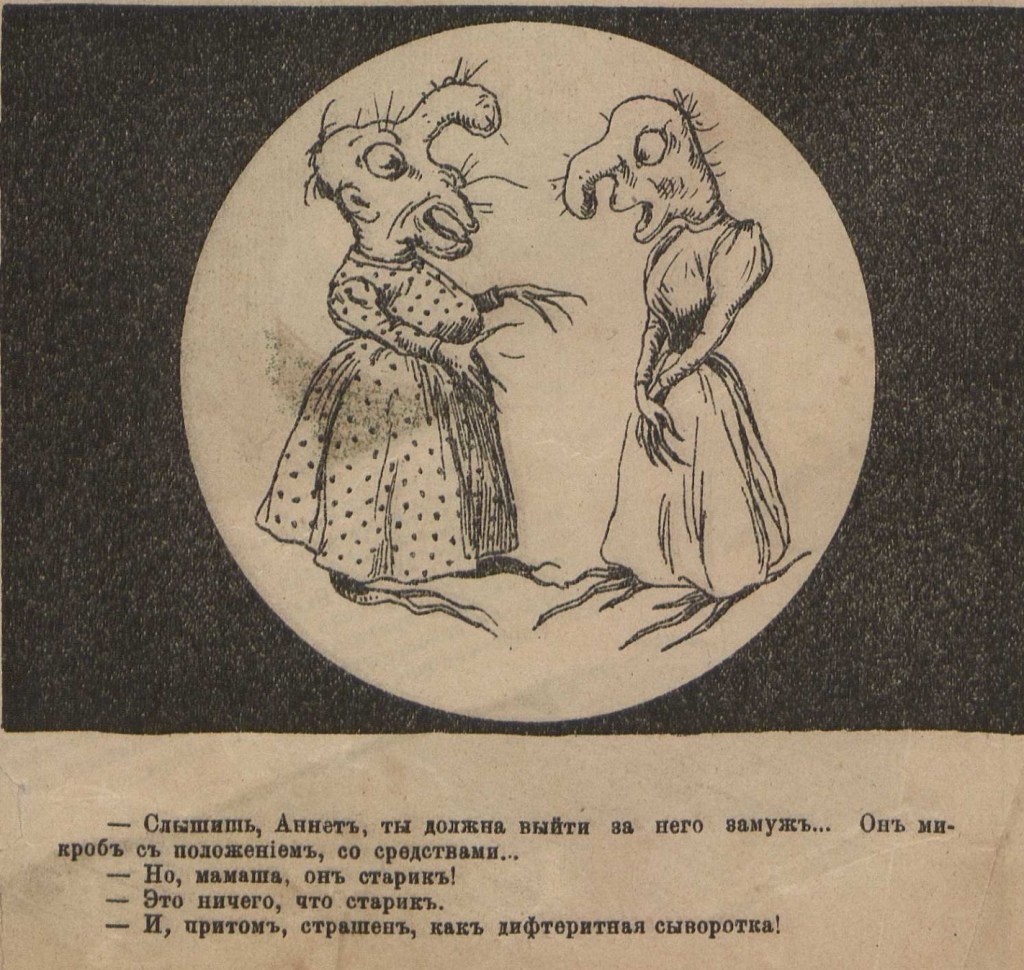
“Listen, Annette, you have to marry him… He’s a microbe with standing and means…” “But mama, he’s an old man!” “It’s nothing that he’s an old man.” “And what’s more, he’s scary like diphtheria serum!”
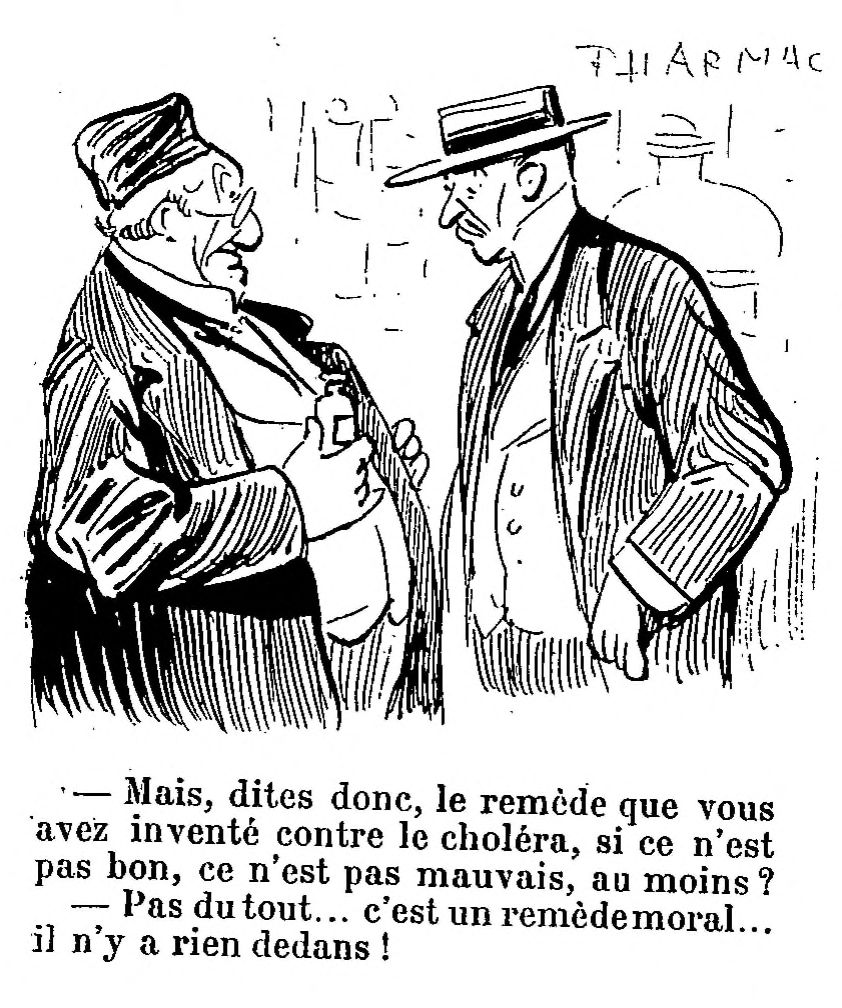
“But tell me then, the remedy that you invented against cholera, if it is not good, at least it’s not bad?” “Not at all… it’s a moral remedy… there’s nothing in it!” (Le Journal amusant, Paris, 1911)
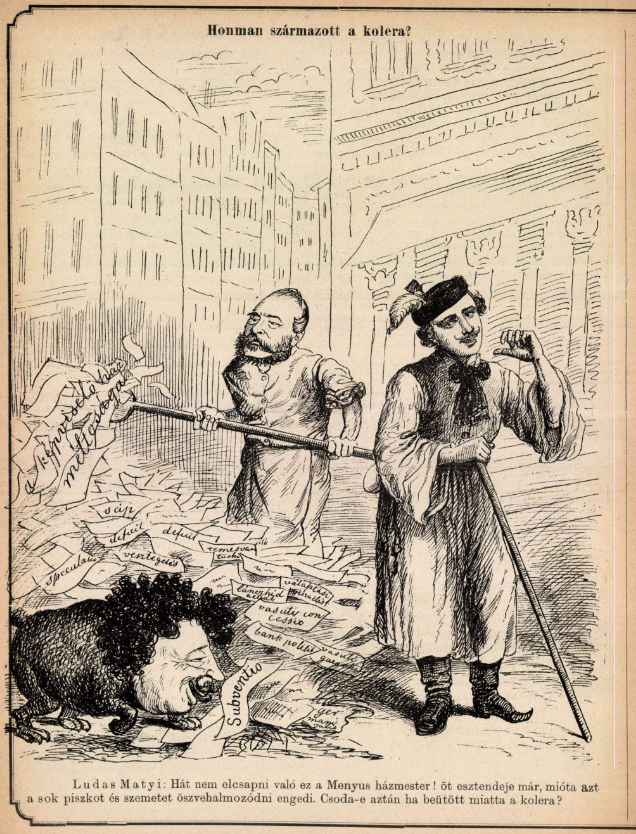
Mattie the goose-boy (mascot of the eponymous Hungarian satirical magazine): “Well, you can’t beat this Menyus housekeeper! He’s been around for years, letting all this dirt and garbage accumulate. Is it any wonder cholera has struck him?” The man (“Menyus”) with the pitchfork tossing out the “dignity of parliament” is Prime Minister Baron Menyhért Lónyay, a frequent object of ridicule in this magazine due to the corruption that plagued his brief tenure. The pieces of paper refer to speculation, deficits, losses, railroad concession, subventions, bank politics, etc. I can’t say anything specific about the anti-semitic caricature in the lower left, though we may presume it is meant to represent stereotypical Jewish banking interests. (Ludas Matyi, Budapest, 1872)
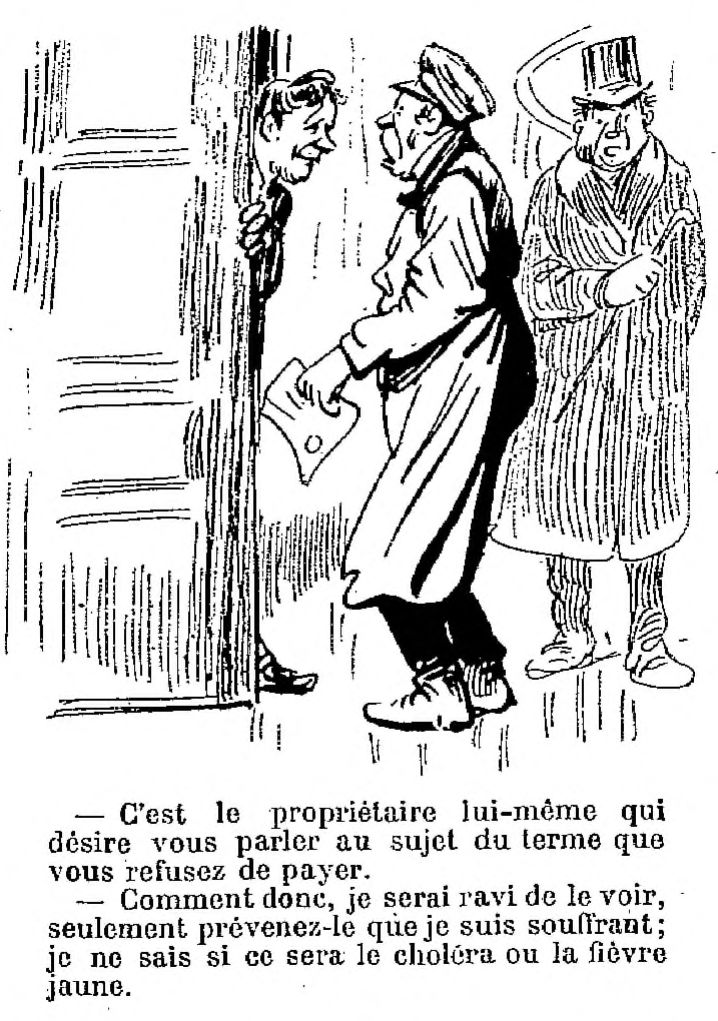
“It is the owner himself who wishes to talk to you about the bill you refuse to pay.” “Whaddya mean, I will be delighted to see him, only warn him that I am suffering; I don’t know if it will be from cholera or yellow fever.” (Le Journal amusant, Paris, 1908)
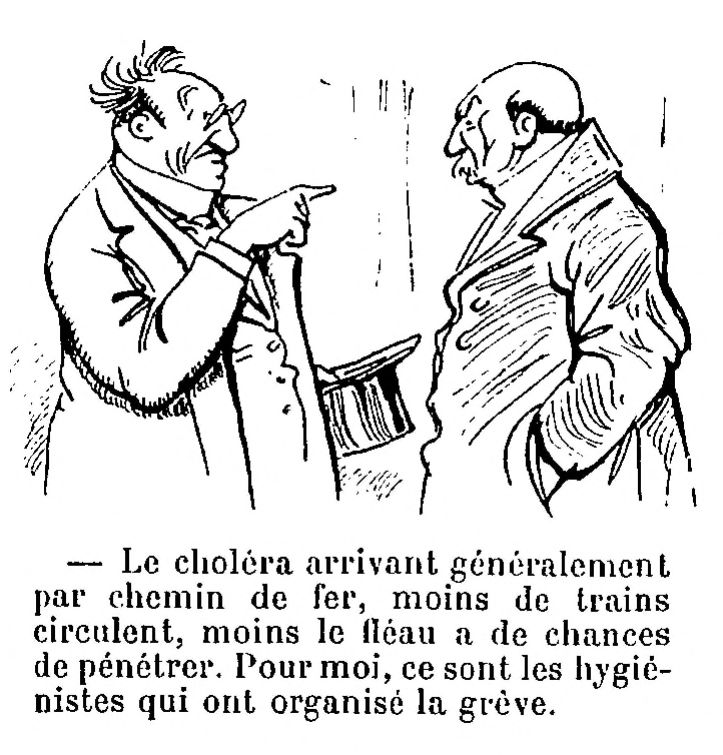
(“Frenchmen are quarreling with their government about their daily bread,” reported The New York Times in October 1910. “Dissatisfaction regarding their wages translates into dissatisfaction with the Republic.” French railway men went on strike, and “before it has lasted a single day, it is discussed whether or not it is revolutionary in character.” Prime Minister Briand managed to quash the strikes, earning him the enmity of former allies among the socialists.) “Cholera generally arrives by trains, the fewer trains are running, the less chance the scourge will get in. As far as I’m concerned, it’s the hygienists who are organizing the strike.” (Le Journal amusant, Paris, 1910)
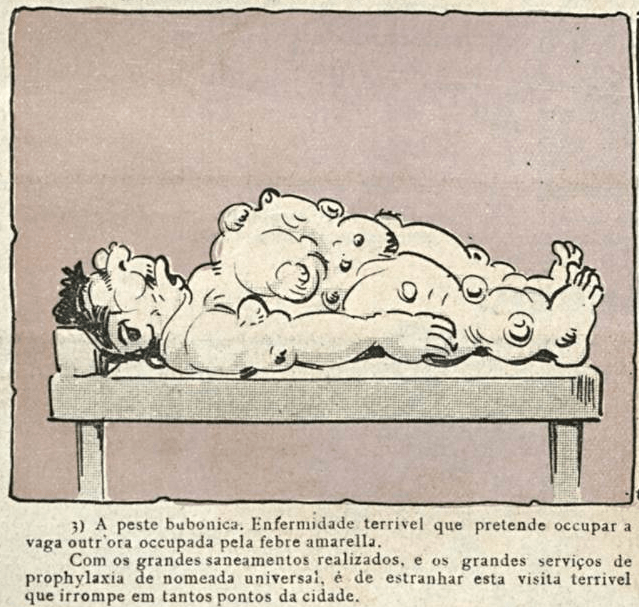
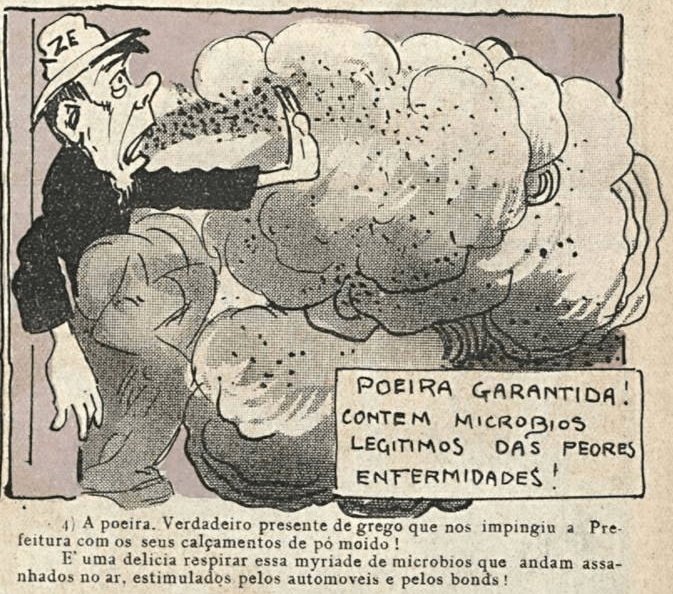
Two panels of six. The other plagues listed are the asphalt inferno of cars in Rio, water shortages, food prices, and the endless riots of republicans and monarchists.
The bubonic plague. Terrible illness that intends to occupy the space formerly occupied by yellow fever. With the great public health surveys that have been carried out, and the great preventive efforts that have gained universal fame, this terrible visitation that is breaking out in so many points of the city is surprising.
Brazilian plague cartoon
The dust. A true gift from the Greek who forced us into the City Hall with its ground-sand paving! It is a delight to breathe this myriad of microbes that roam in the air, stimulated by automobiles and trams!
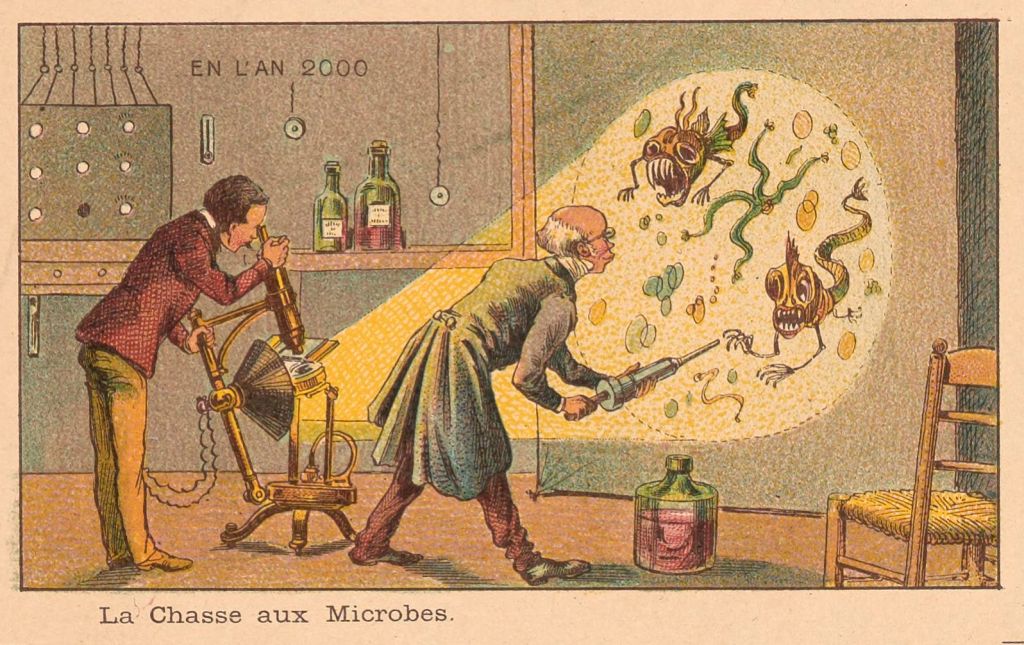
From Jean-Marc Côté, In the Year 2000 (Paris, 1910). (Note the familiar clystère seen in many other settings. Thanks to Theresa Levitt for directing me to this image.)

 Sic Transit Pestilentia