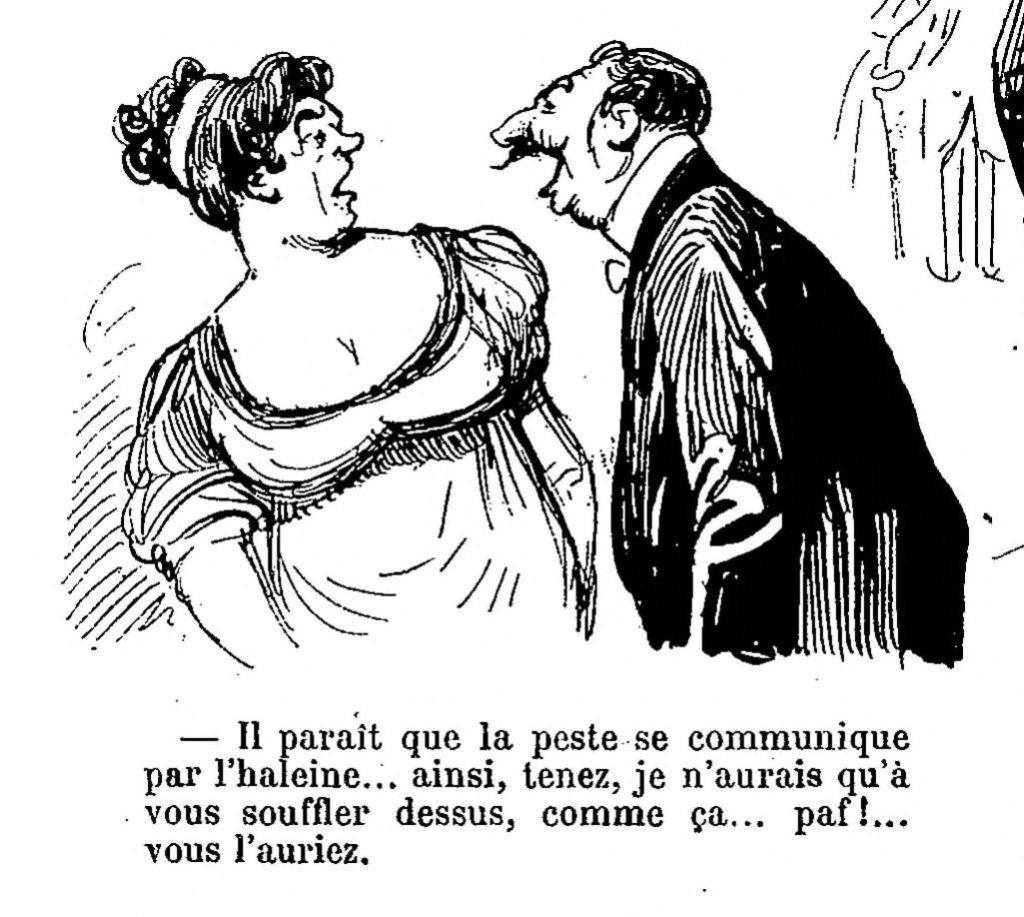
First toilette!

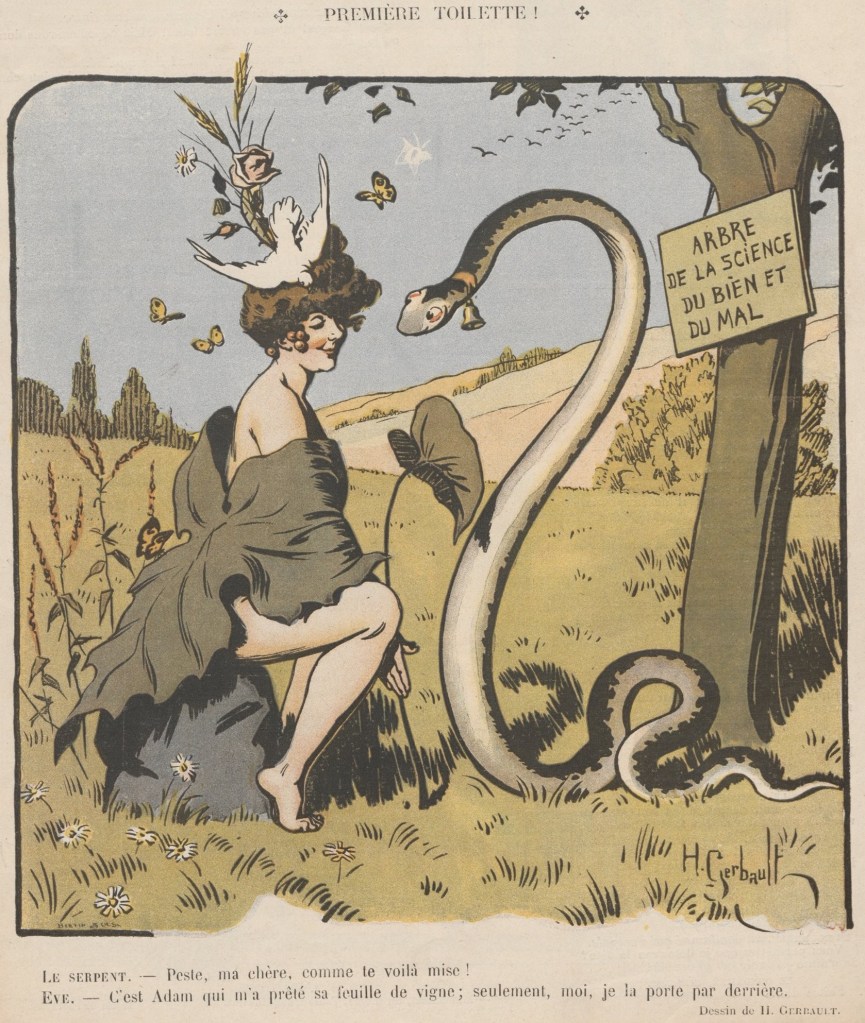
(Under the Tree of the Knowledge of Good and Evil.)
The serpent: “My dear pest, look at how you are arrayed!”
Eve: “It was Adam who lent me his fig leaf; it’s just that I carry it from behind.”
(Le Rire, Paris, 1906) (OK, this is a stretch, since it is not literally about the plague, but in a quirky way it seems to connect original sin with unpleasant modes of disease transmission. Perhaps I am committing the sin of Freudian overinterpretation. Or more likely my grasp of French idiom is not adequate to this case.)
French hygiene cartoon

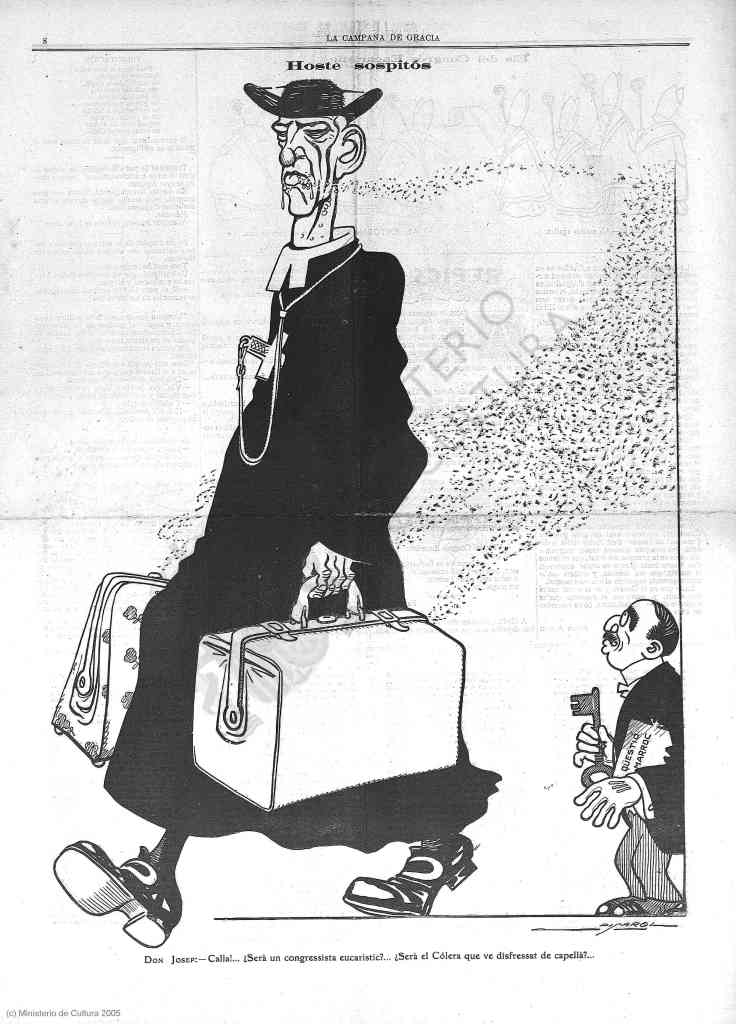
Suspicious host

(The 22nd International Eucharistic Congress was held in Madrid in July 1911. The man on the lower right with a key and a piece of paper labeled “Moroccan Question” would seem to connect church delegates with disease transmission in a colonial context.)
Don Josep: “Shut up! Will he be a eucharistic congressman? Will the Cholera come disguised as a chapel?”
(La Campana de Gracia, Barcelona, 1911)

Catalan cholera cartoon

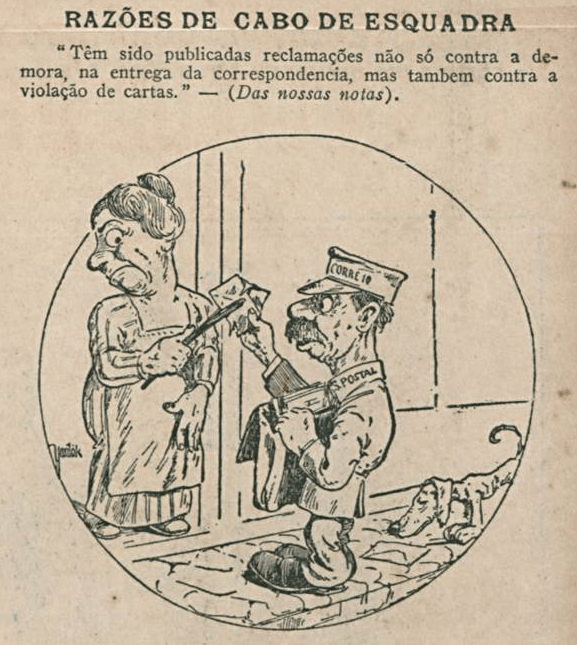
The police station has its reasons

(Complaints have been published not only against the delay in the delivery of correspondence, but also against the violation of letters.)
Lady: “An open letter! I don’t get it! I have no secrets, but I think this is an abuse!”
Postman: “Now, “madame”! Accept the letter! If it is from Europe, don’t you know that everything there is in conflict?… And if it is from here, don’t you know that it is necessary to air the correspondence, because of the mosquitoes and typhus…”
(O Malho, Rio de Janeiro, 1916)

Brazilian typhus cartoon

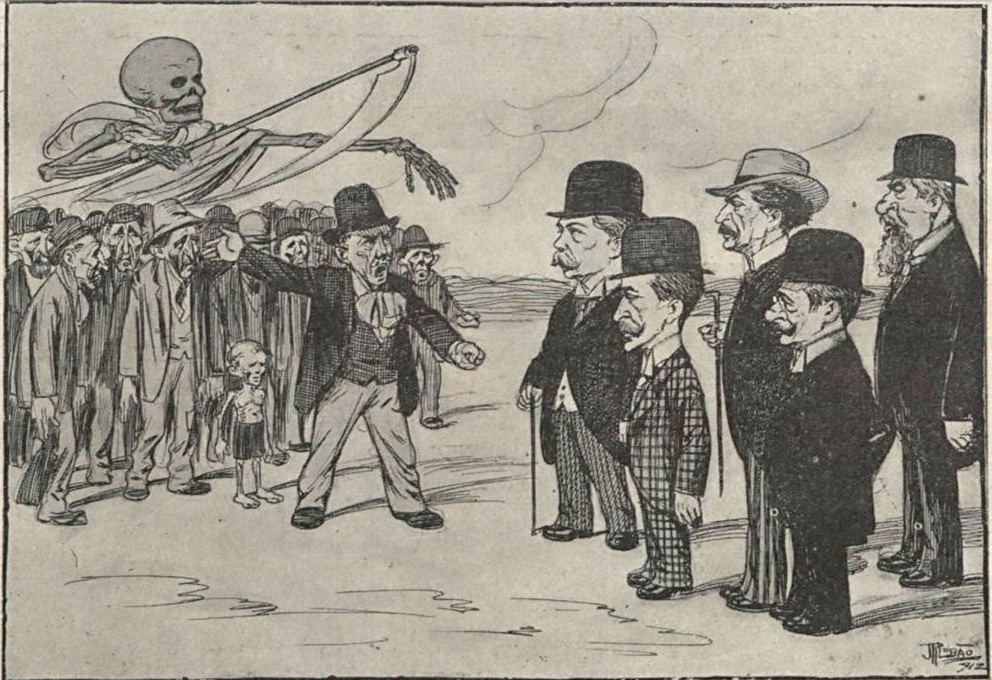
Whistling!

(Newspapers are reporting that the cost of living in Brazil is calamitous, afflicting the poor classes.)
Joe Public: “Look, gentlemen, we are reduced by protectionism, which favors a false national industry. Here are the consumers of tuberculosis. Imagine what the descendants of such a race will look like! The people are positively dying of hunger, they are already on the path of despair.”
(Various officials give mealy-mouthed excuses…)
Republican Senator for São Paulo and former agriculture minister Francisco Glicério: “And in the face of spectacles like this, I will not repeat that this is not the Republic of my dreams!”
Joe Public: “Nor mine. Republic of dreamers is what this is, the Republic of talkers. Some are eaters, the rest are fasters. Republic of doctors!”
(O Malho, Rio de Janeiro, 1912)

Brazilian tuberculosis cartoon

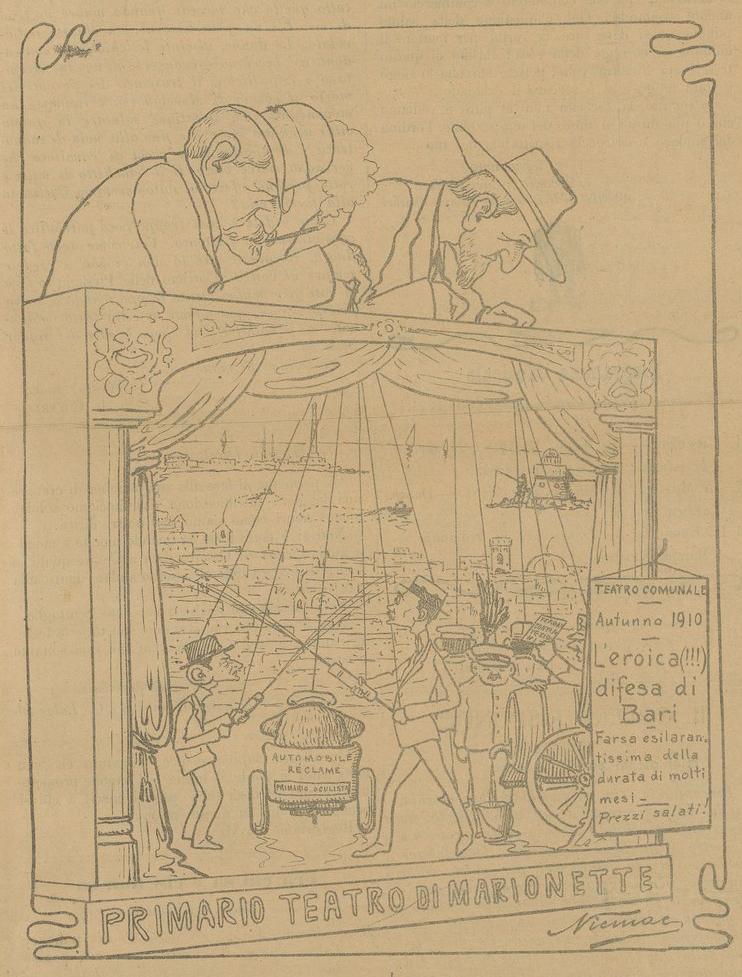
Heroic defense of Bari

The Main Puppet Theater. Accompanying text describes the image as follows: “In the almost natural reproduction above, an attempt is made to make a theatrical representation of the current immortal era. And this illustration was necessary given the decline of the puppet masters, at other times intelligent artists and dear to the people.” I cannot do justice to the municipal politics being satirized here, but the text indicates that they want to show how people dealt with the cholera.
The sign refers to the “Heroic defense of Bari” in autumn 1910, featuring an “Extremely hilarious farce lasting many months,” with “Terrific prices!” What drew my eye was of course the clystères employed by the officials disinfecting the streets, a device oft encountered among our images.
(Pss… Pss…, Bari, 1910)

Italian cholera cartoon

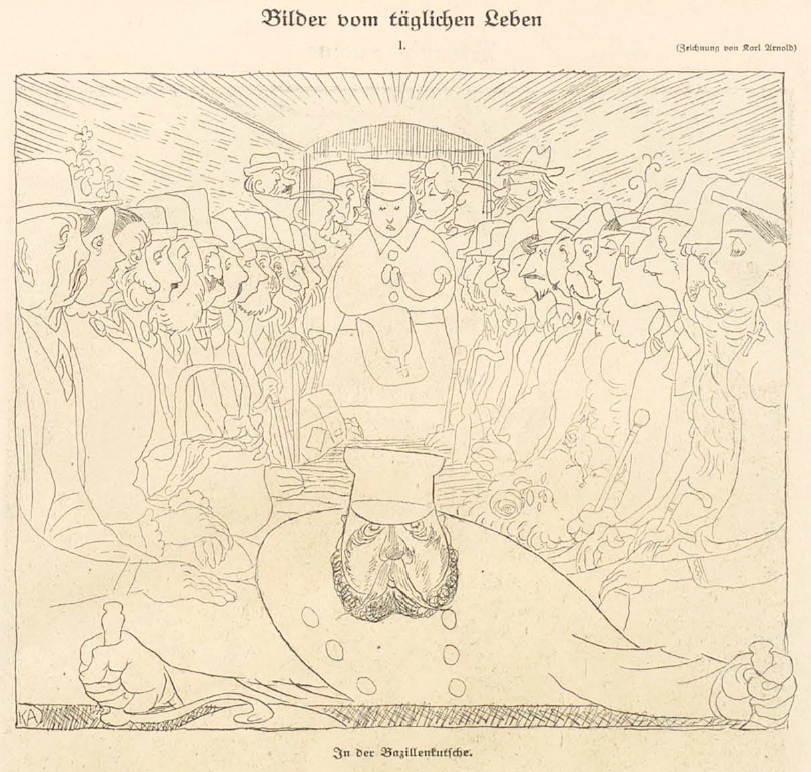
Pictures from daily life

“In the germ car.”
Depicting the close quarters of public transportation during the flu pandemic of 1918. It is worth noting that this may be the only such flu-related image in Simplicissimus that fall. The unusual term “Bazillenkutsch” is sometimes attributed to Robert Koch at the time of the opening of the U-Bahn in working-class Kreuzberg in 1902, perhaps via a 1908 novella by Eduard Goldbeck (not confirmed). Kaiser Wilhelm later gave the term wider notoriety when he visited a new stretch of the U-Bahn and insisted that he would only sit in a brand-new subway car, fearing infection from previous riders. This in turn moved the Berliner Volks-Zeitung to reassure its readers that this perception of germs ran counter to years of medical and scientific efforts to demonstrate otherwise, and the average subway car was not, in fact, the center of an epidemic.
(Simplicissimus no. 33, Munich, 1918)

German hygiene cartoon