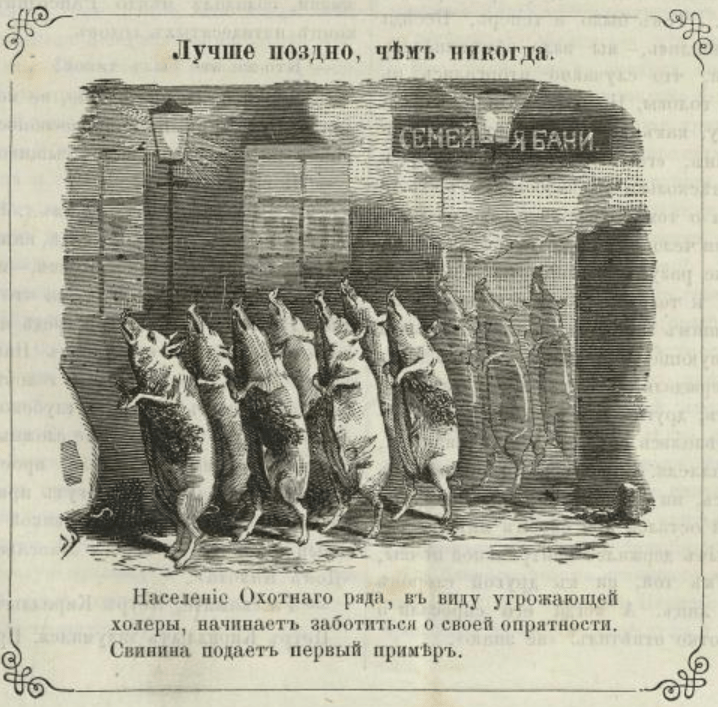
The population of Hunter’s Row [in central Moscow], in view of the cholera threat, are starting to take care about their cleanliness. Swine provide the prime example [passing through a Moscow sauna]. (Several years later the municipal authorities would construct a major public abattoir, motivated in part by public health concerns, as you can learn from the work of Anna Mazanik.) (Razvlechenie, Moscow, 1883)
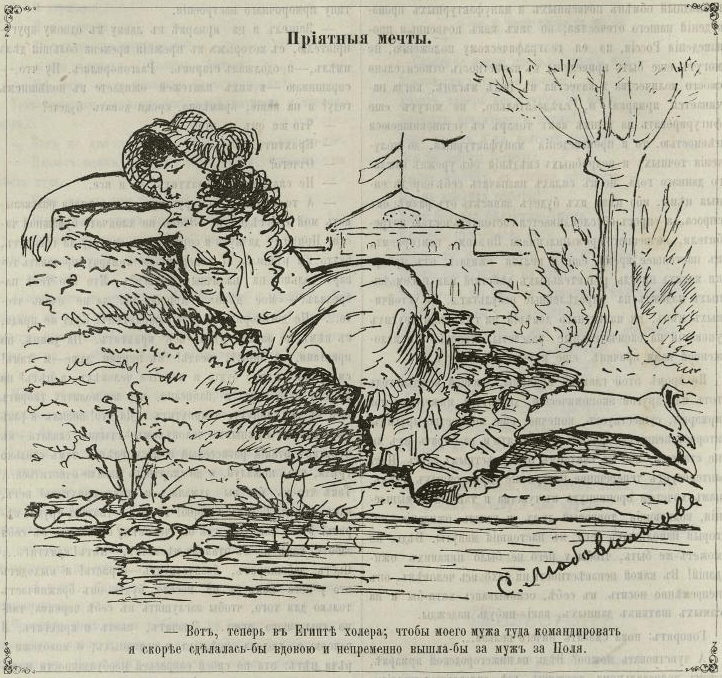
“Now there’s cholera in Egypt; were my husband to be assigned there, I would quickly be made a widow and immediately get married to Paul.” (Razvlechenie, Moscow, 1883)
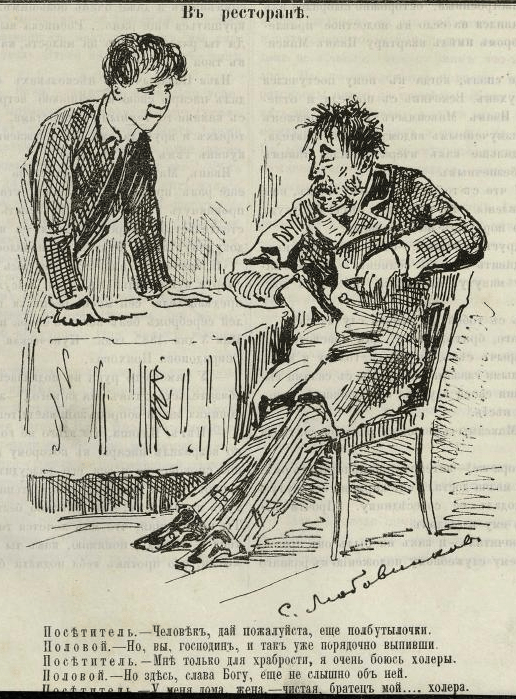
Visitor: “Man, gimme another half bottle, please.” Waiter: “But you, sir, are already properly soused.” Visitor: “It’s just for courage, I’m really afraid of cholera.” Waiter: “But thank God we haven’t heard anything about it here.” Visitor: “At home my wife is clean, and my brother is… cholera.” [presumably the usual wordplay about “choleric”?] (Razvlechenie, Moscow, 1883)
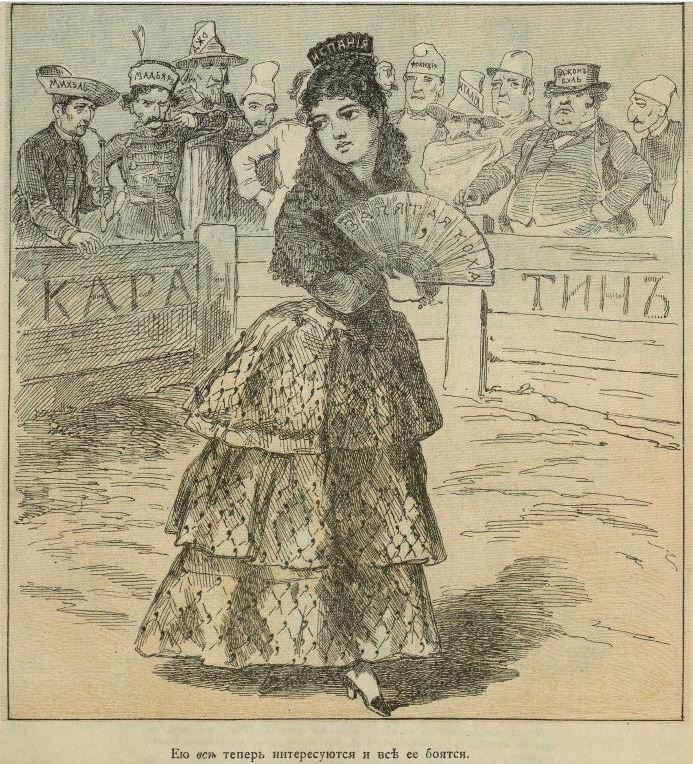
(Young woman outfitted as Spain, carrying fan labeled “Koch’s comma,” a reference to the cholera vibrio. She stands in an enclosure marked “quarantine,” with onlookers Hungary, Italy, John Bull, et al.) Everyone is interested in her now, and everyone is afraid of her. (Razvlechenie, Moscow, 1885)
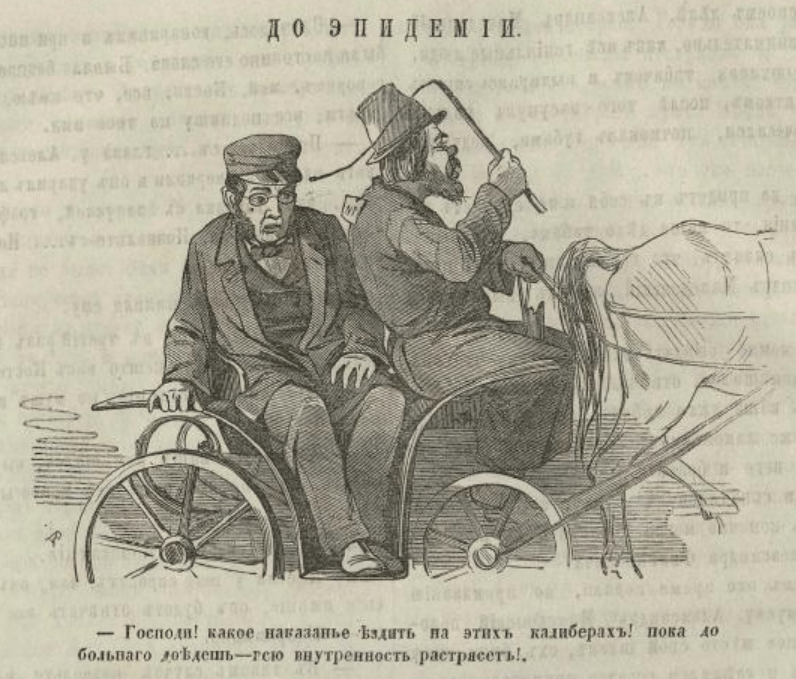
“Heavens! Such punishment to ride in these tiny carriages! By the time you get to the patient, all your insides will get shaken up!” (Razvlechenie, Moscow, 1866)
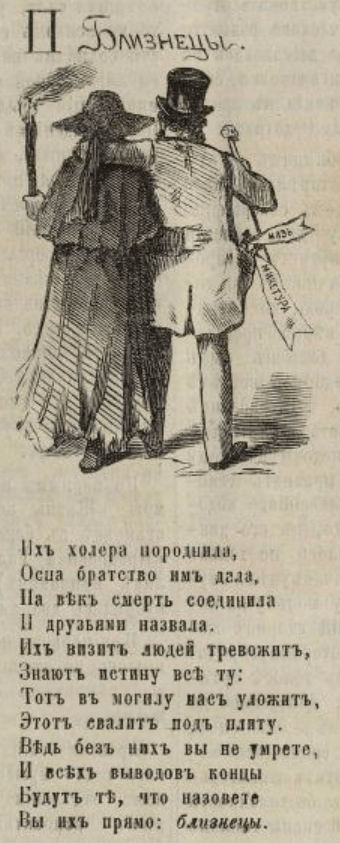
Cholera made them relatives, Smallpox gave them brotherhood, Death united them forever And called them friends. Their visit dismays people, They all know this truth: That one will put us in the grave, This one will dump us under the slab. Because you won’t die without them, And all outcomes will end up being those that you will call directly by the name: twins. (Razvlechenie, Moscow, 1874)
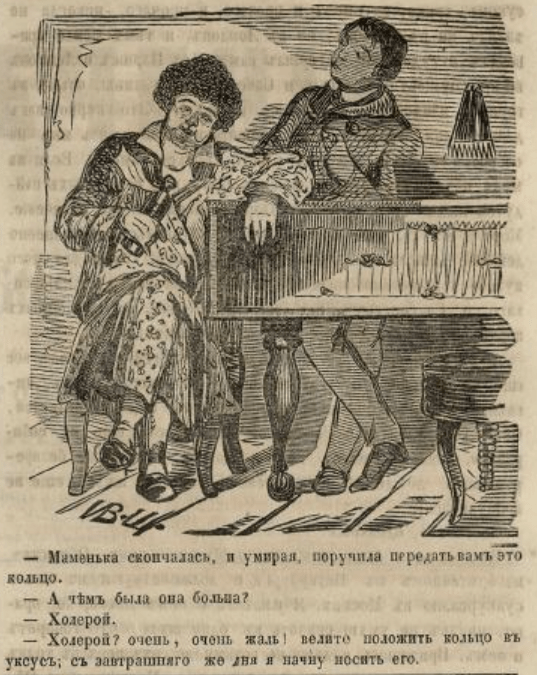
“Mamma passed away, and as she was dying, she instructed me to give you this ring.” “What was she sick with?” “Cholera.” “Cholera? Such a pity! Tell them to put the ring in vinegar, and I’ll start wearing it tomorrow.” (Razvlechenie, Moscow, 1860)
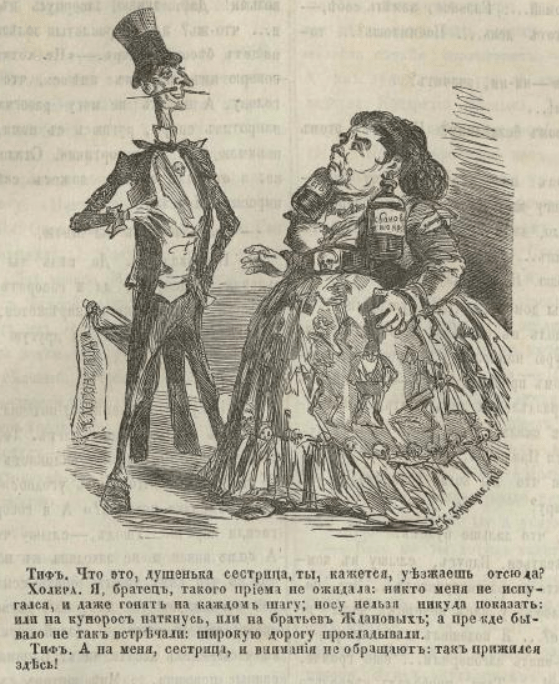
Typhus: “What is it, darling sister, are you going away?” Cholera: “Brother, I did not expect such a reception: no one was afraid of me, and they are even dogging me at every step. You can’t show your face anywhere: either I’ll run up against vitriol, or the Zhdanov brothers [purveyors of a sulphuric deodorant concoction since the 1840s; “Zhdanov liquid” was indeed tested for its effects on cholera and typhus in 1893]. But there was a time when I wasn’t greeted like this: I was given lots of leeway.” Typhus: “And as for me, they don’t pay attention, sister: I have taken root here!” (Razvlechenie, Moscow, 1866)
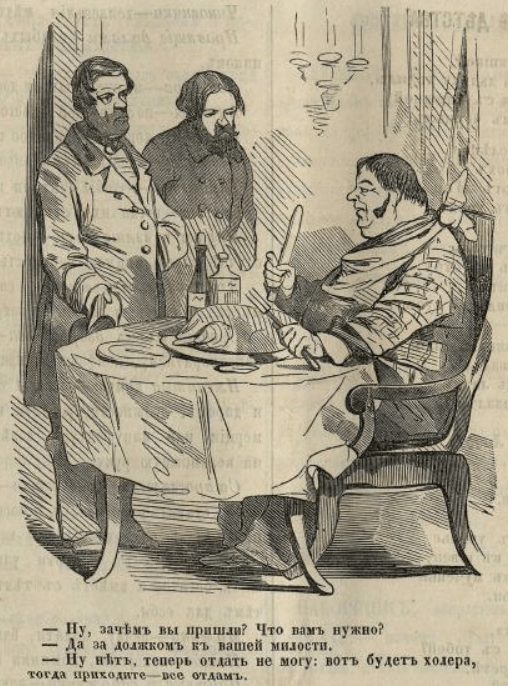
“Why did you come? What do you need?” “For a favor to your grace.” [i.e., a loan] “Well, no, I can’t give it to you now: there’s going to be cholera, come then and I’ll give you everything.” (Razvlechenie, Moscow, 1865)
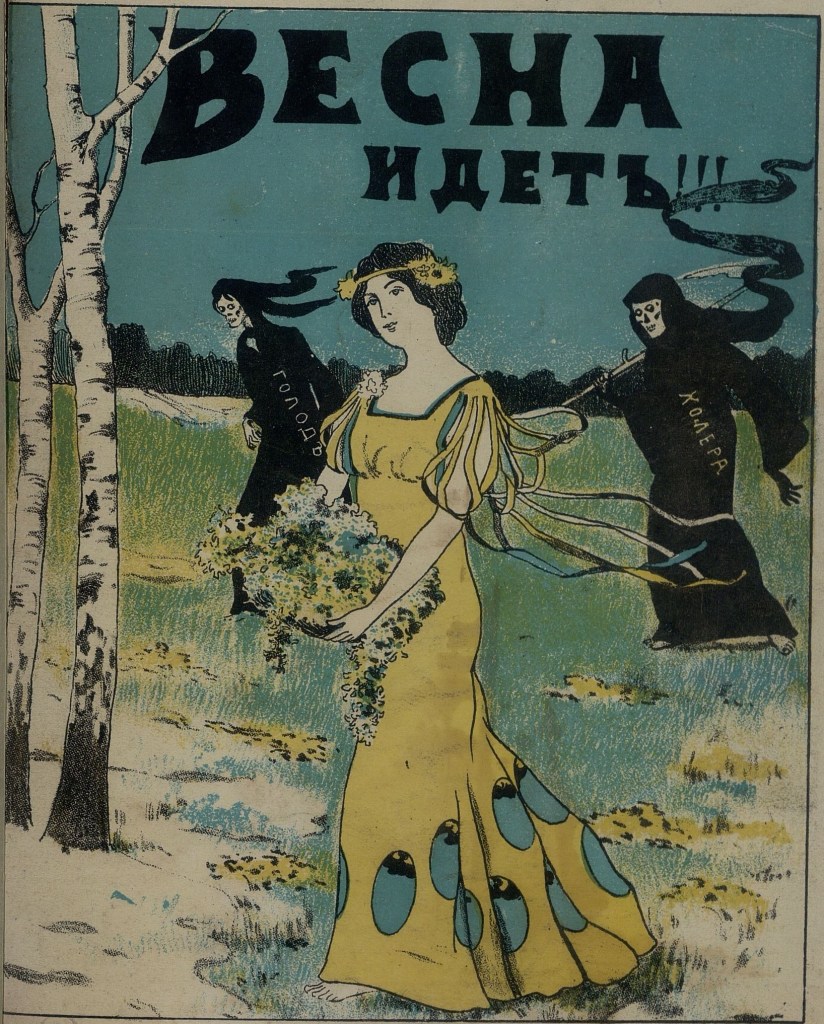
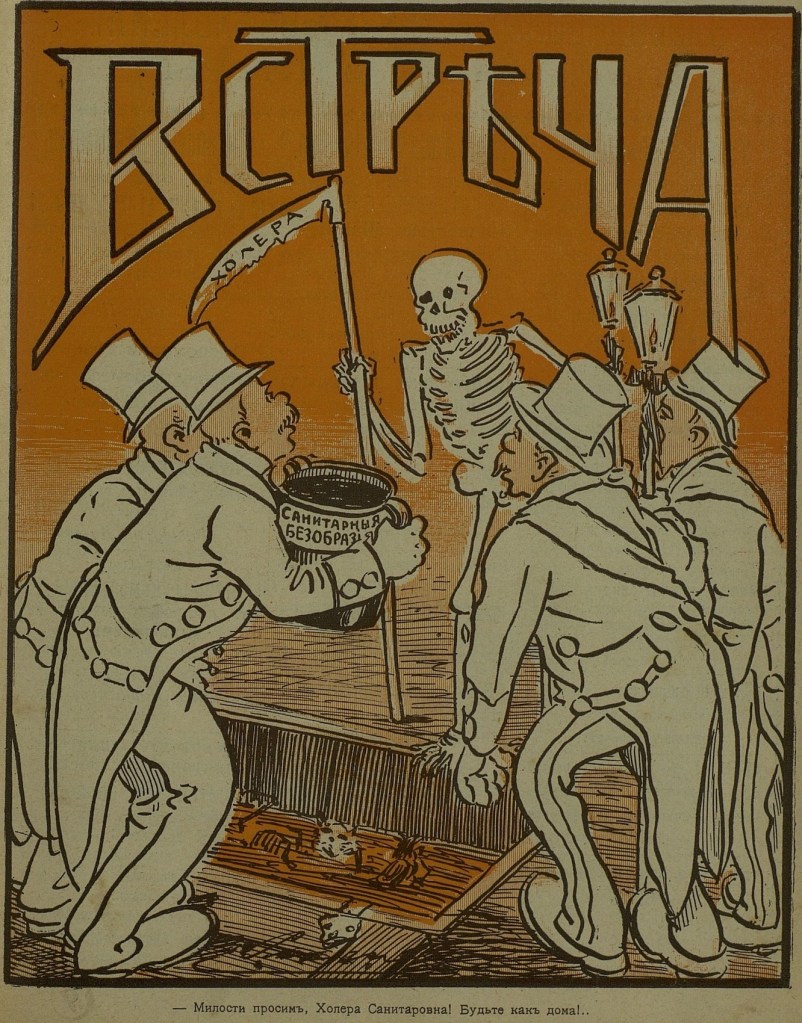
(Pot of “Public health ignorance,” with death bearing scythe marked “cholera.”) “Welcome, Cholera Sanitarovna! Make yourself at home!” (Iumoristicheskii al’manakh, St. Petersburg, 1908)
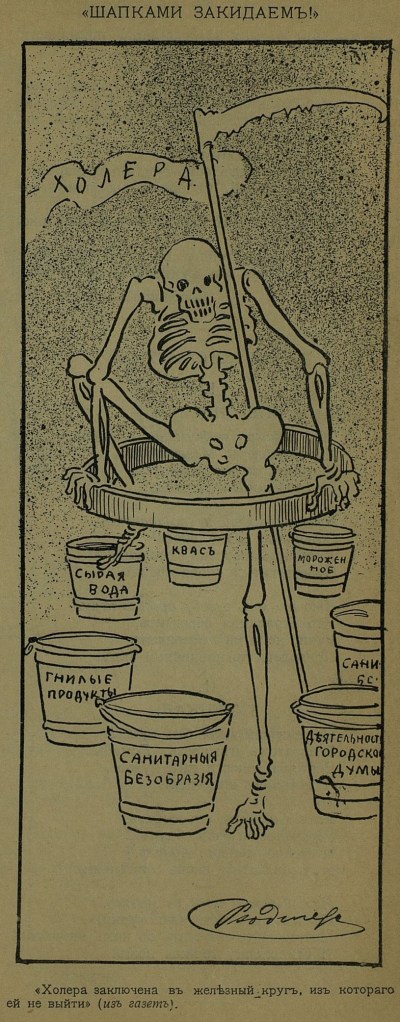
(Cholera miasma in the air… Buckets labeled “Rotten vegetables,” “Public health ignorance,” “Municipal activities,” “Ice cream,” “Kvas,” and “Polluted water.”) “Cholera is contained in an iron circle from which it cannot get out.” (from the newspapers) (Iumoristicheskii al’manakh, St. Petersburg, 1908)
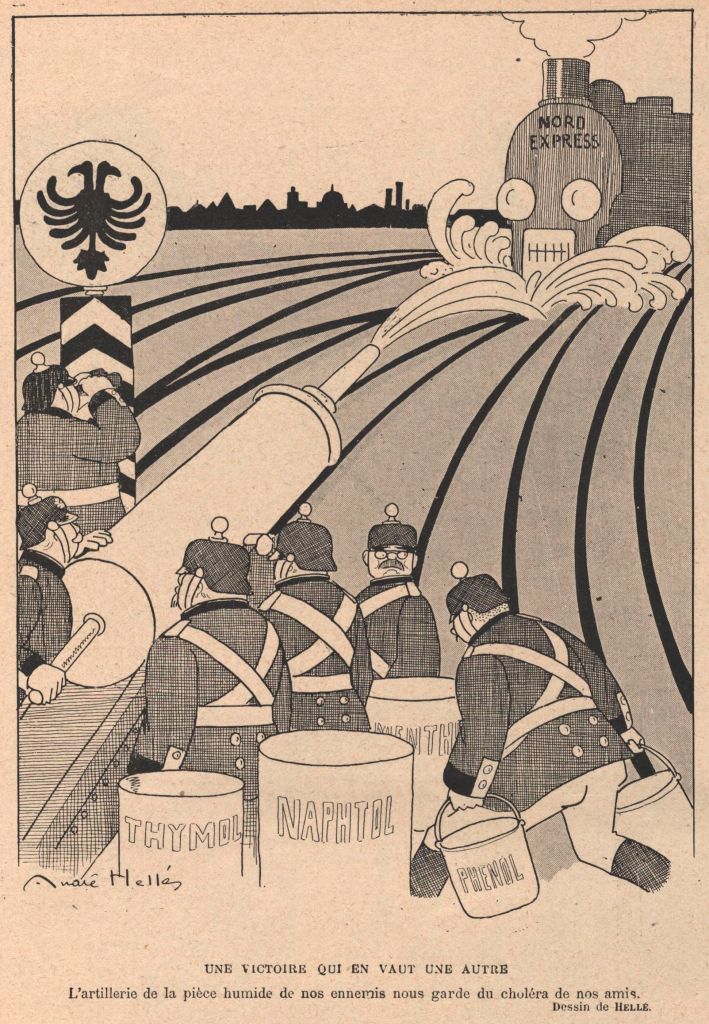
(A large clystère cannon is being loaded with various disinfectants by Prussians.) Our enemies’ damp-room artillery guards us from the cholera of our friends. (Le Rire, Paris, 1908)
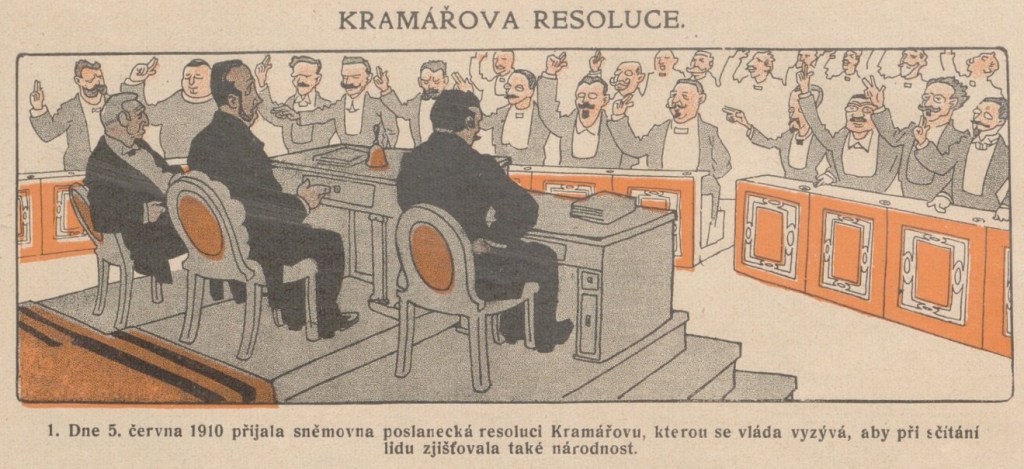
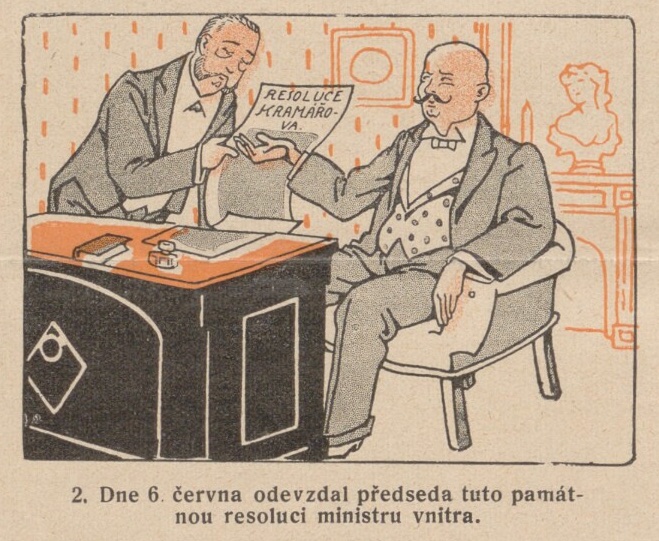
Karl Kramář was the leader of the Young Czech Party in Austria-Hungary. The Austro-Hungarian Minister of the Interior was Guido von Haerdtl, a German nationalist known for his hostility to Czech interests, especially regarding the use of anything but German as the official language in bureaucratic matters. (Kopřivy, Prague, 1910)
On June 5, 1910, the Chamber of Deputies adopted Kramář’s parliamentary resolution, which called on the government to ascertain nationality during the census.
Czech cholera cartoon
On 6 June, the President forwarded this memorable resolution to the Minister of the Interior.
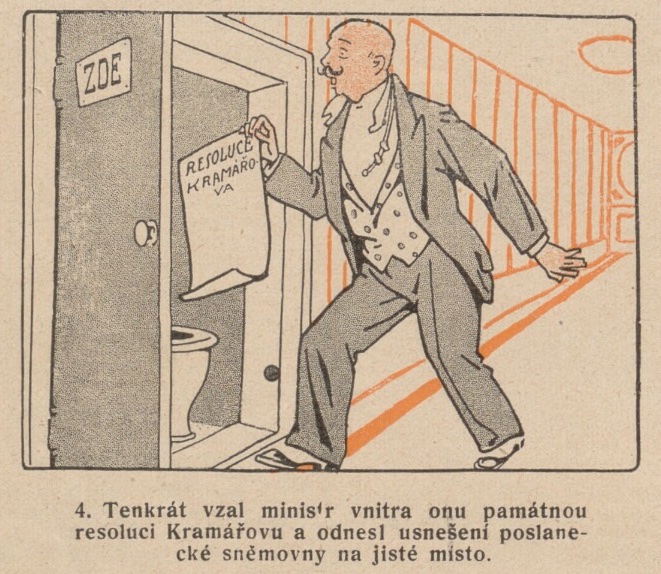
On June 7, the Minister of the Interior felt that he was experiencing symptoms of cholera.
At that time, the Minister of the Interior brought the memorable Kramář resolution and took the decree of the Chamber of Deputies away to a certain locale.
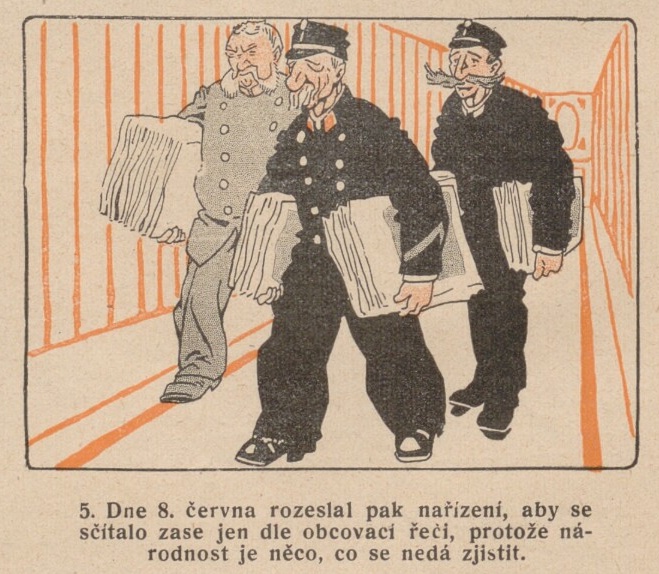
On June 8, he sent out an order to add it again only according to conversational language, because nationality is something that cannot be ascertained.

 Sic Transit Pestilentia