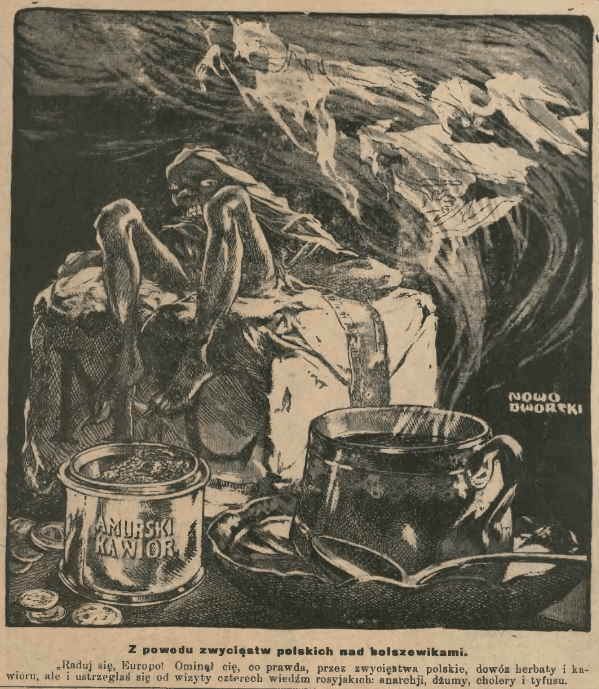
More propaganda than cartoon, this image was published during the Polish-Soviet war of 1920: “Rejoice, Europe! It’s true that because of the Polish victories you have missed the deliveries of tea and caviar, but you have also avoided the visitation of the four Russian witches: anarchy, plague, cholera, and typhus.” (Mucha, Warsaw, 1920)
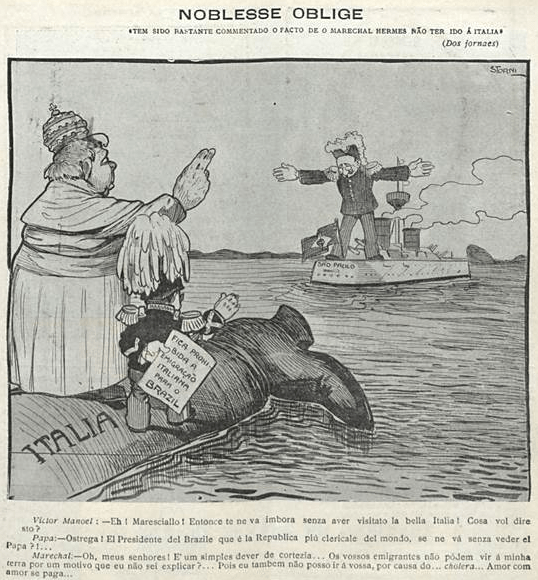
(It has been widely commented that Marshal Hermes [de Fonseca, the president of Brazil] did not go to Italy.) Italian King Victor Emmanuel (holding document behind his back that reads “Italian emigration to Brazil is prohibited”): “Hey! Marshal, my dear! So you’re embarking without having visited la bella Italia! What does this mean?” The Pope: “Darn! The President of Brazil, the world’s most clerical republic, doesn’t want to see the Pope?” The Marshal: “Oh, gentlemen! It is a simple matter of courtesy… Your immigrants cannot come to my land for a reason that I can’t explain? … I can’t go to yours either, because of… cholera… Love is repaid with love.” (O Malho, Rio de Janeiro, 1910)
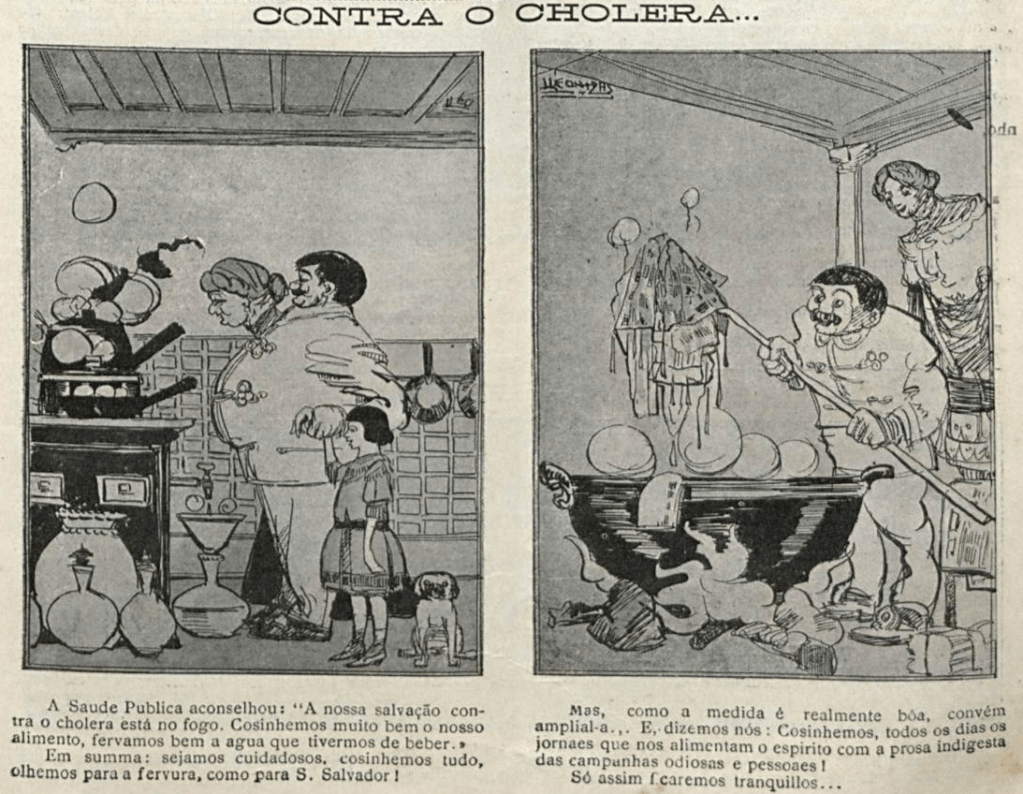
The public health authorities have advised: “Our salvation against cholera lies in fire. Let’s cook our food very well, let’s boil our drinking water well.” In short: let us be careful, cook everything, watch for the boiling point, like in San Salvador! (second image) Yet insofar as the measure is really good, it should be expanded… And, we say to ourselves: Let’s cook the newspapers daily that feed our spirit with the indigestible prose of odious and personal campaigns! Only thus may we fear in tranquillity… (O Malho, Rio de Janeiro, 1910)
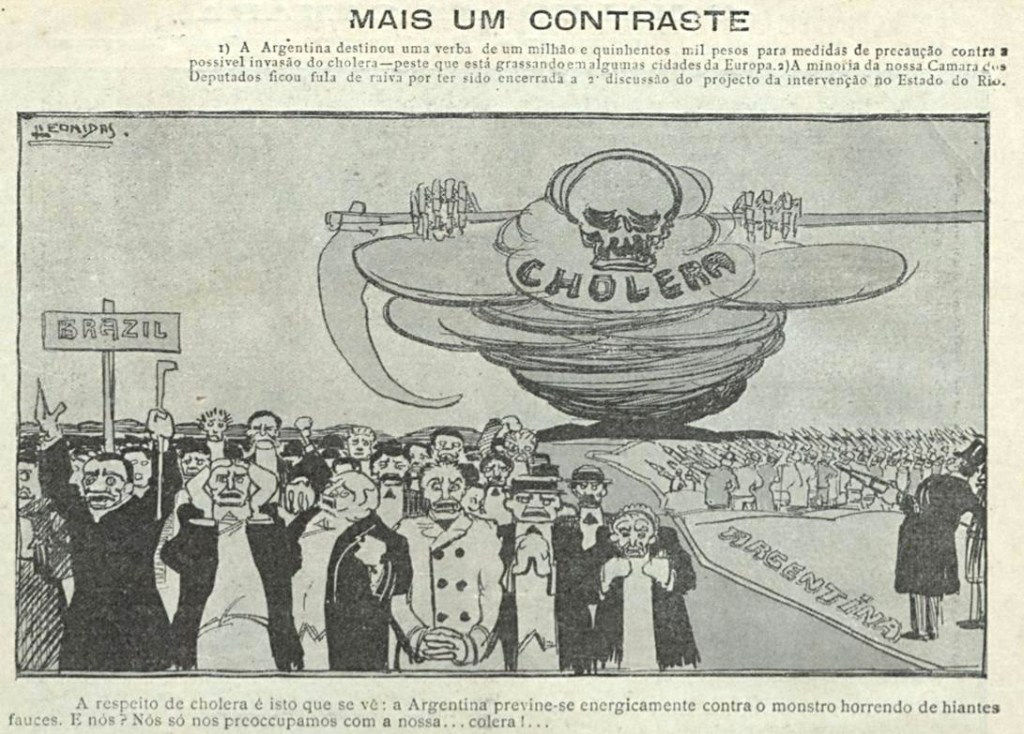
On differences between the Argentinian and Brazilian responses to the cholera epidemic. (The Argentinians appear to be uniformly armed with disinfectant sprayers.) “Regarding cholera and what can be seen: Argentina is energetically preparing for the horrendous monster with its giant maw (?). And us? We are only preoccupied with our… rage!” (I.e., choler) (O Malho, Rio de Janeiro, 1910)
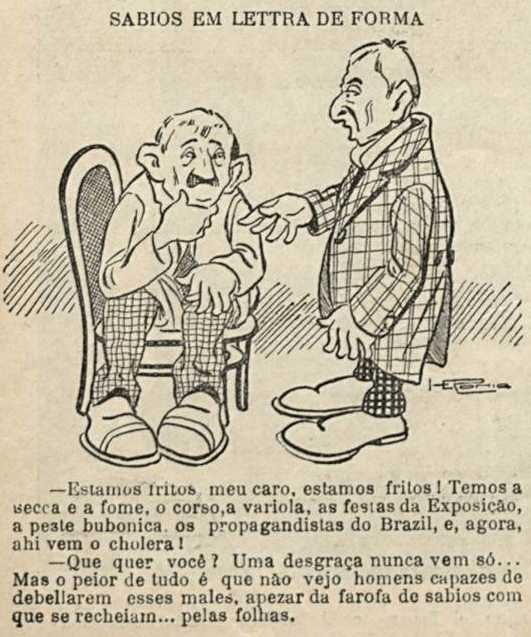
A cartoon set in the year of the Brazilian National Exposition in 1908: “We’re toast, my dear, we are toast! We have drought and famine, parade floats, smallpox, Exposition parties, bubonic plague, propagandists of Brazil, and now here comes cholera!” “What do you want? Disasters always come in multiples… But the worst of it all is that I don’t see men capable of curbing these ills, despite the [manioc] flour of erudition with which they are stuffed… because of the leaves.” (Meaning that appearance prevailed over substance?) (O Malho, Rio de Janeiro, 1908)
From an advertisement for a potion produced by Guyot: “Everyone knows that bad microbes are the cause of almost all of our major diseases: tuberculosis, influenza, diphtheria, typhoid fever, meningitis, cholera, plague, tetanus, etc.” (Am I the only one who sees some Miró here?) (O Malho, Rio de Janeiro, 1919)
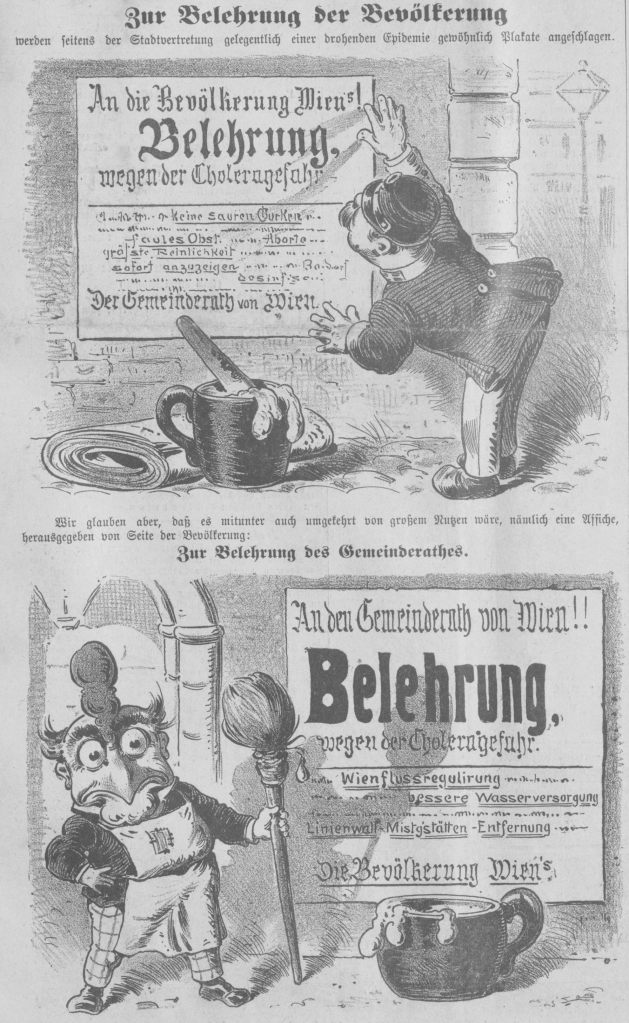
For the instruction of the populace posters of an impending epidemic will occasionally be put up by the city council. (The first poster forbids sour pickles, rotten vegetables, and (I think) abortions (!), while demanding cleanliness.) We believe, however, that it would also be immensely useful to include a placard published on behalf of the populace: For the instruction of the city council. (The second poster wants better channeling of the Danube river against floods, better water services, better waste removal.) (Kikeriki, Vienna, 1886)
“But you’re not afraid to go to the Pyrenees, where cholera is so close?” “I was afraid, but my wife advised an excellent method to me: after the border I will travel under an assumed name.” (Mucha, Warsaw, 1884)
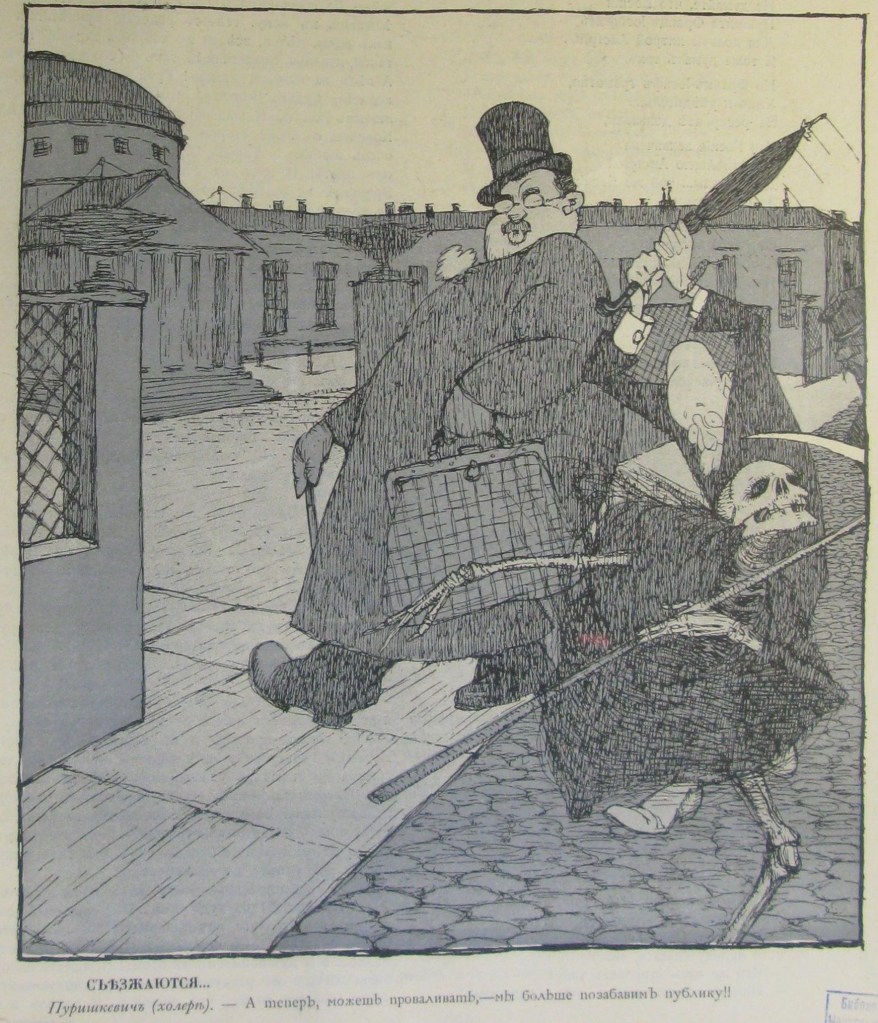
“They are assembling together…” Purishkevich (to cholera while beating it with his umbrella): “It might be failing right now, we’ll have more ways to entertain the public.” (Purishkevich was an ultraconservative and anti-Semitic Russian politician who had recently fallen out with one set of protofascist allies and was cultivating a new group under the name “Russian People’s Union of the Archangel Michael.” Presumably Satirikon regarded neither Purishkevich nor cholera as good for the health of the Russian body politic.) (Satirikon, St. Petersburg, 1908)
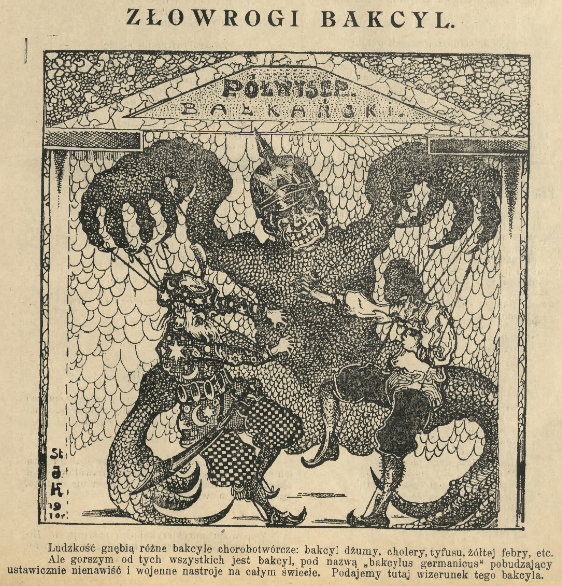
Balkan peninsula. “Humanity is oppressed by various infectious bacteria: plague, cholera, typhus, yellow fever, etc. But worse than all these is the bacillus called bacillus germanicus, which constantly provokes hatred and militant sentiments around the world. Here we provide an image of this bacillus.” (Kogut, Warsaw, 1910)
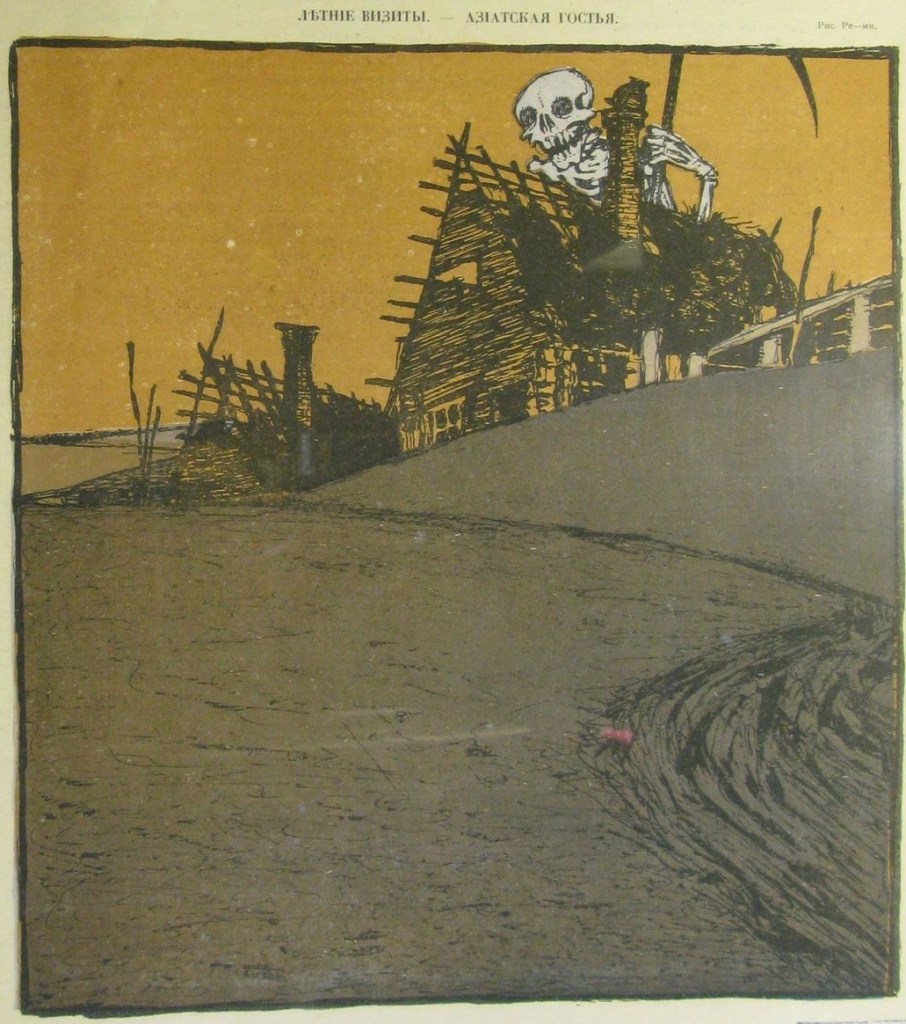
Summer visits — the Asian guest. Cover image of the Russian satirical magazine Satirikon as cholera in the southern provinces of the empire was making itself felt more widely. (Satirikon, St. Petersburg, 1908)
This image of death on wheels is a bit ambiguous for our purposes, but it was published just at the moment when a cholera epidemic in the Caucasus was reaching the Russian capital, so I shall classify it accordingly. (Satirikon, St. Petersburg, 1908)
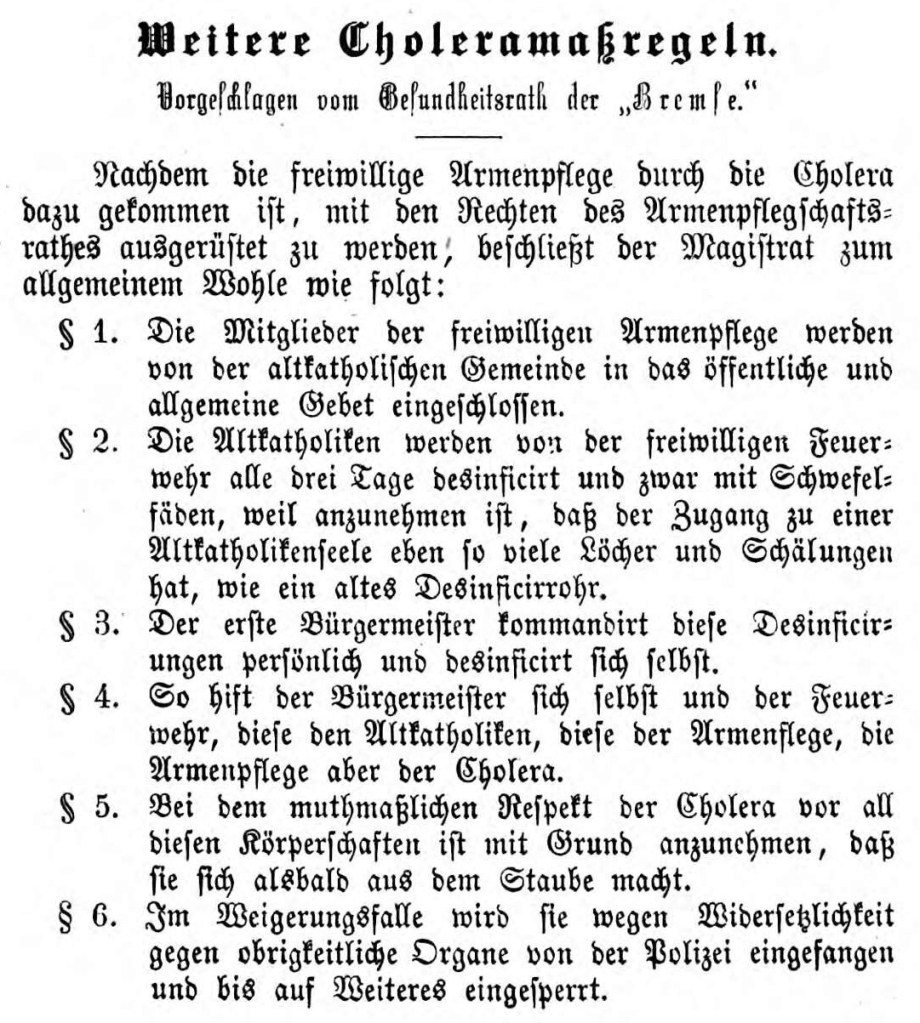
Further cholera measures proposed by the health councilor of Die Bremse. Now that voluntary care for the poor has come to be equipped with the rights of the Council for Care of the Poor, the magistrate has concluded as follows for the general good: 1. The voluntary members caring for the poor will be enclosed by the old Catholic parishioners in public and general prayer. 2. The old Catholics will be disinfected by the voluntary fire department every three days with sulfurous cloths, because it is to be assumed that access to an old Catholic soul has just as many holes and cracks as an old disinfection tube. 3. The mayor commands these disinfections personally and disinfects himself. 4. In this manner the mayor helps himself and the fire department, they in turn help the old Catholics, they in turn help those caring for the poor, while those caring for the poor help cholera. 5. Given the presumed respect of cholera in the face of all these corporations we may fundamentally assume that it will quickly abscond. 6. Should it refuse to cooperate, the police will seize it for violating the authorities and imprison it until further notice. (Die Bremse, Bavaria, 1873)
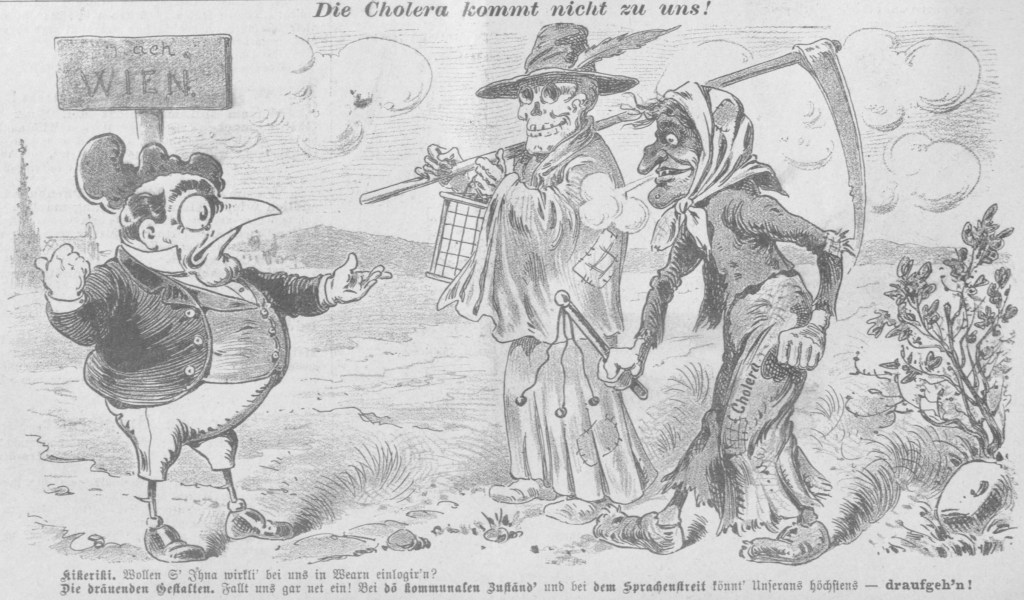
Kikeriki: “Do you really want to take lodgings with us in Vienna?” Looming figures: “It didn’t occur to us! With the communal situation and the language conflict the likes of us could croak at best!” (Kikeriki, Vienna, 1886)
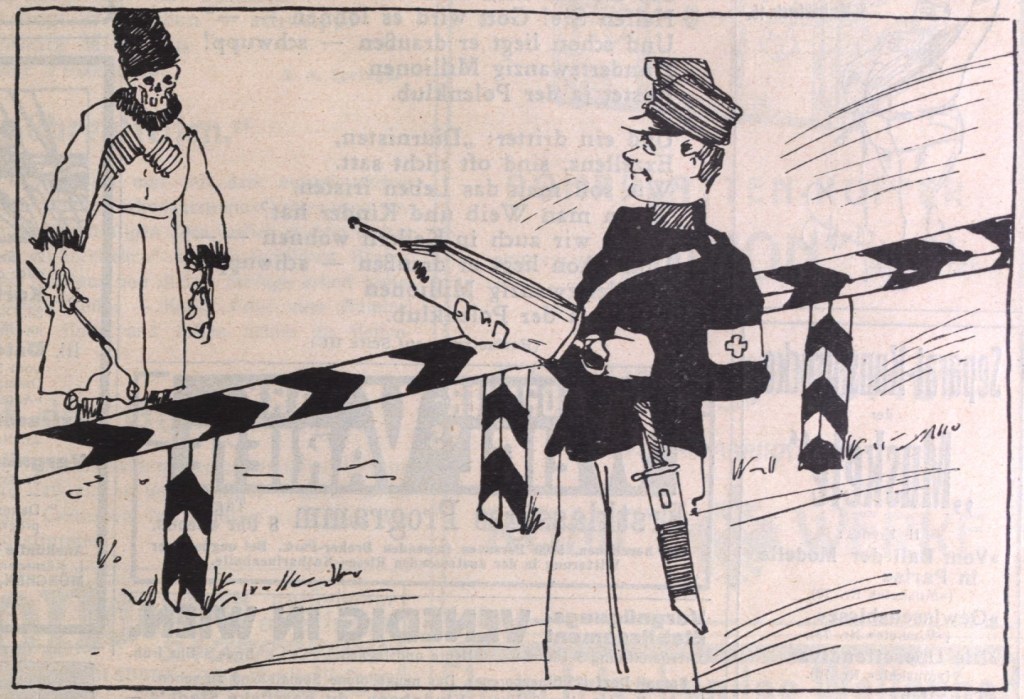
This cartoon set at the Austrian border with the Russian Empire is accompanied by a bit of nasty verse entitled “Cholera Russica” (in my slapdash translation):
The Slavic danger — how should I Just say it? — is not an empty delusion; On the contrary, it swells menacingly In the south and in the east.
Defending against it, cannons are Dispensable and rifles, too; Only from sanitation troops alone Can we make successful use.
In the south, where it is more primitive, Yet still fruitless, It besets us with vermin, In the east with epidemics.
Now due to this realization the eastern one Terrifies us especially clearly, Since its main pathogen is just now Loosing the prohibited heart of the epidemic;
Even though the tightest quarantine, That we usually put in place, Sets hardly more conditions than those, That the Tsar himself always imposes.
And as for the man himself, it was not A plague that instilled fear in him, For whom the greatest of all plagues Hasn’t yet withered him: his regime! (Die Muskete, Vienna, 1910) (Or this bit of German verse in a similar vein.)



 Sic Transit Pestilentia