George Cruikshank, “The Central Board of Health: Cholera Consultation” (1832)
(From the Manfred Kraemer Collection of Medical Prints and Satires, Countway Library, Harvard University)
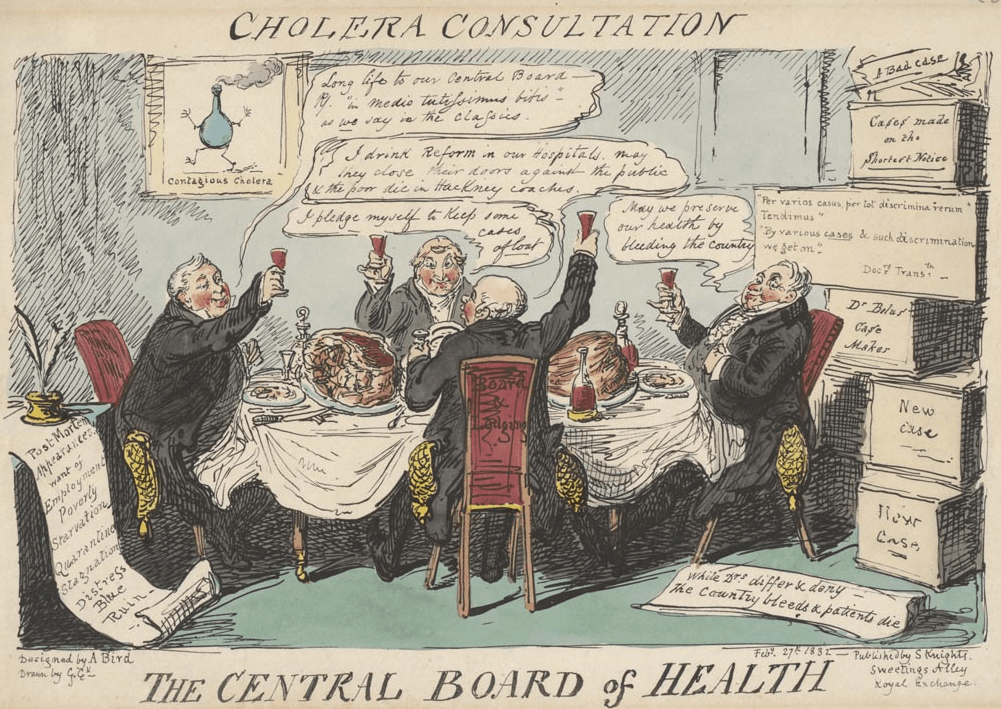
George Cruikshank, “The Central Board of Health: Cholera Consultation” (1832)
(From the Manfred Kraemer Collection of Medical Prints and Satires, Countway Library, Harvard University)
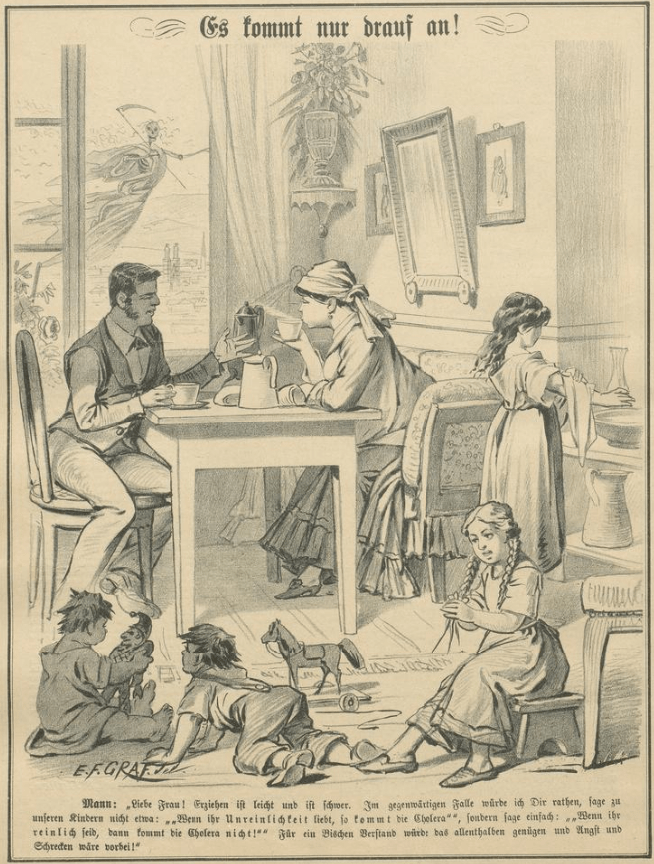
Husband: “Dear wife! Education is easy and it is difficult. In the present case I would advise you not to tell the children “If you love uncleanliness, that’s how cholera comes,” but rather just to say: “If you are clean, then cholera doesn’t come!” That would suffice everywhere for a bit of sense, and fear and terror would be over.”
(Nebelspalter, Zurich, 1883)
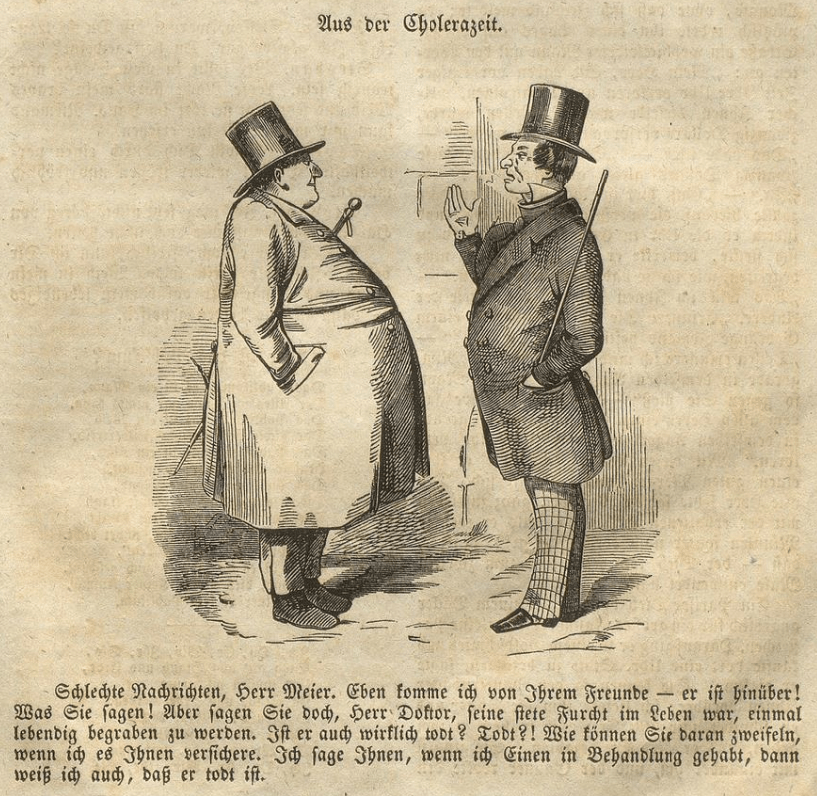
Doctor: “Bad news, Mr. Meier. I’ve just come from your friend — he has passed away!”
Mr. Meier: “What are you saying! But tell me, Doctor, his constant fear in life was that he would someday be buried alive. Is he really dead?”
Doctor: “Dead?! How can you doubt it if I am affirming it. I’m telling you, once I’ve had one of them in treatment, then I know that he’s dead, too.”
(Appenzeller Kalender, Zurich, 1855)
Guest: “Waiter! This soup is really very healthy.”
Waiter: “You’re welcome — how do you mean?”
Guest: “Pure boiled water is a prophylactic against cholera!”
(Figaro, Vienna, 1892)
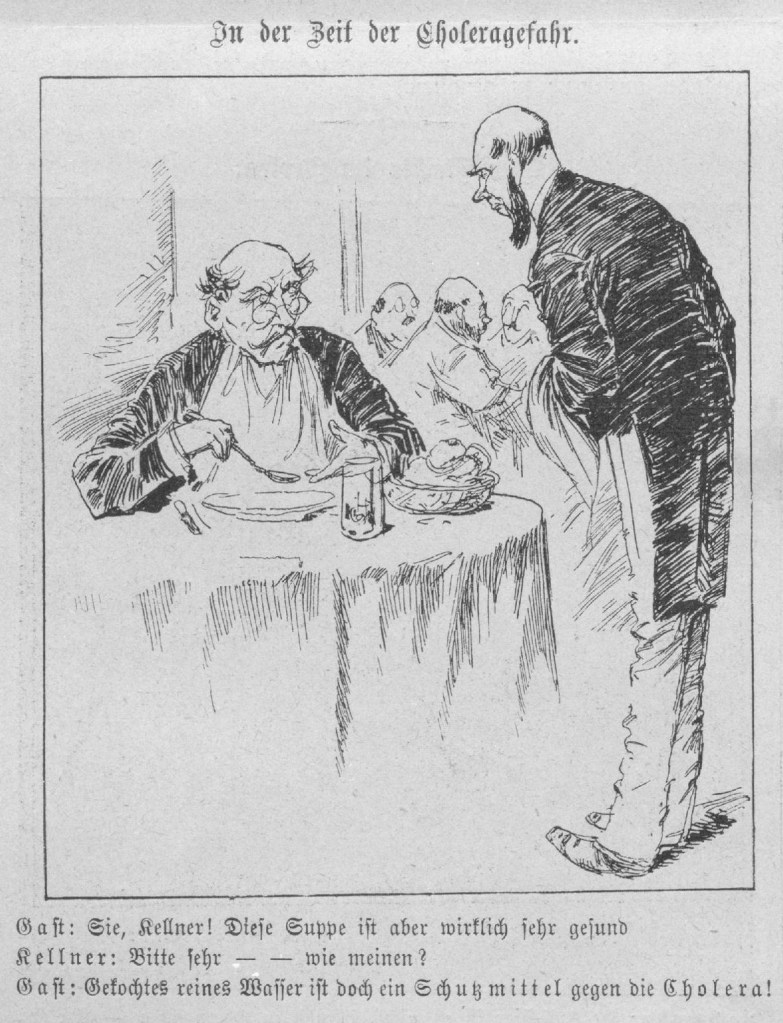
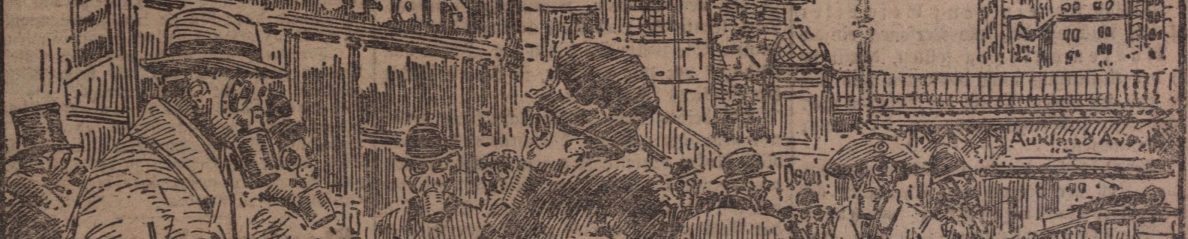
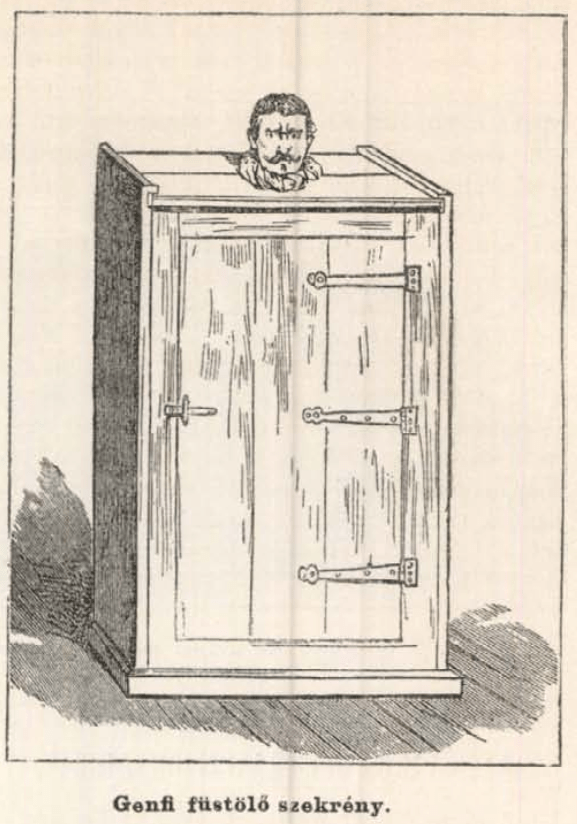
Image of a fumigation chamber used in Geneva during the cholera pandemic as it spread in 1884.
(Vasarnapi Ujság, Budapest, 1884)
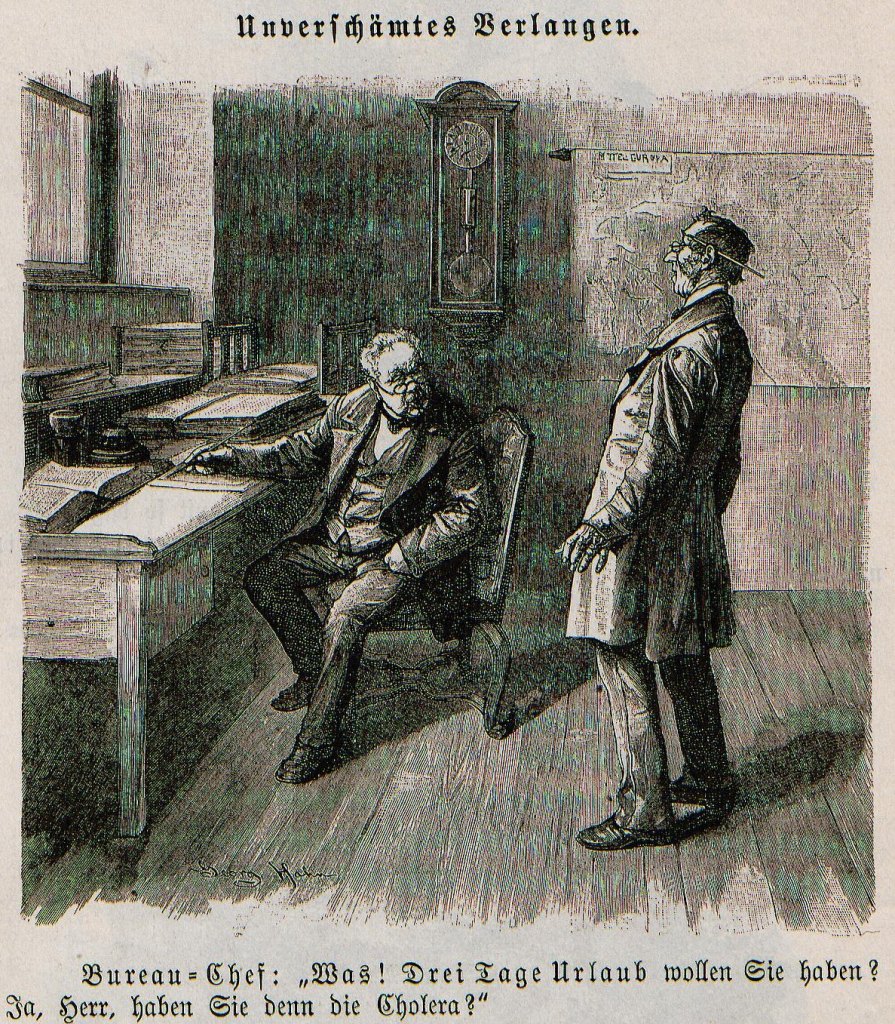
Office manager: “What! You want three days vacation? Indeed, sir, do you have the cholera?”
(Fliegende Blätter, Munich, 1886)
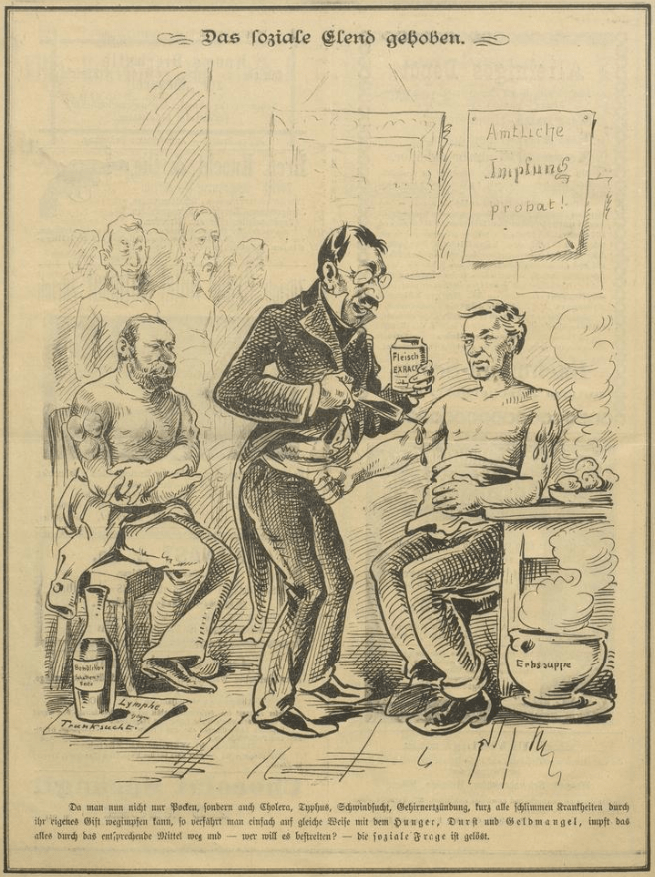
A physician injecting small quantities of meat extract: “Since we can now inoculate away via its own poison, not only smallpox, but also cholera, typhus, consumption, brain inflammation, in short, all bad diseases, we simply proceed in the same manner with hunger, thirst, and lack of money, inoculate it away via the corresponding medium and — who would deny it? — the social question is solved.”
(Nebelspalter, Zurich, 1885)
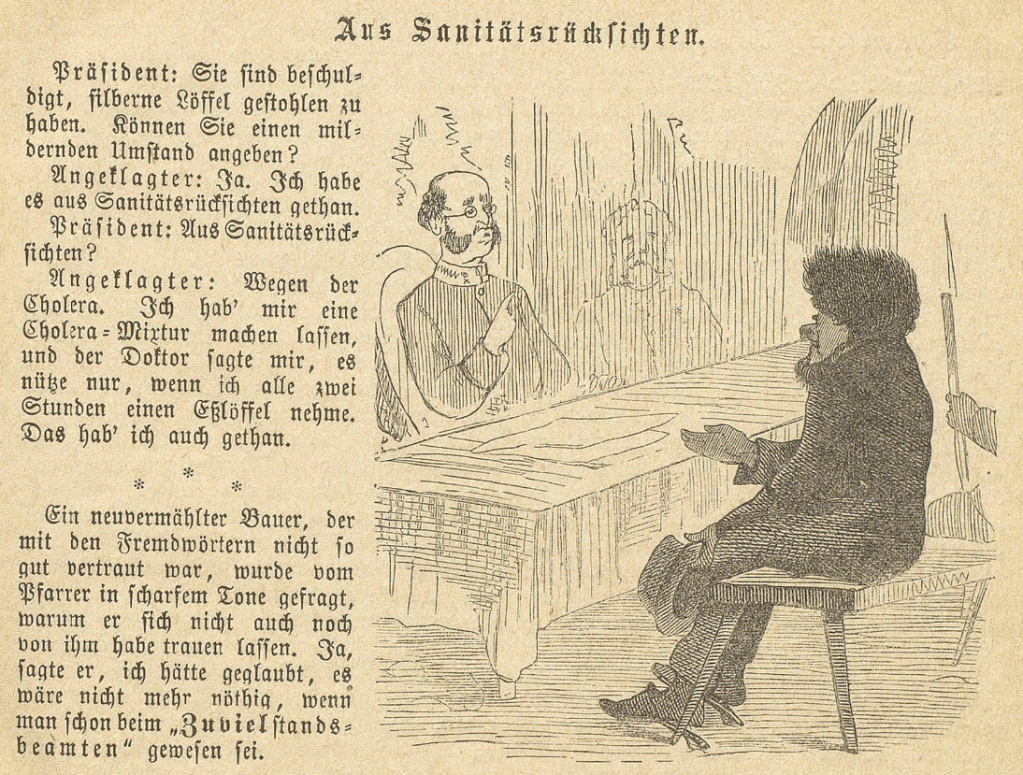
Presiding magistrate: “You are accused of stealing silver spoons. Can you offer any extenuating circumstances?”
Accused: “Yes. I did it for sanitary reasons.”
Presiding magistrate: “For sanitary reasons?”
Accused: “Because of the cholera. I had a cholera concoction made for myself, and the doctor said that it would be effective only if I took a tablespoon every two hours. And that’s what I did.”
(Appenzeller Kalender, Zurich, 1877)
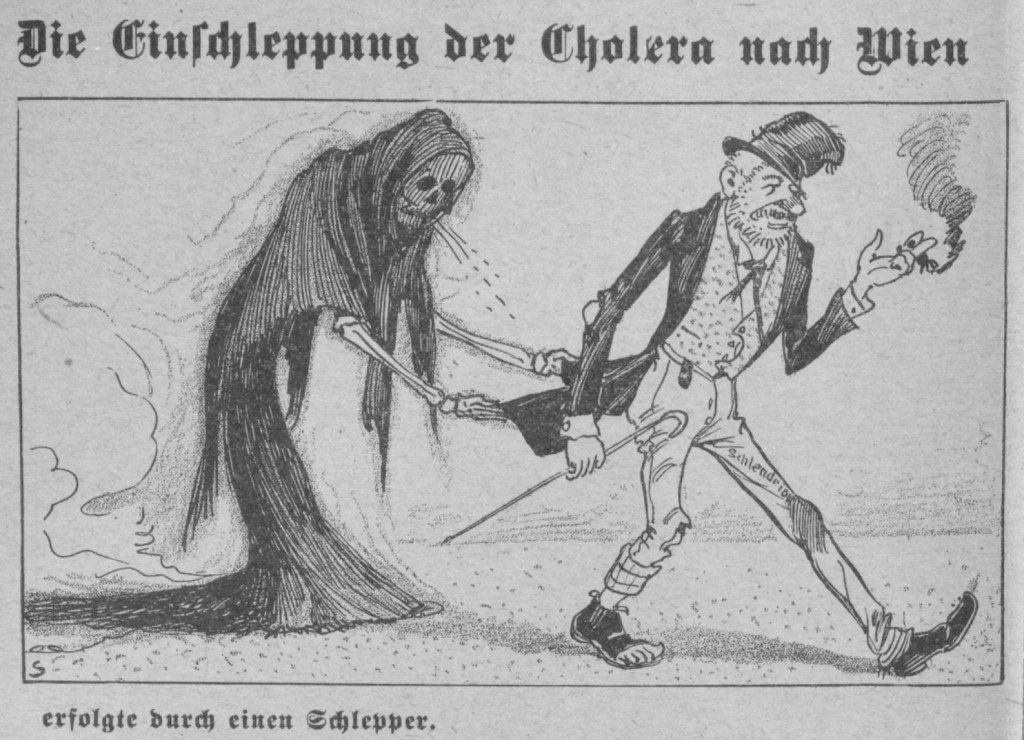
The introduction of cholera to Vienna was effected by a “coyote.” Actually many English speakers will be able to recognize the wordplay on “schlep,” but just to make clear the negative connotations, the cartoonist marks the man as a careless ambler.
(Kikeriki, Vienna, 1911)
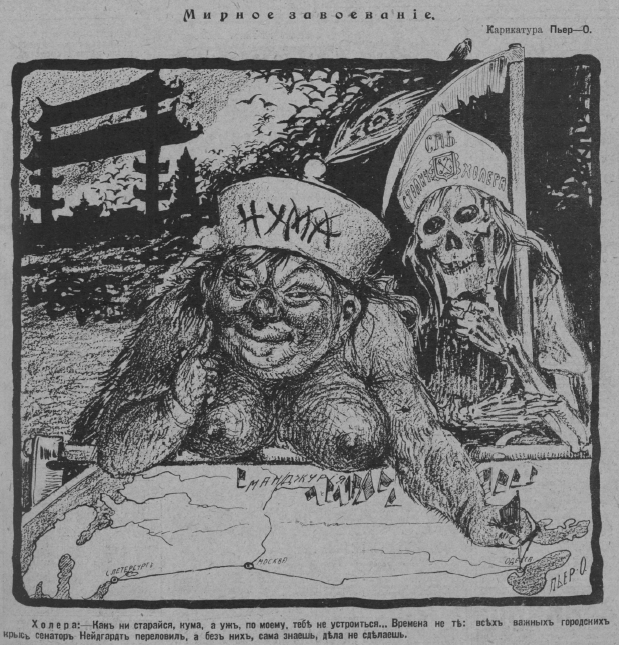
St. Petersburg cholera (to Mother Plague reaching over site markers in Manchuria and points east in the Empire toward Odessa on the Black Sea): “However hard you try, Mother, I think you can no longer get settled there… The times have changed: Senator Neidgardt [Dmitrii Borisovich, who had once served as mayor of Odessa] caught all the important municipal rats, and without them, as you know, you won’t get anywhere in these matters.”
(Ogonek, Russia, 1911)
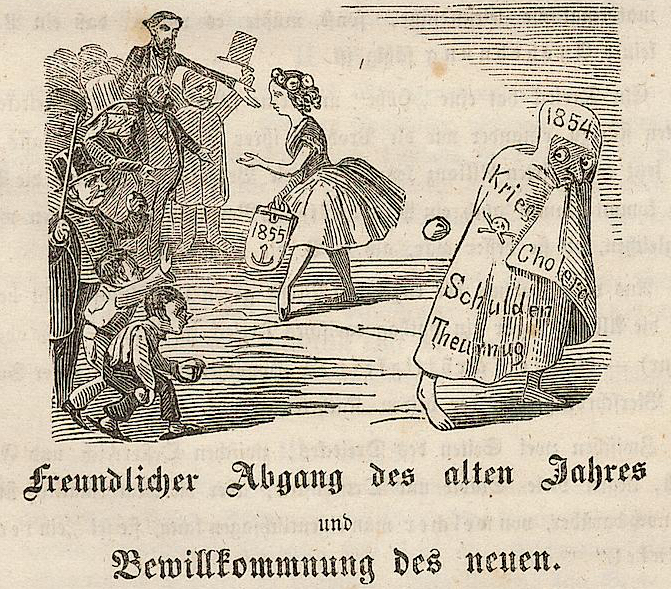
Friendly departure of the old year and welcoming of the new one. (The departing figure is shrouded in War, Cholera, Debts, and Inflation.)
(Punsch, Munich, 1854)
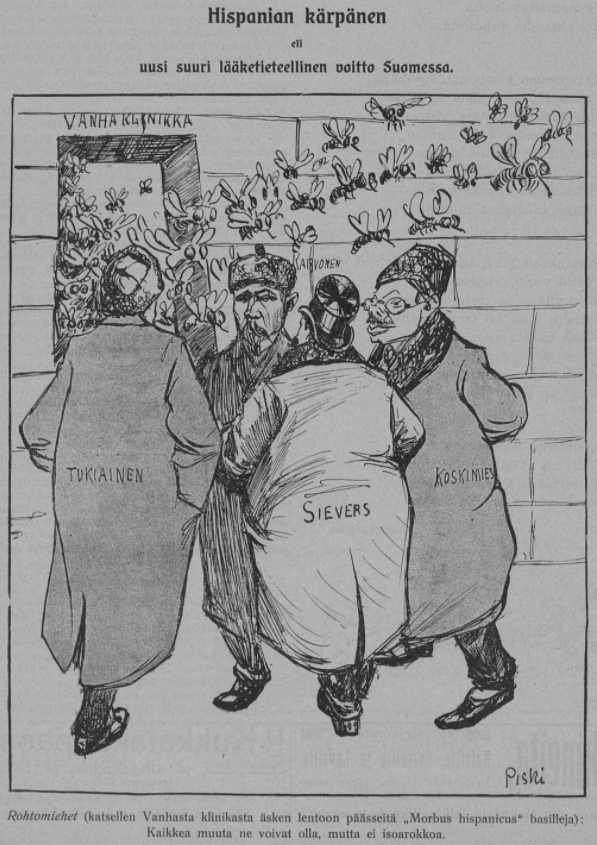
Spanish fly, a great new medical victory in Finland.
Herbalists (watching the Morbus hispanicus bacilli just flown in from the Old Clinic): They could be anything else, but not smallpox.
Among the figures depicted, Richard Sievers was a Finnish-Swedish physician with German roots who was credited with sparing Finland from the cholera epidemic then developing in Russia.
(Tuulispää, Helsinki, 1908)
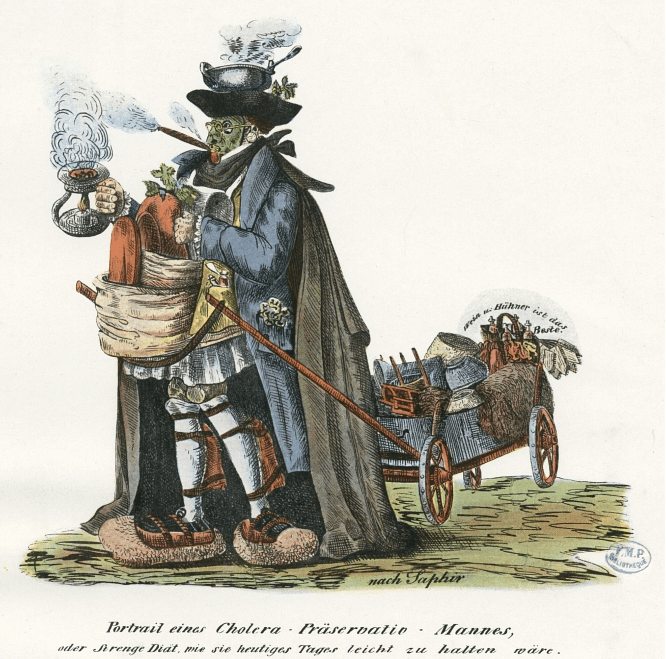
or strict diet as it would be easy to maintain these days.
(Reprinted in Deutsche Medizinische Wochenschrift, 1908; originally 1830s.) (Cf. copy at National Library of Medicine) (And see the female counterpart.) The artist is apparently Peter Carl Geissler.
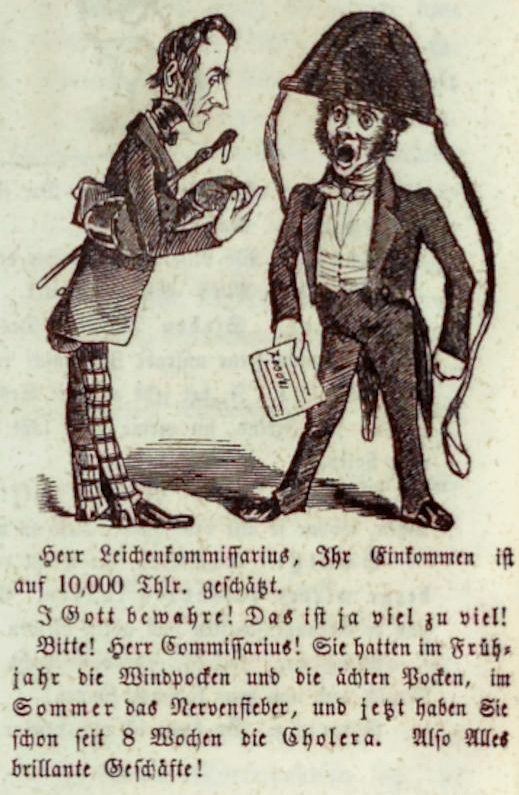
“Mr. Coroner, your income is estimated at 10,000 thaler.”
“God help me! That is far too much!”
“Please, Mr. Coroner! In the spring you had chicken pox and the real smallpox, in the summer you had nervous fever, and now you’ve already had cholera for eight weeks. So it’s all brilliant dealings!”
(Kladderadatsch, Germany, 1850)
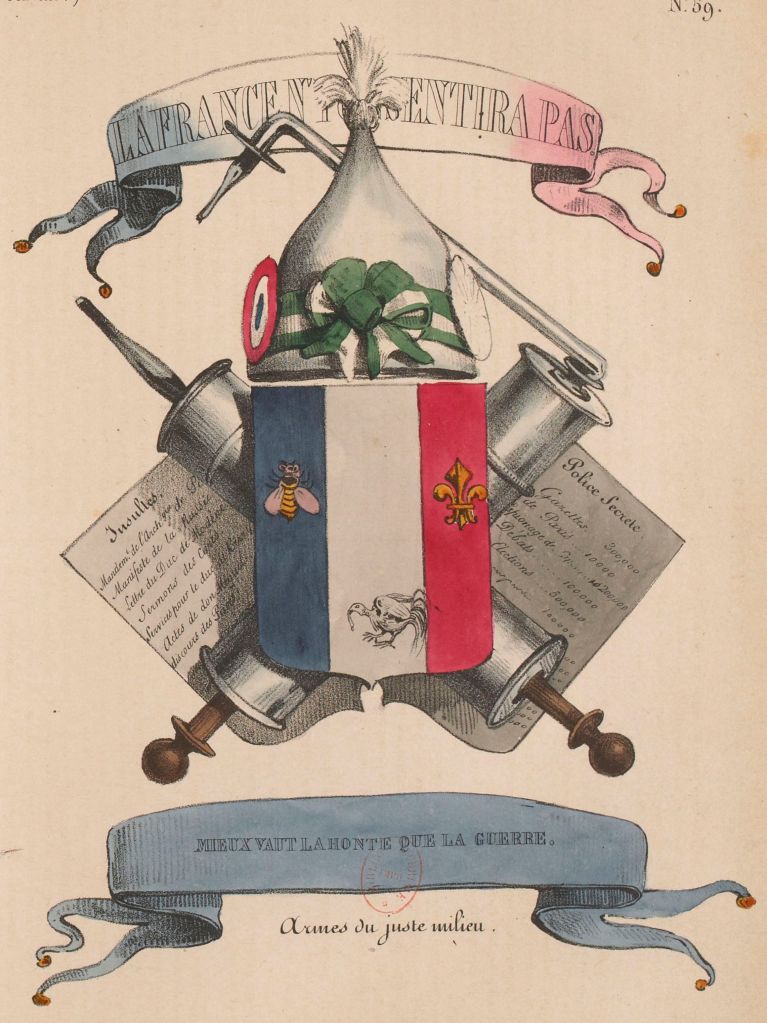
This coat of arms with list of Insults on the left and Secret Police overseeing newspapers and political life on the right prominently features two crossed clystères, syringes suitable for administering enemas. (Note that the one on the right seems designed for self-administration.) At the height of the second cholera epidemic, the slogans at the bottom captured contemporary sentiments: “Better shame than war” and “Judicious moderation in arms.”
(La Caricature, Paris, 1831; this was a recurrent theme)
 Sic Transit Pestilentia