The orders they gave us are these: try to arrest the epidemic and lock it up in the clink.
(Charivari, Lisbon, 1890) (Shaky on the idiom; correction welcome.)
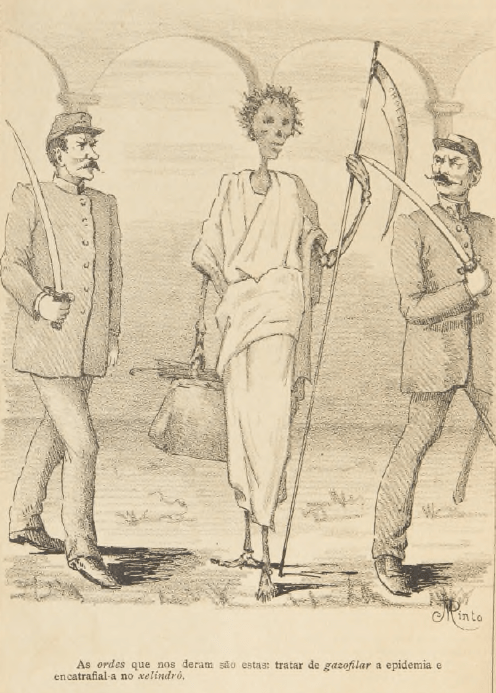
The orders they gave us are these: try to arrest the epidemic and lock it up in the clink.
(Charivari, Lisbon, 1890) (Shaky on the idiom; correction welcome.)
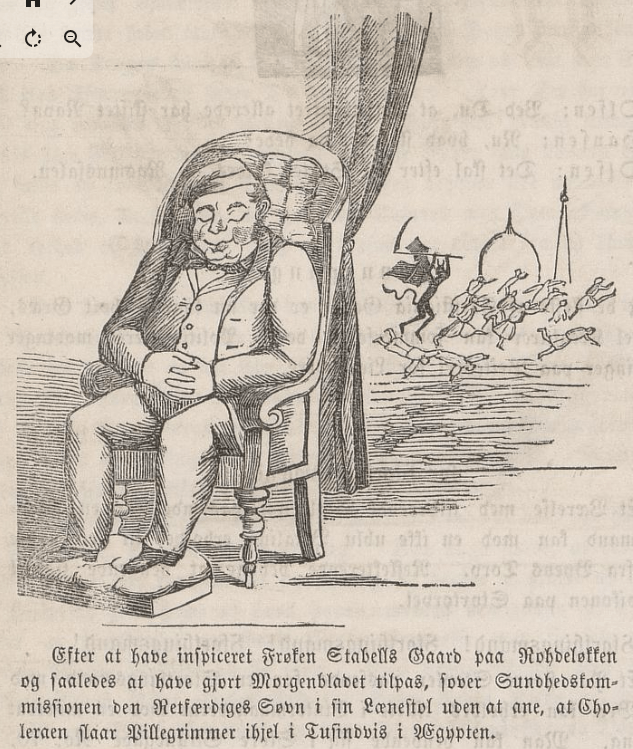
(Vikingen, Oslo, 1865)
After inspecting Miss Stabell’s farm on Rohdeløkken and thus suiting Morgenbladet [the establishment newspaper], the Public Health Commission sleeps the sleep of the righteous in its armchair without having any idea that cholera is killing thousands of pilgrims in Egypt.
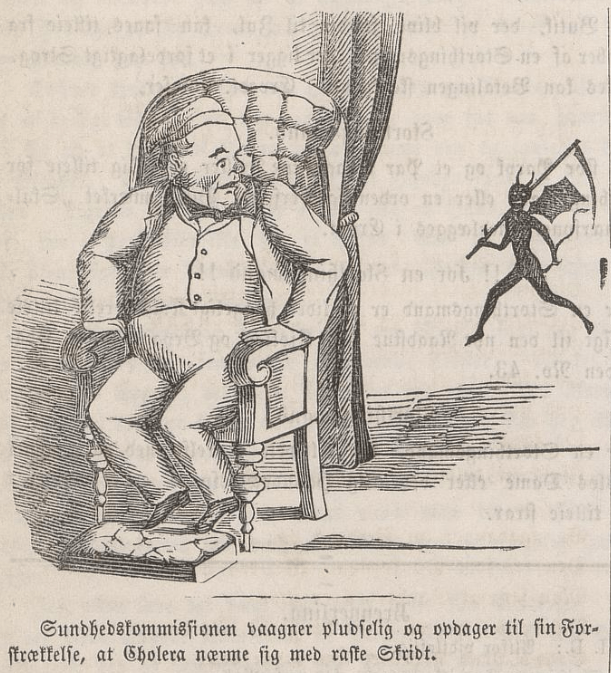
The Public Health Commission suddenly wakes up and discovers to its dismay that Cholera is fast approaching.
The Public Health Commission immediately hurries to sweep Oslo’s gutters and “cut a broad swathe.”
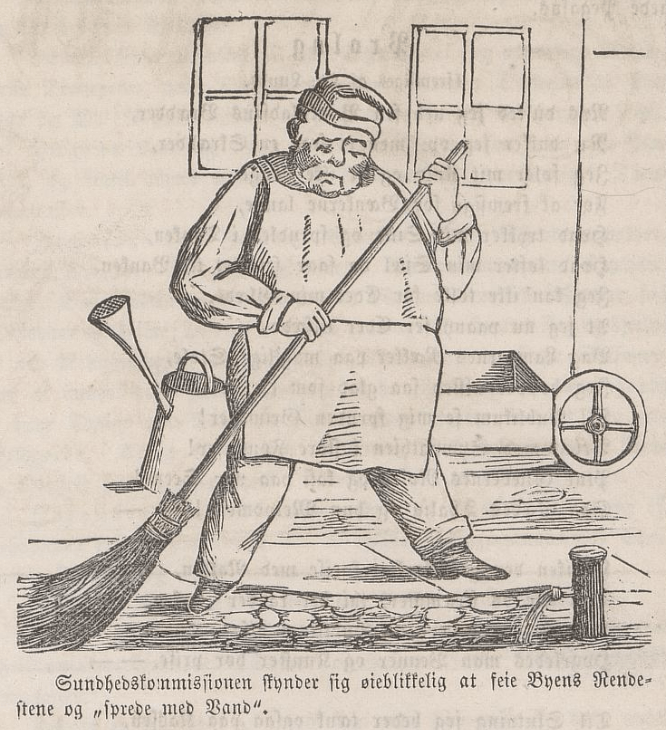
Whereupon the Public Health Commission goes back to sleeping the sleep of the righteous, while Cholera…

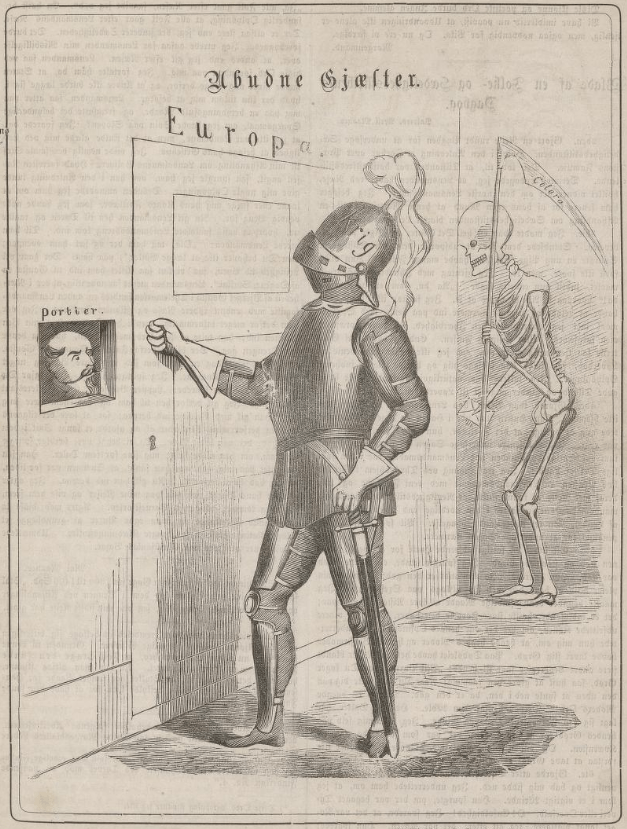
War and cholera
(Vikingen, Oslo, 1866)
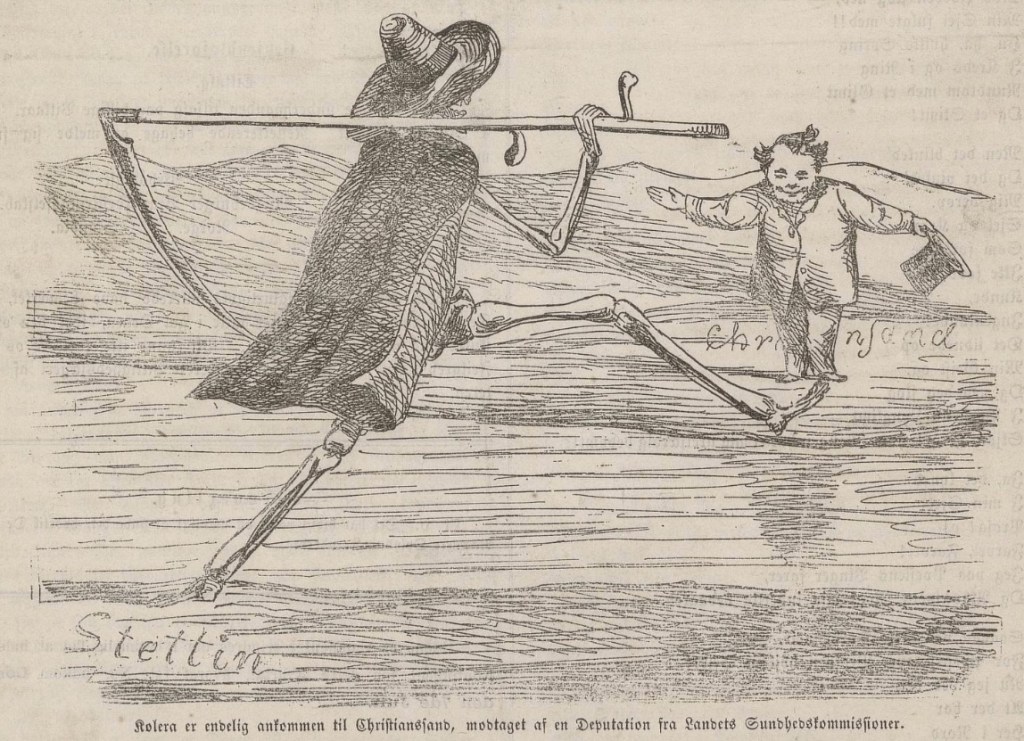
Cholera has finally arrived in Oslo, received by a deputation from the country’s health commissions.
(Vikingen, Oslo, 1866)
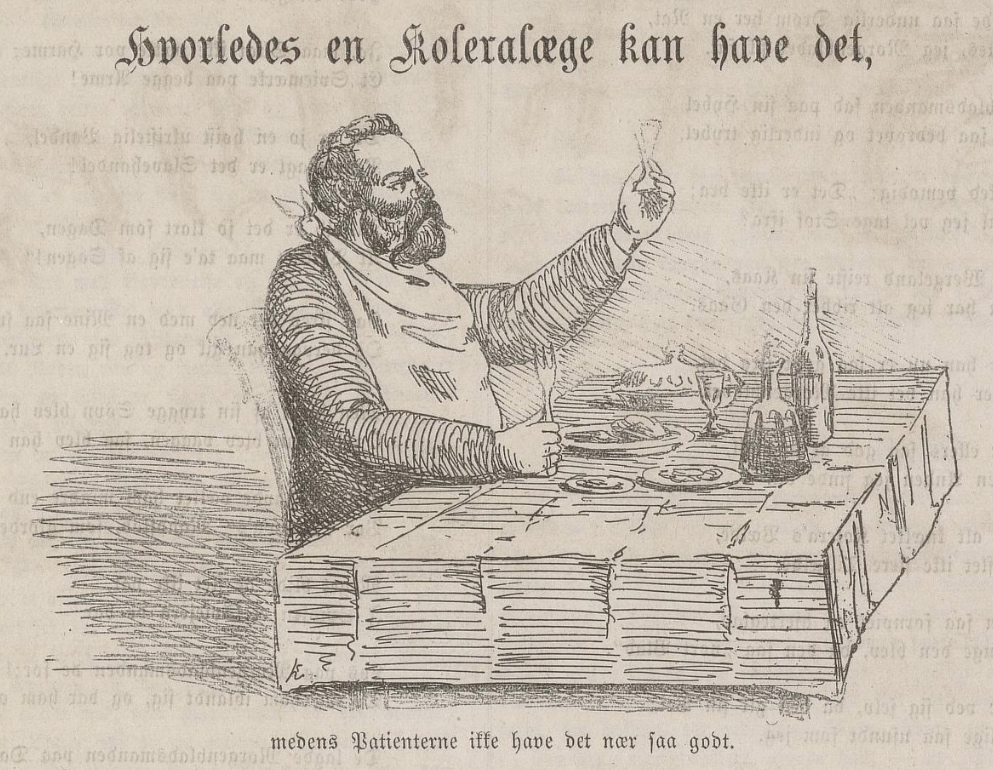
How is it that a cholera doctor can feel fine while patients aren’t.
(Vikingen, Oslo, 1866)
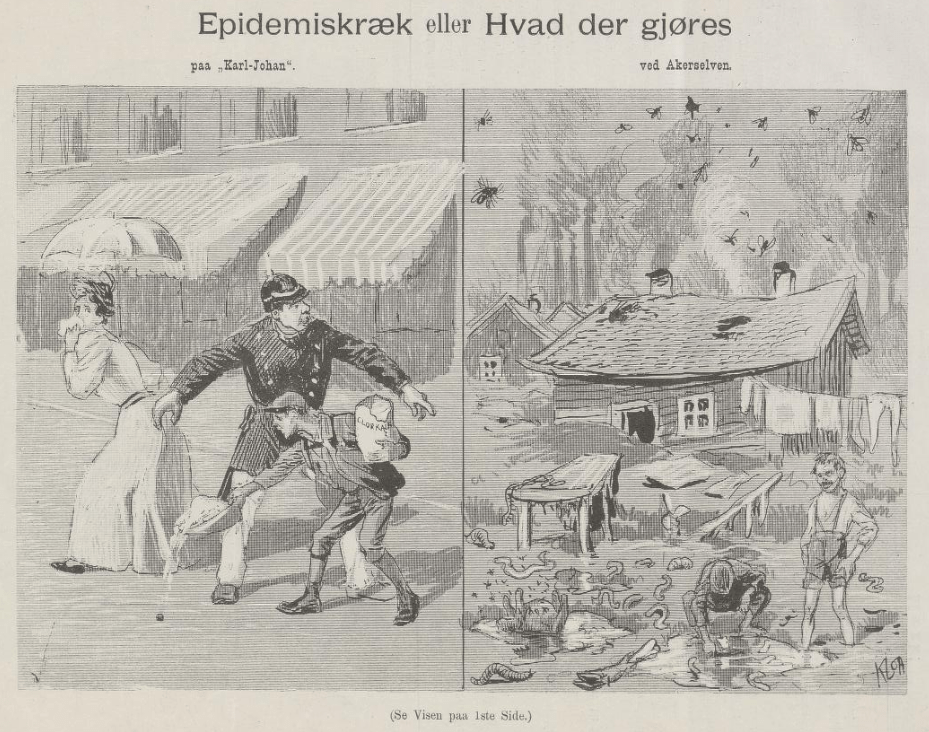
At the Karl-Johan Gate (in central Oslo) (man spreading slaked lime)
On the banks of the Akerselven River (running through Oslo)
(Vikingen, Oslo, 1892)
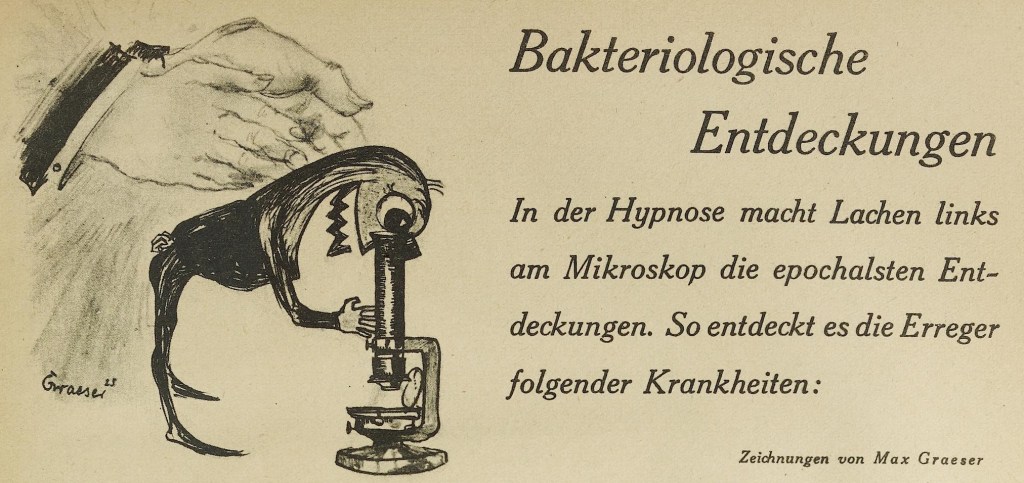
In hypnosis Lachen links [~ “laughing on the left”] is making the most epochal discoveries. Thus the pathogens of the following illnesses are discovered:
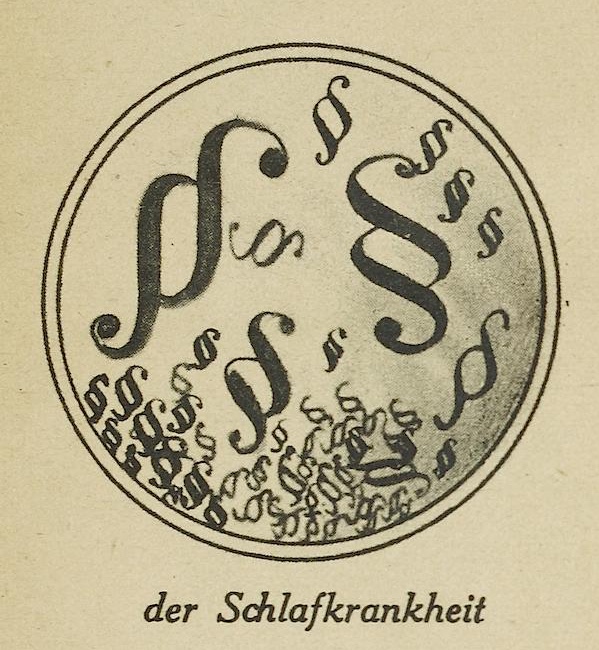
Nine panels follow, of which I include three here. Sleeping sickness:
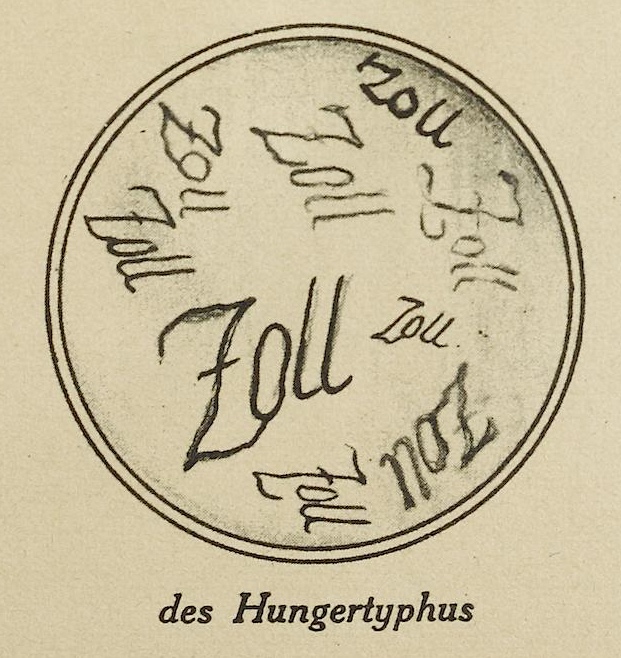
Hunger typhus [“tariff” vibrios]:
Judicial cholera:
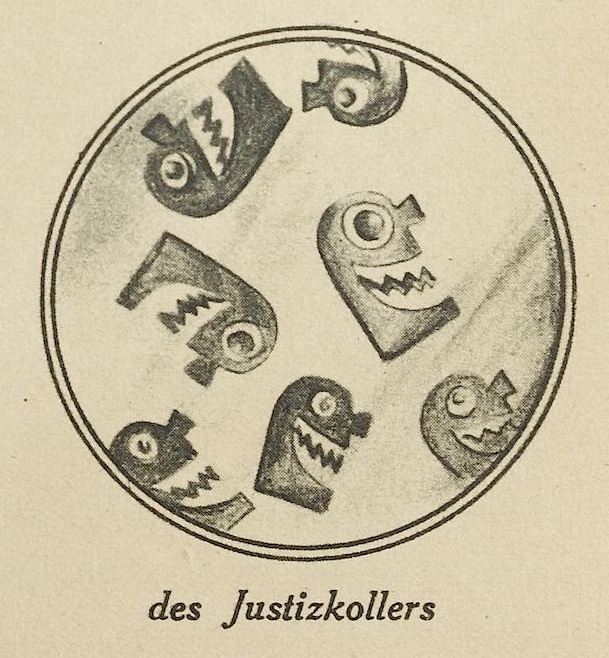
(Lachen links, Berlin, 1926)
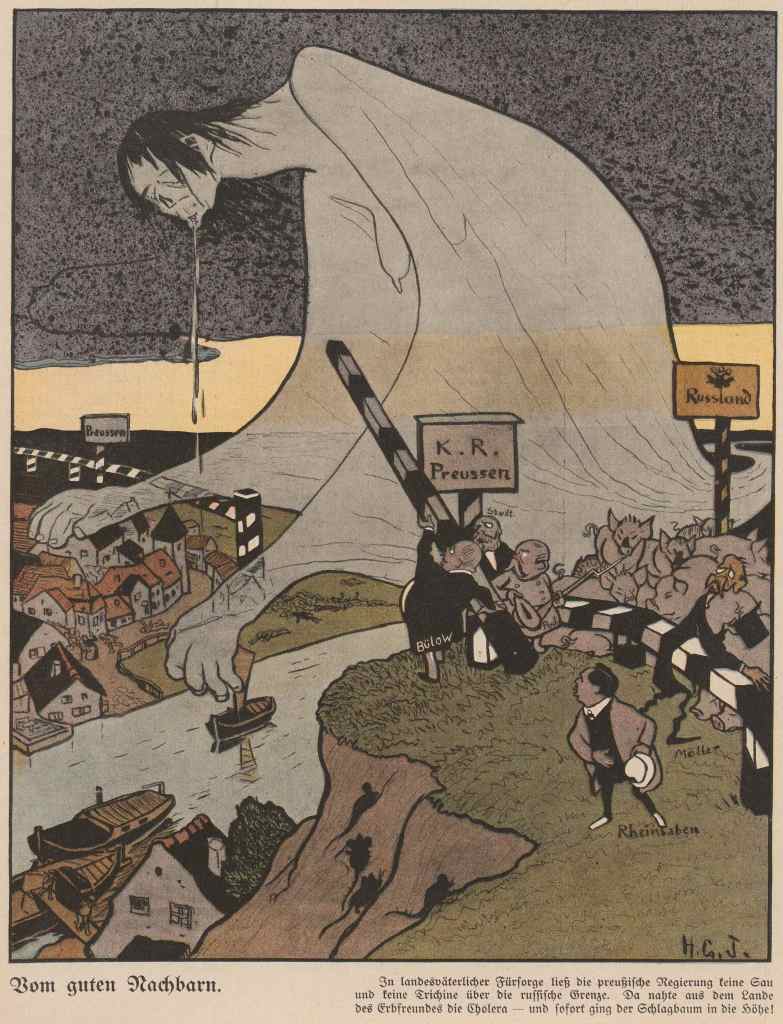
Out of paternal concern for the country, the Prussian government did not let swine and trichina across the Russian border. Then cholera was approaching from the land of the hereditary friend — and immediately the barrier was lifted!
(Der wahre Jacob, Stuttgart, 1905) (With thanks to Alexander Maxwell.)
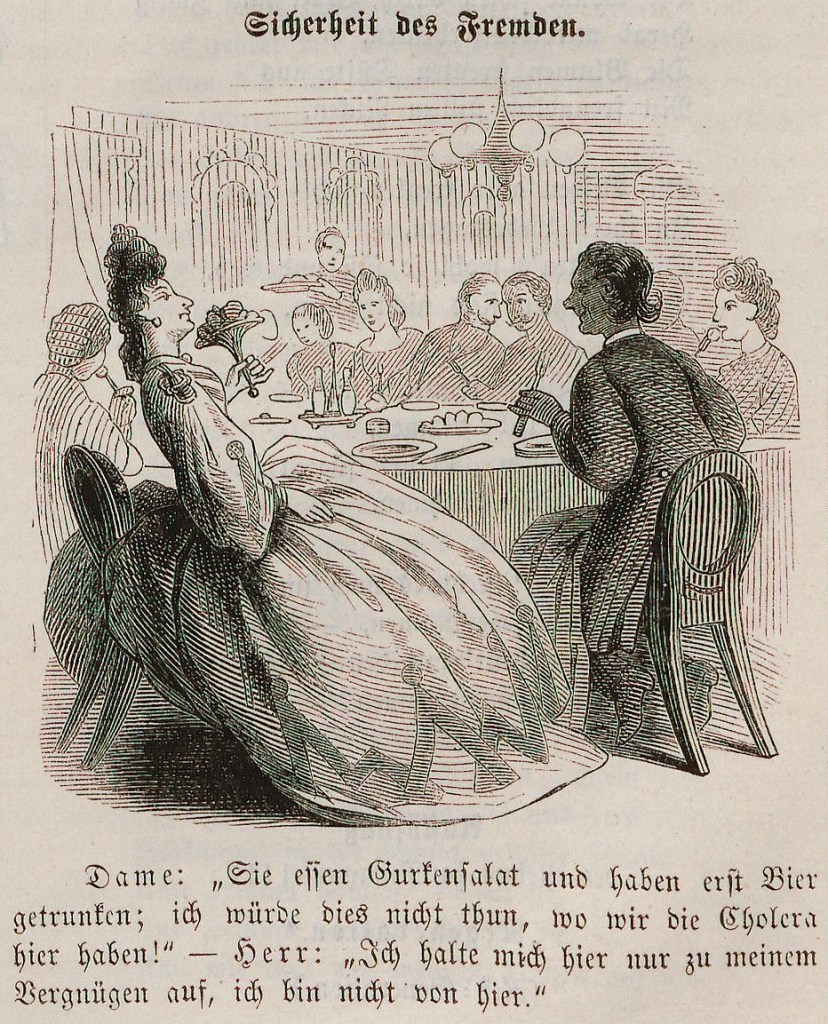
Lady: “You are eating cucumber salad and drank your beer first; I wouldn’t do that here where we have the cholera!”
Gentleman: “I am only staying here for my pleasure, I’m not from here.”
(Fliegende Blätter, Munich, 1866)
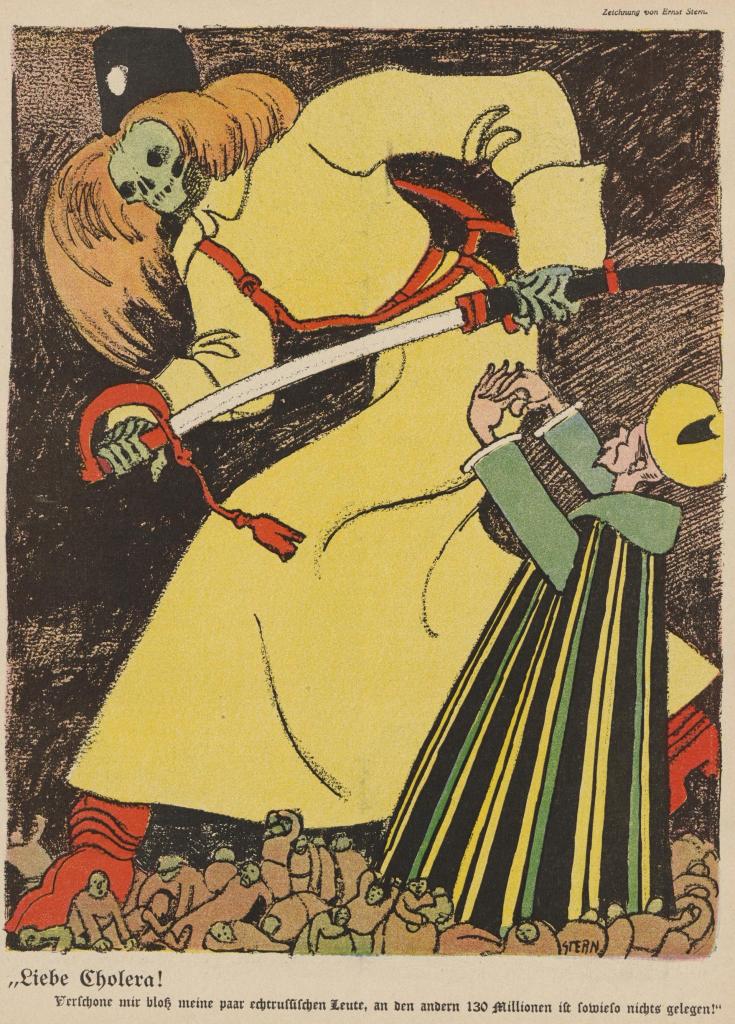
“Just spare my few really Russian people, the others are not important anyway!”
(By the fall of 1908 the last wave of cholera was widespread in the Russian Empire and to a lesser degree in the Ottoman Empire as well. Russia’s entanglements along its southern borders, including a Russian colonel leading a Persian Cossack siege of the Majlis in Teheran in June, but especially the declaration of independence of its client state Bulgaria in October, were cause for concern amid the turmoil of Ottoman politics–when this cartoon appeared, the Young Turks, many from military backgrounds, had upended the Ottoman court. That said, I’m insufficiently informed about the iconography at work here.)
(Lustige Blätter, Berlin, 1908)
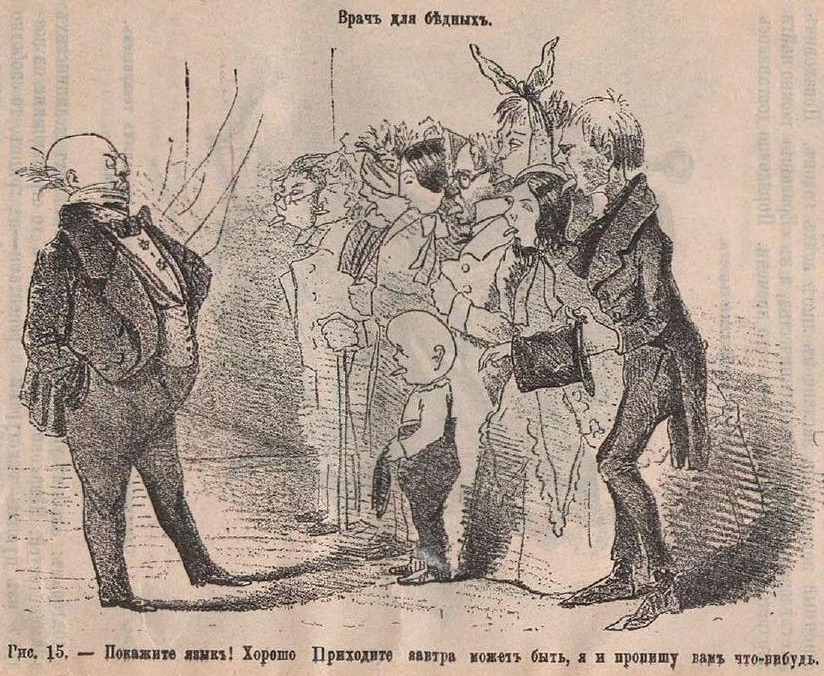
“Stick out your tongue! Fine. Come tomorrow, perhaps I’ll prescribe something for you.”
(Both influenza and cholera were present in St. Petersburg when this was published in one of Russia’s first illustrated satirical journals.)
Mikhail Nevakhovich in Yeralash, c. 1848.
(Reprinted in Aleksandr Shvyrov’s Illustrated History of Caricature, 1903)
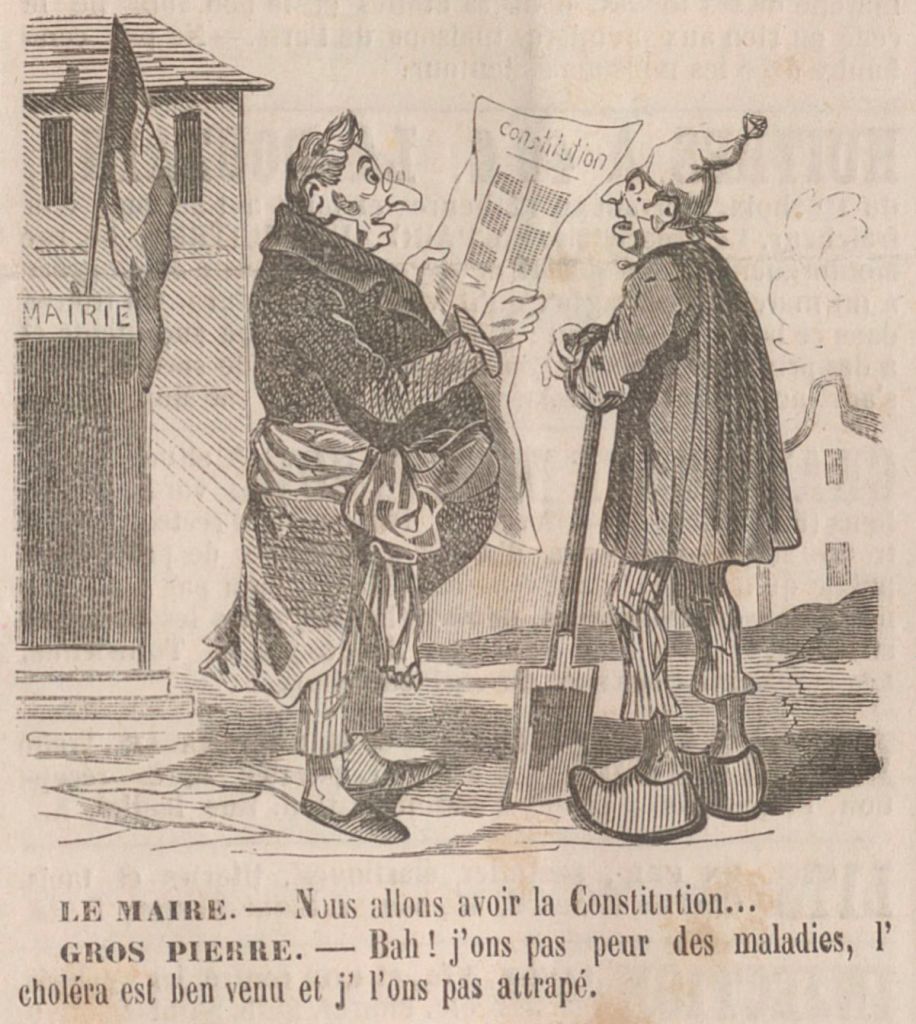
(Following months of revolutionary activities throughout France and Europe, the National Assembly adopted a constitution in November 1848. Scarcely three years later, Napoleon Bonaparte’s coup d’état was soon followed by another constitution establishing the Second Empire.)
The Mayor: “We will have the Constitution…”
Big Pierre: “Bah! I’m not afraid of such maladies, cholera has come along and I haven’t caught it.”
(Le Charivari, Paris, 1848)
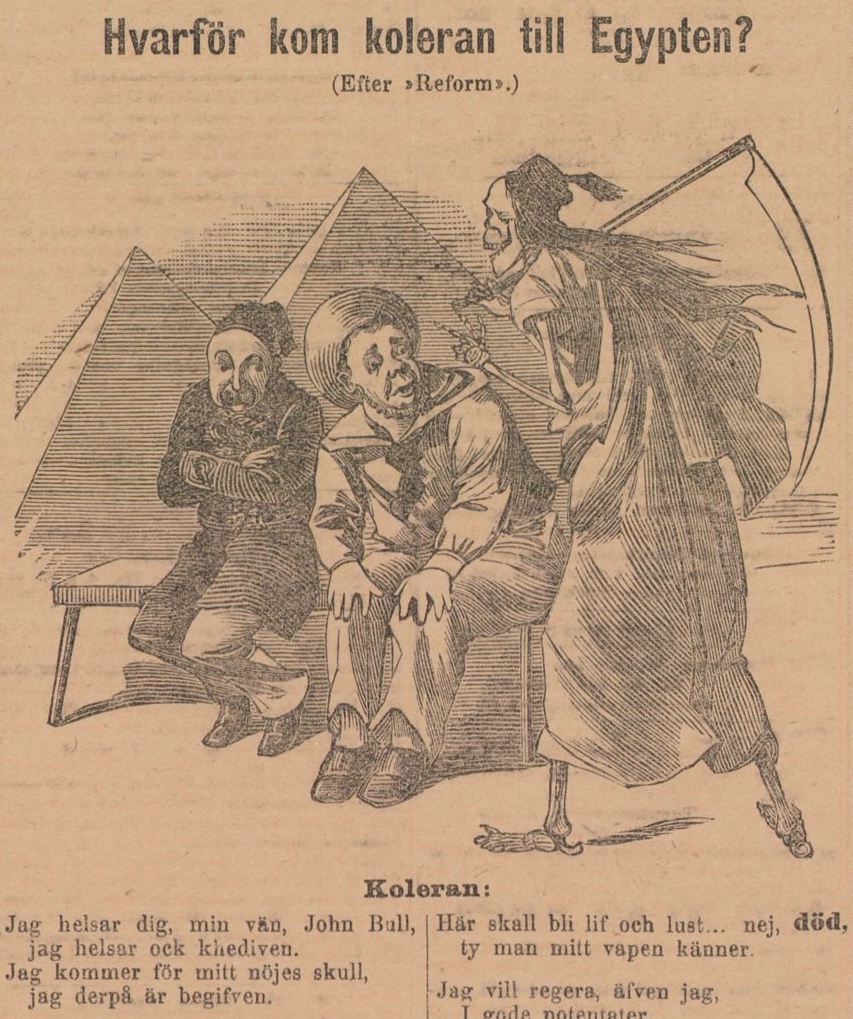
Cholera: I greet you, my friend, John Bull, and I greet the khedive.
I come for my pleasure, I am then besotted.
I think you’re sitting here and still just bored.
Today I have therefore come so we may be together.
None of you invited me here, I invite myself, friends.
There will be life and desire here… no, death, for you know my weapon.
I want to rule, even I, in good potentates.
When I strike, I strike powerful blows, then proud states tremble.
I have an irresistible power, and here, so bright and sunny,
we must now dance to the beat and have so much fun.
(Fäderneslandet, Stockholm, 1883)
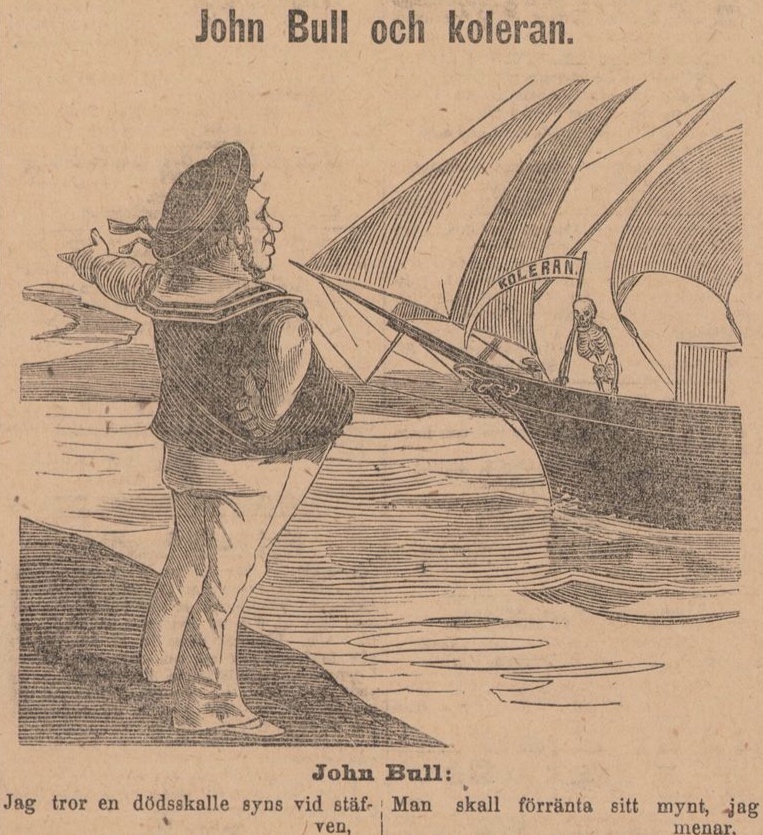
I think a skull is visible at the bow,
a passenger with respect.
But the ship has expensive cargo, too,
and that aroused my desire to shop.
Cholera will never bother me,
whenever it comes to a good deal,
and therefore the ship may pass freely,
even if it carries the infection inside.
You should earn interest on your coin, I mean,
but not salted away in quarantine.
Yes, so long as I earn money,
I’ll steer it to the hometown of cholera.
I do not regret my illness,
no, in my slaked lime I feel so good.
Here we have healthy and sound stomachs,
and gold is everything for a shopkeeper’s soul.
(Fäderneslandet, Stockholm, 1883)
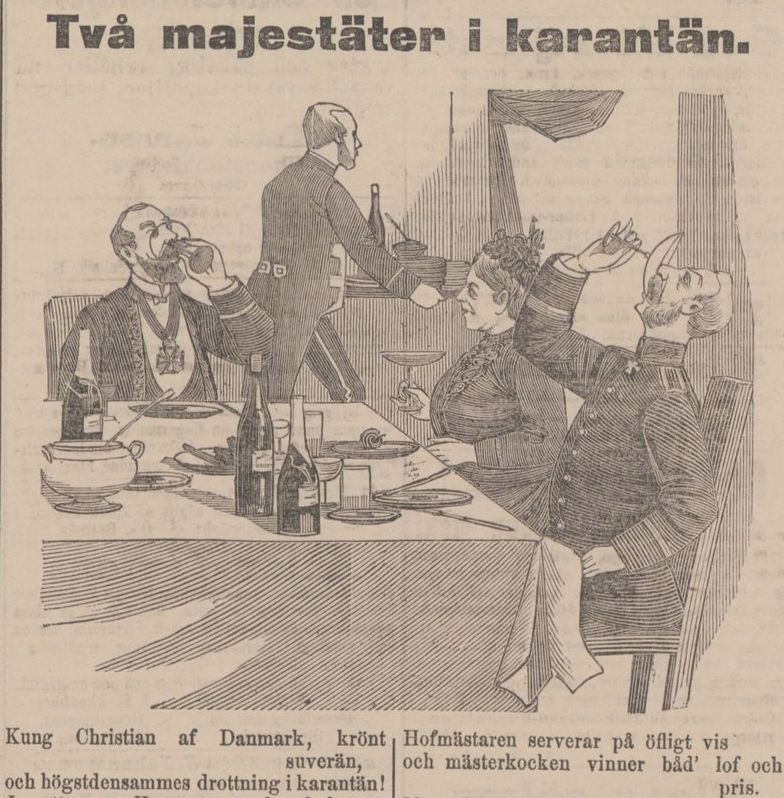
King Christian of Denmark, crowned sovereign,
and equally exalted queen in quarantine!
Yea, that the “Lord’s anointed” be placed there,
is not a breach of majesty the same?
It is believed that the purple itself, which the couple wears,
is now loaded with cholera bacteria,
and shall it be sulphurized, smoked,
shall the king and his consort be soaked with carbolic acid?!
Oh, their majesties feel pretty good,
though it’s not as fun as in a castle.
Delicious dishes and sparkling wine are common here,
but not a single sign of cholera.
The court master serves in the usual way
and the master chef wins both praise and award.
But of Mr. Koch’s bacteria, at the king’s throne,
not even a portion is served here.
There sits the adjutant with champagne glasses,
which must always be in good company.
And now you sound most gracious. Good year, yes, cheers!
You eat and you drink everything you can tolerate.
You can probably be quarantined,
then so you can enjoy there, oh sovereign!
With glass in hand, a roast fowl on fork,
it is, on the whole, like a game.
(Fäderneslandet, Stockholm, 1892) (with apologies for the sloppy translation)
 Sic Transit Pestilentia