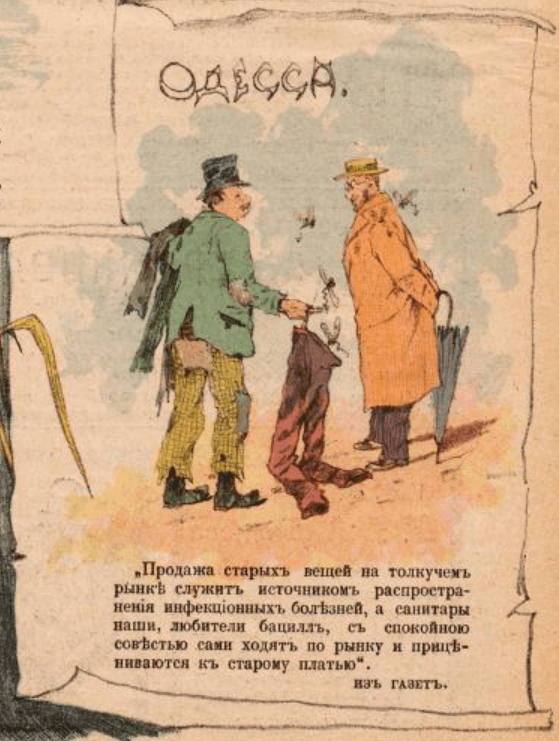
From the newspapers: “The sale of old items at the flea market is a source of the spread of infectious diseases, yet our public health workers, these lovers of bacilli, themselves frequent the market with clean conscience and ask about the price of old clothes.” (Razvlechenie, Moscow, 1897)
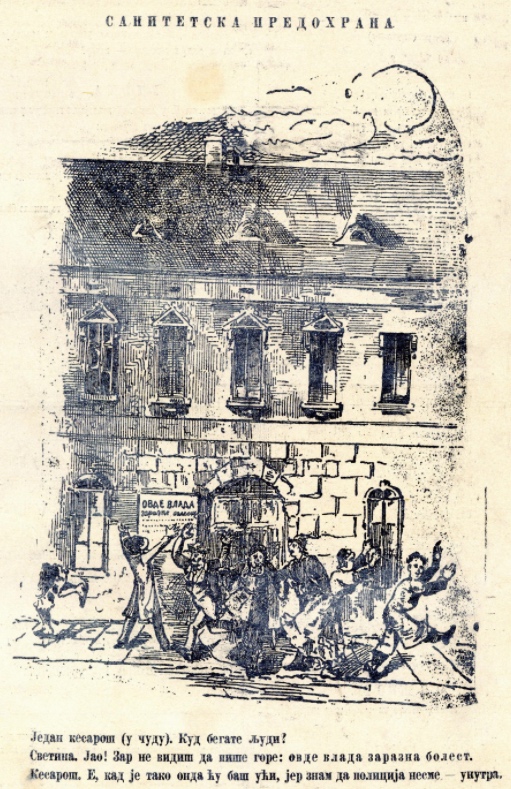
A pickpocket (in wonder): “Where are people running?” Crowd: “Alas! Can’t you see it says above: a contagious disease reigns here.” Pickpocket: “Well, if that’s the case, then I’ll just go in, because I know the police can’t go inside.” (Telefon, Belgrade, 1883)
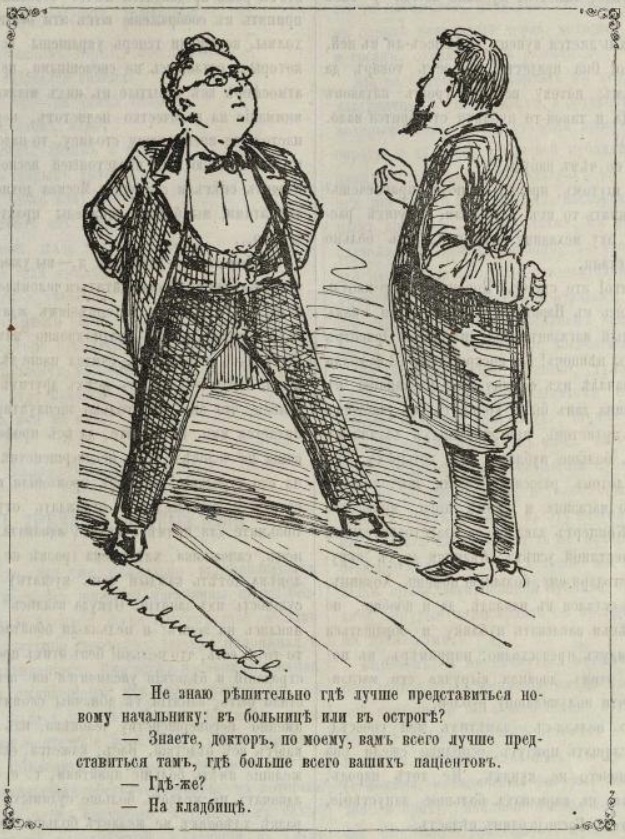
“I’m not entirely sure where it would be best to introduce myself to the new boss: at the hospital or at the prison?” “You know, doctor, I think it would be best to introduce yourself where most of your patients are.” “Where do you mean?” “At the cemetary.” (Razvlechenie, Moscow, 1883)
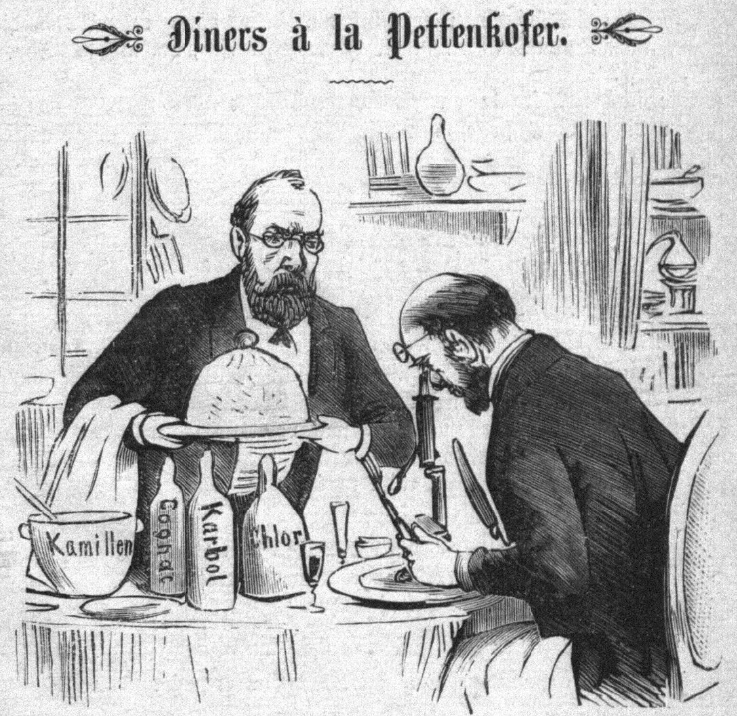
“Juicy, well-fed bacteria freshly served at all times.” (Resoundingly disastrous success guaranteed.) The Koch Bacteria Pub (Max Pettenkofer was a famous Bavarian hygienist whose environmental explanations of disease were then in the process of being eclipsed by the new germ theory, of which Robert Koch was perhaps the most famous German proponent. This cartoon appeared just as the fifth cholera pandemic was cresting in Europe.) (The caption is cropped from this image; see link for original text.) (Berliner Wespen, Berlin, 1884)
“It’s pointless not to believe in medicine, madam…” “To believe in a science which is powerless to invent the kind of illness whose treatment requires a trip to Yalta [on the Crimean peninsula]?! And this is science? Phooey!” (Razvlechenie, Moscow, 1895)
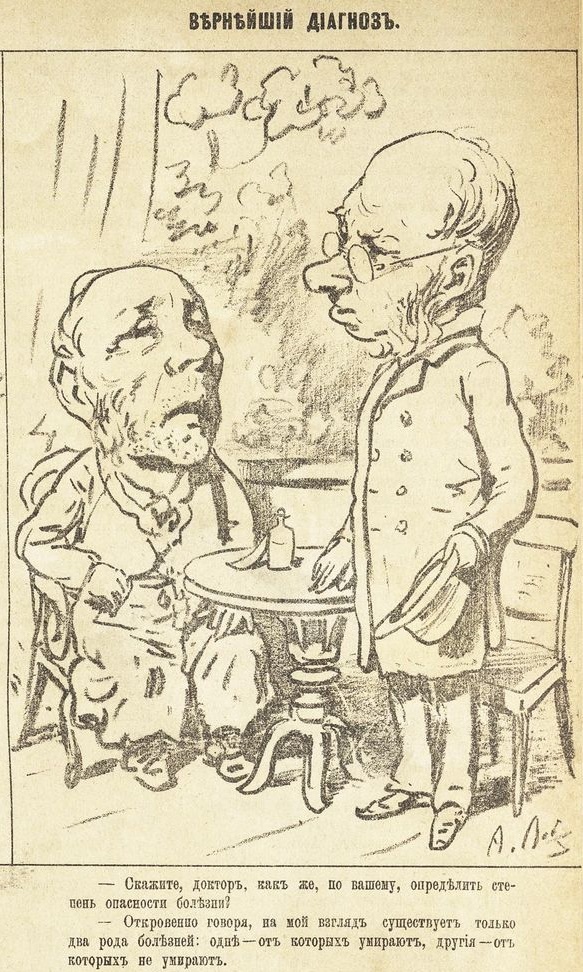
“Tell me, doctor, how do you determine the lethality of a disease?” “To be honest, in my view only two kinds of disease exist: the ones people die from, and the ones they don’t.” (Shut, St. Petersburg, 1887)
From Champfleury’s Histoire de la caricature sous la République, l’Empire et la Restauration (Paris, 1877). Any revolution unfortunately generates excess, any excess is paid for by steps backward. It has been so since the beginning of humanity and it will always be the same, the Progress or Decadence of nations being exercised only imperceptibly and via slow permeations. That a people erect a pyramid at the top of which it engraves the main facts of its history, that a crevasse opens revealing the abyss at the bottom of which a nation is condemned to expiate its faults, long years will pass before the last stone of the commemorative monument is laid, before the collapse in which men and things must disappear.
Many volumes have been written on this theme and had the title page adorned with solemn gentlemen thinkers gaunt as wineskins. The author [Champfleury], predisposed by his studies to fear mockery, considers it appropriate to leave aside the grandeur of the decline of empires as well as banal historical forecasts. His more modest role consists in seeking what futile repercussions sometimes lead to serious events. So one could, according to him, draw a picture of satirical ephemerides relating to important discoveries, to the benefits that humanity accepts only with a mocking smile.
In this order, the century opens with the discovery of vaccine. As soon as Jenner’s name is mentioned, the cartoon catches your eye. “Were the discovery of vaccine,” said Cuvier in a report to the Institut de France, “to be the only thing that medicine had obtained in the present period, it would suffice to forever illustrate our era in the history of science.” But just as there are mockingbirds which parody the song of the nightingale, so also people who practice mockery never lose their rights. They are useful, moreover, helping to popularize a discovery, although their pencil is not cut out for this purpose The discovery of vaccine was therefore set upon by cartoonists, without giving them a strong inspiration.
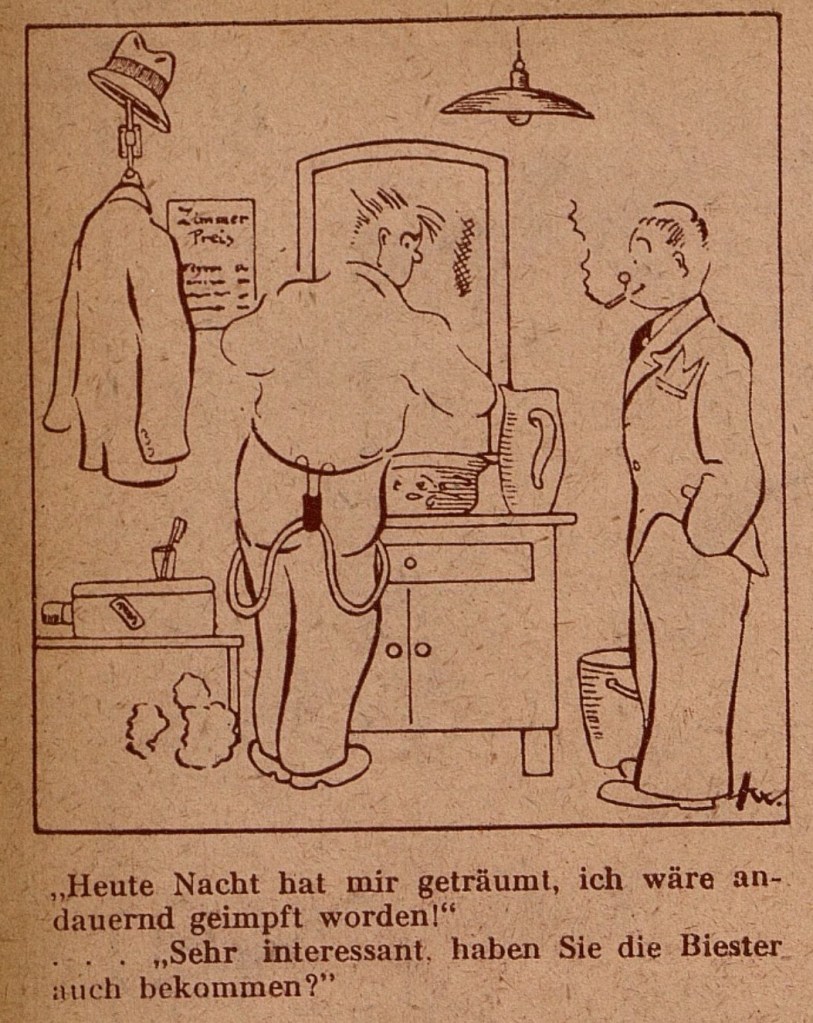
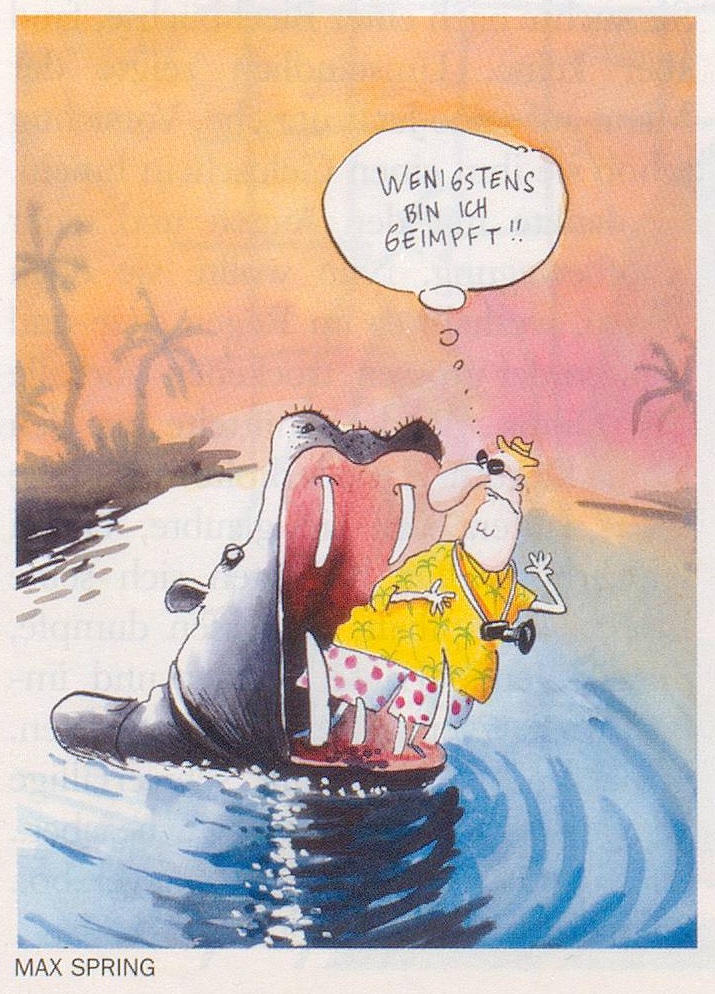
“Last night I dreamed that I was constantly being vaccinated!” “Very interesting, did you get the beasts too?” (Der Lichtblick, Vienna, 1946) (Idiom needs improvement)
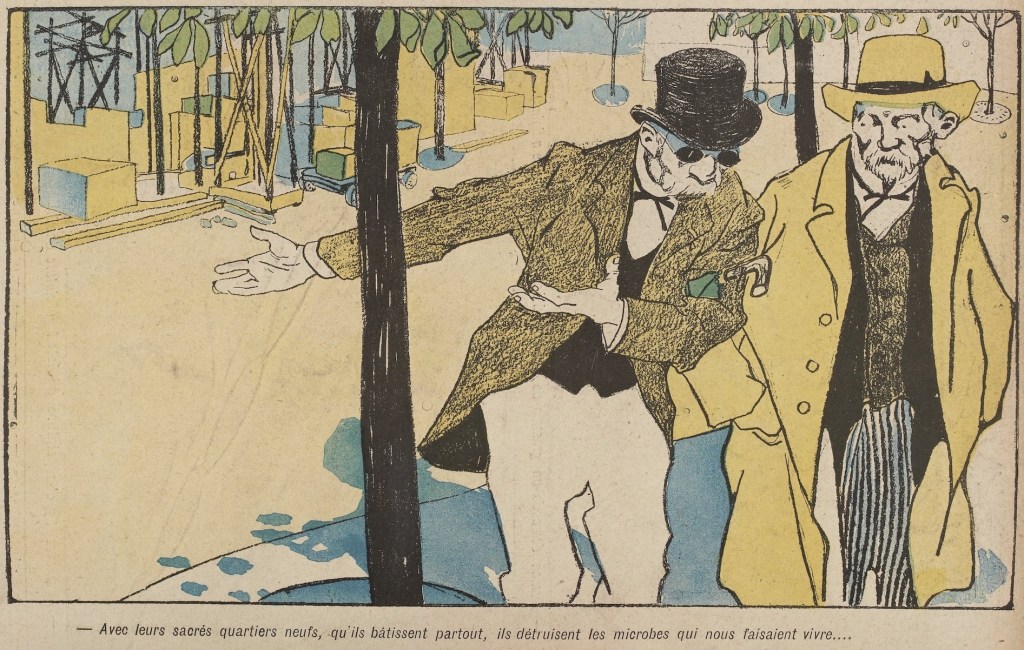
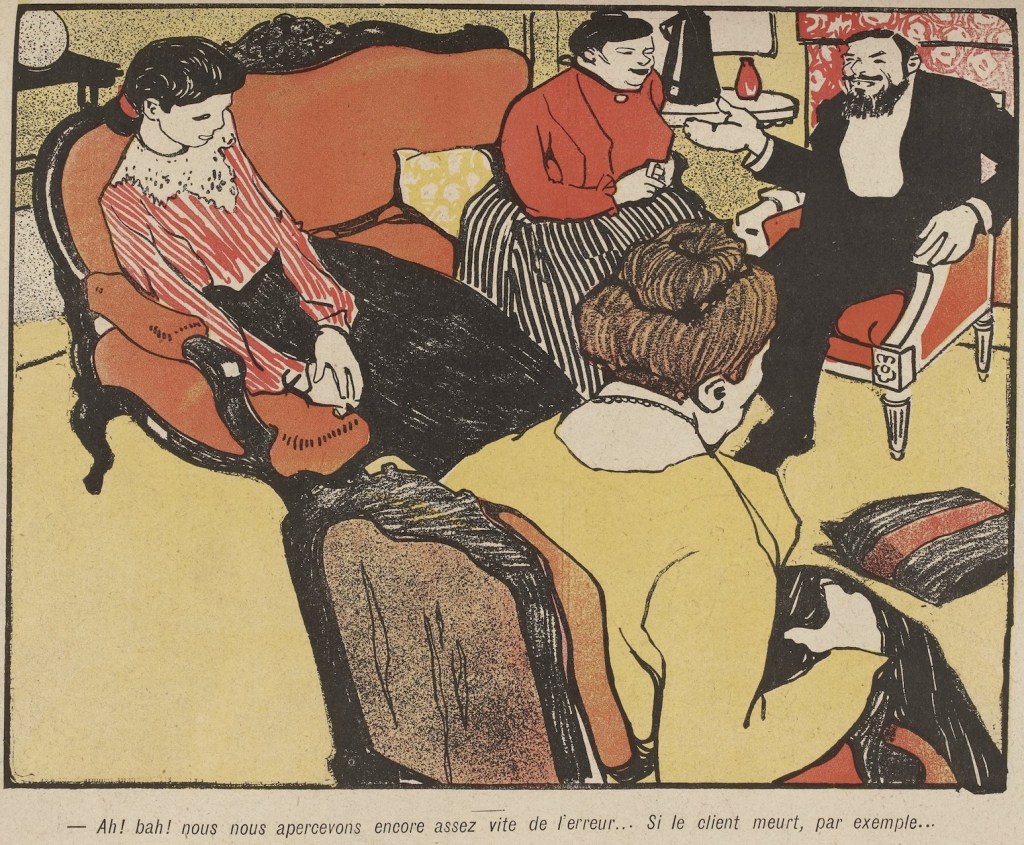
(Pharmacist) “With their bloody new neighborhoods that they’re building everywhere, they are destroying the microbes that make our living…” (L’Assiette au beurre, Paris, 1903)
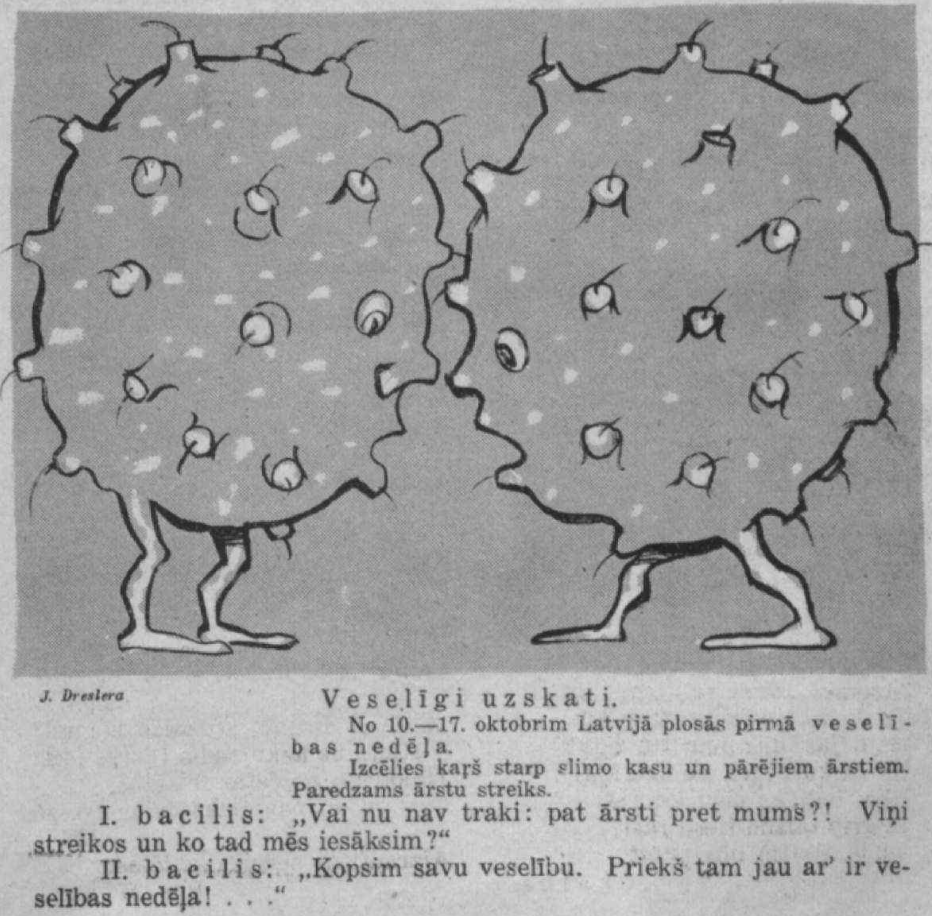
The first health week will take place in Latvia, October 10-17. A fight broke out between the sick fund [health service] and other doctors. A doctor’s strike is expected.
Bacillus 1: “Isn’t it crazy: even doctors are against us?! Strikes and what do we do then?” Bacillus 2: “Let’s take care of our health. For that we already have a health week!…” (Svari, Riga, 1926)
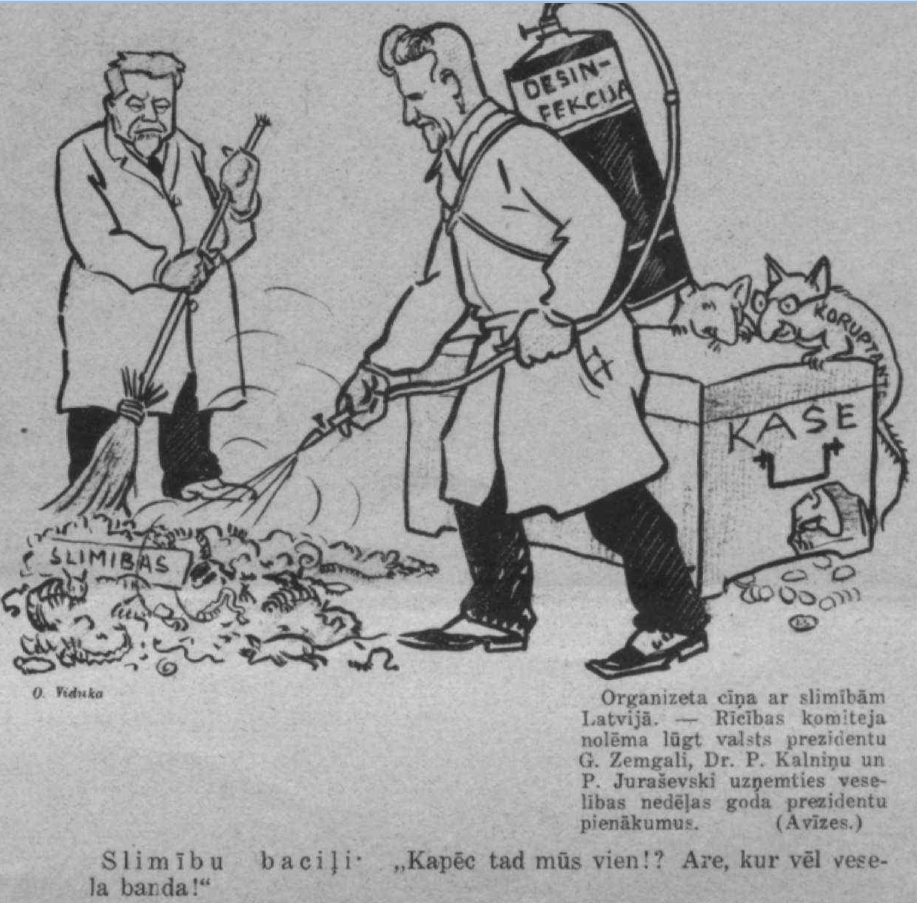
(Newspapers) Organized fight against diseases in Latvia. — The Executive Committee decided to ask President G. Zemgale, Dr. P. Kalniņš, and P. Juraševski to assume the duties of honorary presidents of Health Week.
Disease germs [on the floor being swept away and disinfected]: “Then why us alone! There’s still a whole gang over there!” [corruption at the treasury coffer]
(From newspapers.) People’s Welfare Minister Rudevics has raised the issue of disinfecting incoming items in order to protect officials.
Woman: “If you don’t mind: from the countryside with a petition?! First of all, present a certificate that you’ve had a bath; then a certificate that you have been vaccinated against smallpox, typhus, cholera, tuberculosis, or rhinitis, then a document that your family is not insane; then a covering letter disinfecting the petition; then …” Petitioner: “Then I better wait and bring a certificate that I am dead and buried!…” (Svari, Riga, 1927)



 Sic Transit Pestilentia