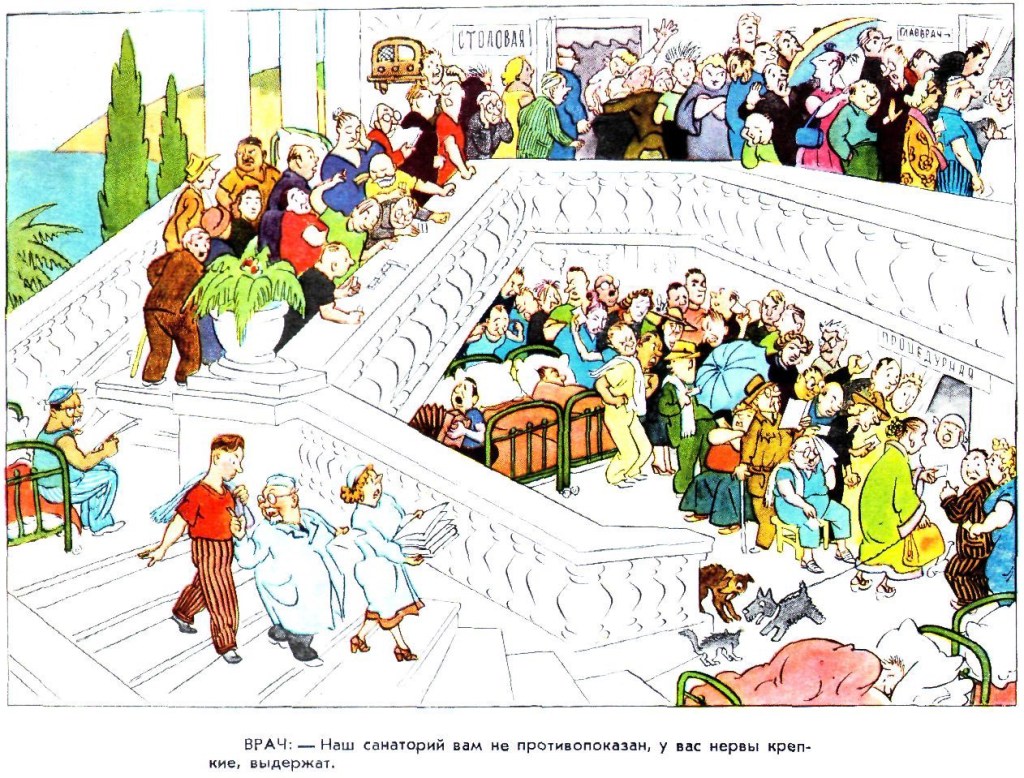
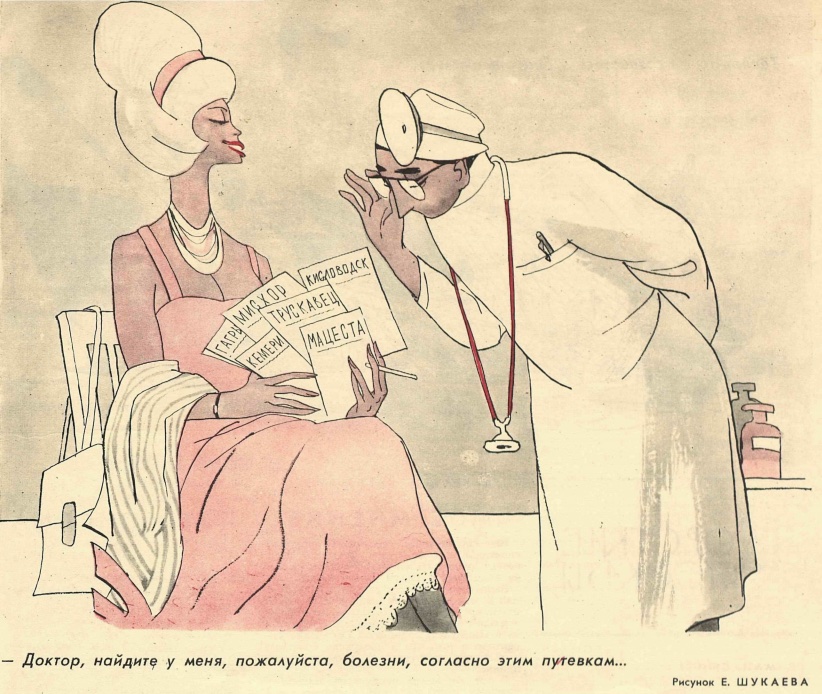
Doctor: “Our sanatorium is not counterindicated for you, you have strong nerves, they can handle it.” (Krokodil, Moscow, 1955) (Public health and disease themes largely disappear from Krokodil after the 1930s, when the Soviet health system finally developed sufficient capacity to serve a burgeoning urban middle class. Yet a Crimean sanatorium like the one depicted here was still a precious resource in high demand, and gentle satire of middle-class aspirations remained a Krokodil specialty.)
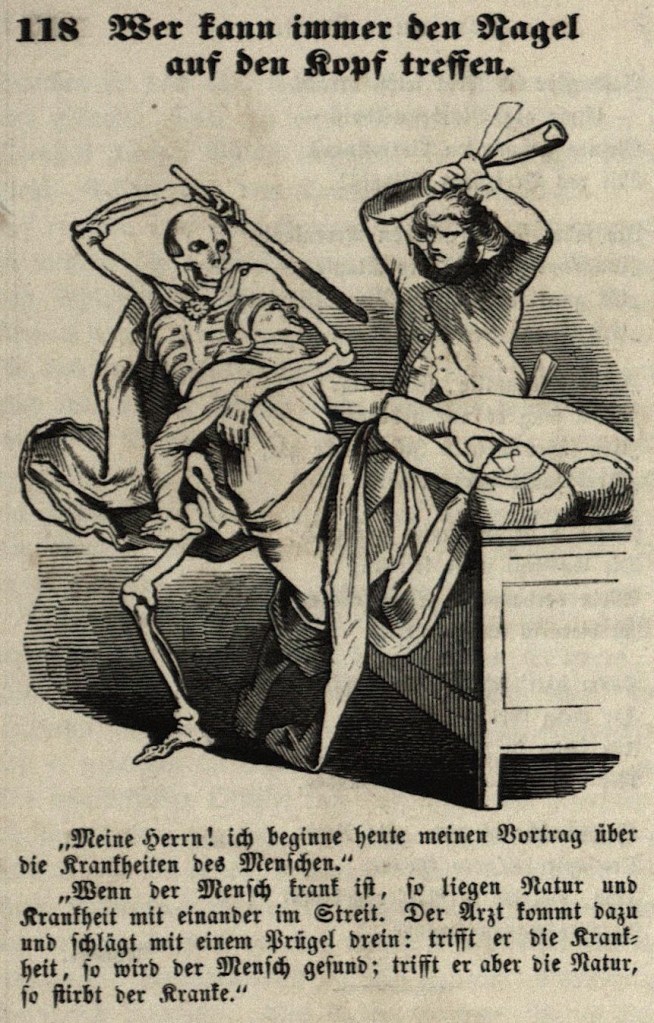
“Gentlemen! I begin today’s lecture on human illnesses.” “If a person is sick, then Nature and illness are at odds with each other. The physician comes in and hits it with a club: if he hits the illness, then the person becomes healthy; but if he hits Nature, then the sick person dies.” (Fliegende Blätter, Munich, 1847) (A British print in a similar vein.)
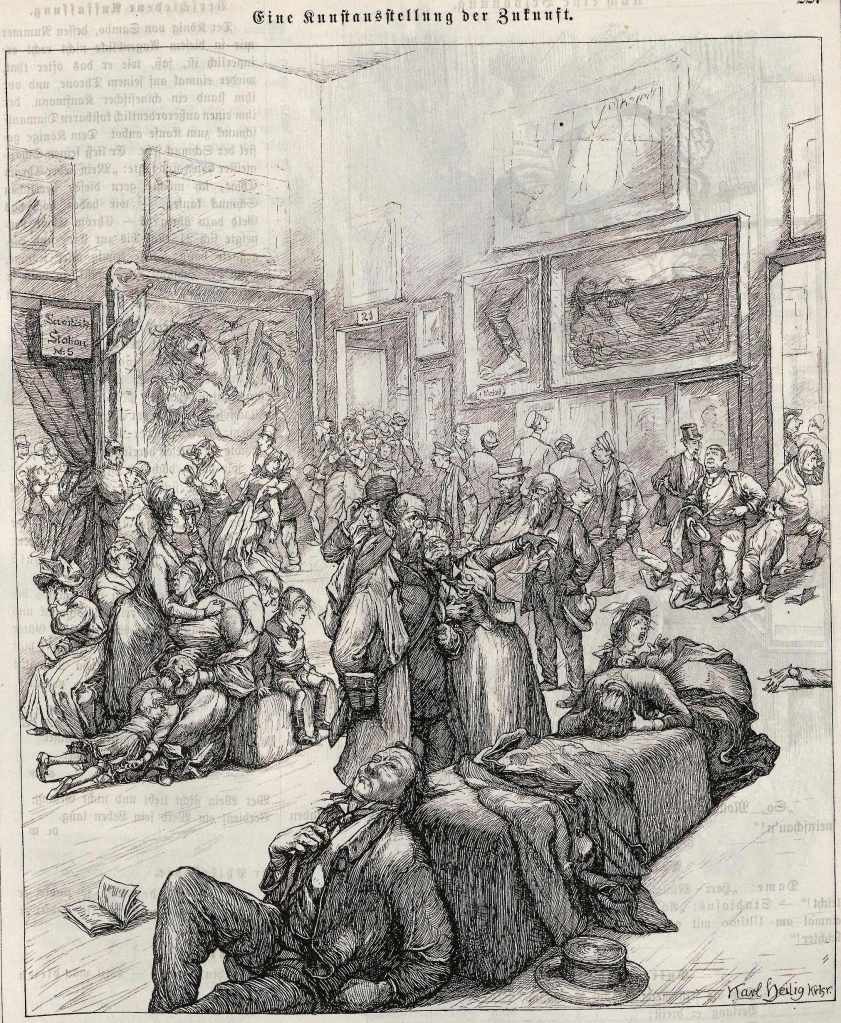
(With a flu epidemic underway late in 1889, this image signaled the duress not only in the grim artworks on the walls and the ailing visitors sprawled around the exhibition space. On the left one can see a sign for “Hygiene Station No. 5,” a deft reminder of our present dilemmas.) (Fliegende Blätter, Munich, 1889)
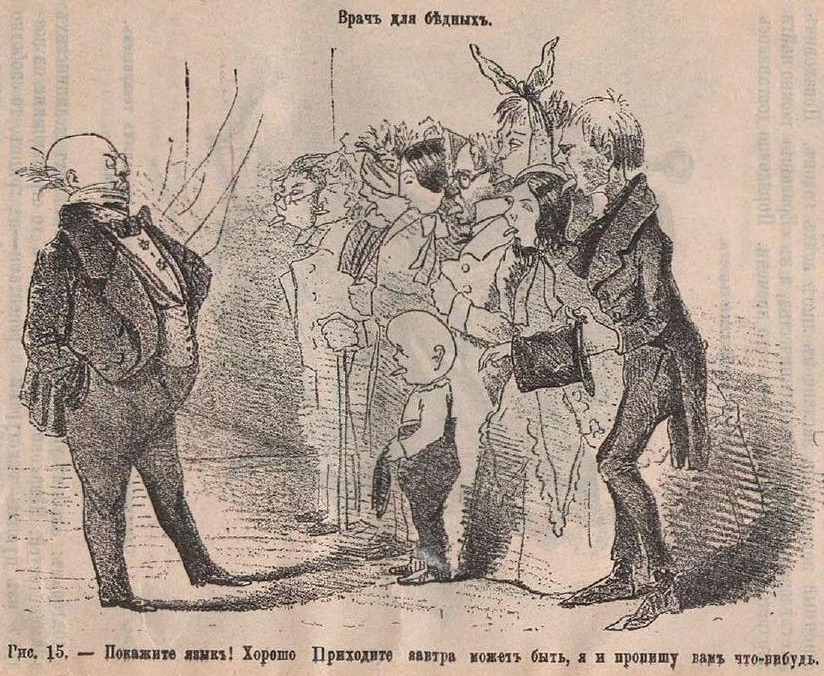
“Stick out your tongue! Fine. Come tomorrow, perhaps I’ll prescribe something for you.” (Both influenza and cholera were present in St. Petersburg when this was published in one of Russia’s first illustrated satirical journals.) Mikhail Nevakhovich in Yeralash, c. 1848. (Reprinted in Aleksandr Shvyrov’s Illustrated History of Caricature, 1903)
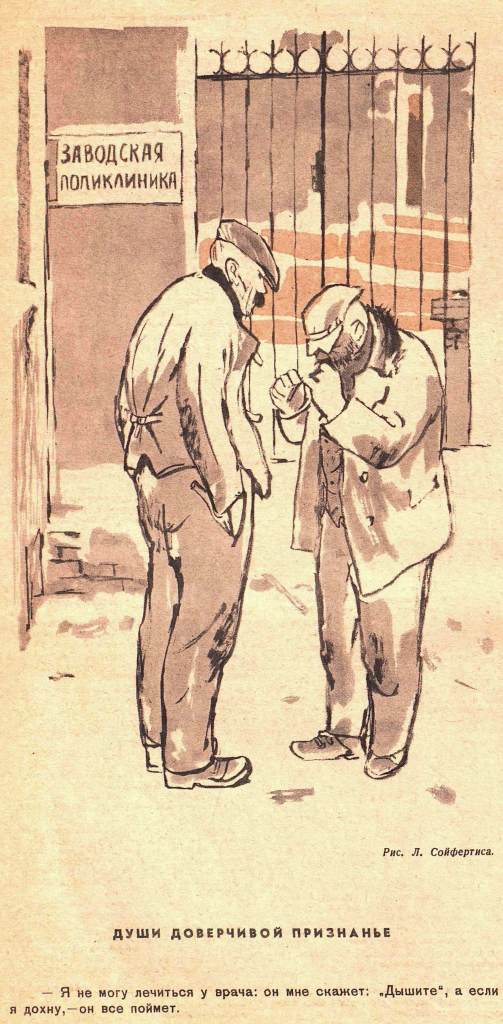
At the factory clinic. “I can’t get treatment from the doctor; he’ll tell me, “Take a deep breath,” and if I exhale, he’ll catch it all.” (Krokodil, Moscow, 1939)
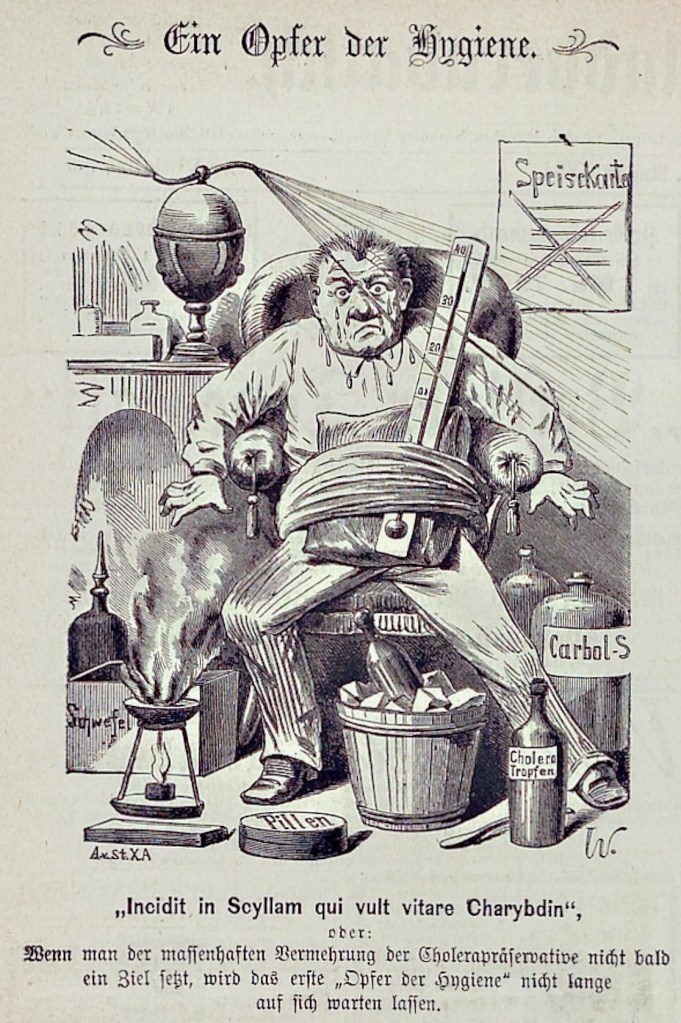
(in Latin) He wants to avoid falling into Scylla or Charybdis, or: Unless a guideline is set soon for the massive increase in cholera-prevention remedies, the first victim of hygiene will not be long in coming. (Kladderadatsch, Berlin, 1884)
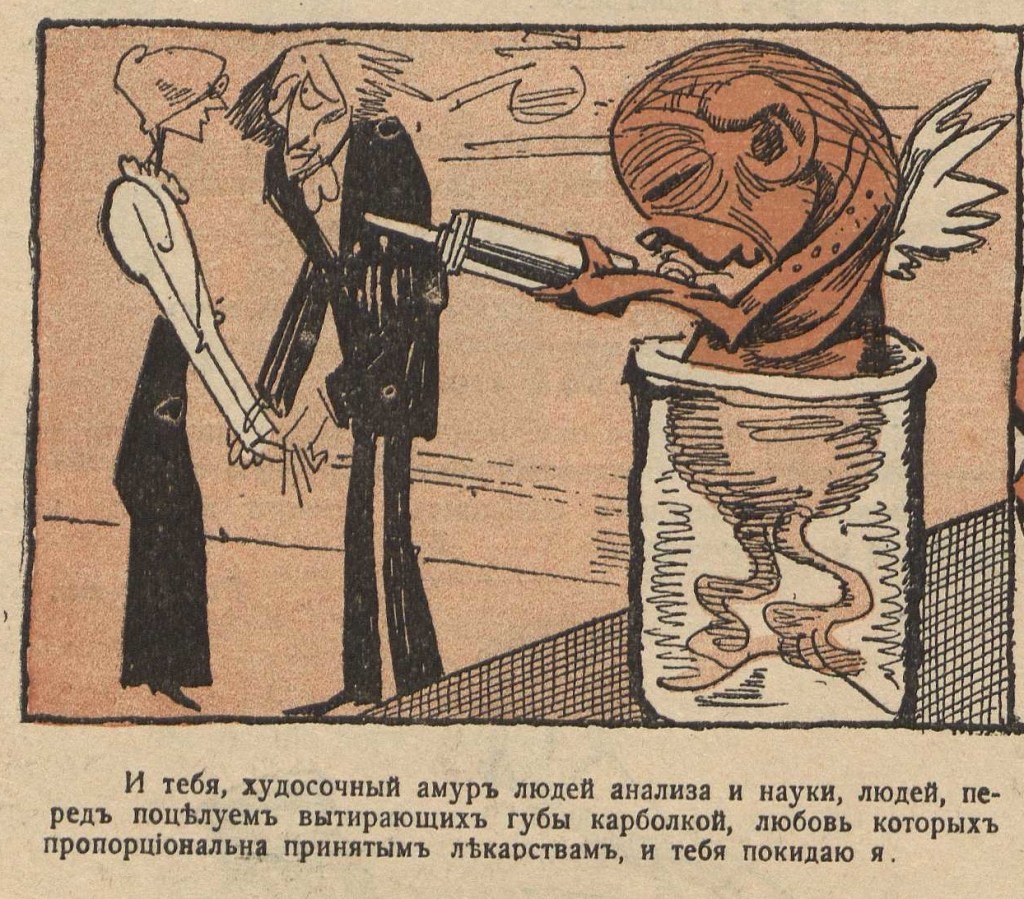
This delightfully bizarre cartoon is one panel of six celebrating the arrival of spring and the renewed efforts of Cupid. Unfortunately, Cupid has various rivals and false pretenders with agendas of their own during the long winter. In this case, our favorite clystère theme is featured. Unfortunately, the anxieties mocked in this image are very much present for us today.
“And you, the disease-wasted cupid of people of analysis and science, people who, before a kiss, wipe their lips with carbolic acid, whose love is proportional to the drugs taken, I take leave of you as well.” (Novyi Satirikon, Petrograd, 1915)
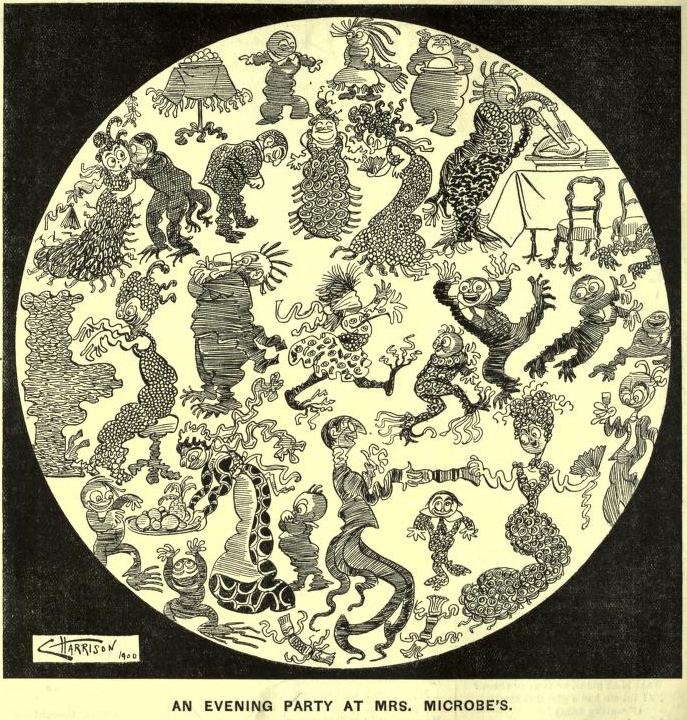
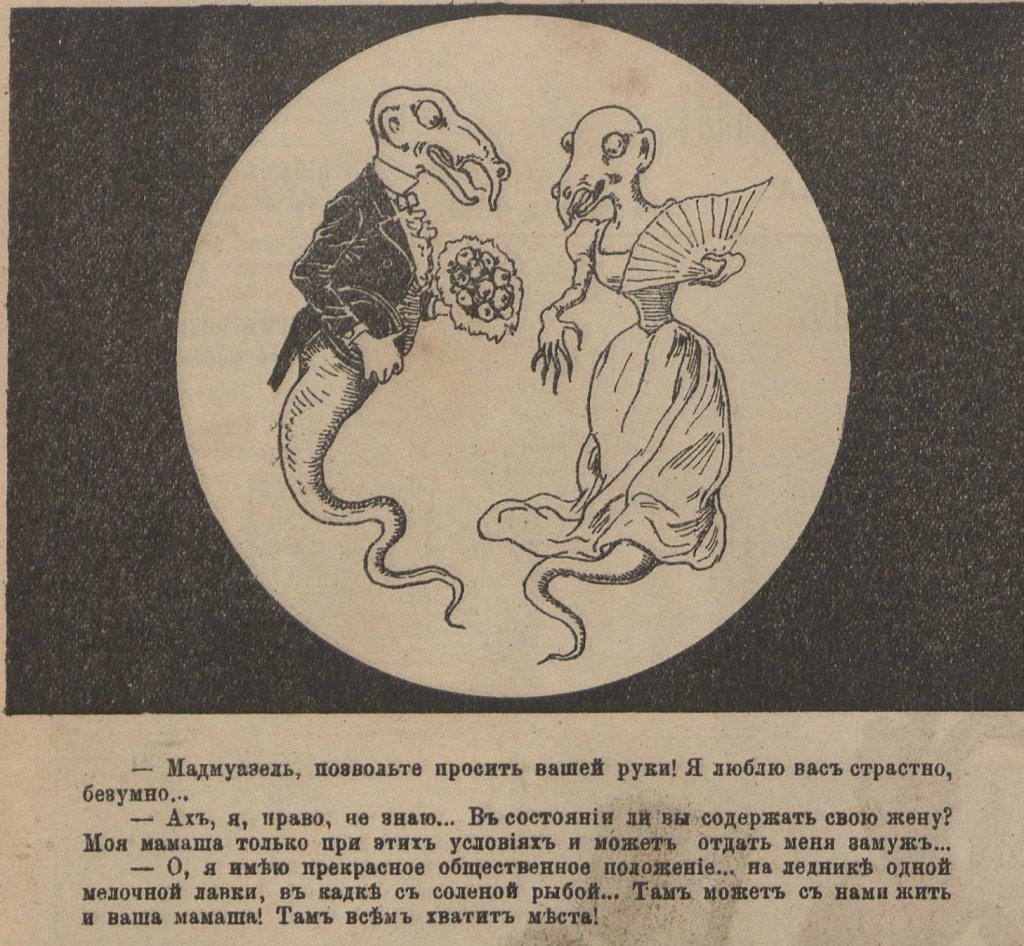
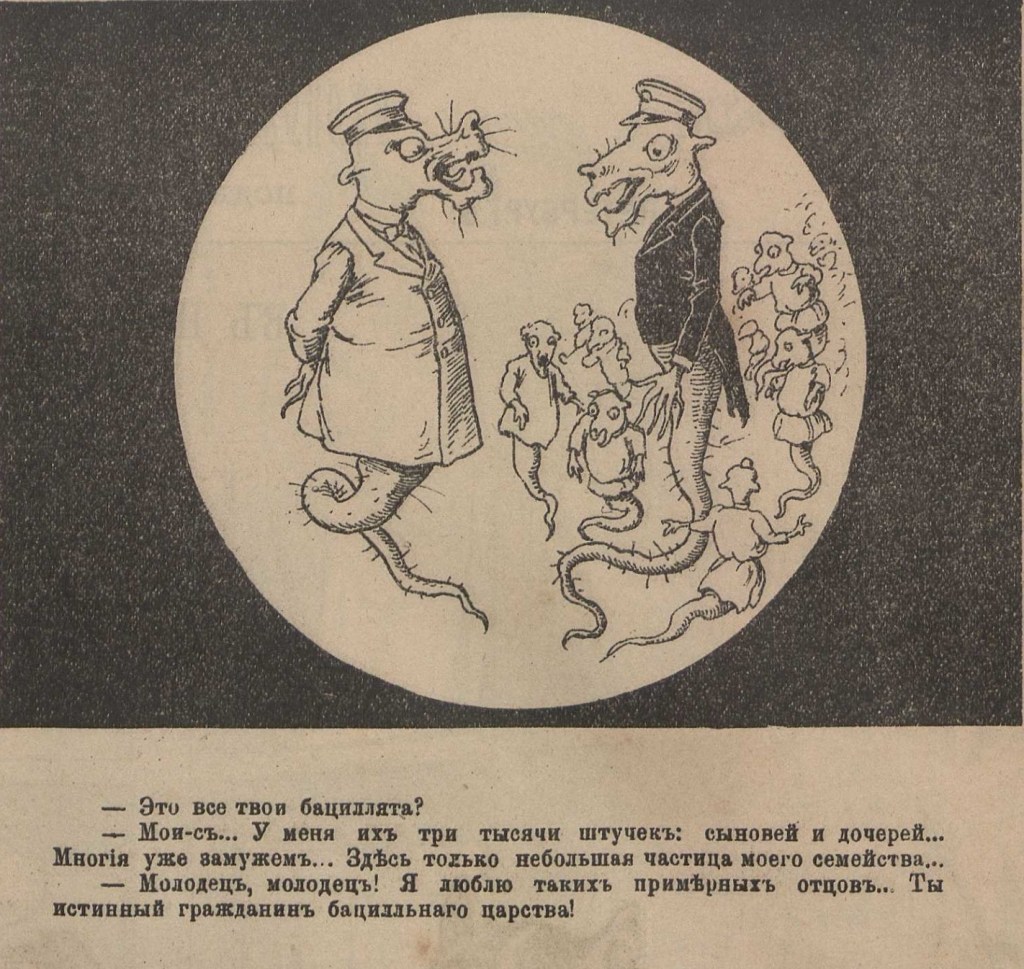
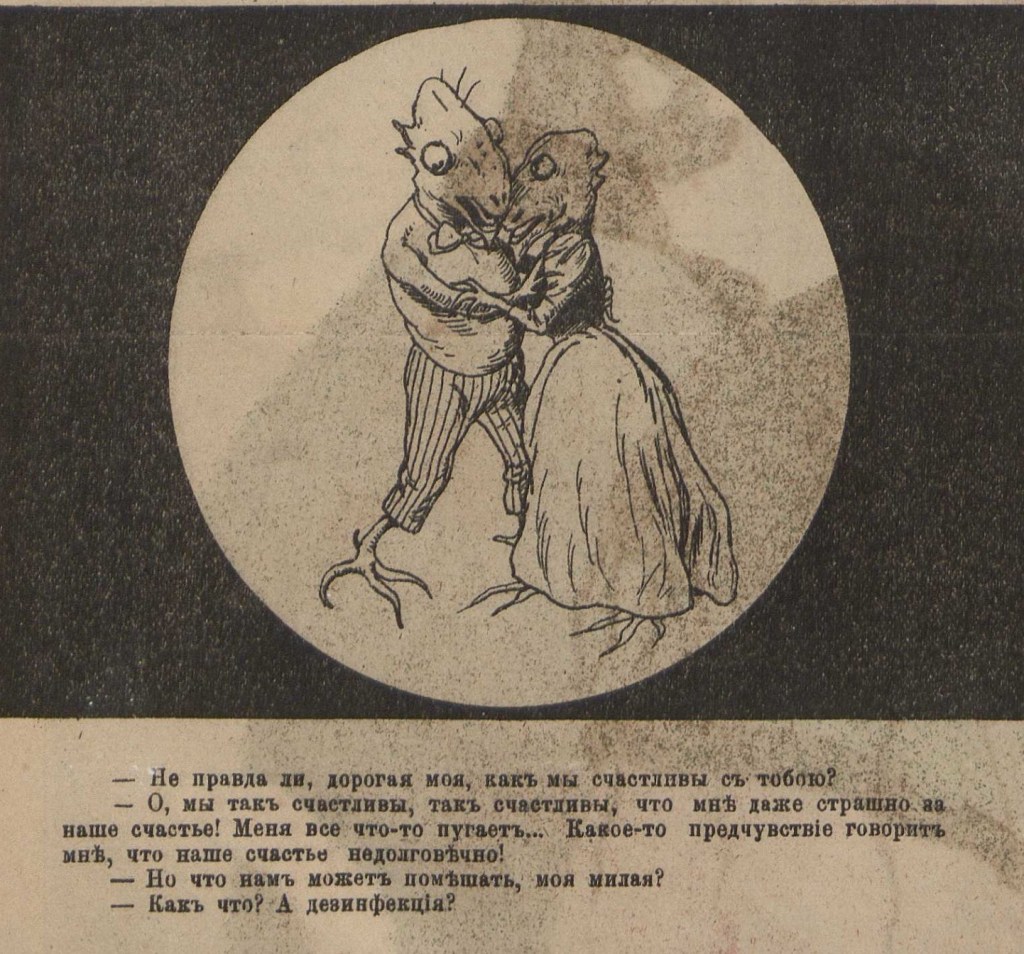
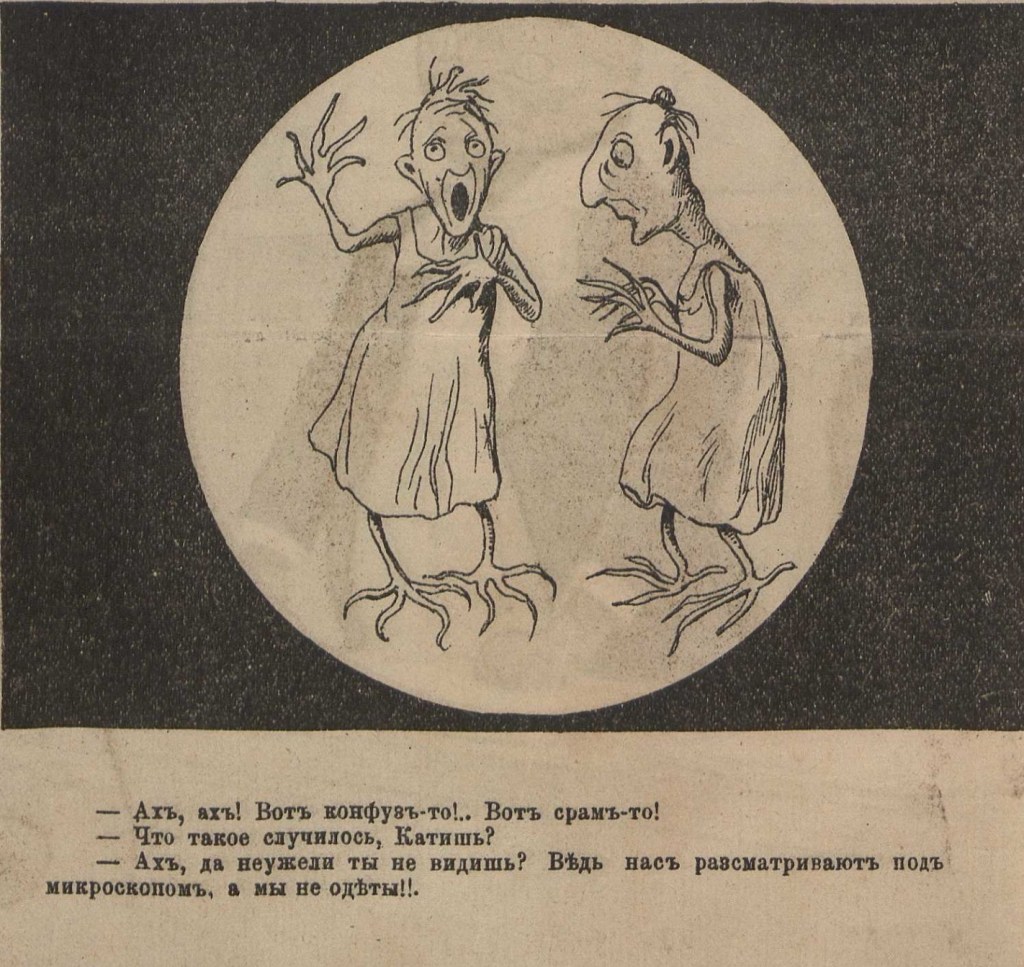
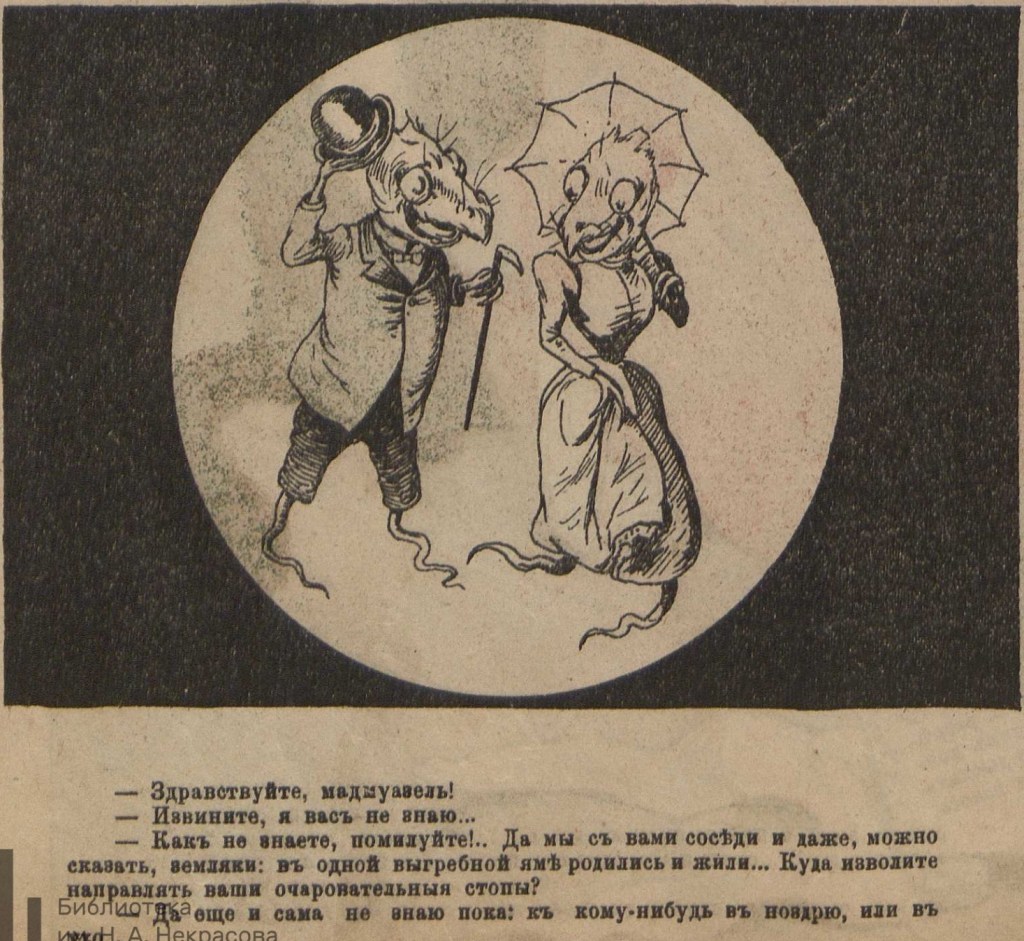
“Photographed under a microscope.” (Oskolki, St. Petersburg, 1898)
“Mademoiselle, may I take your hand in marriage! I love you passionately, madly…” “Oh my, I’m not sure… Are you in a position to keep your wife? My mommy can only let me get married under these conditions…” “Oh, I have a terrific social position… in the cooler of a small shop, in a vat with salted fish… We can live there with your mom as well! There’s room for everyone!”
“Are these all your little bacilli?” “Yes, I have three thousand of them: sons and daughters… Many are already married… This is only a small portion of my family…” “Excellent, excellent! I love such exemplary fathers… You are a true citizen of the bacillus realm!”
“My dear, aren’t we so very happy together?” “Oh, we are so happy, so happy that I’m even scared of our happiness! It all frightens me… Some sort of premonition tells me that our happiness will not last long!” “But what could interfere with us, my darling?” “What? Disinfection!”
“Oh my, oh my! This is so embarrassing!… This is so shameful!” “What happened, Katie?” “Oh my, do you mean to say you can’t see? We’re being looked at under a microscope, and we’re not dressed!”
“Greetings, mademoiselle!” “Excuse me, I don’t know you…” “What do you mean, you don’t know me!… We’re neighbors and you might even say countrymen: we were born and raised in the same cesspool… Where would you like to direct your charming feet?” “I still don’t even know myself: to someone’s nose or ear.”
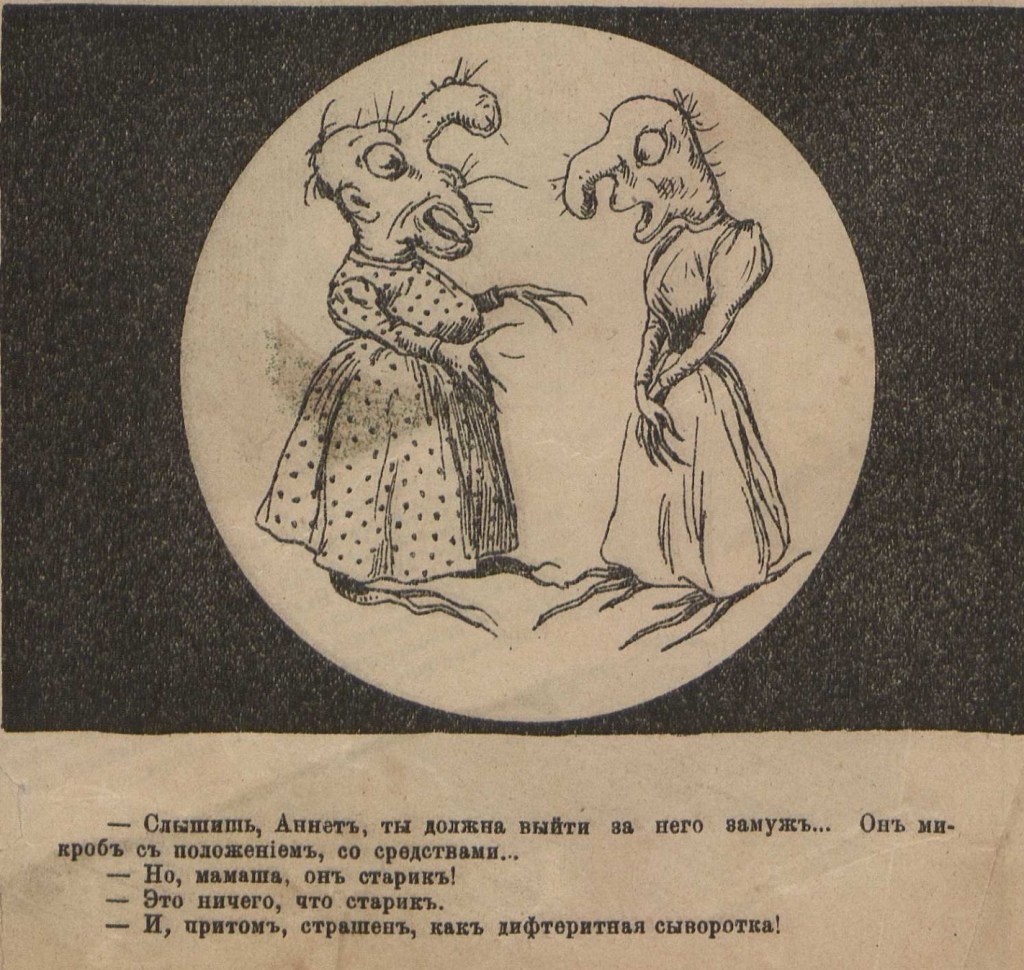
“Listen, Annette, you have to marry him… He’s a microbe with standing and means…” “But mama, he’s an old man!” “It’s nothing that he’s an old man.” “And what’s more, he’s scary like diphtheria serum!”
Two panels of six. The other plagues listed are the asphalt inferno of cars in Rio, water shortages, food prices, and the endless riots of republicans and monarchists.
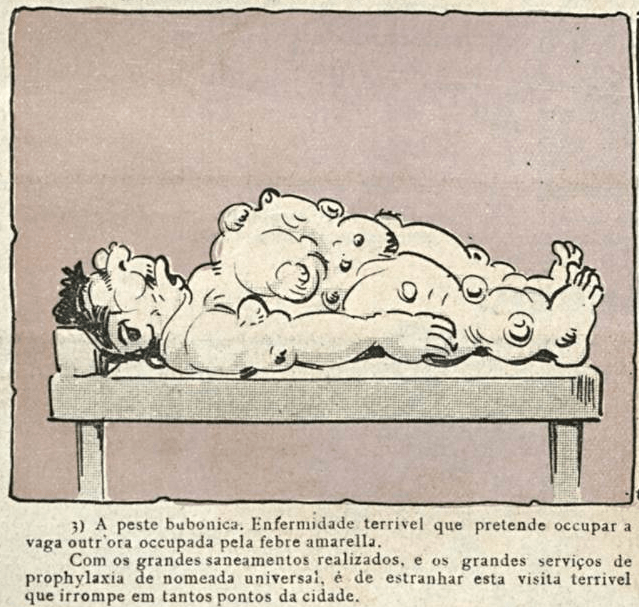
The bubonic plague. Terrible illness that intends to occupy the space formerly occupied by yellow fever. With the great public health surveys that have been carried out, and the great preventive efforts that have gained universal fame, this terrible visitation that is breaking out in so many points of the city is surprising.
Brazilian plague cartoon
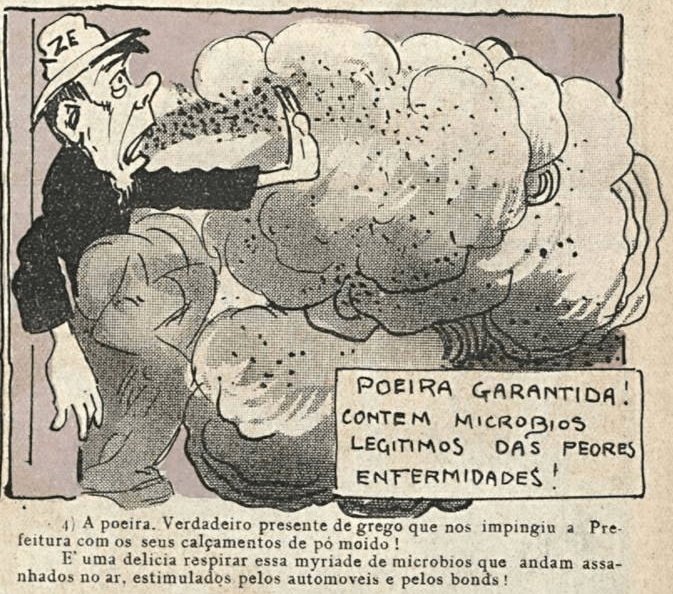
The dust. A true gift from the Greek who forced us into the City Hall with its ground-sand paving! It is a delight to breathe this myriad of microbes that roam in the air, stimulated by automobiles and trams!
 Sic Transit Pestilentia