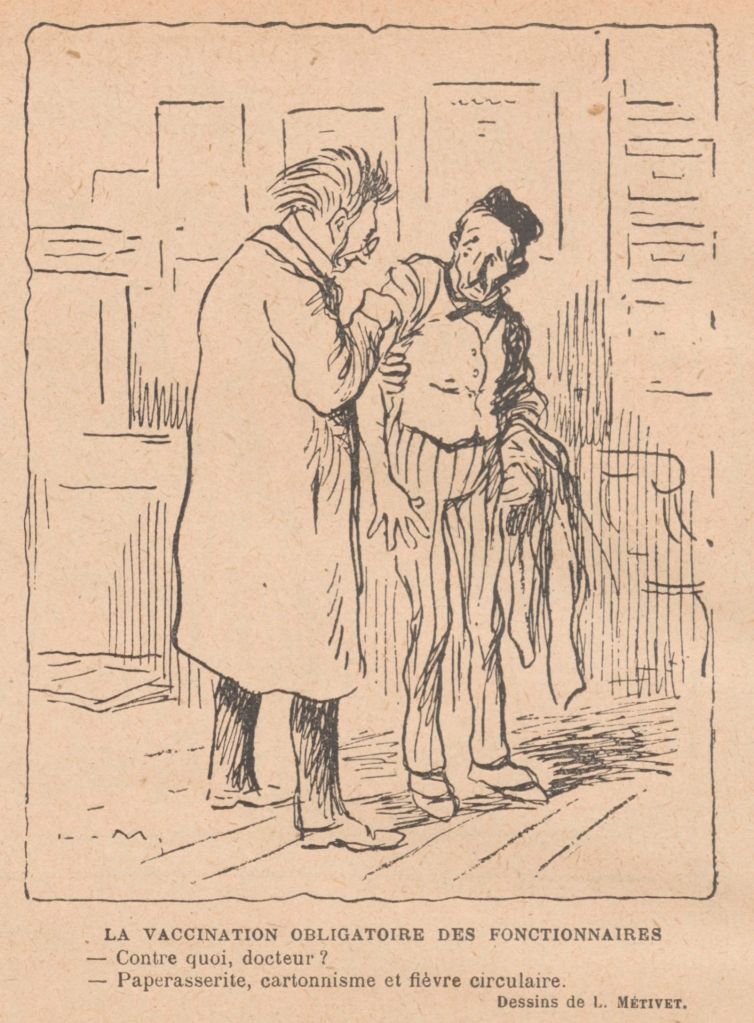
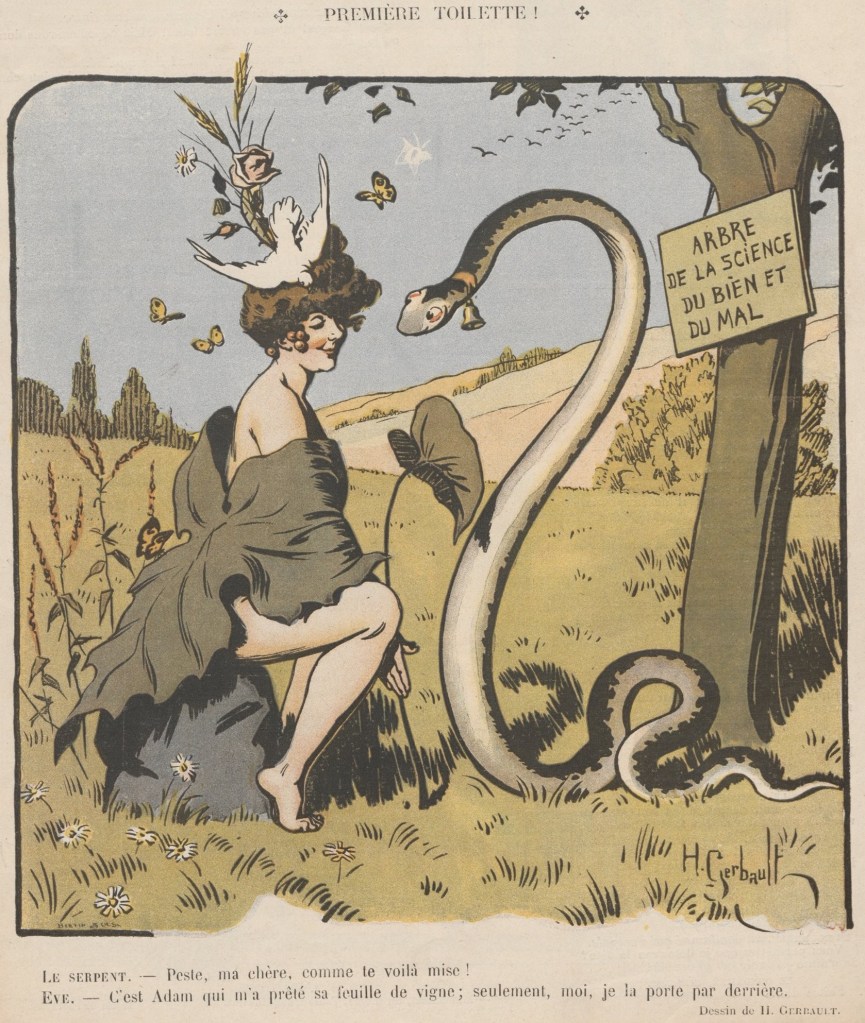
First toilette!

(Under the Tree of the Knowledge of Good and Evil.)
The serpent: “My dear pest, look at how you are arrayed!”
Eve: “It was Adam who lent me his fig leaf; it’s just that I carry it from behind.”
(Le Rire, Paris, 1906) (OK, this is a stretch, since it is not literally about the plague, but in a quirky way it seems to connect original sin with unpleasant modes of disease transmission. Perhaps I am committing the sin of Freudian overinterpretation. Or more likely my grasp of French idiom is not adequate to this case.)
French hygiene cartoon

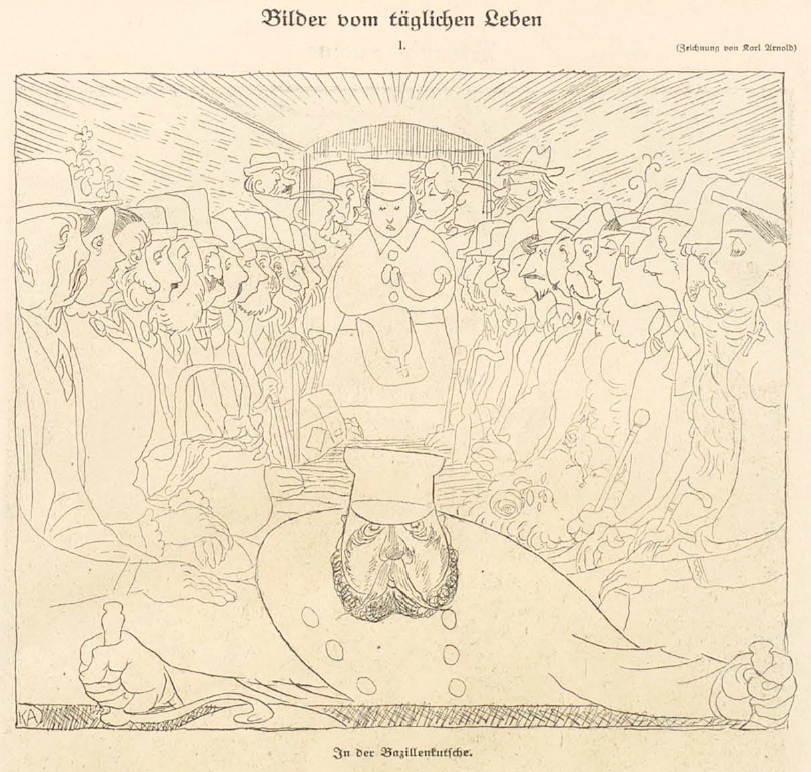
Pictures from daily life

“In the germ car.”
Depicting the close quarters of public transportation during the flu pandemic of 1918. It is worth noting that this may be the only such flu-related image in Simplicissimus that fall. The unusual term “Bazillenkutsch” is sometimes attributed to Robert Koch at the time of the opening of the U-Bahn in working-class Kreuzberg in 1902, perhaps via a 1908 novella by Eduard Goldbeck (not confirmed). Kaiser Wilhelm later gave the term wider notoriety when he visited a new stretch of the U-Bahn and insisted that he would only sit in a brand-new subway car, fearing infection from previous riders. This in turn moved the Berliner Volks-Zeitung to reassure its readers that this perception of germs ran counter to years of medical and scientific efforts to demonstrate otherwise, and the average subway car was not, in fact, the center of an epidemic.
(Simplicissimus no. 33, Munich, 1918)

German hygiene cartoon

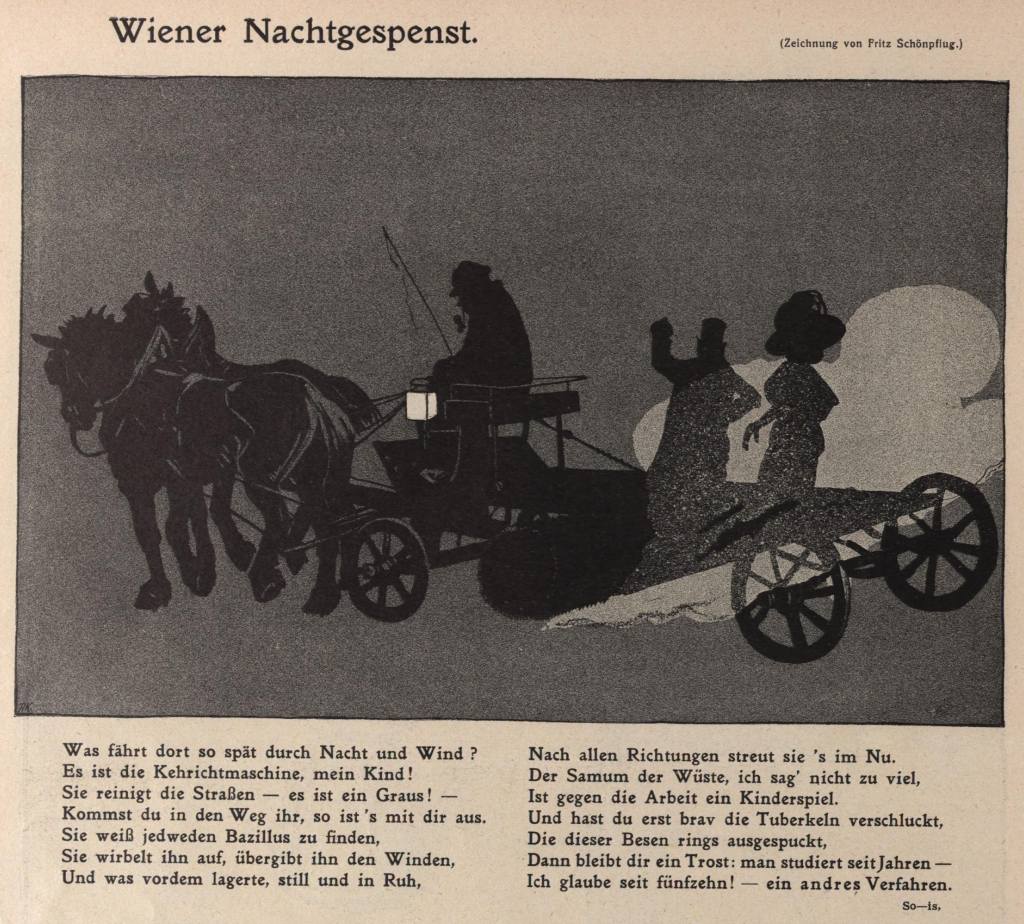
Viennese night specter

What drives through the wind so late at night?
It’s the street sweeper, my child!
It cleans the streets — it’s a horror! —
If you get in its way, you’re done for.
It knows how to find any germ,
It whirls it up, hands it over to the winds,
And what was lying around before, quietly at rest,
It scatters in all directions in no time.
The desert wind, I’m not overstating,
Is child’s play against this work.
And if you’ve just nicely swallowed the tubercles,
That these brooms spit out all around,
Then there is consolation: another process
is being studied — I think for fifteen years!
(Die Muskete, Vienna, 1912)

Austrian hygiene cartoon

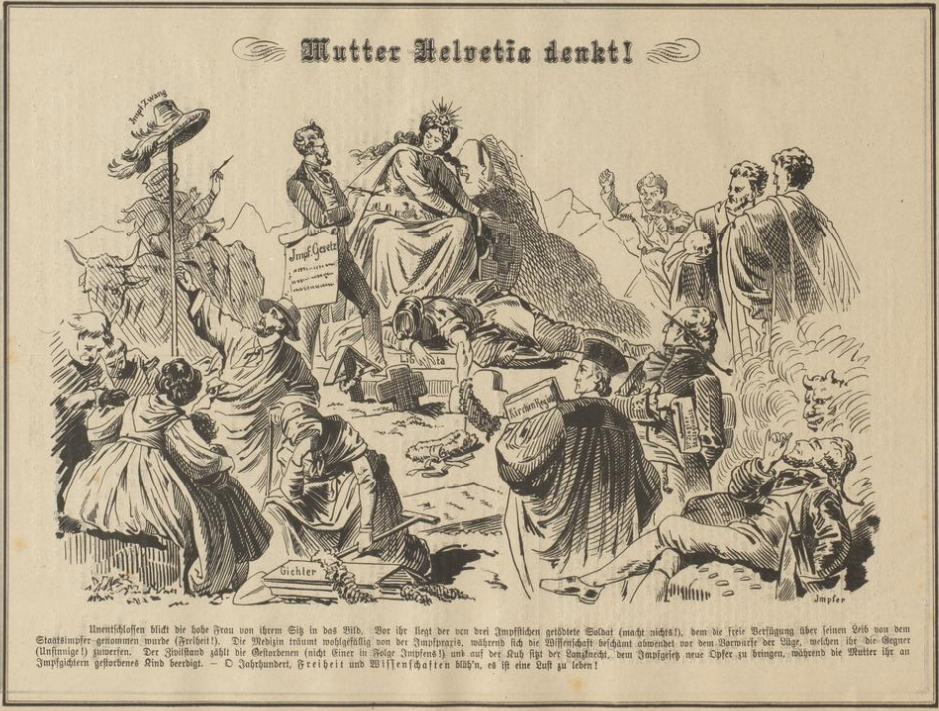
Mother Helvetia is thinking!

(The fancy hat at upper left is labeled “obligatory vaccination.” The gentleman standing before Mother Helvetia carries the vaccination law.)

In the picture the grand lady peers indecisively from her seat. Before her lie three soldiers dead from vaccination (don’t do it!), men whose bodies had been given over to the free disposal of the city vaccinator (freedom!). Medicine dreams pleasantly of vaccination practice, while science turns away in shame from the accusation of lying which the opponents (nonsensical!) lodge at her. The citizens count the deceased (more than one as a result of vaccination!) and on the cow sits the lanceman [administering the knick of inoculation] making new sacrifices to the vaccination law, while the mother buries her child who died from a bad inoculation batch. “O century, freedom and science flourish, it is a pleasure to live!” (Evoking the great Reformation thinker Erasmus.)
(Nebelspalter, Zurich, 1882)

Swiss vaccination cartoon

Messrs. Beust and Gramont are cooling off their heartburn

The former Austrian foreign minister, Count Beust, had clashed with the French foreign minister, the Duc de Gramont, in the lead-up to the Franco-Prussian War in 1870. This cartoon from early 1873 followed upon Beust’s attempt to settle accounts by publishing letters from that period. Though this is straight politics, I include it because of the clystères, an ongoing theme. (See also this Mexican example from 1886, also a cholera year.)
(Humoristické listy, Prague, 1873)

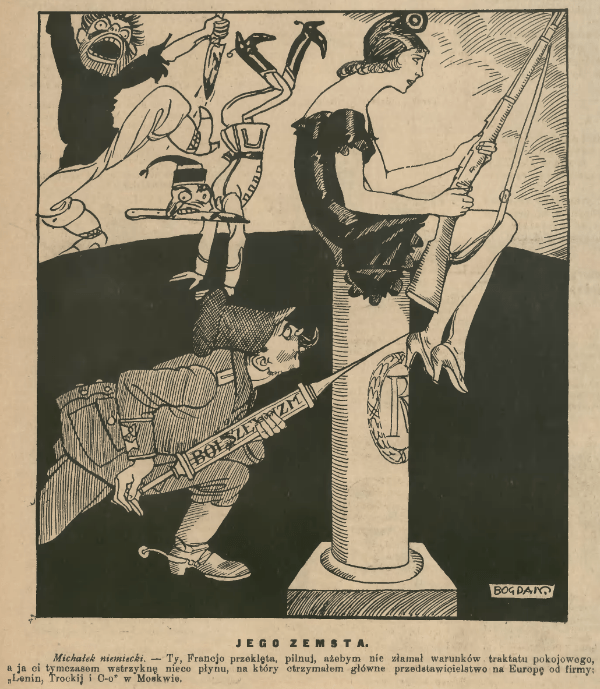
His revenge

German Michaels: “You, accursed France, make sure I don’t break the terms of the peace treaty, and in the meantime I’ll inject some liquid in you for which I received the sales rights in Europe from the firm, “Lenin, Trotsky & Co.” in Moscow. (This is straightforward politics-as-contagion, but note the clystère, an ongoing theme.)
(Mucha, Warsaw, 1920)

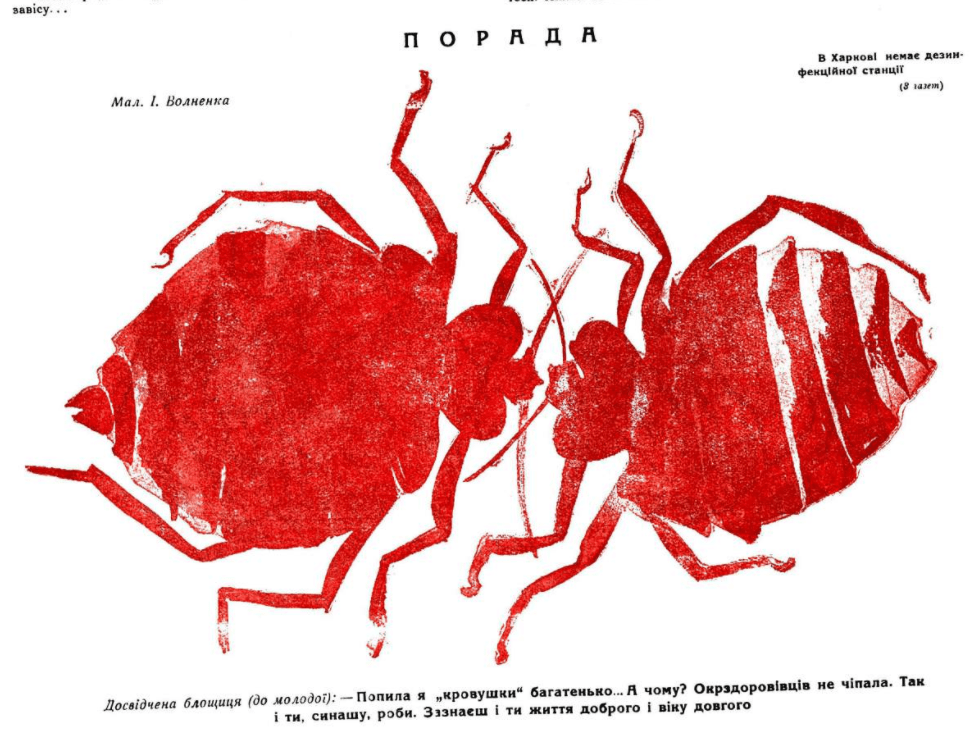
Advice

(Newspapers report there is no disinfection station in Kharkiv)
Experienced flea (to young one): “I’ve drunk my share of ‘nice blood’… And how did I manage? I didn’t bother with the district’s healthy types. Do it like that, son. You will also experience a good life and a nice old age.”
(Perets, Kharkiv, 1928)

Ukrainian hygiene cartoon