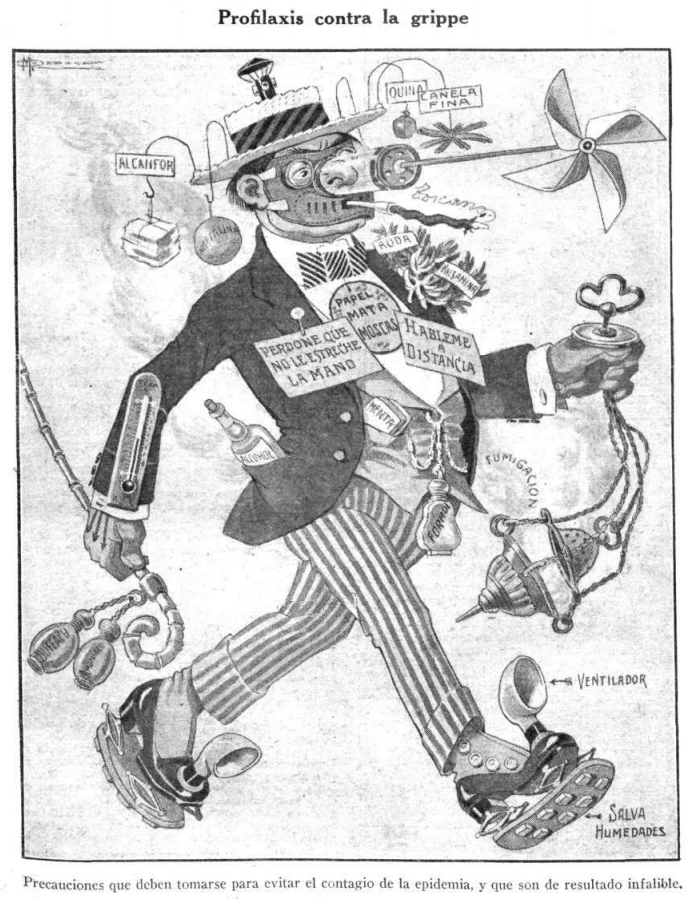
Precautions that must be taken to avoid the spread of the epidemic, and which offer a flawless result. (Among the items affixed to him: camphor, naphthalene, quinine, cinnamon, “Sorry for not shaking your hand,” flypaper, “Please speak to me at a distance,” alcohol, mint, fumigation by censor, a ventilation device, and what I take to be pads for absorbing humidity. Having a thermometer always at the ready is a crowning touch.) (Caras y Caretas, Buenos Aires, 1918) (Note the similarity to Jeremiah Fastidious from 1892)
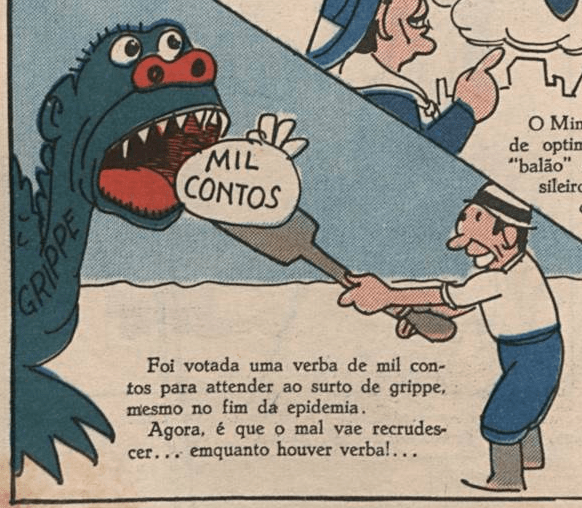
Detail from Storni’s “Believe it or not” feature, where a creature labeled “Flu” is being fed a sack of money. “A sum of one thousand contos was voted to meet the outbreak of influenza, even at the end of the epidemic. Now the evil will increase… so long as there is money!…” (O Malho, Rio de Janeiro, 1935)
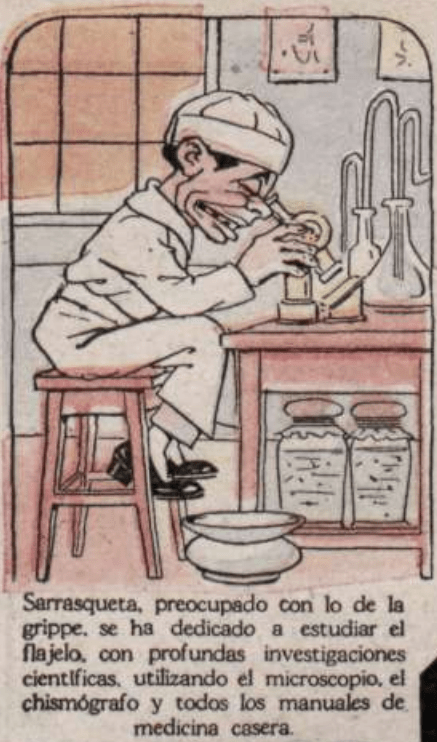
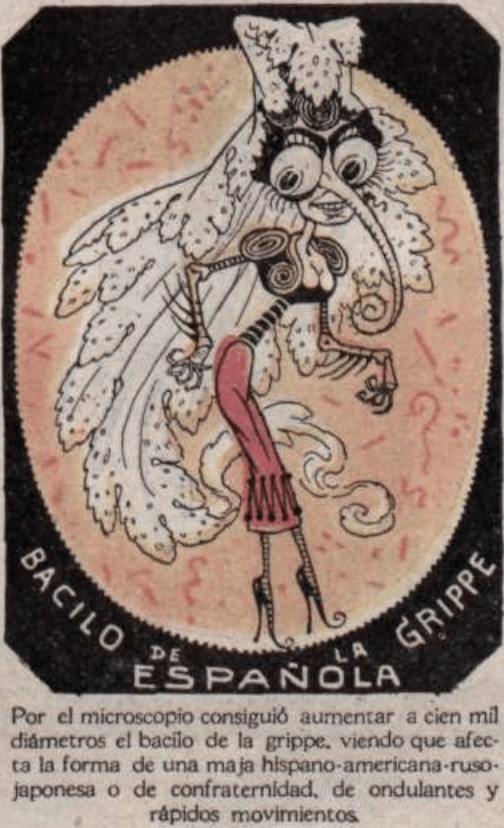
Sarrasqueta, concerned about the flu, has devoted himself to studying flagella, with deep scientific research, using the microscope, the gossip machine and all the manuals on home medicine.
Argentine flu cartoon
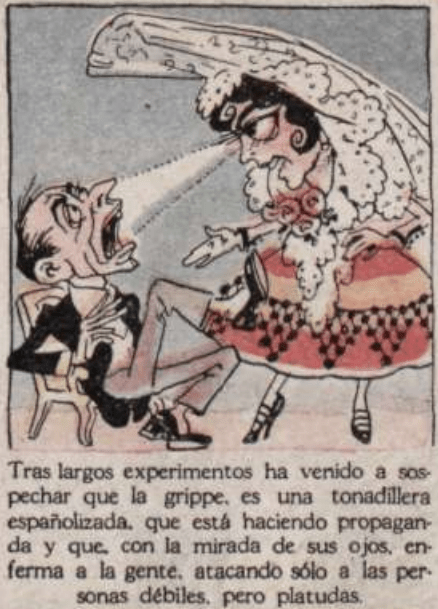
After long experiments he has come to suspect that the flu is a Spanish pop singer, that she is making propaganda, and that she makes people sick with a glance from her eyes, attacking only weak, but well-heeled people.
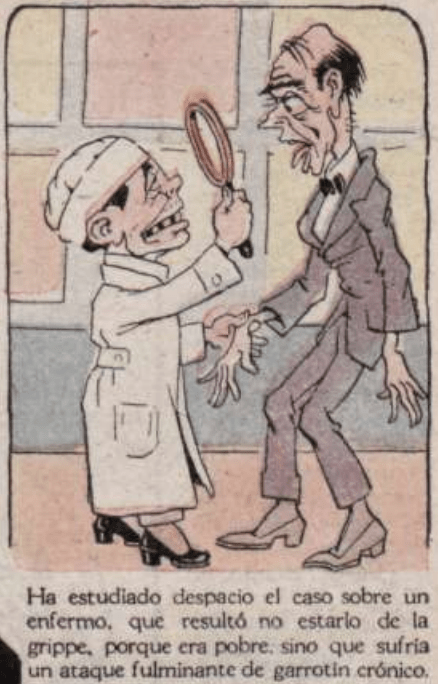
He has slowly studied the case of a patient who turned out not to have the flu, because he was poor, but suffered a sudden attack of chronic flamenco.
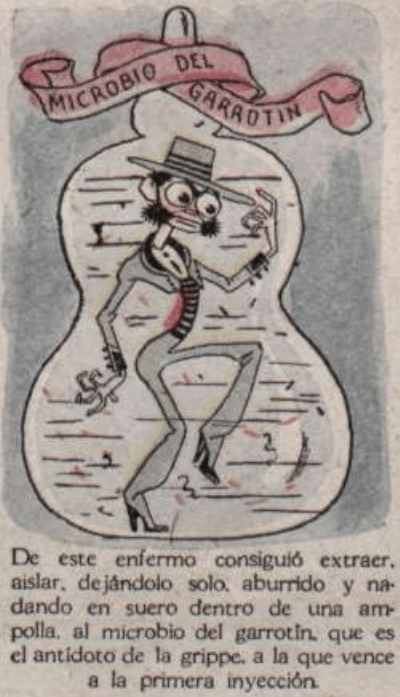
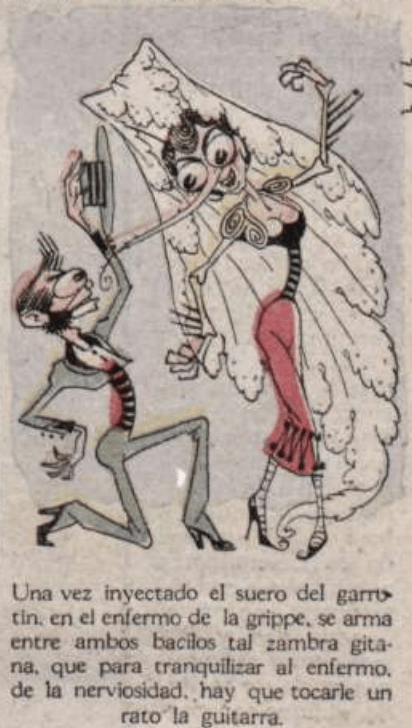
From this patient he managed to extract and isolate the flamenco microbe by leaving him alone, bored and swimming in serum in an ampoule, which is the antidote to the flu, defeating it with a single injection.
Using the microscope, he managed to magnify the flu bacillus to a hundred thousand diameters, seeing that it affects the shape of a pretty Spanish-American-Russian-Japanese or of confraternity, with undulating and rapid movements.
Once the flamenco serum is injected in the patient with the flu, such a gypsy dance is mounted between both bacilli that to calm the patient from his nervousness, one has to play the guitar for a while.
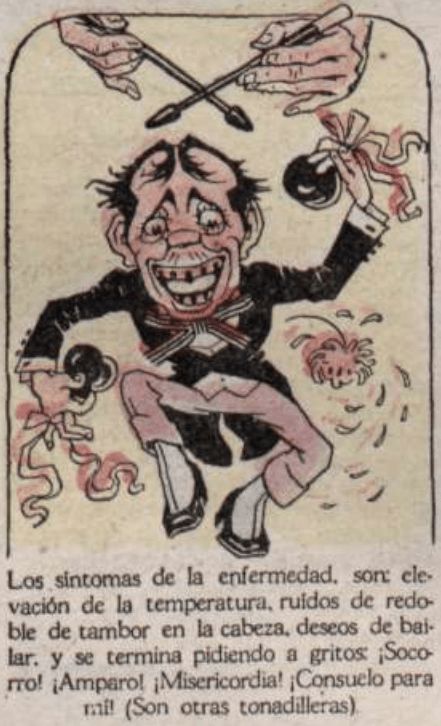
The symptoms of the disease are an increase in temperature, drum roll noises in the head, desire to dance, ending in the cries: Help! Protection! Mercy! Console me! (They are other pop singers)
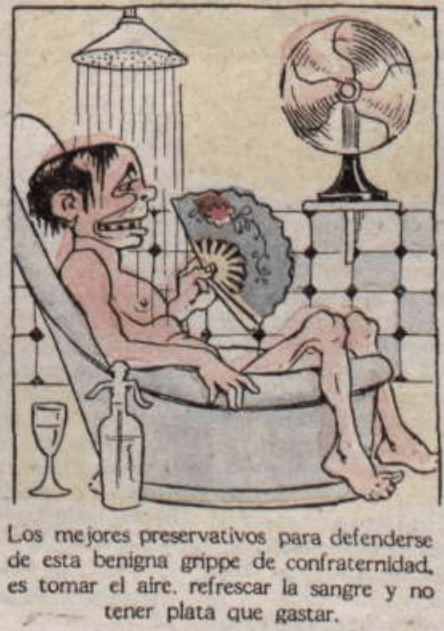
The best protections to defend against this benign flu confraternity is to take the air, refresh the blood, and have no money to spend.
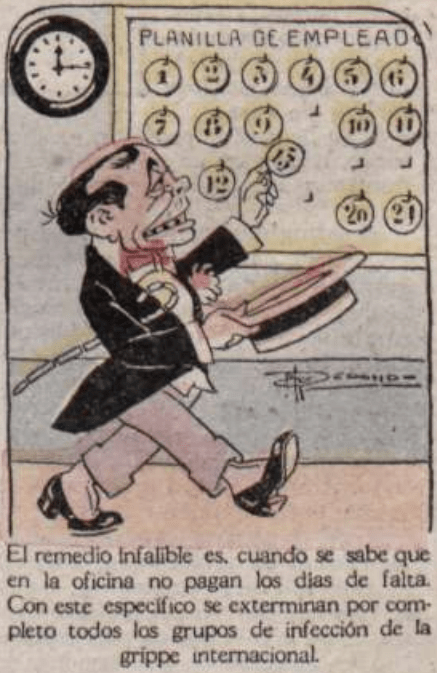
The infallible remedy is when it becomes known that they do not pay for the days lost at the office. With this detail, all the infection groups of the international flu will be completely exterminated.
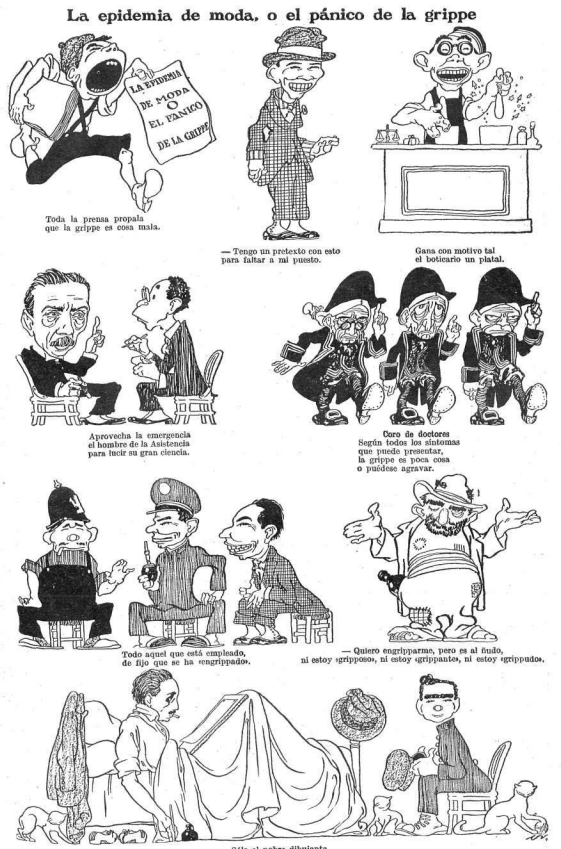
Though it has come to sound a little old-fashioned in English, it is still possible to refer to the flu as “grippe.” This Argentine cartoon is punning relentlessly on the senses of “grip” (e.g., inverting “in the grip of panic” in the title) and I will surely mistake some of the participles, but let’s give it a try. “All the press is propagating the notion that the grippe is a bad thing. “With this I have a pretext to fail at my post.” For this reason the pharmacist is gaining a fortune. The man at Medical Aid takes advantage of the emergency to show off his great science. Chorus of doctors: according to all the symptoms that it can present, the grippe is a minor thing or it can be aggravated. Anyone who is employed has, of course, been “in the grip.” “I want to get a grip on myself, but it is in vain, I am not “grippy,” nor am I “gripping,” nor am I a “gripper.” Only the poor cartoonist is the constant victim of the general contagion, and works at all times, whether he is well or he is ill.” (Caras y Caretas, Buenos Aires, 1918)
Then they say that I develop among the crowds; and as soon as the people took to the streets to celebrate the triumph of the allies, I had to be moved! (Caras y Caretas, Buenos Aires, 1918)
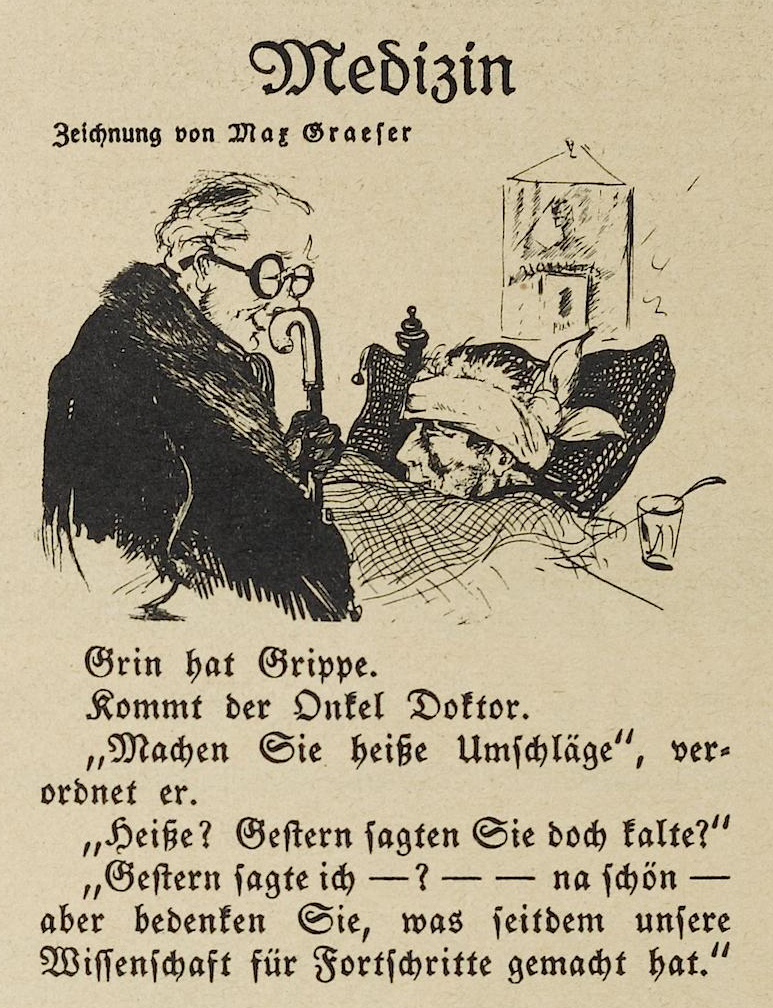
Grin has the flu. His uncle the doctor arrives. “Make hot compresses,” he orders. “Hot? Didn’t you say cold yesterday?” “Yesterday I said–?–alright–but think about the progress our science has made since then.” (Lachen links, Germany, 1927)
Detail from a humorous story in Moravian Illustrated Reporter, subtitled “A few words about flu heroes.” Spraying catarrh (i.e., snot) in the tram: “Oh, please, what are you looking at? Haven’t you ever seen anyone sneeze?” (Moravský illustrovaný zpravodaj, Prague, 1933)
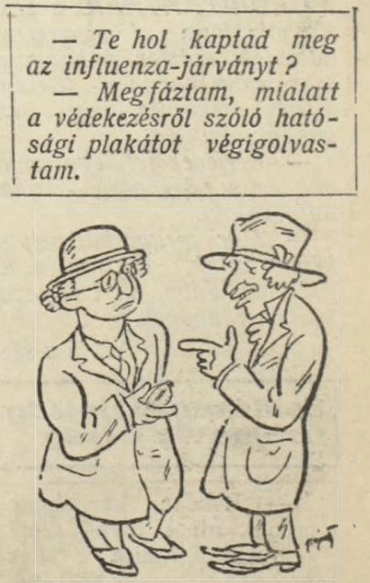
“Where did you get the flu contagion?” “I caught a chill while I was reading all the way to the end of the official poster about how to protect yourself.” (Az Ojság, Budapest, 1927)
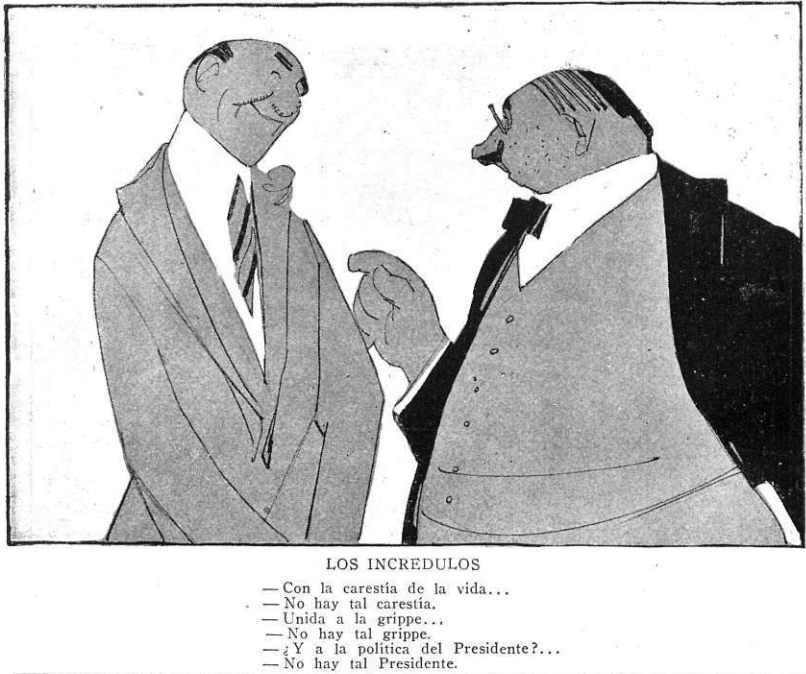
“With the dearth of life …” “There is no such dearth.” “Attached to the flu…” “There is no such flu.” “And to the President’s policy?…” “There is no such President.” (Caras y caretas, Buenos Aires, 1919)
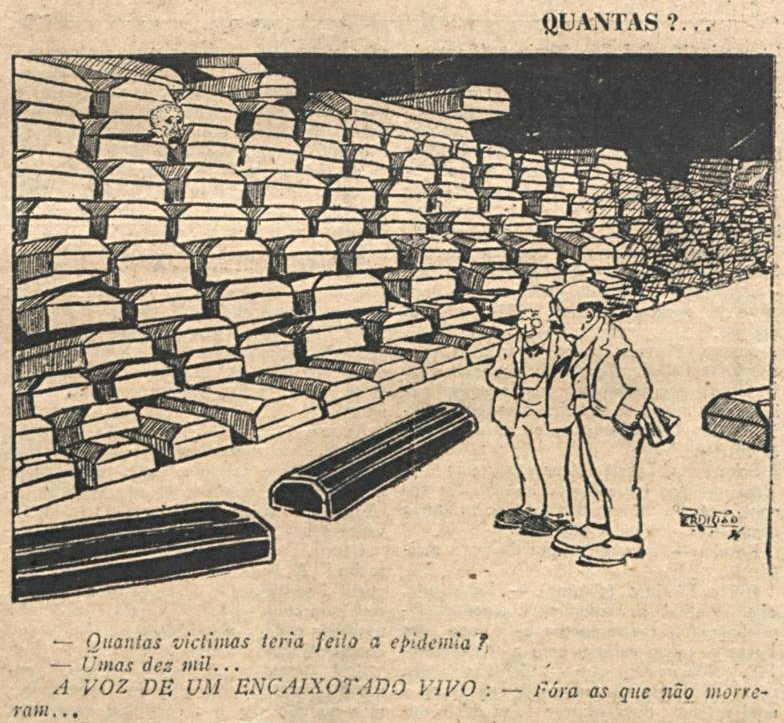
“How many victims has the epidemic caused?” “About ten thousand…” THE VOICE OF SOMEONE TRAPPED IN A COFFIN: “As for those who did not die…” (O Malho, Rio de Janeiro, 1918)
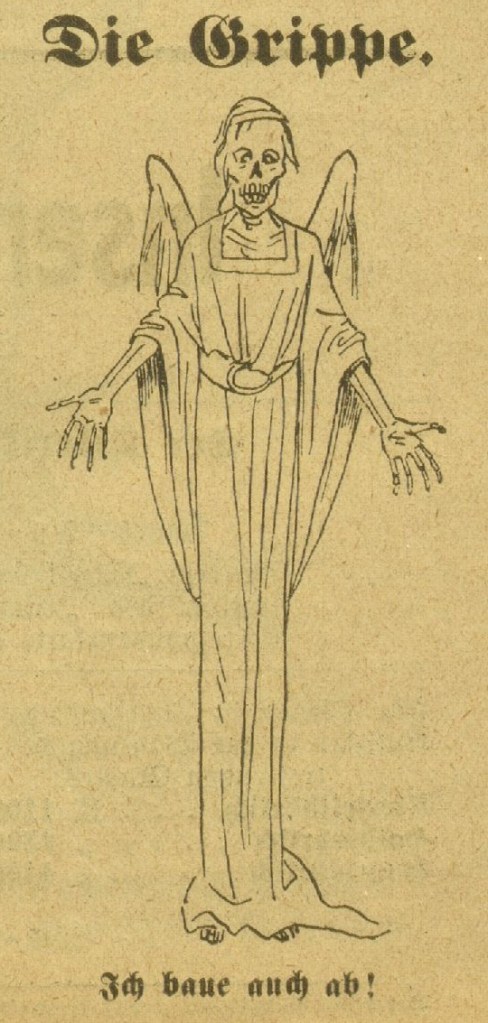
“I’m also cutting back!” (Three years after the Spanish flu epidemic, at a time of reductions in social welfare amid mounting postwar inflation.) (Kikeriki, Vienna, 1922)


 Sic Transit Pestilentia