Influenza was sent for the doctors, and stormy winds were sent for the roofers and glazers.
(Kikeriki, Vienna, 1890)
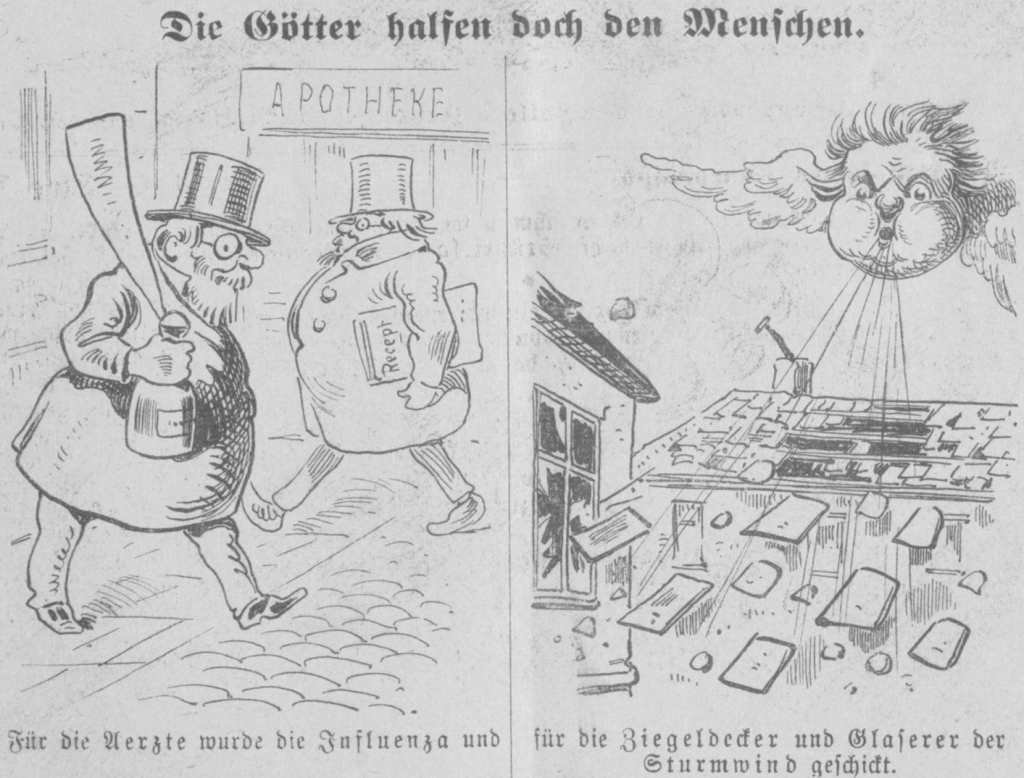
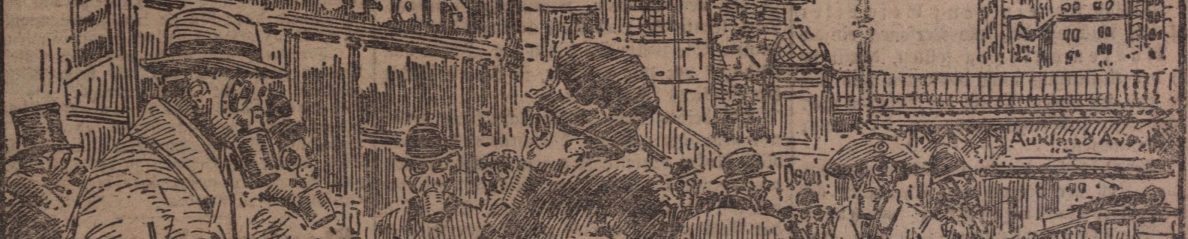
Influenza was sent for the doctors, and stormy winds were sent for the roofers and glazers.
(Kikeriki, Vienna, 1890)
(After only schools and not government offices were closed for the sake of influenza.)
“O blessed, o blessed to be a child still!”
(Kikeriki, Vienna, 1890)

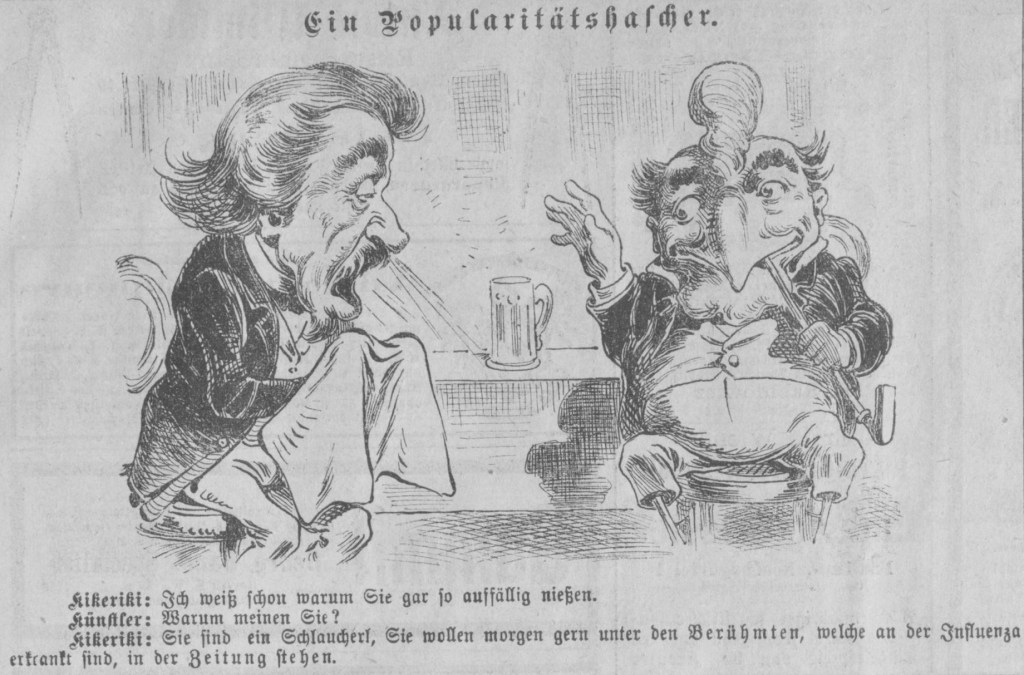
Kikeriki: “I know just why you’re sneezing so conspicuously.”
Artist: “What do you mean?”
Kikeriki: “You’re one of these clever types who would like to find themselves in the newspaper tomorrow among the famous people who are ill with influenza.”
(Kikeriki, Vienna, 1890)
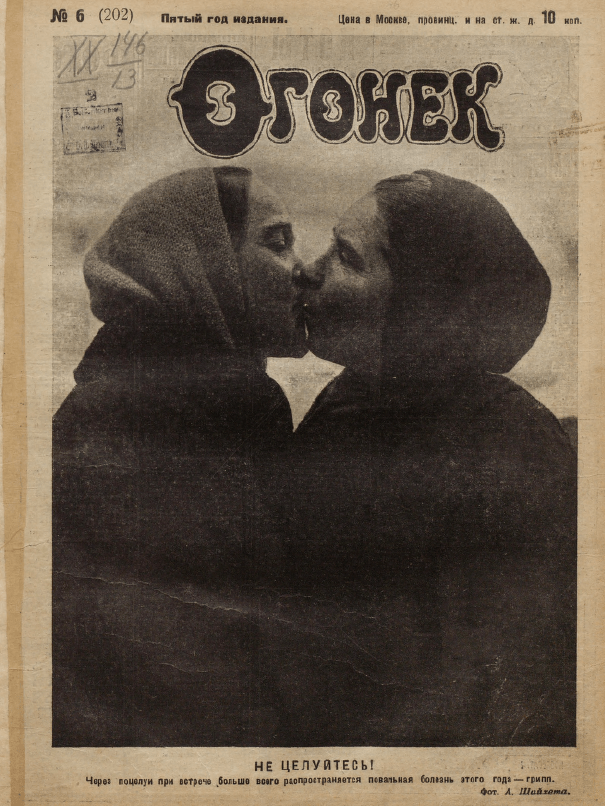
The infectious disease of the year, the flu, is transmitted most of all via kissing when greeting each other.
(Ogonek no. 6, Moscow, 1927)
(Though I took the image from another source, I owe this to the Soviet Visuals page on Facebook.)
(This is not a freestanding cartoon, but one of several small illustrations that accompany an essay by this title. A rather rough translation of a bit of the surrounding text follows. I’m including this item because it is the earliest available Spanish example I have located so far.)
The recent carnival in Madrid has been bountiful in amorous intrigues, very weighty puns, and acts of honor.
As if revolutions, wars, typhus, influenza, morbid cholera, national pneumonia, and doctors who take death as their lackey were not enough, there are men who have such little esteem for their lives, that I must get away from all that chaff pretending to be skewered like veal on a spit. This would be dreadful if, fortunately, there were not charitable souls in the world who would try to convert the fiery impetus of the Matachines [carnivalesque dance troupes] into healthy prudence… [A metaphor or Aesopian tag for revolutionary factions, which did not win the day in 1848? I am out of my depth here.]
(La Linterna mágica, Madrid, 1849)
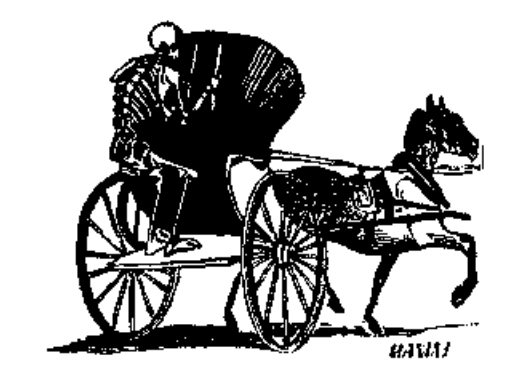
Influenza, obstruction,
This situation is already appalling!
Our nose grew like a tower,
We are failing, abbiony!
(Bolond Istók, Budapest, 1889)
(I hesitate to post this one, since I don’t grasp the context adequately, e.g., the figures blowing wind, or the term “abbiony,” which is not in any dictionary, but shows up multiple times in this journal. It might actually be an informal acronym for its readers.)

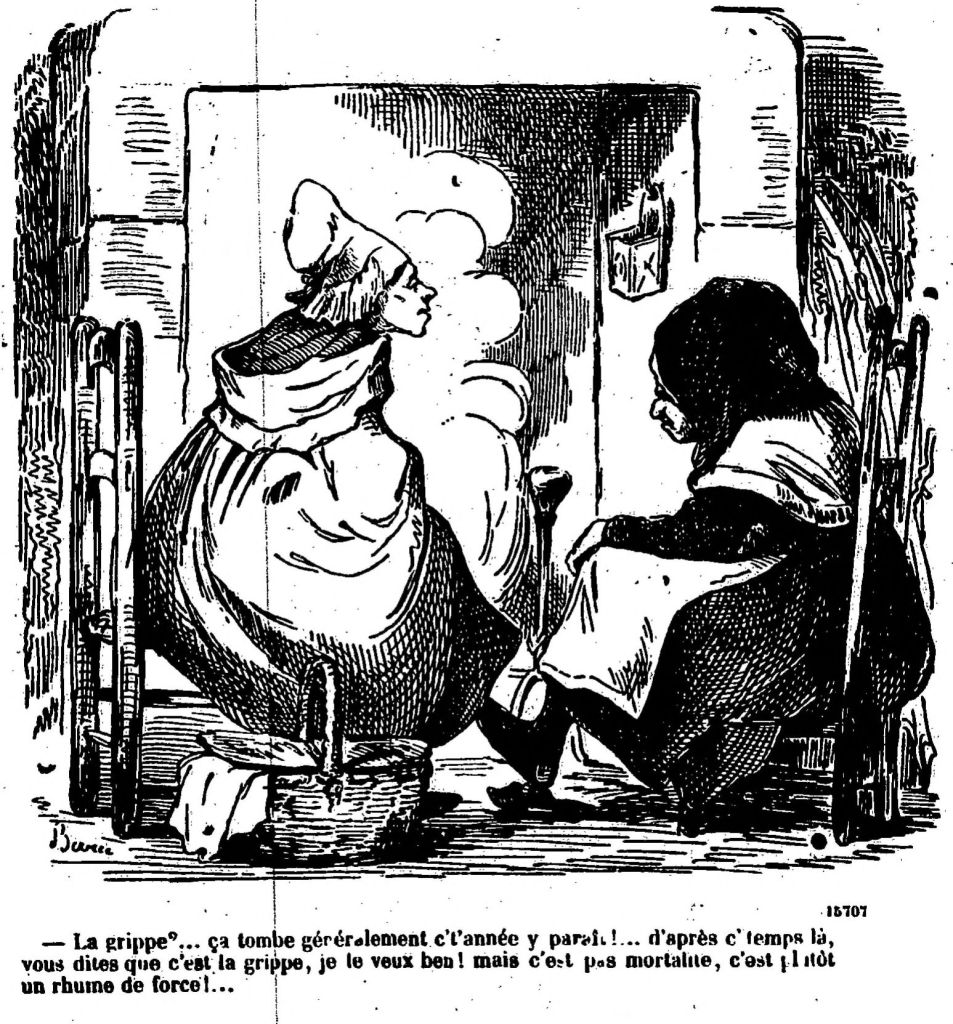
“The flu?… it seems to be getting out of control this year!… after that time, you say it’s the flu, I don’t mind! but it’s not fatal, it’s rather a powerful cold!…”
(Le Journal amusant, Paris, 1859) (Clearly I could use help with the idiom.)
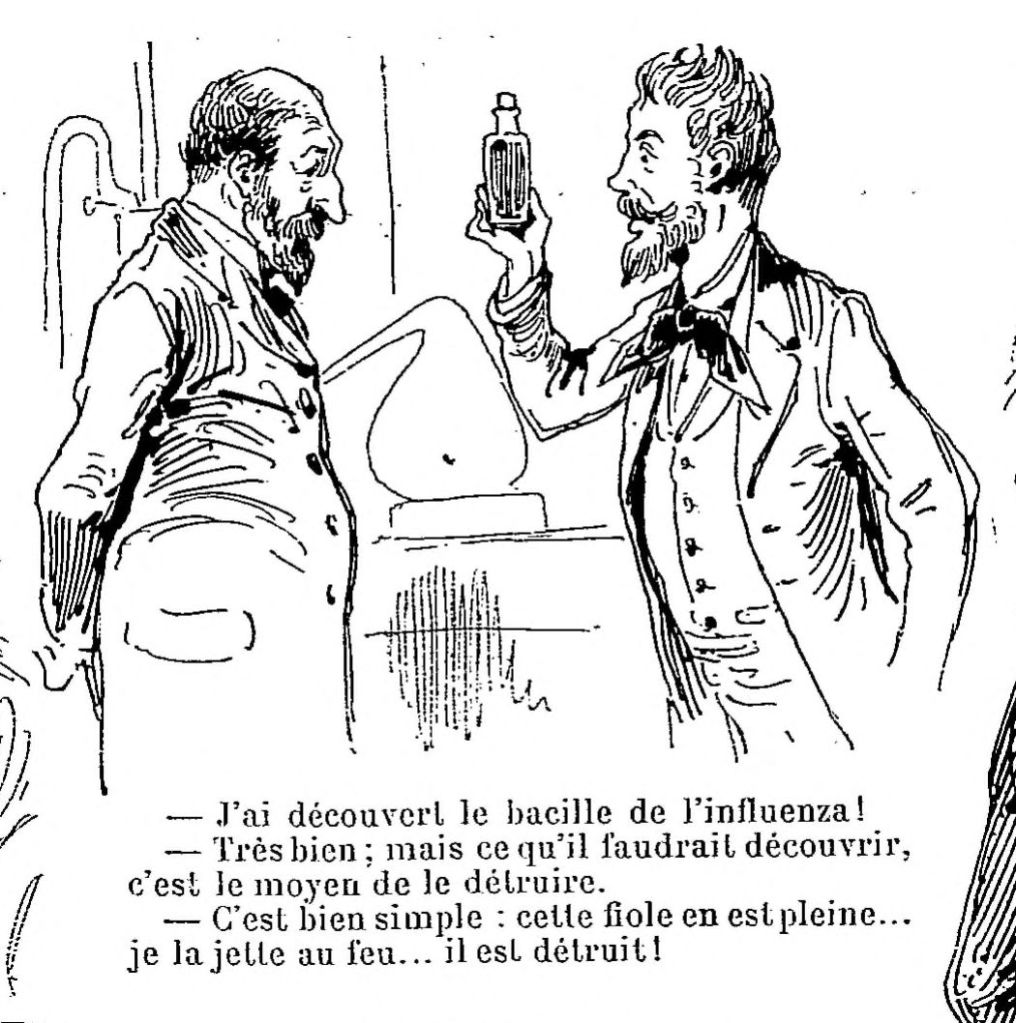
“I’ve discovered the influenza bacillus!”
“Very good; but what needed to be discovered is the means to destroy it.”
“It’s very simple: this vial is full… I throw it into the fire… it is destroyed!”
(Le Journal amusant, Paris, 1892)
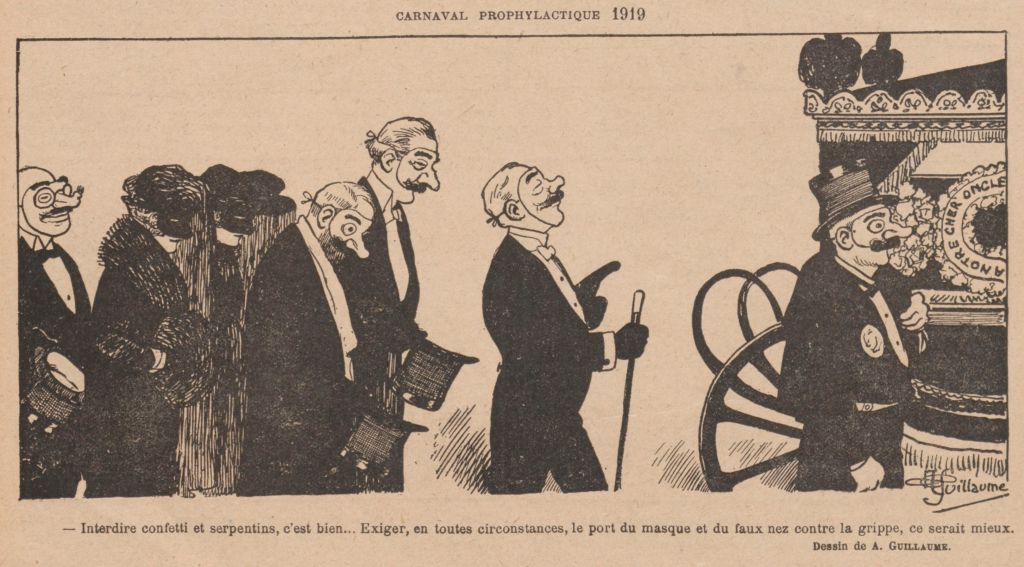
Banning confetti and streamers is good… Requiring the wearing of a mask and false nose against the flu in all circumstances would be better.
(Le Rire, Paris, 1919)
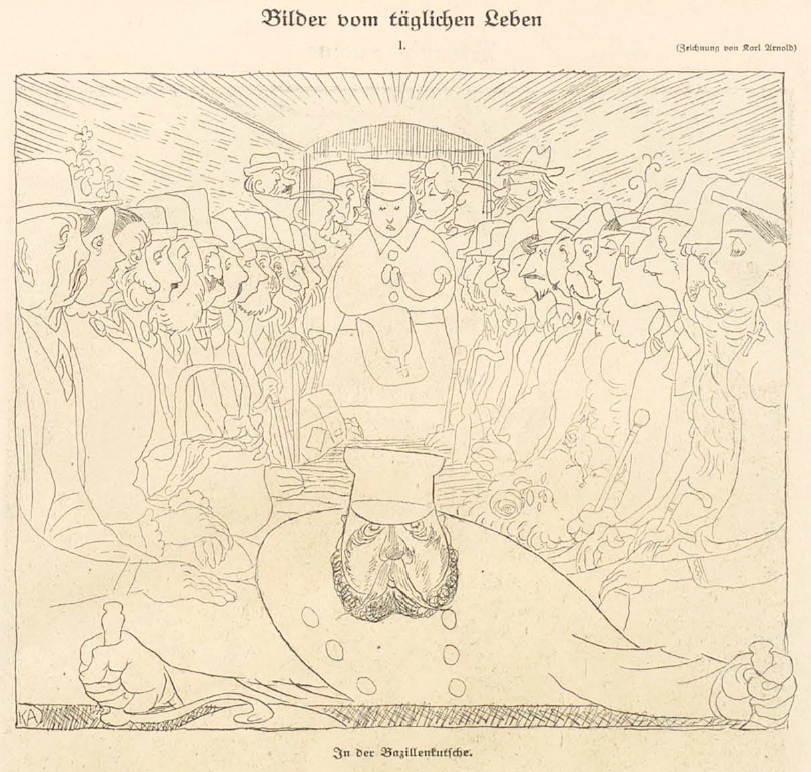
“In the germ car.”
Depicting the close quarters of public transportation during the flu pandemic of 1918. It is worth noting that this may be the only such flu-related image in Simplicissimus that fall. The unusual term “Bazillenkutsch” is sometimes attributed to Robert Koch at the time of the opening of the U-Bahn in working-class Kreuzberg in 1902, perhaps via a 1908 novella by Eduard Goldbeck (not confirmed). Kaiser Wilhelm later gave the term wider notoriety when he visited a new stretch of the U-Bahn and insisted that he would only sit in a brand-new subway car, fearing infection from previous riders. This in turn moved the Berliner Volks-Zeitung to reassure its readers that this perception of germs ran counter to years of medical and scientific efforts to demonstrate otherwise, and the average subway car was not, in fact, the center of an epidemic.
(Simplicissimus no. 33, Munich, 1918)
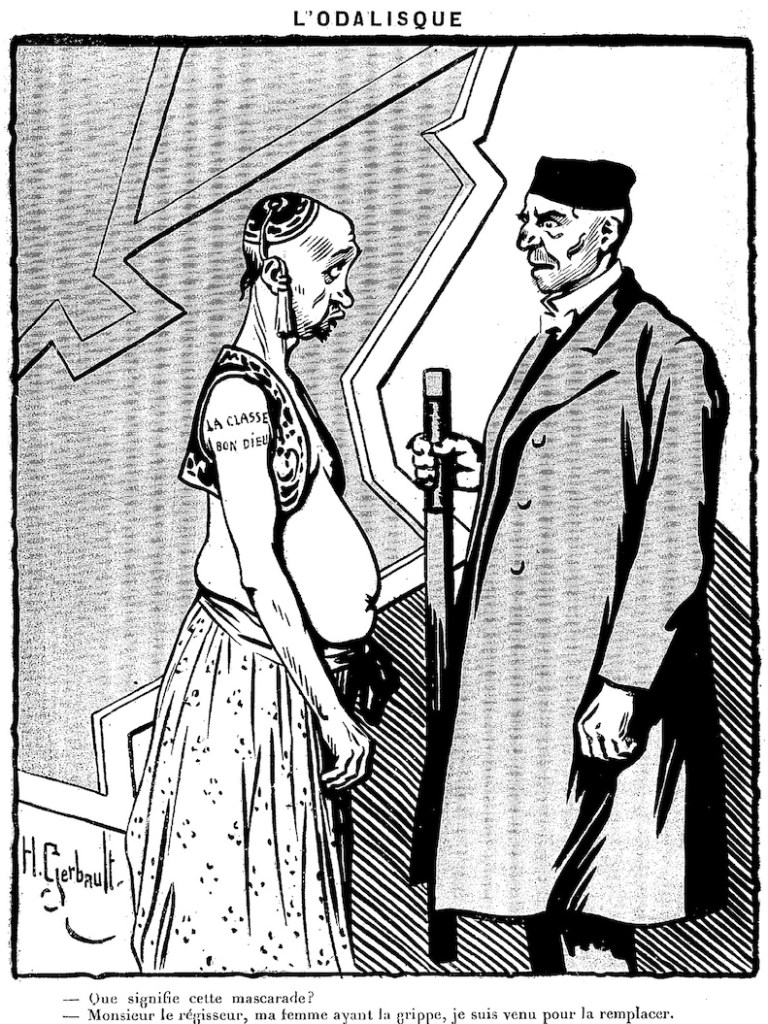
“What is the meaning of this costume?”
“Mr. Director, my wife has the flu, I’ve come to replace her.”
(Le Journal amusant, Paris, 1907)
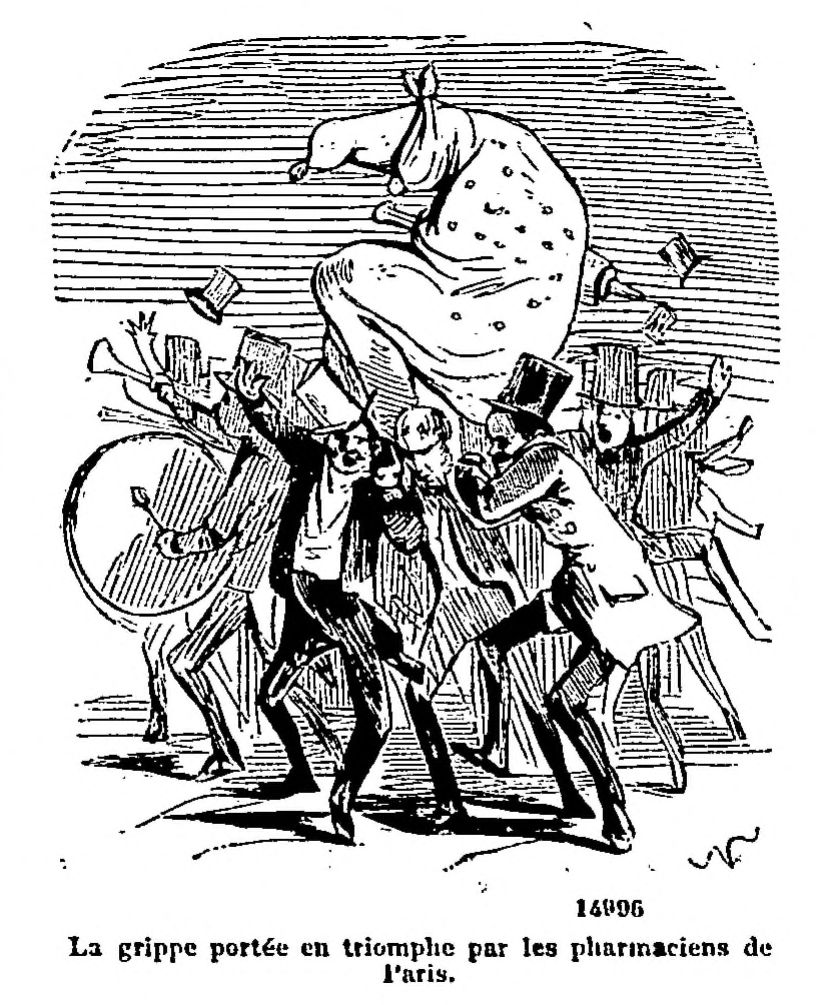
From a 72-panel review of the first trimester of 1858 by Nadar.
(Le Journal amusant, Paris, 1858)
The flu born in triumph by the pharmacists of Paris.
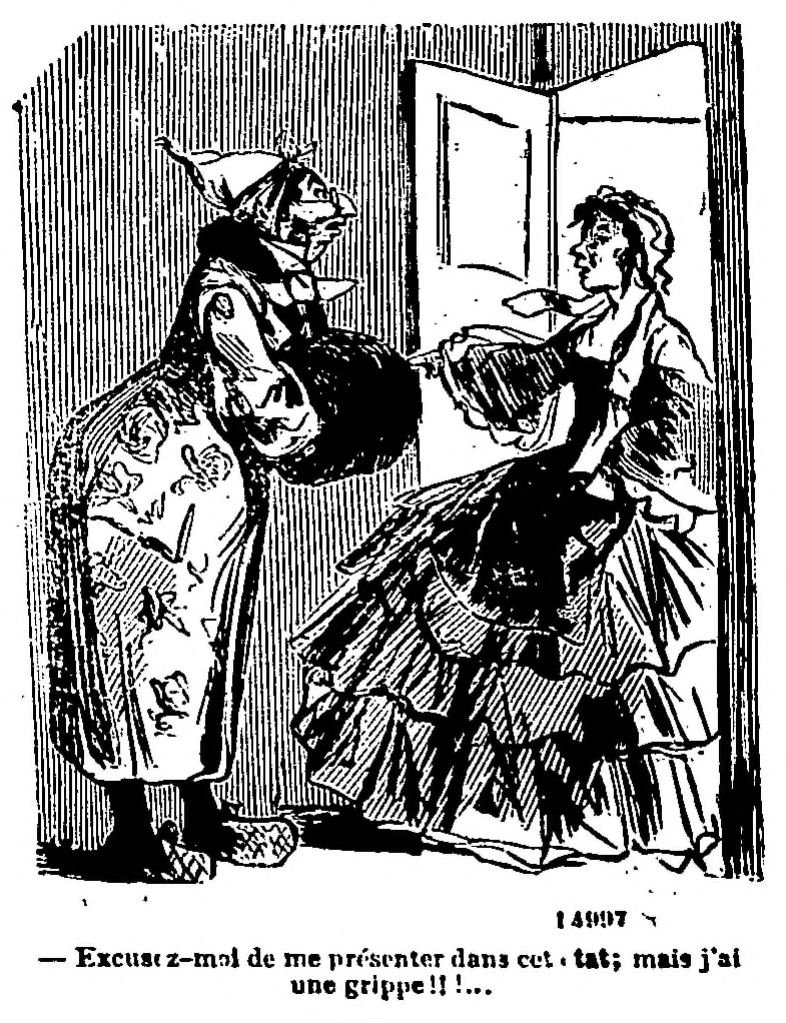
Please pardon me for appearing in this state; but I have the flu!…
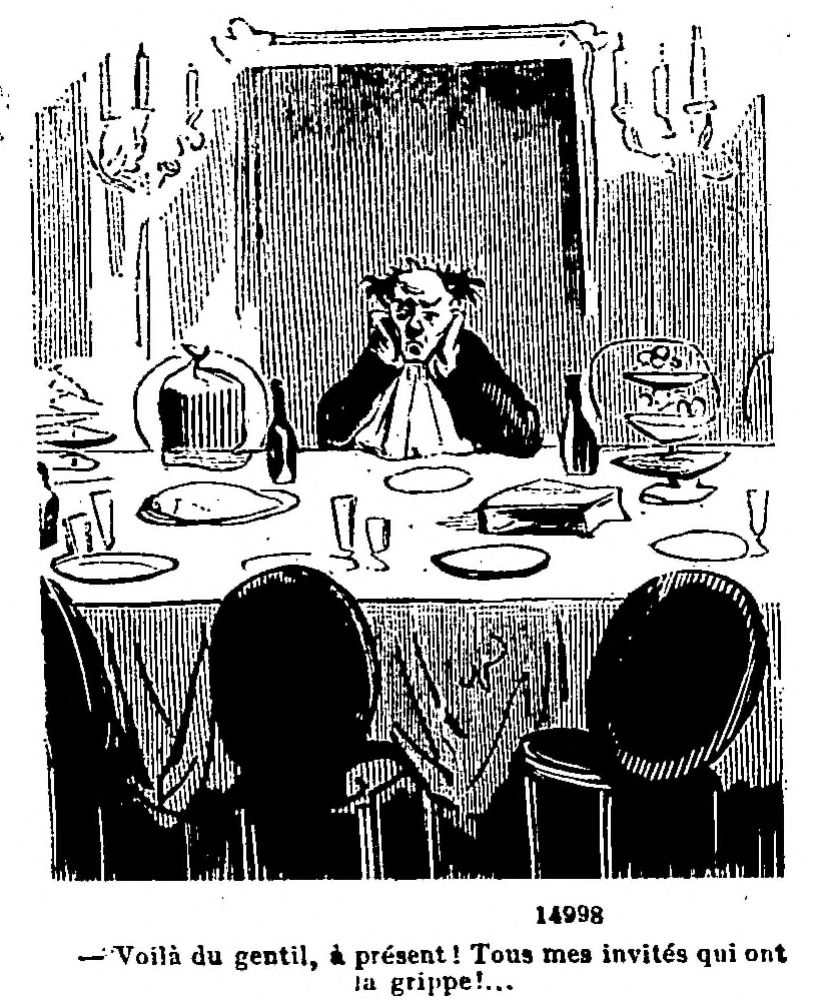
That’s nice now! All the people I invited have the flu!…
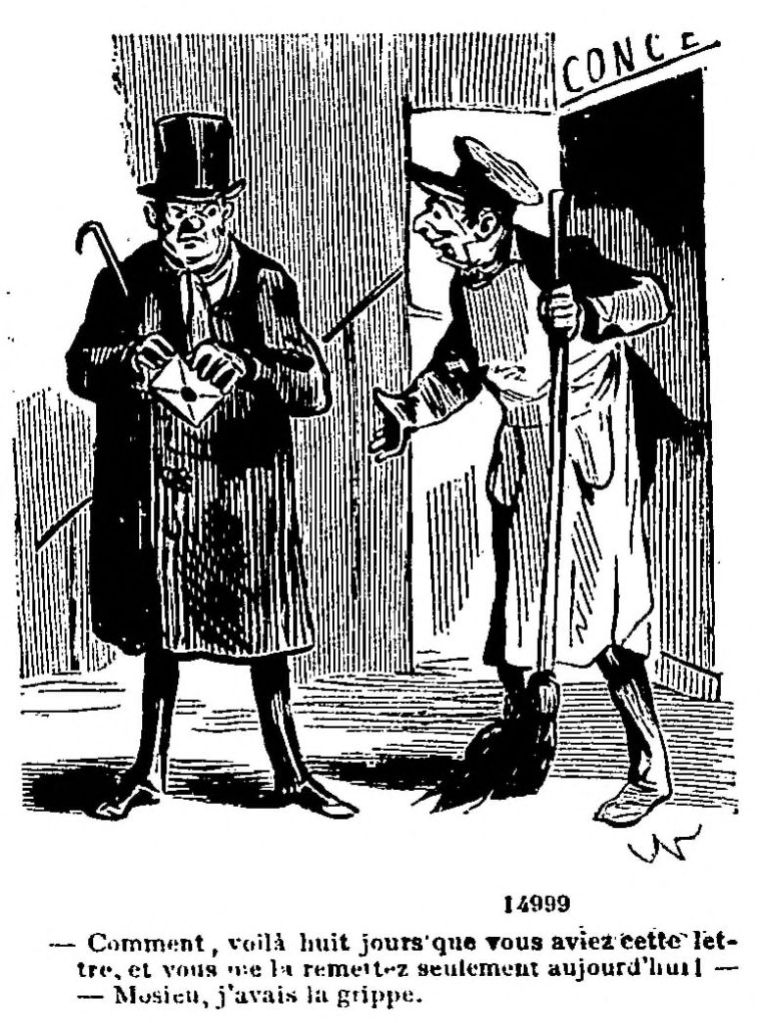
“How is it you’ve have this letter for eight days, and you are only giving it to me today!”
“Mister, I had the flu.”
“Do you have any idea about this fool of a doctor who found a temperature curve in me!”
(Le Rire, Paris, 1919) (I doubt this idiom is adequate to the bad pun. The poor cubist has lost his edge, so to speak.)

From La Caricature (1890):
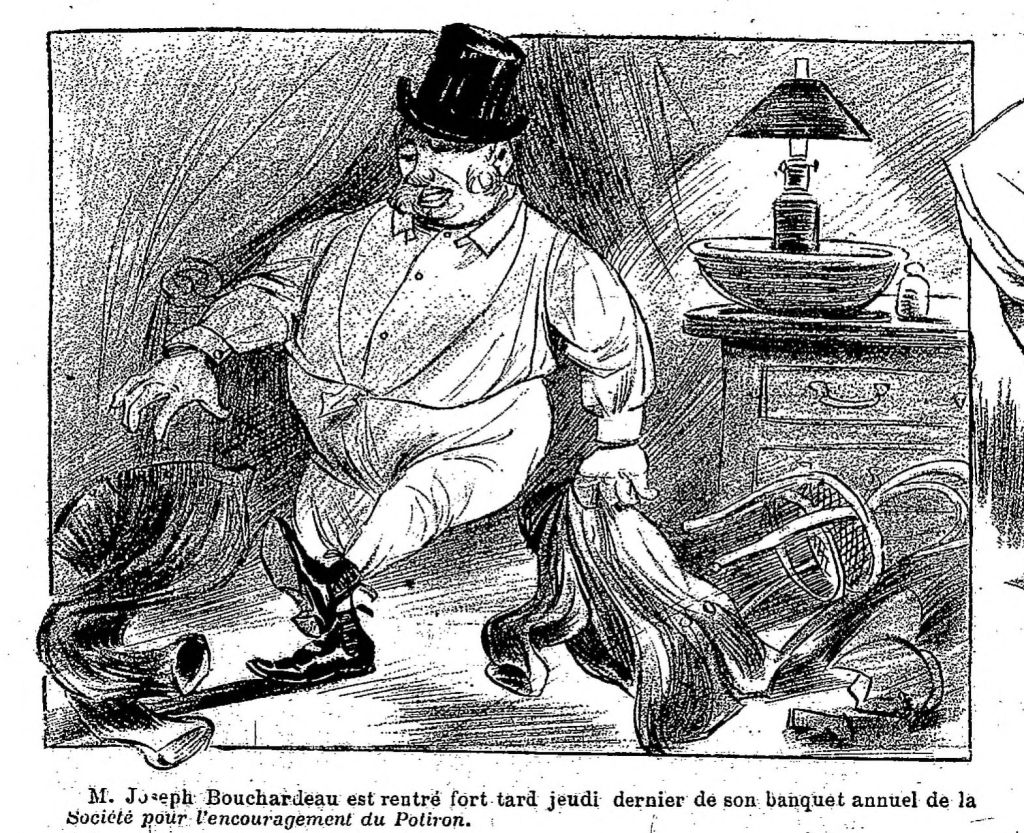
Mr. Joseph Bouchardeau returned very late last Thursday from his annual banquet at the Society for the Encouragement of the Pumpkin.
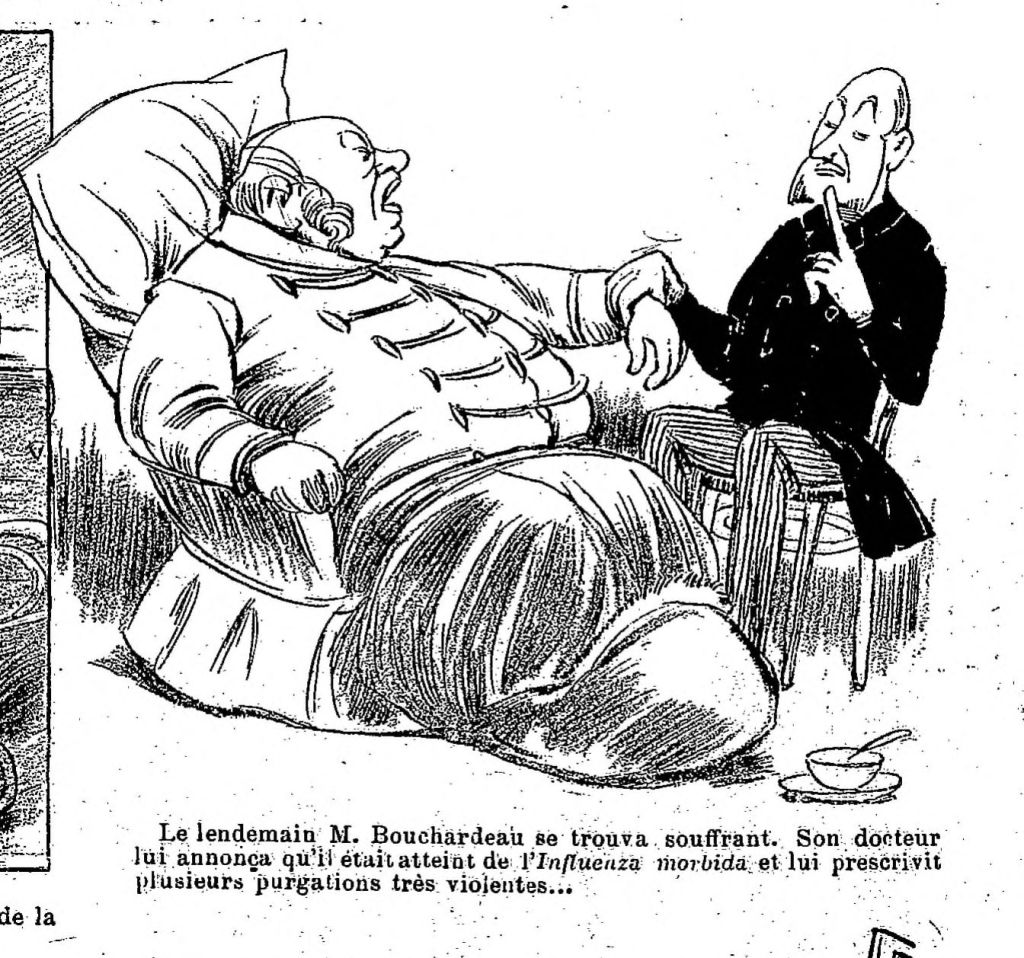
The next day Mr. Bouchardeau found himself ill. His doctor told him that he had morbid influenza and prescribed several very violent purgations…
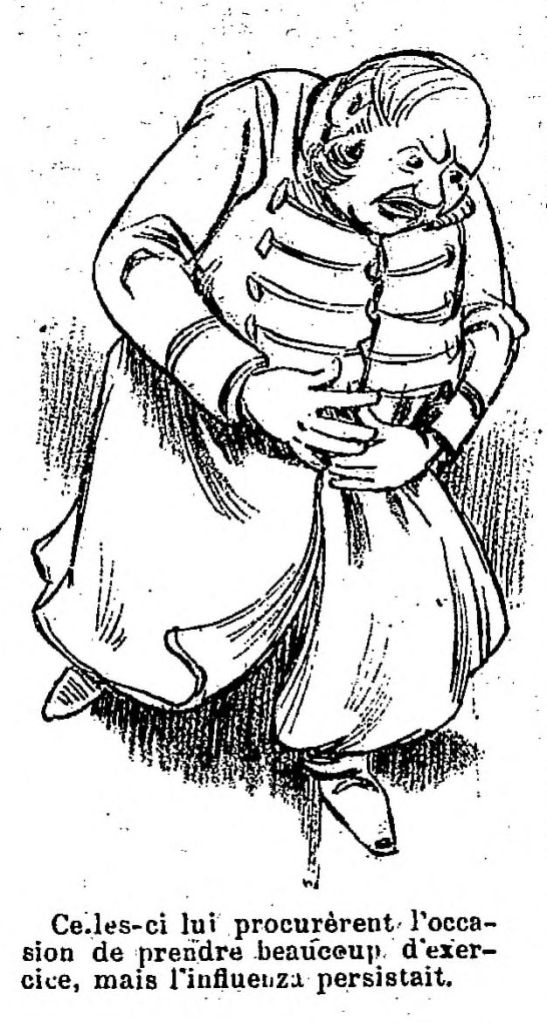
These gave him the opportunity to get plenty of exercise, but the influenza persisted.
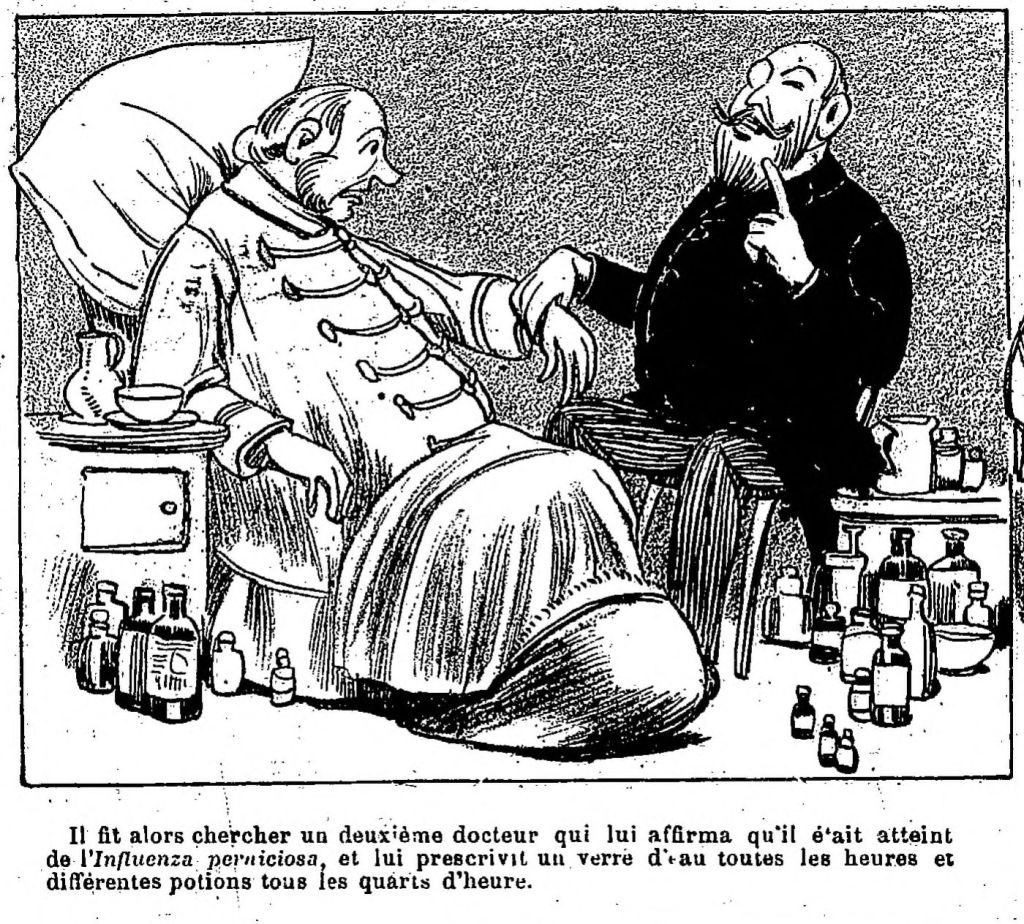
He then sent for a second doctor who told him that he had pernicious influenza and prescribed him a glass of water every hour and different potions every quarter of an hour.
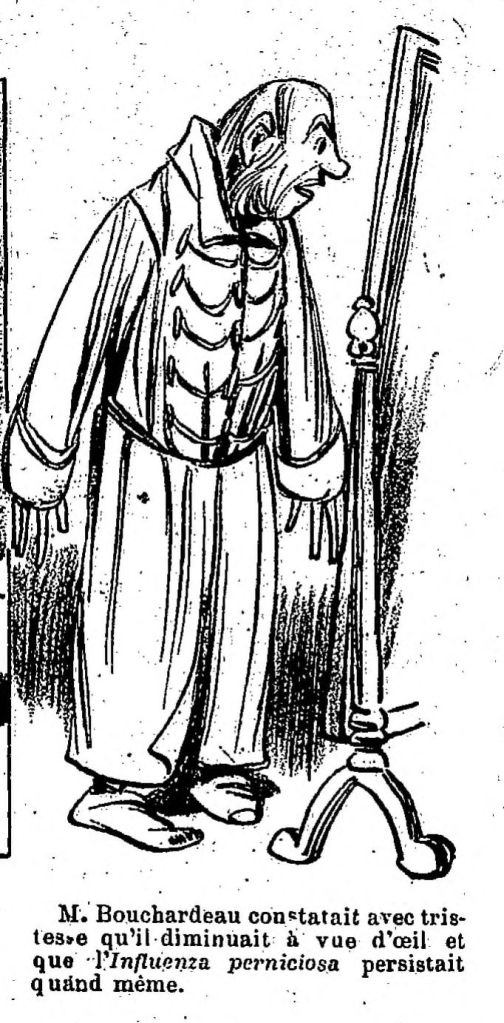
Mr. Bouchardeau noted with sadness that he was visibly declining and that the pernicious influenza persisted anyway.
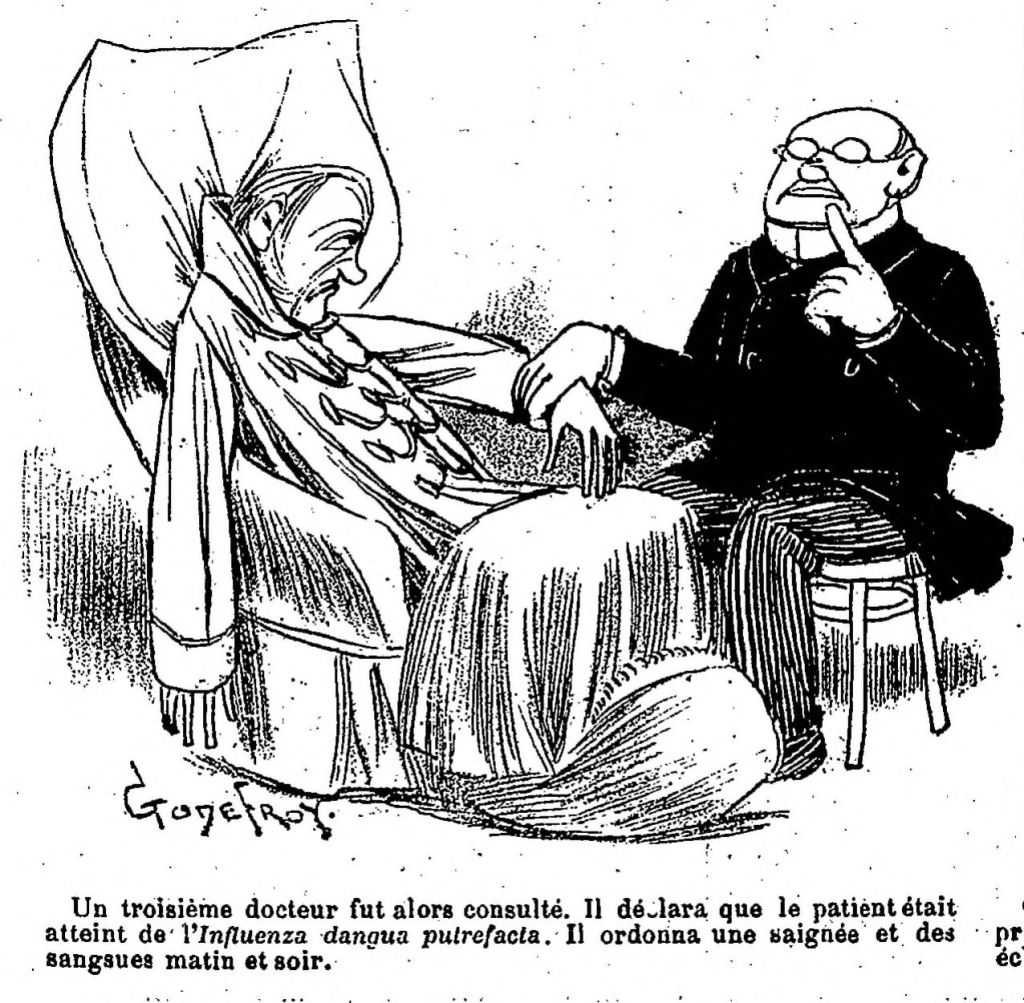
A third doctor was then consulted. He declared that the patient had influenza dangua putrefacta. He ordered bleeding and leeches morning and evening.
Thanks to the intelligent care of these three princes of science, Bouchardeau escaped a premature death.
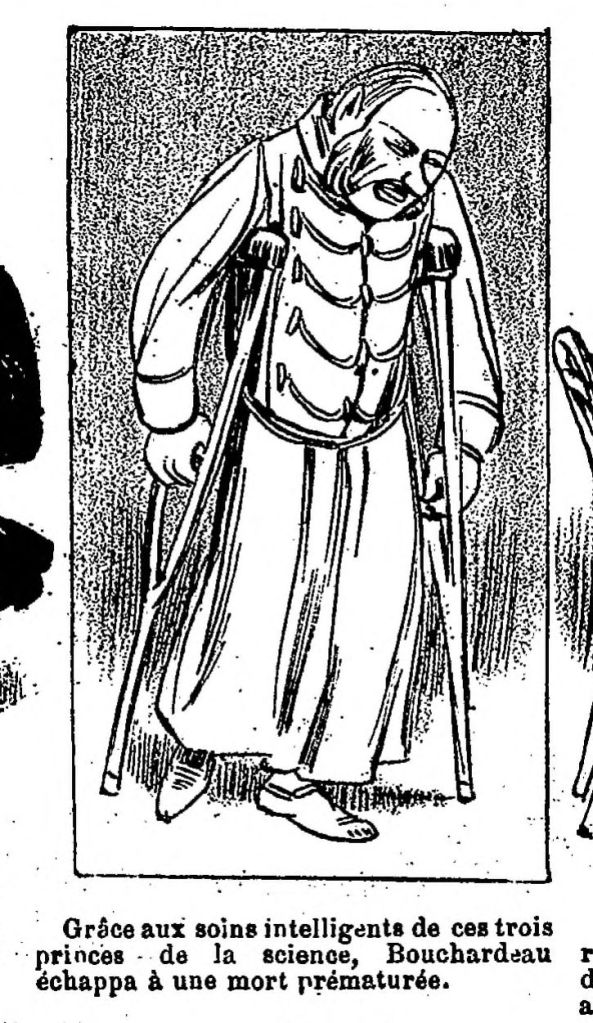
So it was with a feeling of deep gratitude that he paid the bills of doctors, pharmacists, herbalists, etc., who had contributed to his salvation. However, he reflected that the annual pumpkin dinner was costing him a bit dearly, and he resolved to abstain from it henceforth.

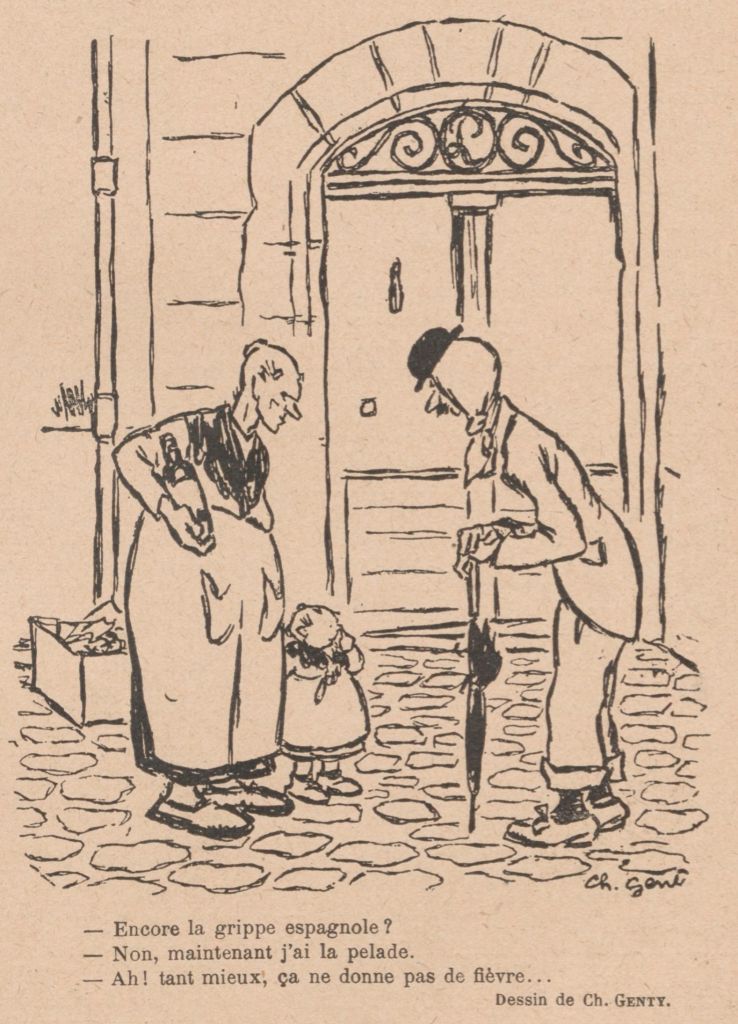
“The Spanish flu again?”
“No, now I have alopecia.”
“Ah! so much the better, it won’t give you fever…”
(Le Rire, Paris, 1918)
 Sic Transit Pestilentia