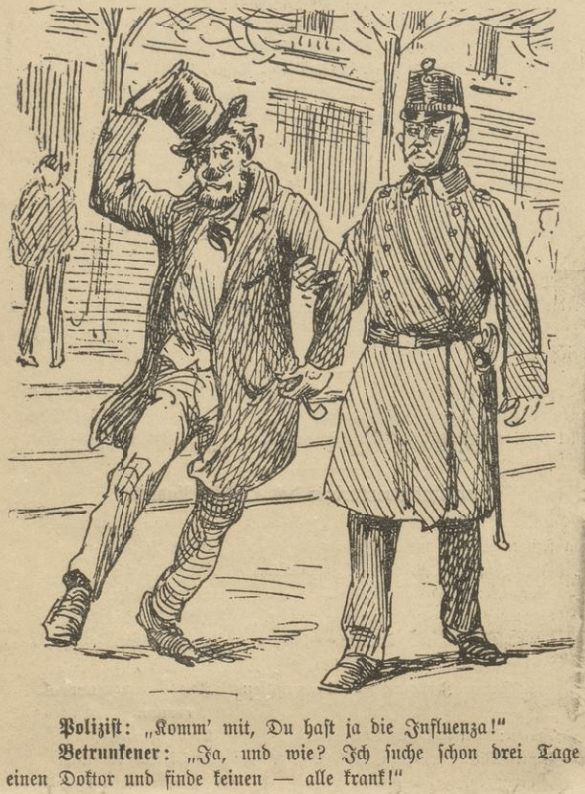
Policeman: “Come along, you have influenza!” Drunk: “Yes, and how? I’ve been looking for a doctor for three days and can’t find one — they’re all sick!”
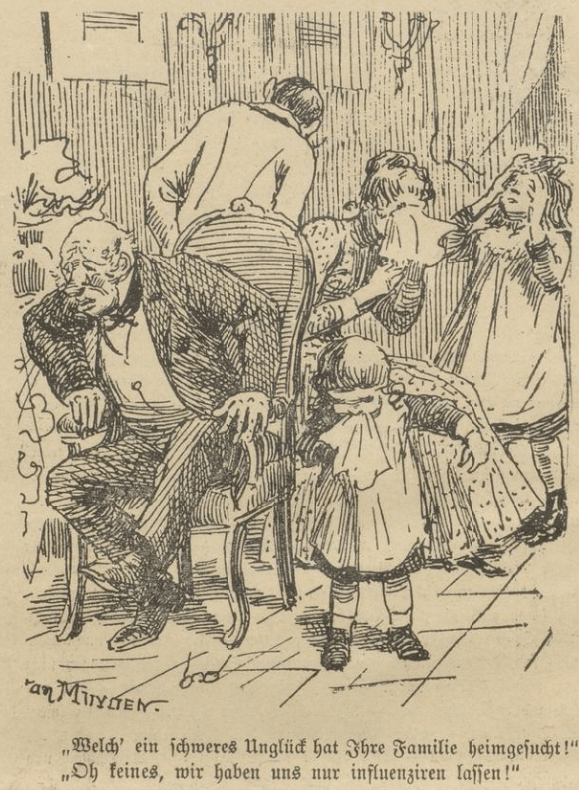
“What a serious misfortune has afflicted your family!” “Oh, it’s nothing, we only let ourselves be influenzed!”
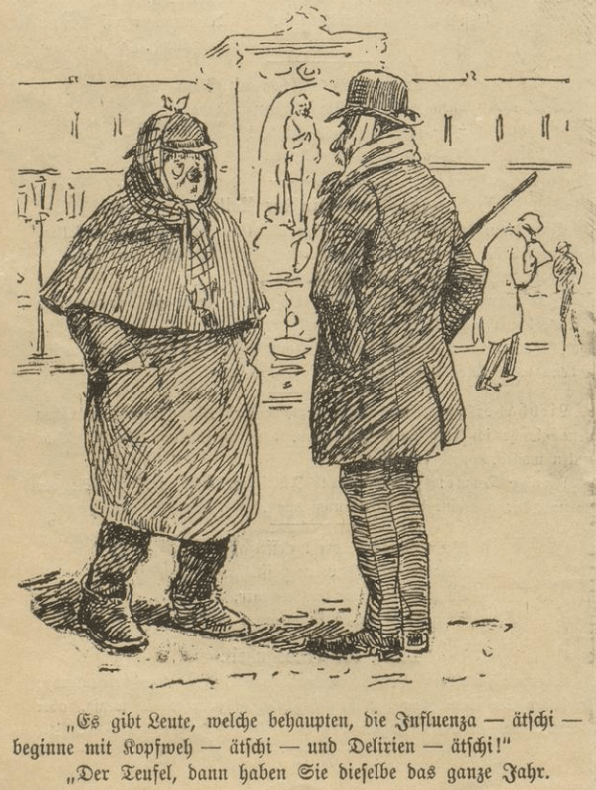
“There are people who claim that influenza (achoo!) starts with a headache (achoo!) and delirium (achoo!).” “Hell, then you’ve got the same thing all year round.”
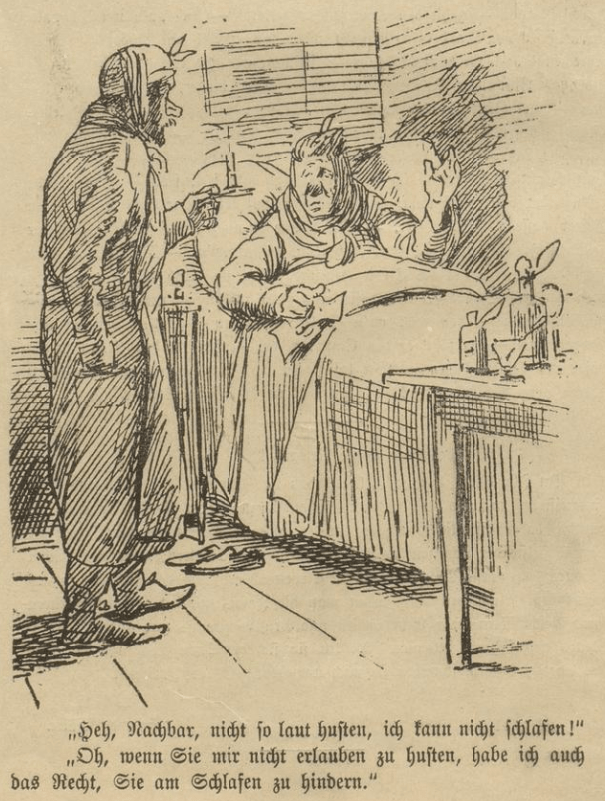
“Hey, neighbor, don’t cough so loud, I can’t sleep!” “Oh, if you don’t allow me to cough, I have the right to stop you from sleeping.”
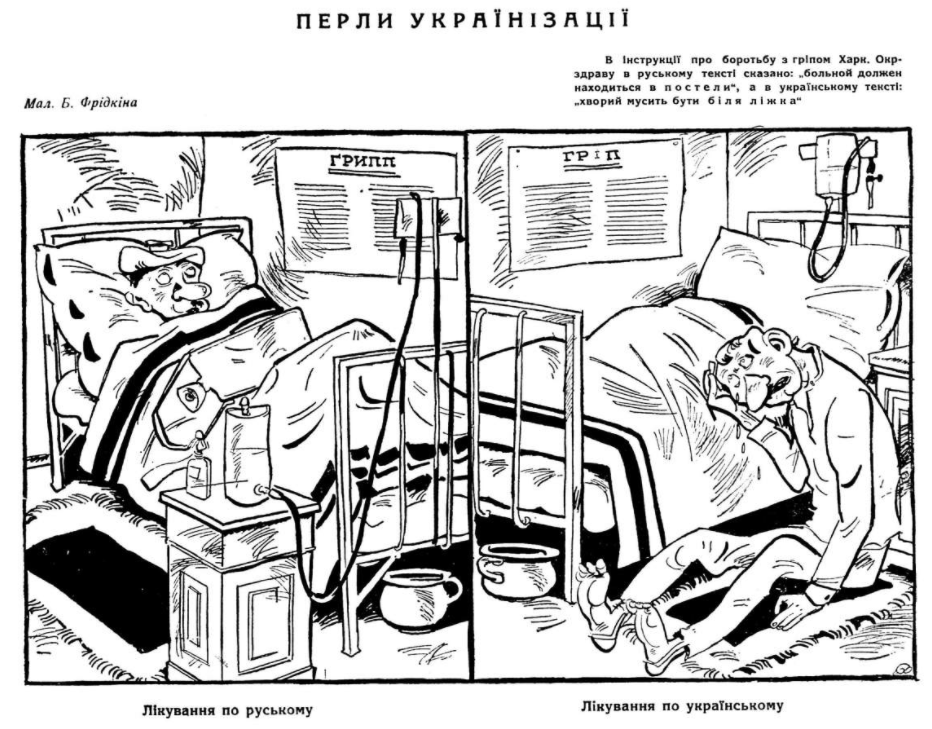
(In the official Instructions for fighting the flu issued by the Kharkov regional public health authorities it says in the Russian text: “The patient must be kept in bed,” but in the Ukrainian text: “The patient must be at the bedside.”) Left panel: Treatment in Russian Right panel: Treatment in Ukrainain (Perets, Kharkiv, 1928)
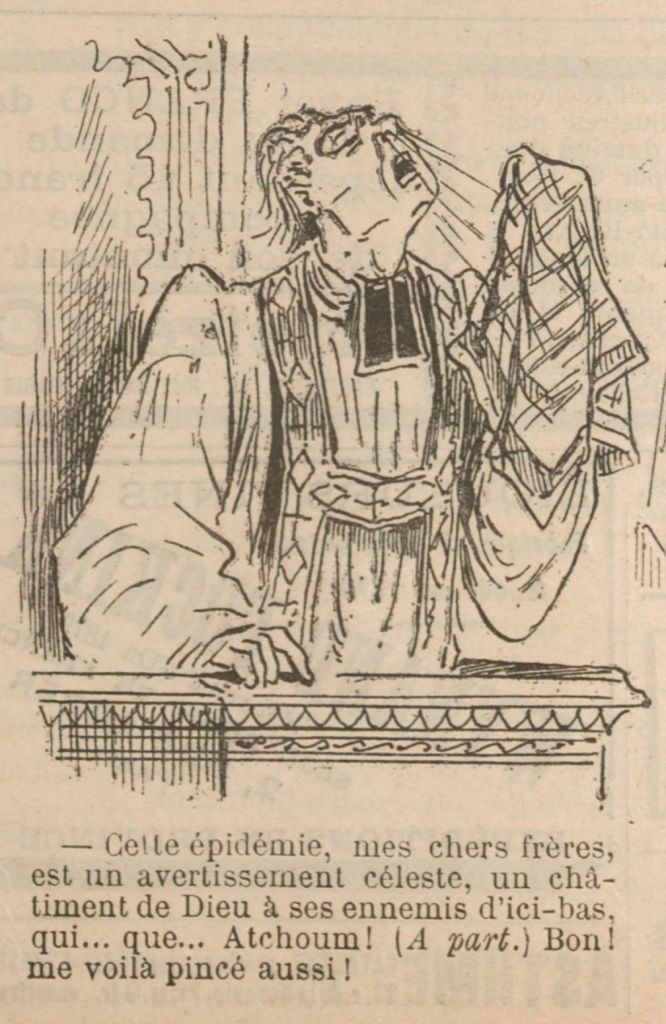
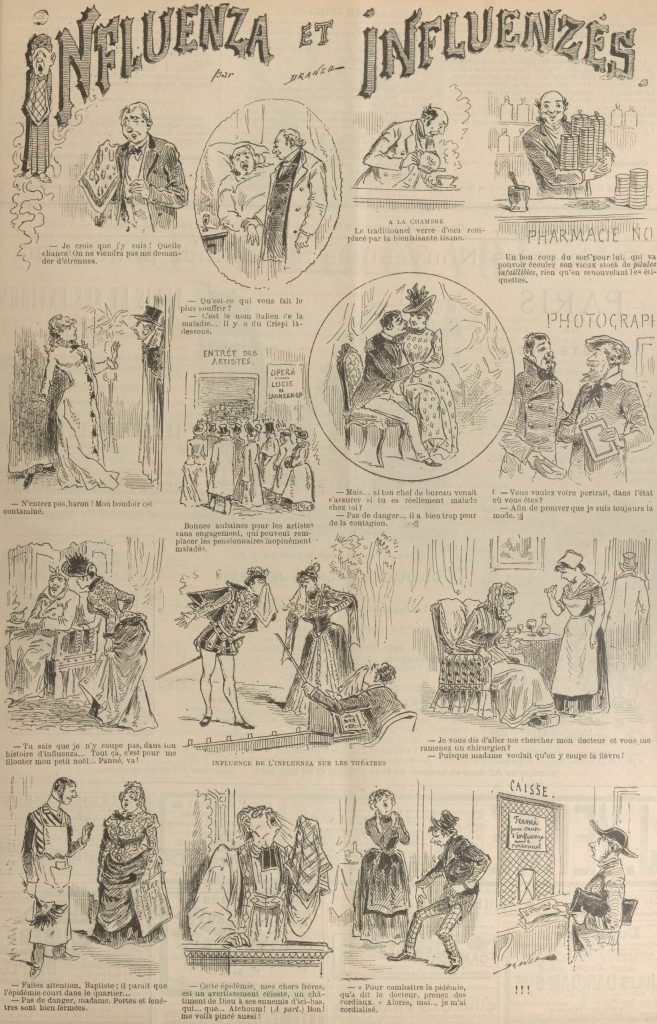
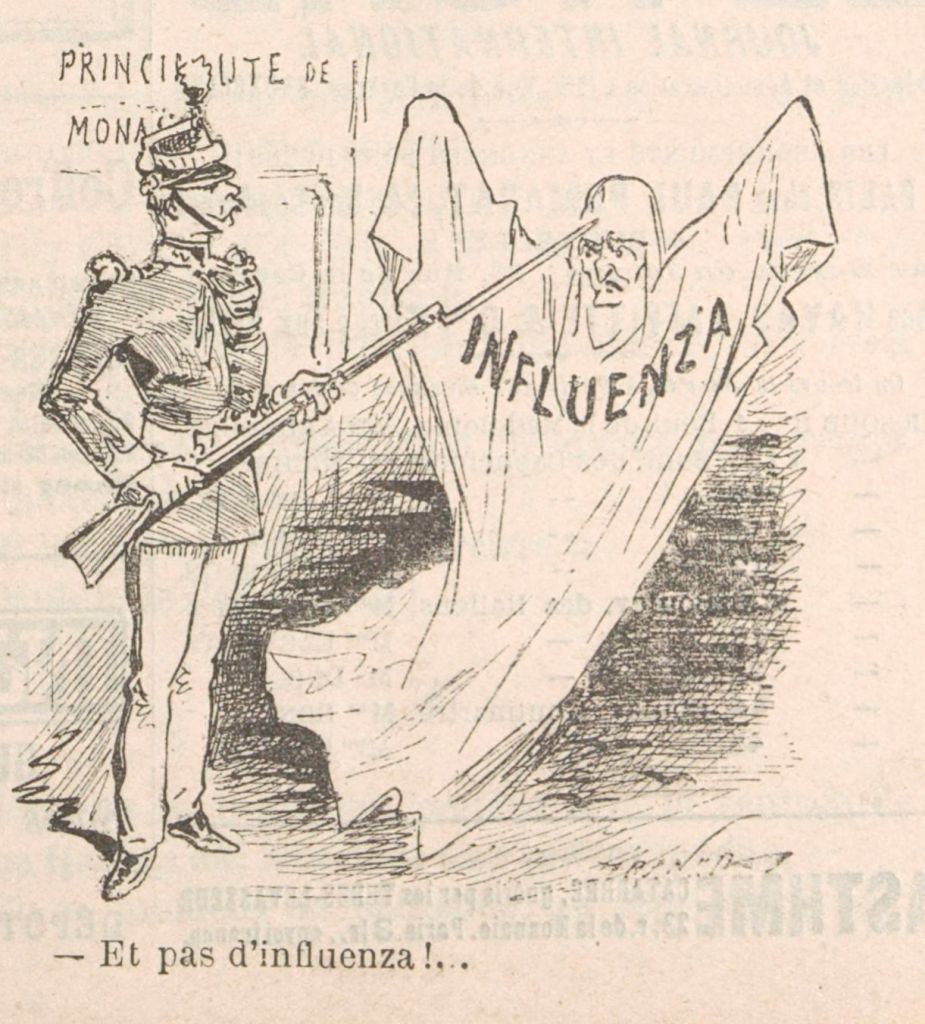
This epidemic, my dear brothers, is a heavenly warning, a punishment from God to his enemies here below that… that… Achoo! (Aside) Fine! here I am affected, too! (detail from full cartoon below, Le Charivari, Paris, 1889)
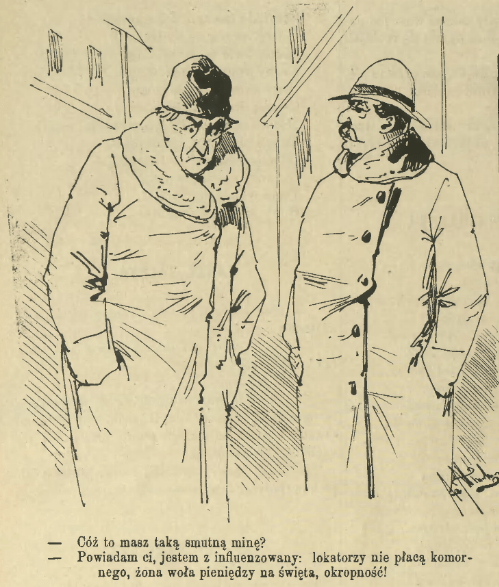
“Why do you have such a sad face?” “I tell you, I’m down with influenza: tenants don’t pay the rent, the wife wants money for the holidays, it’s horrible!”
Polish flu cartoon
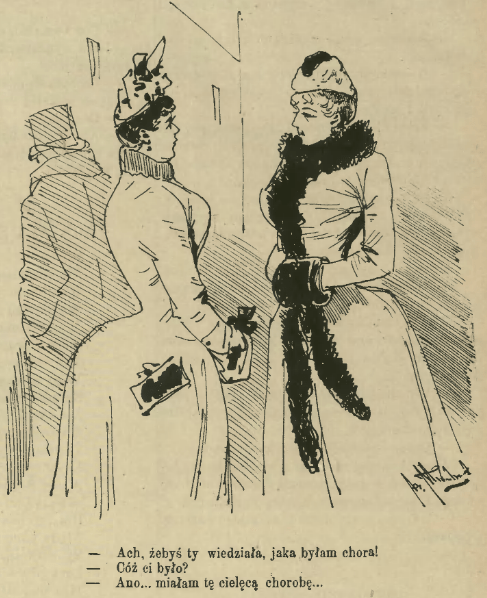
“Oh, if only you knew how sick I was!” “What was wrong with you?” “Well… I had this bovine disease…”
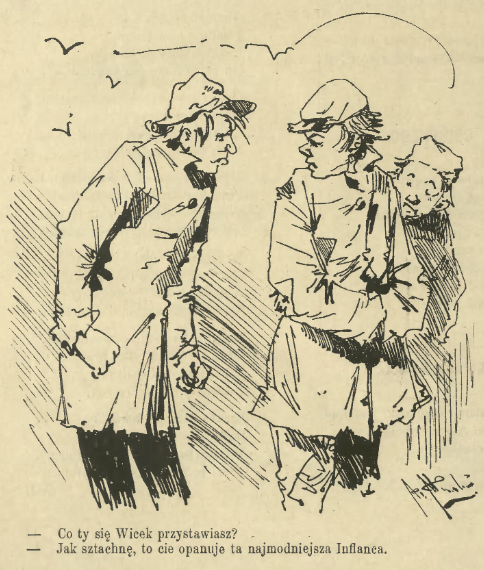
“What are you putting on, Wicek?” “Like a cloud of smoke, you will be overwhelmed by this super fashionable Inflanza.”
“Is the lady at home?” “She is, but she is not receiving anyone, because she has this weakness known as intelligence.”
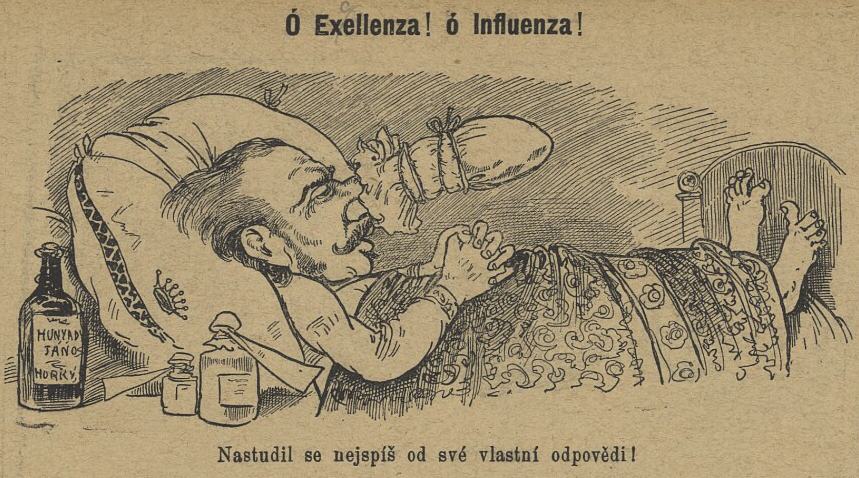
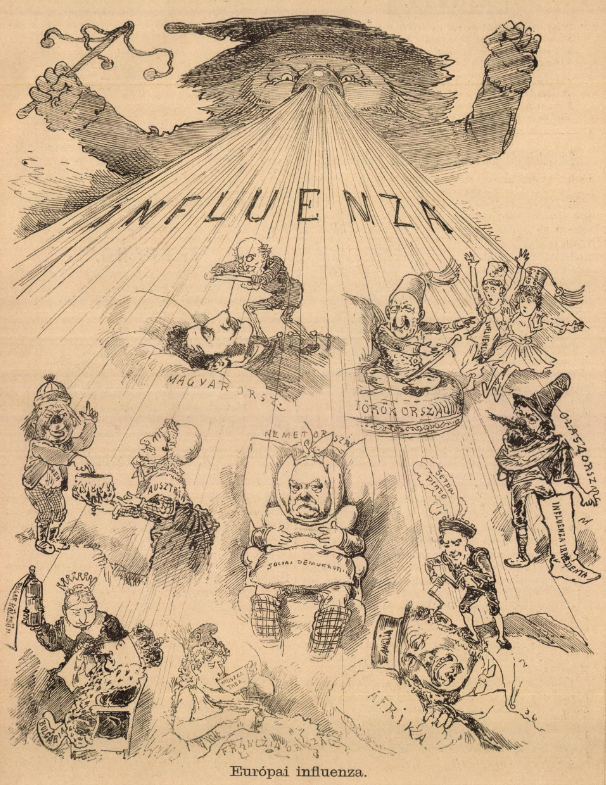
The visual joke here is quite simple, with the title punning on the original Italian sense of influenza as influence. Yet the underlying source of its amusement to contemporaries is not readily apparent to us today. The bedridden figure depicted is Austrian Minister-President Count Taaffe, who came down with a mild case of influenza late in December 1889, at the height of the European epidemic that winter. A masterful coalition-building aristocrat who had balanced Austro-German nationalism against Bohemian-Czech nationalism for much of the 1880s, mostly in service to conservative Liberal and noble landowning interests, Taaffe had finally been stymied by the Bohemian diet elections a few months earlier, when the Young Czech nationalists gained the upper hand. Taaffe’s failing confidence in his own rhetorical ability to sustain coalition politics seems to be the central object of the satire here. At his bedside is a bottle of János Hunyadi Bitters, a real product borrowing on the fame of a fifteenth-century Hungarian military hero–a marvelous touch. (Šípy, Prague, 1889)
Czech flu cartoon
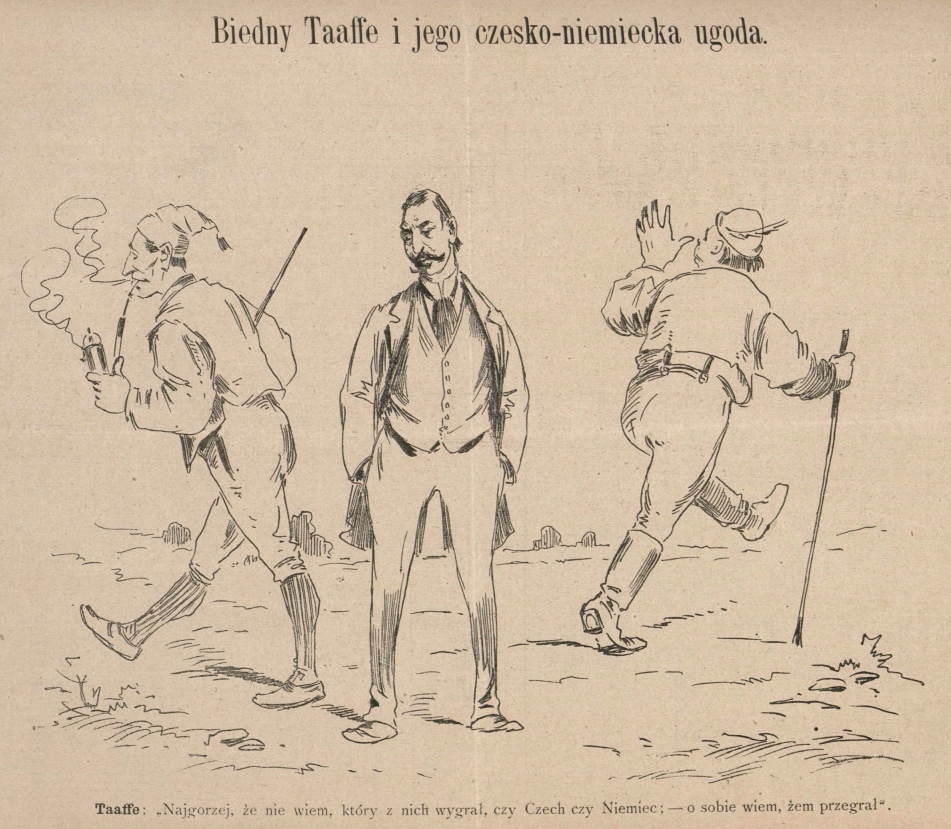
Taaffe’s declining fortunes are satirized in the Polish magazine Szczutek (Lwów, 1892):
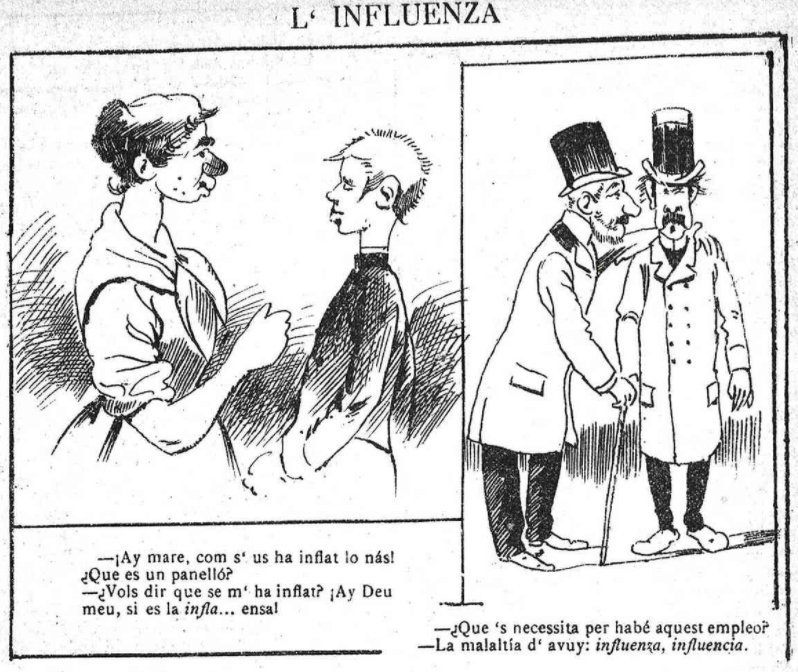
First panel: “Oh mother, how your nose is swollen! Is it chilblains?” “You mean, it’s inflated? Oh my God, if it’s the infla…enza!” Second panel: “What’s needed for this job?” “The disease of the day: influenza, influence.” (La Tomasa, Barcelona, 1892)
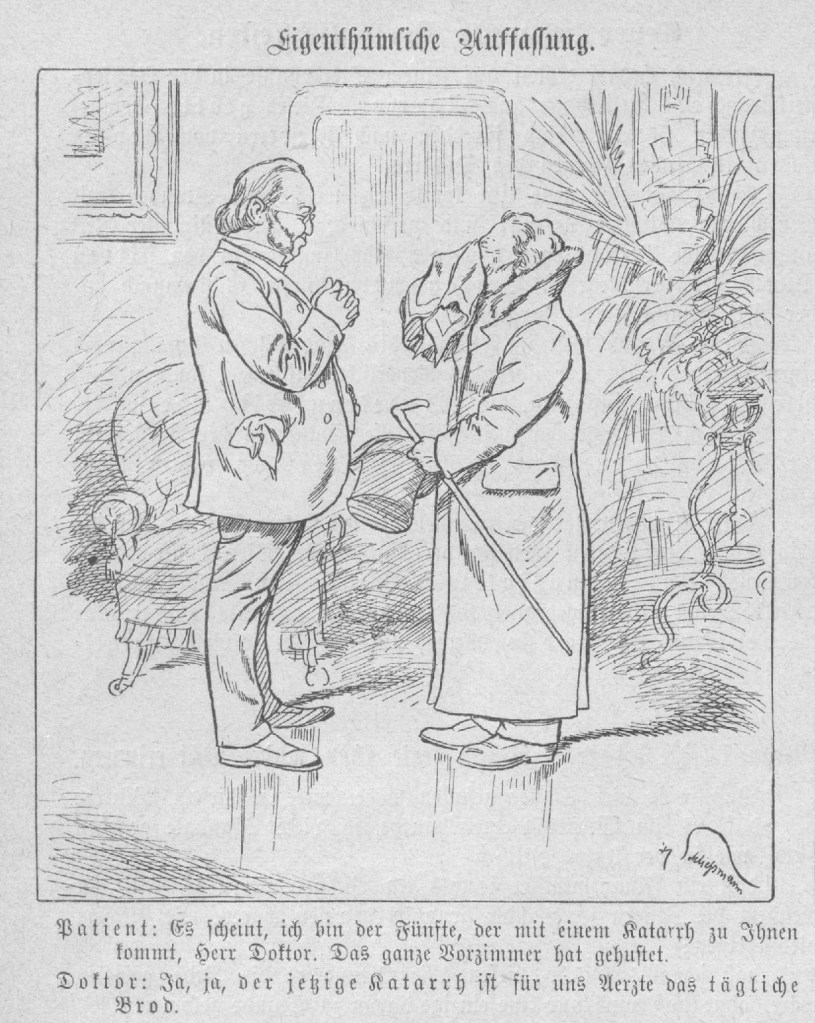
Patient: “It seems that I’m the fifth one coming to you with catarrh, Doctor. The entire reception area was coughing.” Doctor: “Yes, yes, the current catarrh is the daily bread for us doctors.” (Figaro, Vienna, 1889)
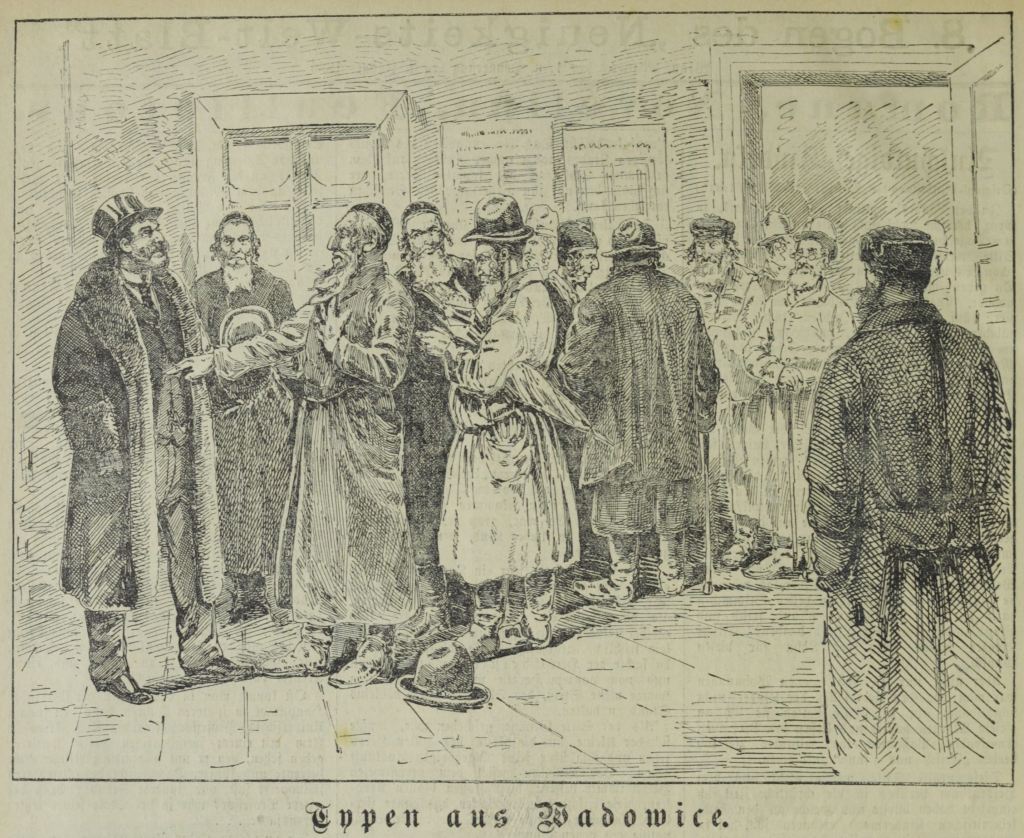
In the fall of 1889 sixty five Galician emigration agents and their associates (including state railway employees) were charged with fraud and other crimes in the course of facilitating emigration to America. At a time when emigration from the Habsburg and Romanov Empires to the United States was beginning its precipitous rise to historic levels after the turn of the century, domestic concerns about what kinds of people were going, under what conditions, and with what potential to maintain financial ties to their homelands all permeated the discussion around the trial, held in Wadowice southwest of Cracow. Many of the middlemen facilitating passage to trans-Atlantic ships out of Hamburg and Bremen came from Jewish backgrounds, while many local opponents of emigration, if not blatantly anti-Semitic, were increasingly fretting about the health of the remaining population (meaning a tangle of both medical-physical and organic-political characteristics). The popular press painted the accused as “humantraffickers,” “vampires,” and “slave traders and bloodhounds,” feeding a strong undercurrent of anti-Semitism. (See the authoritative account by Tara Zahra.) The “echo of the Wadowice trial reverberated across all of Europe,” fostering the conviction among local patriots that “the protection of native land and rational internal colonization should emerge from the fog of fantasies and good intentions and pass as soon as possible into the sphere of accomplished deeds.”
Large-circulation newspapers like Neuigkeits Welt Blatt in Vienna made certain that their readers could not miss the Jewish lineage of many of the shipping agents.
After months of testimony featuring hundreds of witnesses, the lead accused were sentenced to several years in prison. During the prolonged sensation that was the court trial, “Russian influenza” made its epidemic return to Central Europe, traveling quickly by rail and shipping routes from the northeast to the south and west. Though its symptoms were much less dramatic than cholera, influenza hit perhaps 40% of the Hungarian population that winter, for example, and as much as half of the German population, though the associated mortality rates were quite low.
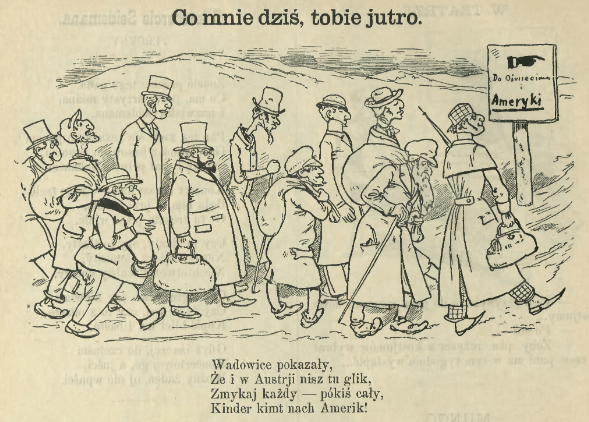
There was a mean-spirited Polish cartoon related to the trial. (The text contains Yiddishisms, so my rendering is surely problematic.)
What’s for me today is for you tomorrow. (sign pointing to the Promised Land of America) Wadowice showed That in Austria, too, good fortune is not here, Each keeps his mouth shut until everyone’s Children come to America! (Mucha, Warsaw, 1890)
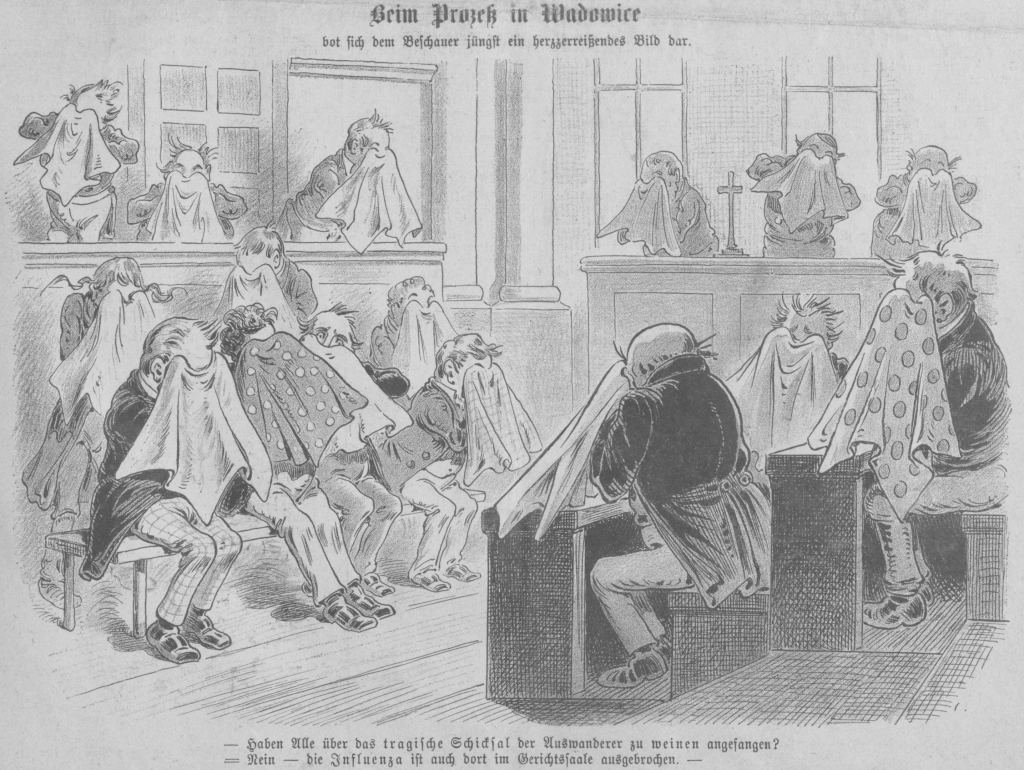
The cartoon below provides an uncomfortable linkage between the trial and the epidemic.
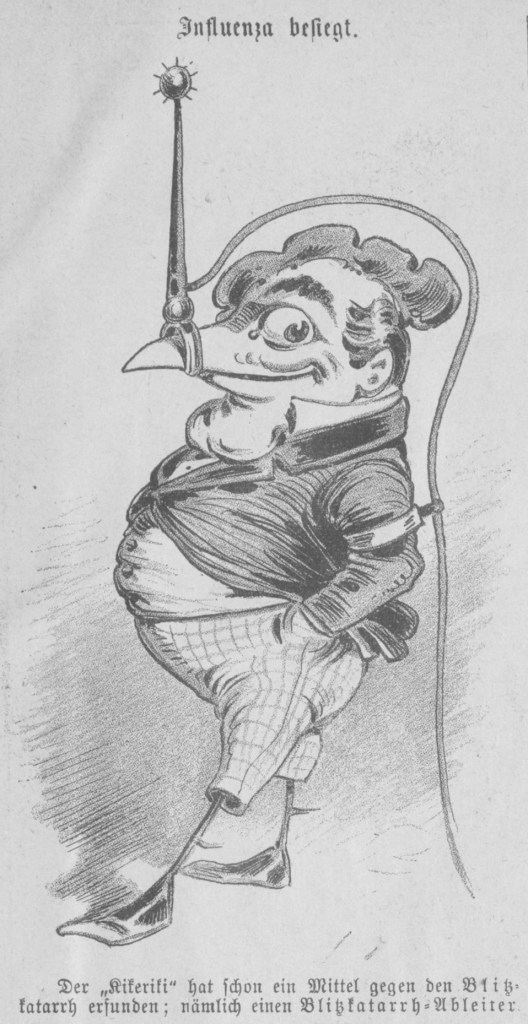
At the trial in Wadowice a heartrending picture presented itself to the onlookers. “Have you started crying about the tragic fate of the emigrants?” “No, influenza has broken out in the courthouse.” (Kikeriki, Vienna, 1890)
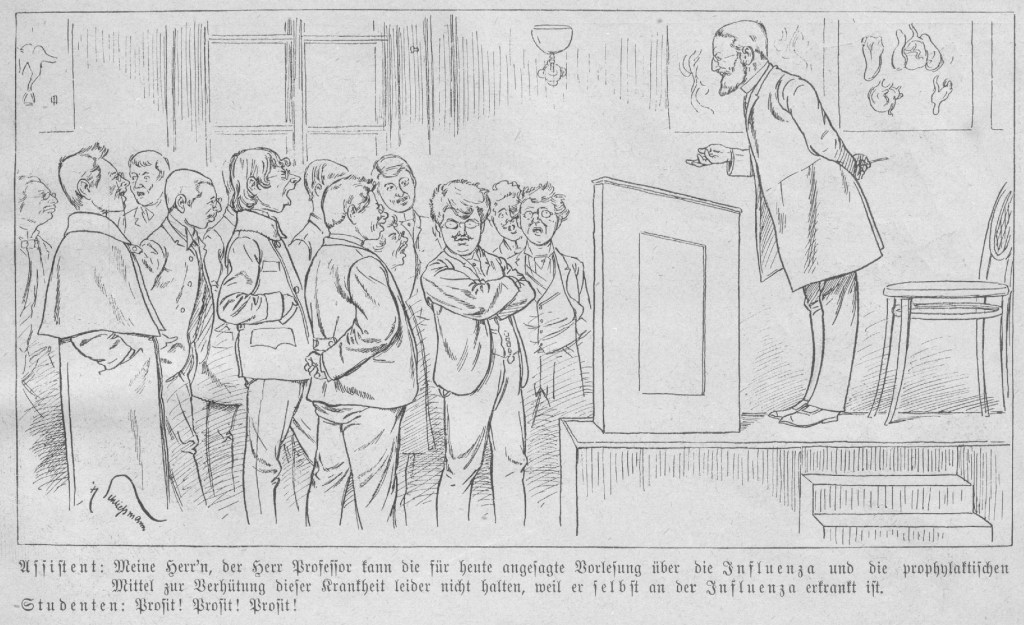
Professor’s assistant: “Gentlemen, unfortunately the professor is unable to give today’s scheduled lecture on influenza and the prophylactic means for preventing this illness, because he is himself sick with influenza.” Students: “Cheers! Cheers!” (Figaro, Vienna, 1889)

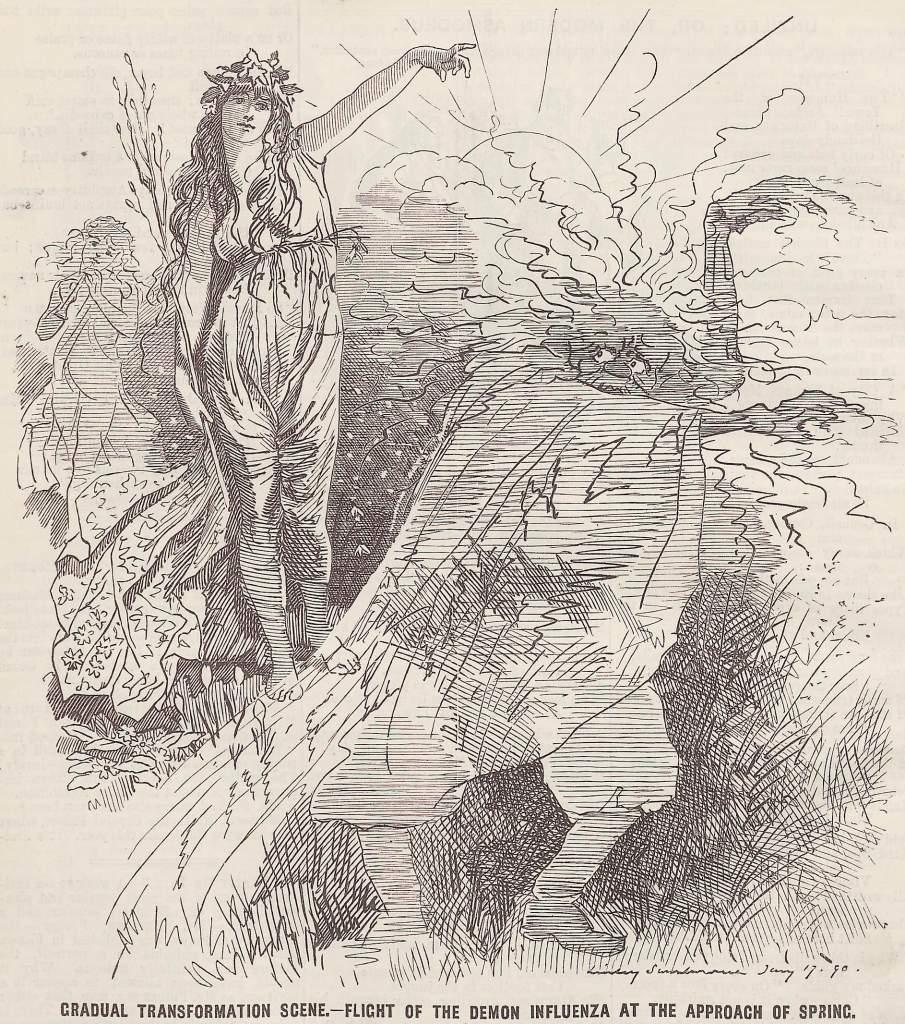

 Sic Transit Pestilentia