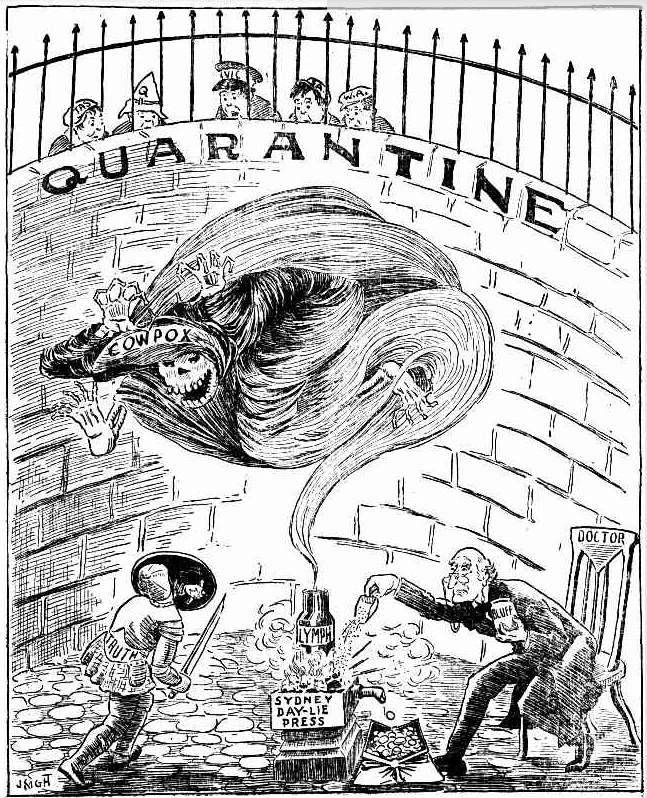
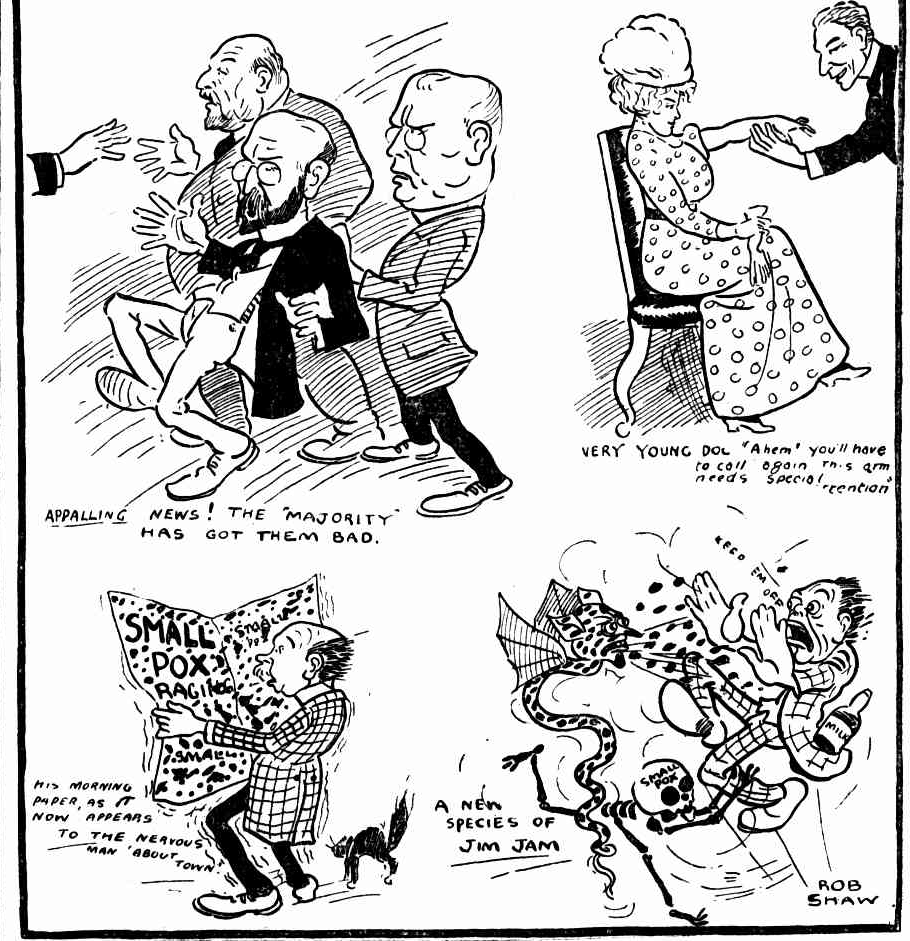
How the dodge is worked: And how it is being fought. (Truth, Sydney, 1913) (During a smallpox scare, compulsory vaccination seems to have aroused considerable opposition, including the sentiment that it constituted “a gross and filthy idolatry, an arrogant superstition, a giant delusion, deified as scientific by the medical fraternity.”)
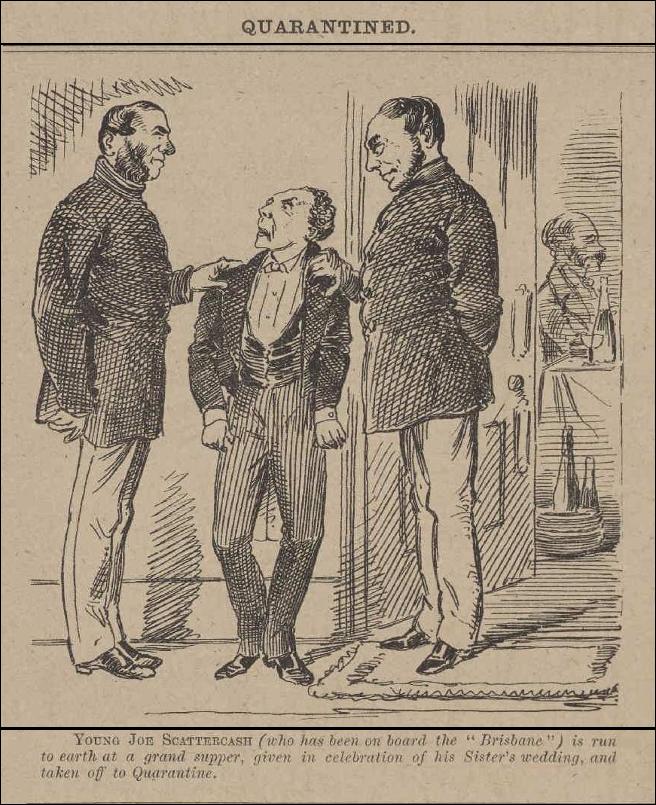
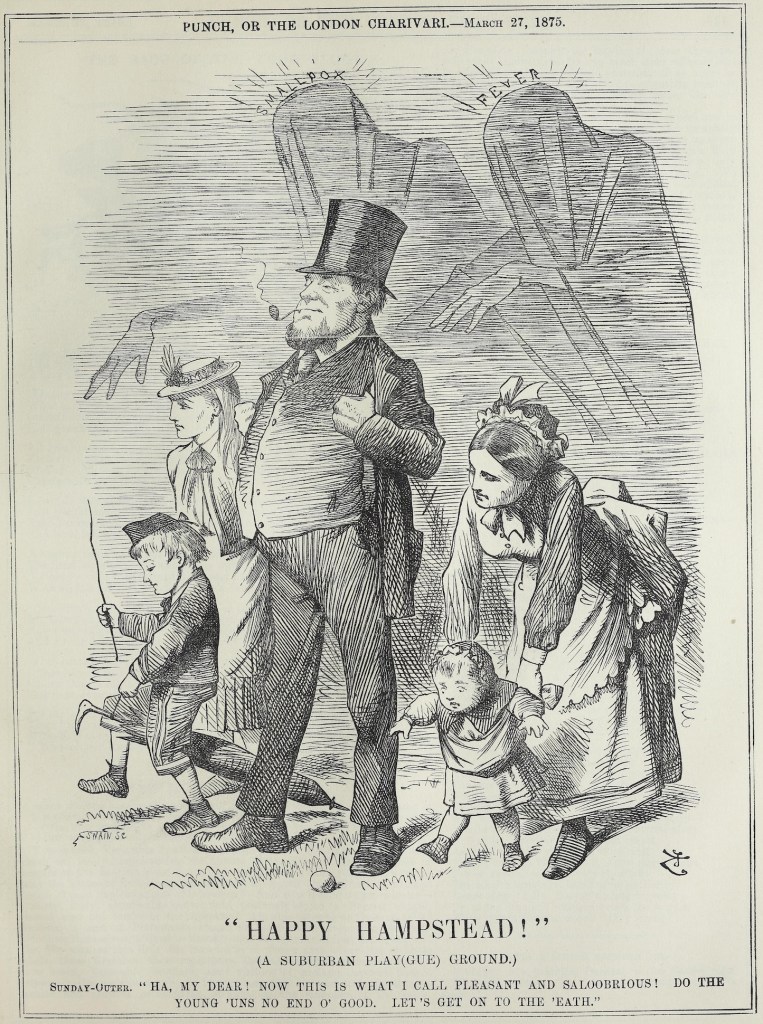
Young John Scattercash (who has been on board the “Brisbane”) is run to earth at a grand supper, given in celebration of his sister’s wedding, and taken off to quarantine. (Sydney Punch, 1877) (When Sir Arthur Kennedy, newly appointed as governor of Queensland, arrived on the steamer Brisbane from Hong Kong in March 1877, a “Chinaman” on board was found to be infected with smallpox. The ship and its hundreds of Chinese passengers were held in quarantine in Moreton Bay, but the political authorities dithered about whether Kennedy and his entourage should be exempted. A special medical commission was created to adjudicate, but this was widely dismissed as merely buying time to downplay a potentially unpopular decision that would be, at root, political. “The people of Australia are looked upon in England as being a trifle too democratic, as inclined to pay too little respect to high rank or exalted dignity,” proclaimed The Brisbane Courier. “It is reserved for the Imperial authorities to lower the state which has always been accorded to the Governor of Queensland, by sending us one, traveling to assume his Government, as a passenger on a merchant steamer crowded with hundreds of Chinese coolies… We have, however, a decided right to object to any relaxation of the precautions usually deemed necessary to prevent the landing of smallpox on our shores.” According to Krista Maglen, Australia favored quarantine as a tool of disease prevention well after Britain had abandoned this tactic, and not only for reasons of geographical isolation. This image makes clear the strong resonances with questions of class which quarantine also excited.)
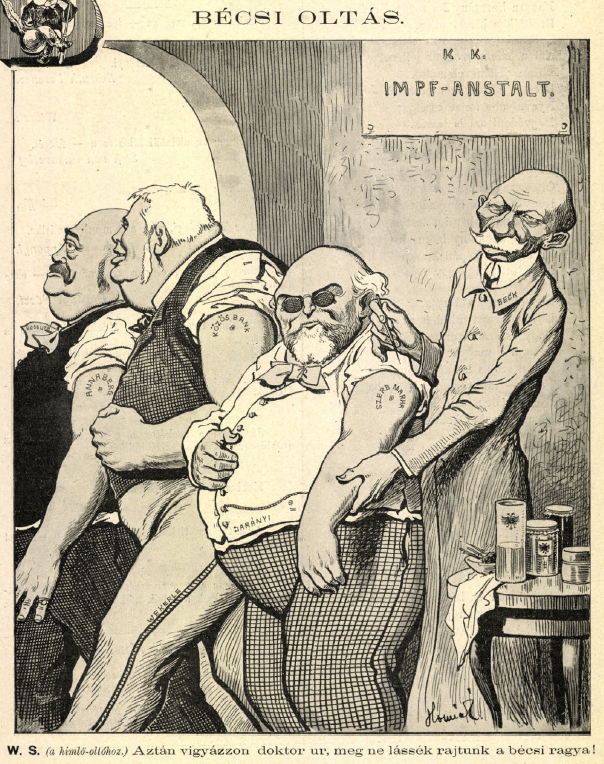
At the Imperial Royal Vaccination Institute [Austrian prime minister Count Max von Beck administering the shots to Hungarian ministers] Hungarian prime minister Sándor Wekerle [second from left] (to the smallpox inoculator) “Take care then, Doctor, we don’t want to be seen with the Viennese pock on us!” (Borsszem Jankó, Budapest, 1907) (The decadal negotiations to renew the 1867 Compromise between the Austrian and Hungarian halves of the Habsburg Empire were exceptionally contentious in 1907. The electoral franchise was broader in Austria than it was in Hungary, and Beck threatened to extend it to the Transleithanian portion of the empire, which would have threatened the ability of Hungarian politicians to control the fractious minorities who slightly outnumbered the Hungarian population. The mark on Minister of Agriculture Ignác Darányi’s shoulder reads “Serbian livestock,” signaling grudging Hungarian accession to a common tariff agreement, while Wekerle’s reads “common bank,” i.e., shared currency.)
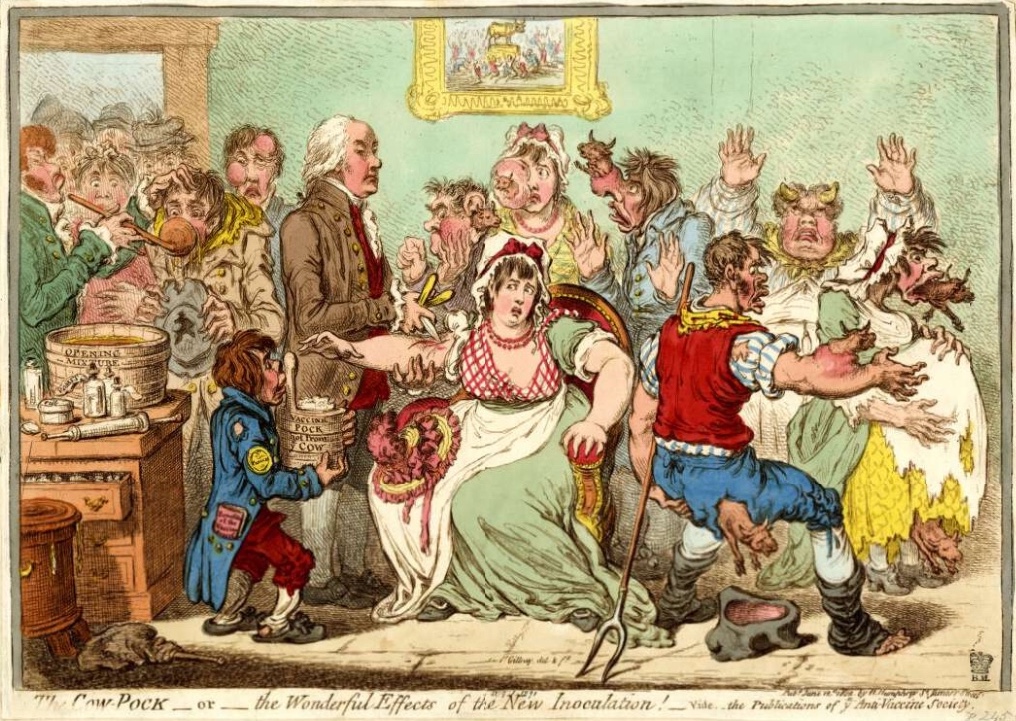
This famous cartoon depicting Edward Jenner administering the smallpox vaccine was published by James Gillray in Vide – the Publications of ye Anti-Vaccine Society in 1802. See the full description by Hannah Humphrey at The British Museum.
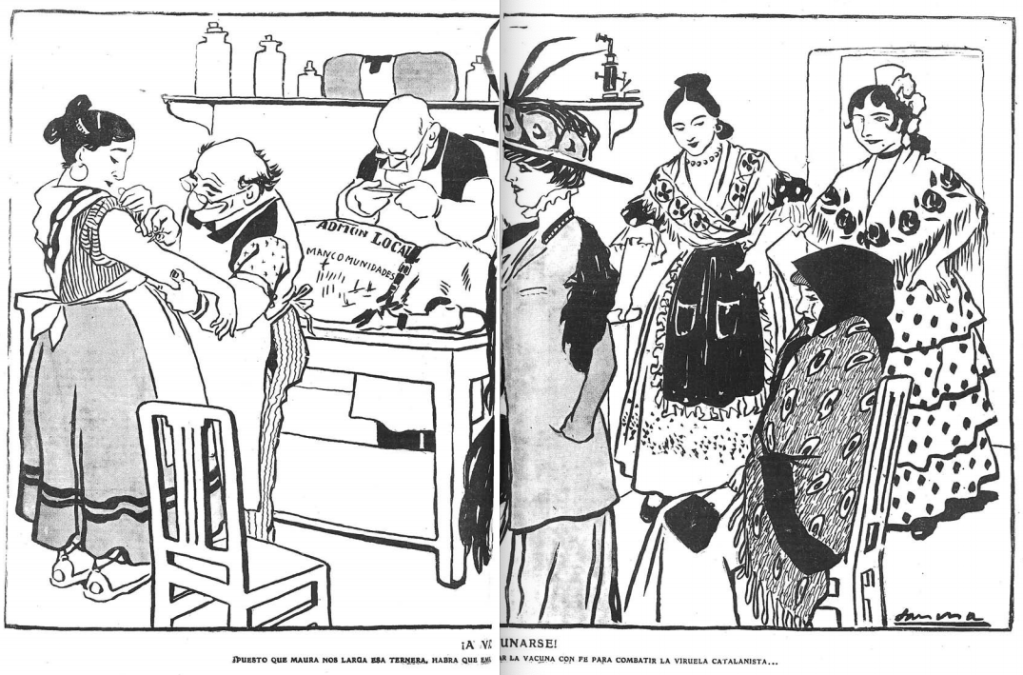
Since Maura gives us that veal, we will have to increase the vaccine with faith to combat Catalan smallpox… (Gedeón, Madrid, 1909) (Correction welcome!)
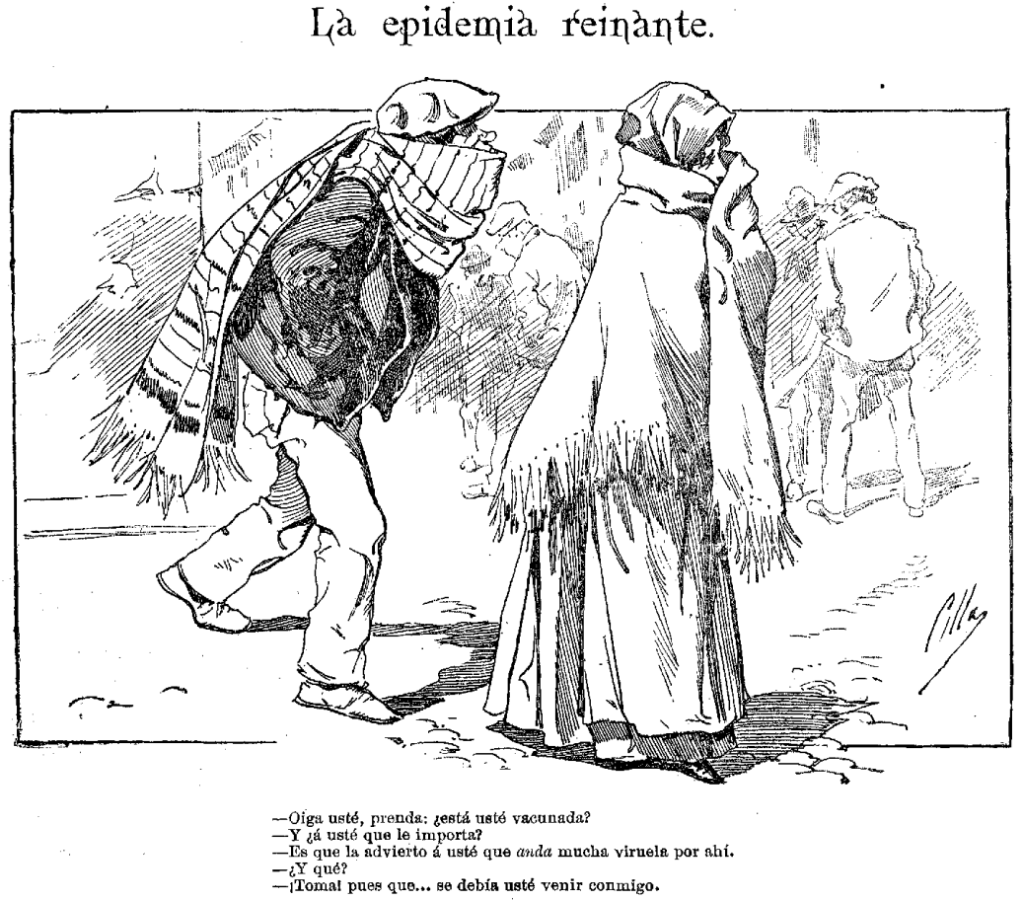
“Hey, gorgeous, are you vaccinated?” “And what do you care?” “I’m just warning you that there is a crazy lot of smallpox out there.” “So what?” “Come on, take a shot… you should come with me.” (Madrid cómico, 1896) (shaky with the idiom here)
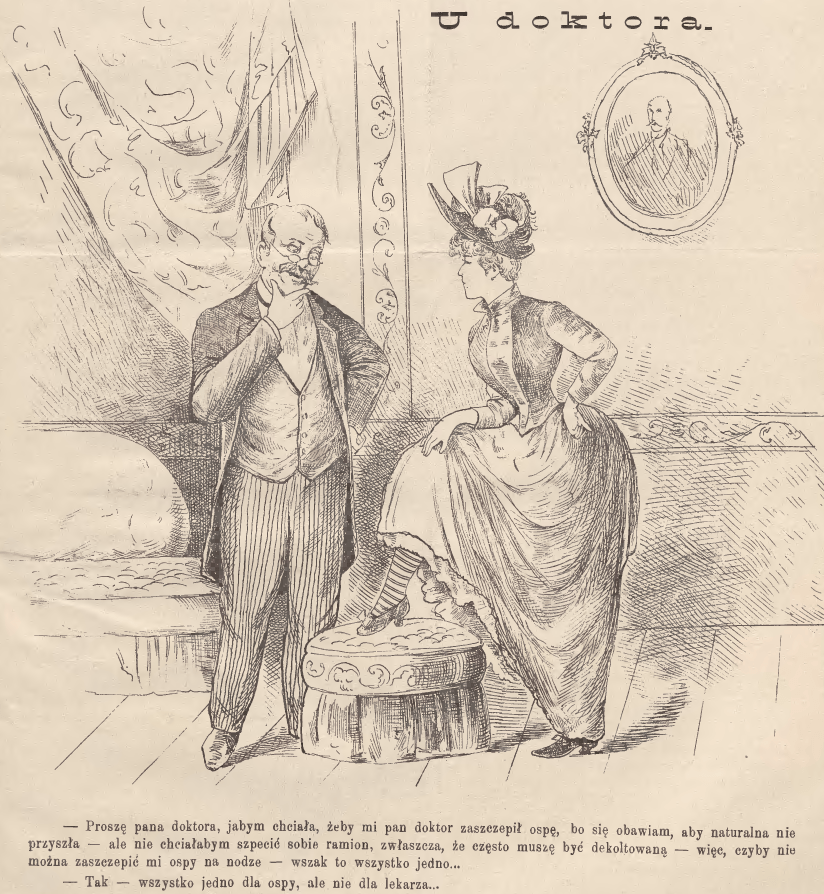
“Please, doctor, I would like you to inoculate me with [attenuated] smallpox, because I am afraid of getting the real thing. But I wouldn’t want to disfigure my shoulders [with a vaccination scar], especially since I often have to show décolletage. So can’t I be inoculated for smallpox on my leg? After all, it is all the same thing…” “Yes, it’s all the same for the smallpox, but not for the doctor…” (Goniec i iskra, Lwów, 1891)
Polish smallpox cartoon
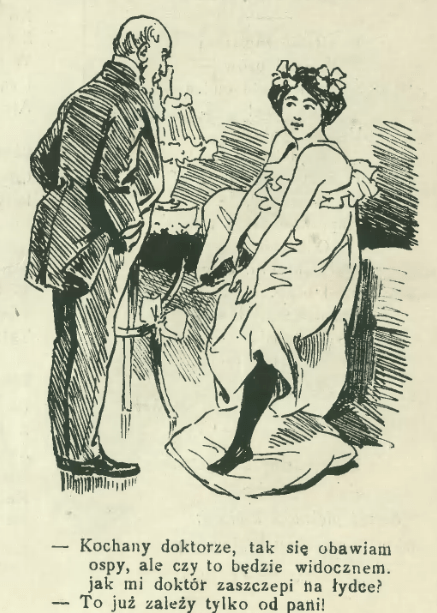
And a similar cartoon some years later: “Dear doctor, I am so afraid of smallpox, but will it be visible when you inoculate on my calf?” “It only depends on you!” (Kolce, Warsaw, 1908)
Polish smallpox cartoon
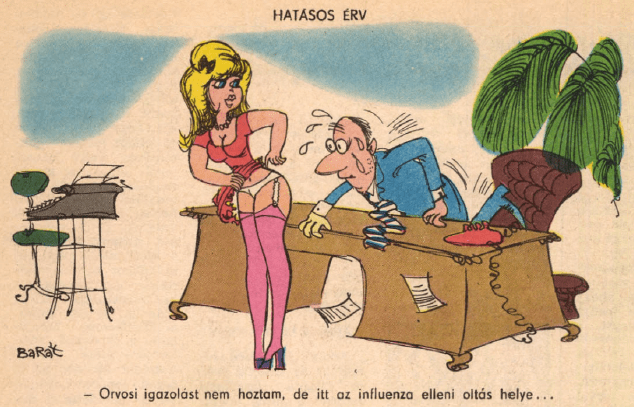
In the same sexist vein, a Hungarian cartoon: Effective argument “I didn’t bring the medical certificate, but here is the location for the flu vaccination…” (Ludas Matyi, Budapest, 1974)
Hungarian flu cartoon
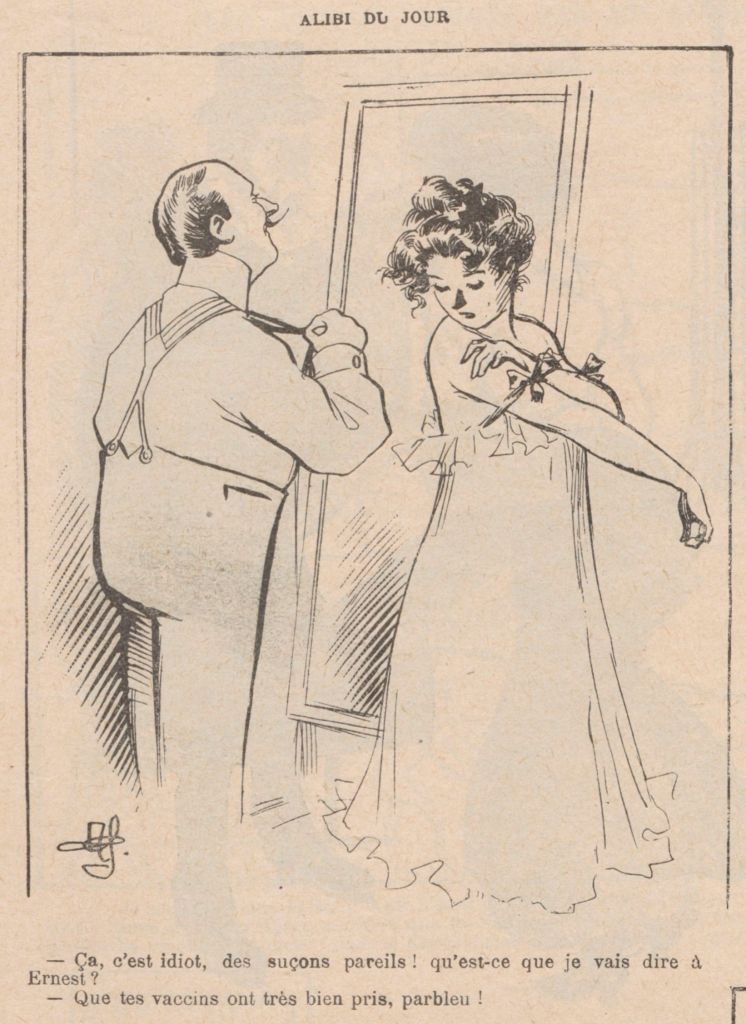
Or another twist: Alibi ju jour “This is silly, hickeys like that! What am I going to tell Ernest?” “That your vaccines have taken very well, by Jove!” (Le Rire, Paris, 1907) (Another French cartoon with related themes. And another from 1920.)
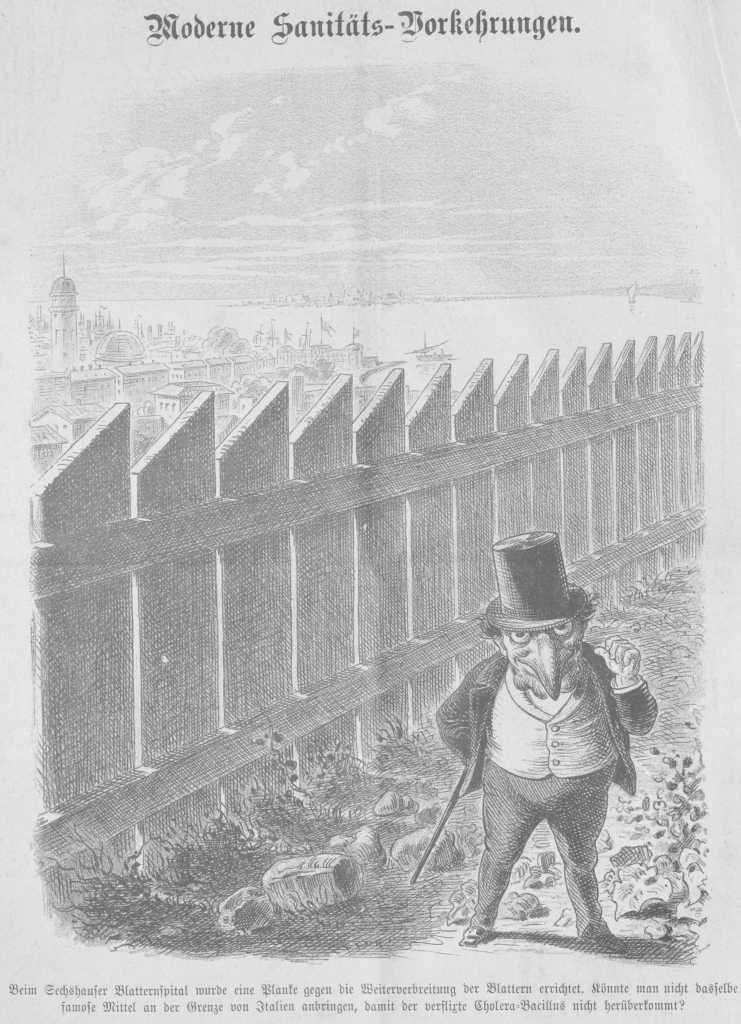
At the Sechshaufer Smallpox Hospital a barrier was erected against the spread of smallpox. Couldn’t one install the same splendid means along the border with Italy, so that the confounded cholera bacillus does not come over here? (Kikeriki, Vienna, 1886) (And in a similar vein.)
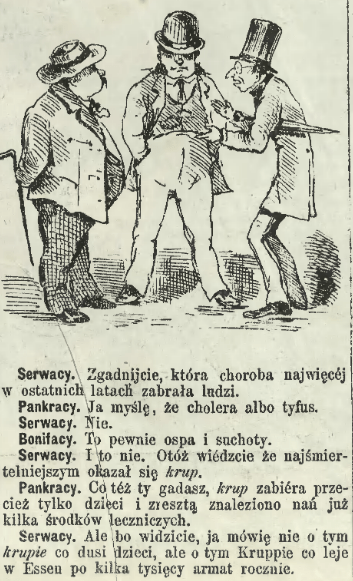
Servatius: Guess which disease has taken the most people in recent years. Pancras. I think it’s cholera or typhus. Servatius. No. Boniface. It’s probably smallpox and consumption. Servatius. Also no. So you should know that the croup was the most lethal. Pancras. What are you talking about, the croup only takes children, and anyway, several medications have already been found. Servatius. But because you see, I’m talking not about this croup that strangles children, but about this Krupp which pours several thousand cannons a year in Essen. (Mucha, Warsaw, 1875)
At the epidemic butcher: “I’ll take half a portion of smallpox microbes.” At the drugstore: “You would like typhus microbes? We don’t have fresh ones in the afternoon.” (La Esquelle de la torratxa, Barcelona, 1894)
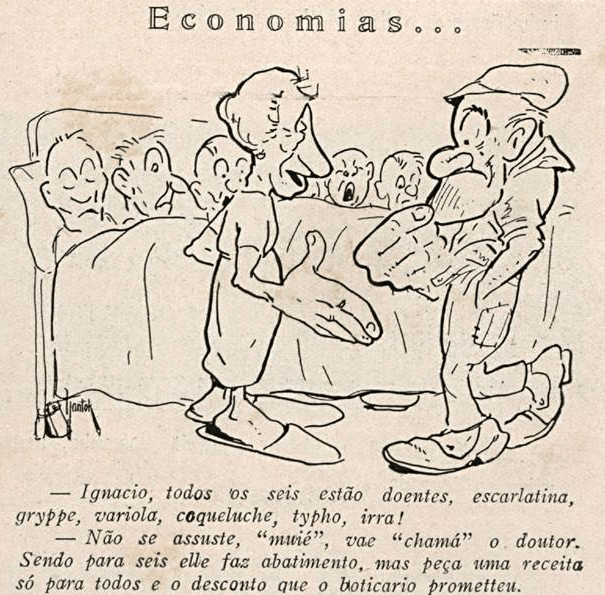
“Ignacio, all six of them are sick with scarlet fever, flu, smallpox, whooping cough, typhus, and choler!” “Don’t be scared, “girl,” go and “call” the doctor. For six he’ll make a discount, but ask for a prescription just for everyone and the discount that the pharmacist promised.” (O Malho, Rio de Janeiro, 1927)
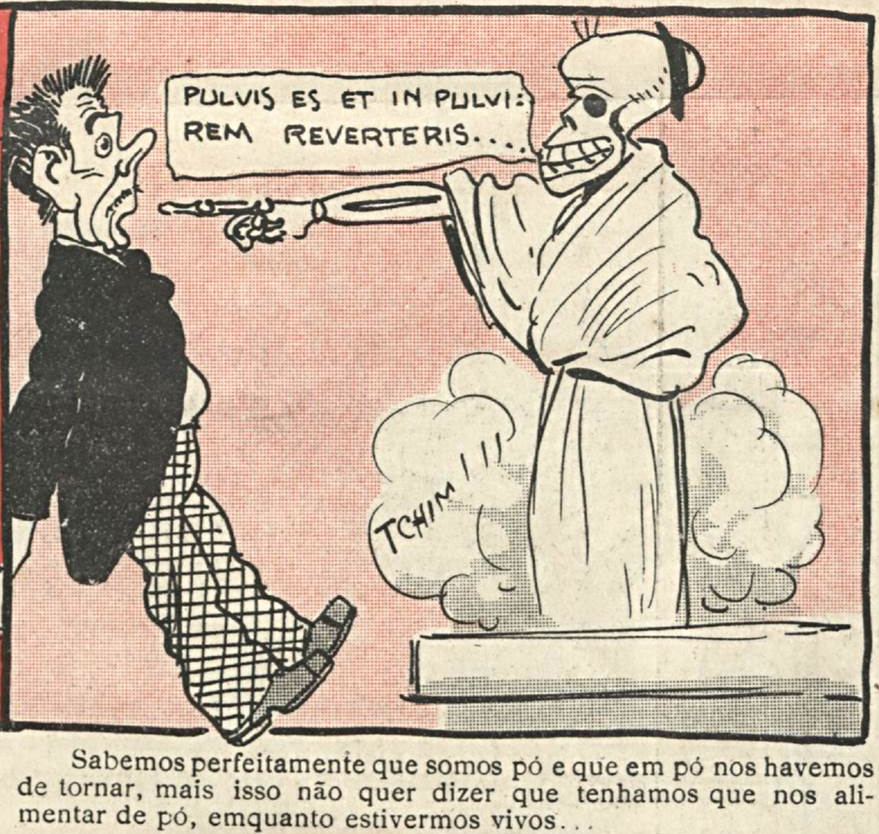
First two panels: (Image of a plate of Carioca dust [flour] with typhus, tuberculosis, yellow fever, smallpox, plague, gastroenteritis, etc. “Carioca” is a way of referring to the inhabitants of Rio de Janeiro.) “We knew the dust of Persia, we knew gold dust, monkey dust and Joanna dust, the river Po [“pó” meaning dust], etc., but… we are completely unaware of this new dust that invades us, suffocates us, and that kills us: the dust from Rio de Janeiro.”
Deathly figure: “Dust thou art, and to dust thou shalt return…” “We know perfectly well that we are dust and that we shall become dust, but that does not mean that we have to feed on dust while we are alive…” (and four more panels of quirky municipal politics…) (O Malho, Rio de Janeiro, 1911)


 Sic Transit Pestilentia