“Madame, he has galloping consumption.”
“Oh, that’s reassuring, he was always a good rider!”
(Nebelspalter, Zurich, 1944)
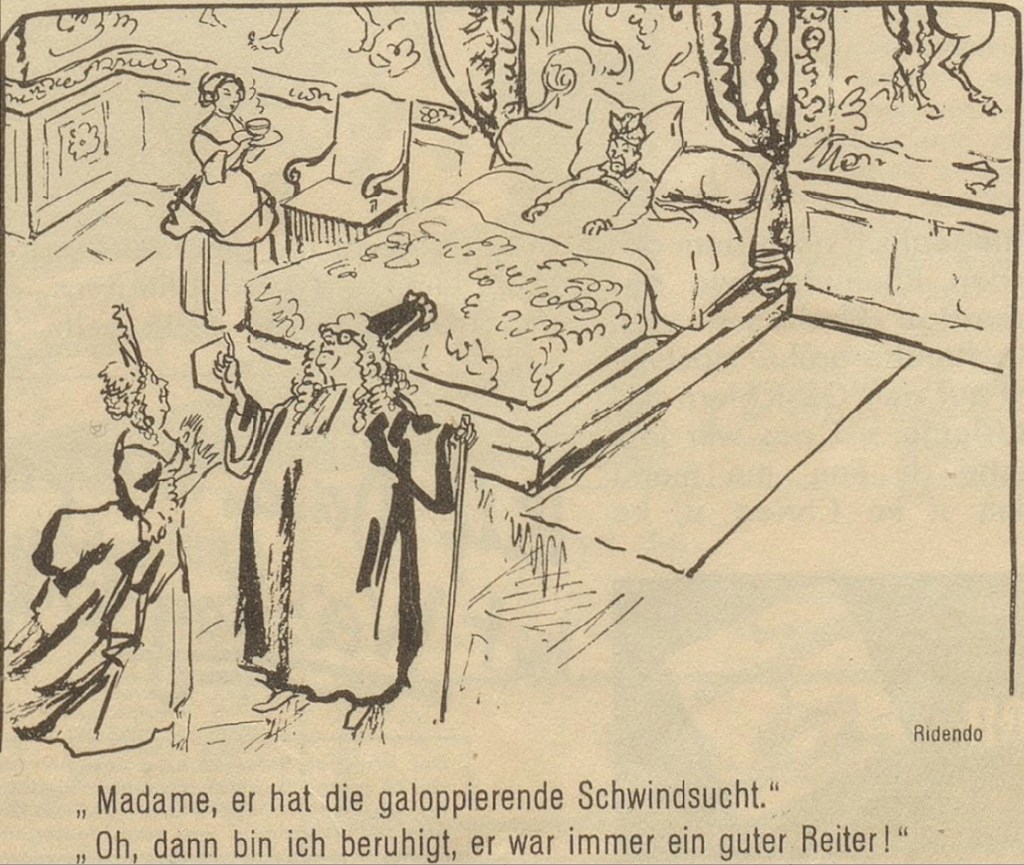
“Madame, he has galloping consumption.”
“Oh, that’s reassuring, he was always a good rider!”
(Nebelspalter, Zurich, 1944)
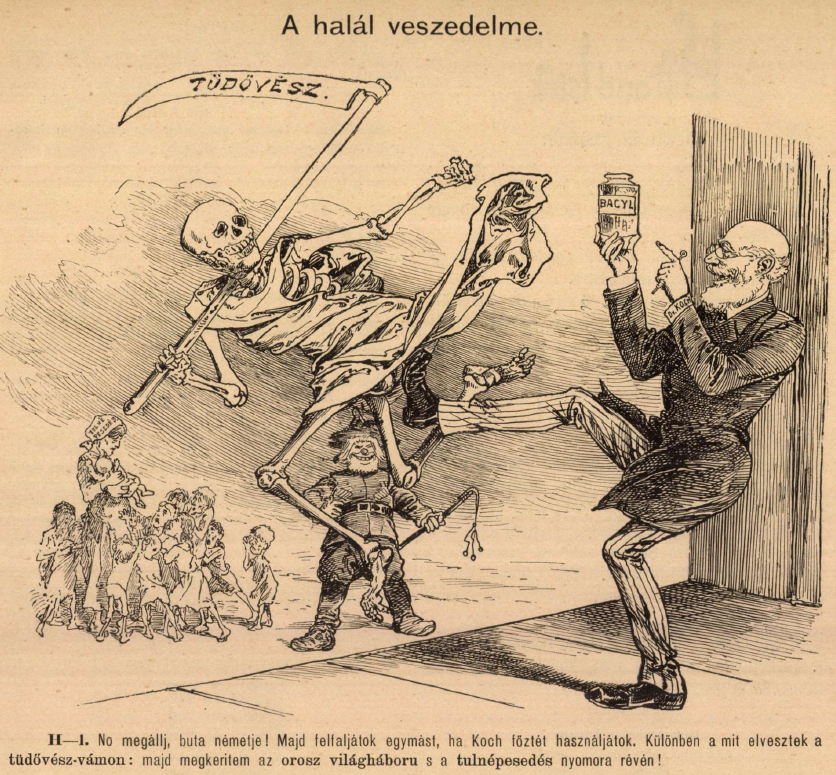
Death: “Well, stop it, silly German! You’re about to devour each other if you use Robert Koch’s concoction. Anyway, whatever I lost in my tuberculosis tariff, I will get hold of through the misery of the Russian world war and overpopulation!” (A reference to the Russian repudiation of alliances with Germany and Austro-Hungary in favor of France, its failed politics in the Balkans, and renewed tensions with imperial Britain in Central Asia.)
(Bolond Istók, Budapest, 1890)
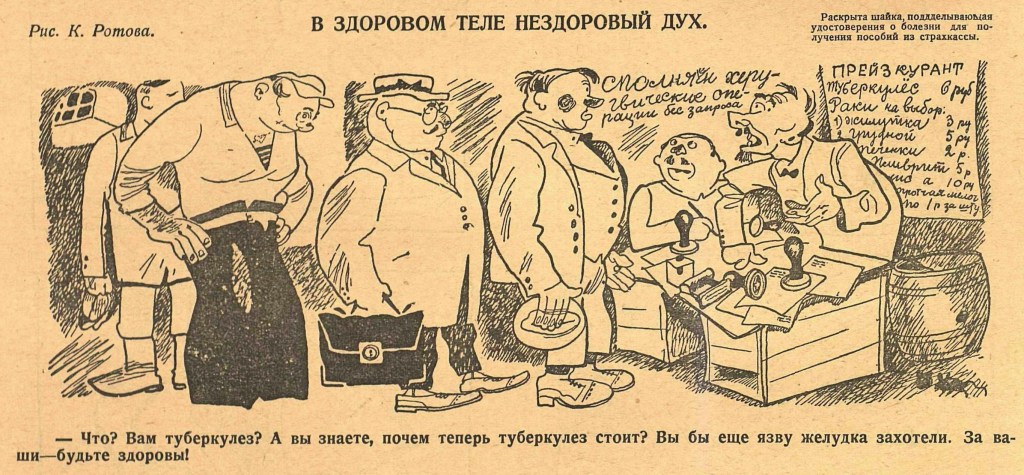
(A gang has been uncovered that is faking certificates of illness for obtaining health insurance benefits.)
“What? You have tuberculosis? But do you know how much tuberculosis costs now? Better you should have a stomach ulcer. For yours–get well soon!”
(Krokodil, Moscow, 1925)
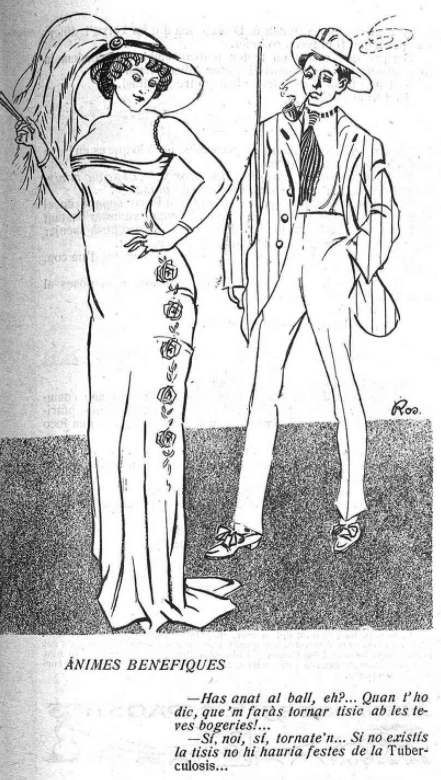
“You went to the dance, eh?… If you tell me that, you’ll make me go crazy with your madness!…”
“Yes, boy, yes, come back… If consumption didn’t exist there would be no Tuberculosis parties…”
(La Esquella de la torratxa, Barcelona, 1910)
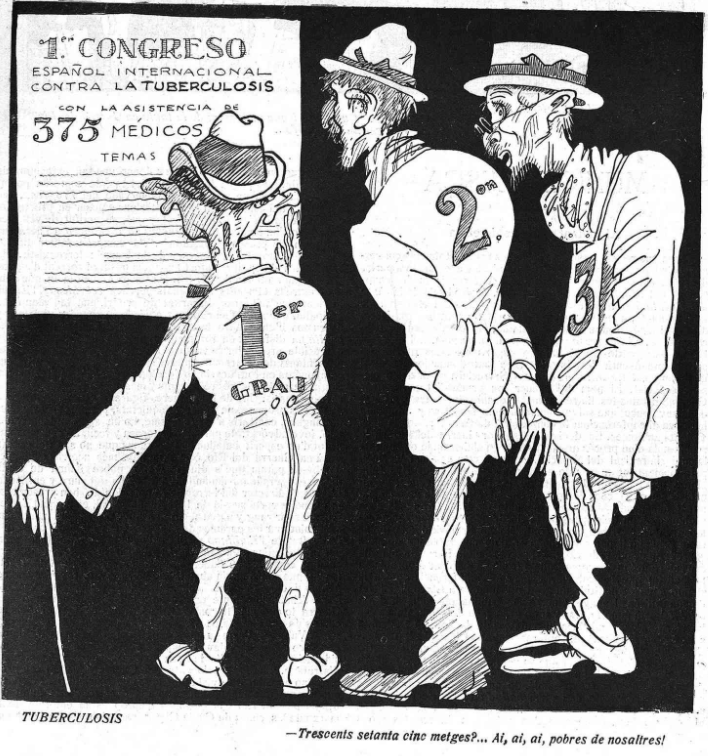
(Elderly figures apparently labeled according to the degree of their consumption affliction, reading poster for 1st Spanish International Congress Against Tuberculosis, convened with the help of 375 physicians.)
“Three hundred and seventy-five doctors?… Alas, alas, alas, poor us!”
(La Esquella de la torratxa, Barcelona, 1910)
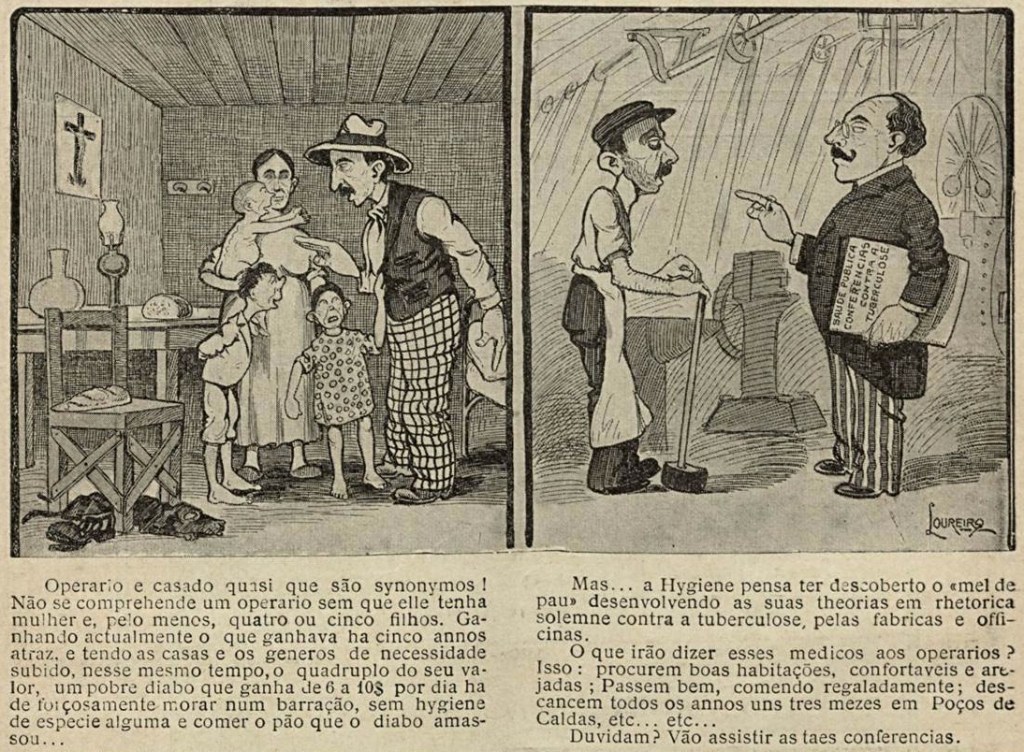
(The Brazilian Public Health Service resolves to send its delegates to hold conferences among workers in factories and offices as a means of combating tuberculosis.)
To be a worker and married are practically synonymous! A worker cannot be understood without having a wife and at least four or five children. Currently earning what he earned five years ago, while at the same time the cost of housing and goods is of necessity going up, quadrupling in value, a poor devil who earns $6-10 a day has to live in a shed without hygiene of any kind and eat bread kneaded by the devil…
But… Hygiene thinks it has discovered “bread honey” by developing its theories for factories and offices in solemn rhetoric against tuberculosis.
What will these doctors say to the workers? This: look for good, comfortable and airy rooms; Have a good time, eating well; rest three months a year in Poços de Caldas [spa city north of São Paulo], etc… etc…
Doubt it? Go attend these conferences.
(O Malho, Rio de Janeiro, 1913)
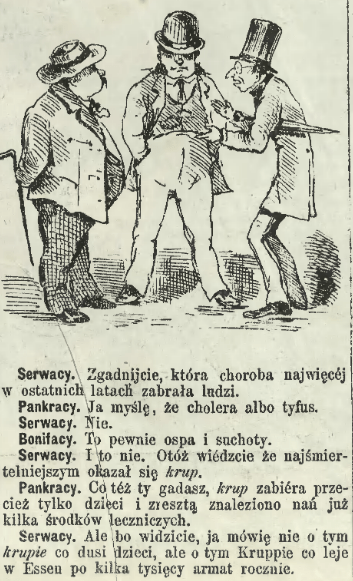
Servatius: Guess which disease has taken the most people in recent years.
Pancras. I think it’s cholera or typhus.
Servatius. No.
Boniface. It’s probably smallpox and consumption.
Servatius. Also no. So you should know that the croup was the most lethal.
Pancras. What are you talking about, the croup only takes children, and anyway, several medications have already been found.
Servatius. But because you see, I’m talking not about this croup that strangles children, but about this Krupp which pours several thousand cannons a year in Essen.
(Mucha, Warsaw, 1875)
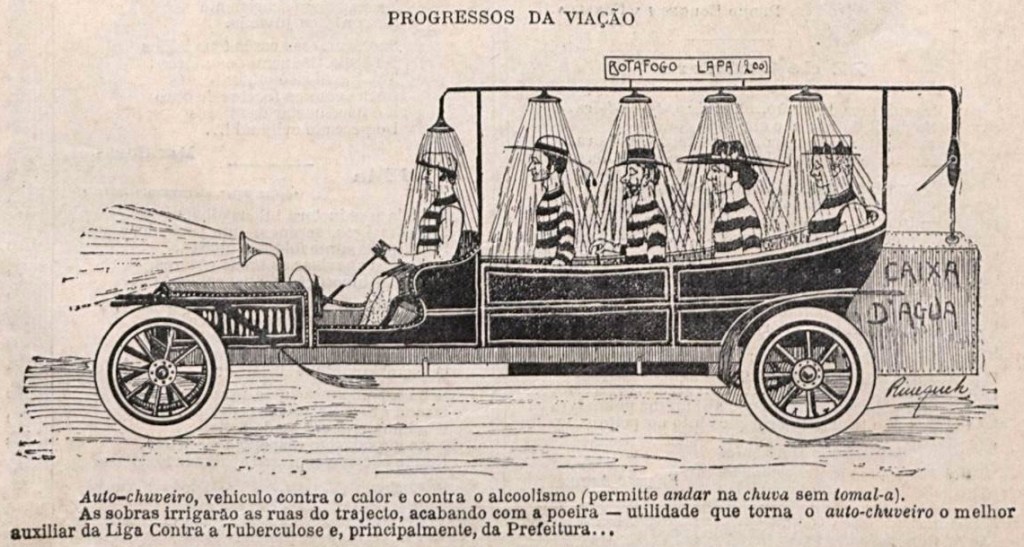
Car-shower, vehicle against heat and against alcoholism (it allows riding in the rain without drinking). The runoff will irrigate the streets along the way, stopping the dust, a use that makes the car-shower the best auxiliary of the Anti-Tuberculosis League and, mainly, of City Hall…
(O Malho, Rio de Janeiro, 1907)
Synthesis of weekly public health newsletters…
A thrill of horror passes through Joe Public’s spine, seeing every week this danse macabre, touched by the inexorable Cape!…
And the one who also senses the consumption in his pockets, seems to exclaim:
“Good God, how long will I have to wait for these so-called Hygiene measures against this terrible specter that also makes me dance on the tightrope?!…”
(O Malho, Rio de Janeiro, 1914)

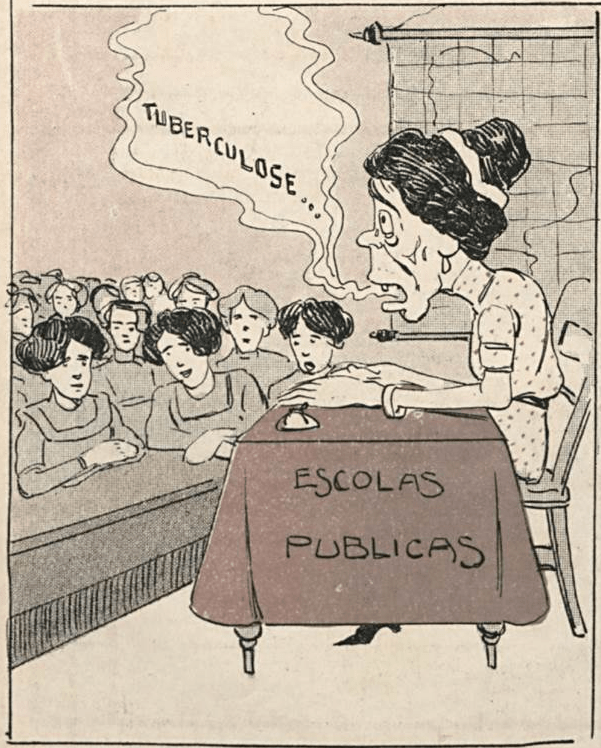
(Detail from “Salad of the Week”) “Discussions and opinions on the hygienic inspection of schools continue; but, like all the serious assumptions of this country, they never go beyond the theoretical and verbose terrain, and it is likely that this will also be seen now… How many adjuncts, teachers and students do not drag an existence already reached by tuberculosis, living in a criminal promiscuity!… Why not take an energetic decision to avoid a greater harm?”
(O Malho, Rio de Janeiro, 1911)
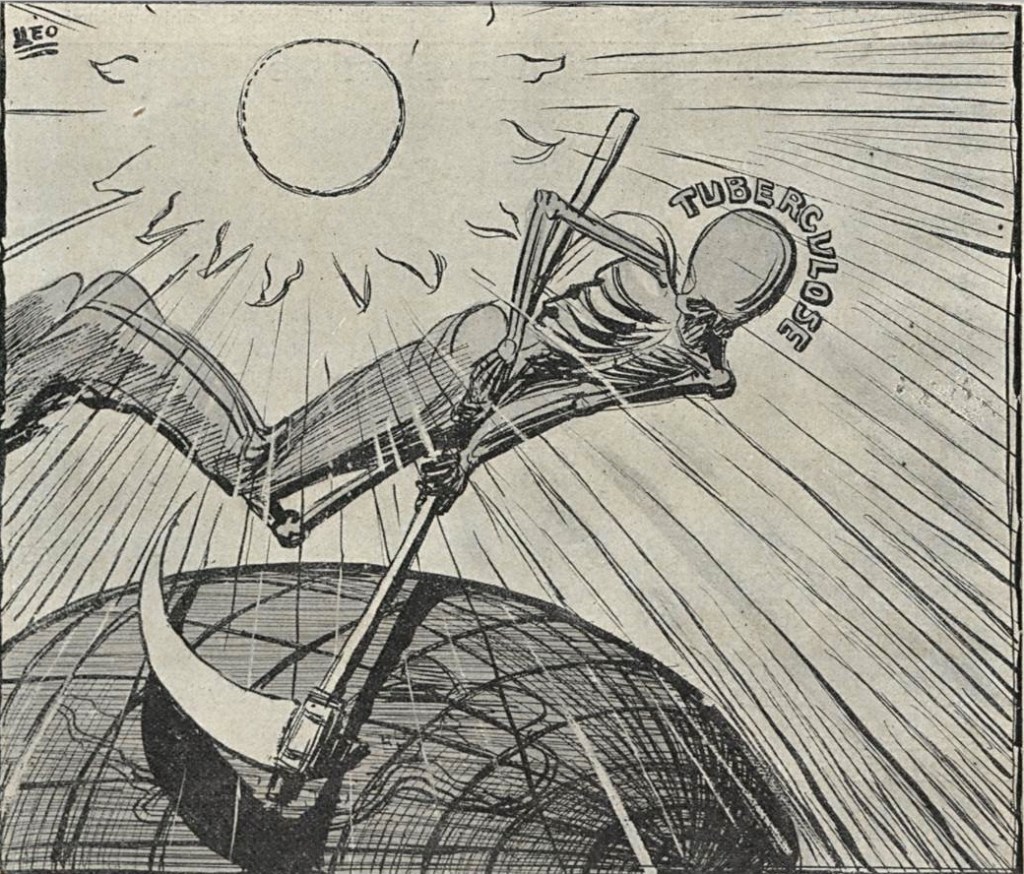
In the winter with humidity, in summer with the oppressive sun, here it is always making its terrible harvest!
(O Malho, Rio de Janeiro, 1911)
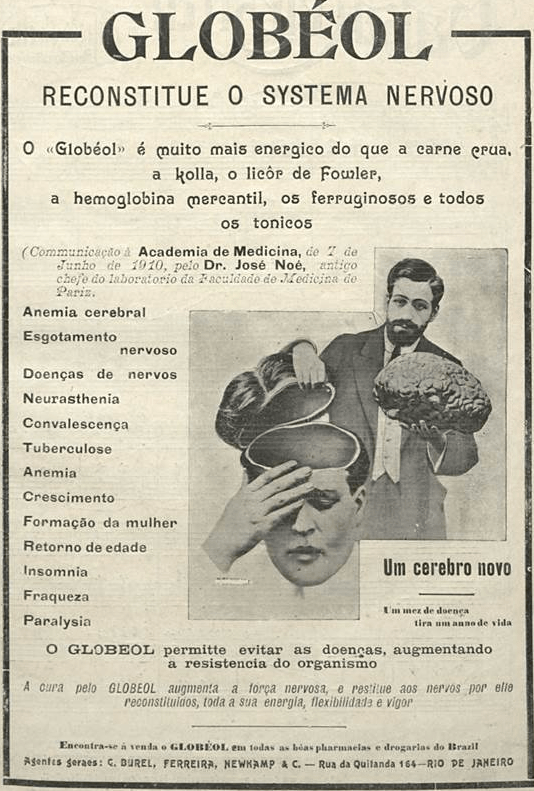
This Brazilian advertisement is a bit distant from our pandemic concerns, but we’ll include on a technicality. In addition to the many nervous ailments it is purported to fight, Globéol also claims to have benefits for tuberculosis. Need we dwell on the horrific brain image?
(O Malho, Rio de Janeiro, 1914)
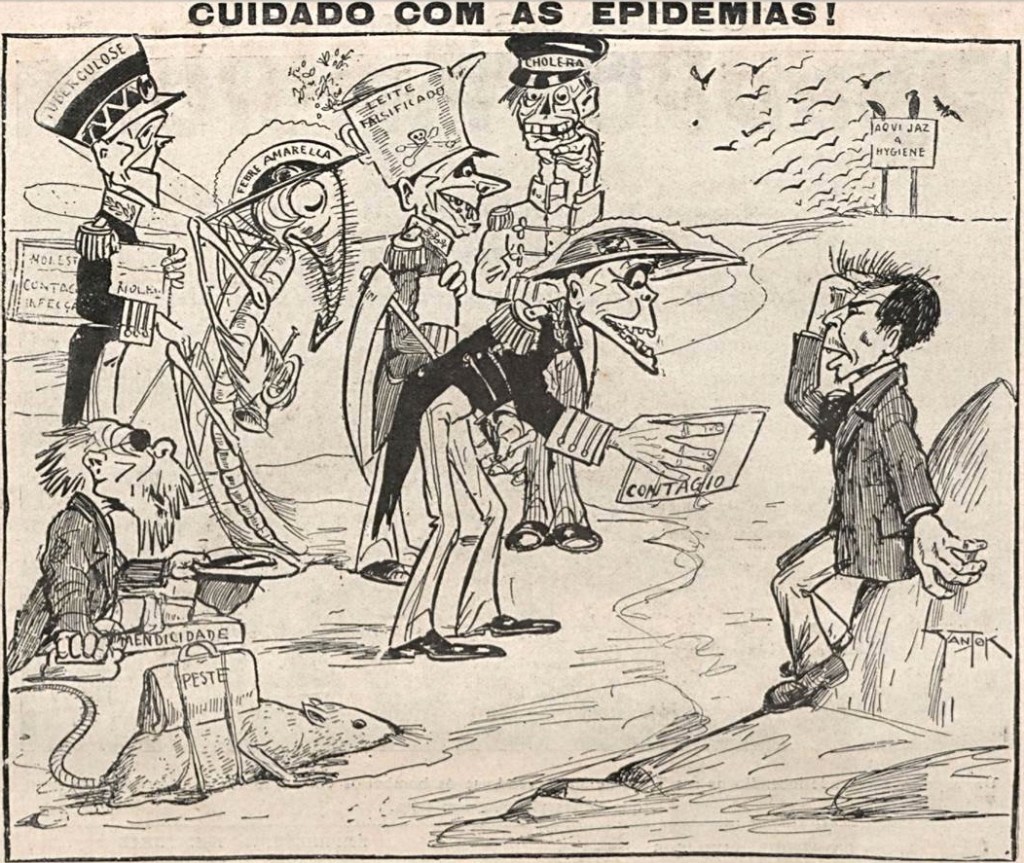
Contagion: “As Minister Plenipotentiary of the Emperor of Infection, I respectfully come forward to present my credentials with the hope that you will want to reestablish the old friendly relations, so unsuccessfully interrupted by the diplomacy of Hygiene. Lady Hygiene having died for lack of care, I do not doubt that our old friendship is now resumed.”
Rio’s poor: “Misericordia! The ambassadors of death are already at the door! [tuberculosis, mendicancy, plague, yellow fever, fake milk, cholera] What kind of diplomacy should I adopt now to drive out such a dangerous band? I will scream and complain at the top of my lungs before tuberculosis destroys us: To arms!”
(O Malho, Rio de Janeiro, 1912)
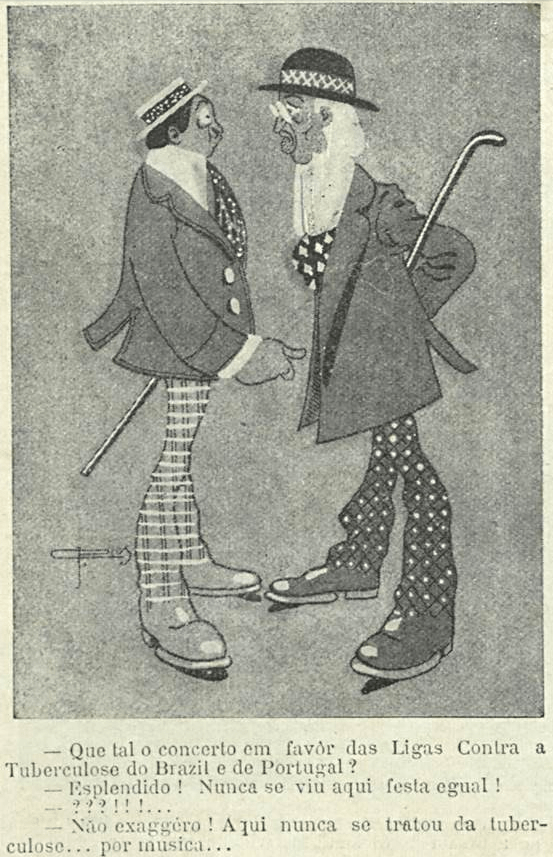
“How about the benefit concert for the Leagues against Tuberculosis of Brazil and Portugal?”
“Splendid! I’ve never seen a party of its like here!”
“???!!!…”
“I’m not exaggerating! Tuberculosis has never been treated here… by music…”
(O Malho, Rio de Janeiro, 1907)
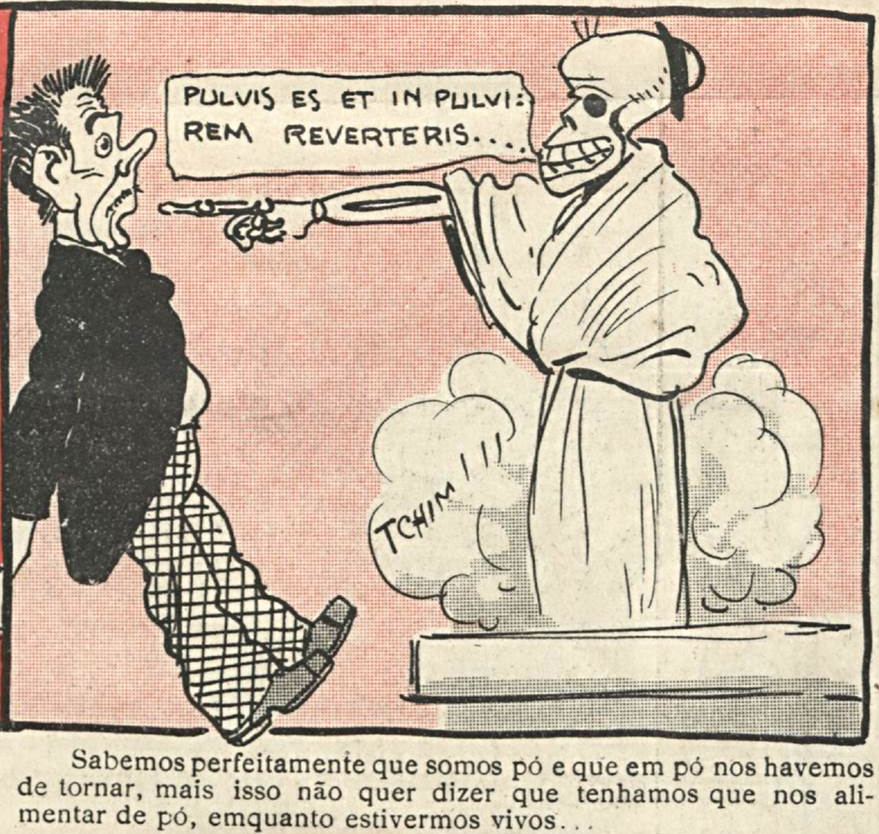
First two panels:
(Image of a plate of Carioca dust [flour] with typhus, tuberculosis, yellow fever, smallpox, plague, gastroenteritis, etc. “Carioca” is a way of referring to the inhabitants of Rio de Janeiro.)
“We knew the dust of Persia, we knew gold dust, monkey dust and Joanna dust, the river Po [“pó” meaning dust], etc., but… we are completely unaware of this new dust that invades us, suffocates us, and that kills us: the dust from Rio de Janeiro.”

Deathly figure: “Dust thou art, and to dust thou shalt return…”
“We know perfectly well that we are dust and that we shall become dust, but that does not mean that we have to feed on dust while we are alive…”
(and four more panels of quirky municipal politics…)
(O Malho, Rio de Janeiro, 1911)
 Sic Transit Pestilentia