“Last week I was vaccinated against smallpox, today I’m going to be treated against typhus, then against cholera–“
“Are you that afraid of those diseases?”
“Oh, that’s not it. But we have a single young doctor…”
(Humoristické listy, Prague, 1915)

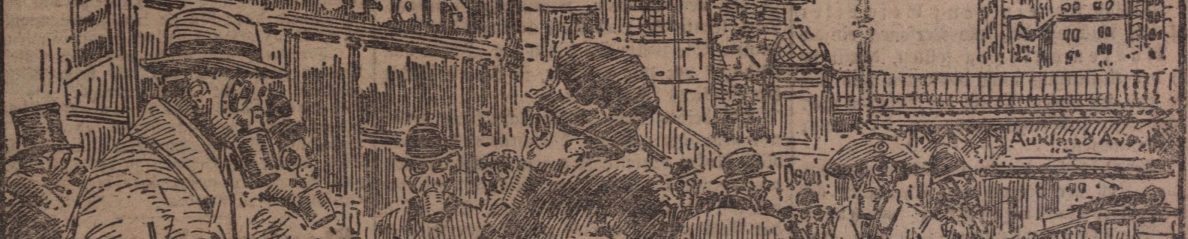
“Last week I was vaccinated against smallpox, today I’m going to be treated against typhus, then against cholera–“
“Are you that afraid of those diseases?”
“Oh, that’s not it. But we have a single young doctor…”
(Humoristické listy, Prague, 1915)
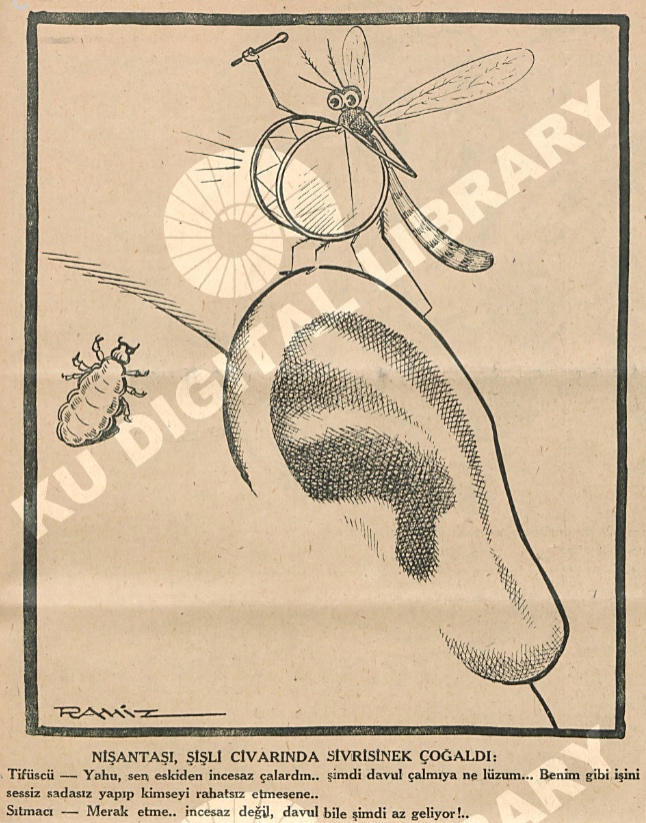
Typhus vector: Yeah, you used to play the saz [traditional lute]… Why do you need to play the drums now? Why don’t you work quietly like me and don’t bother anyone?
Malaria vector: Don’t worry… even the drums are not loud enough now!
(Karikatür, Istanbul, 1943)
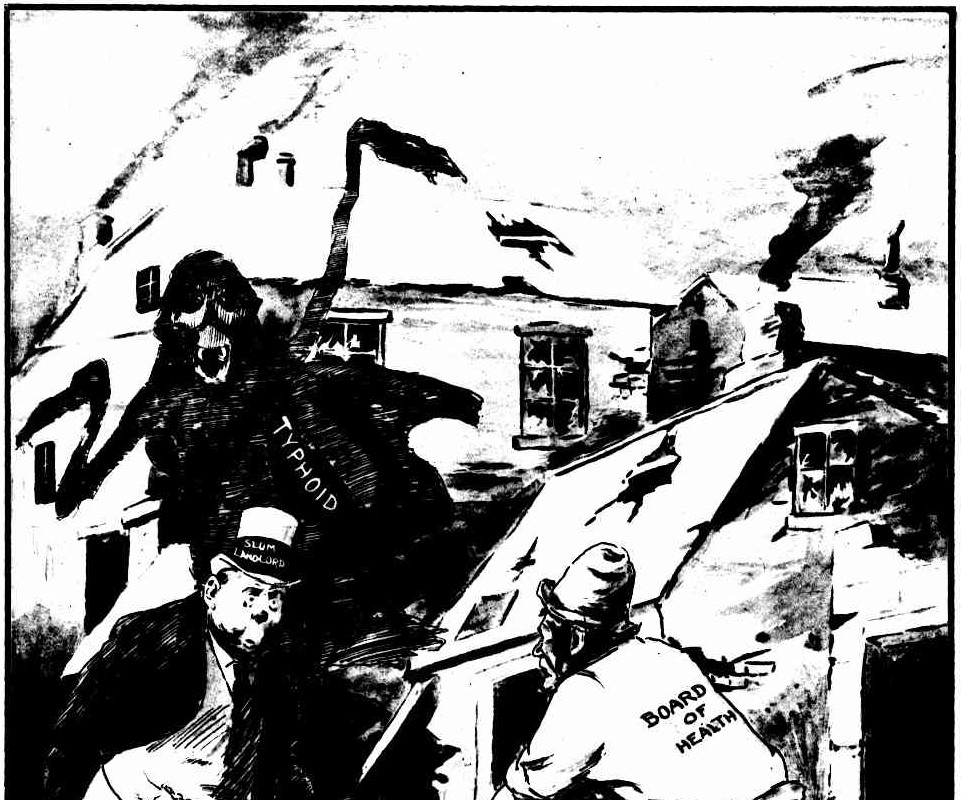
“The time has arrived when drastic steps should be taken by the Council to remove a number of the dilapidated structures which exist.”
Health Board (to slum landlord as Typhoid lurks in the background): My methods are not nice, but neither is the company you keep.
(Western Mail, Perth, 1907)

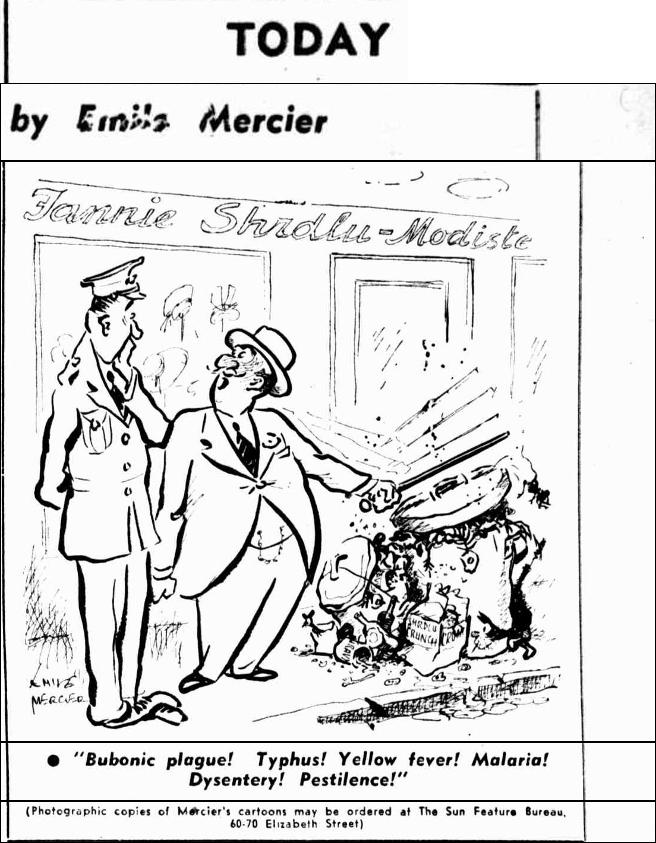
Smith’s Weekly, Sydney, 1949
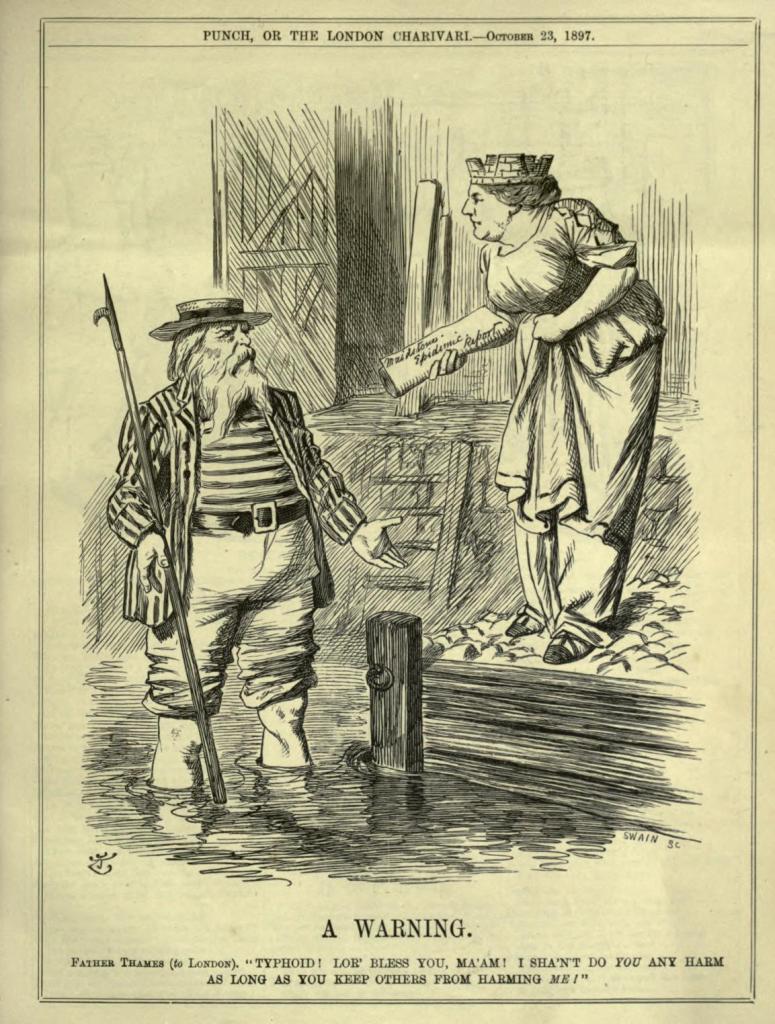
Father Thames (to London): “Typhoid! Lor’ bless you, ma’am! I shan’t do you any harm as long as you keep others from harming me!”
The Maidstone Epidemic Report in the hand of Lady London followed upon an outbreak of typhoid fever in Kent in September 1897 that eventually cost more than a hundred lives. The commission reporting on the causes of the epidemic found fault in the provision of water services by the Maidstone Company, in violation of the Public Health Act of 1878. The outbreak prompted an early successful experiment with immunization among nurses at a local hospital, according to this history.
(Punch, London, 1897)
In hypnosis Lachen links [~ “laughing on the left”] is making the most epochal discoveries. Thus the pathogens of the following illnesses are discovered:
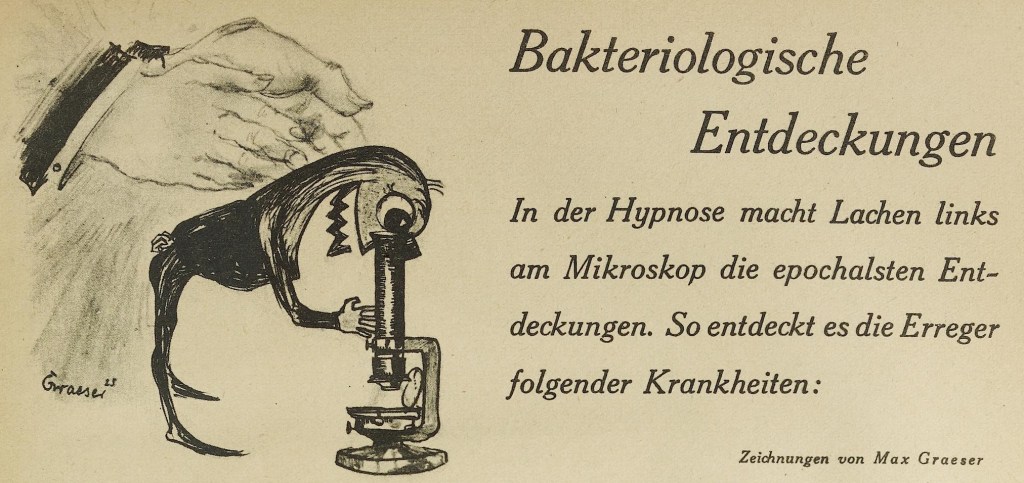
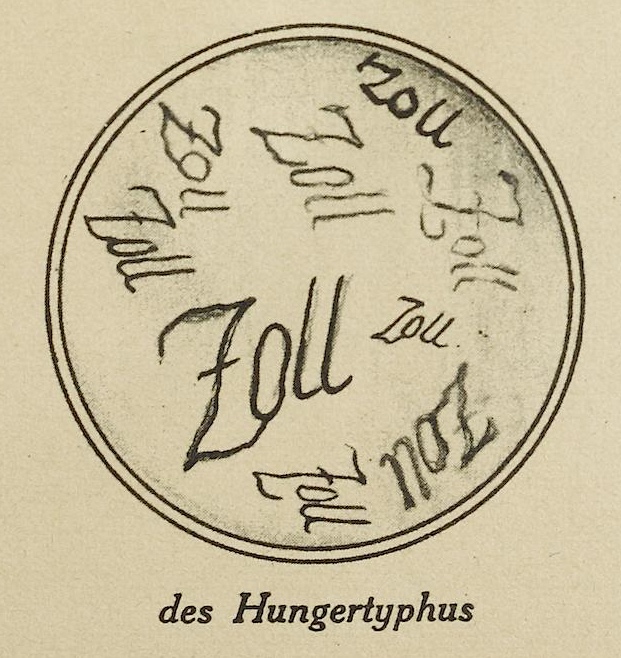
Nine panels follow, of which I include three here. Sleeping sickness:

Hunger typhus [“tariff” vibrios]:
Judicial cholera:
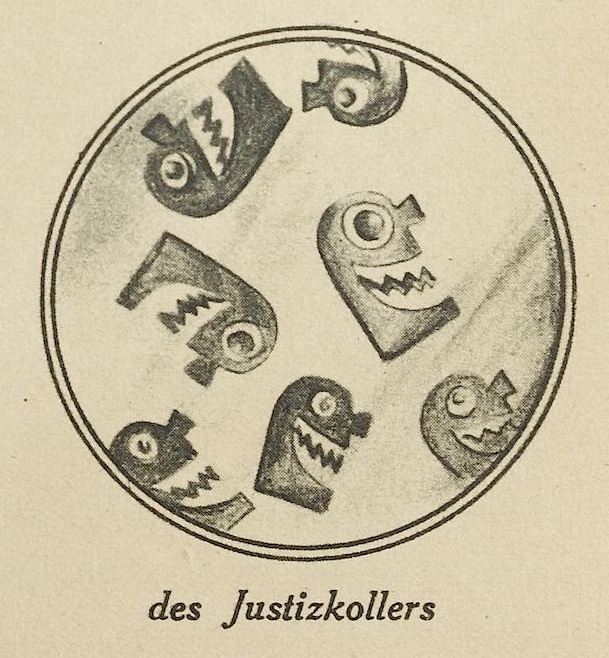
(Lachen links, Berlin, 1926)
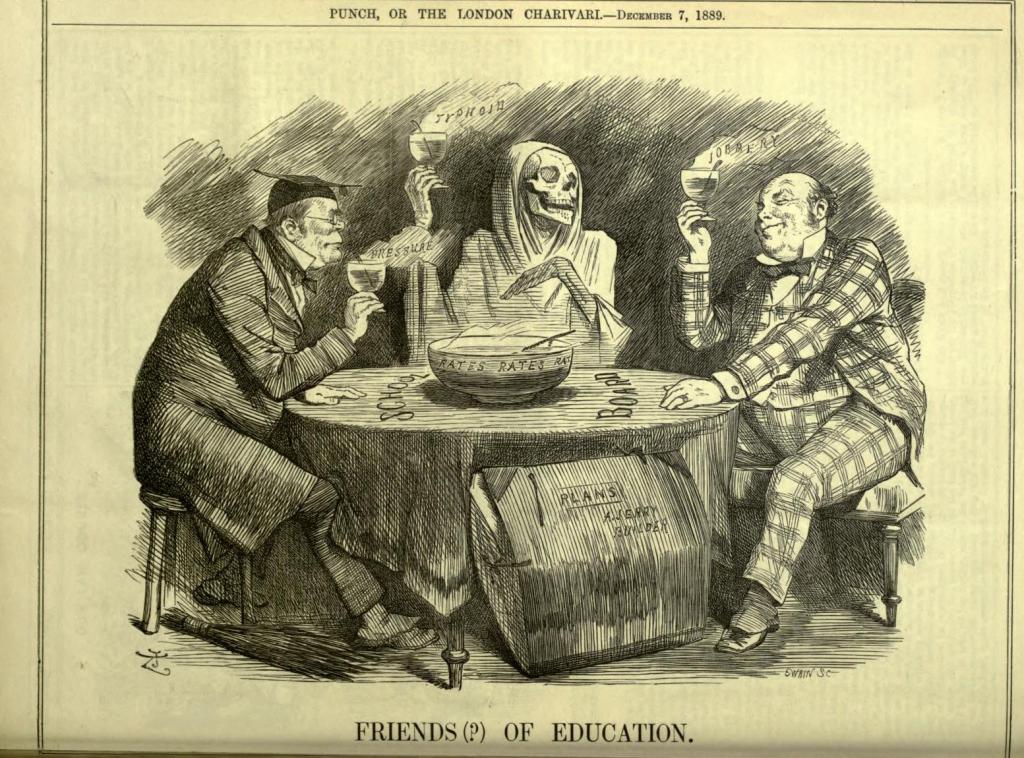
Pressure, typhoid fever, and jobbery as members of the school board. I haven’t looked into the politics referenced here, but I include this image because of its seeming resonances with our own current imperatives, trying to reconcile in-person instruction with the real-world behaviors of students in epidemic conditions.
(Punch, London, 1889)
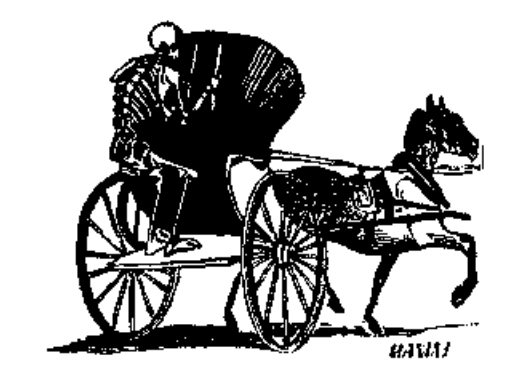
(This is not a freestanding cartoon, but one of several small illustrations that accompany an essay by this title. A rather rough translation of a bit of the surrounding text follows. I’m including this item because it is the earliest available Spanish example I have located so far.)
The recent carnival in Madrid has been bountiful in amorous intrigues, very weighty puns, and acts of honor.
As if revolutions, wars, typhus, influenza, morbid cholera, national pneumonia, and doctors who take death as their lackey were not enough, there are men who have such little esteem for their lives, that I must get away from all that chaff pretending to be skewered like veal on a spit. This would be dreadful if, fortunately, there were not charitable souls in the world who would try to convert the fiery impetus of the Matachines [carnivalesque dance troupes] into healthy prudence… [A metaphor or Aesopian tag for revolutionary factions, which did not win the day in 1848? I am out of my depth here.]
(La Linterna mágica, Madrid, 1849)
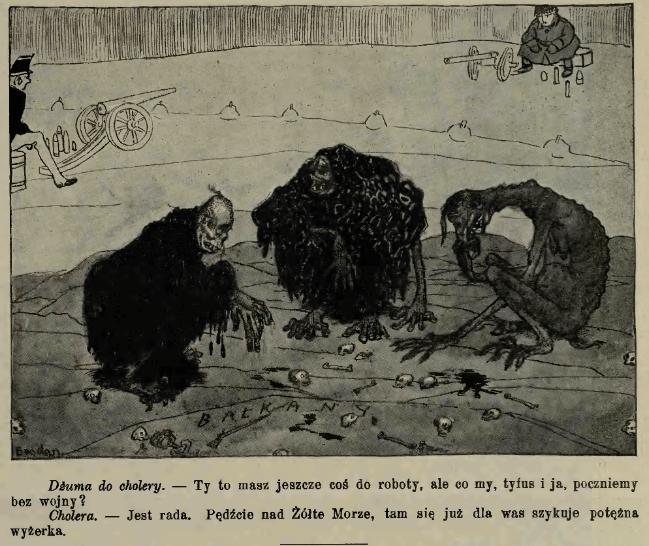
Plague to cholera: “You have something else to do, but what will we, typhus and I, do without war?”
Cholera: “Here’s some advice. Rush to the Yellow Sea, there is already a mighty battle preparing for you.”
(Mucha, Warsaw, 1913)
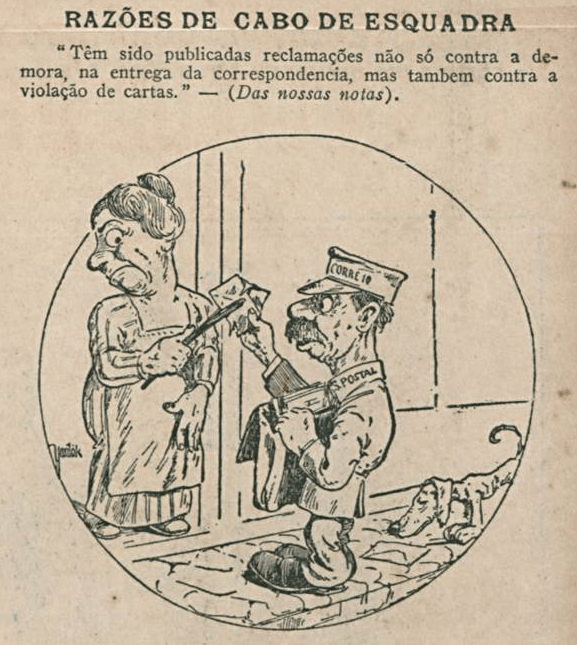
(Complaints have been published not only against the delay in the delivery of correspondence, but also against the violation of letters.)
Lady: “An open letter! I don’t get it! I have no secrets, but I think this is an abuse!”
Postman: “Now, “madame”! Accept the letter! If it is from Europe, don’t you know that everything there is in conflict?… And if it is from here, don’t you know that it is necessary to air the correspondence, because of the mosquitoes and typhus…”
(O Malho, Rio de Janeiro, 1916)
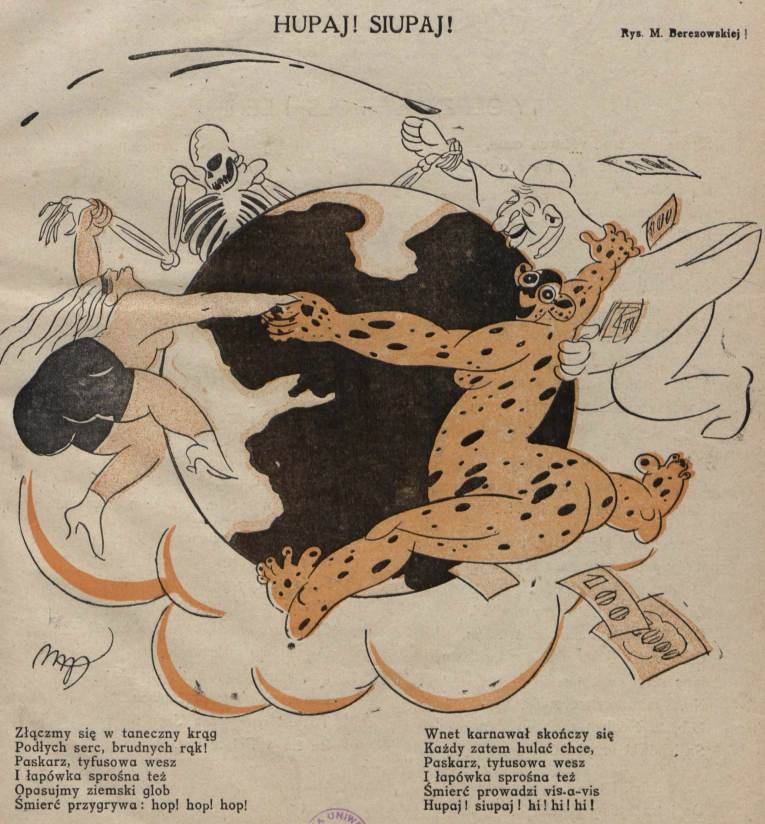
Let’s join in a dance circle
Vile hearts, dirty hands!
The profiteer, the typhus louse
And an obscene bribe, too
Let’s wrap around the globe
Death accompanies: hop! hop! hop!
Soon the carnival will end
So everyone wants to romp,
The profiteer, the typhus louse
And an obscene bribe, too
Death plays along
Hop to it! hi! hi! hi!
(Szczutek, Lwów, 1920) (No bonus points for noting that the profiteer is caricatured as Jewish.)
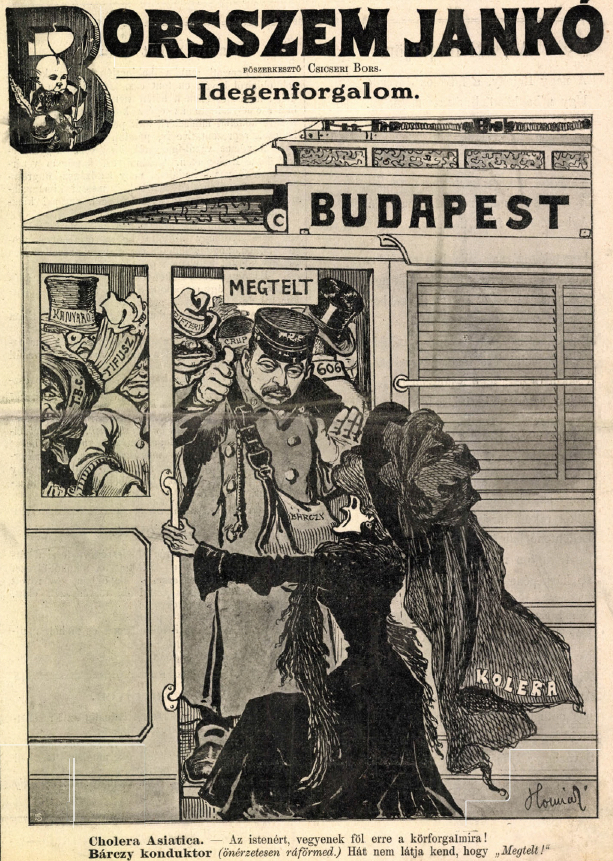
(Riders of the tram include measles, tuberculosis, typhus, diphtheria, croup, and syphilis–the “606” signals Ehrlich’s Salvarsan remedy.)
Cholera Asiatica: “For heaven’s sake, let me onto this route!”
[Budapest mayor István] Bárczy the Conductor (confidently denigrating her): “Well, don’t you see the sign saying it’s ‘Full!’?”
(Borsszem Jankó, Budapest, 1910)
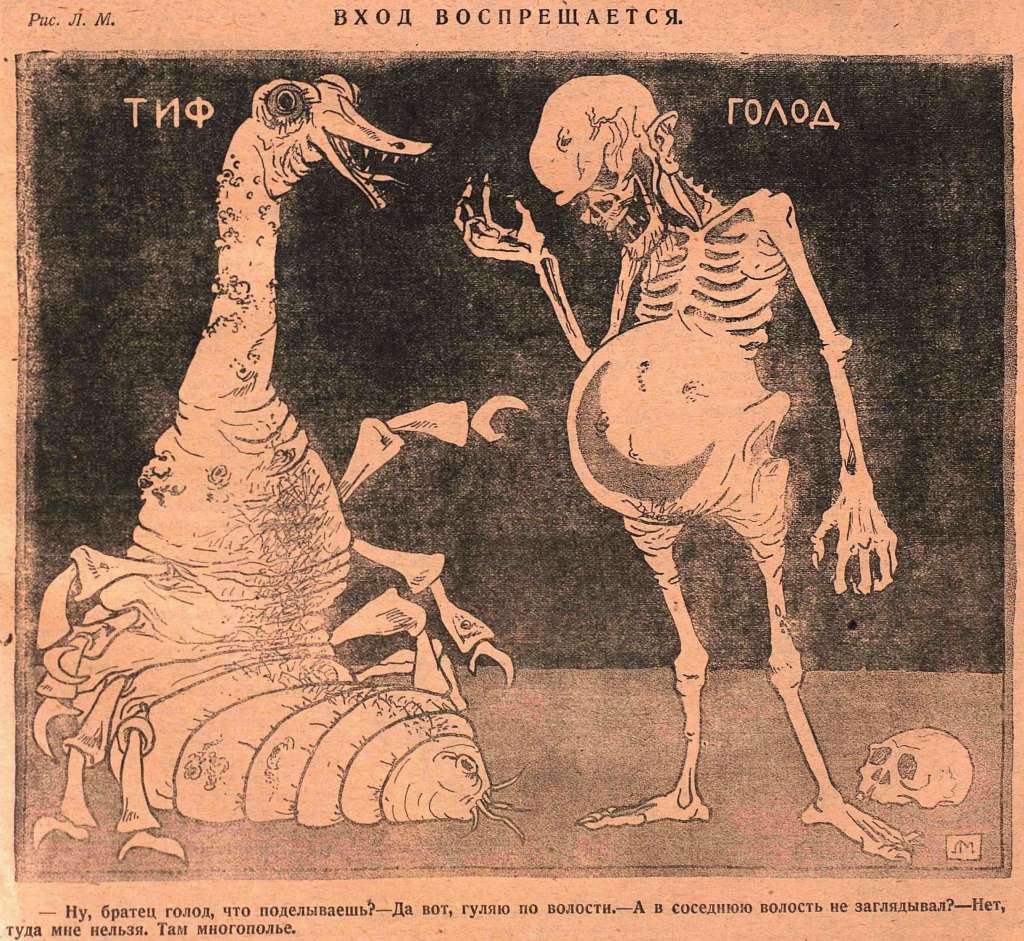
Typhus: “Well, brother famine, what are you up to?”
Famine: “Here I am, wandering around the district.”
Typhus: “Not taking a look at the neighboring district?”
Famine: “No, I’m not allowed over there. They have the rotating crop field system there.”
(Krokodil, Moscow, 1924)
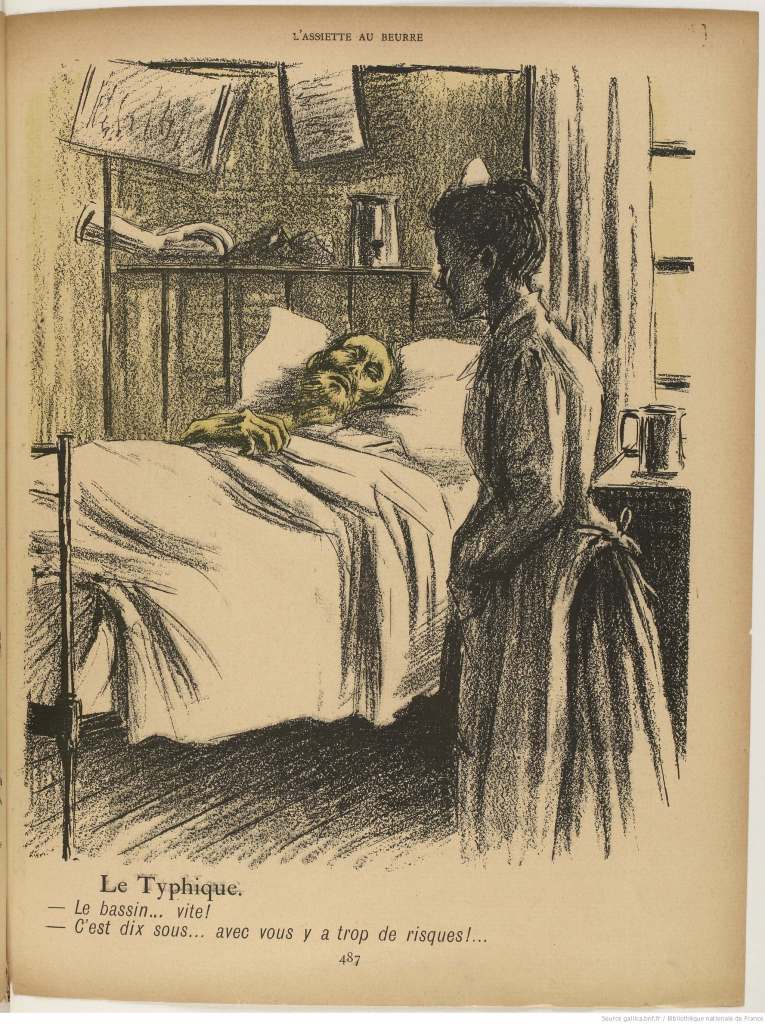
“The basin… quickly!”
“It costs ten sous… with you there are too many risks!…”
(L’Assiette au beurre, Paris, 1901)
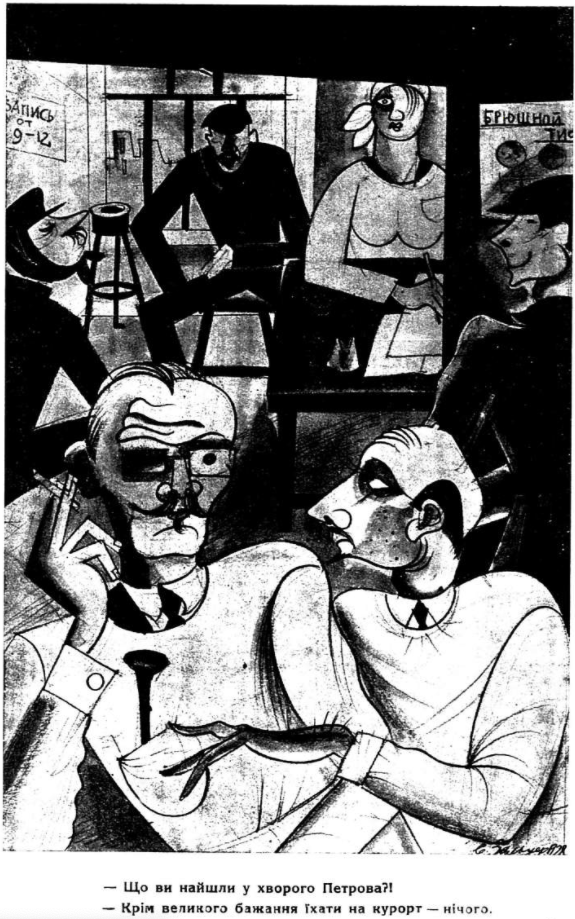
“What did you find with the patient Petrov?”
“Aside from a great desire to go to a resort, nothing.”
(We’ll include this on a technicality, since there is a public health poster about typhus in the background. More remarkable is the quasi-Cubist style of the artist, Semyon Zaltser, a prolific caricaturist working in Odessa. See also Zaltser’s “Medicine and life.”)
(Perets, Kharkiv, 1928)
 Sic Transit Pestilentia