“Is it true, miss, that typhus is contagious?”
“Yes… But it infects only those who have a tendency for it.”
“And that’s again not so dangerous, because who, miss, would want a tendency for typhus.”
(Kogut, Warsaw, 1912)
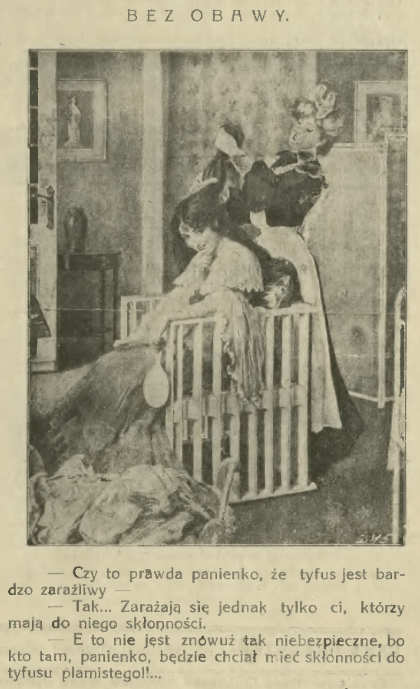
“Is it true, miss, that typhus is contagious?”
“Yes… But it infects only those who have a tendency for it.”
“And that’s again not so dangerous, because who, miss, would want a tendency for typhus.”
(Kogut, Warsaw, 1912)
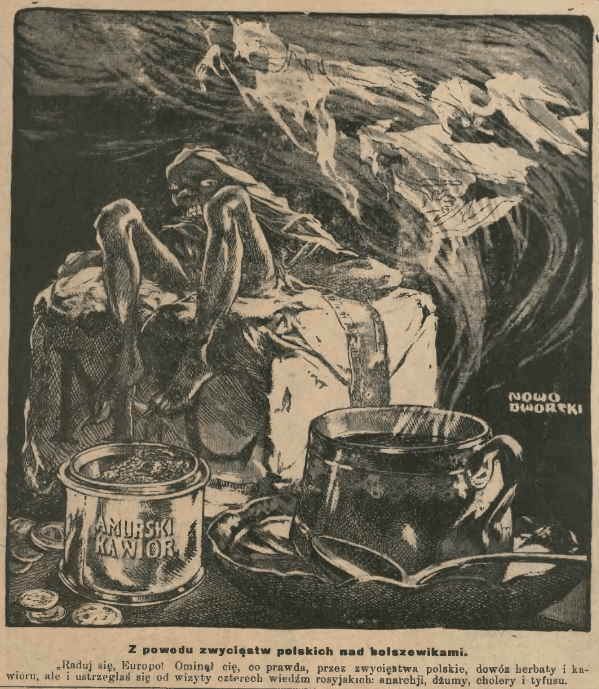
More propaganda than cartoon, this image was published during the Polish-Soviet war of 1920: “Rejoice, Europe! It’s true that because of the Polish victories you have missed the deliveries of tea and caviar, but you have also avoided the visitation of the four Russian witches: anarchy, plague, cholera, and typhus.”
(Mucha, Warsaw, 1920)
From an advertisement for a potion produced by Guyot: “Everyone knows that bad microbes are the cause of almost all of our major diseases: tuberculosis, influenza, diphtheria, typhoid fever, meningitis, cholera, plague, tetanus, etc.” (Am I the only one who sees some Miró here?)
(O Malho, Rio de Janeiro, 1919)

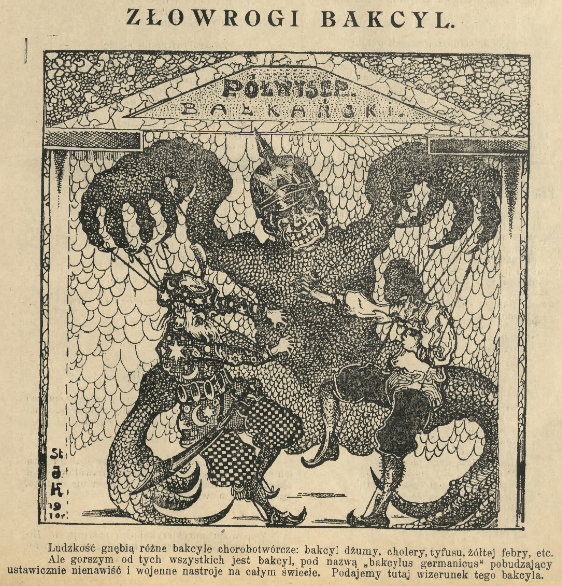
Balkan peninsula. “Humanity is oppressed by various infectious bacteria: plague, cholera, typhus, yellow fever, etc. But worse than all these is the bacillus called bacillus germanicus, which constantly provokes hatred and militant sentiments around the world. Here we provide an image of this bacillus.”
(Kogut, Warsaw, 1910)
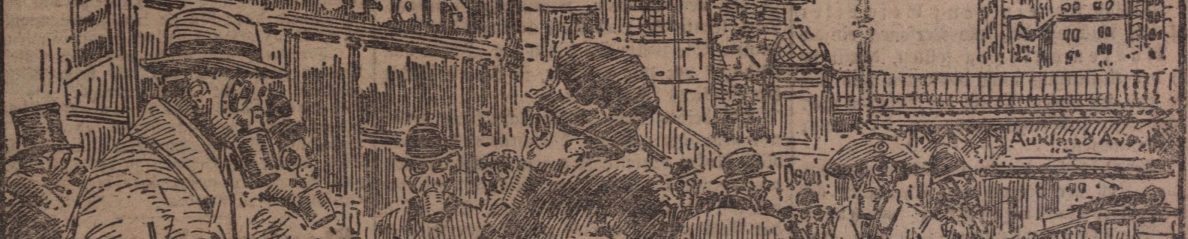
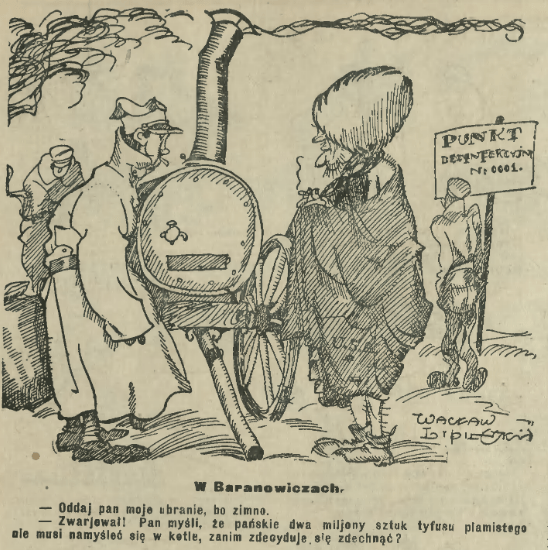
Disinfection Site No. 0001
“Give me my clothes, it’s freezing.”
“You’re crazy! Do you think your two million bits of typhus don’t have to meditate in the boiler before deciding to die?”
(Mucha, Warsaw, 1922)
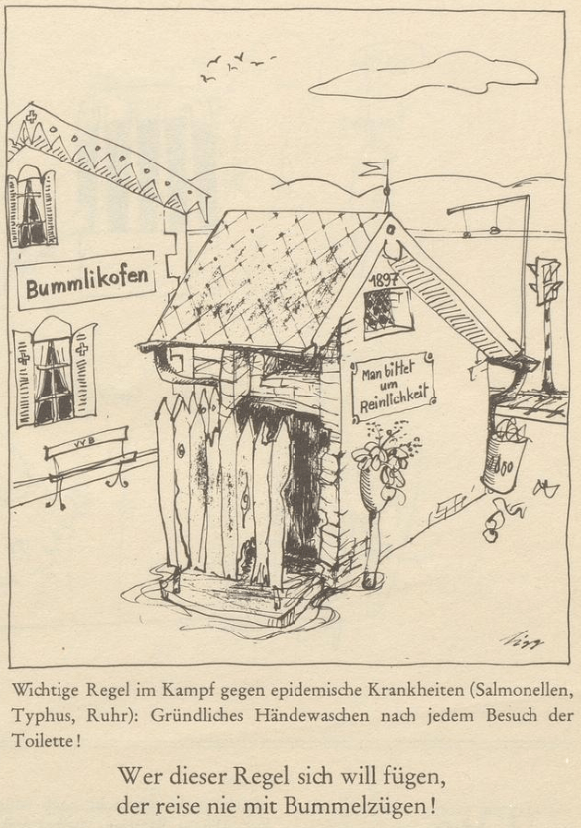
Such a marvelous idiom: Bummelzug, “boomelzoog,” the slow train that stops at every last station along the way. Here a pitiful little provincial station with terrible facilities posts a sign, “Please keep clean.” The caption then reads: “Important rule in the battle against epidemic diseases (salmonella, typhus, dysentery): Thorough hand-washing after every visit to the restroom!” Which prompts the rhyme (in German):
Whoever wants to comply with this rule,
He’ll never be traveling on slow trains!
Draw appropriate hygienic conclusions.
(Nebelspalter, Zurich, 1966)
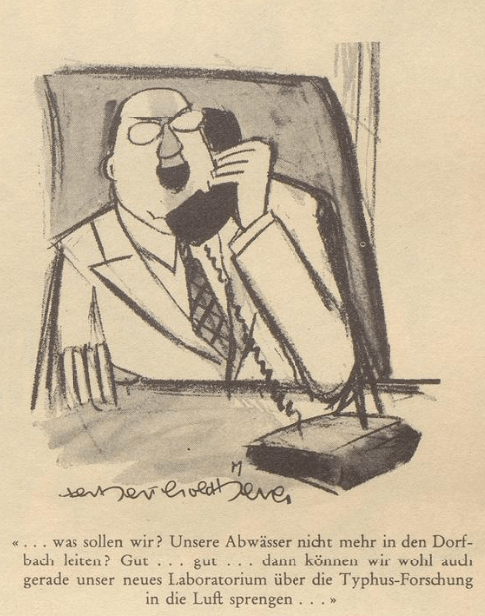
“… what should we do? No longer discharge our wastewater into the village stream? Alright… alright… then we can probably just blow up our new laboratory for typhus research…”
(Nebelspalter, Zurich, 1971)
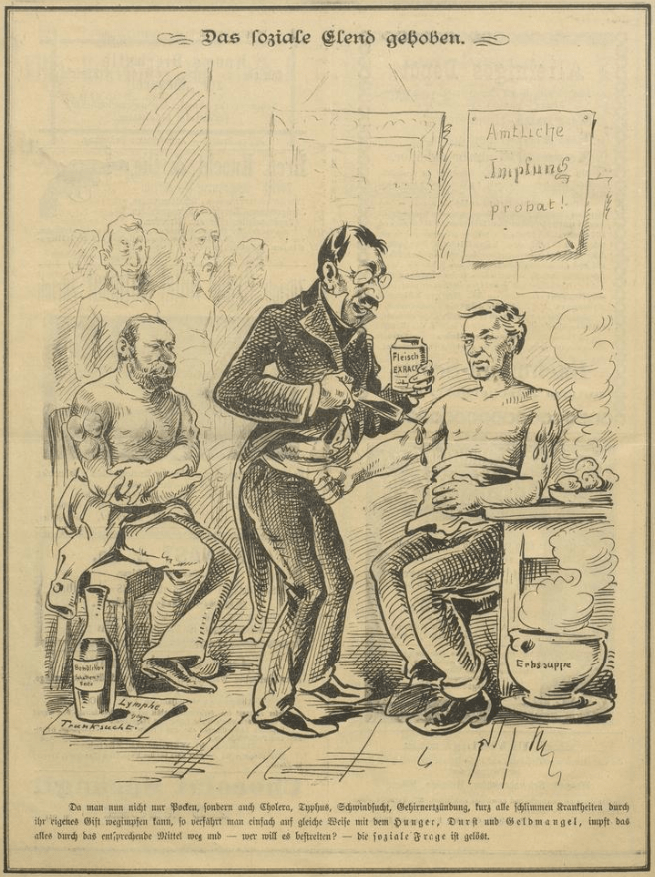
A physician injecting small quantities of meat extract: “Since we can now inoculate away via its own poison, not only smallpox, but also cholera, typhus, consumption, brain inflammation, in short, all bad diseases, we simply proceed in the same manner with hunger, thirst, and lack of money, inoculate it away via the corresponding medium and — who would deny it? — the social question is solved.”
(Nebelspalter, Zurich, 1885)
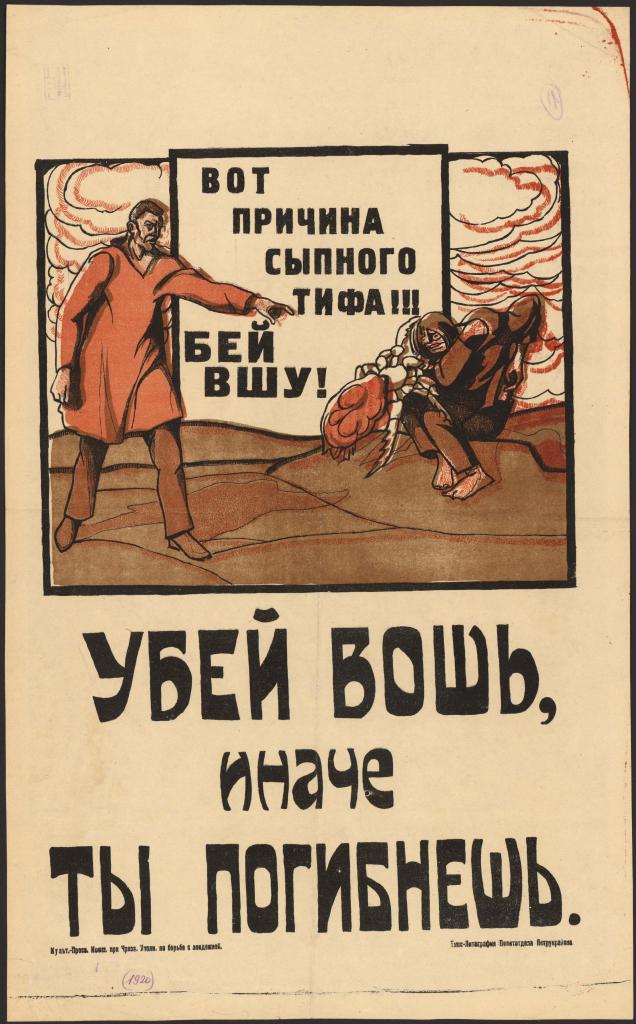
“Here is the cause of typhus!!! Beat the louse! Kill the louse or you will die.”
Soviet public health poster, c. 1920.
(Russian State Library)
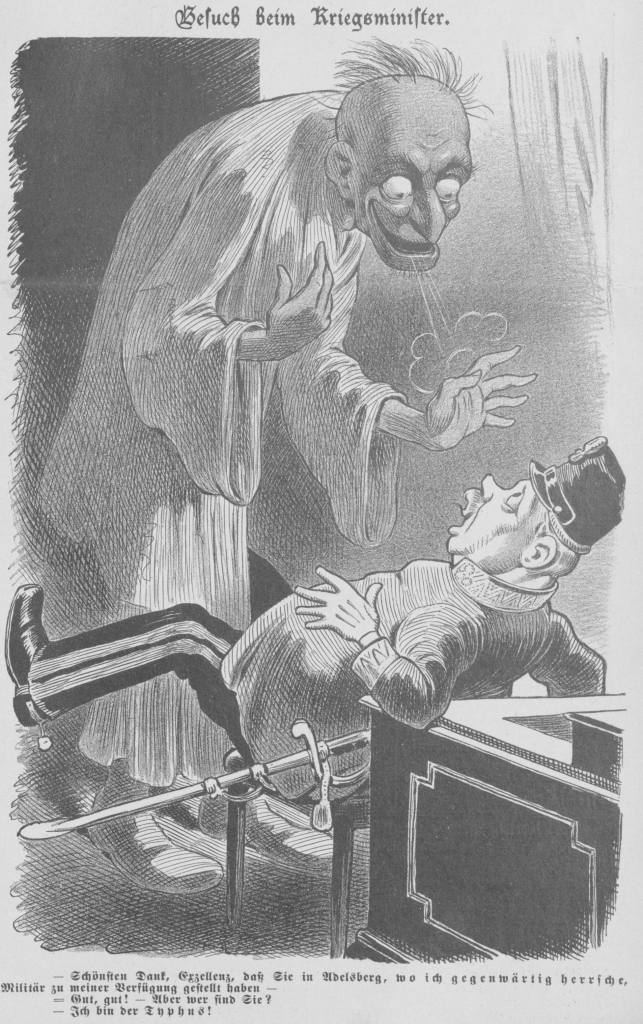
“My best thanks, Excellency, for putting the military at my disposal in Adelsberg [Postojne in the Slovenian countryside northeast of Trieste], where I currently rule.”
“Fine, fine! But who are you?”
“I am Typhus!”
(Kikeriki, 1907)
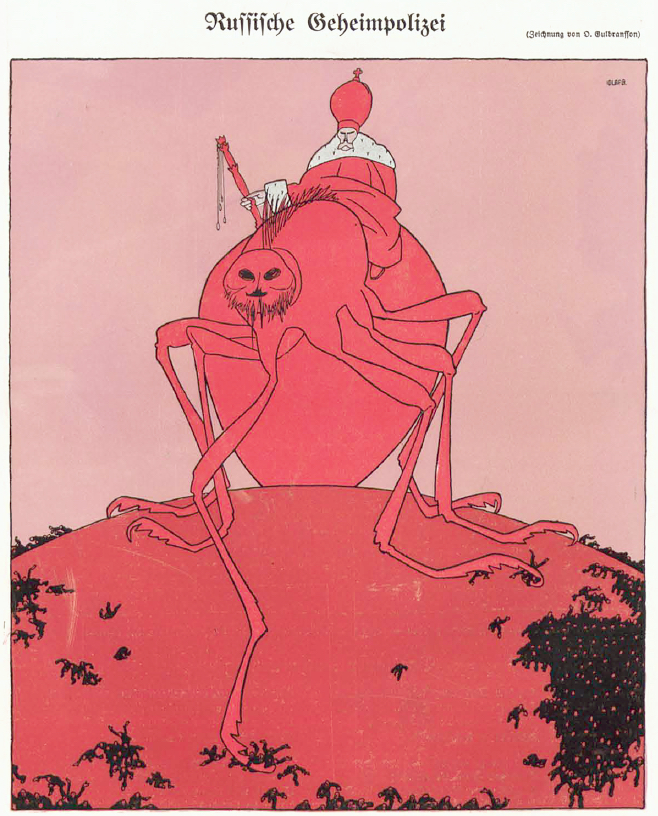
In 1908 a typhus epidemic began spreading from the northern Caucasus and southern Russia to the more densely populated northwestern districts of the Romanov Empire. By and large the epidemic failed to reach further west in Europe, but that did not prevent the German magazine Simplicissimus from offering this curious variant of the classic trope of disease as invasive agent.
(Simplicissimus no. 24, 1909)
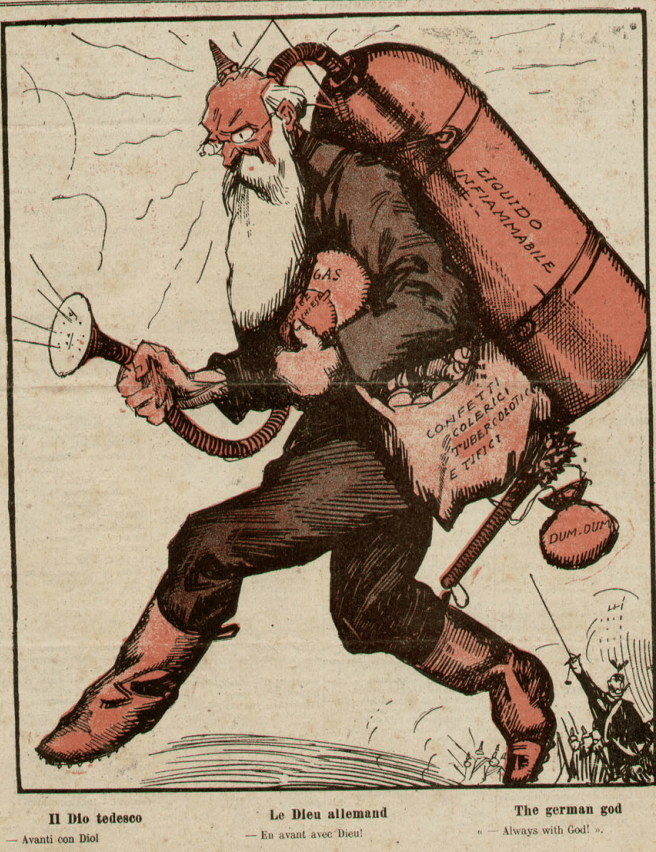
“Always with God!” Note the conflation of poison gas with spreading bacterial contagion. The man is carrying inflammable liquid along with cholera, tuberculosis, and typhus “confetti.”
(L’Asino, Rome, 1918)
“Tell me, Vomáček, how does one say “foot” in German: das Fuss, der Fuss or die Fuss?”
“If you please, Your Honor: typhus!”
(Humoristké listy, Prague, 1894)

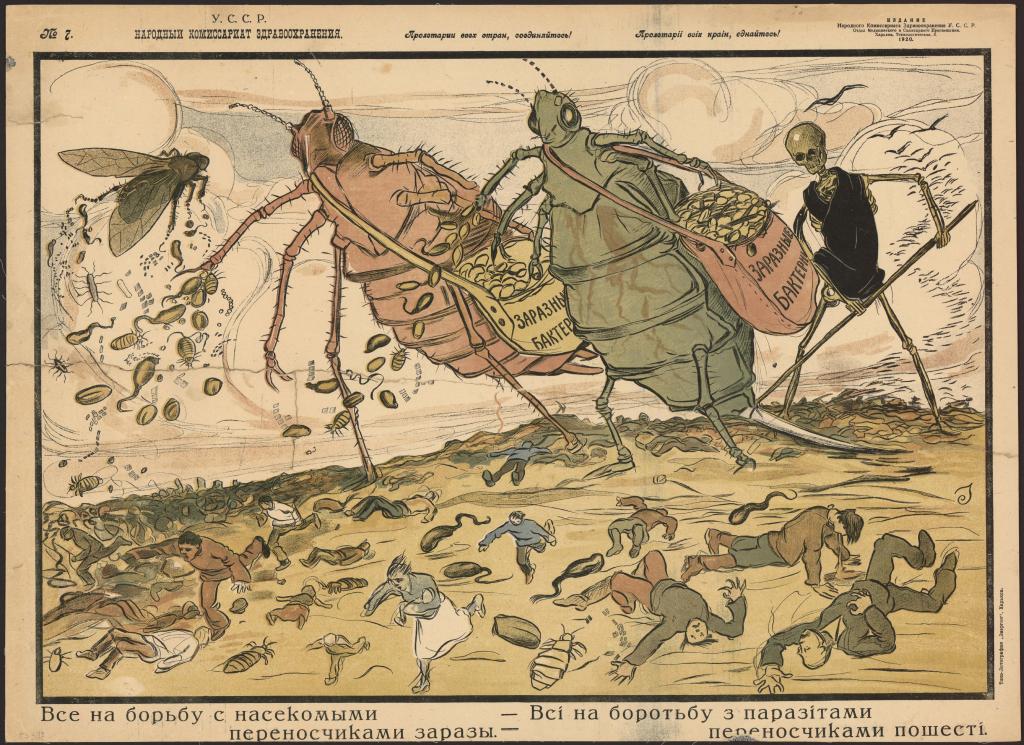
Bugs bearing bags of infectious bacteria. “Everyone to war with disease-bearing insects.” Soviet Ukrainian Commissariat of People’s Health, 1920.
(Russian State Library)
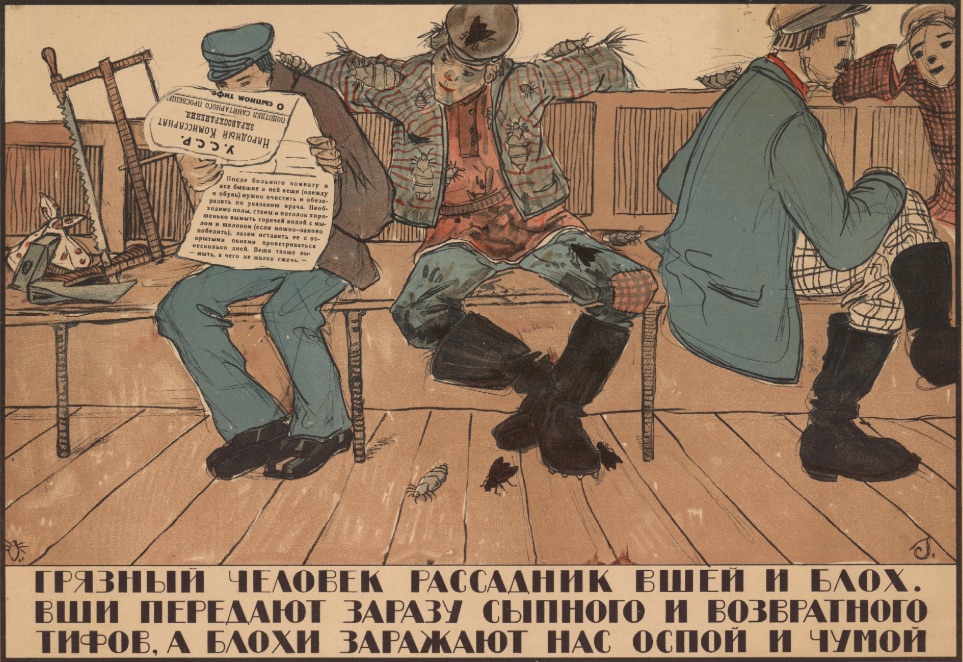
“A filthy man is a hotbed of lice and fleas. Lice transmit the typhus contagion and relapsing fever, and fleas infect us with smallpox and plague.” (Ukrainian People’s Commissariat of Health, 1920) A pity that Soviet didacticism in service to public health still managed to send mixed messages about class. (Russian State Library)
 Sic Transit Pestilentia