Against cholera, cleaning up.
(La Campana de Gracia, Barcelona, 1883)
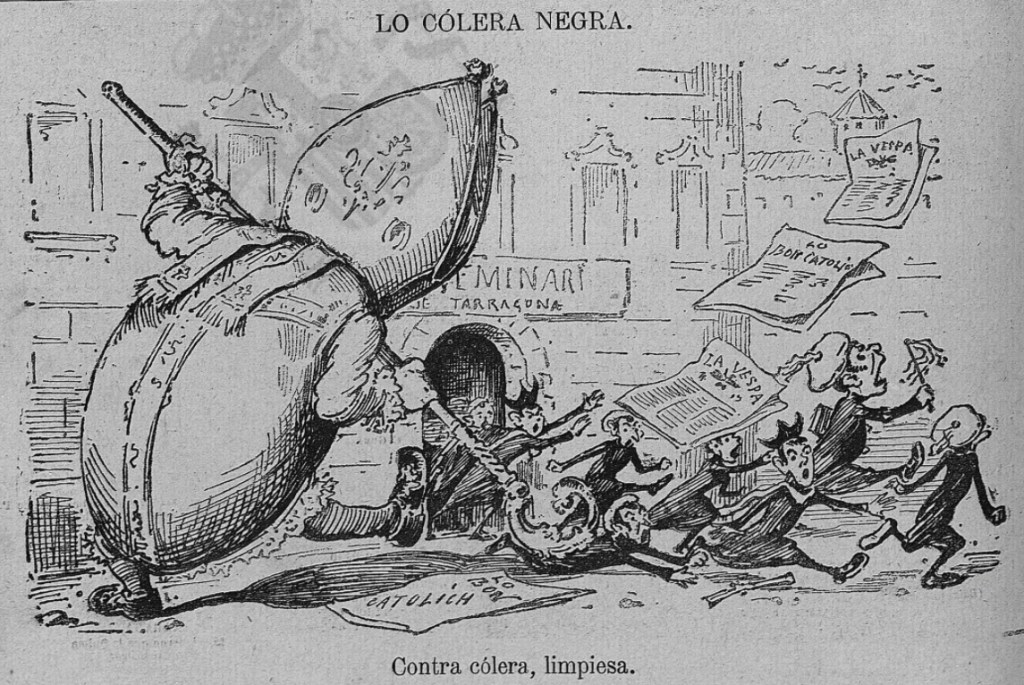
Against cholera, cleaning up.
(La Campana de Gracia, Barcelona, 1883)
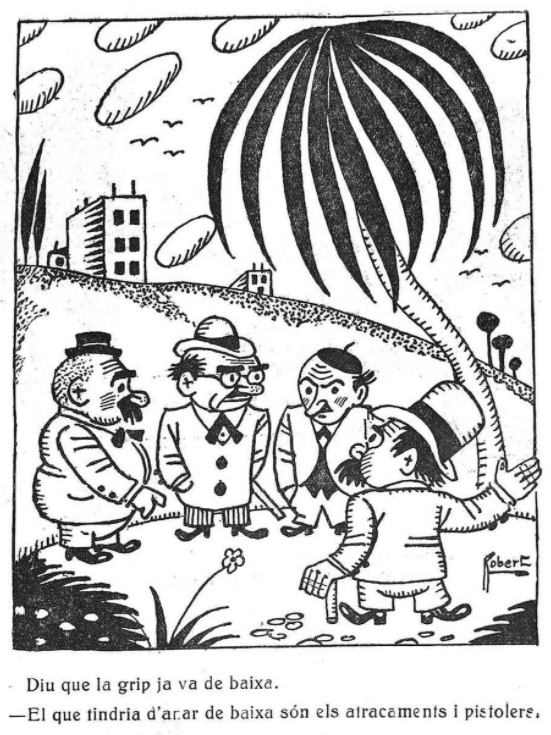
They say the flu is already going down.
“What would have to go down are the robberies and gunmen.”
(La Esquella de la torratxa, Barcelona, 1933)
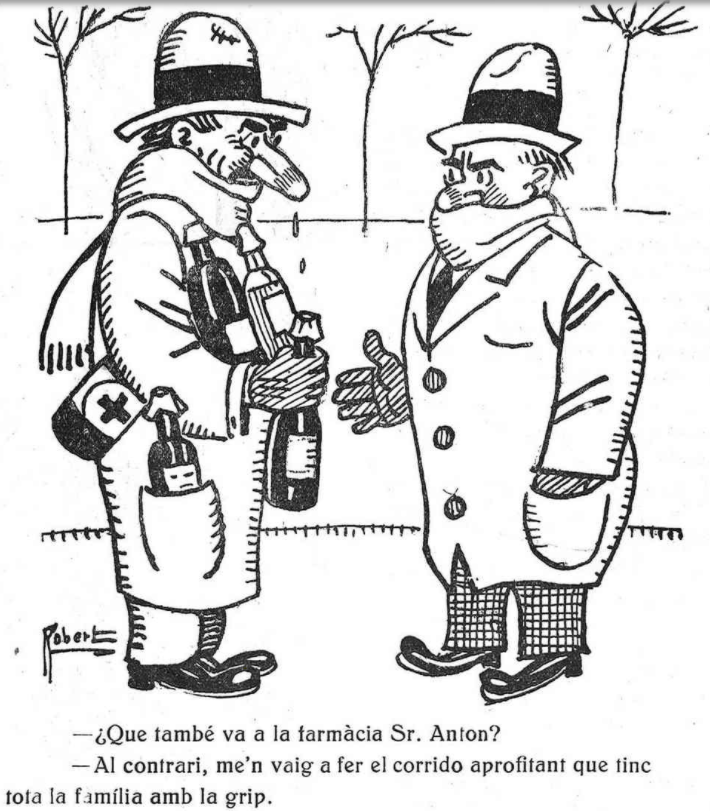
“Are you also going to the pharmacy, Mr. Anton?”
“On the contrary, I’m going to take advantage of the fact that my whole family is down with the flu.”
(La Esquella de la torratxa, Barcelona, 1933)
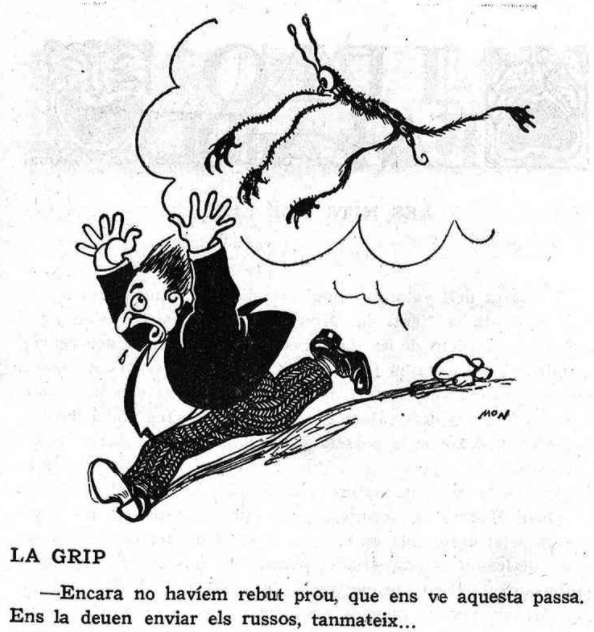
As if we had not yet received enough, that things have come to this pass. The Russians must have sent it to us, however…
(La Esquella de la torratxa, Barcelona, 1931)
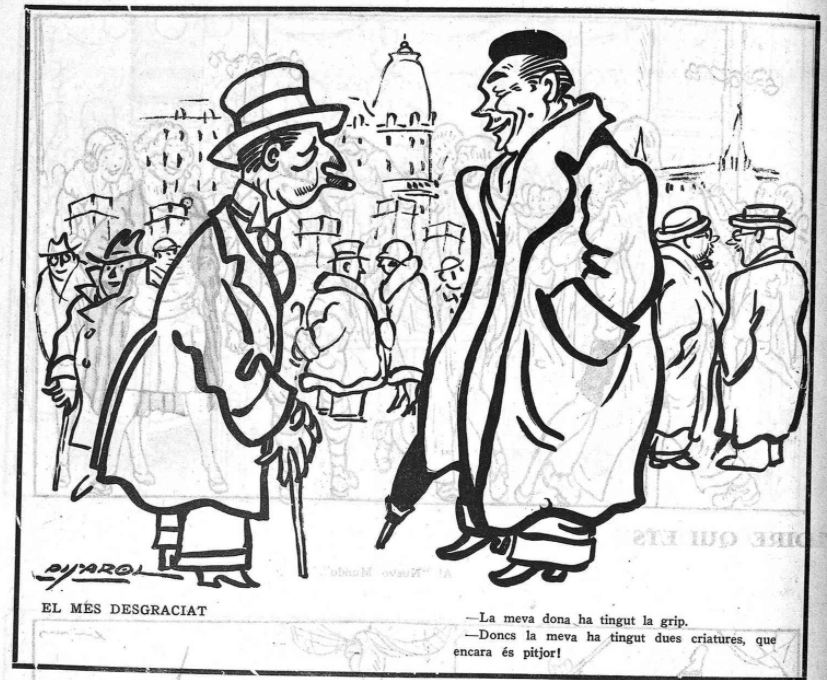
“My wife has had the flu.”
“Well, mine has had two creatures, which is even worse!”
(La Esquella de la torratxa, Barcelona, 1929)
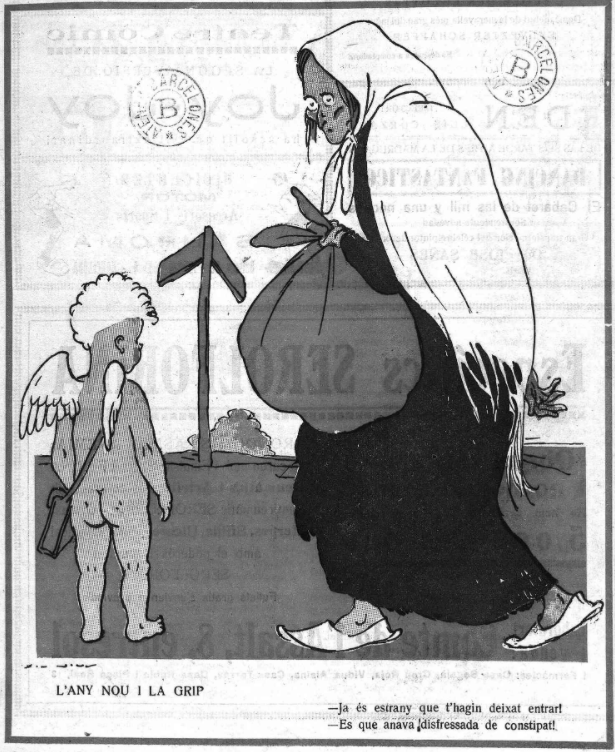
“It’s weird they let you in!”
“It’s because it was disguised as constipation!”
(La Esquella de la torratxa, Barcelona, 1927)
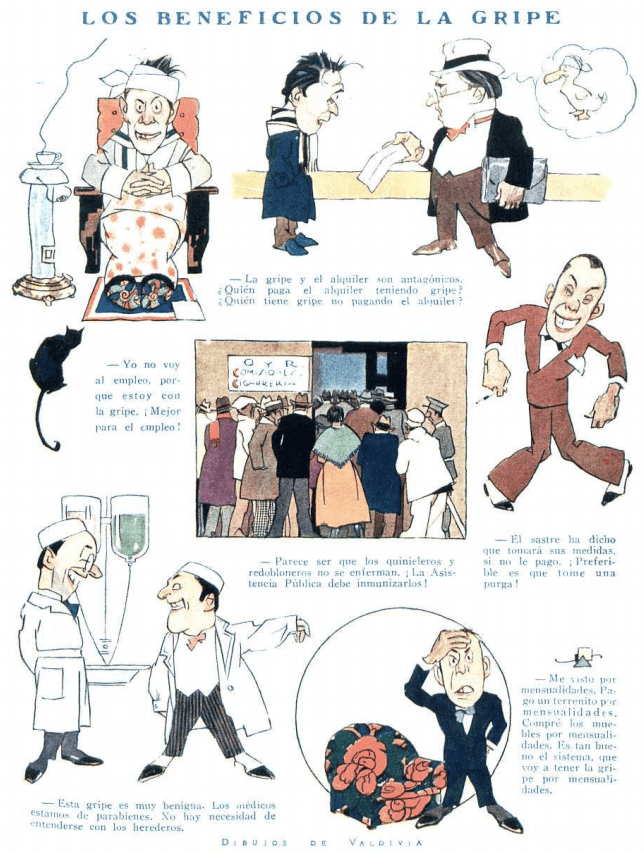
Flu and rent are antagonistic. Who pays the rent while they have the flu? Who has the flu without paying the rent?
I’m not going to work, because I’ve got the flu. Better for employment!
It seems that the bookmakers and the drummers do not get sick. Public Assistance must be immunizing them!
The tailor has said to take your measurements if I don’t pay. It is preferable to take a purge!
This flu is very benign. The doctors are in good spirits. There is no need to get along with the heirs.
I buy clothes on the installment plan. I buy a piece of land on the installment plan. I buy furniture on the installment plan. The system is so good that I will get the flu on the installment plan.
(Caras y Caretas, Buenos Aires, 1927)
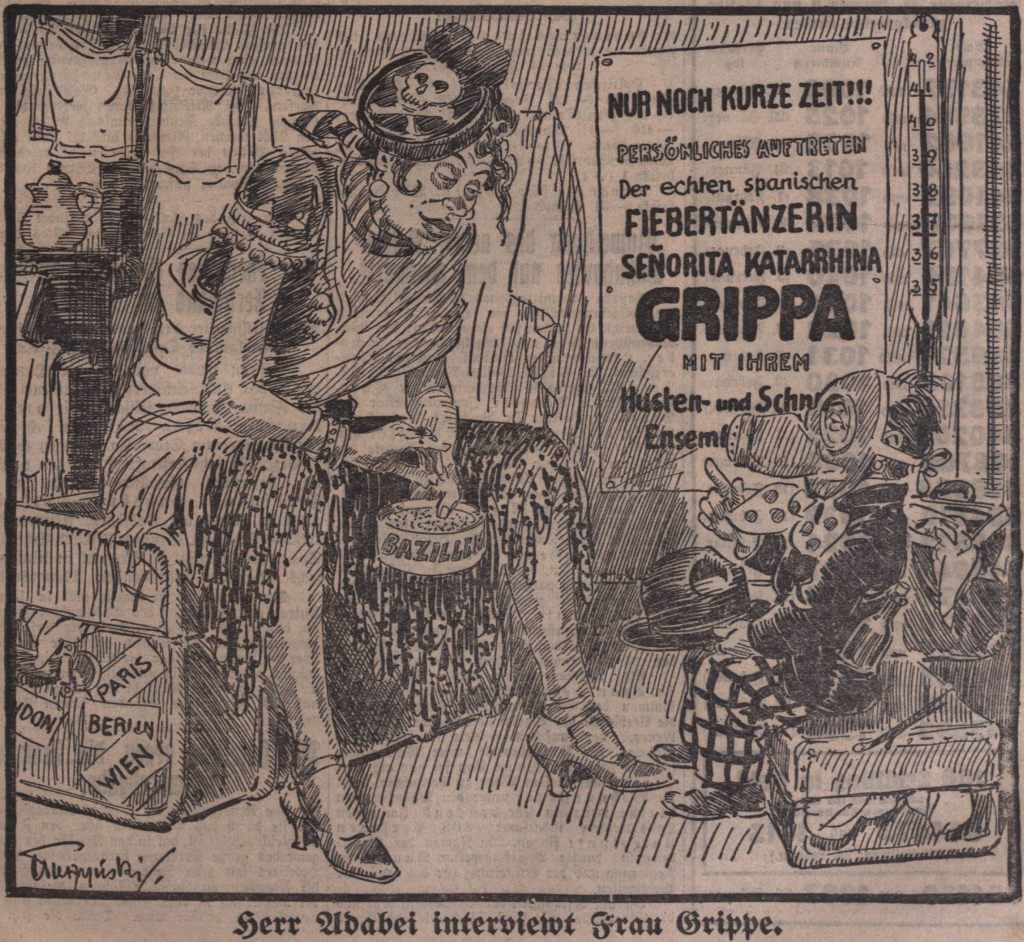
“Adabei” (roughly, “Also there”) was a byline for a series of columnists at Illustrierte Kronen Zeitung in Vienna. Sometimes cast as a pompous mascot for the newspaper, Adabei is here depicted in a mask interviewing a disreputable visitor, another recurrence of influenza. The poster reads: “Only for a short time longer!!! Personal appearance of the true Spanish feverish dancer, Señorita Katarrhina Flu, with her coughing and sneezing ensemble.” (1931)
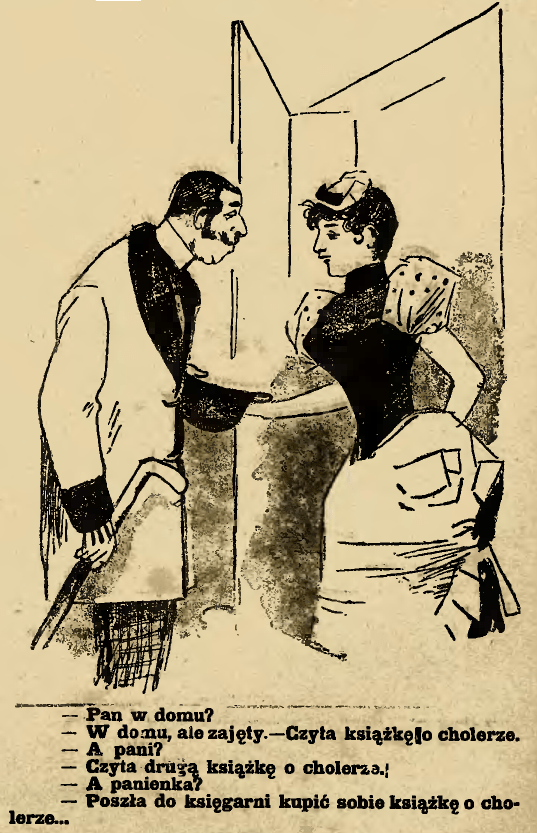
“Is the man of the house at home?”
“He’s at home, but he’s busy. He’s reading a book about cholera.”
“And the lady?”
“She’s reading another book about cholera.”
“And mademoiselle?”
“I’m off to the bookstore to buy myself a book about cholera…”
(Mucha, Warsaw, 1892)
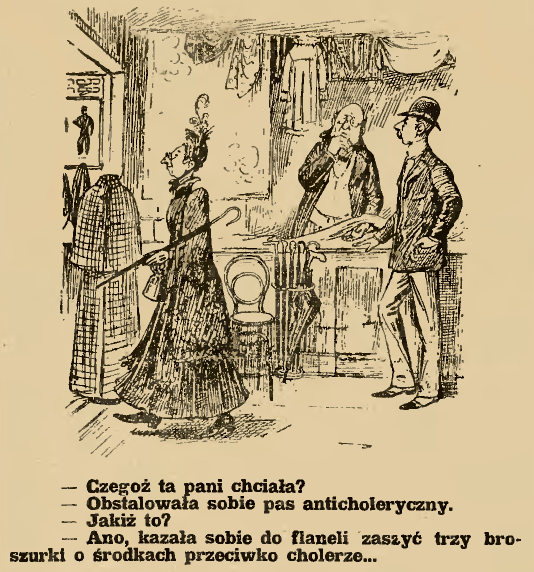
“What did that lady want?”
“She arranged for an anti-cholera waistband.”
“What is that?”
“Well, she ordered three brochures on anti-cholera measures sewn into the fabric…”
(Mucha, Warsaw, 1892)
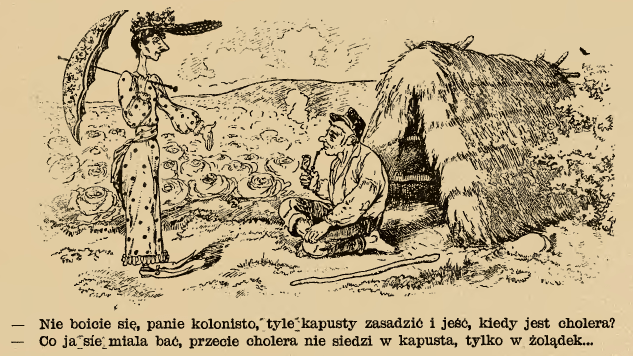
“Mr. Settler, aren’t you afraid to plant and eat so much cabbage when there is cholera?”
“What do I have to fear, after all cholera is not in the cabbage, but in the stomach…”
(Mucha, Warsaw, 1892)
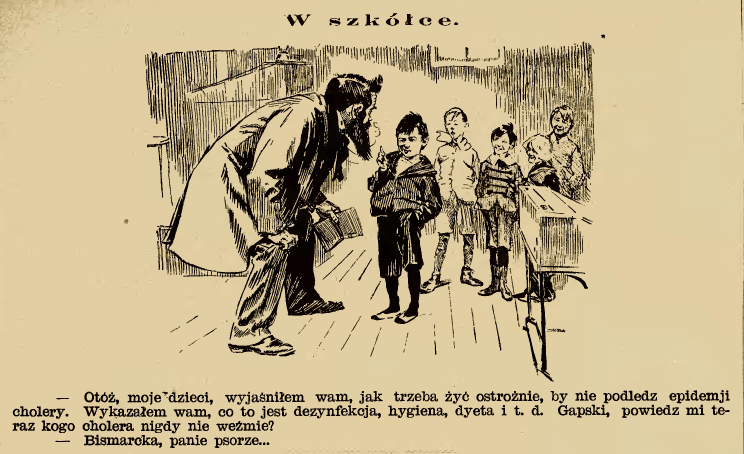
“Well, my children, I explained to you how to live carefully so as not to be subject to the cholera epidemic. I showed you what disinfection, hygiene, diet, and so on are. Gapski, tell me who the cholera will never take?”
“Bismarck, sir…”
(Mucha, Warsaw, 1892)
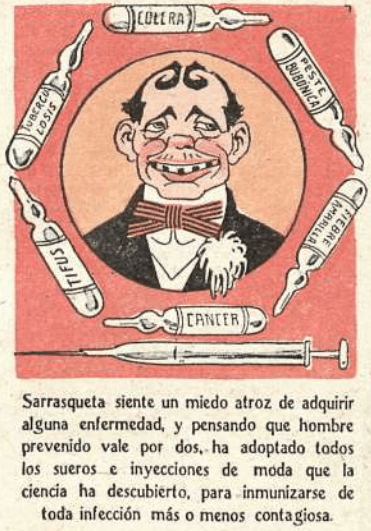
(Caras y Caretas, Buenos Aires, 1918)
Sarasqueta feels an atrocious fear of acquiring some disease, and thinking that a protected man is worth two, he has adopted all the fashionable serums and injections that science has discovered, to immunize himself from any more or less contagious infection.
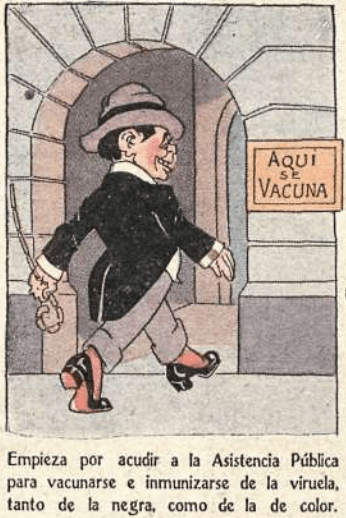
He starts by going to Public Assistance to get vaccinated and immunized from smallpox, both black and colored.
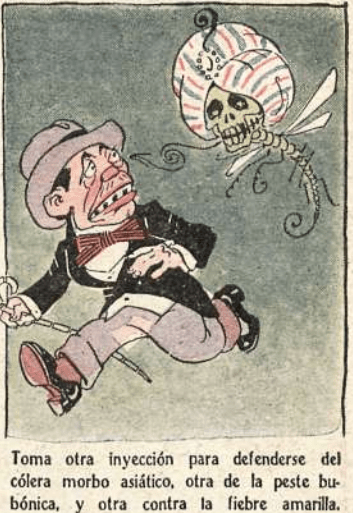
He takes another injection to defend himself from Asian cholera morbus, another against bubonic plague, and another against yellow fever.
Another against hydrophobia or anti-rabies, because he is always raging without knowing why.
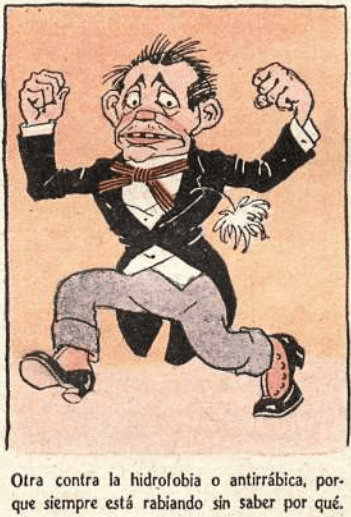
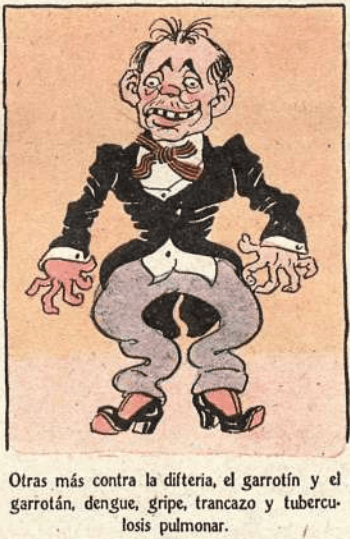
Still others against diphtheria, flamenco, dengue, influenza, flu, and pulmonary tuberculosis.
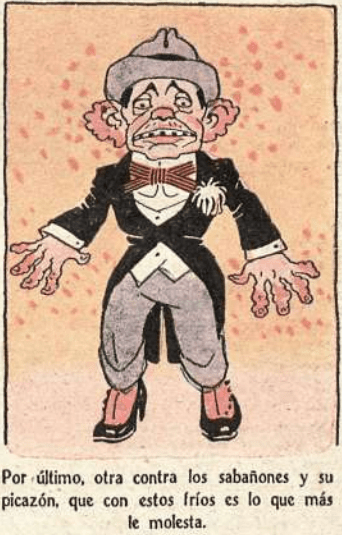
Finally, another against the chilblains and their itching, which with these colds is what bothers him most.
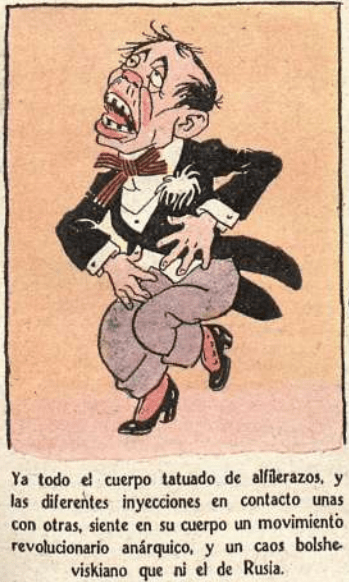
With his entire body already tattooed with needles, and the different injections in contact with each other, he feels an anarchic revolutionary movement inside, and a Bolshevik chaos that is not the Russian one.
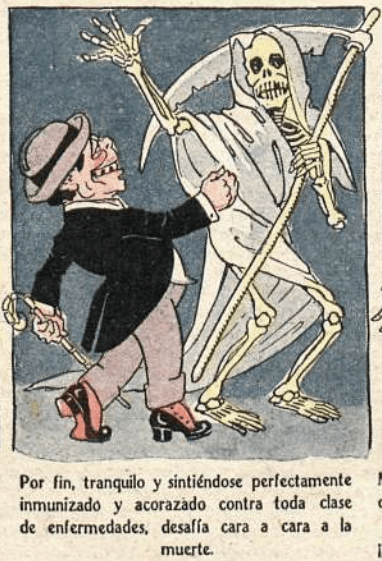
Finally, calm and feeling perfectly immunized and armored against all kinds of diseases, he defies death face to face.
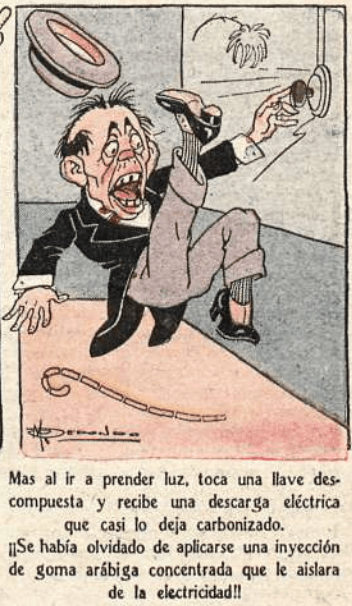
But when he goes to turn on the light, he touches a broken switch and receives an electric shock that almost leaves him charred.
He had forgotten to apply a concentrated gum acacia injection that would insulate him from electricity!
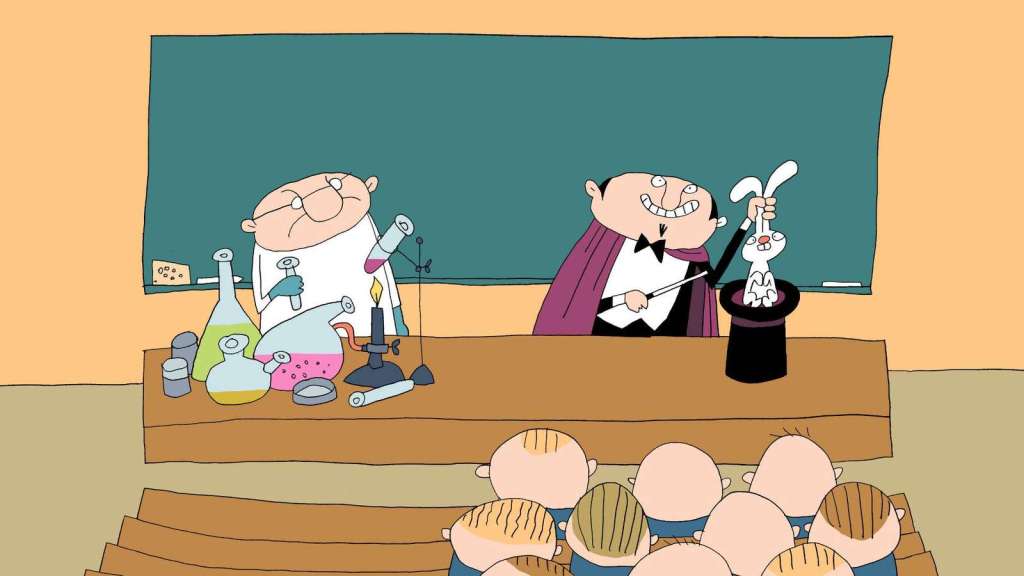
Although this site is largely devoted to archiving obscure historical humor, this amusing illustration by the marvelous Hungarian cartoonist Marabu (aka László Róbert Szabó) accompanies a recent article on hostility to science as a pandemic threat.
(Népszava, Budapest, 2020)
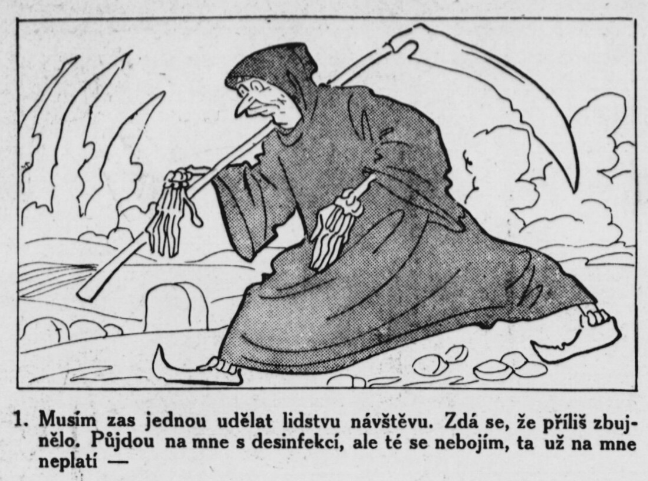
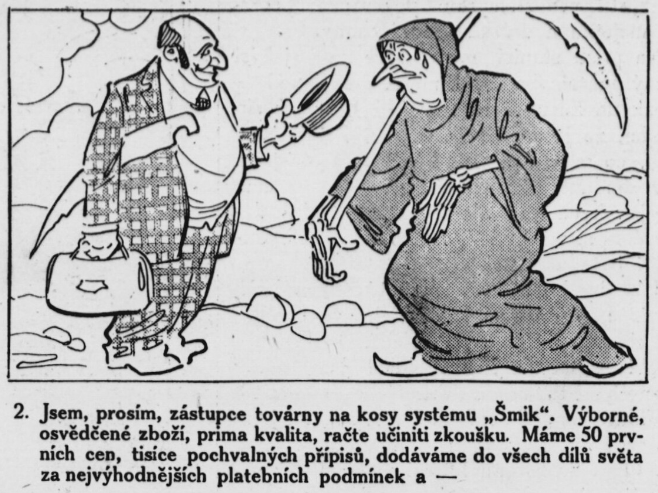
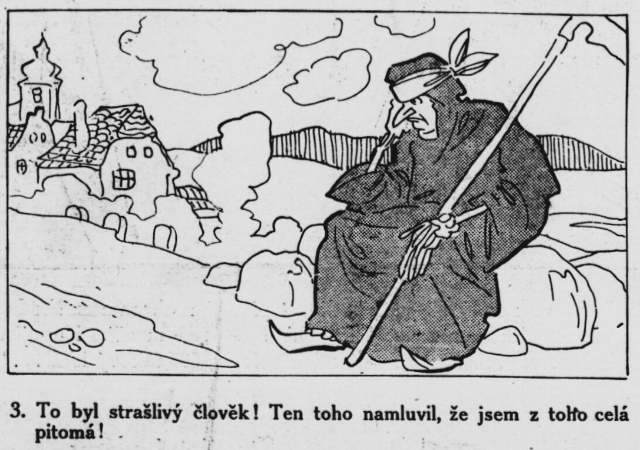
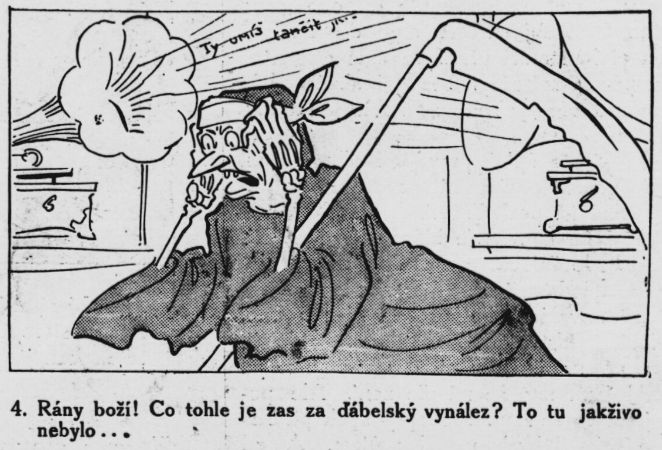
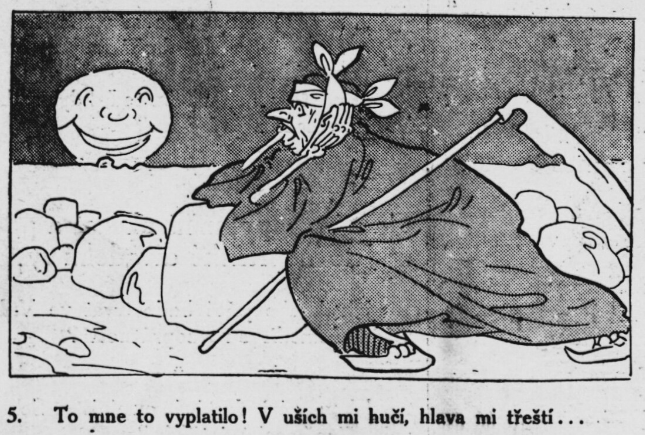
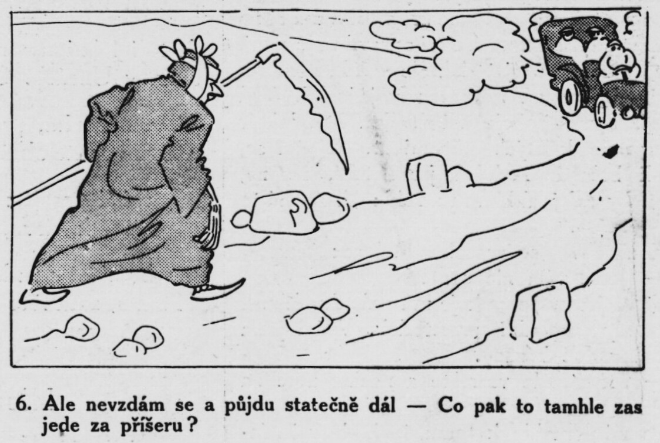
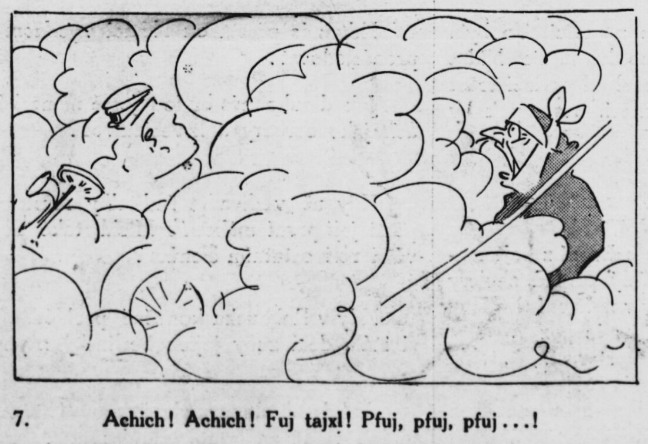
A multi-panel cartoon by Karel Stroff from Humoristické listy (Prague, 1910)
I must visit humanity again. It seems to have become too wanton. They will come after me with disinfectants, but I’m not afraid of that, it no longer applies to me.
Pardon me, I am a representative of the “Chiseler”* scythe factory. We have excellent, proven wares of great quality, please give it a test. We have fifty first-prize awards, thousands of commendations, we deliver to all parts of the world under the most advantageous payment terms and —
*(very loosely; no bonus for noticing the ethnic stereotype employed)
That was a terrible man! He spoke to me as if I was completely stupid!
Zounds! What kind of diabolical invention is this? There has never been such a thing…
That cost me dearly! My ears are buzzing, my head is splitting…
But I will not give up and I will bravely go on — What kind of monster is going over there?
Achoo! Achoo! Ugh, taxi. Yuck, yuck, yuck…!
And the crows fell upon his tortured body…
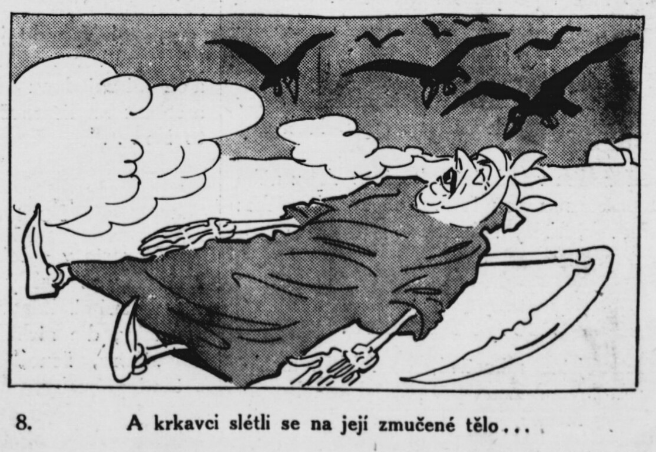
 Sic Transit Pestilentia