Wife: “Old man, I don’t know what is wrong with Sepp; he sits behind the outhouse all day immersed in himself!!”
Husband: “Yes, this makes me apprehensive. Either he’ll get measles or he’ll become a poet.”
(Fliegende Blätter, Munich, 1887)
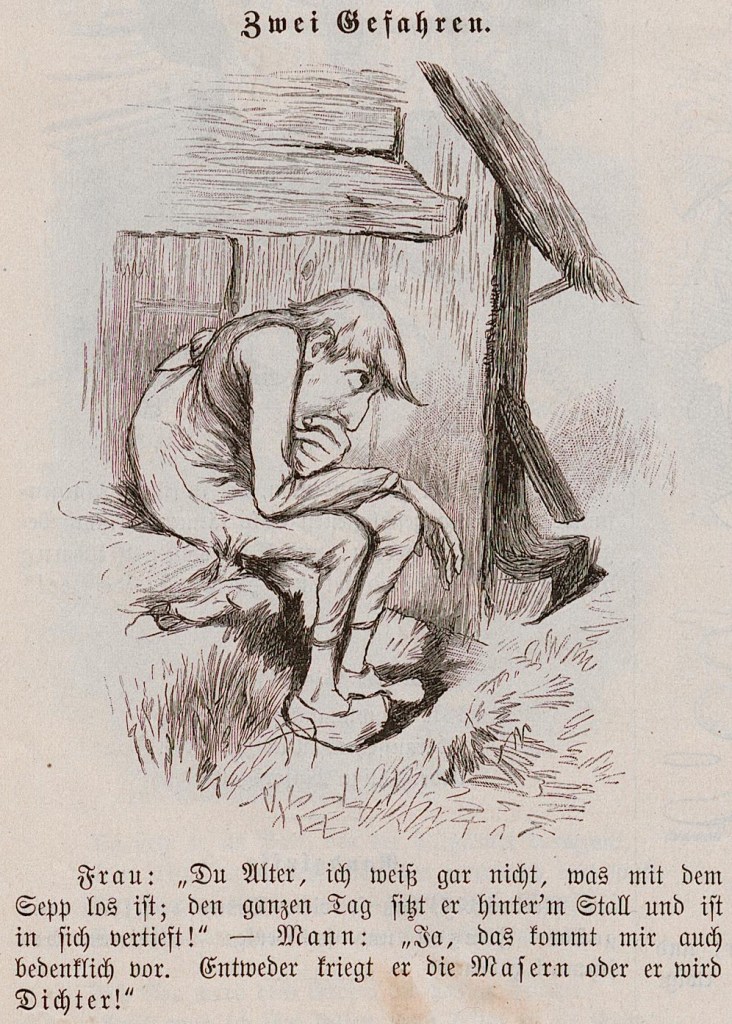
Wife: “Old man, I don’t know what is wrong with Sepp; he sits behind the outhouse all day immersed in himself!!”
Husband: “Yes, this makes me apprehensive. Either he’ll get measles or he’ll become a poet.”
(Fliegende Blätter, Munich, 1887)
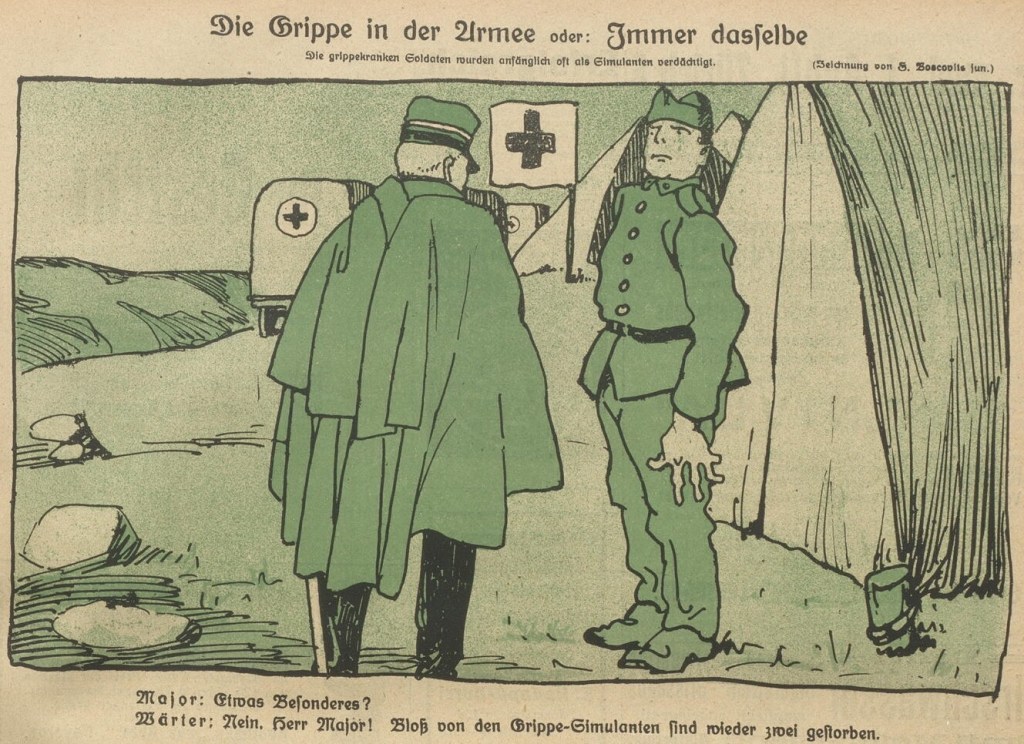
The flu in the army or: Always the same thing. The soldiers sick with flu initially were often suspected of faking it.
Major: “Anything special?”
Attendant: “No, sir! Just that two of the flu fakers have died again.”
(Nebelspalter, Zurich, 1918)
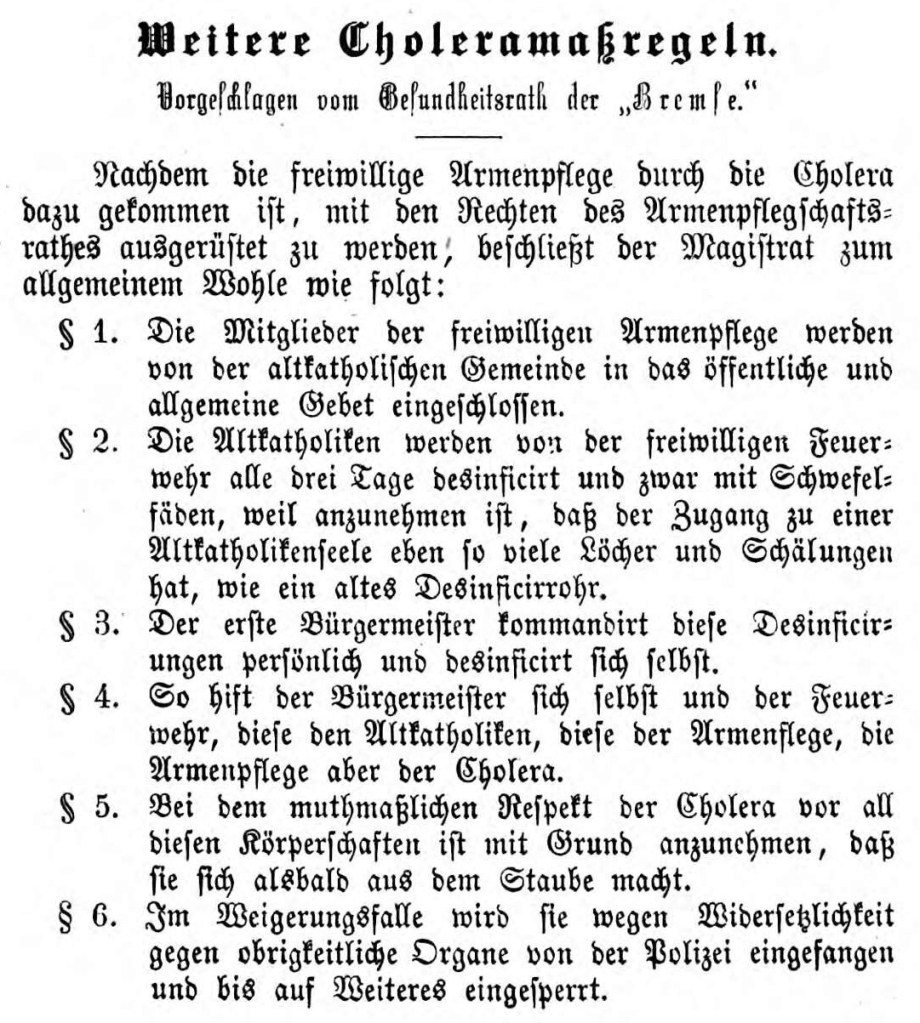
Further cholera measures proposed by the health councilor of Die Bremse.
Now that voluntary care for the poor has come to be equipped with the rights of the Council for Care of the Poor, the magistrate has concluded as follows for the general good:
1. The voluntary members caring for the poor will be enclosed by the old Catholic parishioners in public and general prayer.
2. The old Catholics will be disinfected by the voluntary fire department every three days with sulfurous cloths, because it is to be assumed that access to an old Catholic soul has just as many holes and cracks as an old disinfection tube.
3. The mayor commands these disinfections personally and disinfects himself.
4. In this manner the mayor helps himself and the fire department, they in turn help the old Catholics, they in turn help those caring for the poor, while those caring for the poor help cholera.
5. Given the presumed respect of cholera in the face of all these corporations we may fundamentally assume that it will quickly abscond.
6. Should it refuse to cooperate, the police will seize it for violating the authorities and imprison it until further notice.
(Die Bremse, Bavaria, 1873)
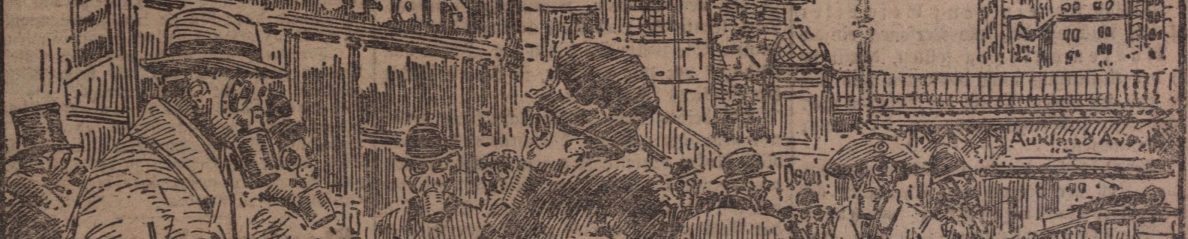
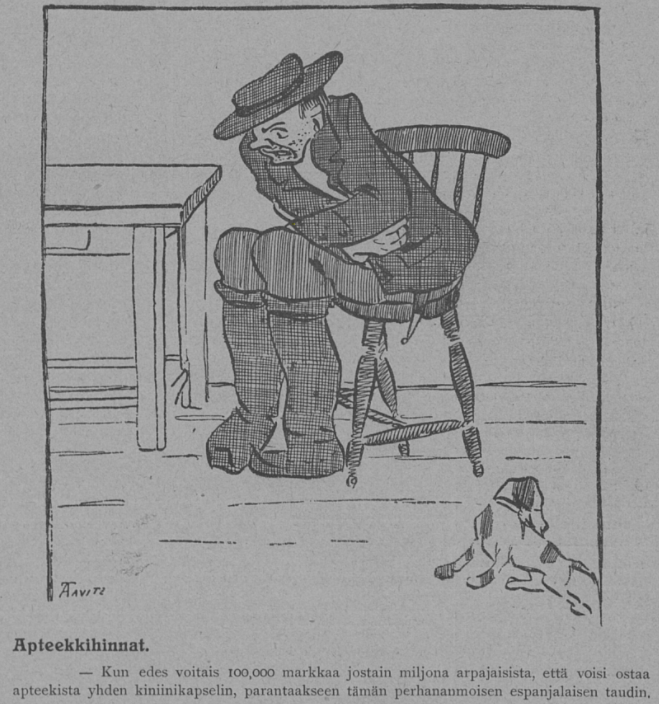
When you could win 100,000 marks from one of a million lotteries so that you could buy one capsule of quinine from a pharmacy to cure this awful Spanish disease.
(Tuulispää, Helsinki, 1918)
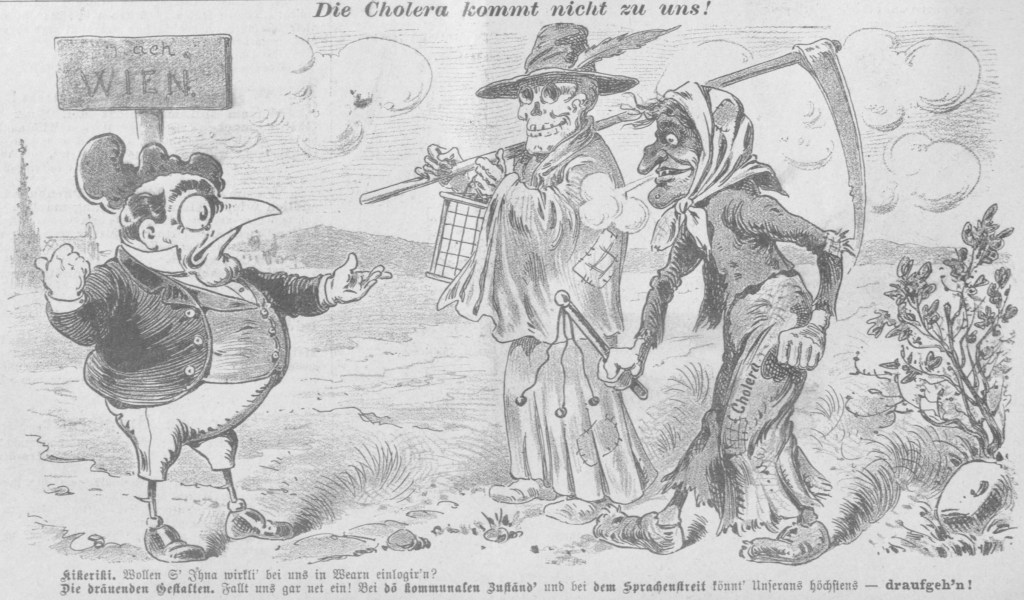
Kikeriki: “Do you really want to take lodgings with us in Vienna?”
Looming figures: “It didn’t occur to us! With the communal situation and the language conflict the likes of us could croak at best!”
(Kikeriki, Vienna, 1886)
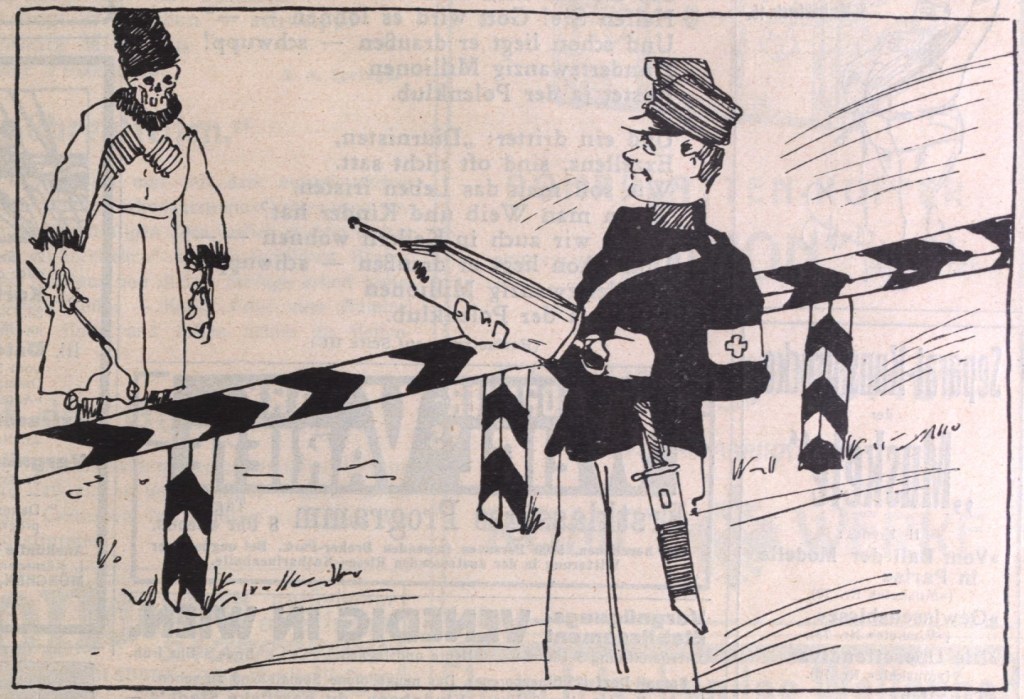
This cartoon set at the Austrian border with the Russian Empire is accompanied by a bit of nasty verse entitled “Cholera Russica” (in my slapdash translation):
The Slavic danger — how should I
Just say it? — is not an empty delusion;
On the contrary, it swells menacingly
In the south and in the east.
Defending against it, cannons are
Dispensable and rifles, too;
Only from sanitation troops alone
Can we make successful use.
In the south, where it is more primitive,
Yet still fruitless,
It besets us with vermin,
In the east with epidemics.
Now due to this realization the eastern one
Terrifies us especially clearly,
Since its main pathogen is just now
Loosing the prohibited heart of the epidemic;
Even though the tightest quarantine,
That we usually put in place,
Sets hardly more conditions than those,
That the Tsar himself always imposes.
And as for the man himself, it was not
A plague that instilled fear in him,
For whom the greatest of all plagues
Hasn’t yet withered him: his regime!
(Die Muskete, Vienna, 1910) (Or this bit of German verse in a similar vein.)
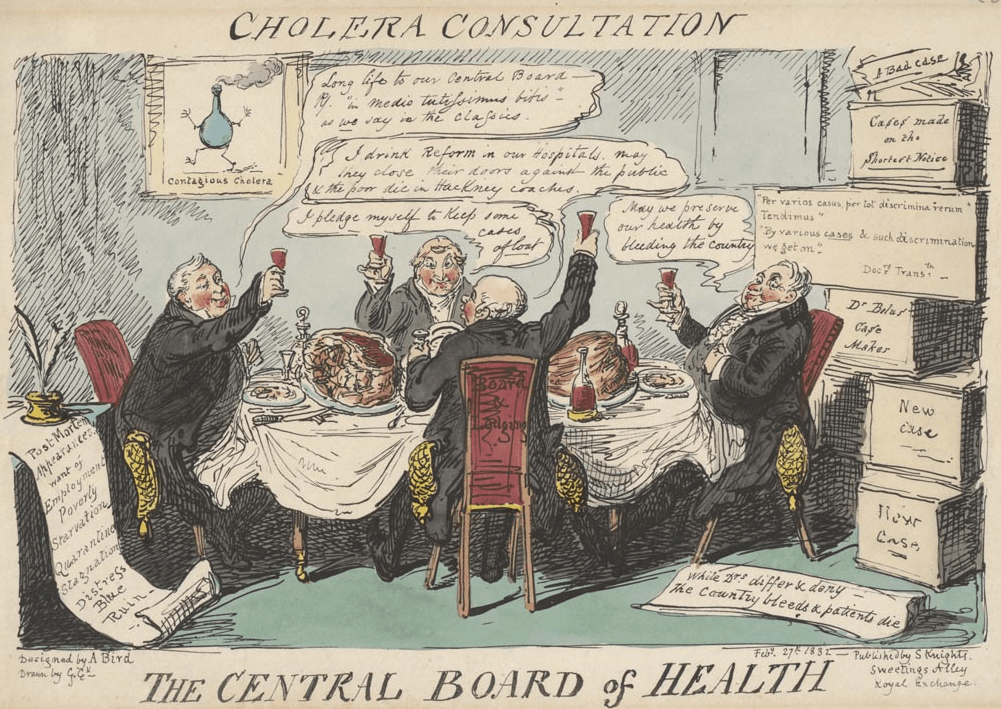
George Cruikshank, “The Central Board of Health: Cholera Consultation” (1832)
(From the Manfred Kraemer Collection of Medical Prints and Satires, Countway Library, Harvard University)
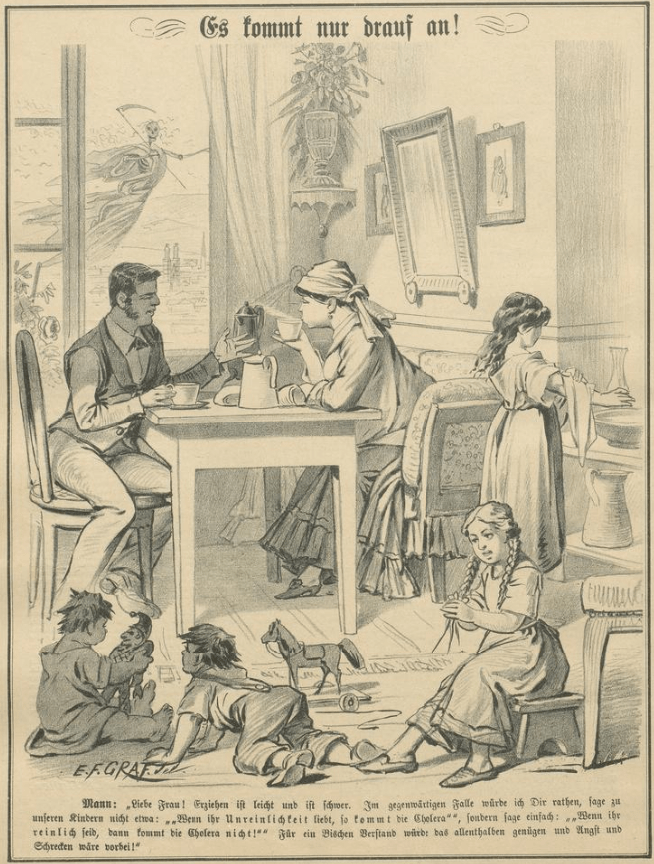
Husband: “Dear wife! Education is easy and it is difficult. In the present case I would advise you not to tell the children “If you love uncleanliness, that’s how cholera comes,” but rather just to say: “If you are clean, then cholera doesn’t come!” That would suffice everywhere for a bit of sense, and fear and terror would be over.”
(Nebelspalter, Zurich, 1883)
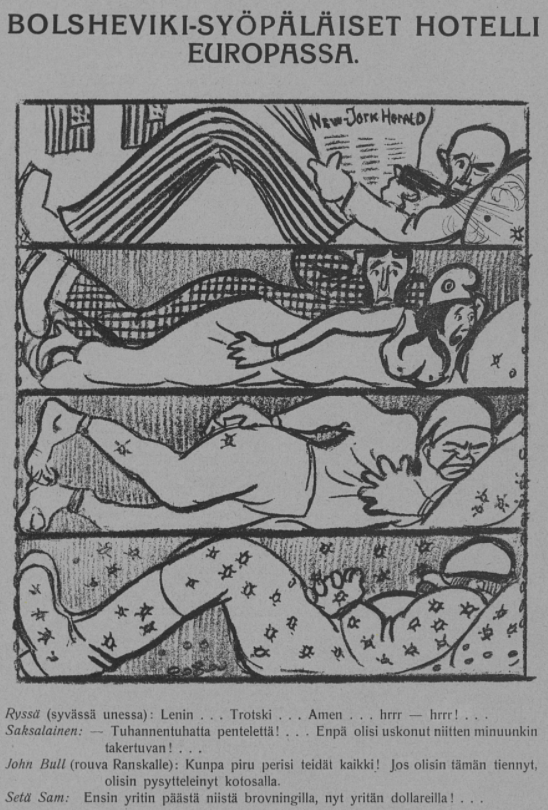
Politics-as-contagion is low-hanging fruit, to be sure, but this Finnish cartoon still warrants preservation.
Russian (fast asleep): “Lenin… Trotsky… Amen… hrrr — hrrr! …”
German: “A million spawn! … I wouldn’t have thought they would cling to me either! …”
John Bull (to Mrs. France): “The devil take you all! If I had known about this, I would have stayed at home.”
Uncle Sam: “First I tried to get rid of them with a Browning, now I’ll try with dollars! …”
(Tuulispää, Helsinki, 1919)
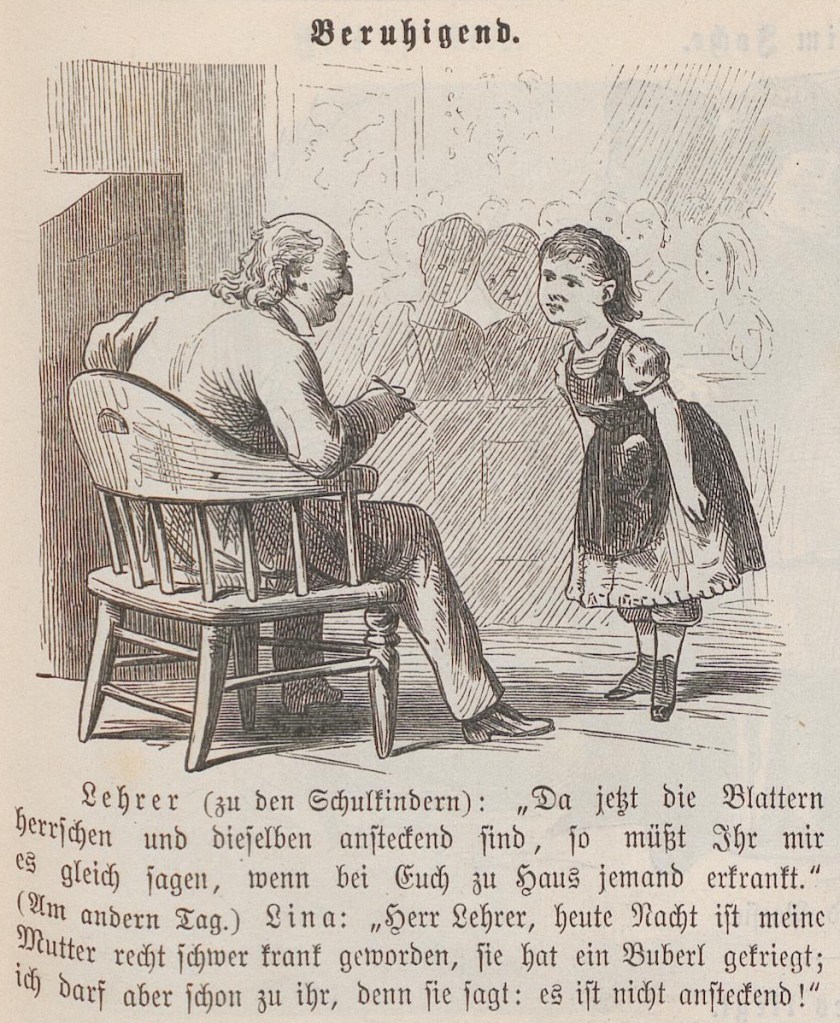
Teacher (to schoolchildren): “Because smallpox is rampant and it is contagious, you must tell me immediately if someone in your home gets sick.”
Lina (the next day): “Mr. Teacher, last night my mother got really sick, she got a little baby; it’s already fine to be around her, because she says that it is not contagious!”
(Fliegende Blätter, Munich, 1874)
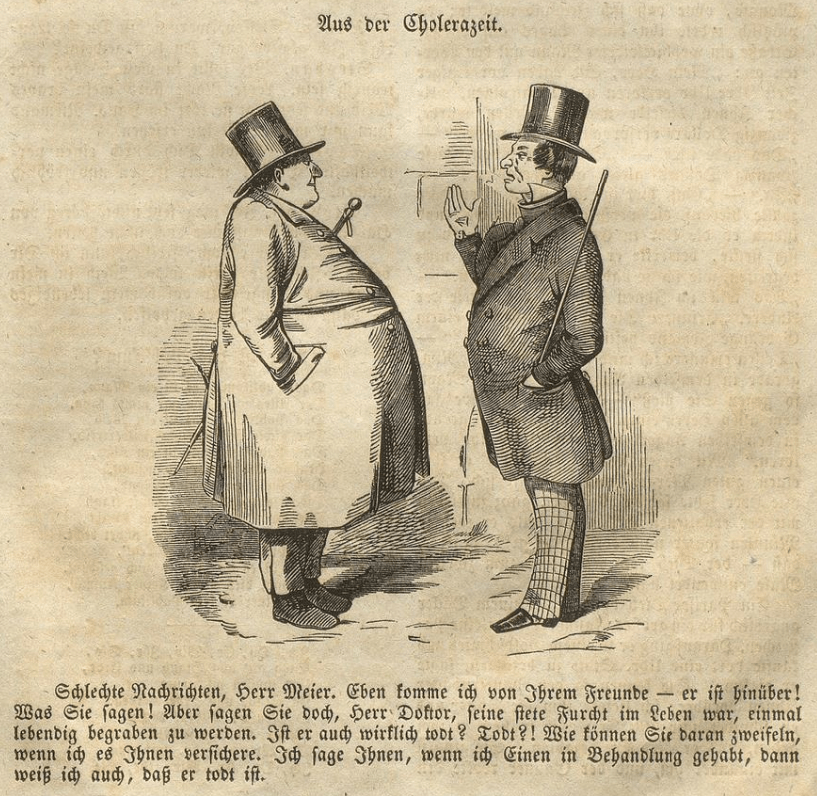
Doctor: “Bad news, Mr. Meier. I’ve just come from your friend — he has passed away!”
Mr. Meier: “What are you saying! But tell me, Doctor, his constant fear in life was that he would someday be buried alive. Is he really dead?”
Doctor: “Dead?! How can you doubt it if I am affirming it. I’m telling you, once I’ve had one of them in treatment, then I know that he’s dead, too.”
(Appenzeller Kalender, Zurich, 1855)
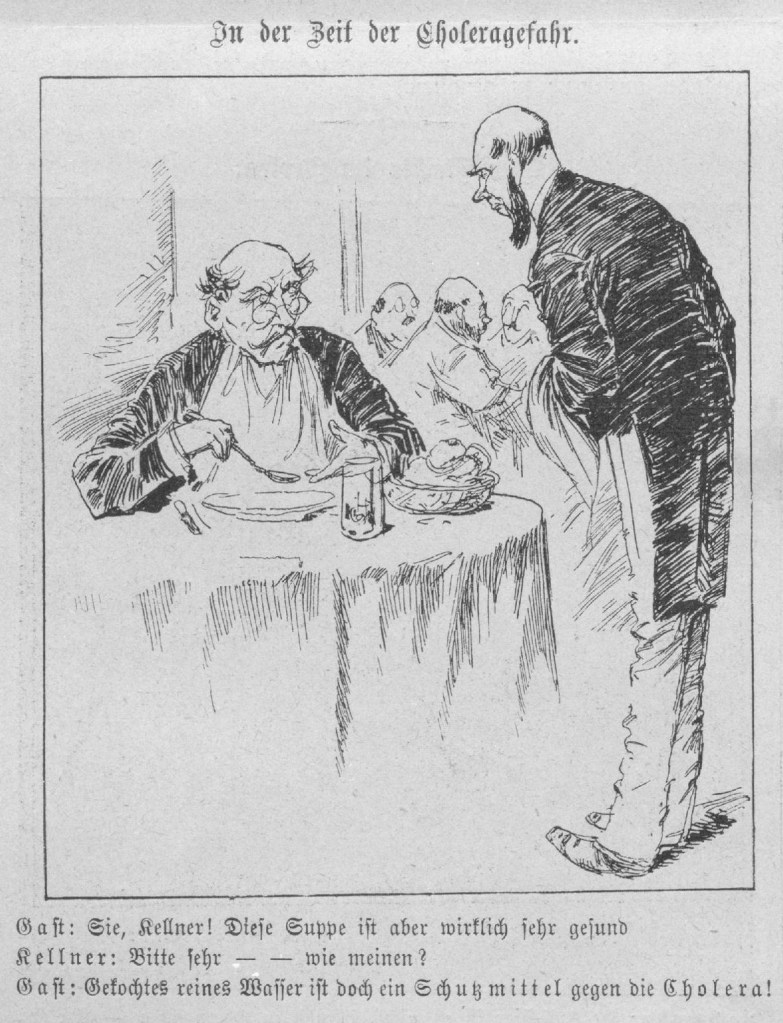
Guest: “Waiter! This soup is really very healthy.”
Waiter: “You’re welcome — how do you mean?”
Guest: “Pure boiled water is a prophylactic against cholera!”
(Figaro, Vienna, 1892)
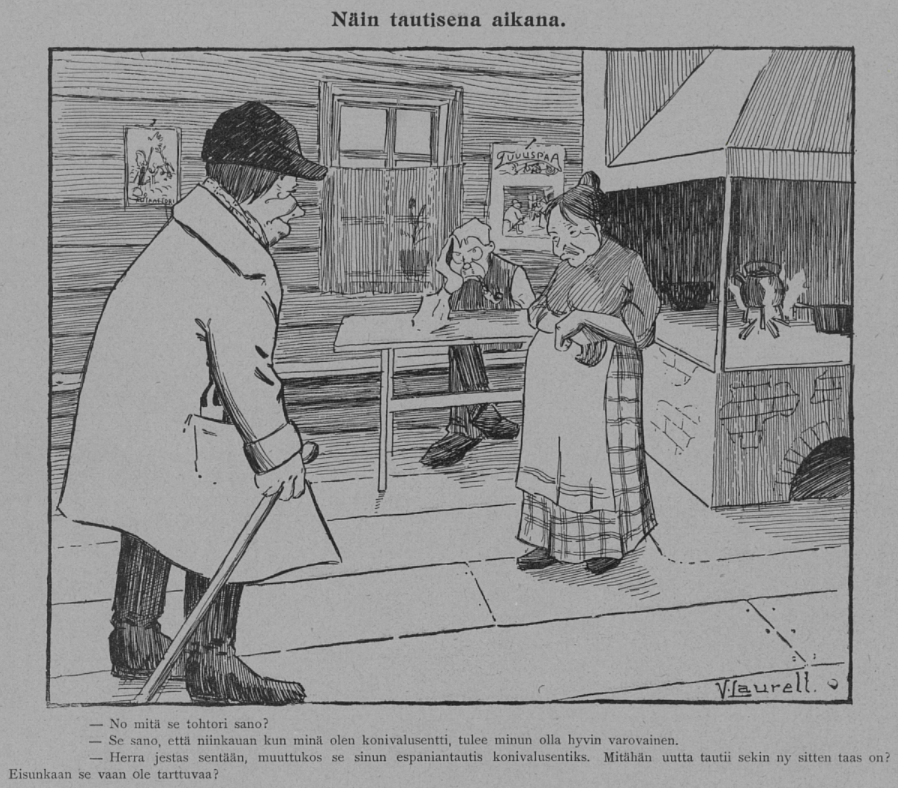
“Well, what does that doctor say?”
“He said that as long as I’m convalescing, I need to be very careful.”
“At least the gentleman said it would turn your Spanish disease into a convalescent. What’s new about the disease then again? Isn’t that contagious?”
(OK, I’ve surely botched the wordplay here, but it’s clearly about “convalescence” as medical neologism.)
(Tuulispää, Helsinki, 1918)
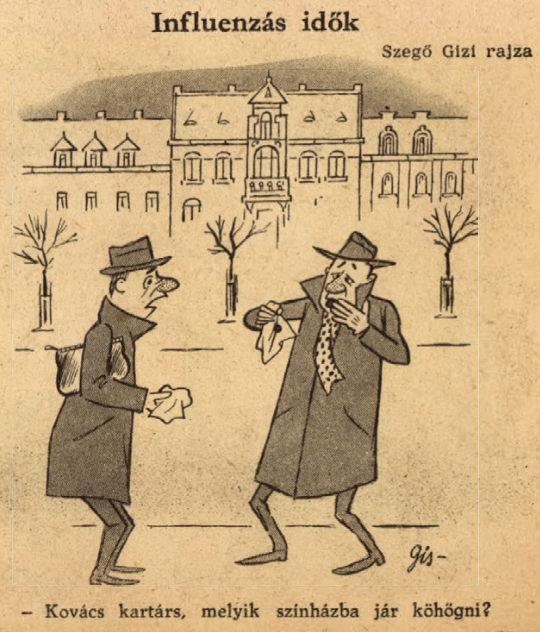
“Mr. Smith, which theater are you heading to cough?”
(Ludas Matyi, Budapest, 1958)
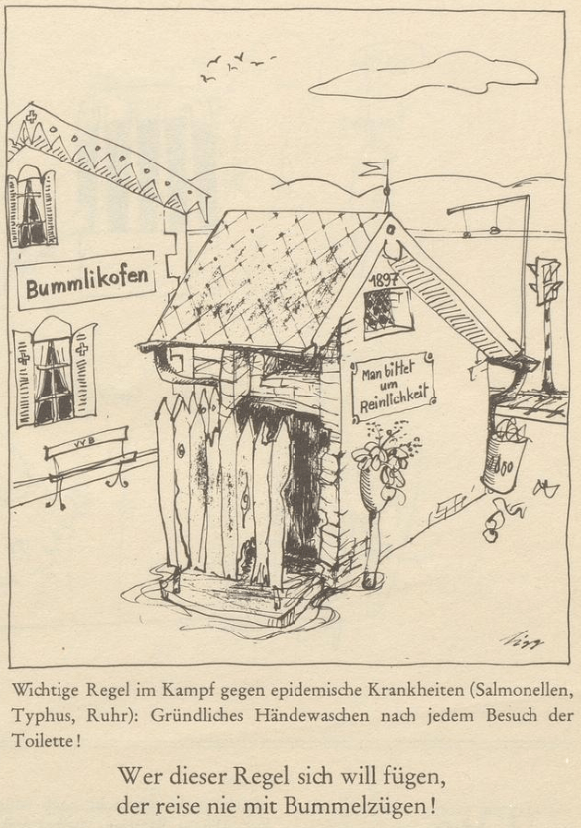
Such a marvelous idiom: Bummelzug, “boomelzoog,” the slow train that stops at every last station along the way. Here a pitiful little provincial station with terrible facilities posts a sign, “Please keep clean.” The caption then reads: “Important rule in the battle against epidemic diseases (salmonella, typhus, dysentery): Thorough hand-washing after every visit to the restroom!” Which prompts the rhyme (in German):
Whoever wants to comply with this rule,
He’ll never be traveling on slow trains!
Draw appropriate hygienic conclusions.
(Nebelspalter, Zurich, 1966)
 Sic Transit Pestilentia