“Confound it!” As the fourth global cholera epidemic swept through Bavaria, a recovering victim contemplated the difficulty of returning to normal food consumption, having improvised ways to cushion the blows to his bodily orifices wrought by cholera’s violent dehydrating symptoms. (Die Bremse, Munich, 1873)
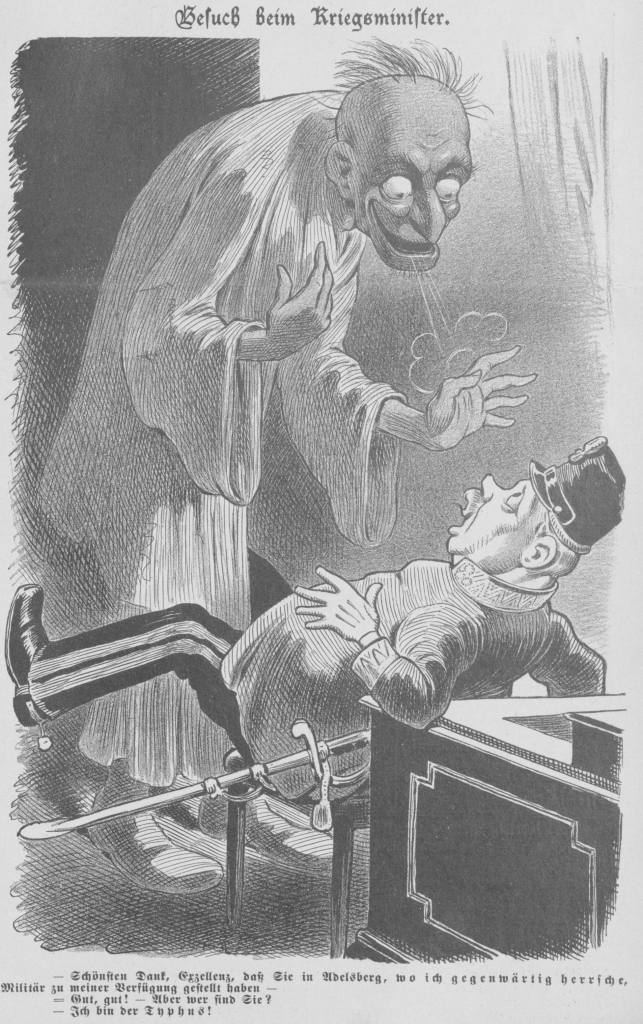
“My best thanks, Excellency, for putting the military at my disposal in Adelsberg [Postojne in the Slovenian countryside northeast of Trieste], where I currently rule.” “Fine, fine! But who are you?” “I am Typhus!” (Kikeriki, 1907)
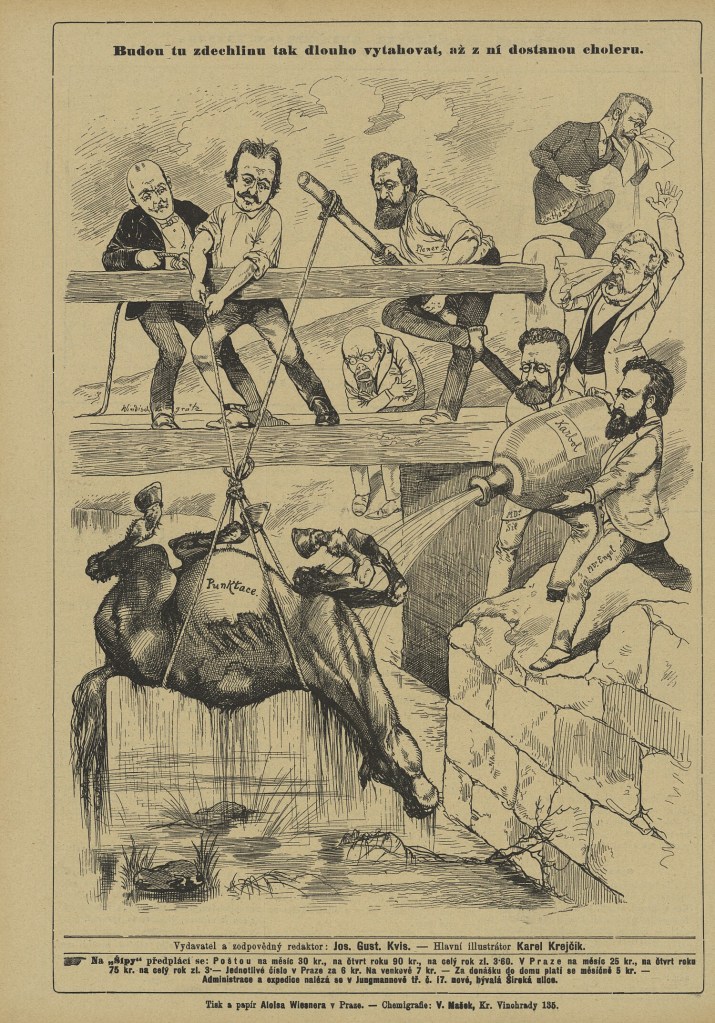
This is an elaborate and slightly intriguing variant on the disease metaphor in politics. Since before the Austro-Hungarian Ausgleich of 1867, Czech nationalists had aspired to a similar agreement with the German-speaking populace in the Bohemian lands. The Old Czech faction pressed repeatedly for a formal list of potential points of agreement (the dead horse labeled “Punktace”), largely centered on a strategy of cooperation with the great landowners and loyalty to the Habsburg monarchy. After 1874 the Young Czech faction rejected this strategy and demanded more direct representation in the parliament, hobbling any compromise. The Old Czechs made a final push for an agreement in 1890, but with the victory of the Young Czechs in the elections the following spring, any prospect for its success faded from view. This cartoon from the Prague satirical journal Šípy in 1892 mocks several Old Czech politicians as they endeavor to lift the dead horse, one applying generous quantities of carbolic acid.
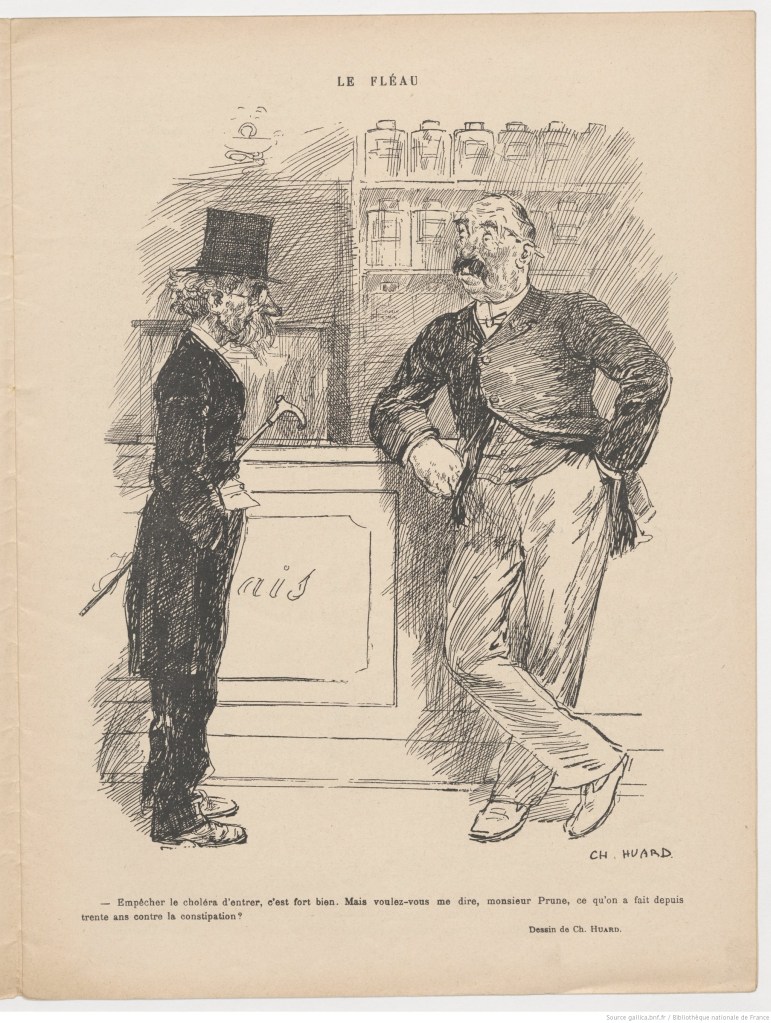
“Preventing cholera from entering is fine. But would you tell me, Mr. Prune, what has been done for thirty years against constipation?” (Le Rire, 1911)
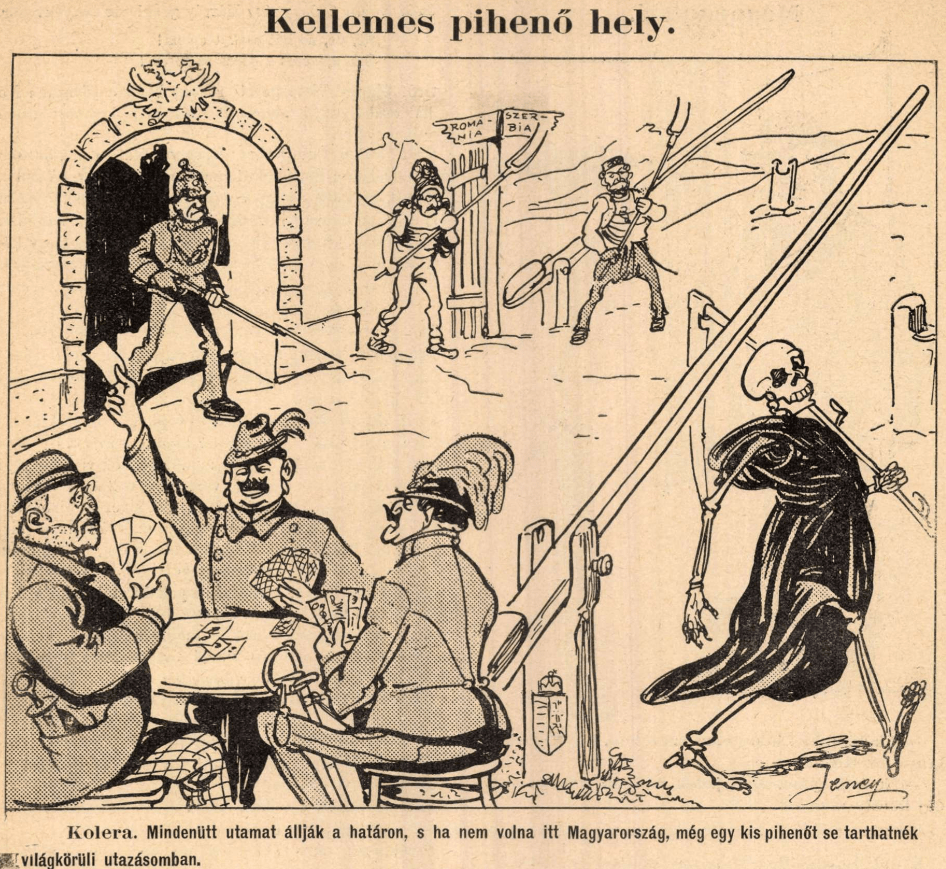
Cholera: “They block my path at the border everywhere, and if it weren’t for Hungary, I wouldn’t be able to take a break from my trip around the world.” (Bolond Istók, Budapest, 1910) Let’s hope Mr. Emergency Decree can appreciate this kind of epidemic humor.
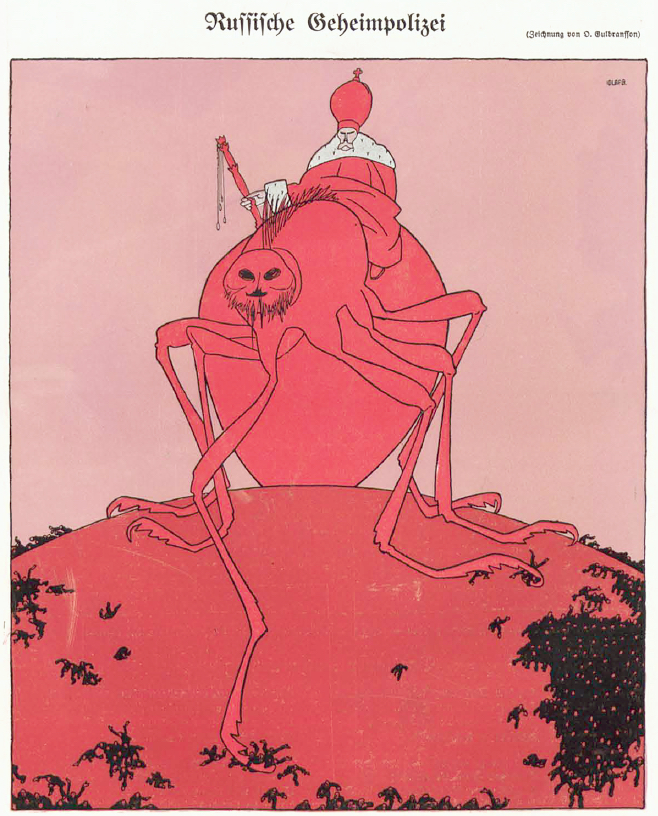
In 1908 a typhus epidemic began spreading from the northern Caucasus and southern Russia to the more densely populated northwestern districts of the Romanov Empire. By and large the epidemic failed to reach further west in Europe, but that did not prevent the German magazine Simplicissimus from offering this curious variant of the classic trope of disease as invasive agent. (Simplicissimus no. 24, 1909)
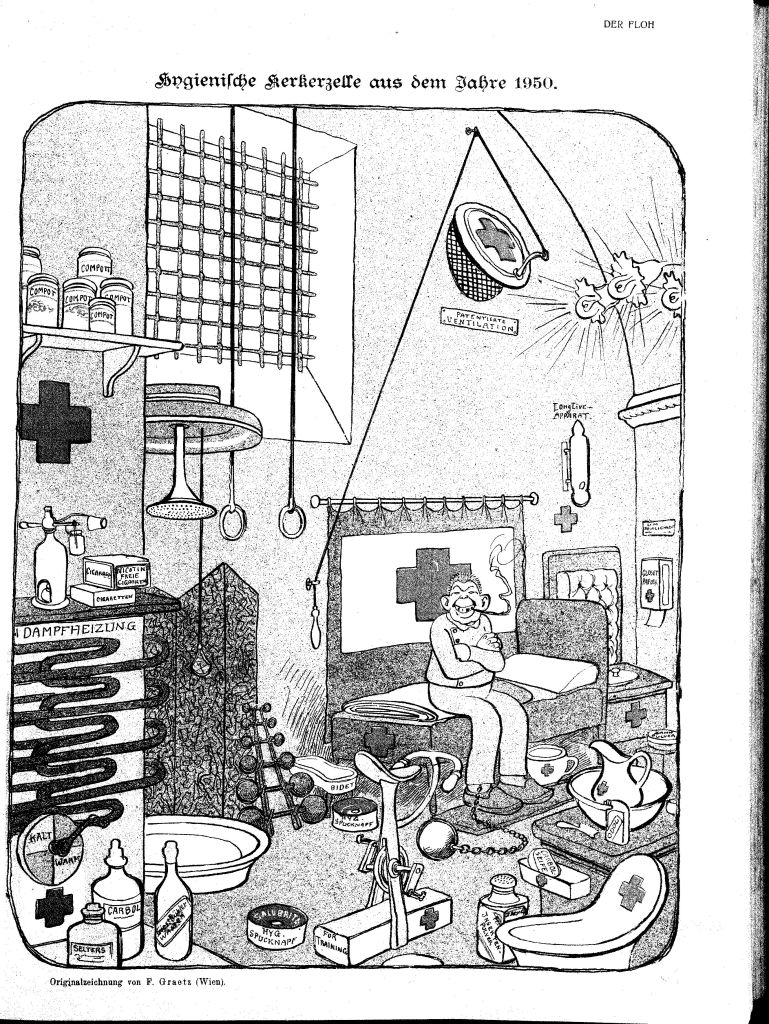
In May 1906 Archduke Franz Salvator opened a large international hygiene exhibition in Vienna. In early July the first major revision to the Hague Convention was adopted in Geneva, among other things strengthening the protections for prisoners of war. The International Committee of the Red Cross was especially prominent in pressing for these provisions, surely strengthening the modern conviction that enforced confinement should be sanitary. In this image we see a “hygienic dungeon cell from the year 1950,” as imagined in Viennese satirical magazine Der Floh in June 1906. Note how all the accoutrements come with the Red Cross symbol.


 Sic Transit Pestilentia