“Always with God!” Note the conflation of poison gas with spreading bacterial contagion. The man is carrying inflammable liquid along with cholera, tuberculosis, and typhus “confetti.”
(L’Asino, Rome, 1918)
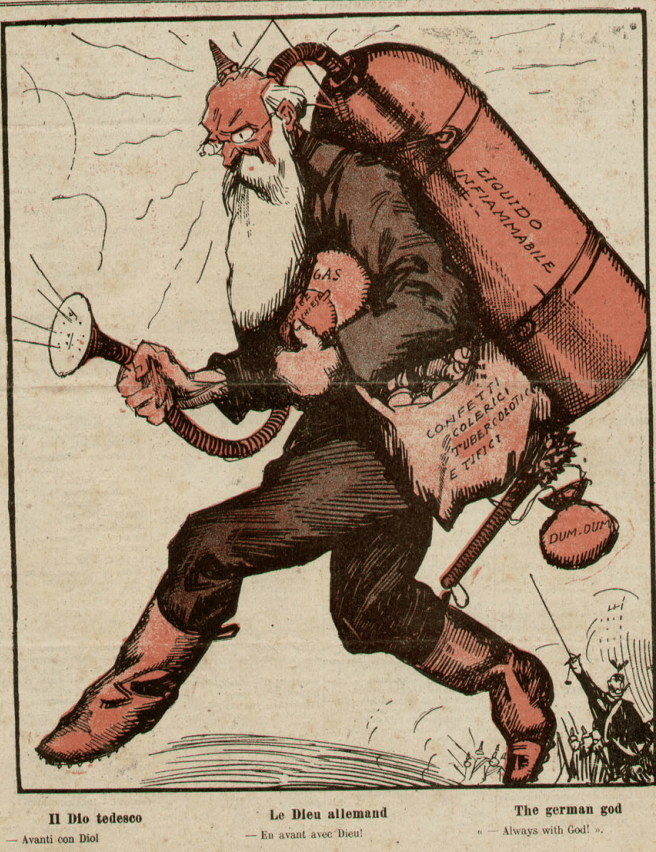
“Always with God!” Note the conflation of poison gas with spreading bacterial contagion. The man is carrying inflammable liquid along with cholera, tuberculosis, and typhus “confetti.”
(L’Asino, Rome, 1918)
“Say Bunny, did you have the Spanish thing?”
“Not that. But I did have a Bulgarian.”
(Borsszem Jankó, Budapest, 1920)

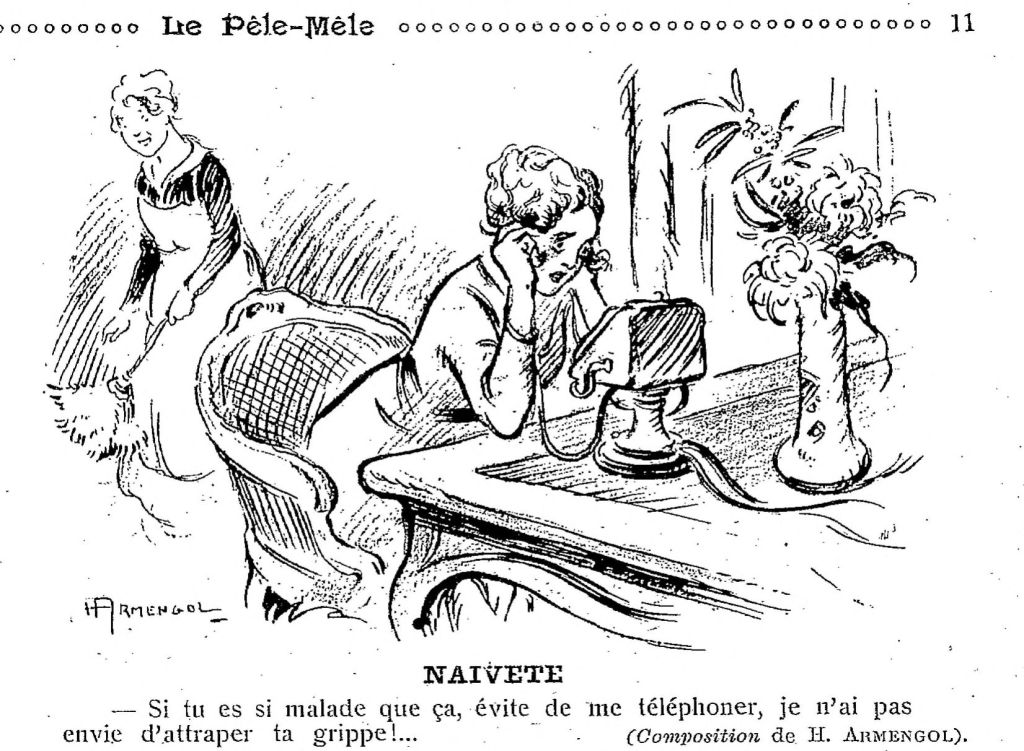
“If you’re that sick, don’t call me, I don’t want to catch your flu! …”
(Le Pêle-mêle, France, 1919) (For the 5G conspiracy theorists.)
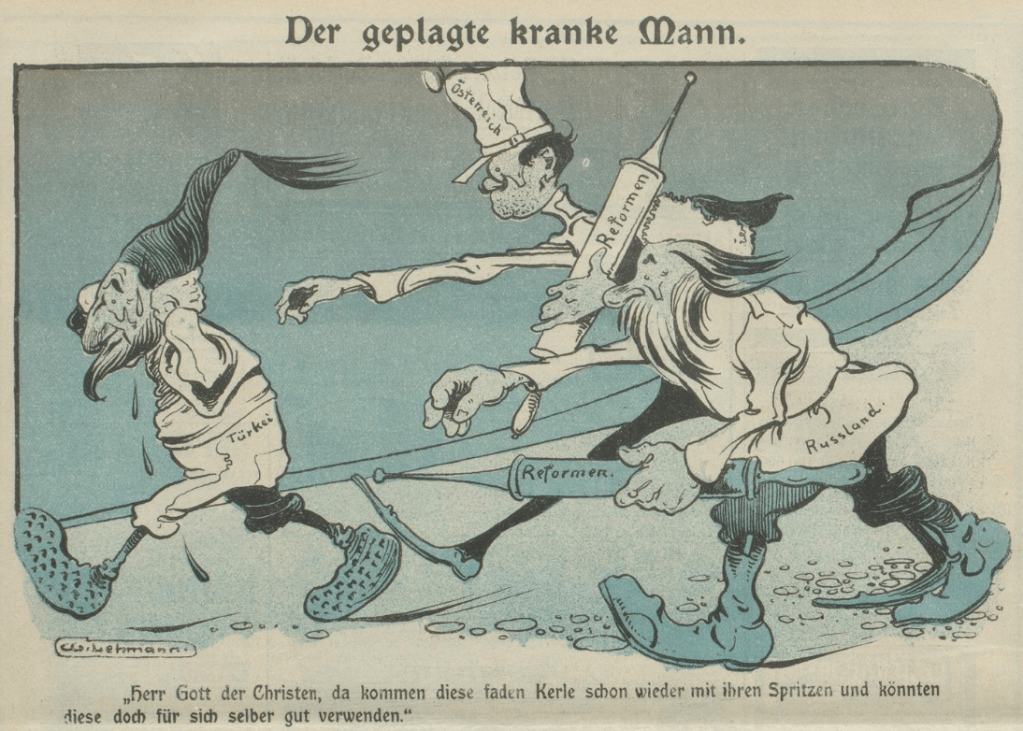
Turkey pursued by Austria and Russia with syringes full of reforms. “Lord God of the Christians, here come these stupid guys again with their syringes and yet they could put them to use for themselves.” (Included mainly for the use of the clystère theme.)
(Nebelspalter, Zurich, 1907)
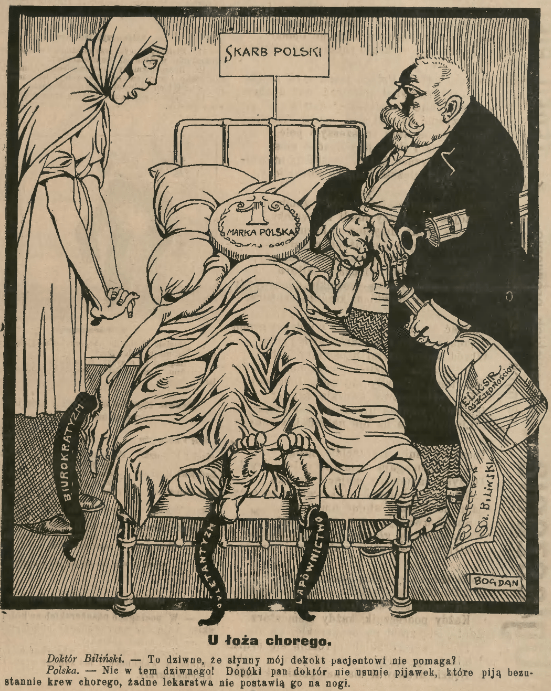
Hospital ward: Polish treasury. Patient: The Polish mark.
Doctor Biliński [the Polish finance minister with his austerity elixir]: “Isn’t it strange that my famous decoction is not helping the patient?”
Polish woman: “No wonder! Until the doctor removes the leeches [bureaucratism, dilettantism, bribery] that constantly drink the patient’s blood, no medicine will put him on his feet.”
(Mucha, Warsaw, 1919)
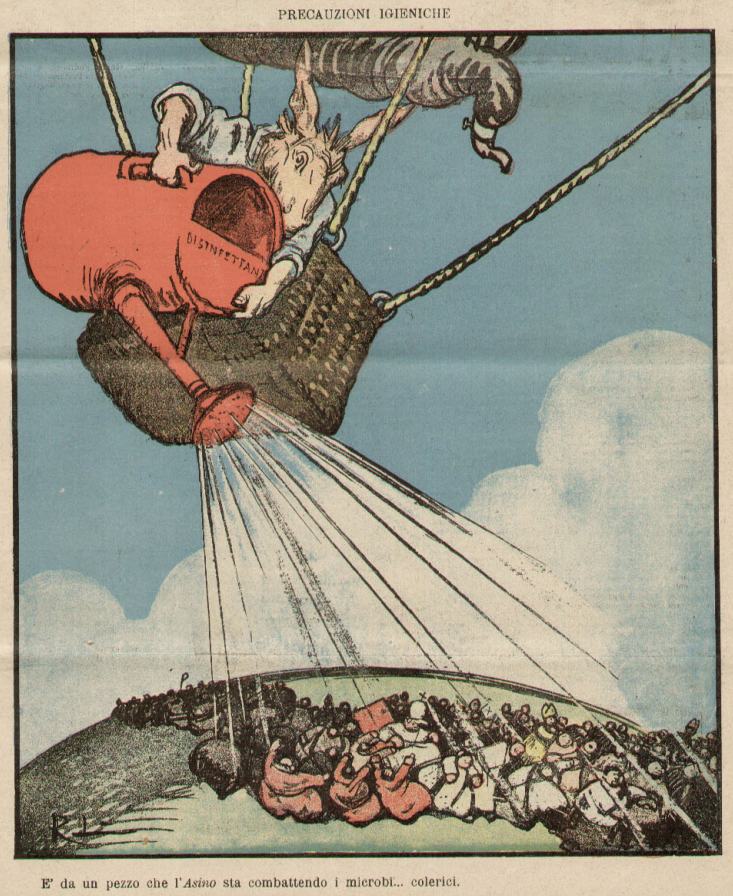
Really wandering beyond my ken here, but I find this image from the Italian satirical magazine L’Asino rather amusing. The eponymous mascot is pouring disinfectant on what seems to be a very clerical populace below. The caption reads, “It has been a long time that The Ass has been fighting against microbes… cholera microbes.” (I imagine there is word play on the sense of “choleric” here, but I don’t speak Italian.) The magazine was stridently anticlerical, and the winking implication is that it has been doing battle with metaphorical contagions, while cholera (the sixth pandemic then touching mainly the easternmost portions of Europe) was a literal latecomer.
(L’Asino, Rome, 1910)
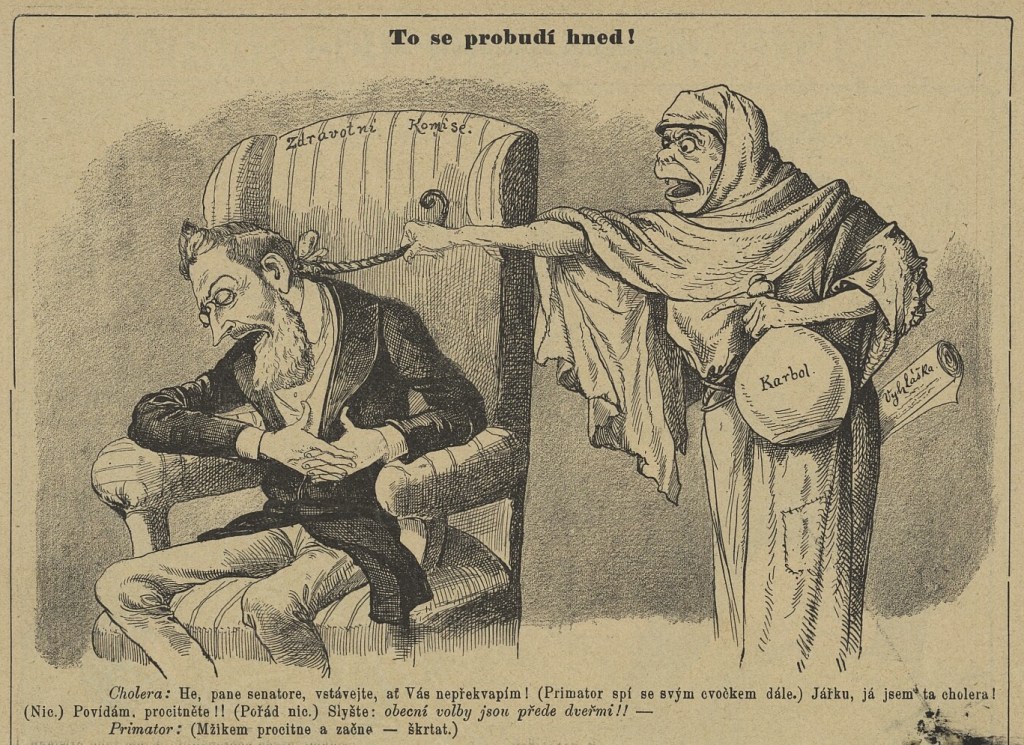
Health Commission (armchair). Cholera, bearing a container of carbolic acid and a decree in her pocket, pulls the pigtail of the mayor of Prague: “Hey, Senator, get up, I wouldn’t want to catch you by surprise!” (The mayor sleeps further with his spectacles.) “I say, I’m the cholera!” (Nothing.) “I’m telling you, wake up!! (Still nothing.) “Listen: the municipal elections are at the front door!!“
Mayor of Prague: (Instantly wakes up and starts making budget cuts.)
(Czech satirical magazine Šípy, Prague, 1892)
This advertisement from 1927 for Formamint lozenges nicely captures some present dilemmas. The Berlin bacteriologist Max Piorkowski developed these anti-bacterial pills before World War I, when they were already widely marketed. During the 1918 influenza pandemic, when very little was known about the properties of viruses, the overwhelming cause of death was secondary infection stemming from bacterial pneumonia. Formamint was then sold for its antiseptic properties as an aid to avoiding contagion risks. The active ingredient was formaldehyde (now thought to be a carcinogen at higher exposures), bound with sugar and citric acid for convenient oral administration. Notice how the advertisement conflates the site of risk—a crowded movie theater—with the site of the didactic commercial insight. “The risk of contagion grows if many people gather, such as in theaters, cinemas, concert halls, on trains and trams, in schools, public assemblies and associations.” The screen depicts three different slide cross-sections of “influenza bacteria” (sic). The first slide, full of bacteria, did not have the benefit of Formamint. The second slide shows the reduction in bacteria by ingesting three lozenges, while the third slide, free of bacteria, comes courtesy of five lozenges. The obvious implication: take a lozenge to assuage your public health anxiety. If someone asks, “What have you got to lose?“, exercise caution before taking magic pills. (Austrian National Library)
(Compare also this earlier advertisement in English. It would seem that it had a strong market among war veterans.) On the more complex reasons for imputing the disease to Bacillus influenzae during the war, see Michael Bresalier, “Fighting flu: Military pathology, vaccines, and the conflicted identity of the 1918-19 pandemic in Britain,” J. Hist. Med. 68 (2013).

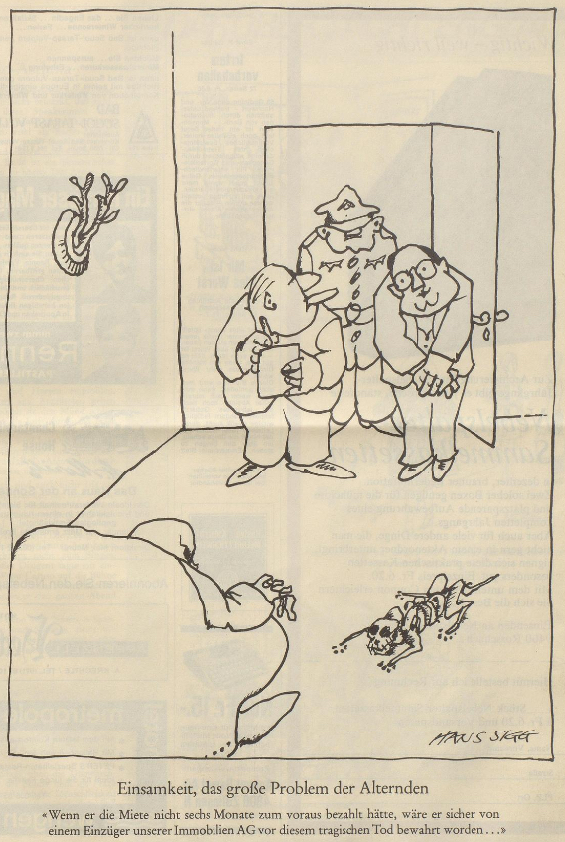
“If he hadn’t paid rent six months in advance, he would surely have been kept from this tragic death by one of our real estate companies…”
(Nebelspalter, Zurich, 1972)
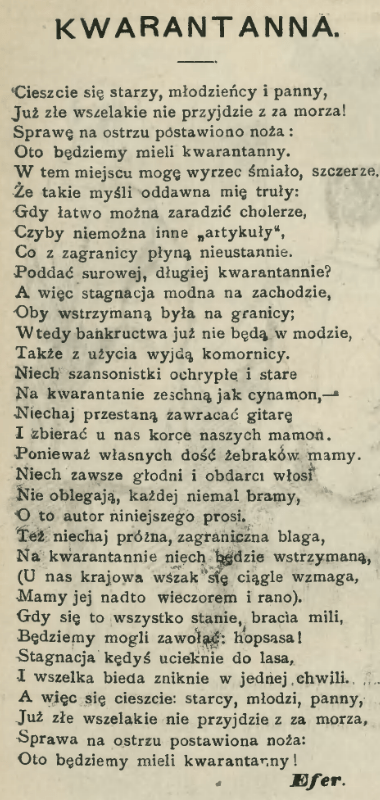
And now for something completely different. This playful poem on the solemn subject of cholera quarantine was published in the Polish humor magazine Mucha in 1886. Once again we see contagion metaphors giving expression to economic anxieties, in this case related to the persistently tepid European economic growth in the years following the Vienna stock exchange crash of 1873, all amid the fourth great cholera pandemic. Although the agrarian Polish economy was much less vulnerable to speculative bubbles, the author seizes upon quarantine as a way to make isolation from “the West” into a virtue.
The rhyme scheme is ABBA ABAB AABB and so forth, but I have only translated as literally as my limited Polish skills permit. Editorial suggestions welcome.
(Mucha, 1886)
Rejoice, elders, lads and ladies,
No longer do all evils come from abroad!
Matters have come to a head:
We are going to have quarantine here.
In this place I can say boldly, sincerely,
That such thoughts have long troubled me:
If cholera can easily be remedied,
Wouldn’t it be possible to subject other “goods,”
From what is constantly flowing from abroad,
To strict and lengthy quarantine?
And namely stagnation is fashionable in the west,
May it be stopped at the border;
Then bankruptcies will no longer be in vogue,
Bailiffs will also fall out of use.
May the hoarse old sirens of stagnation
Dry out like cinnamon on quarantine,
May they stop plaguing us on the guitar
And collecting bundles of money from us.
Because we have enough beggars.
May the ever hungry and ragged Italians
Not besiege almost every gate,
That is what this author asks for.
May stagnation also be a vain, foreign sham,
Let it be subject to quarantine,
(In Poland it is indeed still increasing,
Day and night we have it in excess).
If all this happens, dear brothers,
We will be able to call out: tralala!
Stagnation will escape to the woods
And all poverty will disappear in an instant.
So rejoice: elders, lads and ladies,
No longer do all evils come from abroad,
Matters have come to a head:
Here we will have quarantine!
“Tell me, Vomáček, how does one say “foot” in German: das Fuss, der Fuss or die Fuss?”
“If you please, Your Honor: typhus!”
(Humoristké listy, Prague, 1894)

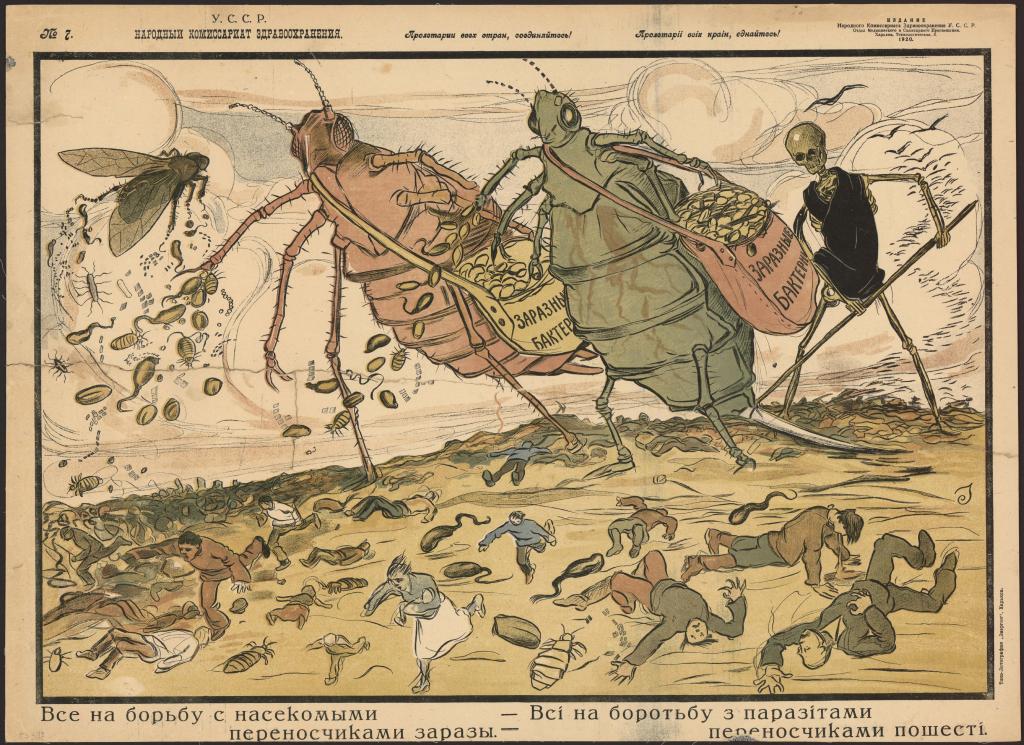
Bugs bearing bags of infectious bacteria. “Everyone to war with disease-bearing insects.” Soviet Ukrainian Commissariat of People’s Health, 1920.
(Russian State Library)
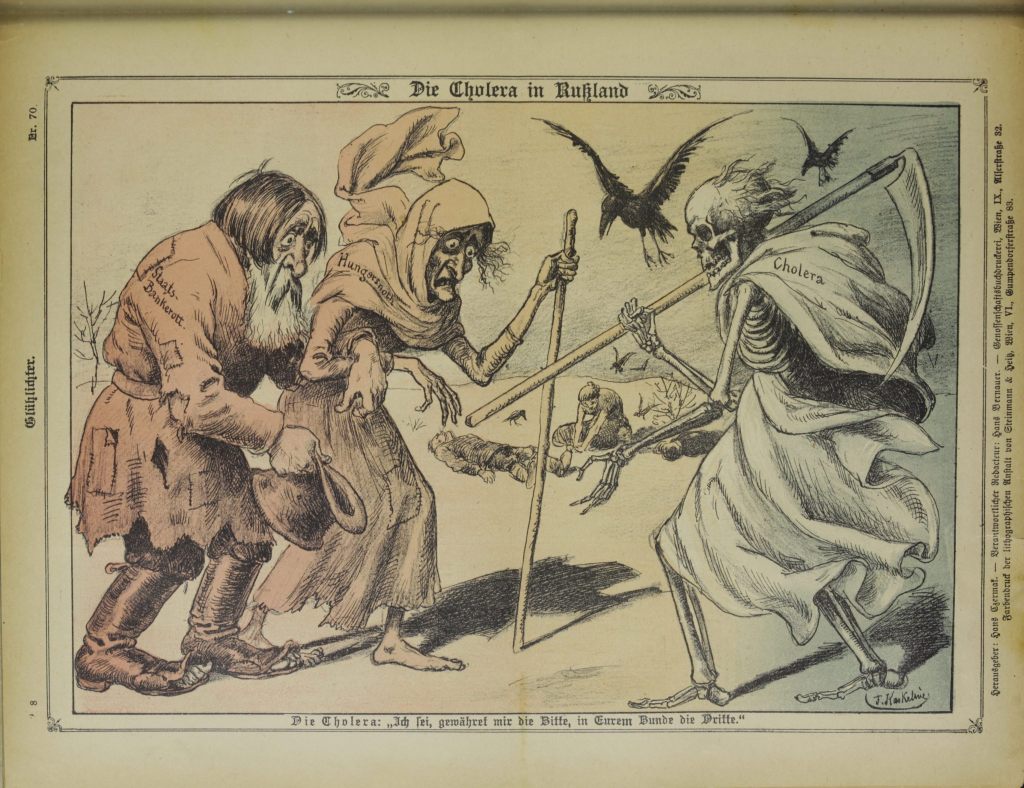
To state bankruptcy and famine: “Were you to grant my request, I would be the third member of your alliance.”
(Glühlichter, Vienna, 1892)
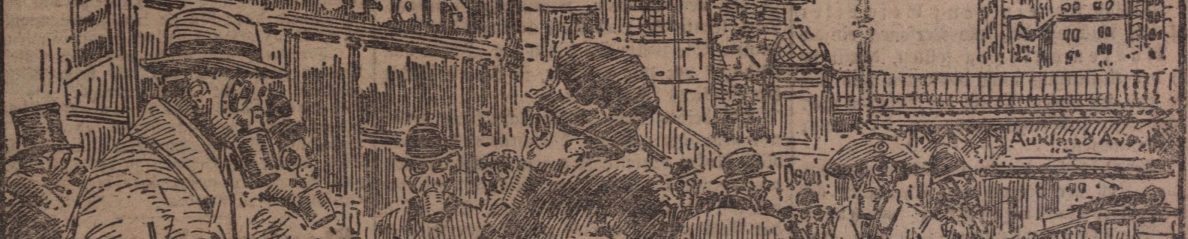
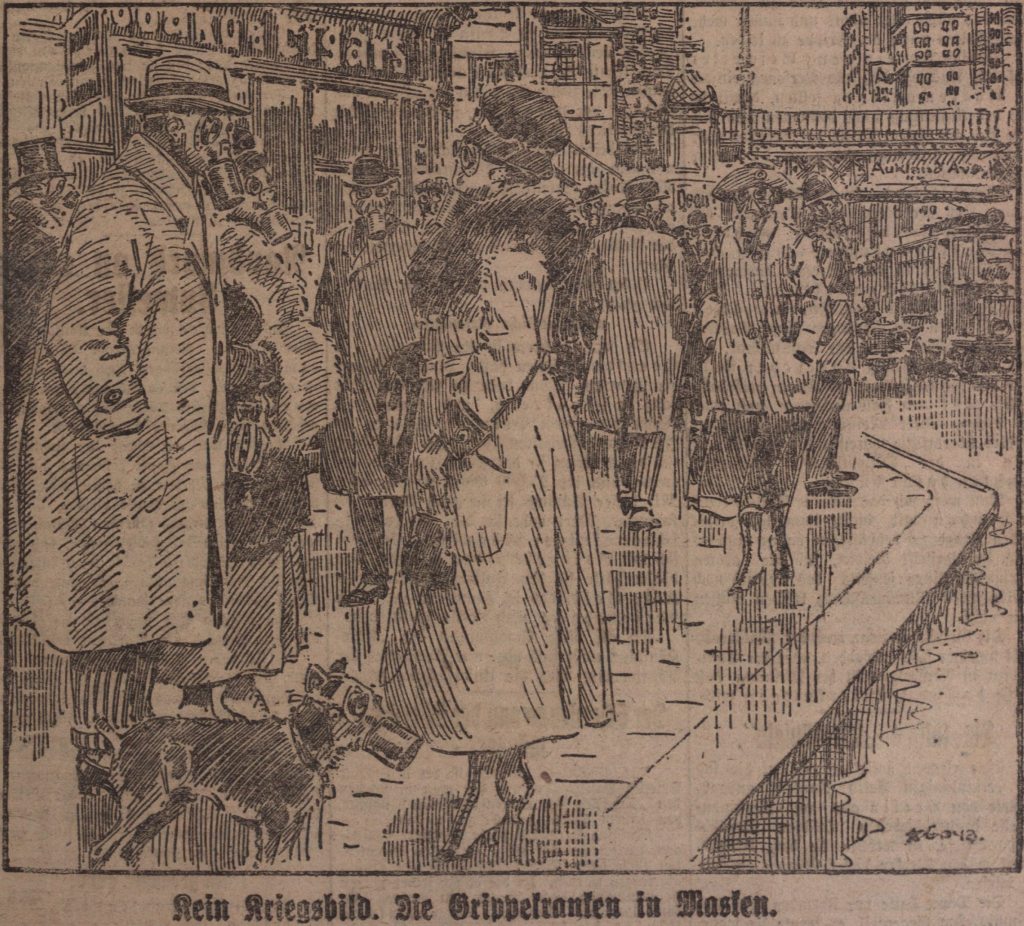
Flu sufferers in masks.
(Kronen Zeitung, Vienna, 1919)
 Sic Transit Pestilentia