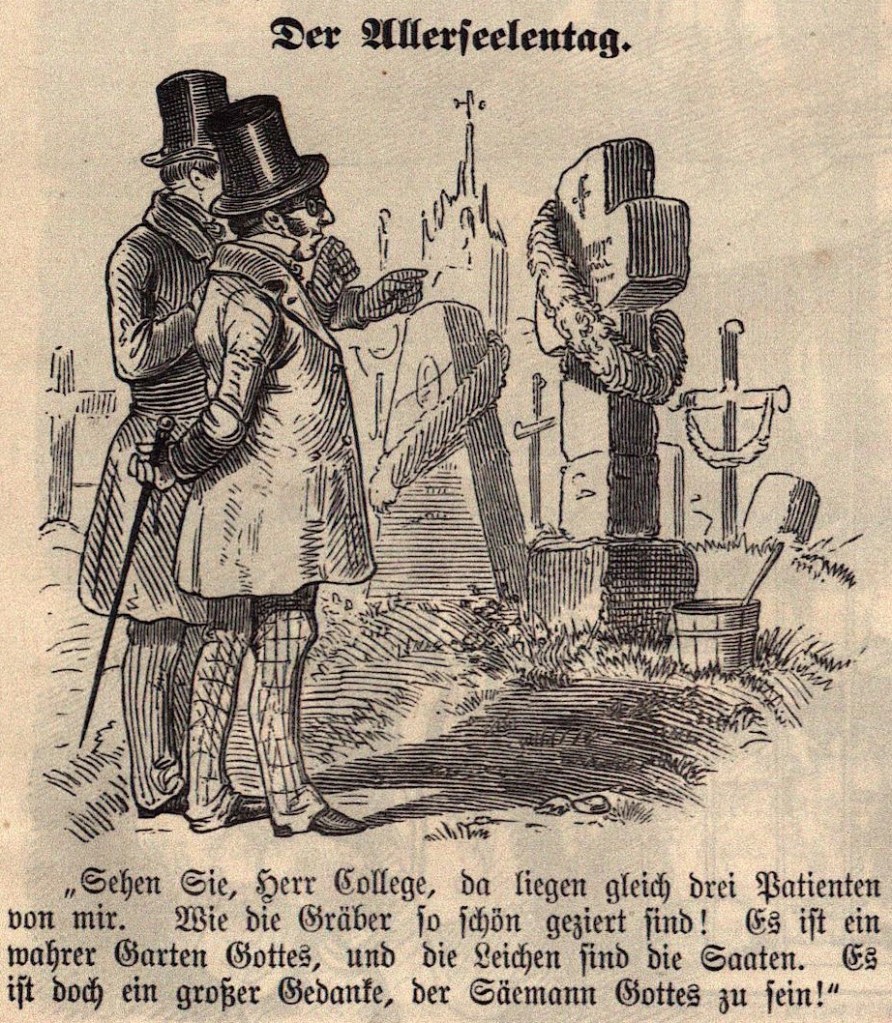
“You see, dear colleague, over there lie three patients of mine. How nicely adorned the graves are! It is truly a divine garden, and the bodies are the seeds. It’s a grand thought, to be the divine sower!”
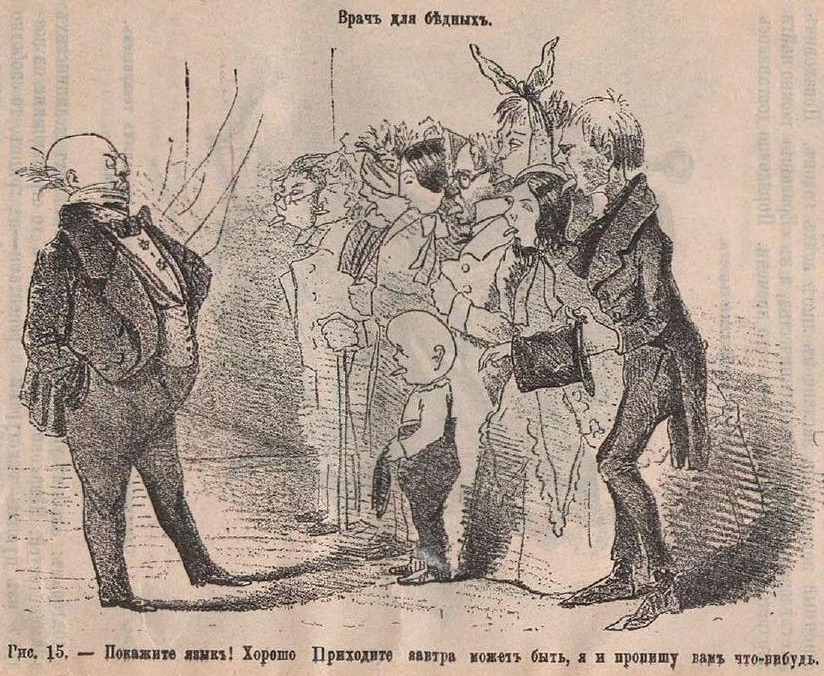
“Stick out your tongue! Fine. Come tomorrow, perhaps I’ll prescribe something for you.” (Both influenza and cholera were present in St. Petersburg when this was published in one of Russia’s first illustrated satirical journals.) Mikhail Nevakhovich in Yeralash, c. 1848. (Reprinted in Aleksandr Shvyrov’s Illustrated History of Caricature, 1903)
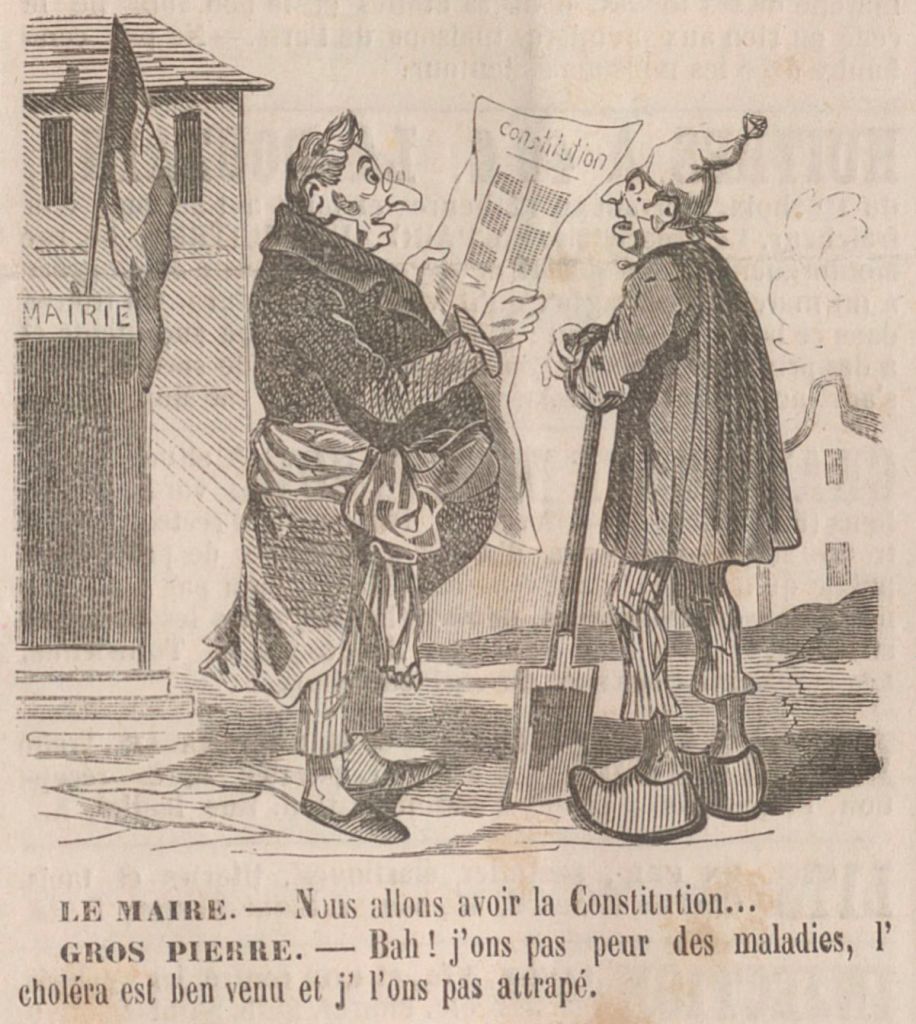
(Following months of revolutionary activities throughout France and Europe, the National Assembly adopted a constitution in November 1848. Scarcely three years later, Napoleon Bonaparte’s coup d’état was soon followed by another constitution establishing the Second Empire.) The Mayor: “We will have the Constitution…” Big Pierre: “Bah! I’m not afraid of such maladies, cholera has come along and I haven’t caught it.” (Le Charivari, Paris, 1848)
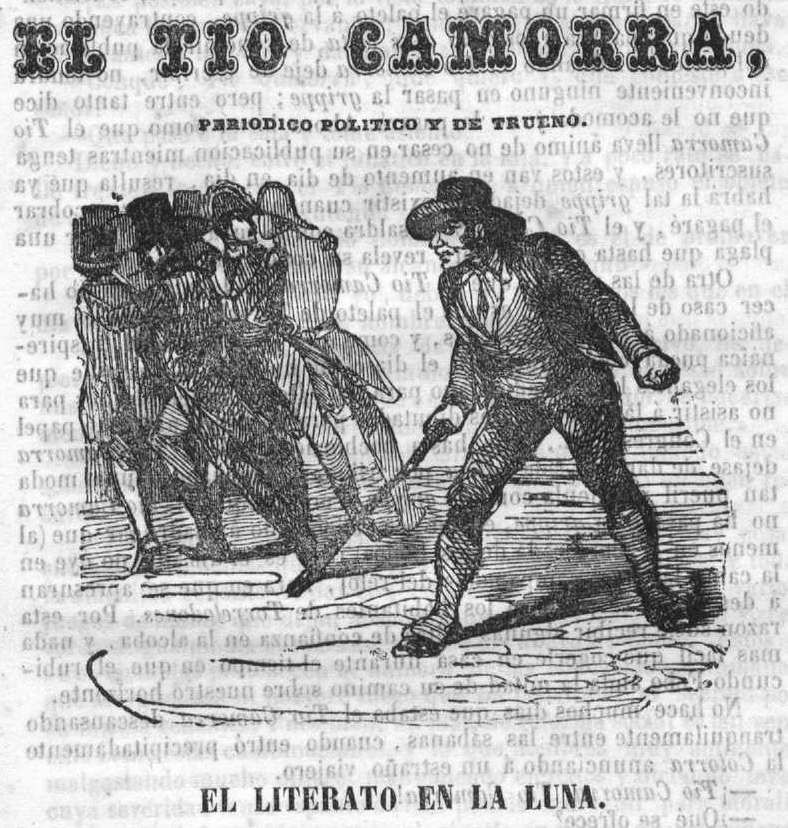
Juan Martinez Villergas launched the Spanish satirical magazine El Tío Camorra (Uncle Trouble) in September 1847, and this plate is featured on the front cover of all the early issues of this short-lived venture, which was closed in July 1848. I lack the expertise to comment on his agendas, but I was struck by the opening passage from the 26 January 1848 issue, several weeks before the revolutionary disturbances that broke out elsewhere in Europe.
“Uncle Trouble has not wanted to catch the flu until now, and has had more than one reason for it. The first and foremost of all is that Uncle Trouble has a great commitment contracted with the Spanish public, and he does not want his beatings to suffer interruption [see image], I do not say for something so mean and petty as having the flu, but for all typhus and cholera around the world. So, then, although the prevailing disease has penetrated the home of the citizen of Torrelodones [i.e., JMV’s alter ego] and resolutely attacked Don Juan de la Pilindrica [his worldly mentor] and the Parrot [another prop in his dialogues], and for other instances that the flu has undertaken to meet with Uncle Trouble, this one has categorically refused to receive it, as he is willing to reject any epidemics that arise while the yokel [meaning Uncle Trouble] pursues the noble and holy mission of enlightening the people and unmasking the public villains. And in order for the flu to desist from its reckless endeavor, it was necessary to reach a compromise in the most prudent way possible, which consisted of the yokel signing a promissory note to the flu, contracting a debt that will be paid within eight days after the publication is completed. When Uncle Trouble stops writing, there will be no problem for anyone to get the flu; but meanwhile he says that it does not suit him and he will not get it. Having said that, as Uncle Trouble has the courage to not stop publishing as long as he has subscribers, and these are increasing from day to day, it turns out that the flu will no longer exist when he wants to come to collect the bill, and Uncle Trouble will get away with not getting a plague that even in name [“la grippe”] reveals his French condition.
Another reason that Uncle Trouble has had for ignoring the flu is that the Torrelodones yokel is not very fond of following fashions, and because the trans-Pyrenean disease can be considered in the day as a bad fashion that the elegant types have used to put on airs, the employees not to go to the office, the deputies not to play a sad role in Congress, etc., it would be even embarrassing for Uncle Trouble to stop giving a single beating for paying homage to a fashion as childish and ridiculous as the flu. But although Uncle Trouble has not had the flu, he is so little fond of getting up early that (at least in the cold season) rare is the day that he does not hear the twelve chimes of the clock in bed, time in which the other inhabitants of Torrelodones hurry to empty the cooking pot. For this reason, he usually receives some trustworthy visitors in the bedroom, and nothing is easier than to catch him at home during the time when the ruddy Phoebus walks halfway over our horizon.” (El Tio Camorra, Madrid, 1848)
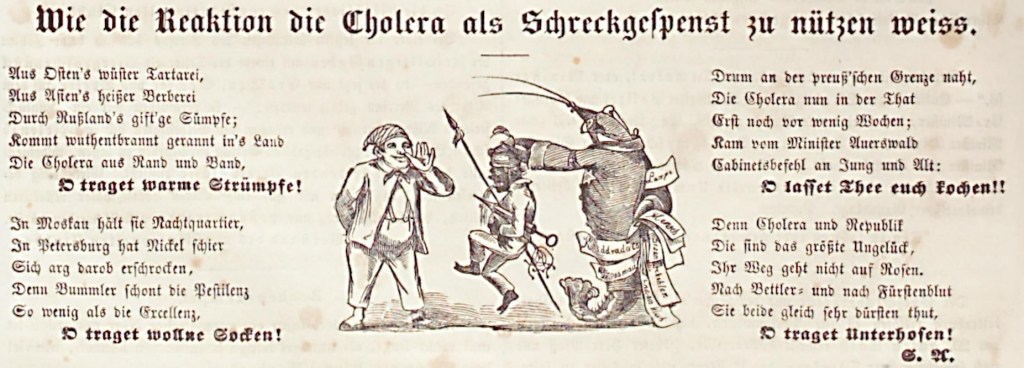
From desert Tartary to the east From sweltering Berbers of Asia Through Russia’s poisonous swamps; Cholera from the wild margin Comes wrathful into the country, O wear warm stockings!
In Moscow it has night quarters In Petersburg, the swampman has nearly To be hopelessly terrified Because the pestilence spares drifters As little as their betters, O wear woolly socks!
Thence is cholera indeed Just a few weeks ago Nearing the Prussian border; From Minister Auerswald came To young and old the cabinet order: O let tea be brewed for you!!
Because cholera and republic They are the greatest misfortune Yours is not the primrose path. Beggarly and princely blood alike You both feel very thirsty O wear underpants!
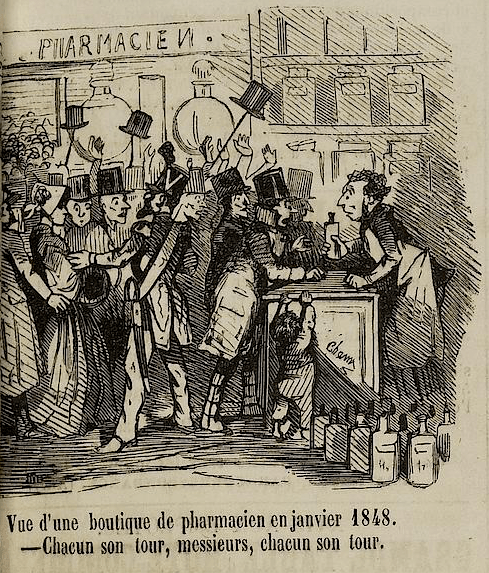
View of a pharmacist shop in January 1848. “Each in turn, gentlemen, each in turn.”
French flu cartoon
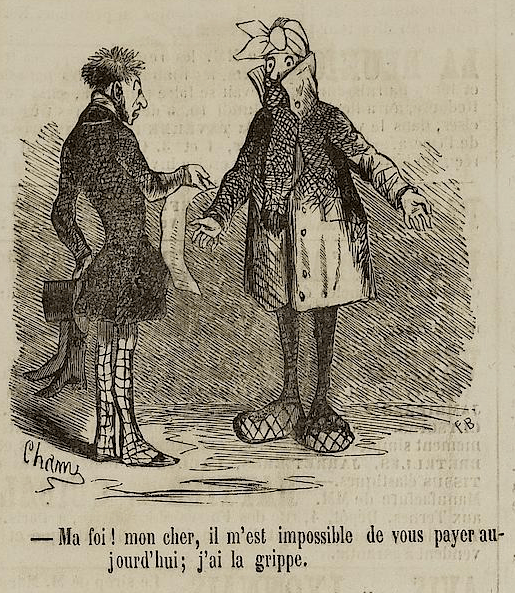
“Well, my dear, it is impossible for me to pay you today; I have the flu.”
French flu cartoon
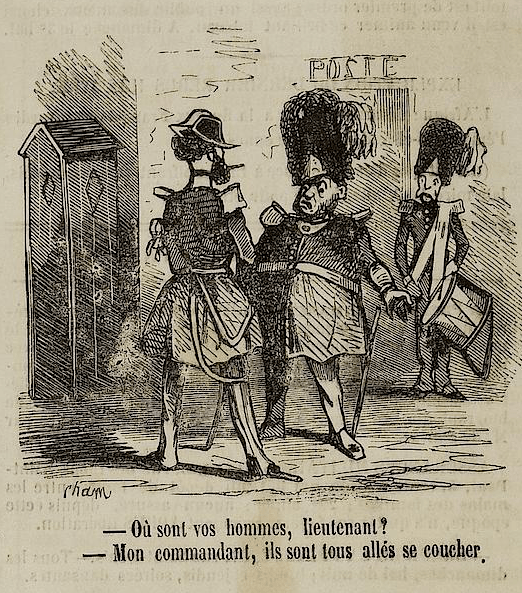
“Where are your men, lieutenant?” “My commander, they’ve all gone to bed.”
French flu cartoon
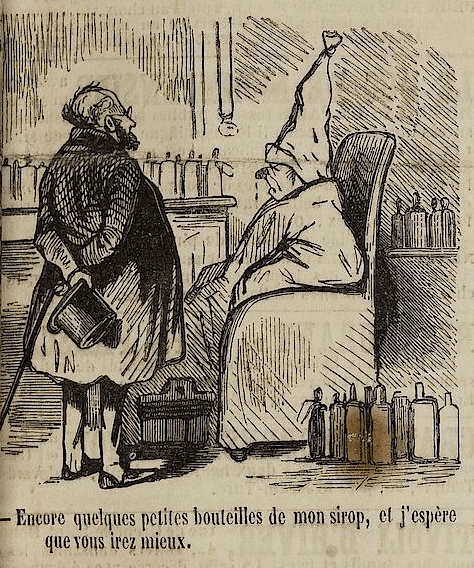
“Just a few more bottles of my syrup, and I hope you’ll get better.”
French flu cartoon
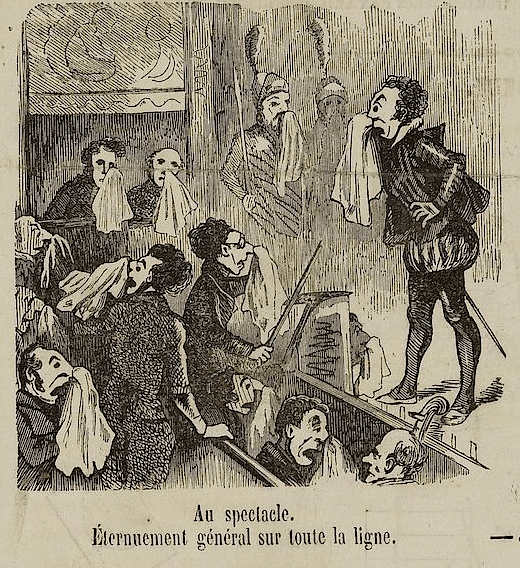
At the show. General sneezing across the board.
French flu cartoon
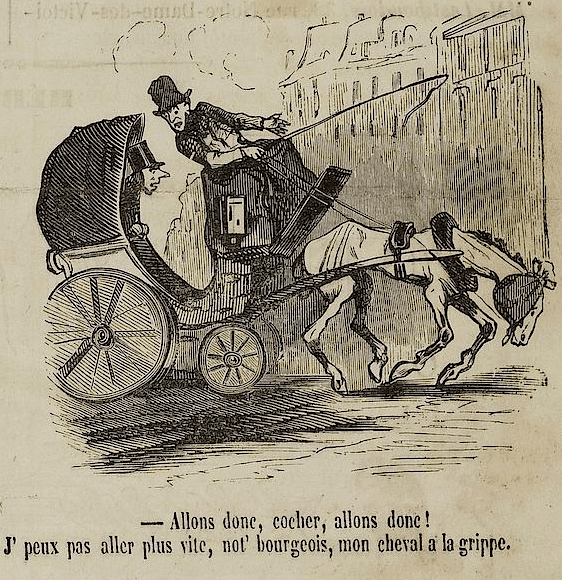
“Come on, coachman, come on!” “I can’t go any faster, sir, my horse has the flu.”
French flu cartoon
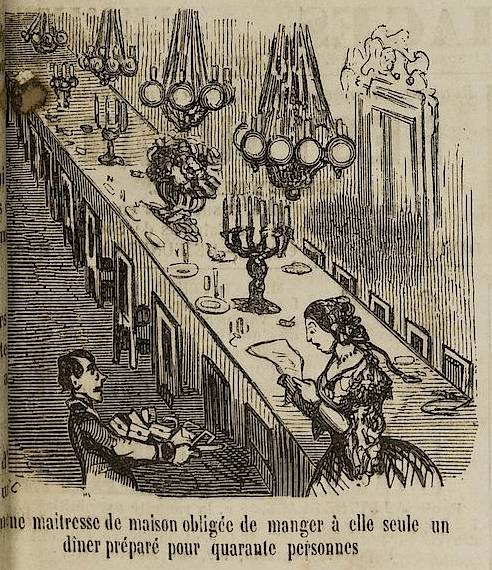
A mistress of the house has to eat alone a dinner prepared for forty people. (No doubt punning on “quarantine.”)
French flu cartoon
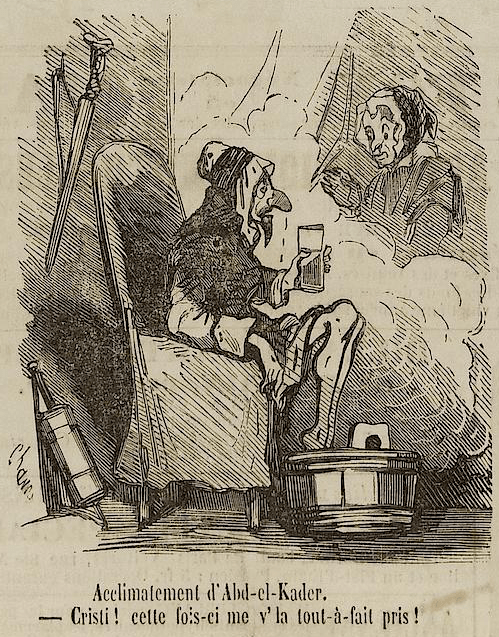
Acclimatization of Abd-el-Kader. (Algerian military leader then held captive by the French. Note the clystère in the background, a familiar French theme.) “Cristi! This time here I am completely taken!”
French flu cartoon
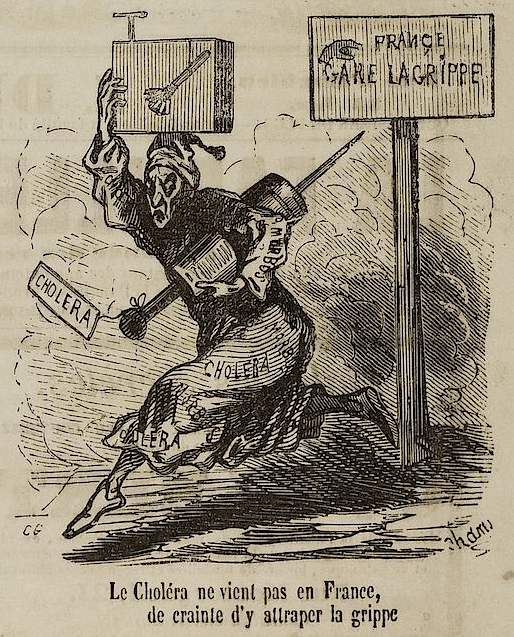
Cholera does not come to France for fear of catching the flu there.
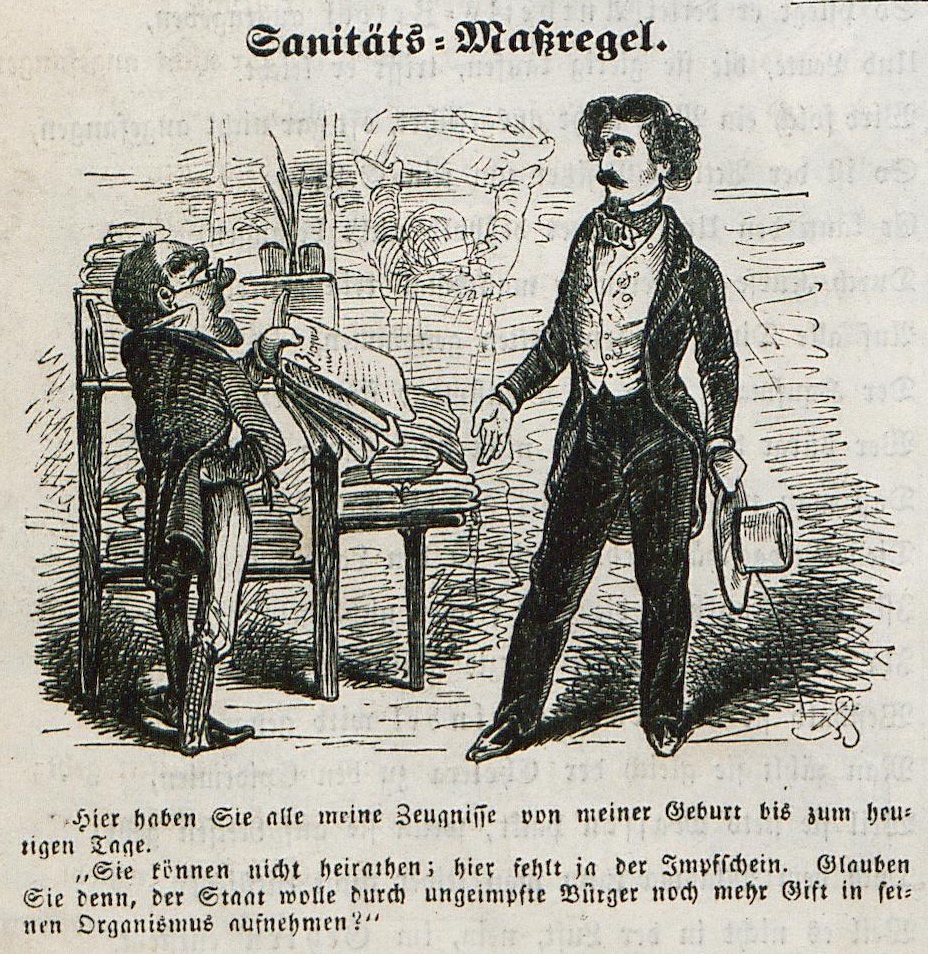
“Here you have all my documents from birth to the present day.” “You cannot get married; this is missing a vaccination certificate. Do you really think the state wants to absorb even more poison in its organism via unvaccinated citizens?” (Leuchtkugeln, Munich, 1848)
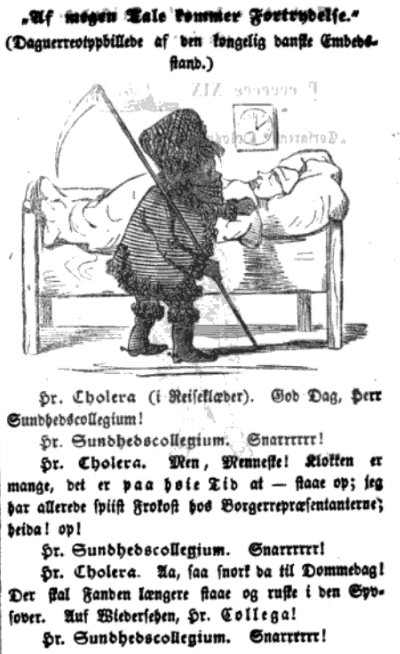
(I can’t make out the main title, though the last word might imply “undoing.”) Mr Cholera (in travel clothes): Good day, Mr Public Health Authority! Mr Public Health Authority: Snore! Mr Cholera: But, man! The clock is ticking, it is high time to get up; I have already eaten lunch with the Citizens’ Representatives; hey there! up! Mr Public Health Authority: Snore! Mr Cholera: Oh, then snore till doomsday! Whoever the hell has to stand it longer and shake the late riser. Auf Wiedersehen, Mr Colleague! Mr Public Health Authority: Snore! (Corsaren, Copenhagen, 1848) (Definitely needs improvement.)
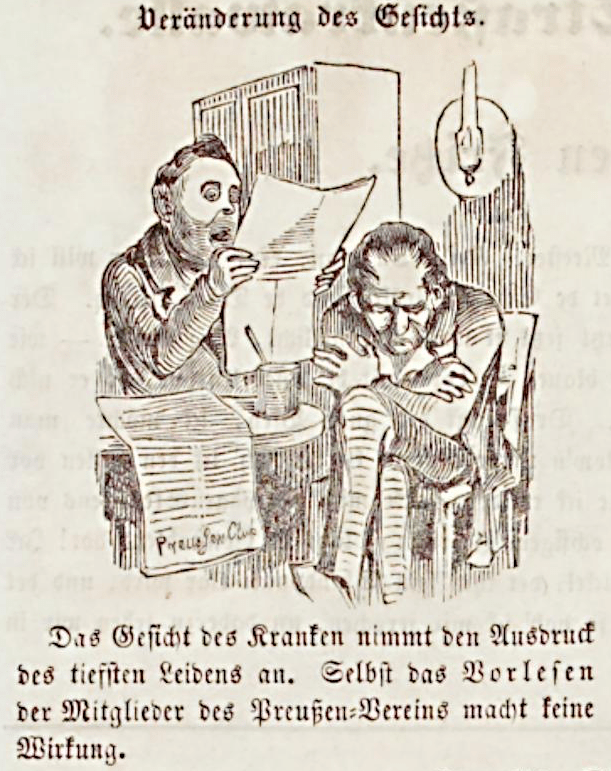
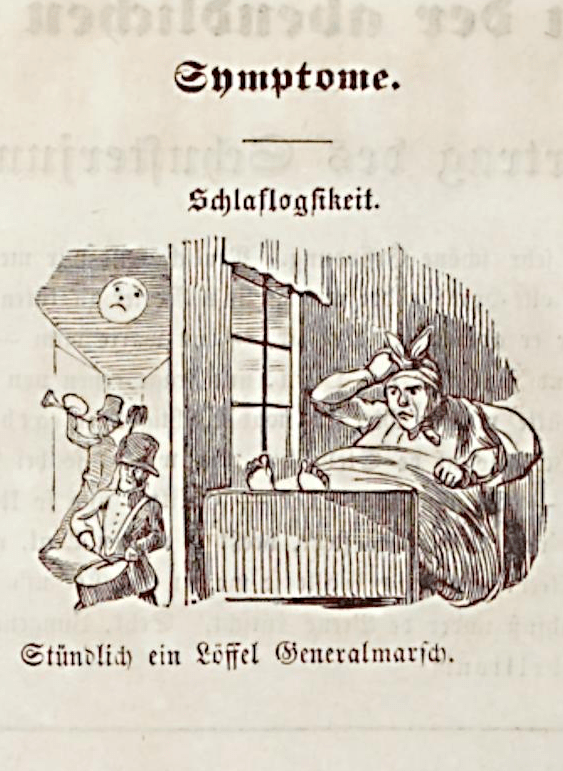
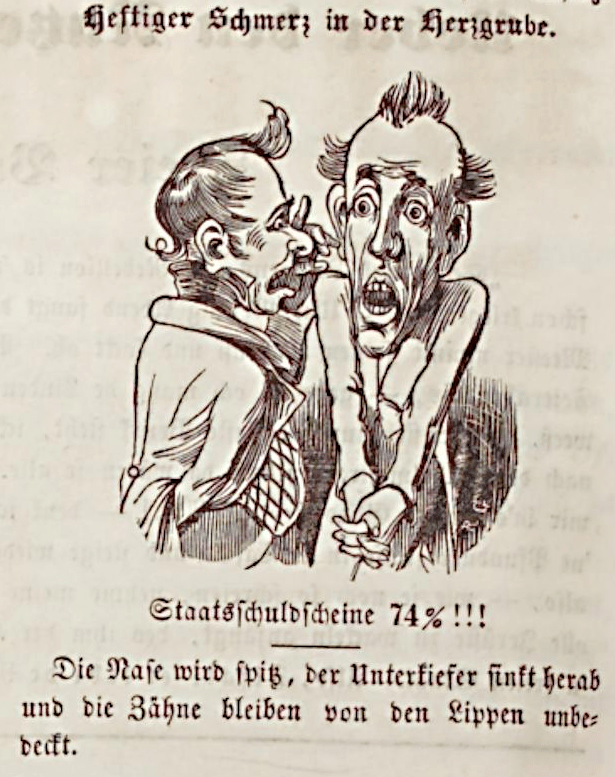
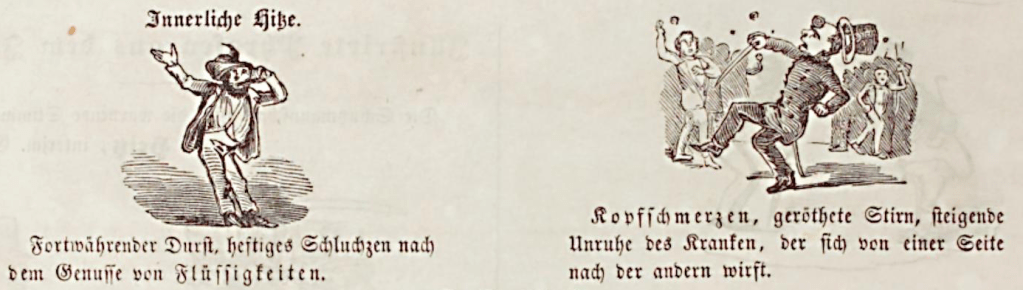
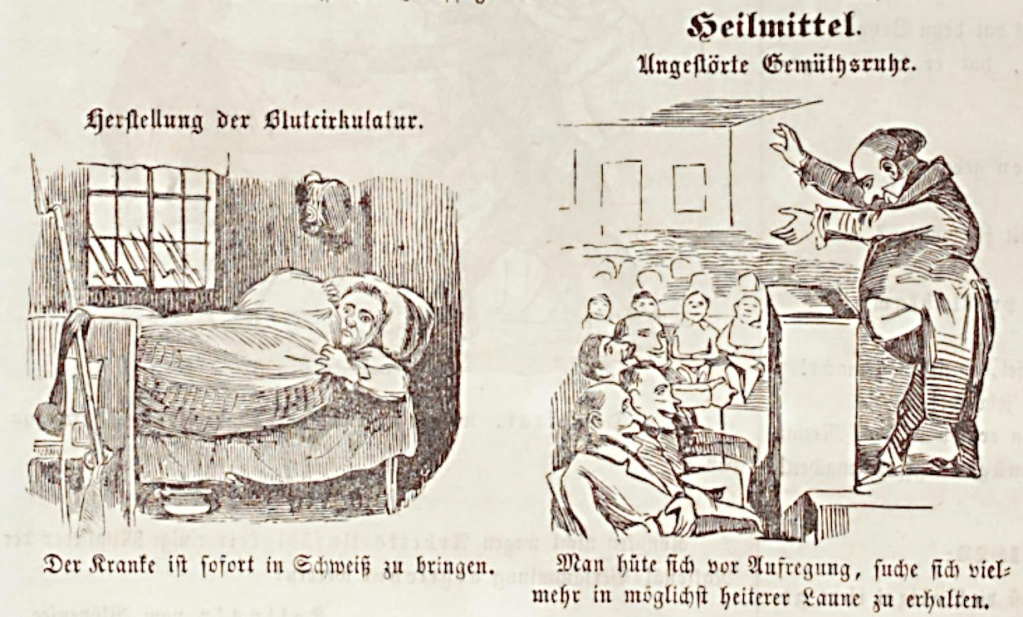
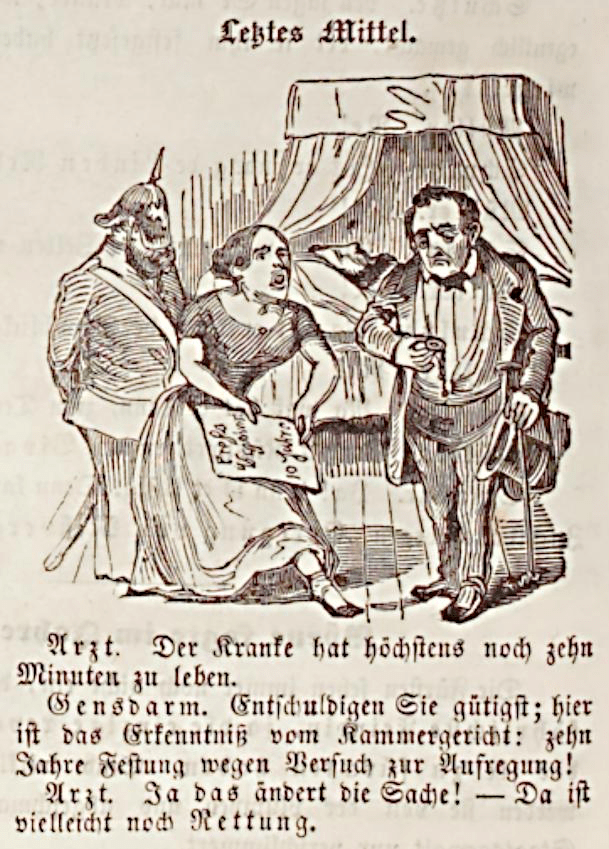
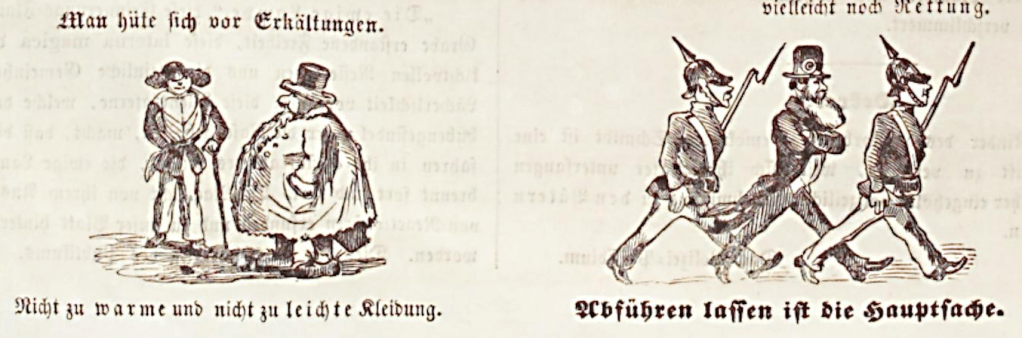
Popular lessons about the occurrence and fight with this contagion. (text by August Ritter, drawings by Wilhelm Scholz, Kladderadatsch, Germany, 1848)
Symptoms
Change of face: The face of the patient assumes an expression of the most profound suffering. Even lectures of members of the Prussian Union have no effect.
German cholera cartoon
Sleeplessness: A spoonful of marching music hourly.
Sharp heartburn: State bonds at 74%!!! The nose becomes sharp, the jaw drops, and the teeth remain uncovered by the lips.
Internal heat: Persistent thirst, powerful sobbing after the pleasure of liquids. Headache, reddened forehead, increasing agitation of the patient, acting from one side to the other. [vegetables are being lobbed from all sides]
Remedies
Production of blood circulation: The patient easily breaks into a sweat. Undisturbed calm: Avoid stimulation, seek to maintain a the most cheerful possible mood.
Final remedy Doctor: The patient has at most ten minutes left to live. Gendarme: Excuse me, here is the finding of the chamber court: ten years confinement for seeking stimulation. Doctor: That changes things! Perhaps deliverance lies there.
Avoid chills: Do not wear clothing that is too warm or too light. The main thing is to be led away.
 Sic Transit Pestilentia