At home and at the ball

At home: “Oh, my goodness, Mama, why do I have to get a smallpox vaccination? It’s embarrassing: the doctor will see my naked arm!”
At the ball: “I’m very grateful, doctor, that you want to rid me of this shawl: it’s making me so warm…”
(Razvlechenie, Moscow, 1873)
(See Spanish, Czech, Polish, and Swedish variants on this sexist theme.)
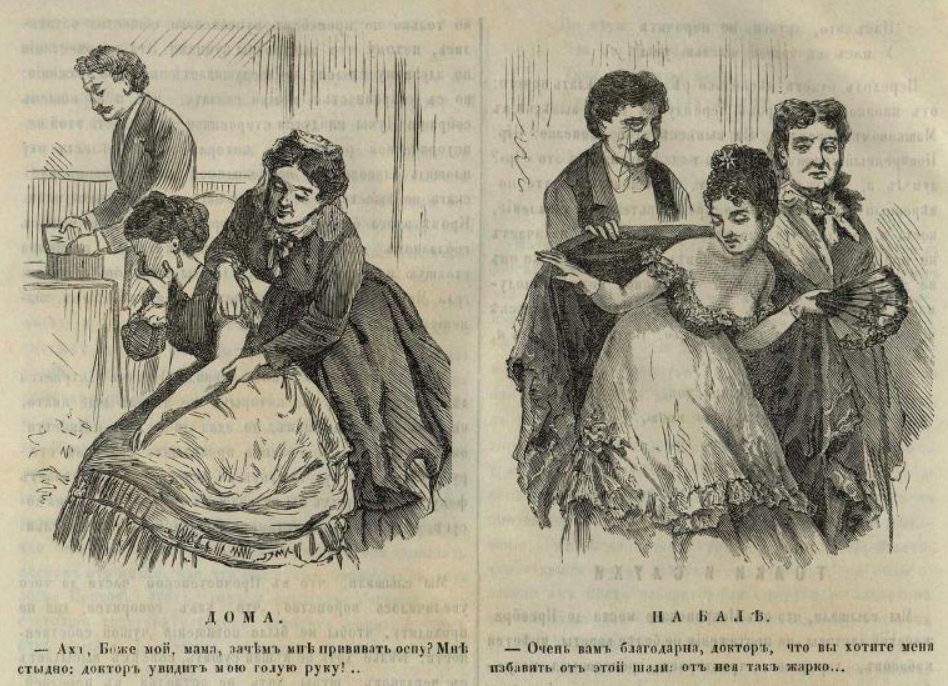
Russian smallpox cartoon

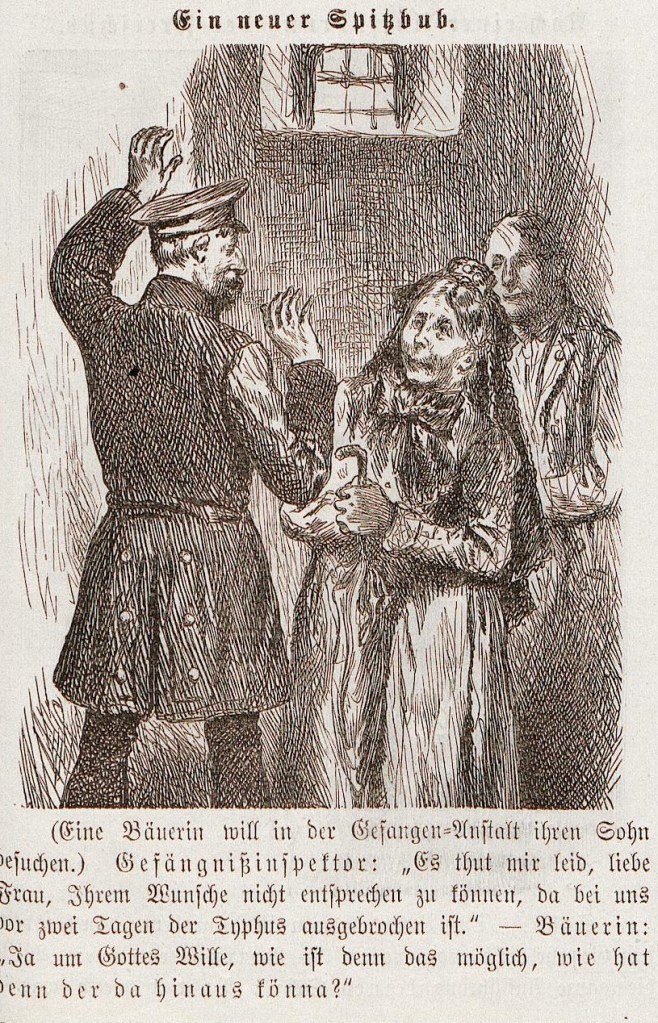
A new rascal

(A farmer woman wants to visit her son in prison.) Prison warden: “I’m sorry I can’t accommodate your wish, dear lady, two days ago the typhus broke out here.”
Farmer woman: “Oh for God’s sake, how is that possible, how could he have gotten out of there?”
(Some untranslatable wordplay here, with the farmer woman confusing “typhus” [Typhus] and “type” [Typus], as in, “the type of guy who would try to break out of prison.”)
(Fliegende Blätter, Munich, 1873)

German typhus cartoon

Preventive measures for cholera (2)

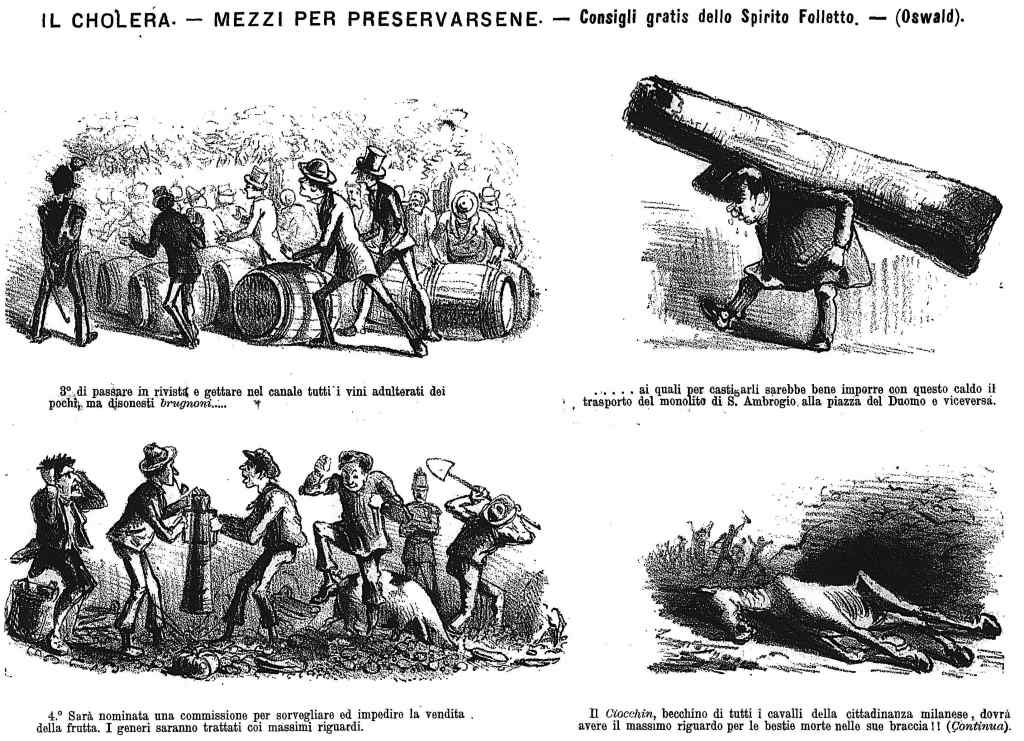
From Lo Spirito folletto, Milan, 1873:

  1. to review and throw in the channel all the adulterated wines of the few, but dishonest brewers

…for whom it would be good in this heat to chastise them by imposing the transport of the monolith of San Ambrogio to Piazza del Duomo and back again.

  1. A commission will be appointed to oversee and prevent the sale of fruit. The varieties will be treated with the greatest concern.

The Ciocchin, undertaker of all the horses of the Milanese citizenry, must have the utmost respect for the dead beasts in his care!!

Italian cholera cartoon

Preventive measures for cholera (1)

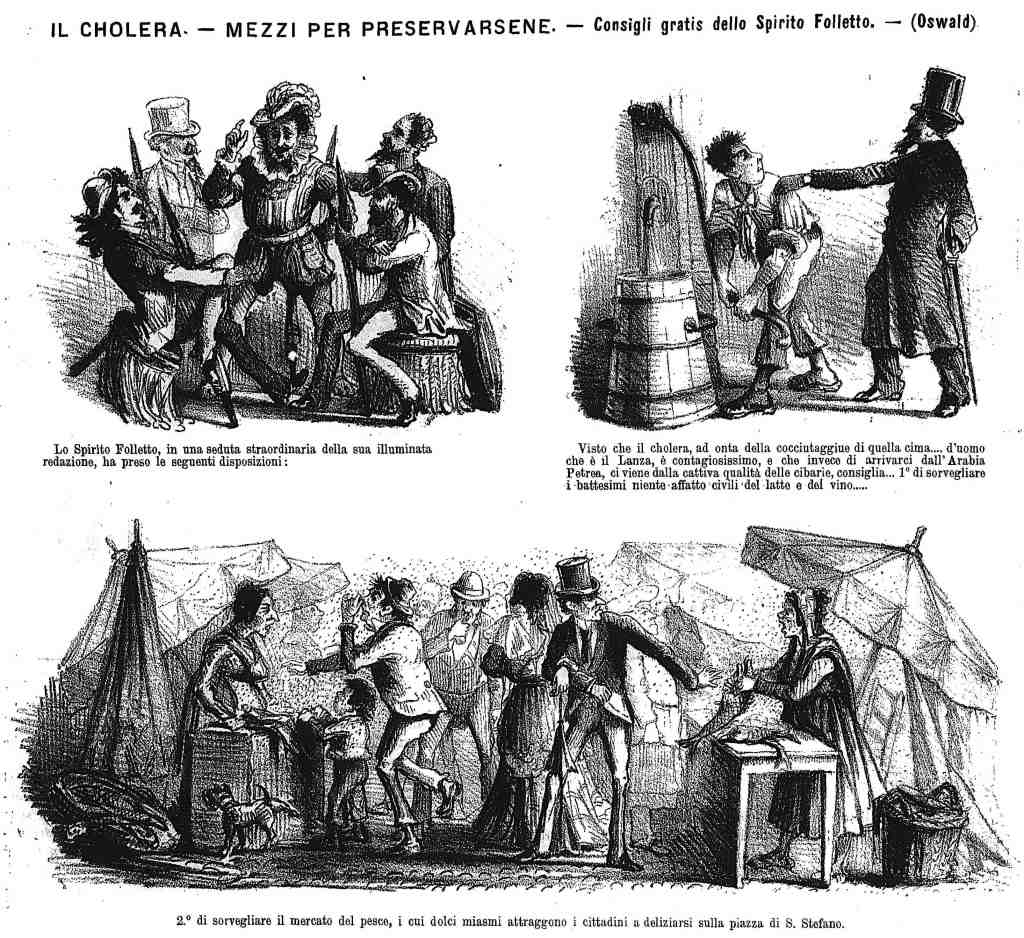
From Lo Spirito folletto, Milan, 1873:

Lo Spirito Folletto, in an extraordinary session of its enlightened editorial staff, made the following provisions:

Since cholera, in spite of the stubbornness of that genius… of man that is [Italian Prime Minister] Lanza, is very contagious, and that instead of getting there from Petrea Arabia, it comes from the bad quality of the food, the staff recommends… 1. to oversee the not-at-all civil baptisms of milk and wine…

  1. to supervise the fish market, whose sweet miasmas attract citizens to the delights in the square of San Stefano.
Italian cholera cartoon

Preventive measures for cholera (4)

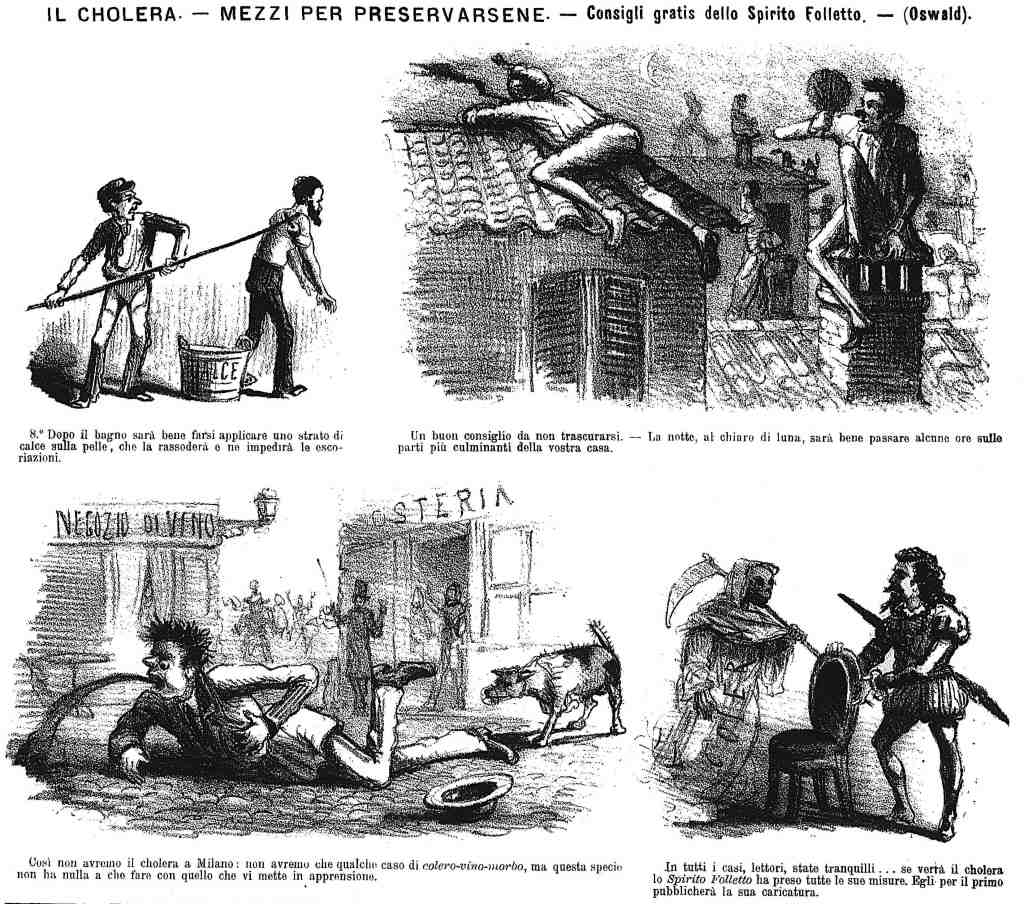
From Lo Spirito folletto, Milan, 1873:

After bathing, it is a good idea to have a layer of lime applied to the skin, which will firm it and will not prevent bruising.

A good tip not to be overlooked. At night, in the moonlight, it will be good to spend a few hours on the uppermost parts of your home.

So that we will not have cholera in Milan: we will have only a few cases of cholero-vino-morbo, but this variety has nothing to do with what worries you.

In all cases, readers, rest assured… if cholera comes, Lo Spirito Folletto [The Spritely Spirit] has taken all his measures. He will first publish his caricature.

Italian cholera cartoon

Preventive measures for cholera (3)

From Lo Spirito folletto, Milan, 1873:

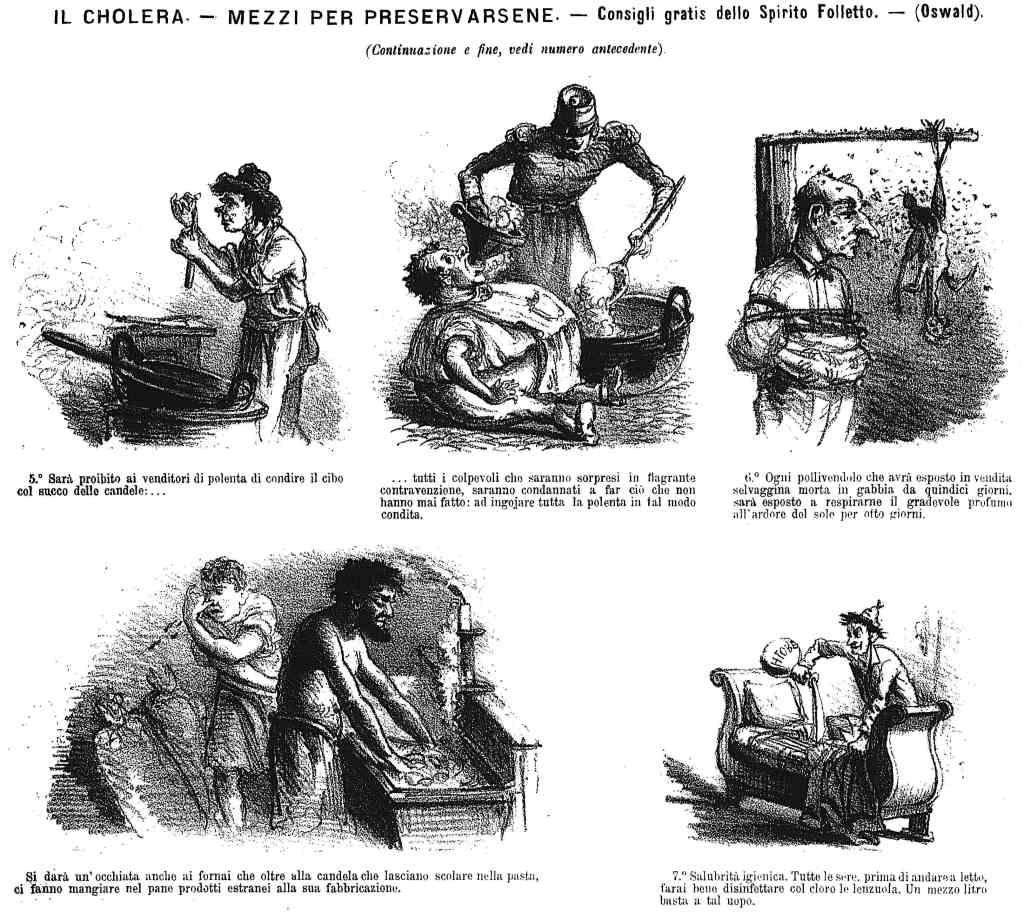
Polenta vendors will be prohibited from seasoning food with candle wax:…

…all the culprits caught in flagrant contravention will be condemned to do what they have never done: to swallow all the polenta thus seasoned.

Any poultryman who has put up dead game for sale for fifteen days will be exposed to breathe the pleasant scent of the sun for eight days.

We will also take a look at the bakers who, in addition to the candle which they allow to drip into the pasta, make us eat products unrelated to its manufacture on bread.

Healthy hygiene. Every evening, before going to bed, you will do well to disinfect the sheets with chlorine. A half liter is enough for this.

Italian cholera cartoon

Messrs. Beust and Gramont are cooling off their heartburn

The former Austrian foreign minister, Count Beust, had clashed with the French foreign minister, the Duc de Gramont, in the lead-up to the Franco-Prussian War in 1870. This cartoon from early 1873 followed upon Beust’s attempt to settle accounts by publishing letters from that period. Though this is straight politics, I include it because of the clystères, an ongoing theme. (See also this Mexican example from 1886, also a cholera year.)
(Humoristické listy, Prague, 1873)

Further cholera measures

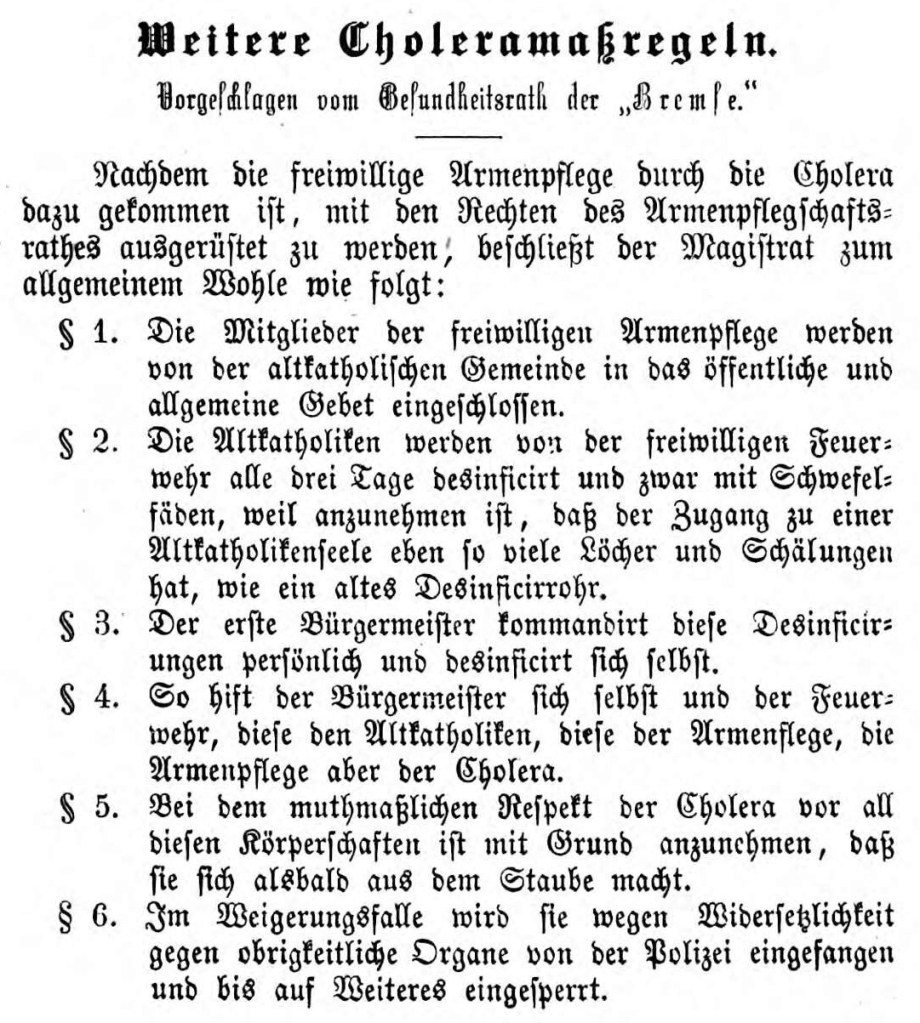
Further cholera measures proposed by the health councilor of Die Bremse.
Now that voluntary care for the poor has come to be equipped with the rights of the Council for Care of the Poor, the magistrate has concluded as follows for the general good:
1. The voluntary members caring for the poor will be enclosed by the old Catholic parishioners in public and general prayer.
2. The old Catholics will be disinfected by the voluntary fire department every three days with sulfurous cloths, because it is to be assumed that access to an old Catholic soul has just as many holes and cracks as an old disinfection tube.
3. The mayor commands these disinfections personally and disinfects himself.
4. In this manner the mayor helps himself and the fire department, they in turn help the old Catholics, they in turn help those caring for the poor, while those caring for the poor help cholera.
5. Given the presumed respect of cholera in the face of all these corporations we may fundamentally assume that it will quickly abscond.
6. Should it refuse to cooperate, the police will seize it for violating the authorities and imprison it until further notice.
(Die Bremse, Bavaria, 1873)

Official style of the Wiener Zeitung

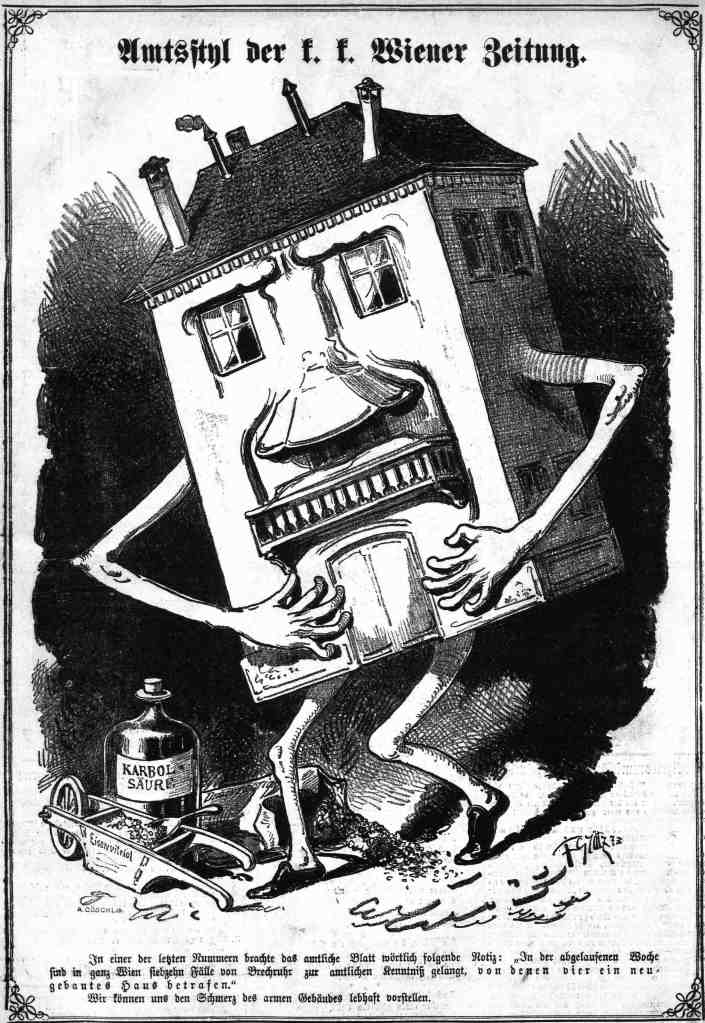
Kikeriki mocking the imperial royal newspaper of Vienna, Wiener Zeitung (supplied with “iron vitriol” and carbolic acid): “In a recent issue the official newspaper included the following literal notice: ‘In the past week seventeen cases of dysentery have come to official attention in all of Vienna, of which four pertained to a newly constructed residence.’
We can vividly imagine the pain of the poor building.”
(Kikeriki, Vienna, 1873)

Austrian dysentery cartoon

A victim of popular lectures

Professor: “… It is not rare for diseases to exist in the human body which go entirely unmarked for years at a time.”
(after the lecture)
“Why are you so quiet today, dear Flora?”
“Oh, dear Mama, I will die soon, I just know it, I have consumption!”
“But why would you get such a strange idea, you’ve never complained about any pains!”
Flora (crying): “That’s just it, I don’t feel anything at all!”
(Fliegende Blätter, Munich, 1873)

German tuberculosis cartoon