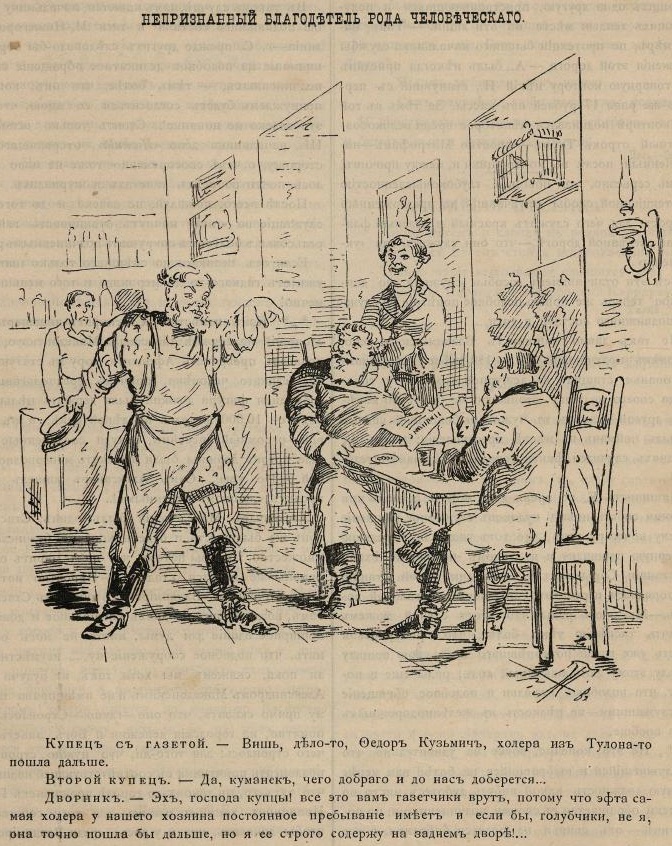
Merchant with newspaper: “Didya see the business, Fedor Kuzmich, about cholera going beyond that Toulon thing.” Second merchant: “Yes, kinsman, what good thing ever makes its way to us…” Yardman: “Hey, mister merchants! The newspaper types are all lying to us, because the same cholera is constantly here at our owner’s place and if it weren’t for me, duckies, it would have gone further, but I keep it strictly in the back yard!” (Razvlechenie, Moscow, 1884)
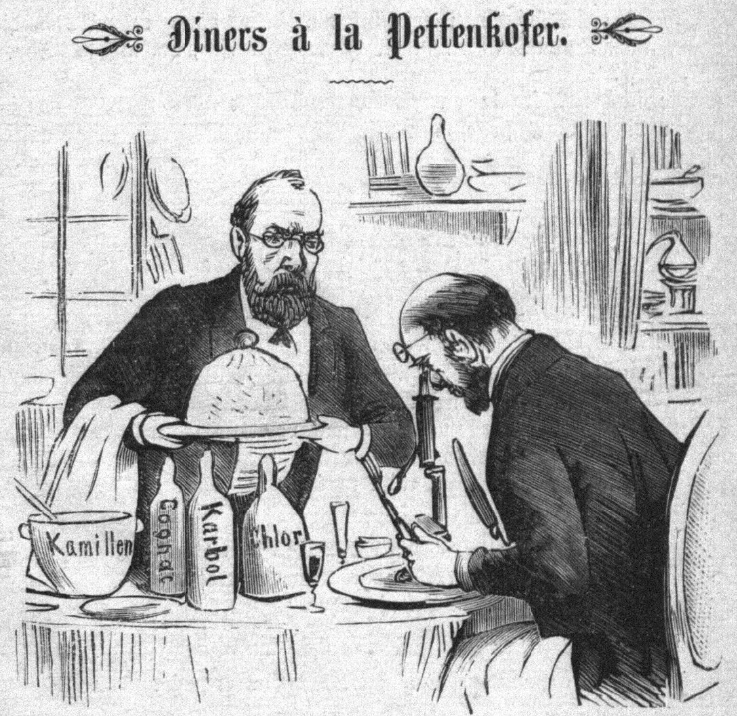
“Juicy, well-fed bacteria freshly served at all times.” (Resoundingly disastrous success guaranteed.) The Koch Bacteria Pub (Max Pettenkofer was a famous Bavarian hygienist whose environmental explanations of disease were then in the process of being eclipsed by the new germ theory, of which Robert Koch was perhaps the most famous German proponent. This cartoon appeared just as the fifth cholera pandemic was cresting in Europe.) (The caption is cropped from this image; see link for original text.) (Berliner Wespen, Berlin, 1884)
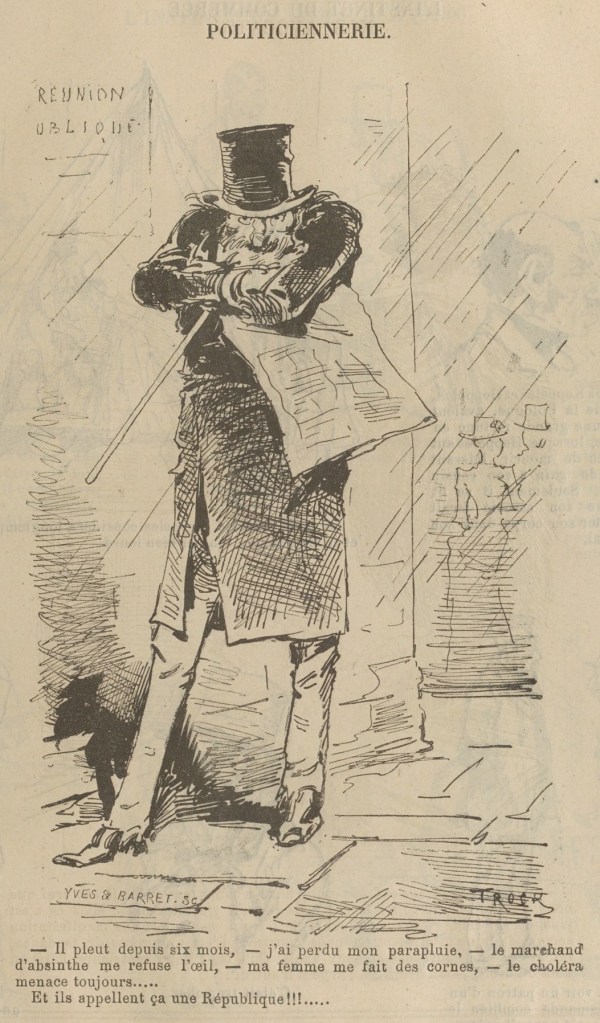
It has been raining for six months, I lost my umbrella, the absinthe merchant refuses to look me in the eye, my wife is stepping out on me, cholera is still threatening… And they call this a Republic!!! (Le Monde comique, Paris, 1884)
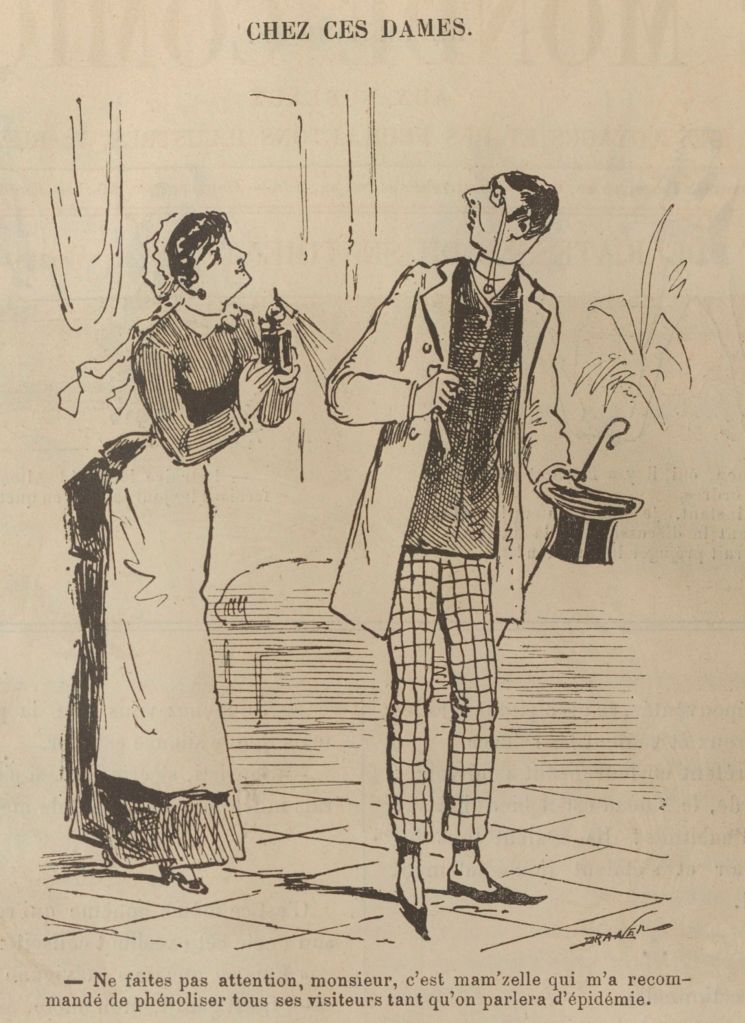
“Pay it no mind, sir, it’s the missy who recommended that I phenolize all her visitors as long as there’s talk of an epidemic.” (Le Monde comique, Paris, 1884)
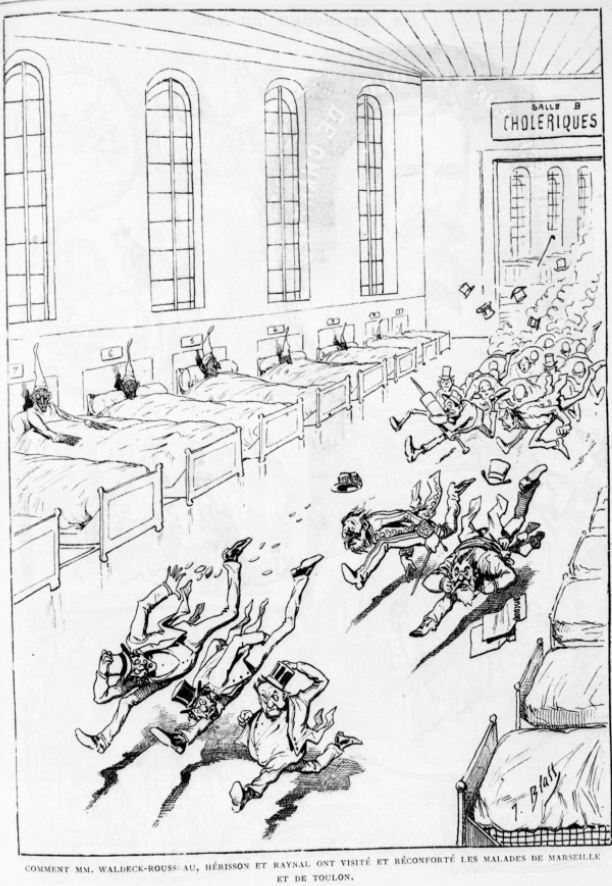
How Mr. Waldeck-Rousseau, Mr. Hérisson, and Mr. Raynal visited and comforted the sick in Marseille and Toulon. (Le Triboulet, Paris, 1884) (Waldeck-Rousseau was minister of the interior, Hérisson was minister of commerce, and Raynal was minister of public works in the government of Jules Ferry.)
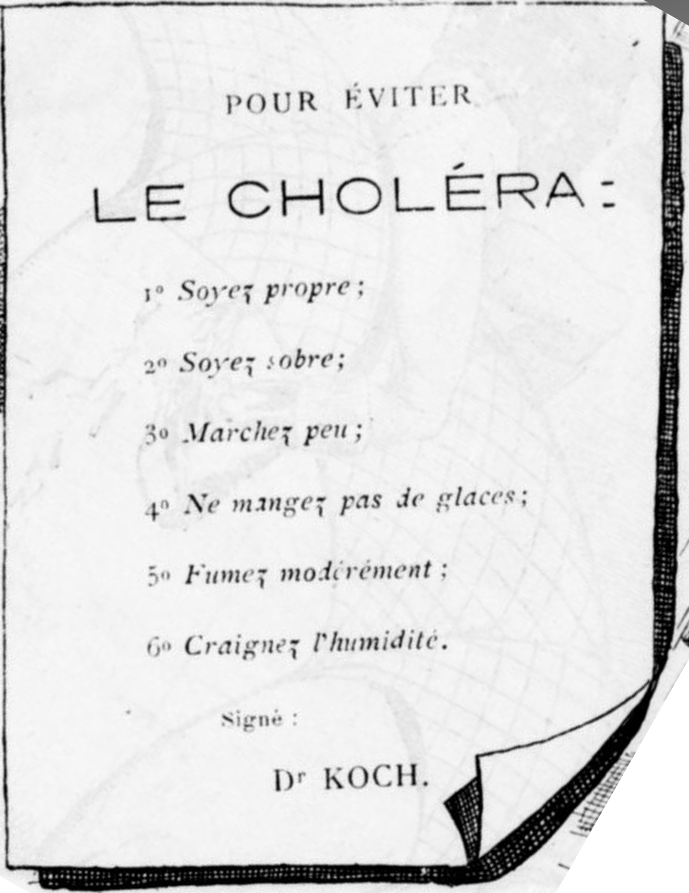
To avoid cholera: 1. Be clean 2. Be sober 3. Don’t walk too much 4. Don’t eat ice cream 5. Smoke in moderation 6. Beware of humidity (signed) Dr. Koch
French cholera cartoon
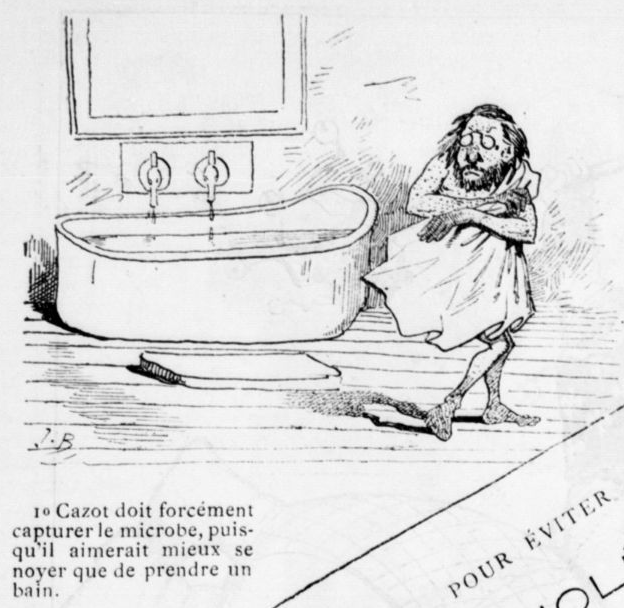
Cazot is bound to catch the microbe, since he would rather drown than take a bath.
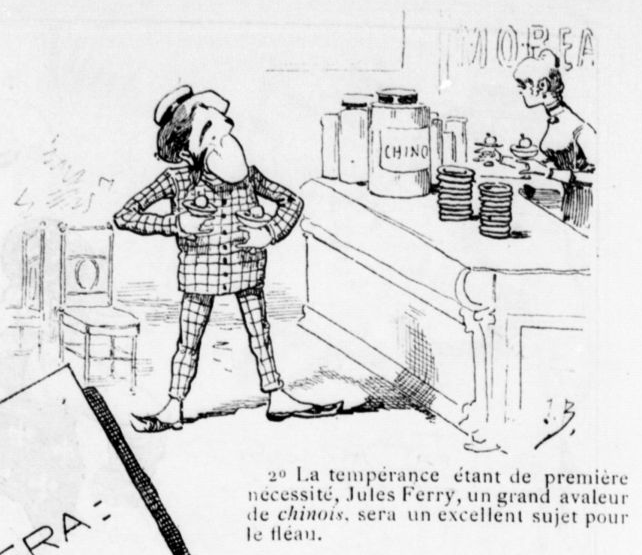
Temperance being the primary necessity, Jules Ferry, a great swallower of all things Chinese, will be an excellent subject for the scourge. [As Prime Minister, Ferry was the chief culprit in accelerating French colonial entanglements in Indochina.]
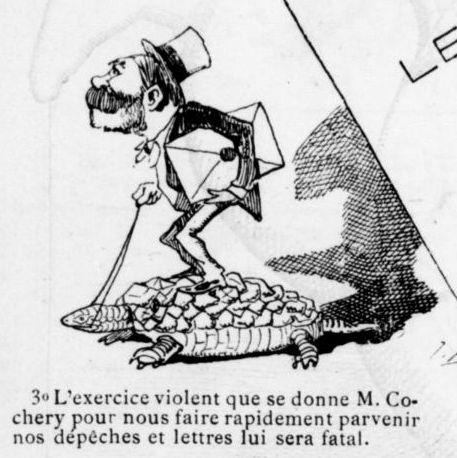
The violent exertion that Mr. Cochery is giving himself to quickly send us our despatches and letters will be fatal to him. [Cochery was Minister of Posts and Telegraphs.]
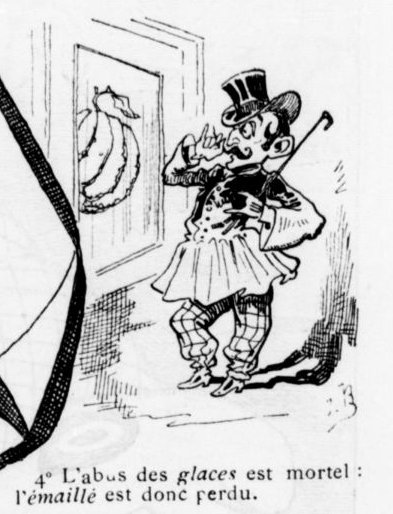
Abusing ice cream is fatal: enamelling is a lost gift. [Punning on the double meaning of “mirror.”]
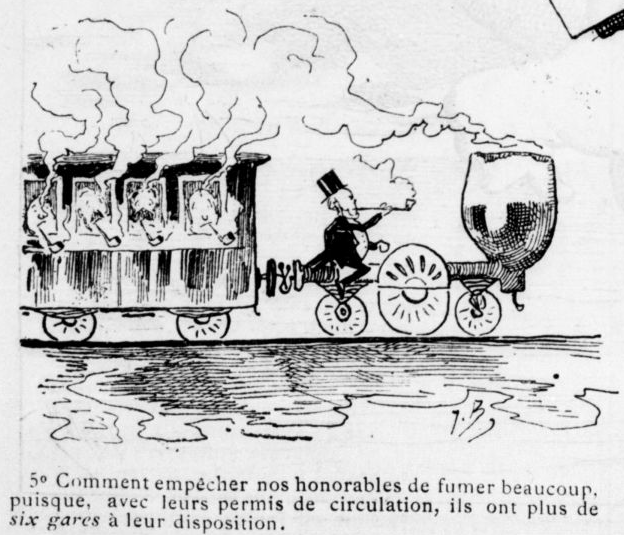
How can we prevent our respectable people from smoking a lot, since, with their driving permits, they have more than six stations at their disposal?
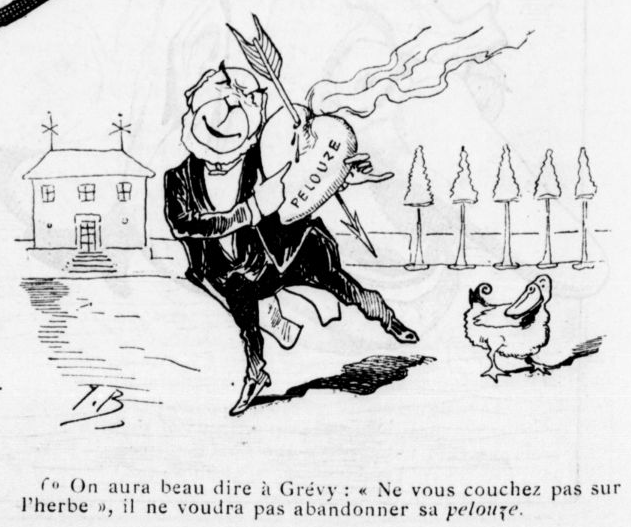
We can say to Grévy [president of the Republic]: “Don’t lie down on the grass, he won’t want to give up his pelouze.” [Grévy was rumored to be having an affair with the wealthy socialite Marguerite Wilson-Pelouze.]
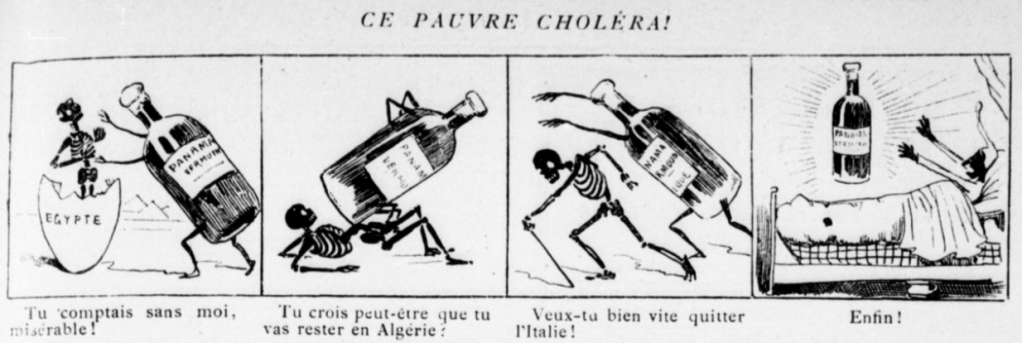
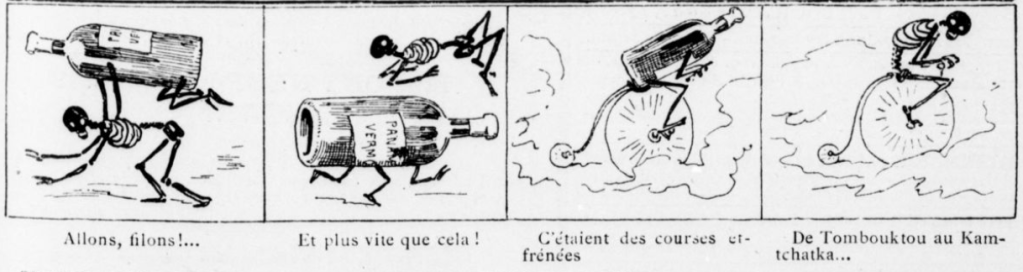
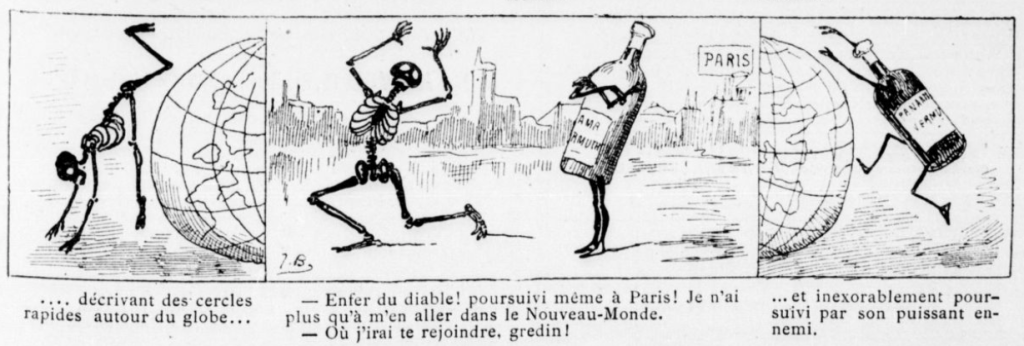
You didn’t count on me, wretch! You thought you might be able to take a break in Algeria? Would you like to leave Italy soon! Finally! (What the Panama Vermouth pursuing the cholera figure is meant to signal is not entirely clear to me, but at the height of French attempts to dig a canal through Panama, huge quantities of quinine were consumed to fight tropical diseases, and it was common to dissolve sulphate of quinine in vermouth for consumption every morning before breakfast.)
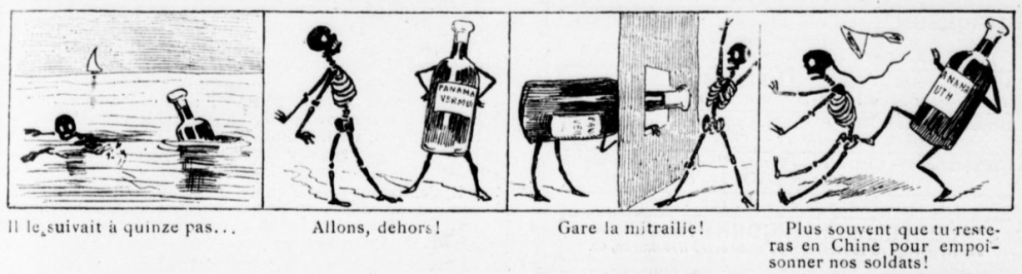
He followed him fifteen paces behind… Come on, outside! Beware of the grapeshot! More often than you will stop in China to poison our soldiers!
(The “anticholera Panama Vermouth” would appear to confirm the assumption above.)
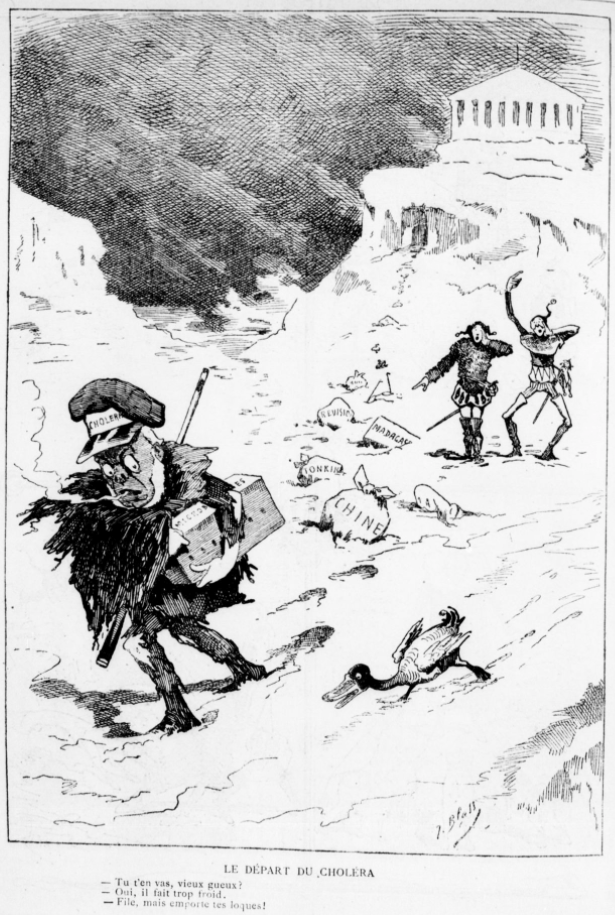
Come on, let’s get away!… And faster than that! They were frantic races from Timbuktu to Kamchatka…
…describing rapid circles around the globe… “What the hell! Chasing me even to Paris! I’ll just have to go to the New World.” “Where I will join you, rascal!” …and inexorably pursued by his powerful enemy.
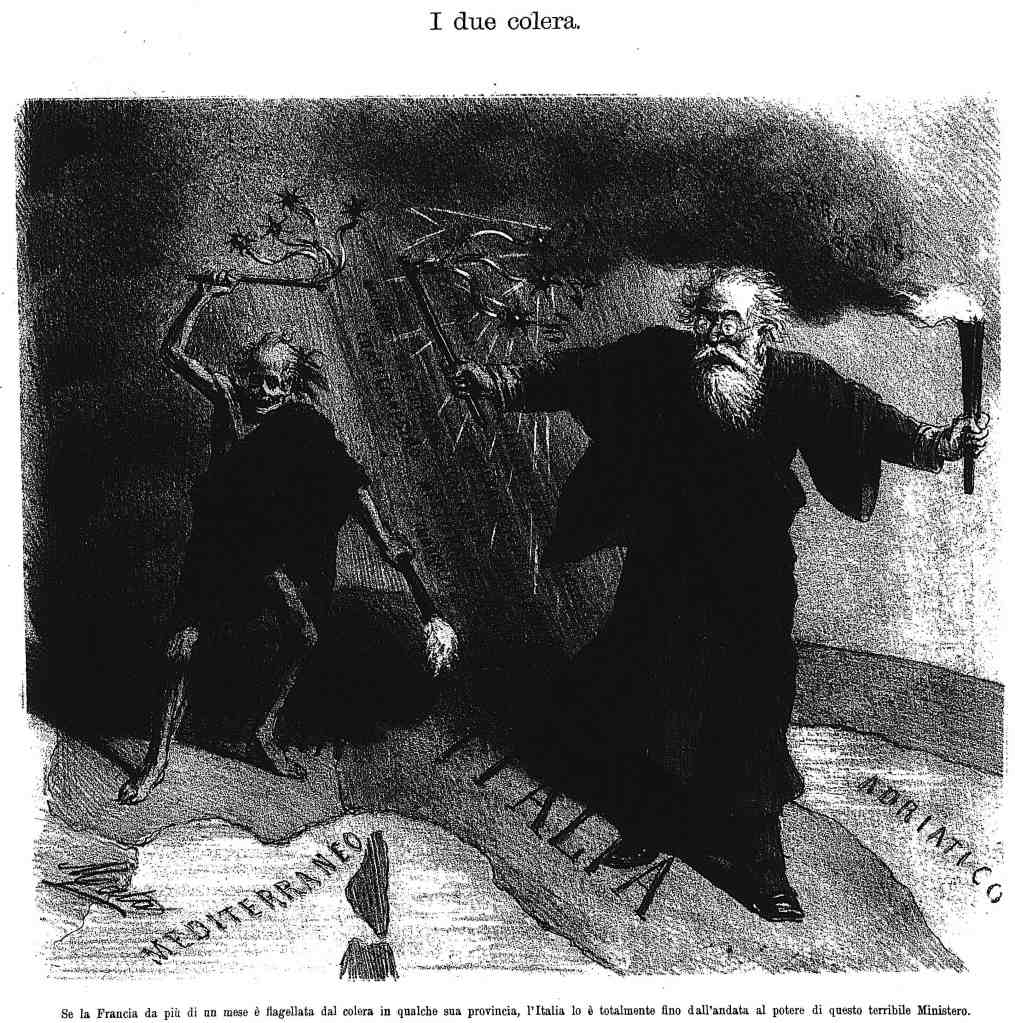
If France has been plagued by cholera for more than a month in some of its provinces, Italy has been totally so since the coming to power of this terrible Ministry. (Lo Spirito folletto, 1884)
(Skåne is the southern country in Sweden on the eastern side of the Øresund Strait from Copenhagen. The specter of Cholera is reaching out from France.)
His Royal Majesty and generals.
(accompanied by some playful verse which I cannot render in full, but here’s one pair of couplets)
But look into the distance! What do we get to see? It is the cholera that is seen to prevail, She, who explains all gaiety and caressing, should she interfere with our play?!
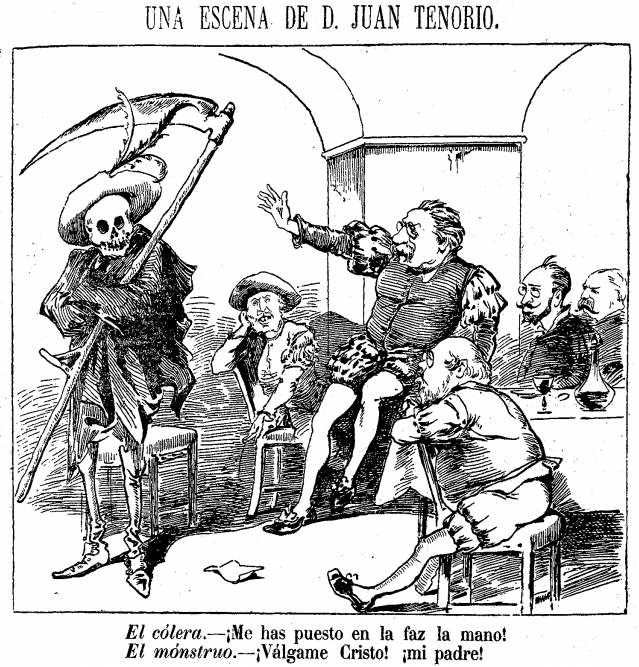
Don Juan Tenorio (the Seducer) was a 1844 play by José Zorrilla that retold the Don Juan legend for modern Spanish audiences. The object of satire here is prime minister Antonio Cánovas del Costillo, sometimes referred to as “the monster” for his curious combination of intellectual hauteur and political brutality. Cholera: “You have slapped me in the face!” [i.e., “I demand satisfaction!”] The monster: “Christ almighty! My father!” (El Busilis, Barcelona, 1884)
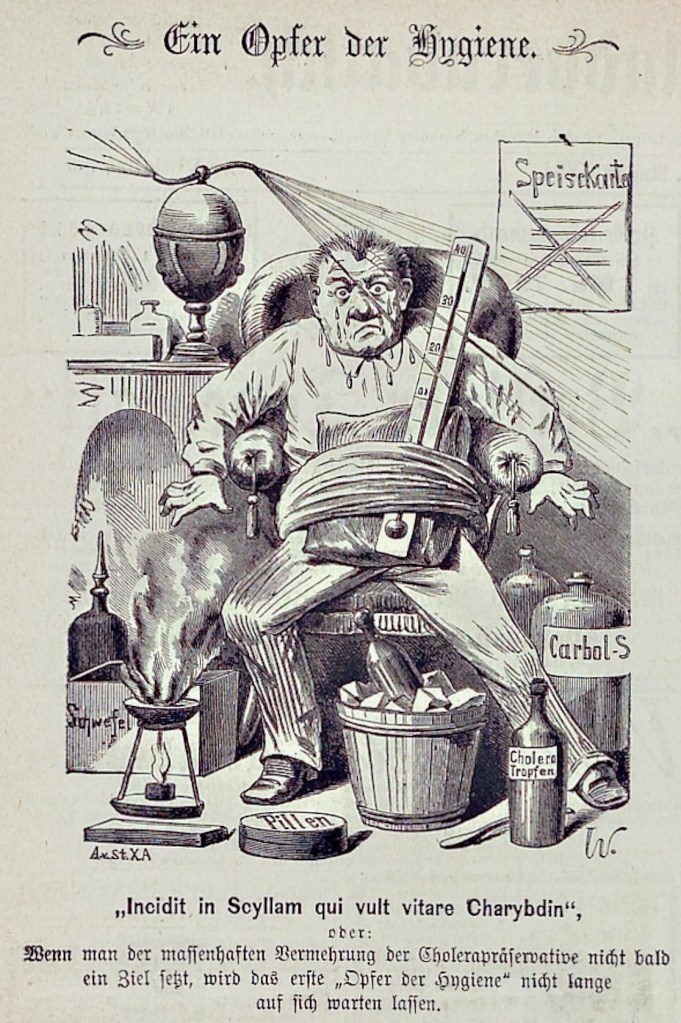
(in Latin) He wants to avoid falling into Scylla or Charybdis, or: Unless a guideline is set soon for the massive increase in cholera-prevention remedies, the first victim of hygiene will not be long in coming. (Kladderadatsch, Berlin, 1884)



 Sic Transit Pestilentia