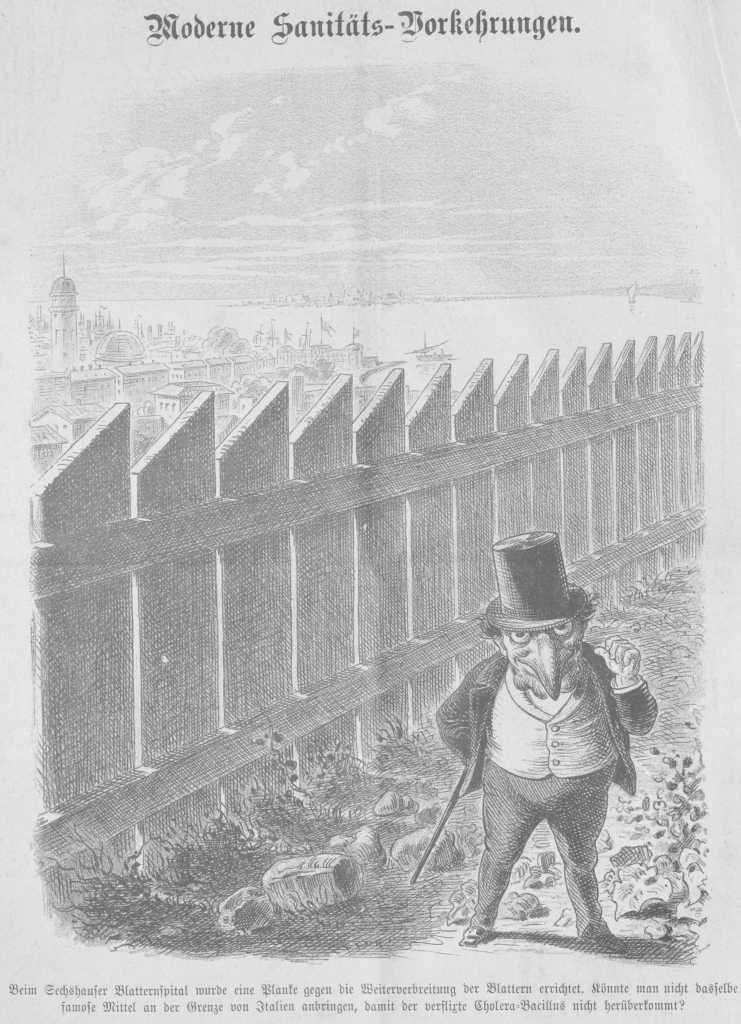
At the Sechshaufer Smallpox Hospital a barrier was erected against the spread of smallpox. Couldn’t one install the same splendid means along the border with Italy, so that the confounded cholera bacillus does not come over here? (Kikeriki, Vienna, 1886) (And in a similar vein.)
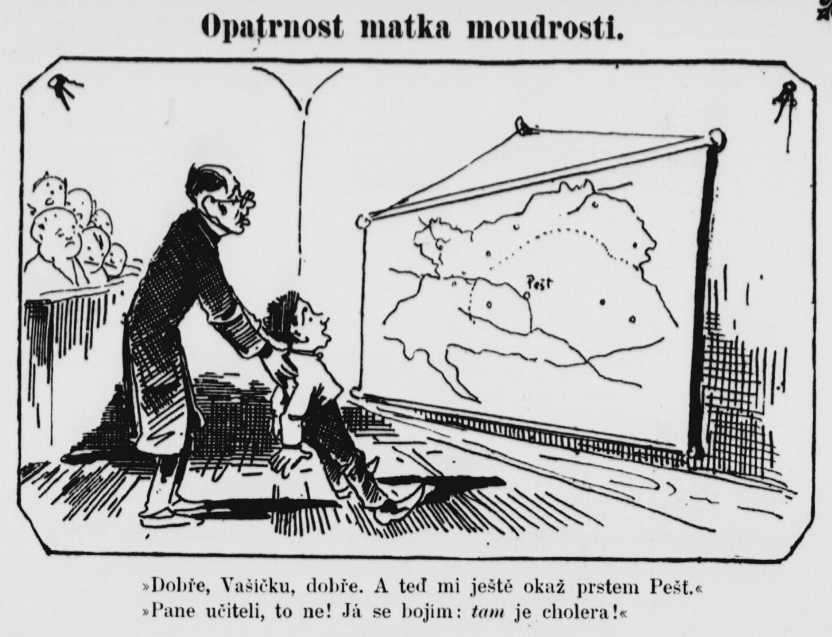
“Good, Vasicka, good. And now point your finger at Pest.” “Teacher, not that! I’m afraid that there it’s cholera.” (Humoristické listy, Prague, 1886) (A nearly identical French cartoon.)
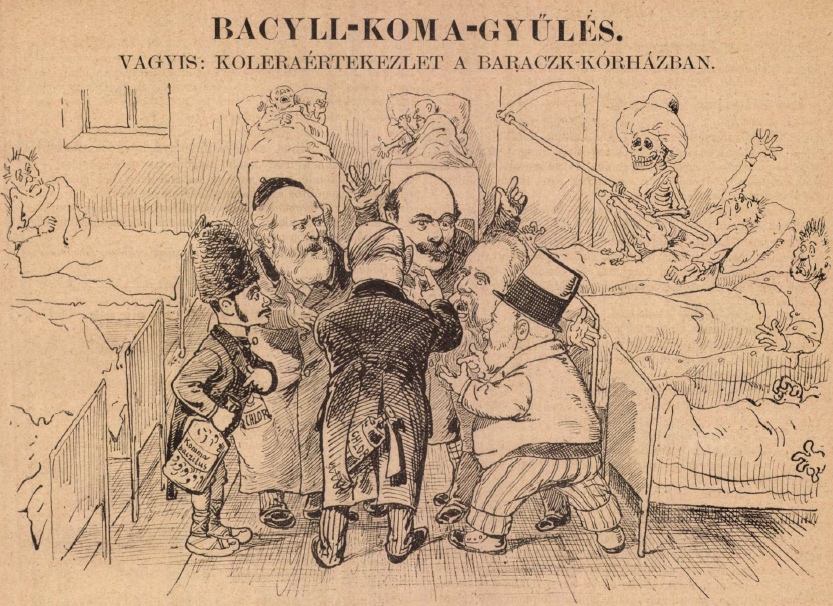
Or: Cholera meeting at the Peach Hospital The image is accompanied by statements from Dr. Cheeseslicer, Dr. Bacillus Bacterius, Dr. Bablesi-Bibasiu (the Hungarian Pasteur), Dr. Striker! (Louis the Great, Cholera King), Dr. Veterinarius Bacterius, and Dr. Lacyllus Lupus. A note at the end indicates, “While the doctors strew about the seeds of the theory, Cholera Asiatica reaps happily, and Dr. Cheeseslicer notes with consolation: Yet this is cholera nostras and not Asian, because they are dying for us!” (Bolond Istók, Budapest, 1886) (Yes, this wants further parsing in the context of domestic politics.) (See also this Dutch variant of cholera nostras.)
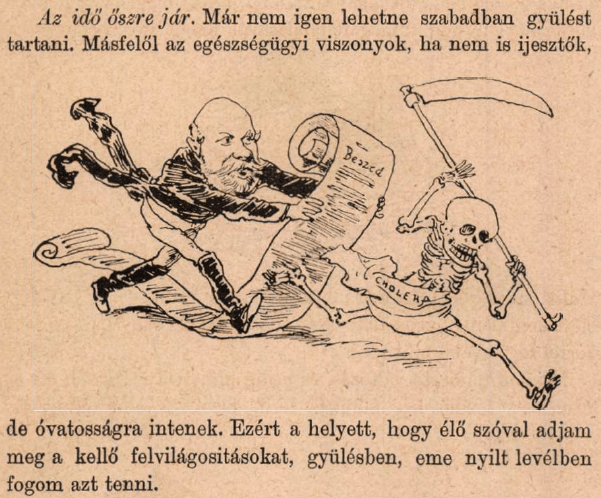
This image is singled out from a series mocking the Hungarian minister of public works and transport, Baron Gábor Kemény. Known as an advocate of Hungarian economic modernization, Kemény seems to be faulted here for raising long-winded written objections to convening the next session of parliament, at a time when cholera was recurring in Hungary. “It is getting on toward autumn,” writes the satirist in his voice. “It would no longer be possible to hold an outdoor session. On the other hand, health conditions, if not frightening, do call for caution. Therefore, instead of giving the appropriate clarifications in person at the session, I will do so in this open letter.” Here even cholera is put off by his stentorian prose. (Bolond Istók, Budapest, 1886)
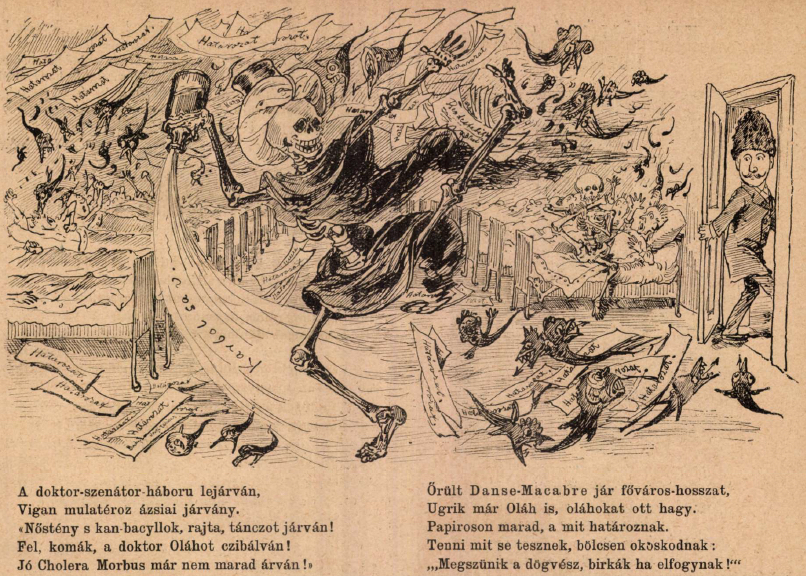
As the Doctor-Senator War comes to an end, The Asian contagion is carousing merrily. “Female and male bacilli, let’s get dancing! Rise up, comma-bacilli, Dr. Oláh* urges them! Good Cholera Morbus is no longer an orphan!” Crazy Danse Macabre runs the length of the capital, Oláh is already skipping out, leaving the Wallachians** there. What has been decreed remains on paper. Doing whatever they do, they reason wisely: “The pest will disappear, they’re sheep if they run out!” (*Presumably Gyula Oláh, physician, public health figure, and former parliamentarian) (**Punning on Oláh’s name, which could also mean a derogatory term for Romanians.) (Bolond Istók, Budapest, 1886)
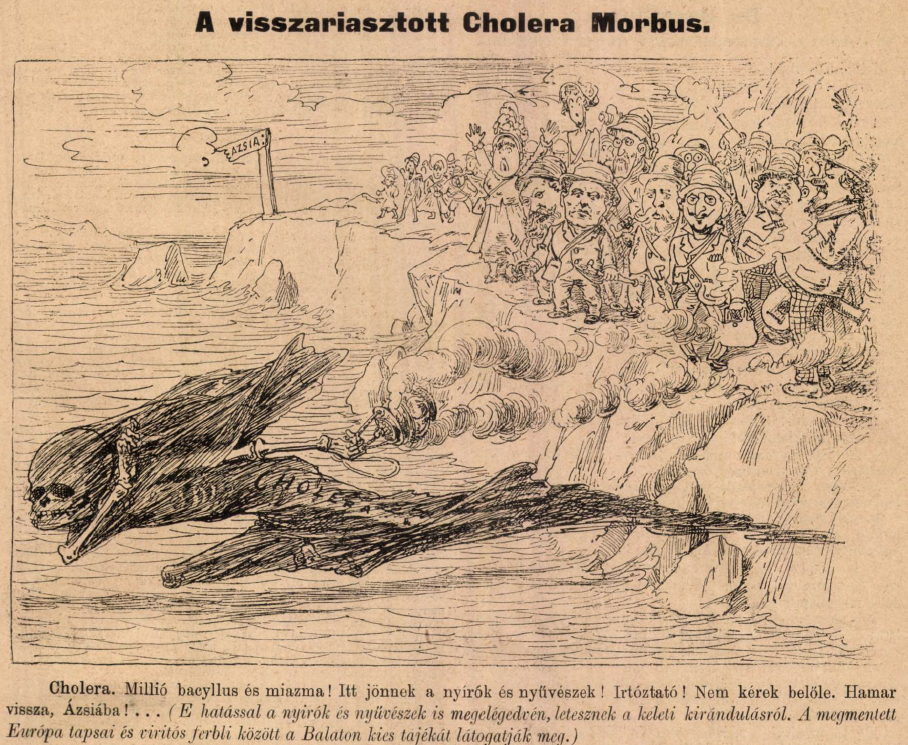
Cholera: Millions of bacteria and miasma! Here come the shearers and wormeaters! Loathsome! I want nothing to do with it. Right back to Asia!… (Bolond Istók, Budapest, 1886)
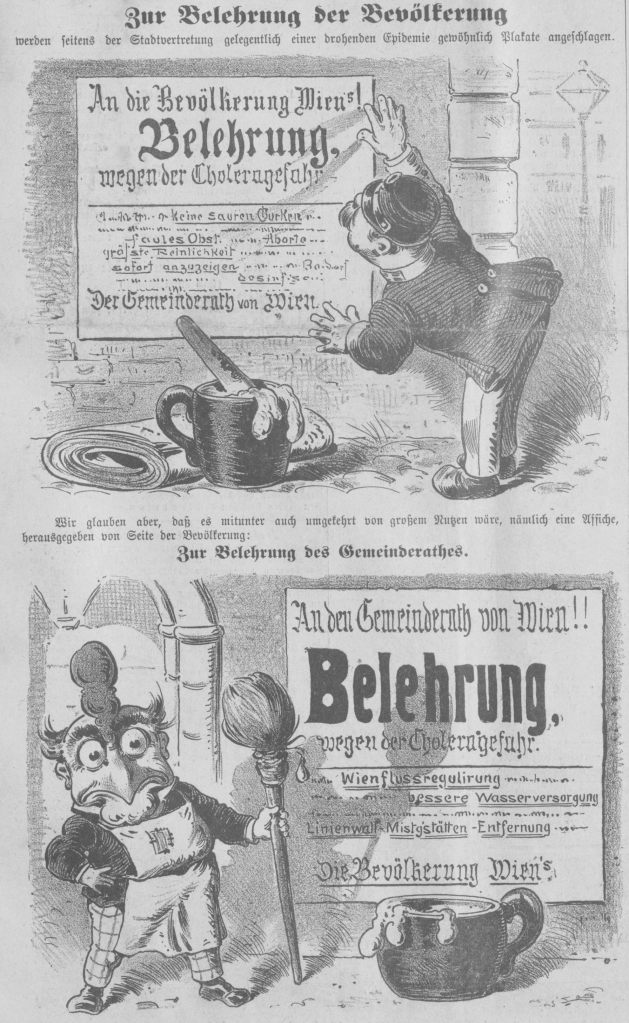
For the instruction of the populace posters of an impending epidemic will occasionally be put up by the city council. (The first poster forbids sour pickles, rotten vegetables, and (I think) abortions (!), while demanding cleanliness.) We believe, however, that it would also be immensely useful to include a placard published on behalf of the populace: For the instruction of the city council. (The second poster wants better channeling of the Danube river against floods, better water services, better waste removal.) (Kikeriki, Vienna, 1886)
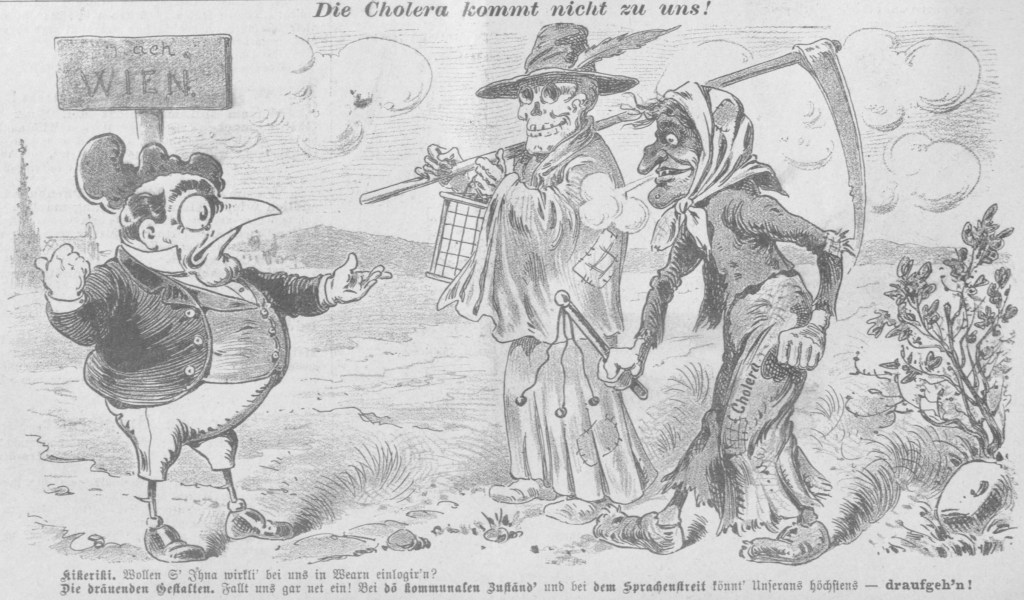
Kikeriki: “Do you really want to take lodgings with us in Vienna?” Looming figures: “It didn’t occur to us! With the communal situation and the language conflict the likes of us could croak at best!” (Kikeriki, Vienna, 1886)
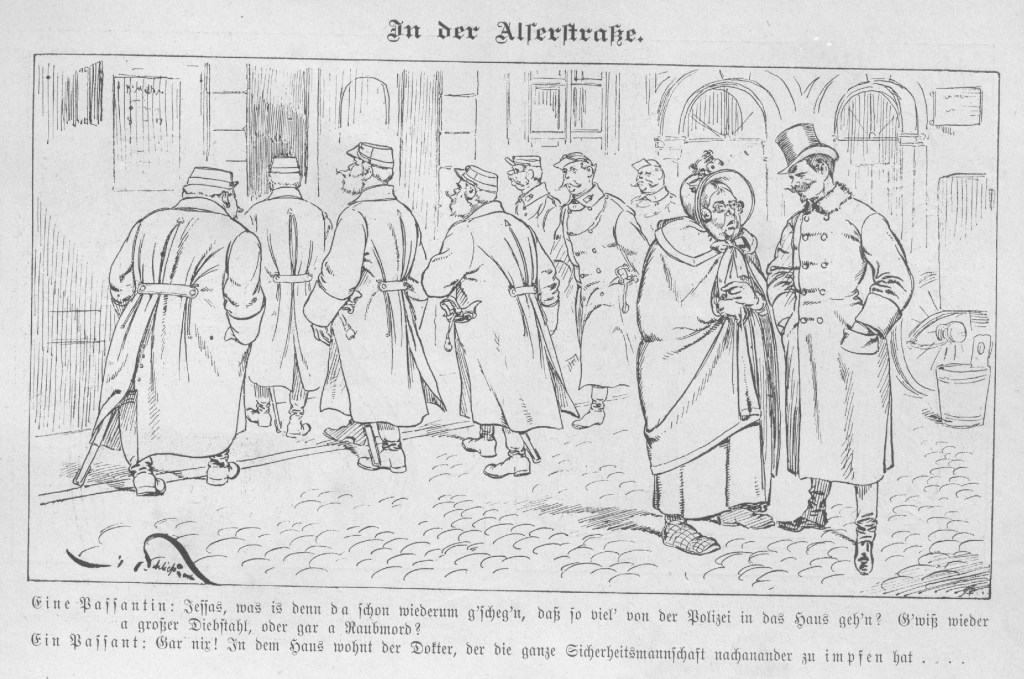
Lady passing by: “Goodness, what’s happening around there again, that so many police are going into that house? It’s got to be another big burglary, or even a robbery?” Man passing by: “Not at all! In that house lives the doctor who has to vaccinate the entire security team…” (Figaro, Vienna 1886)
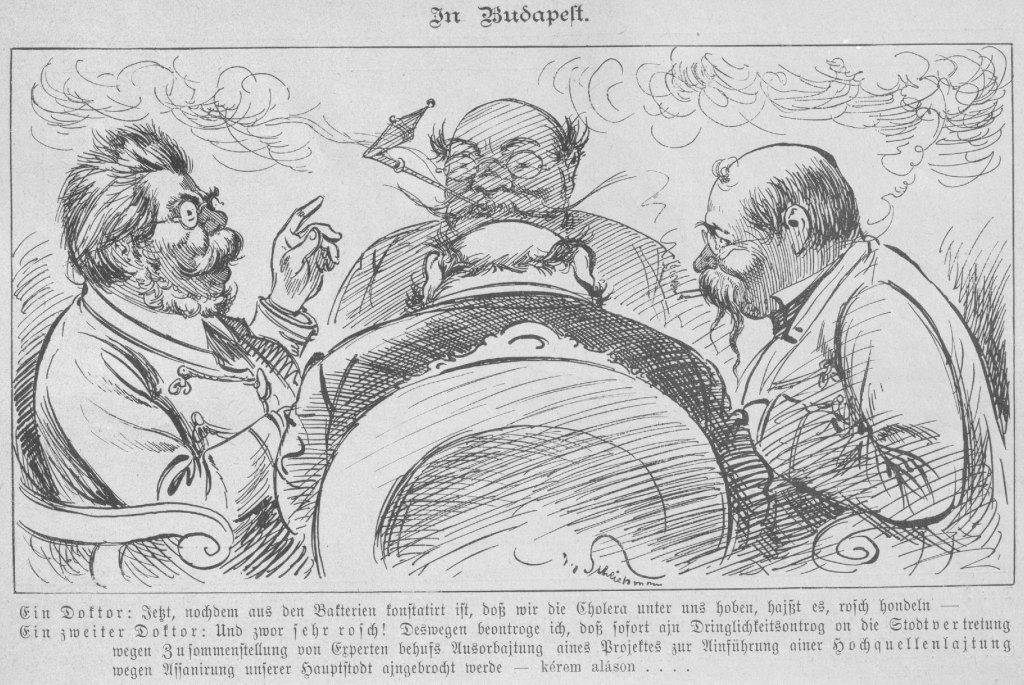
Doctor: “Now that it has been established from the bacteria that we have cholera among us, it means that we must act promptly.” Second doctor: “And indeed very promptly! That is why I propose that an urgent request to the city council regarding the assembly of experts for preparation of a draft plan for introduction of a high-quality water supply on account of the renovation [?] of our capital is to be introduced immediately, (in Hungarian) I humbly request….” (Lost here are the cartoon’s subtler linguistic caricatures amid the mockery of hyperbureaucratic formulations.) (Figaro, Vienna, 1886)
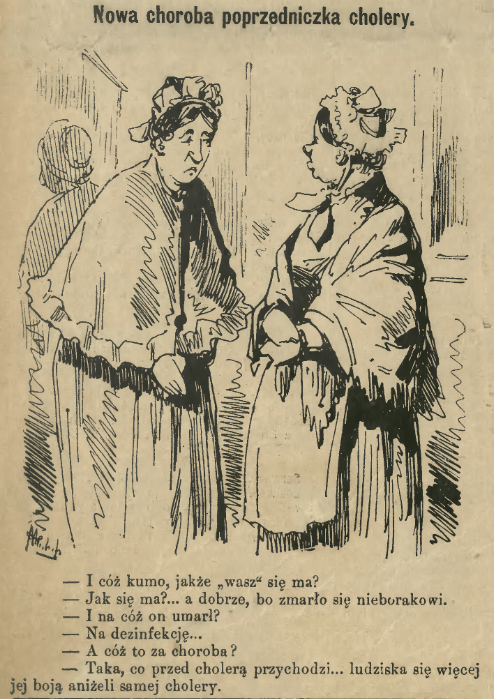
“And godmother dear, how’s your man?” “How’s he doing? … well, fine, because the poor devil has died.” “And what did he die from?” “From disinfection.” “What kind of disease is that?” “The one that comes before cholera… people are more afraid of it than cholera itself.” (Mucha, Warsaw, 1886) See also these miasmatic contemporary images of disinfection measures at Paris train stations (and again in 1892).
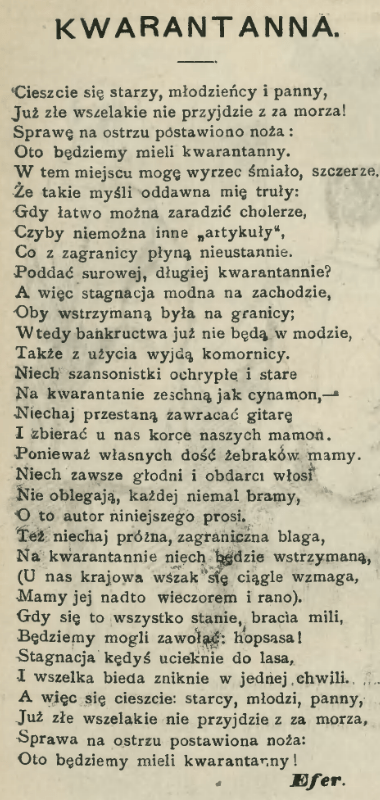
And now for something completely different. This playful poem on the solemn subject of cholera quarantine was published in the Polish humor magazine Mucha in 1886. Once again we see contagion metaphors giving expression to economic anxieties, in this case related to the persistently tepid European economic growth in the years following the Vienna stock exchange crash of 1873, all amid the fourth great cholera pandemic. Although the agrarian Polish economy was much less vulnerable to speculative bubbles, the author seizes upon quarantine as a way to make isolation from “the West” into a virtue.
The rhyme scheme is ABBA ABAB AABB and so forth, but I have only translated as literally as my limited Polish skills permit. Editorial suggestions welcome. (Mucha, 1886)
Rejoice, elders, lads and ladies, No longer do all evils come from abroad! Matters have come to a head: We are going to have quarantine here. In this place I can say boldly, sincerely, That such thoughts have long troubled me: If cholera can easily be remedied, Wouldn’t it be possible to subject other “goods,” From what is constantly flowing from abroad, To strict and lengthy quarantine? And namely stagnation is fashionable in the west, May it be stopped at the border; Then bankruptcies will no longer be in vogue, Bailiffs will also fall out of use. May the hoarse old sirens of stagnation Dry out like cinnamon on quarantine, May they stop plaguing us on the guitar And collecting bundles of money from us. Because we have enough beggars. May the ever hungry and ragged Italians Not besiege almost every gate, That is what this author asks for. May stagnation also be a vain, foreign sham, Let it be subject to quarantine, (In Poland it is indeed still increasing, Day and night we have it in excess). If all this happens, dear brothers, We will be able to call out: tralala! Stagnation will escape to the woods And all poverty will disappear in an instant. So rejoice: elders, lads and ladies, No longer do all evils come from abroad, Matters have come to a head: Here we will have quarantine!
 Sic Transit Pestilentia