The European rulers attacked by the “Russian snuff”

(Box labeled “Quinine against runny nose”)
Not now, by the Russian knout and the Prussian Pickelhaube
and by the swords with which they fight,
we suffer from the Russian snuff
and we in grace cheat ourselves.
All of Europe’s sovereigns
have got a sense of the snuff;
but thrones shall not fall
just for this sudden catarrh…
Then England’s proud mistress
does not go free of the flu,
may Spain’s little king reconsider,
that she also rules over him.
And look at Bismarck, look at him,
he was a grand old diplomat!
He cannot outsmart her,
she grabbed him neatly.
There, in the high courtrooms,
living doctors fall asleep easily;
but behold, she is still awake,
and you do not know her right.
It has been said that she passes so gently:
she pinches, but lightly and softly.
Well, it’s tiny! She cruelly martyrs royal purple.
Yes, the kingdom, it is sick.
(Fäderneslandet, Stockholm, 1889)
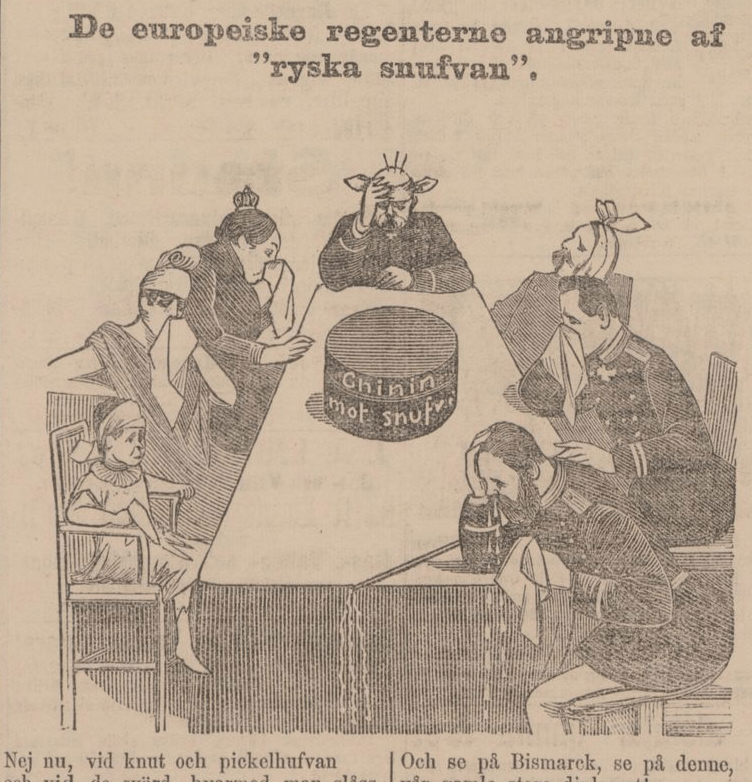
Swedish flu cartoon

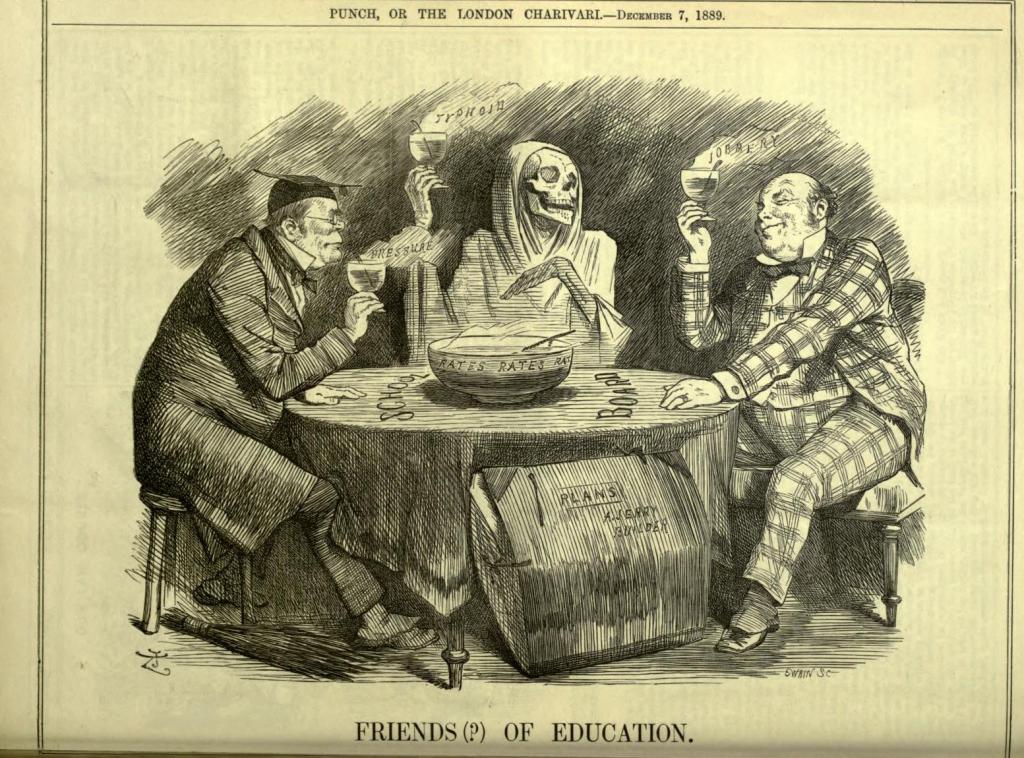
Friends (?) of education

Pressure, typhoid fever, and jobbery as members of the school board. I haven’t looked into the politics referenced here, but I include this image because of its seeming resonances with our own current imperatives, trying to reconcile in-person instruction with the real-world behaviors of students in epidemic conditions.
(Punch, London, 1889)

British typhus cartoon

Influenza

Influenza, obstruction,
This situation is already appalling!
Our nose grew like a tower,
We are failing, abbiony!
(Bolond Istók, Budapest, 1889)
(I hesitate to post this one, since I don’t grasp the context adequately, e.g., the figures blowing wind, or the term “abbiony,” which is not in any dictionary, but shows up multiple times in this journal. It might actually be an informal acronym for its readers.)

Hungarian flu cartoon

Influenza sketches

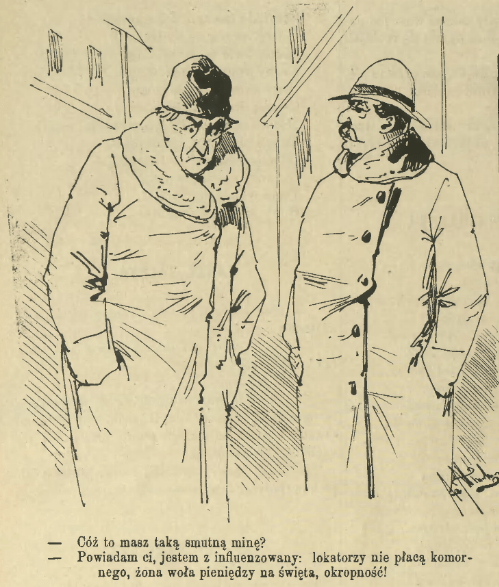
(Kolce, Warsaw, 1889)

“Why do you have such a sad face?”
“I tell you, I’m down with influenza: tenants don’t pay the rent, the wife wants money for the holidays, it’s horrible!”

Polish flu cartoon

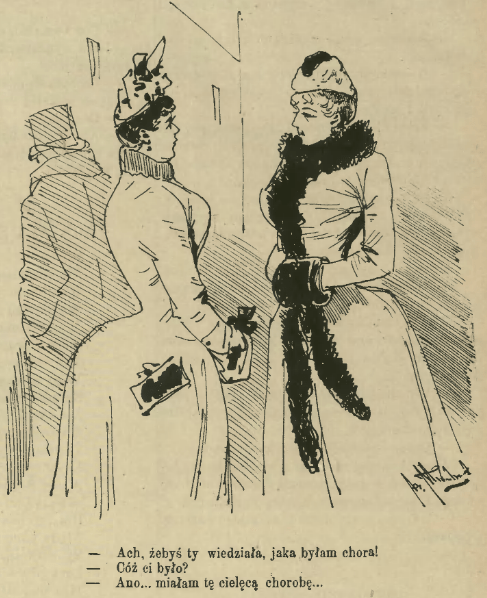
“Oh, if only you knew how sick I was!”
“What was wrong with you?”
“Well… I had this bovine disease…”

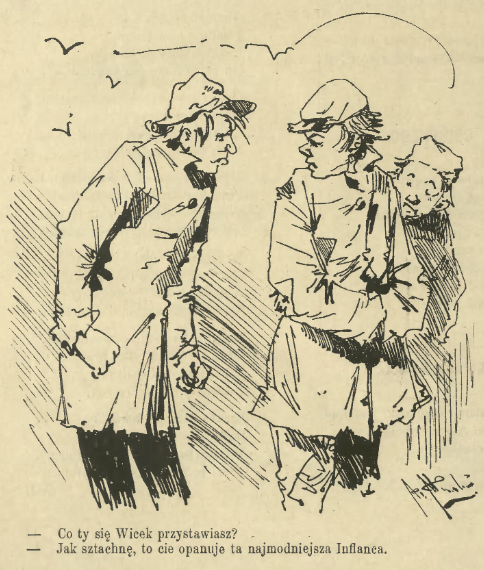
“What are you putting on, Wicek?”
“Like a cloud of smoke, you will be overwhelmed by this super fashionable Inflanza.”

“Is the lady at home?”
“She is, but she is not receiving anyone, because she has this weakness known as intelligence.”

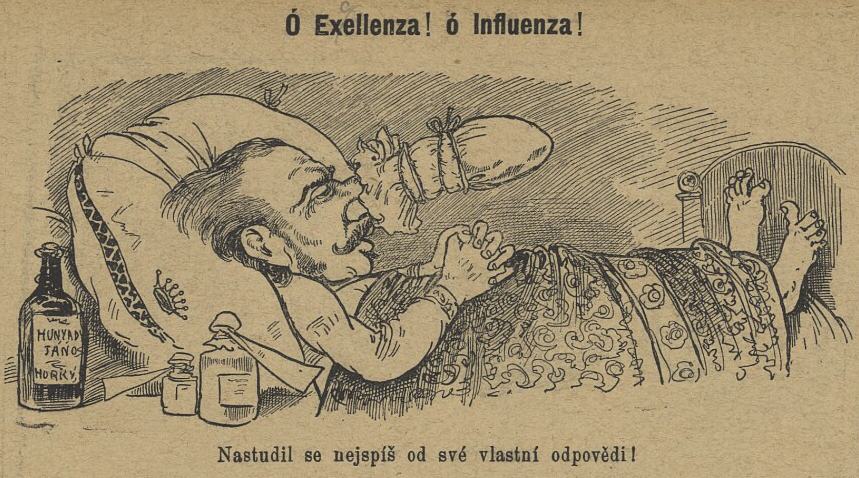
Oh Excellency! Oh Influenza!

“He probably caught cold from his own response!”

The visual joke here is quite simple, with the title punning on the original Italian sense of influenza as influence. Yet the underlying source of its amusement to contemporaries is not readily apparent to us today. The bedridden figure depicted is Austrian Minister-President Count Taaffe, who came down with a mild case of influenza late in December 1889, at the height of the European epidemic that winter. A masterful coalition-building aristocrat who had balanced Austro-German nationalism against Bohemian-Czech nationalism for much of the 1880s, mostly in service to conservative Liberal and noble landowning interests, Taaffe had finally been stymied by the Bohemian diet elections a few months earlier, when the Young Czech nationalists gained the upper hand. Taaffe’s failing confidence in his own rhetorical ability to sustain coalition politics seems to be the central object of the satire here. At his bedside is a bottle of János Hunyadi Bitters, a real product borrowing on the fame of a fifteenth-century Hungarian military hero–a marvelous touch.
(Šípy, Prague, 1889)

Czech flu cartoon

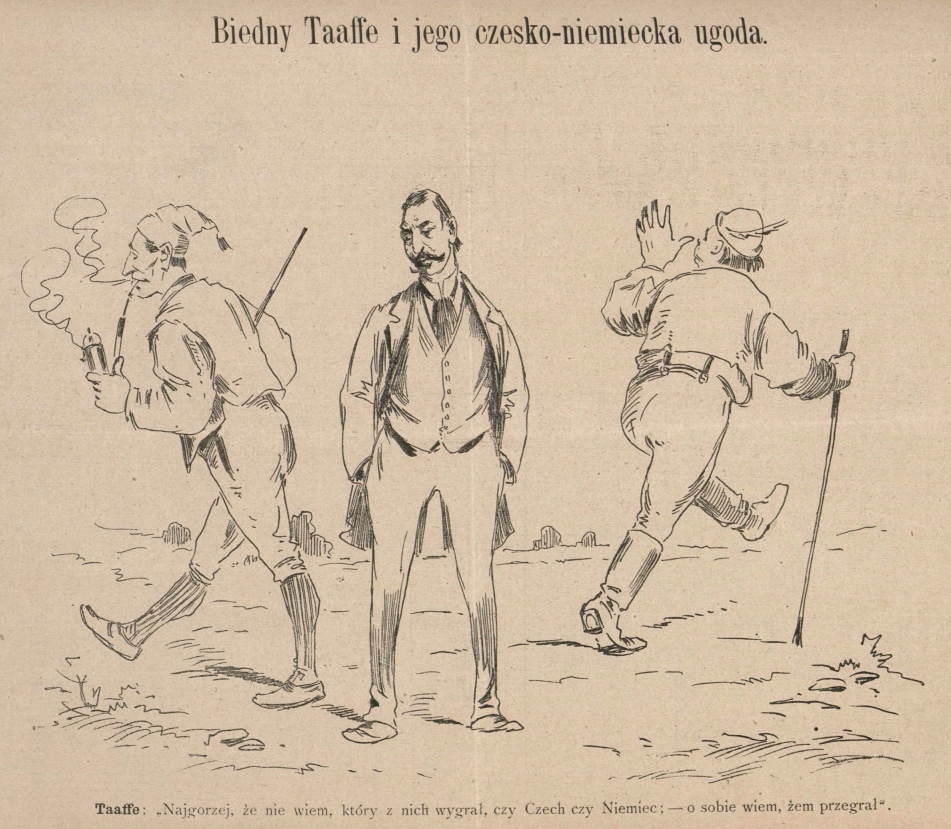
Taaffe’s declining fortunes are satirized in the Polish magazine Szczutek (Lwów, 1892):