First the decisive factors covered up the contagion;
but when it swelled to gigantic proportions before their eyes,
they lost their heads over it.
(Kikeriki, Vienna, 1892)
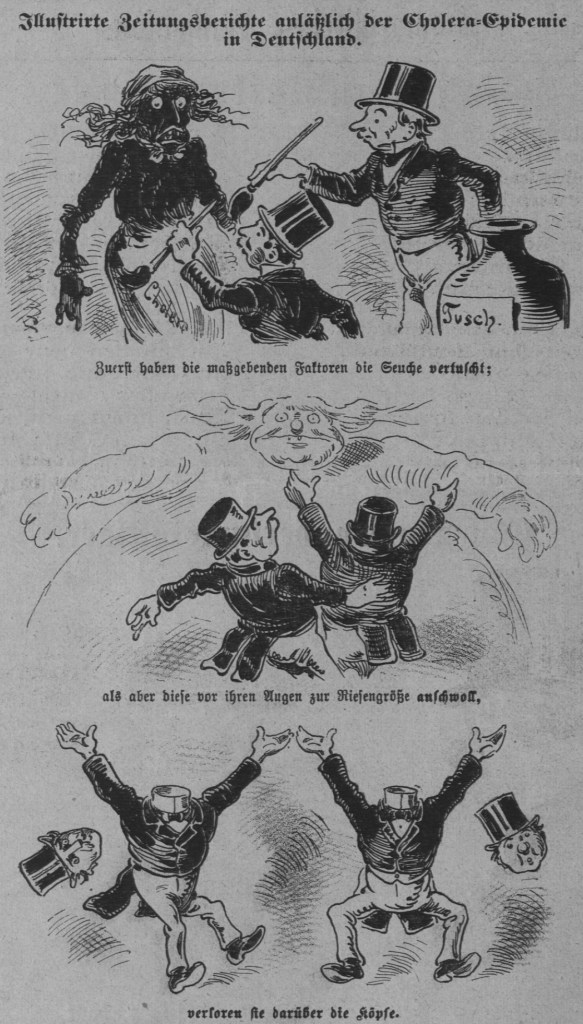
First the decisive factors covered up the contagion;
but when it swelled to gigantic proportions before their eyes,
they lost their heads over it.
(Kikeriki, Vienna, 1892)
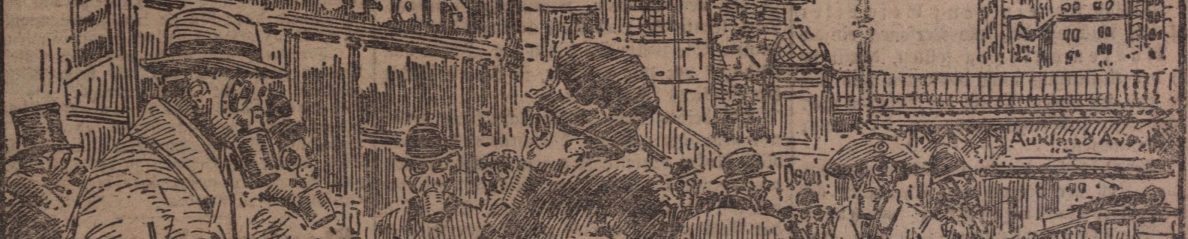
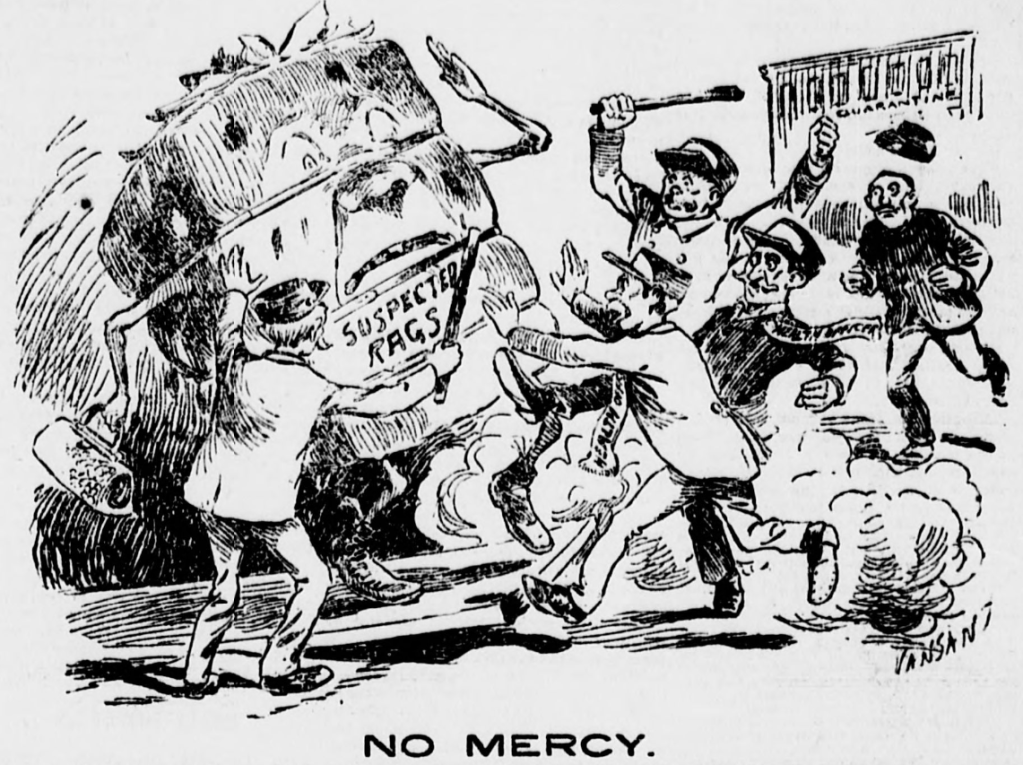
Public health officers are depicted beating away at rags suspected of bearing contagion. This issue contained extensive coverage of the advance of cholera in Europe and the preparations of New York public health authorities for its possible arrival on American shores.
(The Evening World, New York, 1892)
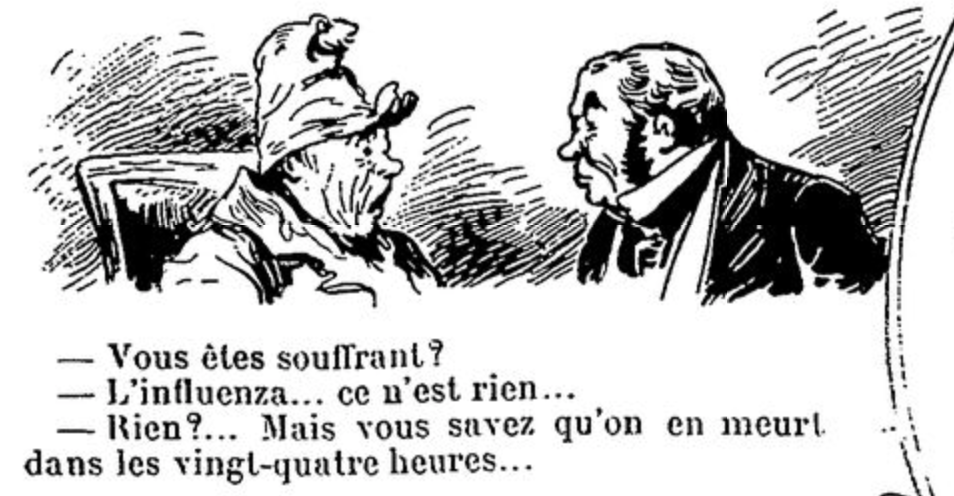
“What are you ailing from?”
“Influenza… it’s nothing…”
“Nothing?… But you know that one dies within twenty-four hours…”
(Le Journal amusant, Paris, 1892)
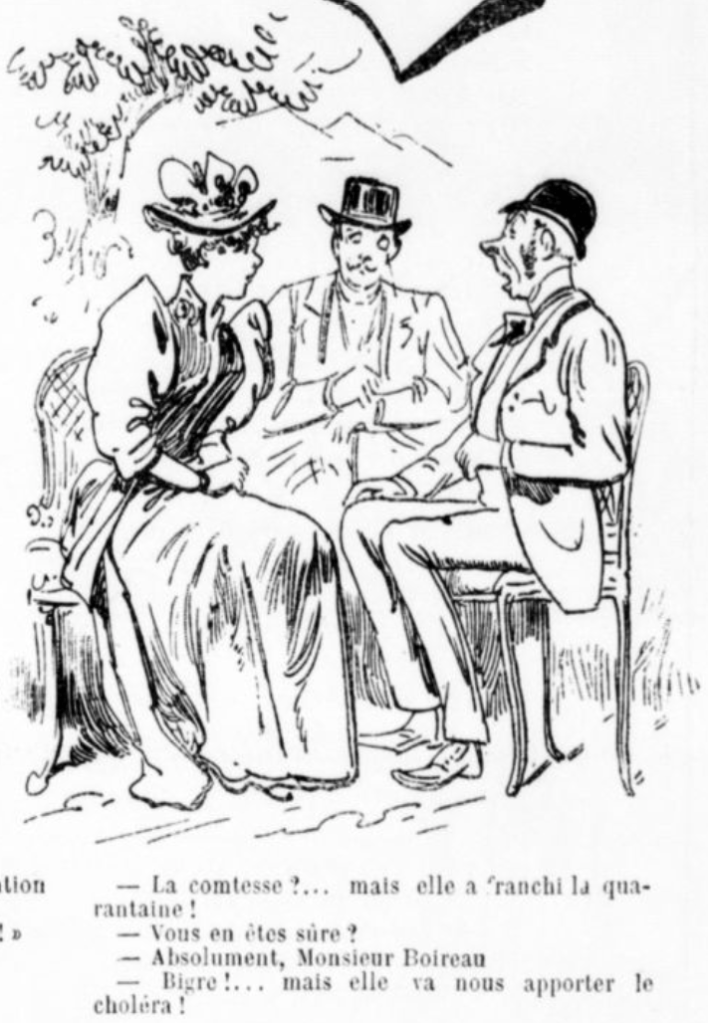
“The countess?… but she was put in quarantine!”
“Are you sure?”
“Absolutely, Mr. Drinker.”
“Damn!… but she will bring us cholera!”
(Le Triboulet, Paris, 1892)
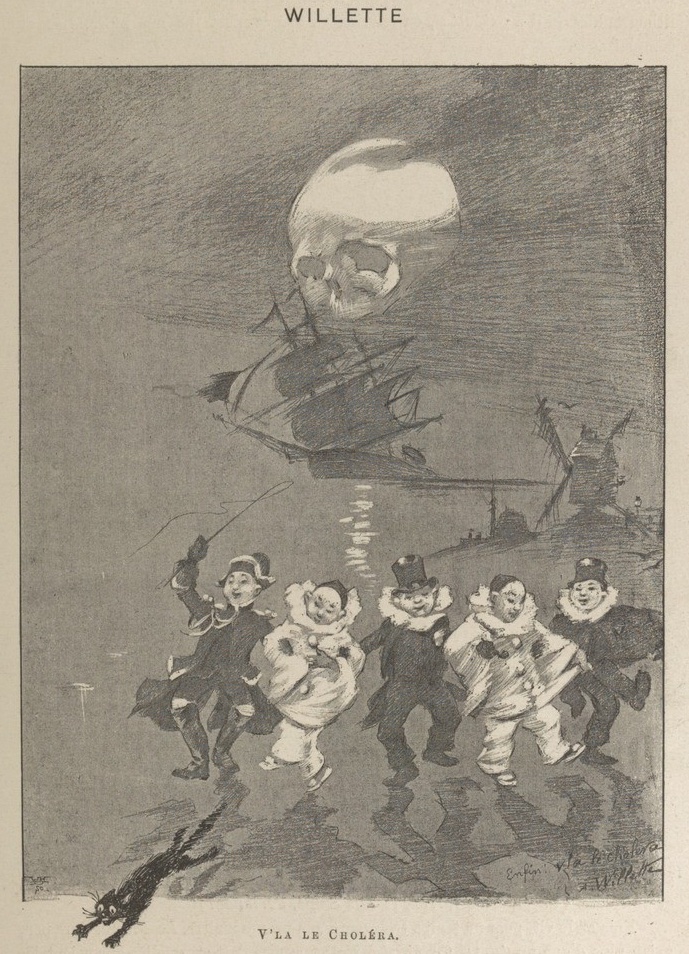
(A cartoon by Adolphe Willette in Arsène Alexandre, L’art du rire et de la caricature, 1892)
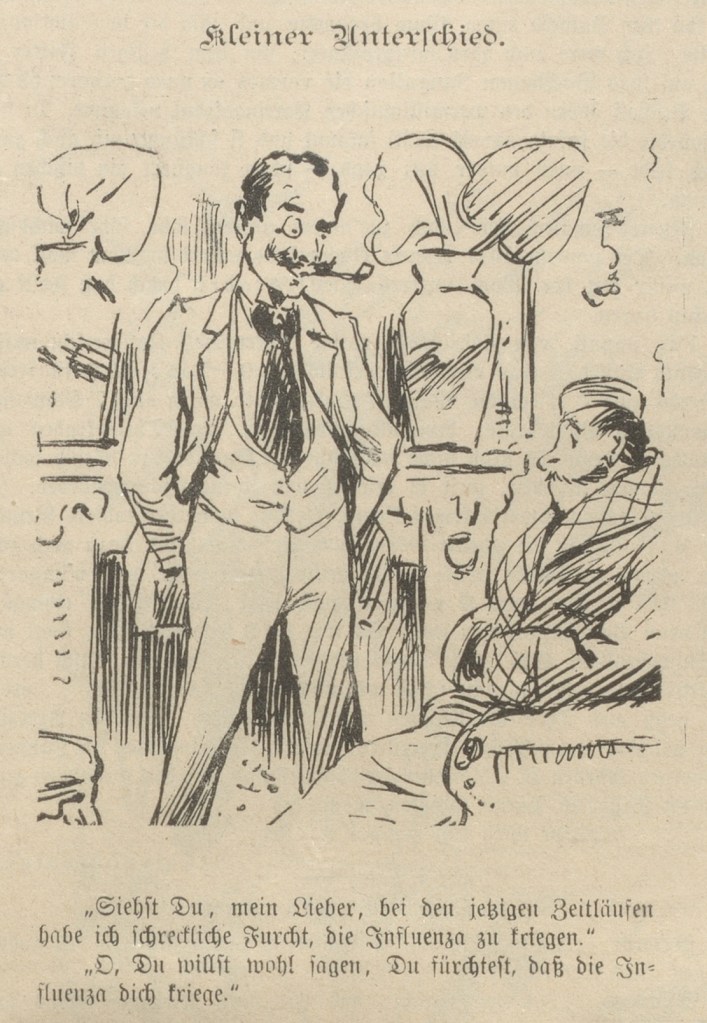
“You see, my dear, the way things are going, I have terrible fear of catching the flu.”
“Oh, you really mean to say you’re afraid that the flu will catch you.”
(Nebelspalter, Zurich, 1892) (In a similar vein, this Polish cartoon.) (And similar French pun.)
The major of ‘s Gravenhage has forbidden a large demonstration for Universal Suffrage and Voting Rights on the grounds that the Medical Inspector did not consider it desirable, at this time when cholera threatens us, to gather a great multitude of persons from all parts of the country!
(Abraham Prikkie’s op- en aanmerkingen, Rotterdam, 1892)
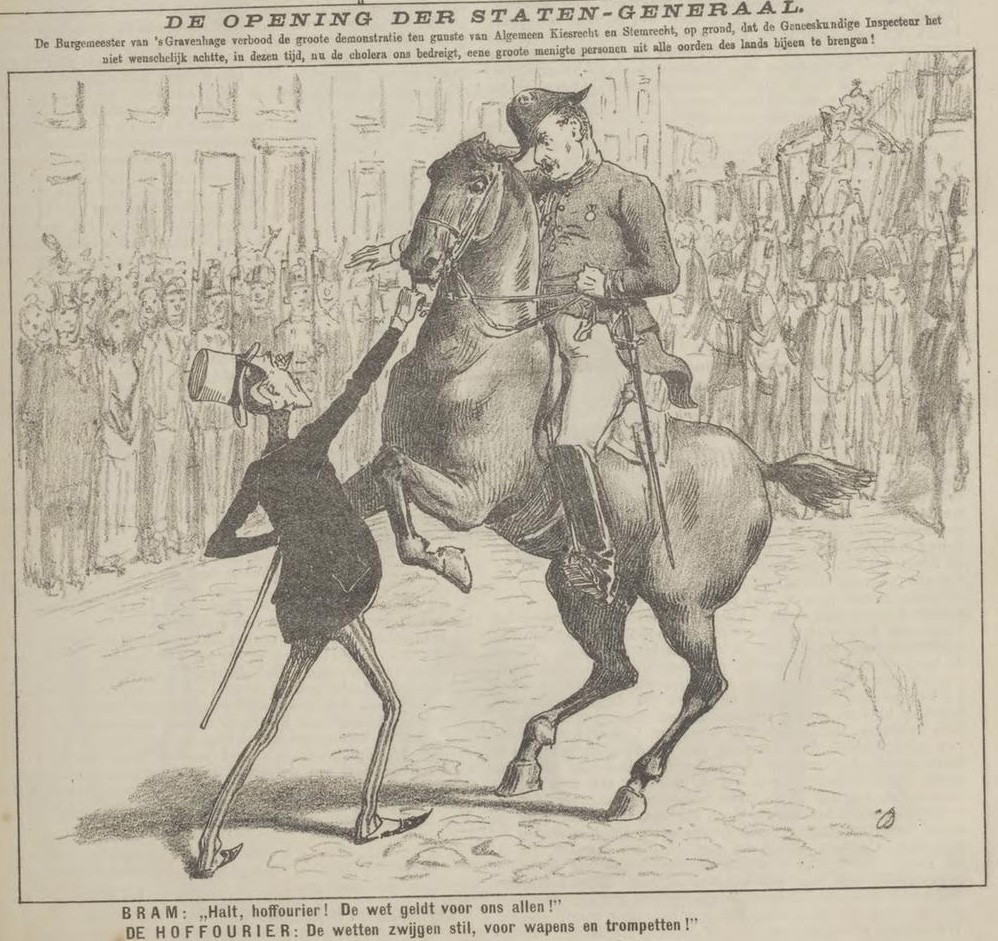
BRAM: “Halt, Royal Quartermaster! The law applies to all of us!”
ROYAL QUARTERMASTER: “The laws fall silent before weapons and trumpets!”
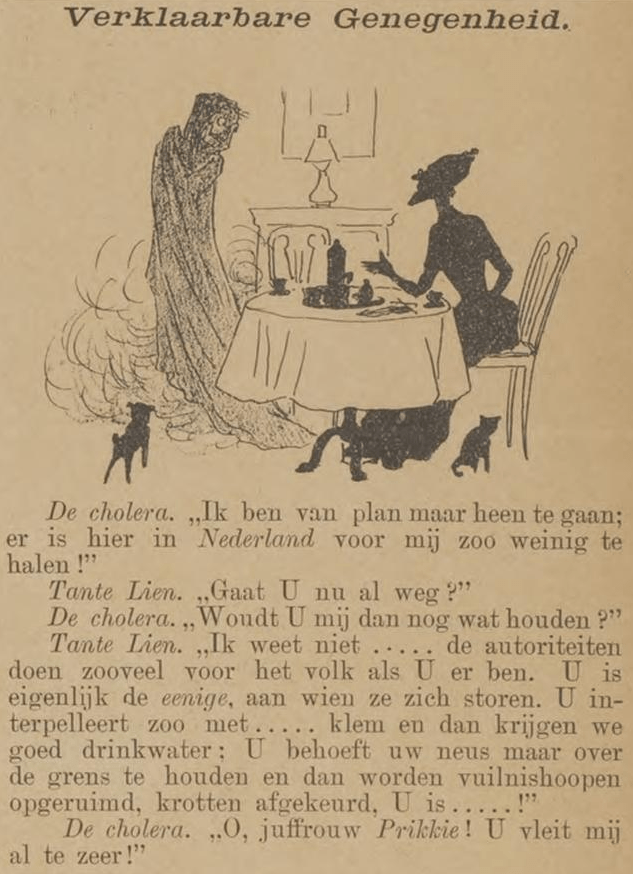
Cholera: “I’m just going to go; there is so little for me to contribute here in the Netherlands!”
Auntie Lien: “Are you leaving already?”
Cholera: “Would you still like me to stay?”
Auntie Lien: “I don’t know… since you’ve been here the authorities have been doing so much for the people. You are actually the only one they can be bothered with. You interfere so emphatically… and then we get good drinking water; you only have to stick your nose over the border and then garbage piles are cleared away, hovels are condemned, you are…!”
Cholera: “Oh, Miss Prickie! You flatter me too much!”
(Abraham Prikkie’s op- en aanmerkingen, Rotterdam, 1892)
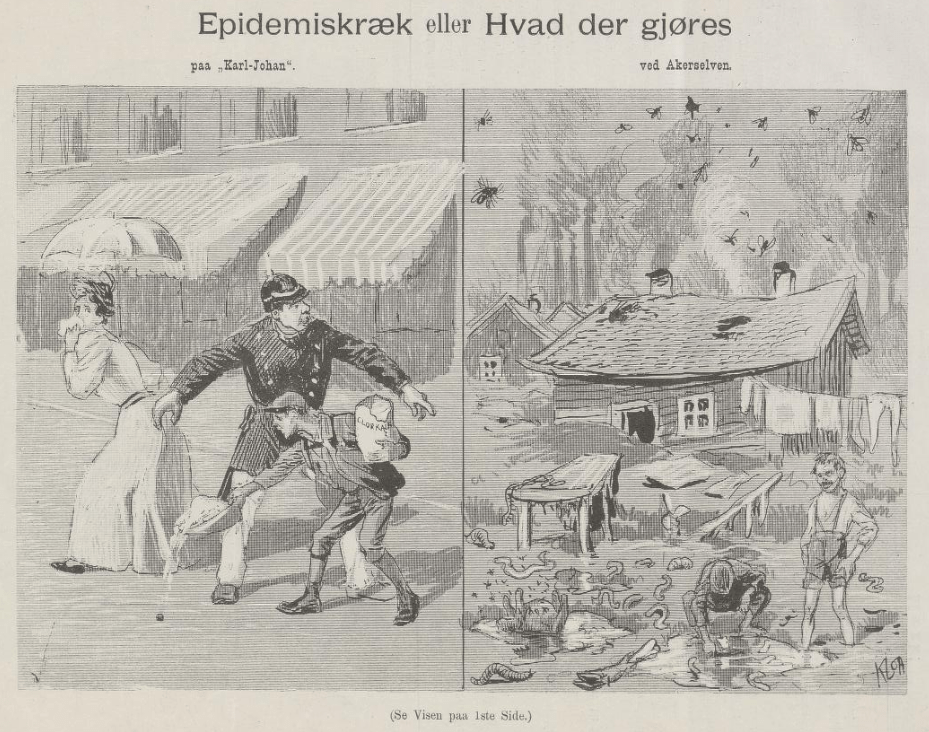
At the Karl-Johan Gate (in central Oslo) (man spreading slaked lime)
On the banks of the Akerselven River (running through Oslo)
(Vikingen, Oslo, 1892)
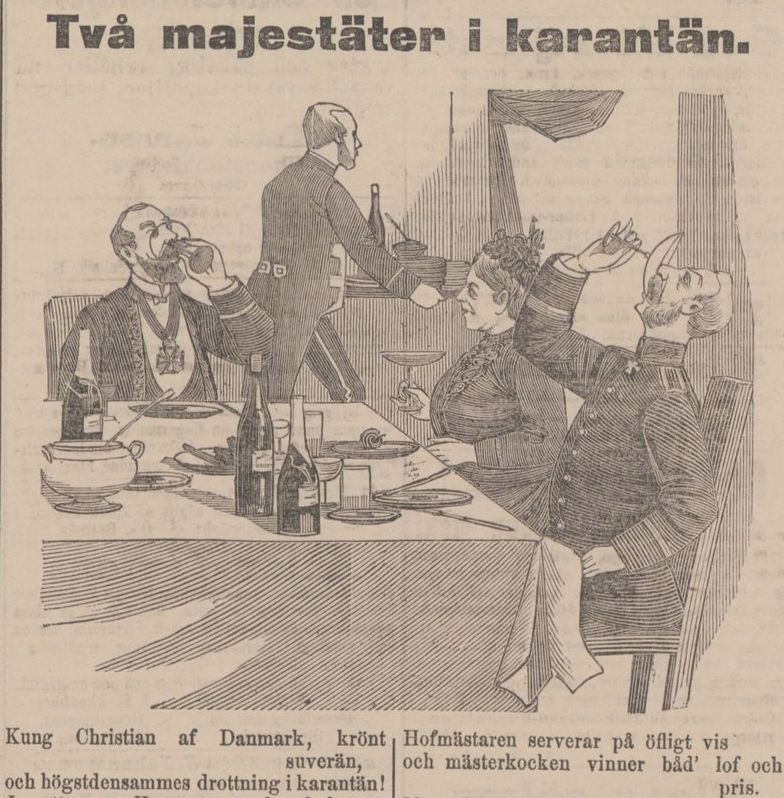
King Christian of Denmark, crowned sovereign,
and equally exalted queen in quarantine!
Yea, that the “Lord’s anointed” be placed there,
is not a breach of majesty the same?
It is believed that the purple itself, which the couple wears,
is now loaded with cholera bacteria,
and shall it be sulphurized, smoked,
shall the king and his consort be soaked with carbolic acid?!
Oh, their majesties feel pretty good,
though it’s not as fun as in a castle.
Delicious dishes and sparkling wine are common here,
but not a single sign of cholera.
The court master serves in the usual way
and the master chef wins both praise and award.
But of Mr. Koch’s bacteria, at the king’s throne,
not even a portion is served here.
There sits the adjutant with champagne glasses,
which must always be in good company.
And now you sound most gracious. Good year, yes, cheers!
You eat and you drink everything you can tolerate.
You can probably be quarantined,
then so you can enjoy there, oh sovereign!
With glass in hand, a roast fowl on fork,
it is, on the whole, like a game.
(Fäderneslandet, Stockholm, 1892) (with apologies for the sloppy translation)
(I’ll only venture the first and last couplets that accompany this image.)
Mr. Sörensen! I have blocked the road for you.
You must not bring cholera to me.
…………
Yes, dear captain, turn on your engine
and sail so the sea trolls get the cholera!
(Fäderneslandet, Stockholm, 1892)

For early Swedish satirical press one should apparently look to Grönköpings Veckoblad, but so far as I can tell, there is no historical digital archive available. Rather by accident I’ve finally run across another potential Swedish contribution to this collection. Fäderneslandet (Fatherland) was a Stockholm newspaper in operation since 1830, achieving a rather large circulation by the 1870s. Sporting the subheading “Freedom Work Justice,” it apparently fostered a politically radical stance, but more often functioned as a scandalous broadsheet. In any event, they occasionally published cartoons, including this one from during the cholera pandemic of 1892, accompanied by rhymed couplets in the original.
(Fäderneslandet, Stockholm, 1892)

Attention! This newspaper is reporting:
“The Traveling Kaiser is not coming.”
Because of cholera? Yes, it’s a given,
he cannot defy it – no.
But, alas, organizers of festivities,
Officers and gentlemen who bear the sword!
Yes, major patrons and merchants,
it’s a blow to the bill of goods.
That Kaiser Wilhelm would visit us,
it was just said in all the squares.
And we wanted to hold a feast for him
in our proud Gothenburg.
We intended to light things up
and put on the fireworks.
“He will decorate us for this
with ribbons and medals,” we thought.
But these were golden illusions
they evaporated away for this time.
Yes, now by forests [of newspapers?] and millions [of kroner?]
our nose has become terribly long.
Whose fault it is, we all know,
it is cholera, at the knees of the gods!
Oh, may it go to Gehenna
and be put there in quarantine!
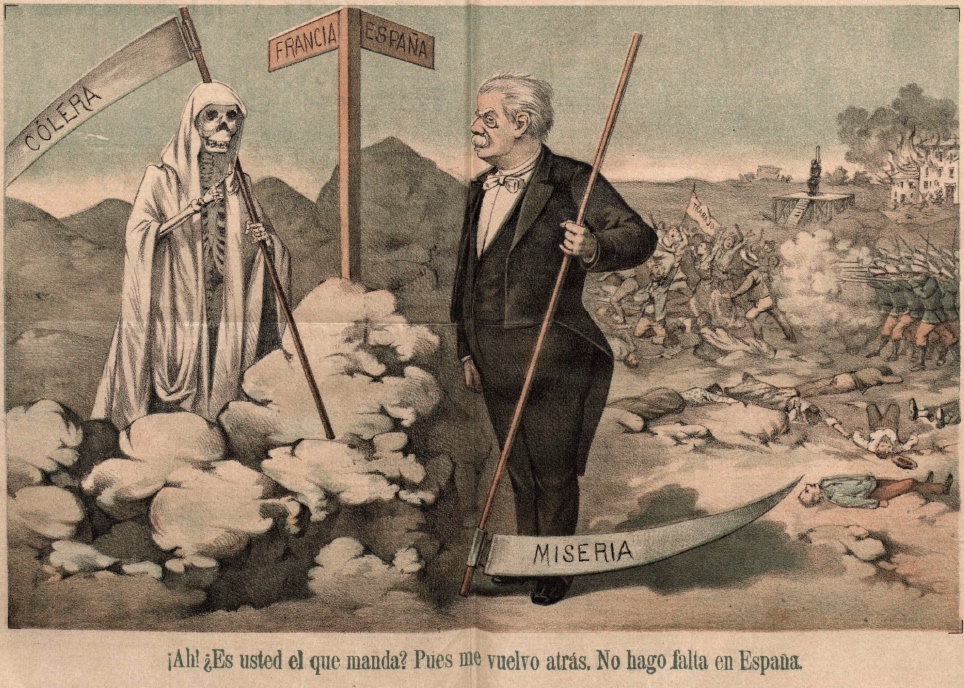
Cholera at the French-Spanish border, to Spanish prime minister Antonio Cánovas del Castillo: “Ah! Are you the boss? Well, I’ll head back. I’m not needed in Spain.”
In January Andalusian anarchist workers associations had tried to take control of Jerez de la Frontera, an action that was violently suppressed by the government. The following month four anarchist workers were executed, but not before a small bomb was set off in the Plaza Real in Barcelona. Just weeks before this image was published, greengrocers in Madrid launched a “mutiny,” a popular revolt in the face of new municipal taxes. The Conservative Cánovas, then serving his fifth turn as prime minister, strongly resisted expanding suffrage to the working class. (See a previous issue for another excellent image; El Motin was unsurprisingly deeply hostile to monarchist politicians.) He also pursued a hard line against Cuban independence. He was eventually assassinated by an Italian anarchist in 1897.
(El Motin, Madrid, 1892)
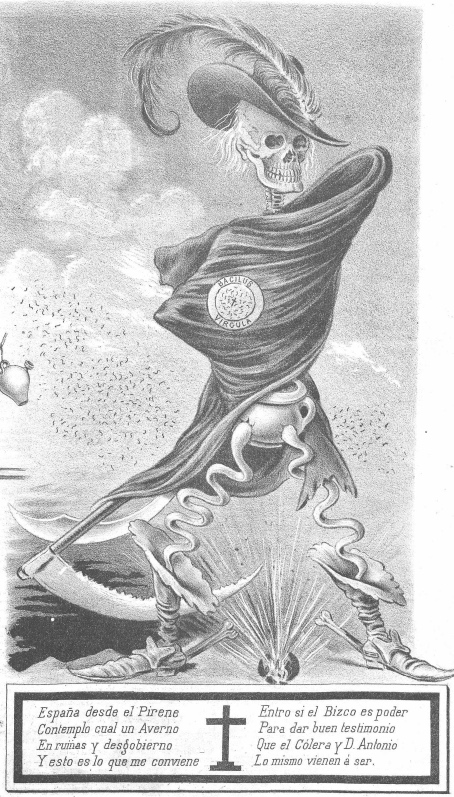
Spain from the Pyrenees on down
I contemplate what an inferno
In ruins and misrule
And this is what suits me
I enter if the Squint-eye lets me
To give good testimony
That the Cholera and Don Antonio [Cánovas del Costillo, prime minister who was forced from office by the end of that year]
Are coming to be one and the same.
(Don Quijote, Madrid, 1892)
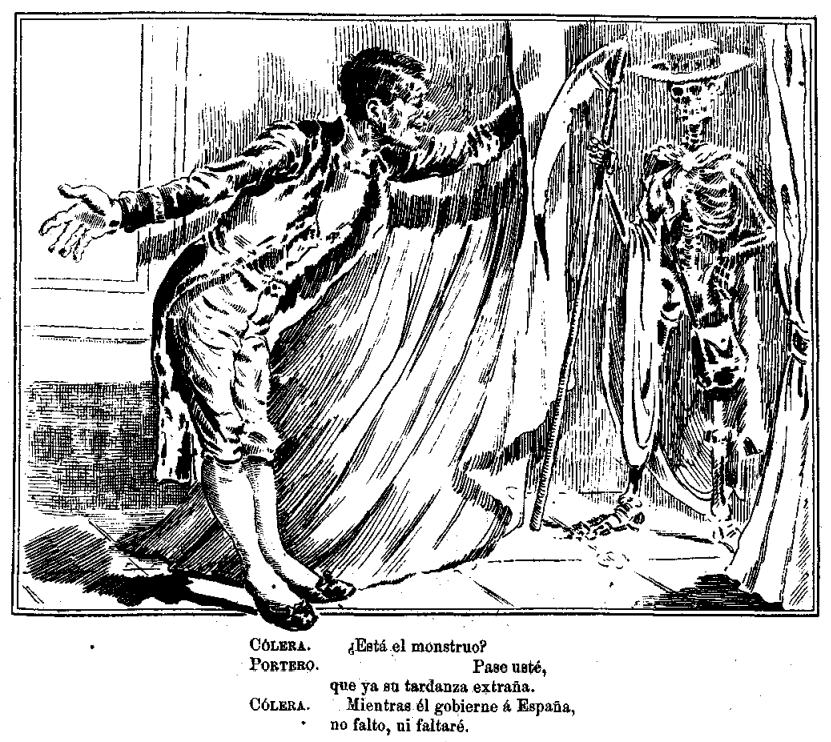
Cholera: “Is the monster in?”
Porter: “Do come in, your delay is strange.”
Cholera: “While he governs Spain, you don’t need me, nor shall you.”
(Don Quijote, Madrid, 1892)
(Prime minister Antonio Cánovas del Castillo was sometimes referred to as “el Monstruo,” as seen in this image from El Motin.)
 Sic Transit Pestilentia