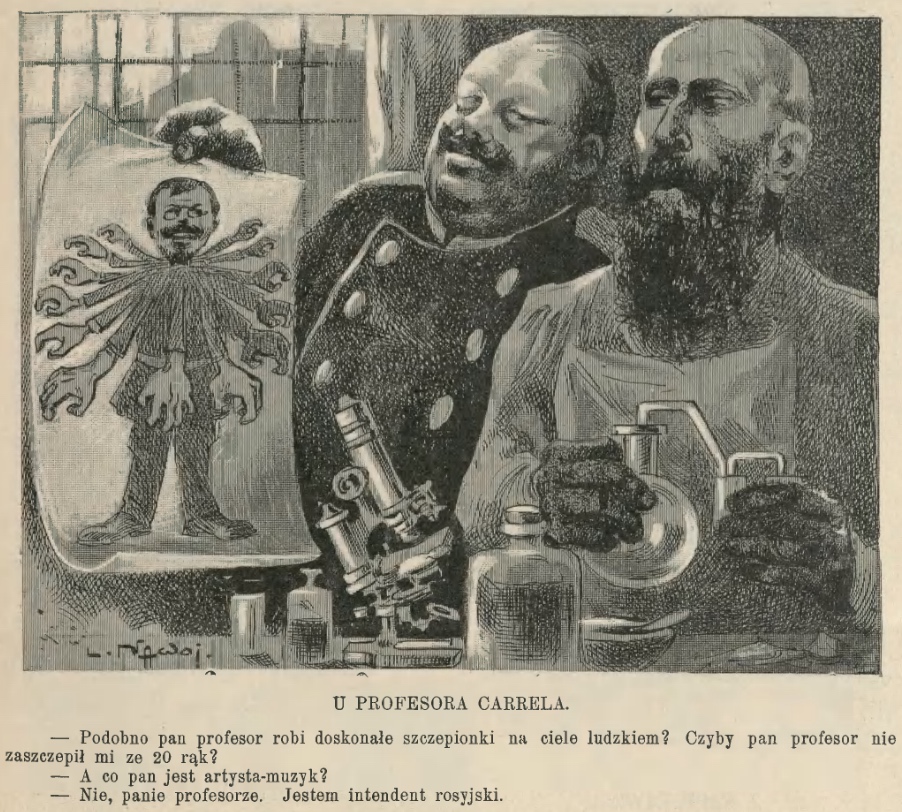
At Professor Carrel’s lab

(Early in 1911 the French-American medical researcher Alexis Carrel, then working at Rockefeller University, drew attention in The New York Times for having “succeeded in stimulating the growth of animal tissues outside the body” and “caus[ing] cancer tissues to grow after removal from the human body.” The bearded professor depicted here bears little resemblance to the clean-shaven Carrel, who would soon win the Nobel Prize for Medicine for other work. But the Polish cartoonist in Russian-ruled Warsaw somehow managed to find inspiration for a political jab, so to speak, at his oppressors.)
“Professor, apparently you make excellent vaccines [sic] for the human body? Wouldn’t you be able to graft twenty hands onto me?” [a strange pun, since rąk can also mean cancer; the word for “graft” can also mean “inoculate”]
“Are you a musical artist?”
“No, Professor. I am the Russian quartermaster.”
(Mucha, Warsaw, 1911)
Polish vaccine cartoon

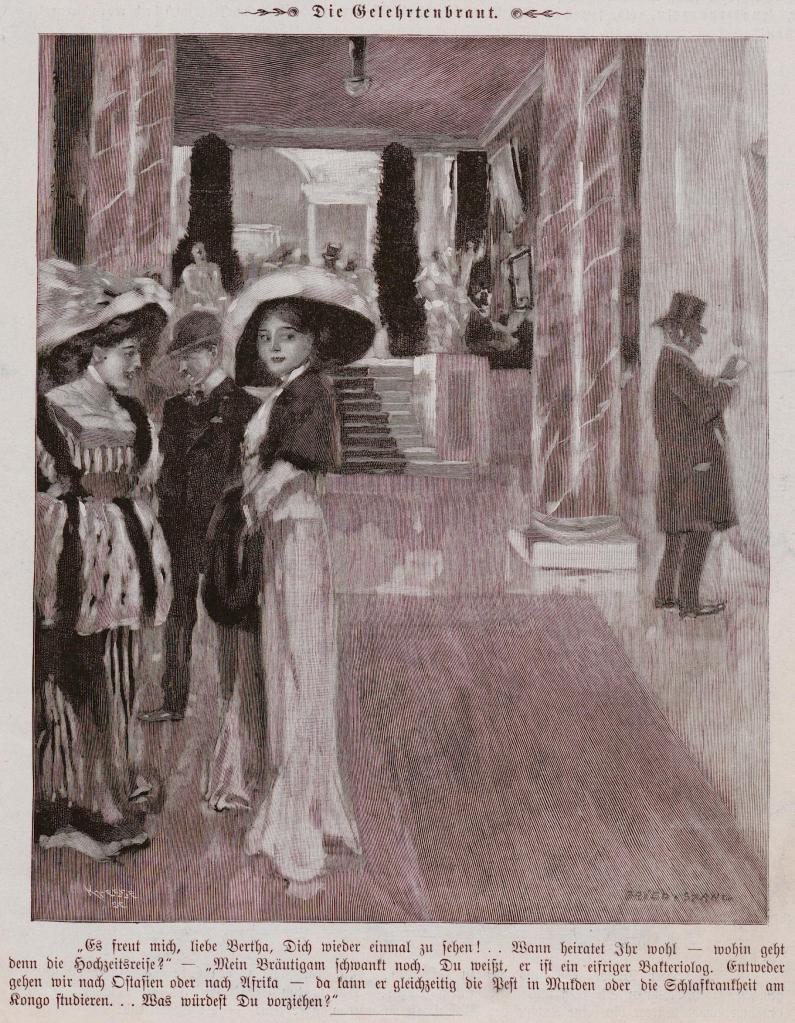
The scholar’s bride

“I am so glad to see you again, dear Bertha!… When will you get married, where are you going for your honeymoon?”
“My bridegroom is still wavering. You know he’s an avid bacteriologist. We are going either to East Asia or to Africa. He can just as well study plague in Mukden or sleeping sickness in the Congo… Which would you prefer?”
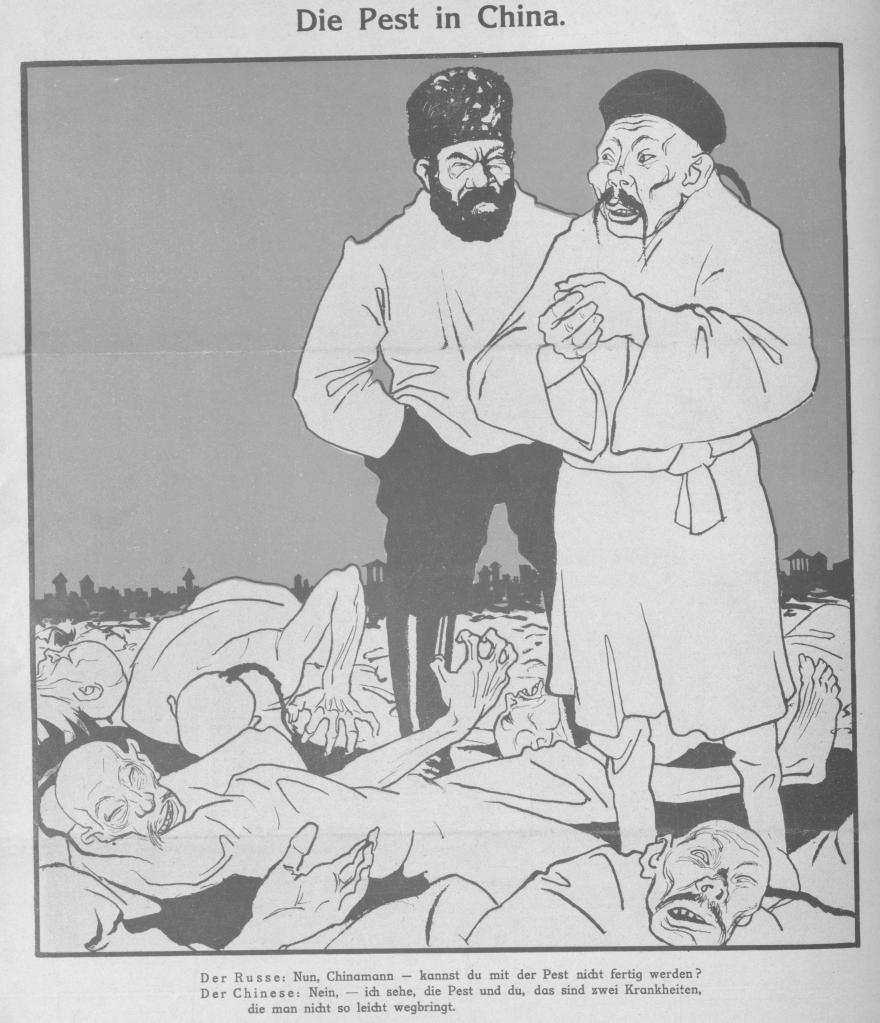
(Fliegende Blätter, Munich, 1911) (See also this French version.)

German plague cartoon

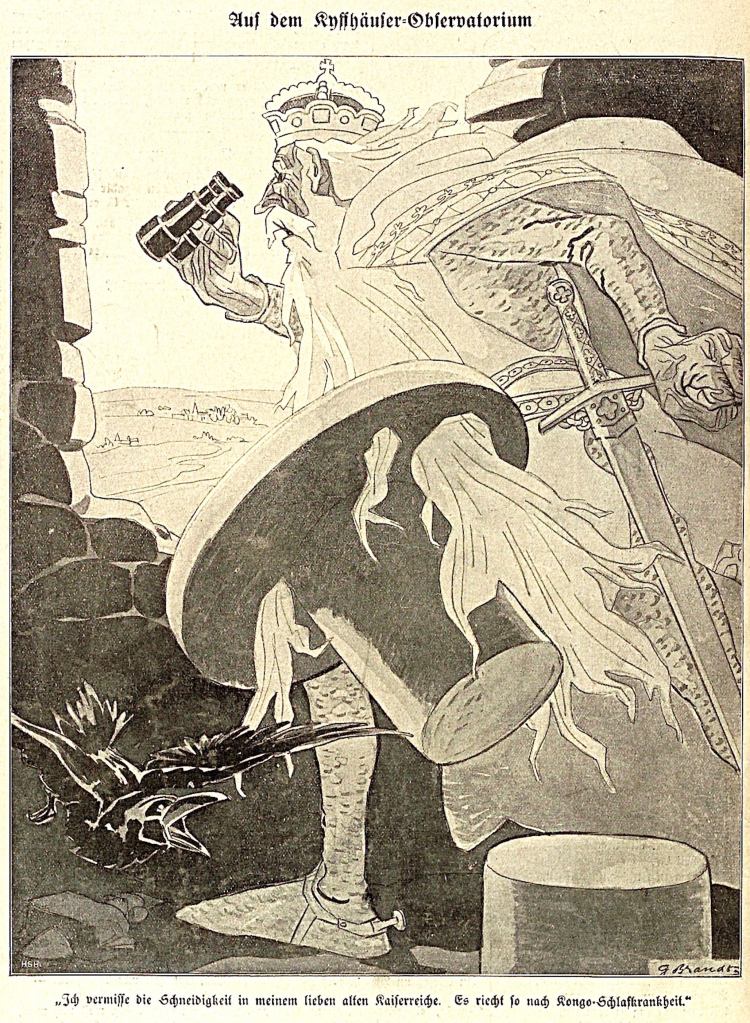
At the Kyffhäuser Observatory

At Kyffhäuser on the northern border of Thuringia in Germany lies a giant modern monument to the Holy Roman Emperor Frederick I (“Barbarossa”), also the site of an ancient astronomical observatory. This image was published more or less at the height of the Second Reich’s modest colonial ventures in Africa.
“I miss the edginess in my dear old empire. It smells so much like Congo sleeping sickness.”
(Kladderadatsch, Berlin, 1911)

German sleeping sickness cartoon

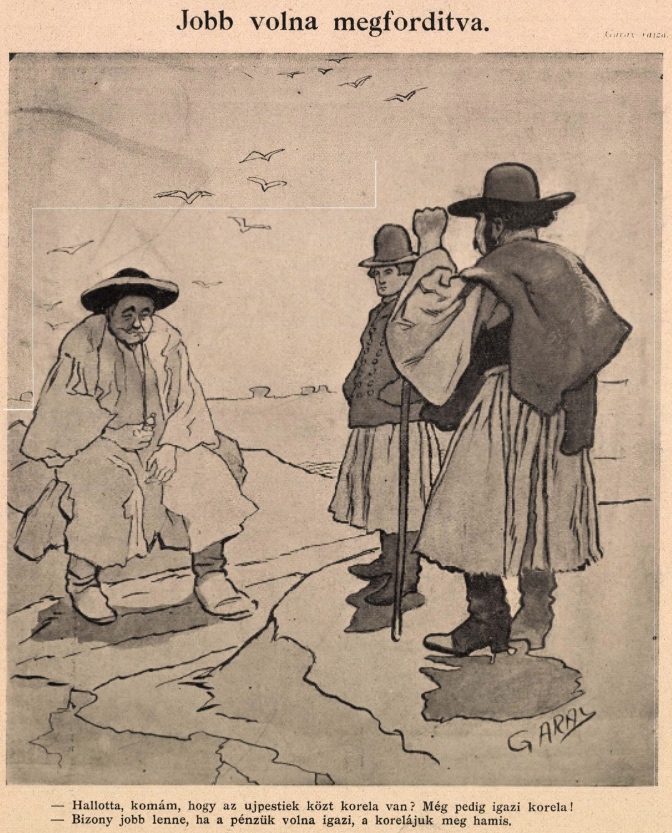
It would have been better the other way around

“Pardner, did you hear that there is chorela [cholera] among the people of Újpest? Even real chorela!”
“Surely it would be better if their money was real and their chorela fake.”
(Újpest, or New Pest, was a recently-incorporated town on the north side of Budapest proper, and a higher proportion of its residents were Jewish, though not from the bourgeois elite.)
(Kakas Márton, Budapest, 1911)

Hungarian cholera cartoon

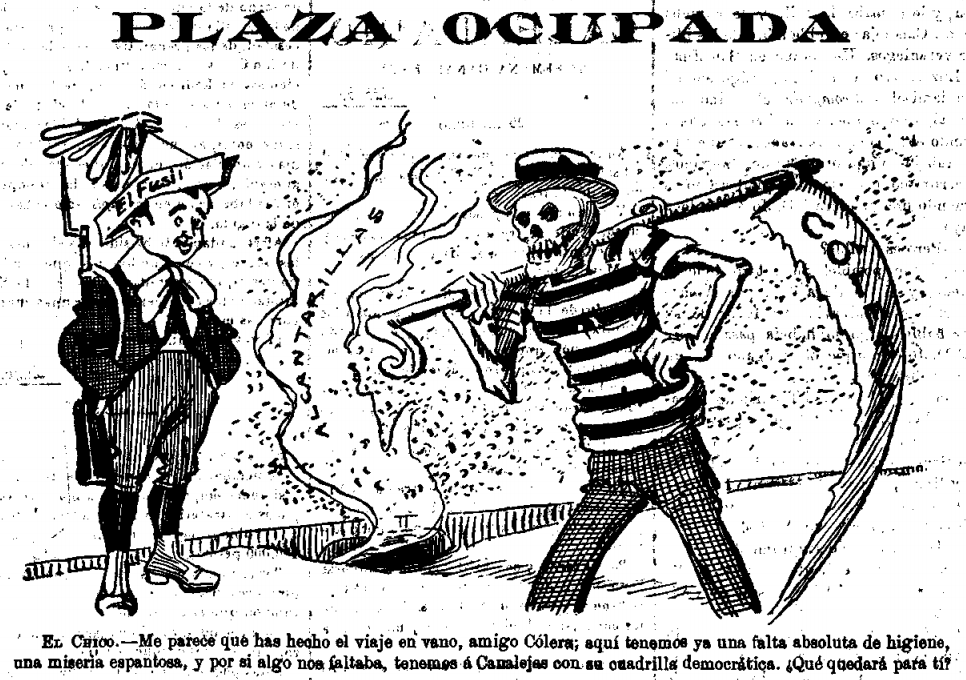
Busy square

(Sewers belching miasma)
Boy: “It seems to me that you have made the trip in vain, friend Cholera; here we already have an absolute lack of hygiene, dreadful misery, and in case something was missing, we have [prime minister José] Canalejas with his democratic squad. What will be left for you?”
(El Fusil, Madrid, 1911)

Spanish cholera cartoon

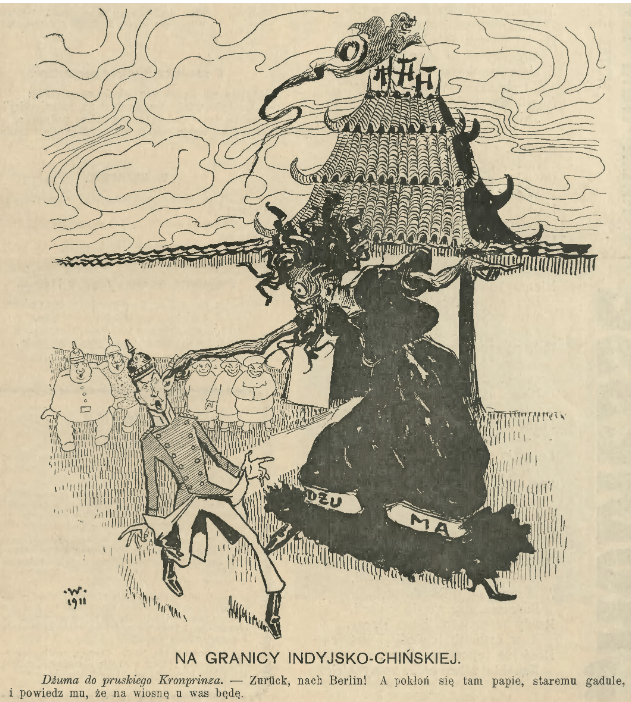
At the Indo-Chinese border

Plague, to the Prussian crown prince: “Back to Berlin! And bow to your papa, the old chatterbox, and tell him that I will be there in the spring.”
(Mucha, Warsaw, 1911)
(Crown prince Wilhelm, though lacking in foreign diplomatic experience, won approval to embark on a lengthy journey to Asia in November 1910, ostensibly to learn more about German interests in the far east. After much wining and dining with British colonial officials in India, Wilhelm cut short his trip late in February 1911. Originally slated to include Siam, Dutch Indonesia, China, and Japan, it was interrupted by news of an outbreak of plague in Calcutta, as well as reports of bouts in China that were already crossing the Russian border.)

Polish plague cartoon

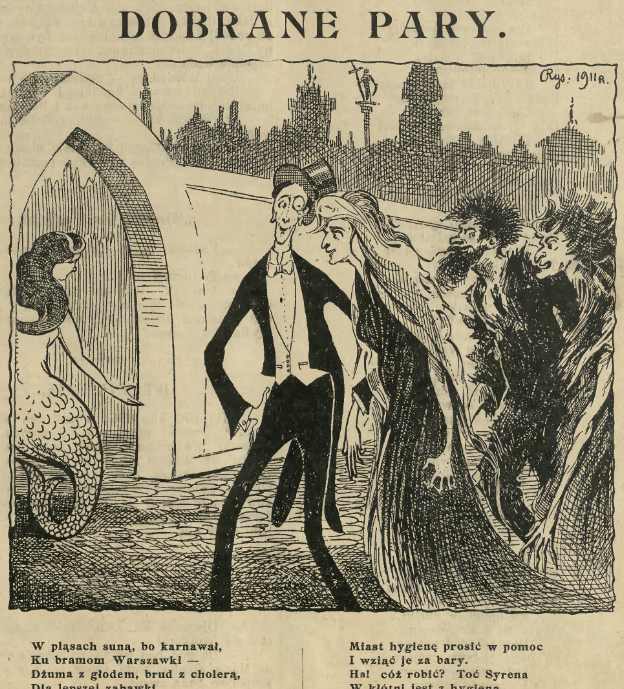
Matched pairs

They glide in festive dance, for it is carnival,
Towards the gates of Warsaw
Plague with hunger, dirt with cholera,
For better entertainment.
And out of hospitality the Siren
Is inviting these couples
To ask cities for help with hygiene
And take them for bars.
Ha! what to do? This Siren
Is in a quarrel with hygiene,
No wonder she wants to show off
Luck as hospitality.
(Kogut, Warsaw, 1911) (translation wants improvement)

Polish cholera cartoon

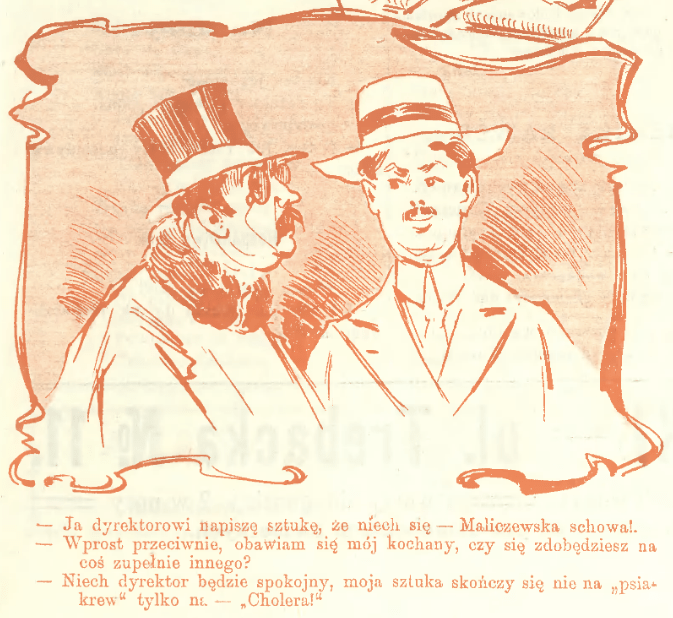
Miss Maliczewska

Gabriela Zapolska (b. 1857) was an actor and prolific playwright whose Miss Maliczewska enjoyed its premier while she was living in Lwów in 1910. Drawn in part on her itinerant life as an aspiring actor after breaking from her gentry family, the play was a conventional moral tale about an impoverished and beautiful young woman named Stefka Maliczewska seeking an acting career, but falling under the malign influence of the lecherous old lawyer Daum, who becomes her patron. After various betrayals, ethical compromises, and debt-ridden dilemmas, the play ends with Stefka stymied and cursing her lot in life. (Her term of choice was “psia krew!” intimating dog’s blood but meaning “damn!”) Though not exactly scandalous in 1910, with one reviewer welcoming the “merciless truth” of her Zolaesque naturalism, such unrefined language from the mouth of a young female character did invite disapproval in some circles, which in turn drew the attention of the satirist.

The caption: “I will write a play for the [female] director so that she lets Maliczewska abscond!”
“Quite the contrary, my dear, I am afraid that you will do something completely different?”
“Let the director be at ease, my play will end not on ‘damn’ but on ‘cholera!'”

In keeping with its old-fashioned “choleric” association with anger, “cholera” is sometimes employed as a curse (roughly, “damn”). At a time when the last cholera pandemic was gradually coming to an end, this trivial pun would have been especially resonant.

Polish cholera cartoon

(Kolce, Warsaw, 1911)

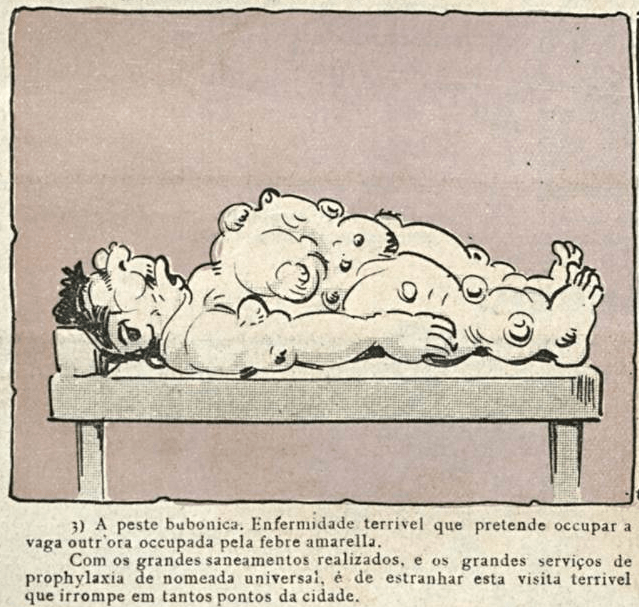
The seven plagues of Egypt

Two panels of six. The other plagues listed are the asphalt inferno of cars in Rio, water shortages, food prices, and the endless riots of republicans and monarchists.

The bubonic plague. Terrible illness that intends to occupy the space formerly occupied by yellow fever.
With the great public health surveys that have been carried out, and the great preventive efforts that have gained universal fame, this terrible visitation that is breaking out in so many points of the city is surprising.

Brazilian plague cartoon

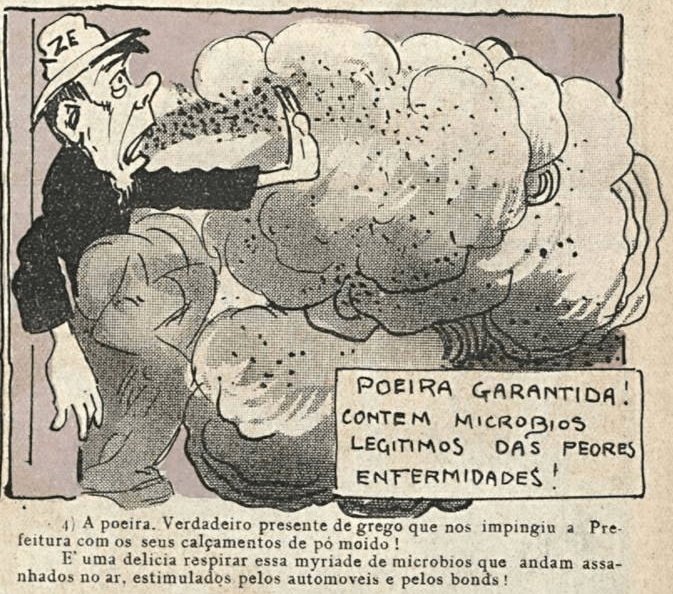
The dust. A true gift from the Greek who forced us into the City Hall with its ground-sand paving!
It is a delight to breathe this myriad of microbes that roam in the air, stimulated by automobiles and trams!

Brazilian hygiene cartoon

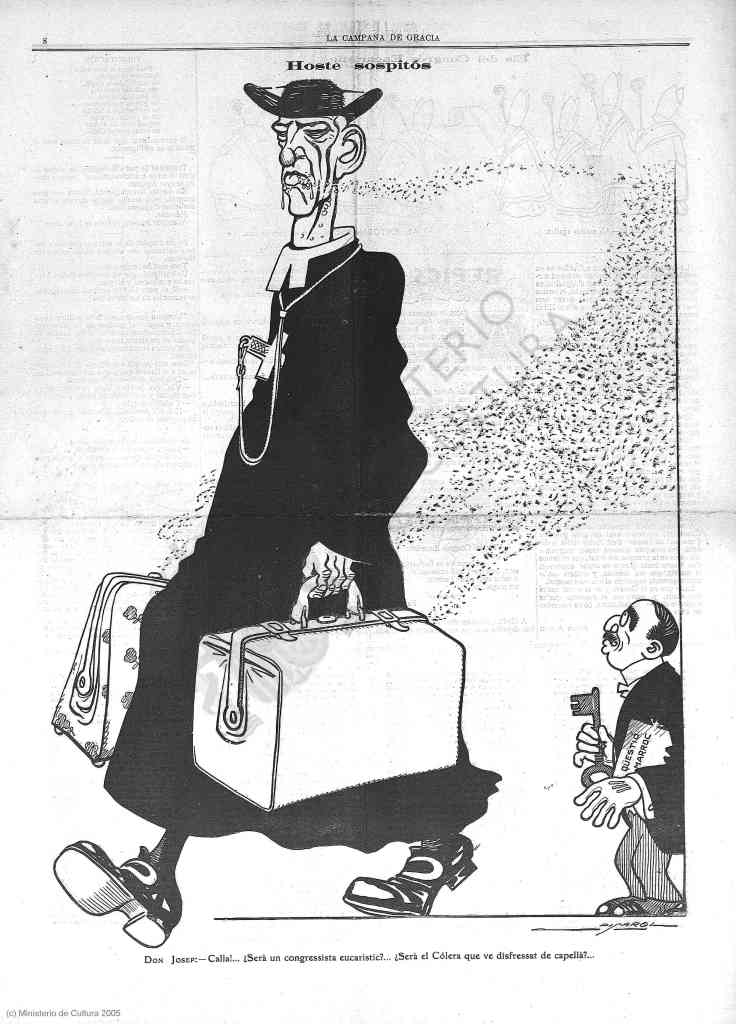
Suspicious host

(The 22nd International Eucharistic Congress was held in Madrid in July 1911. The man on the lower right with a key and a piece of paper labeled “Moroccan Question” would seem to connect church delegates with disease transmission in a colonial context.)
Don Josep: “Shut up! Will he be a eucharistic congressman? Will the Cholera come disguised as a chapel?”
(La Campana de Gracia, Barcelona, 1911)

Catalan cholera cartoon