Brigadier general: “Captain, the company looks terrific! People are getting proper bellies–and without a warm supper!”
Captain: “General, at your command, sir! That stems from influenza body-bandages!”
(Figaro, Vienna, 1891)
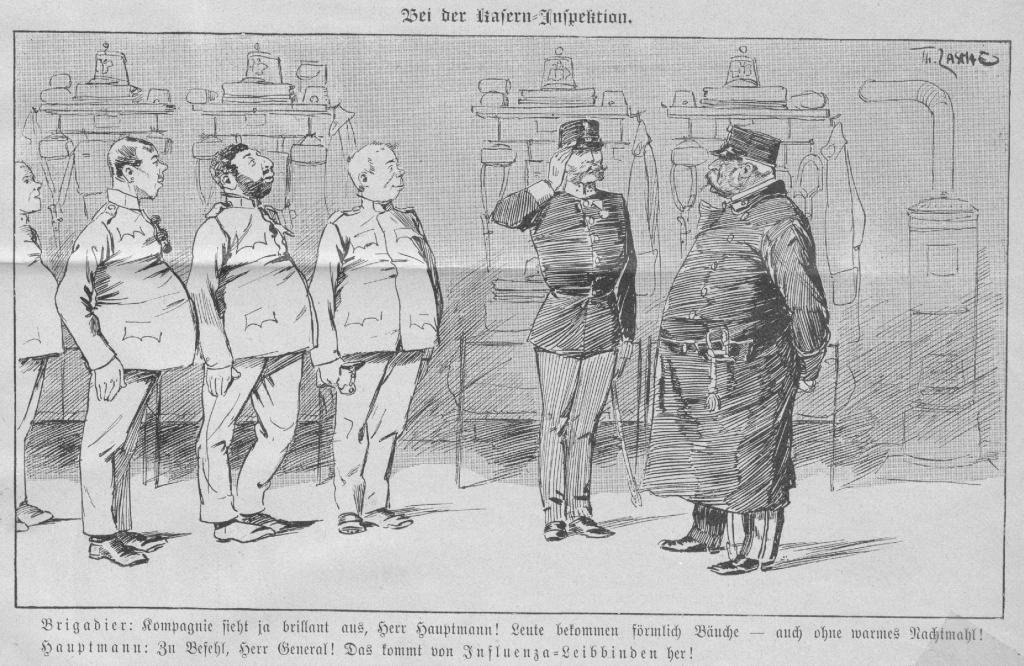
Brigadier general: “Captain, the company looks terrific! People are getting proper bellies–and without a warm supper!”
Captain: “General, at your command, sir! That stems from influenza body-bandages!”
(Figaro, Vienna, 1891)
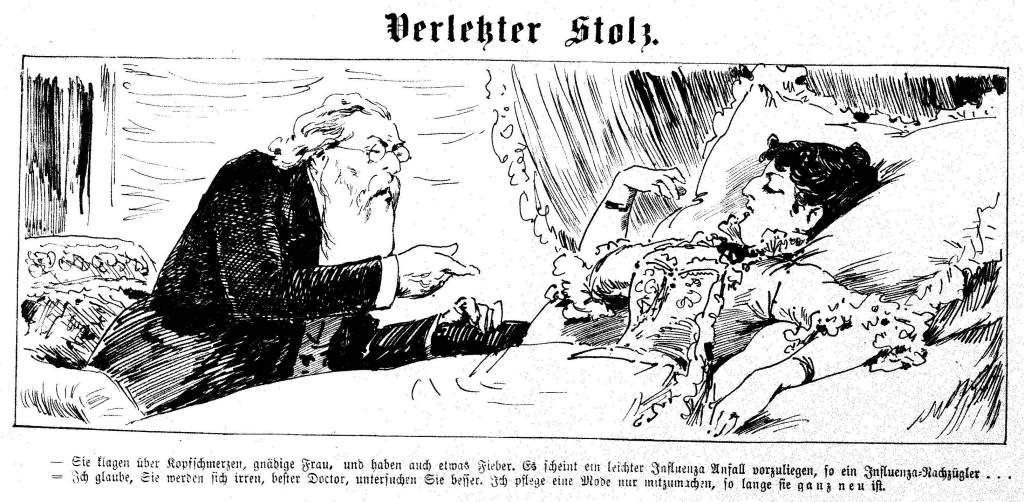
“You complain of headache, madame, and you also have some fever. It seems to be a mild case of influenza, a sort of influenza-straggler…”
“You will prove wrong, finest doctor, examine better. I take care to join in a fashion only when it is completely new.”
(Die Bombe, Vienna, 1890)
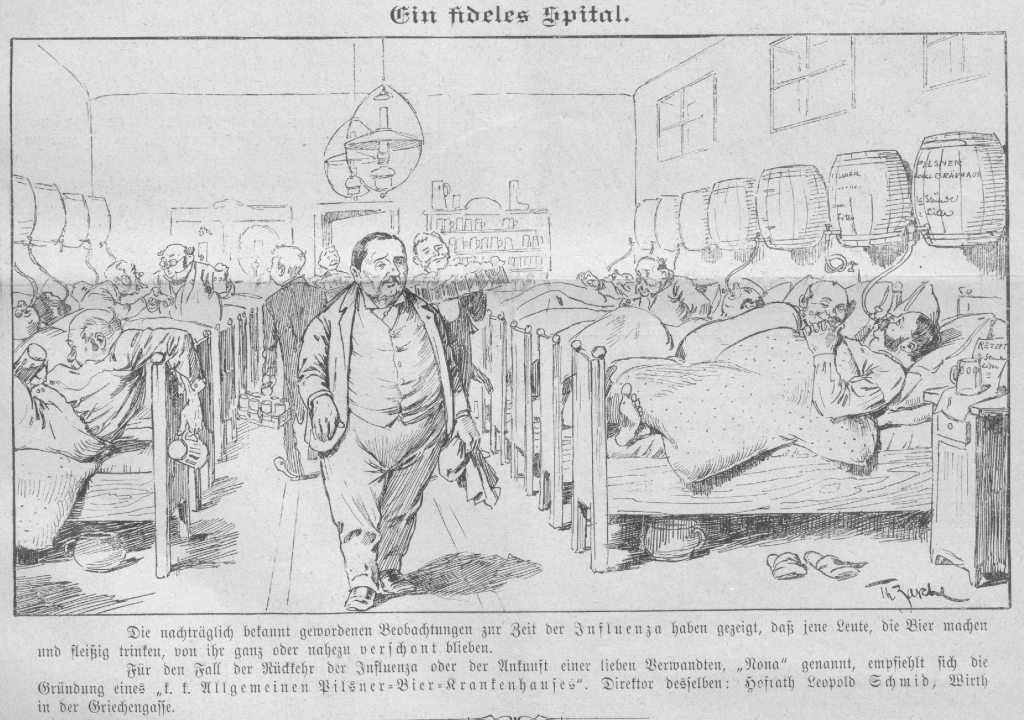
The observations that have now become familiar from the time of the influenza showed that the people who make beer and drink diligently were spared from it completely or nearly so.
In the event of the return of influenza or the arrival of a dear relative called “Rona”, the establishment of an “Imperial and Royal General Pilsner Beer Hospital” is recommended. Its director: Councillor Leopold Schmid, innkeeper in Griechengasse.
(Figaro, Vienna, 1890)
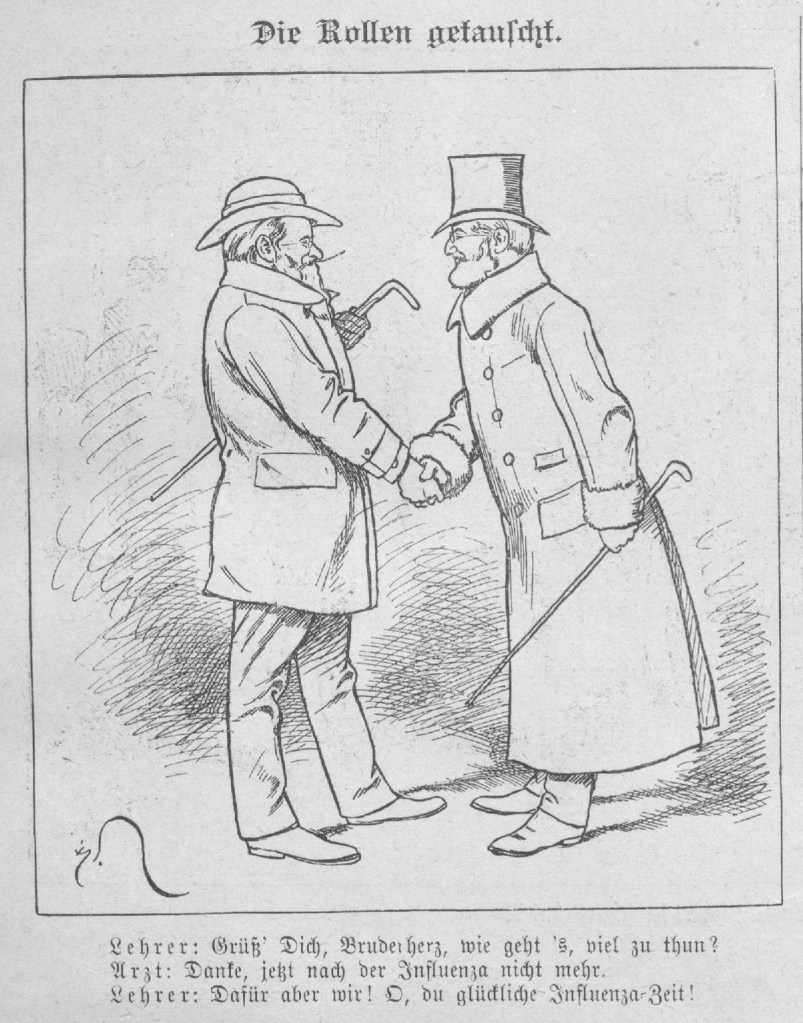
Teacher: “Greetings, dear colleague, how’s it going, lots to do?”
Physician: “Thanks, nothing now that the influenza is over.”
Teacher: “But that’s why we do! Oh, fortunate influenza times!”
(Figaro, Vienna, 1890)
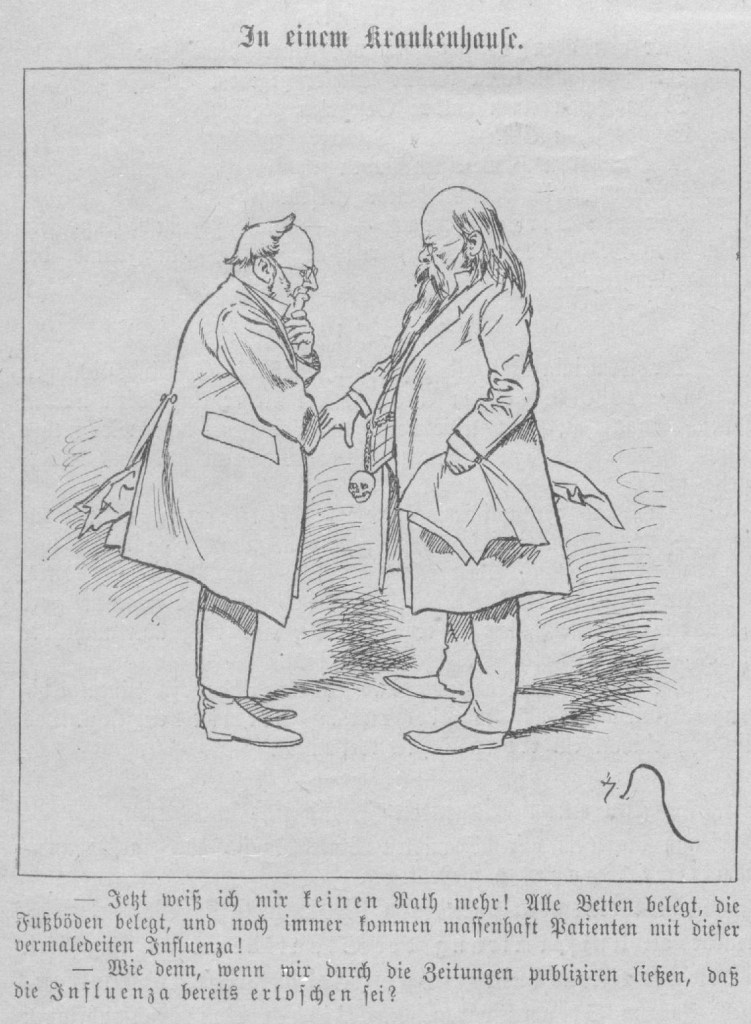
“Now I’m at my wit’s end! All the beds are occupied, all the walkways are occupied, and huge numbers of patients keep coming with this damned influenza!”
“What if we were to let it be publicized in the newspapers that influenza has just been stamped out?”
(Figaro, Vienna, 1890)
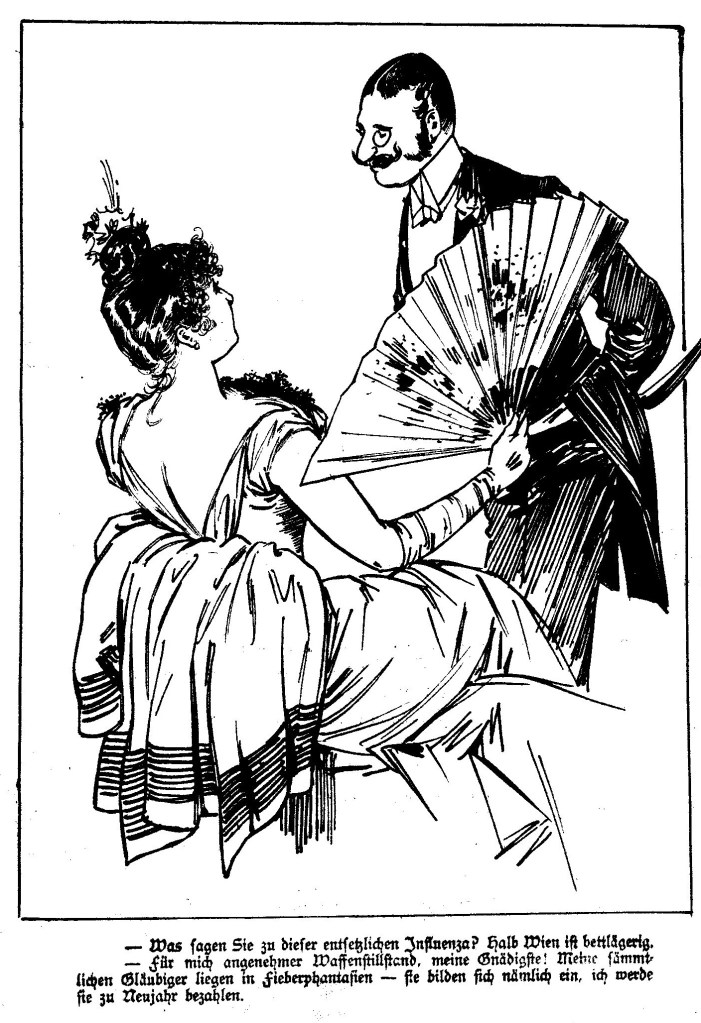
“What do you think about this awful influenza? Half of Vienna is confined to its bed.”
“It’s a pleasant ceasefire, madam! All of my creditors lie in feverish delirium, they imagine namely that I will repay them by the New Year.”
(Wiener Caricaturen, Vienna, 1890)
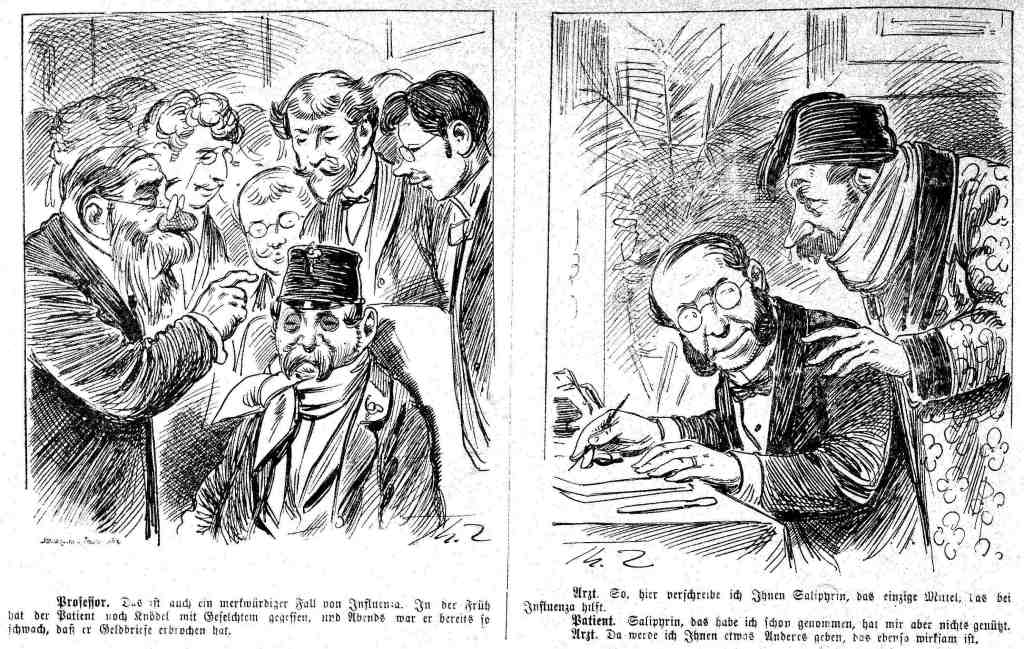
(left) Professor: This is also a remarkable case of influenza. In the morning he ate dumplings with smoked meat, and in the evening he was already so weak that he broke money orders.
(right) Physician: OK, I’m prescribing you Salipyrin, the only remedy that helps with influenza.
Patient: Salipyrin, I’ve already taken that, but it was no use to me.
Physician: Then I’ll give you something else that is just as effective.
(Der Floh, Vienna, 1892)
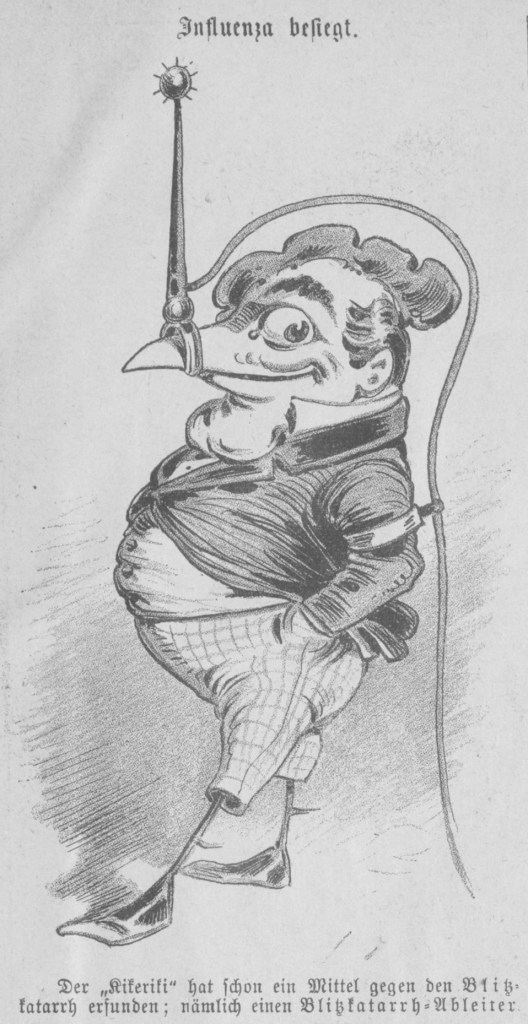
Kikeriki has already invented a remedy against “lightning rhinitis” [i.e., influenza]; namely a rhinitis rod.
(Kikeriki, Vienna, 1889)
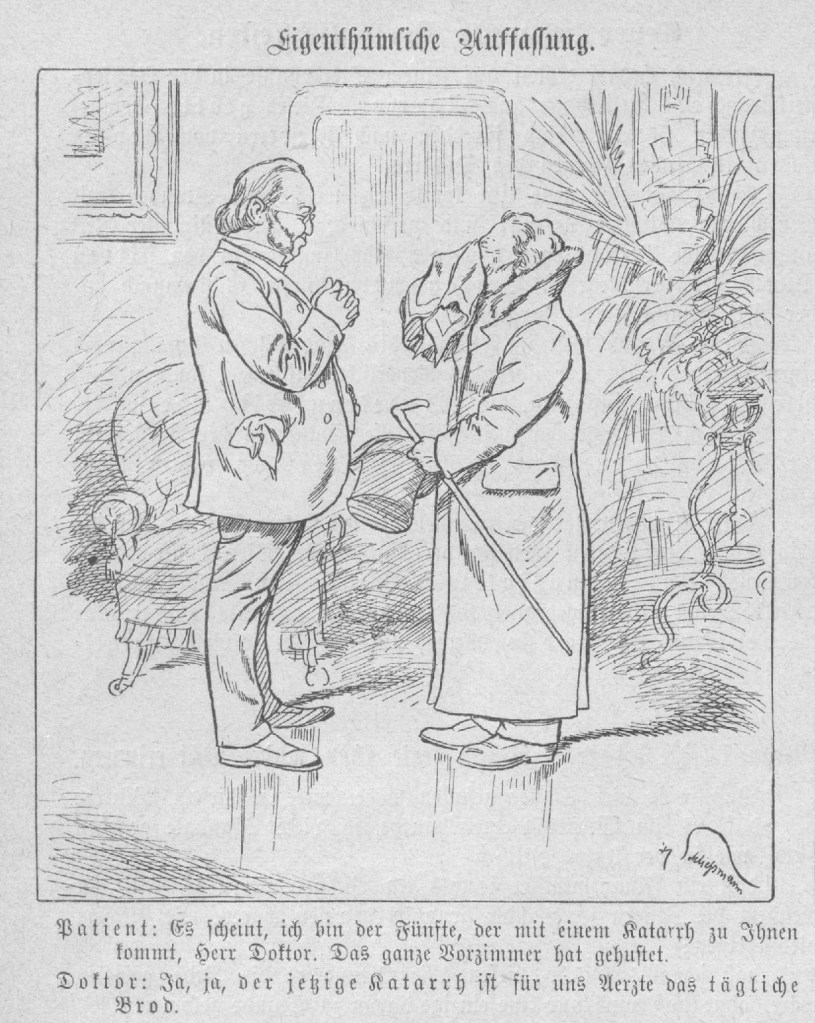
Patient: “It seems that I’m the fifth one coming to you with catarrh, Doctor. The entire reception area was coughing.”
Doctor: “Yes, yes, the current catarrh is the daily bread for us doctors.”
(Figaro, Vienna, 1889)
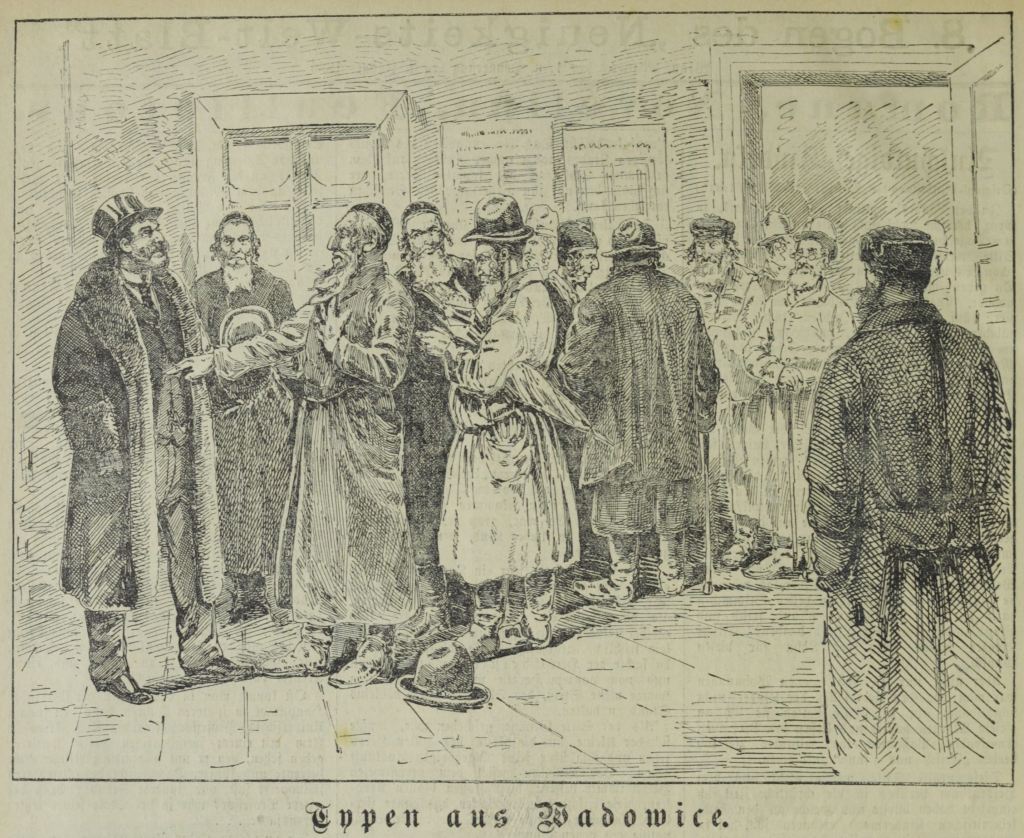
In the fall of 1889 sixty five Galician emigration agents and their associates (including state railway employees) were charged with fraud and other crimes in the course of facilitating emigration to America. At a time when emigration from the Habsburg and Romanov Empires to the United States was beginning its precipitous rise to historic levels after the turn of the century, domestic concerns about what kinds of people were going, under what conditions, and with what potential to maintain financial ties to their homelands all permeated the discussion around the trial, held in Wadowice southwest of Cracow. Many of the middlemen facilitating passage to trans-Atlantic ships out of Hamburg and Bremen came from Jewish backgrounds, while many local opponents of emigration, if not blatantly anti-Semitic, were increasingly fretting about the health of the remaining population (meaning a tangle of both medical-physical and organic-political characteristics). The popular press painted the accused as “human traffickers,” “vampires,” and “slave traders and bloodhounds,” feeding a strong undercurrent of anti-Semitism. (See the authoritative account by Tara Zahra.) The “echo of the Wadowice trial reverberated across all of Europe,” fostering the conviction among local patriots that “the protection of native land and rational internal colonization should emerge from the fog of fantasies and good intentions and pass as soon as possible into the sphere of accomplished deeds.”
Large-circulation newspapers like Neuigkeits Welt Blatt in Vienna made certain that their readers could not miss the Jewish lineage of many of the shipping agents.
After months of testimony featuring hundreds of witnesses, the lead accused were sentenced to several years in prison. During the prolonged sensation that was the court trial, “Russian influenza” made its epidemic return to Central Europe, traveling quickly by rail and shipping routes from the northeast to the south and west. Though its symptoms were much less dramatic than cholera, influenza hit perhaps 40% of the Hungarian population that winter, for example, and as much as half of the German population, though the associated mortality rates were quite low.
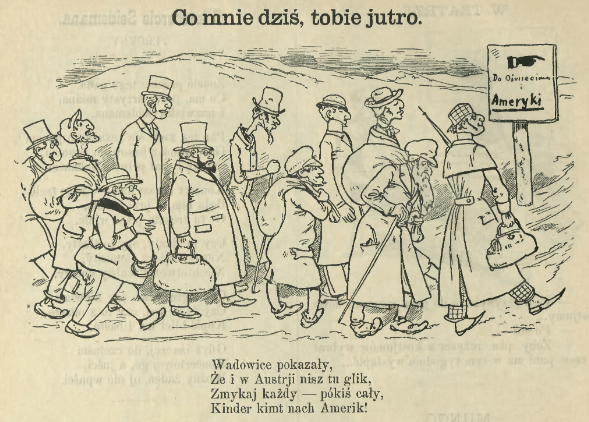
There was a mean-spirited Polish cartoon related to the trial. (The text contains Yiddishisms, so my rendering is surely problematic.)
What’s for me today is for you tomorrow.
(sign pointing to the Promised Land of America)
Wadowice showed
That in Austria, too, good fortune is not here,
Each keeps his mouth shut until everyone’s
Children come to America!
(Mucha, Warsaw, 1890)
The cartoon below provides an uncomfortable linkage between the trial and the epidemic.
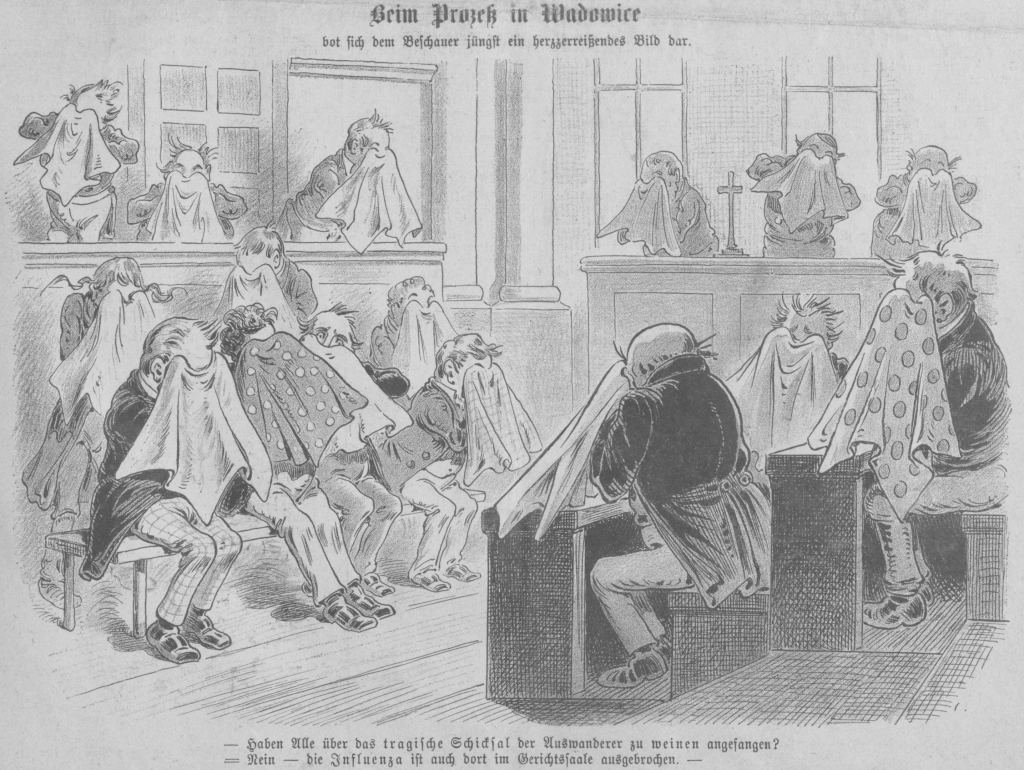
At the trial in Wadowice a heartrending picture presented itself to the onlookers.
“Have you started crying about the tragic fate of the emigrants?”
“No, influenza has broken out in the courthouse.”
(Kikeriki, Vienna, 1890)
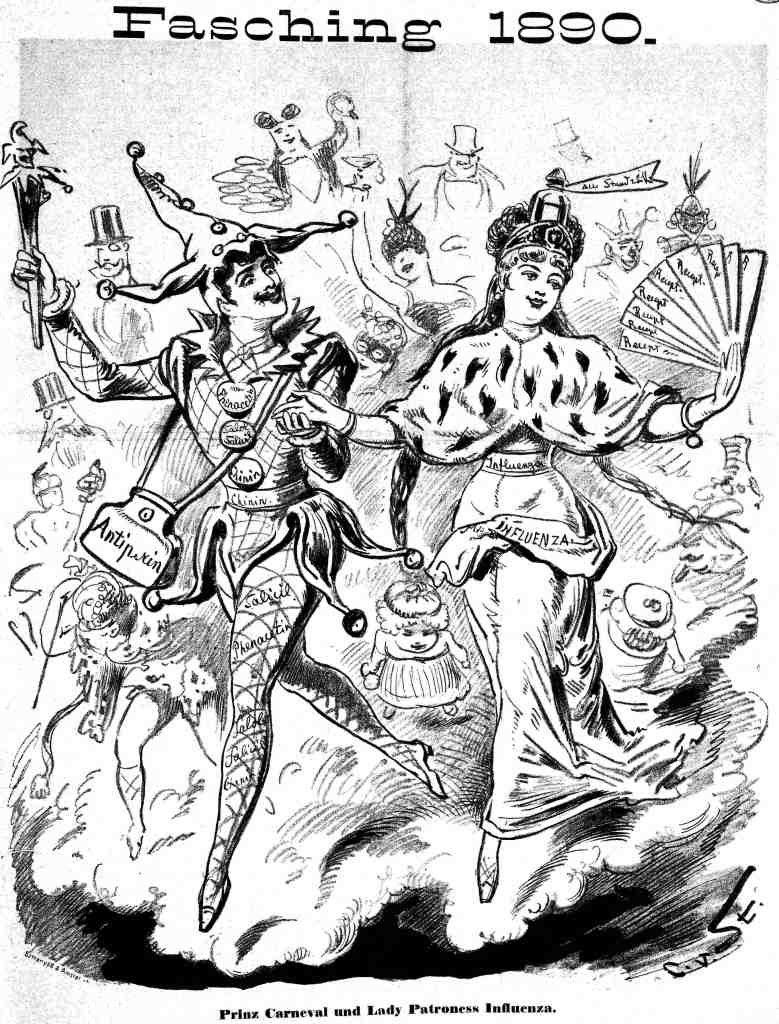
Prince Carneval and Lady Patroness Influenza
(Der Floh, Vienna, 1890)
…schools were closed, but ice skating was opened in thick fog.
(Kikeriki, Vienna, 1890)

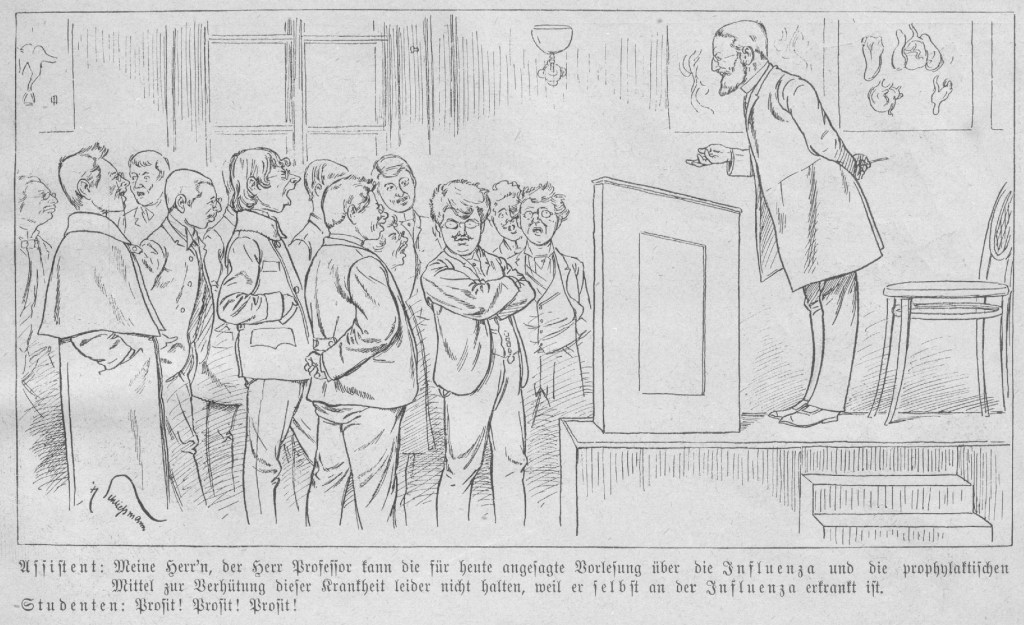
Professor’s assistant: “Gentlemen, unfortunately the professor is unable to give today’s scheduled lecture on influenza and the prophylactic means for preventing this illness, because he is himself sick with influenza.”
Students: “Cheers! Cheers!”
(Figaro, Vienna, 1889)
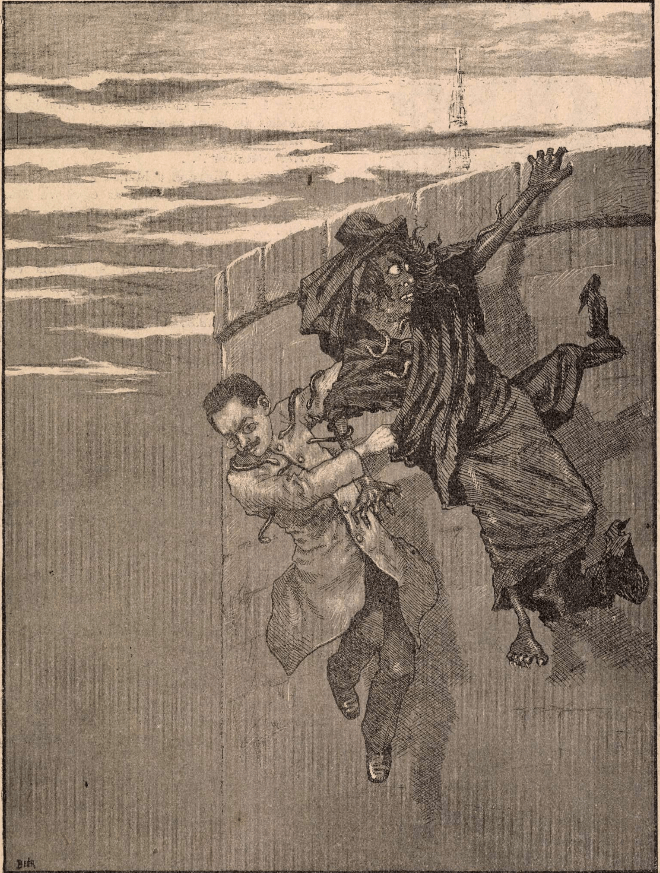
Caption: The one who is pulling the plague off the walls of Vienna on his own. (Following a visit by four staff members to India to study the plague, the Institute of Pathology in Vienna unwittingly developed a pneumonic strain leading to four fatalities, sparking fears of a renewed outbreak in Europe. The man depicted is Dr. Hermann Franz Müller, who treated the first fatality and then died three days later. Titusz Dugovics was a mythical Hungarian soldier who had helped fend off Ottoman invaders in the fifteenth century.)
(Kakas Martón, Budapest, 1898)
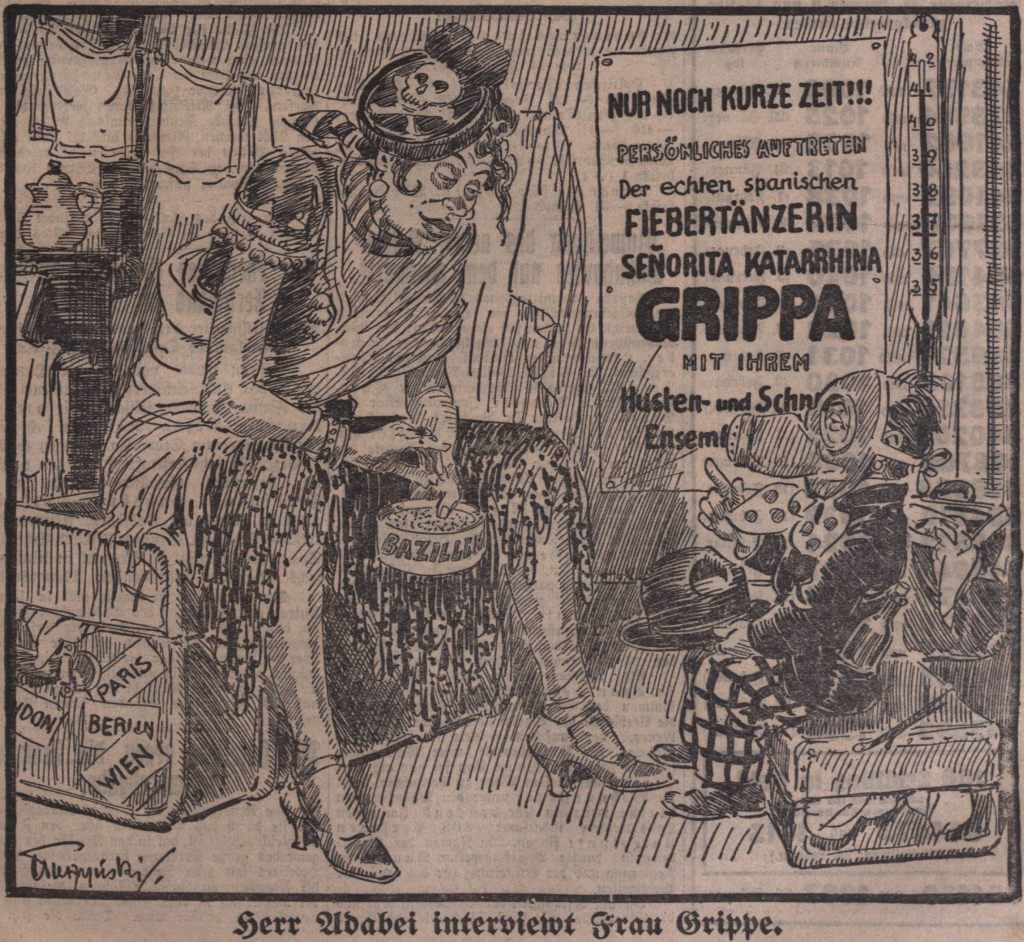
“Adabei” (roughly, “Also there”) was a byline for a series of columnists at Illustrierte Kronen Zeitung in Vienna. Sometimes cast as a pompous mascot for the newspaper, Adabei is here depicted in a mask interviewing a disreputable visitor, another recurrence of influenza. The poster reads: “Only for a short time longer!!! Personal appearance of the true Spanish feverish dancer, Señorita Katarrhina Flu, with her coughing and sneezing ensemble.” (1931)
 Sic Transit Pestilentia