“The Quartet” is the new fashionable disease; and the Quartet is enemy of the Allies since Bulgaria’s defection. This is: Germany, Austria, Turkey, and Spanish flu.”
(O Malho, Rio de Janeiro, 1918)
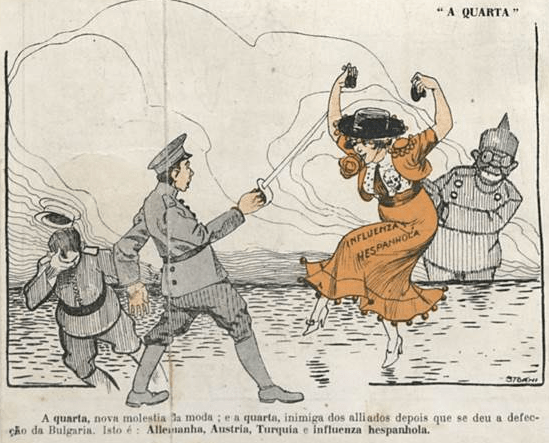
“The Quartet” is the new fashionable disease; and the Quartet is enemy of the Allies since Bulgaria’s defection. This is: Germany, Austria, Turkey, and Spanish flu.”
(O Malho, Rio de Janeiro, 1918)
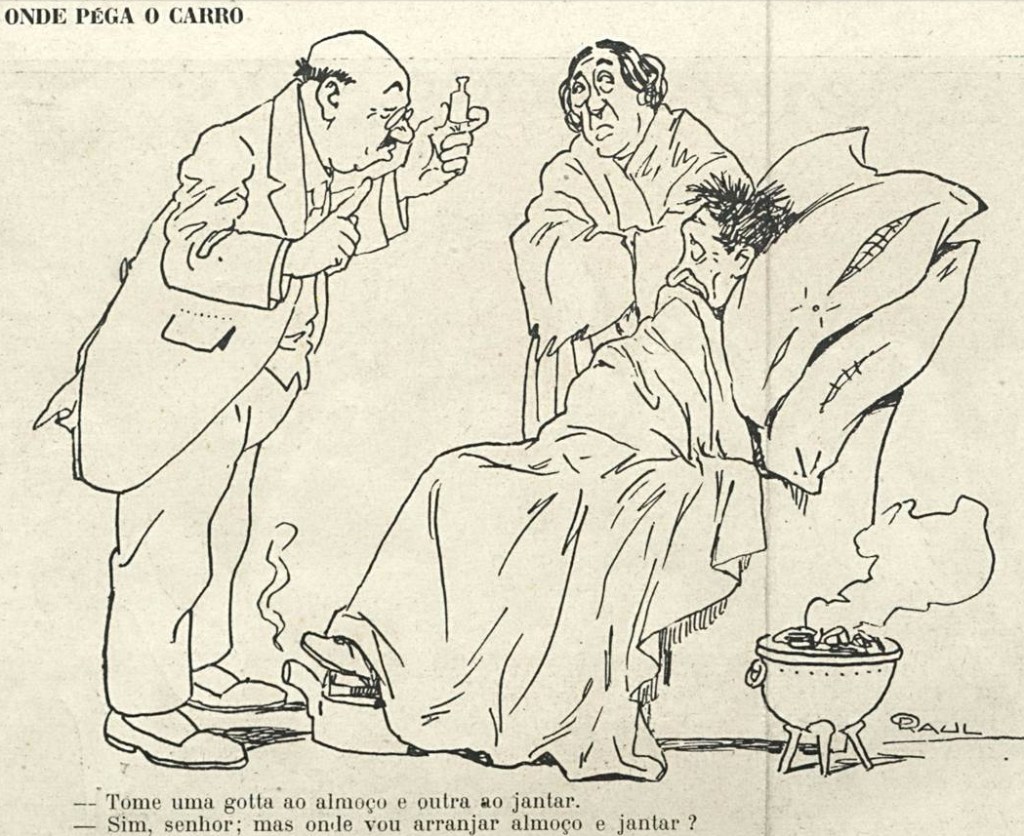
“Take one drop at lunch and another at dinner.”
“Yes, sir, but where am I going to get lunch and dinner?”
(O Malho, Rio de Janeiro, 1918) (I might have missed the idiom in the title.) (A later German cartoon with a similar motif.)
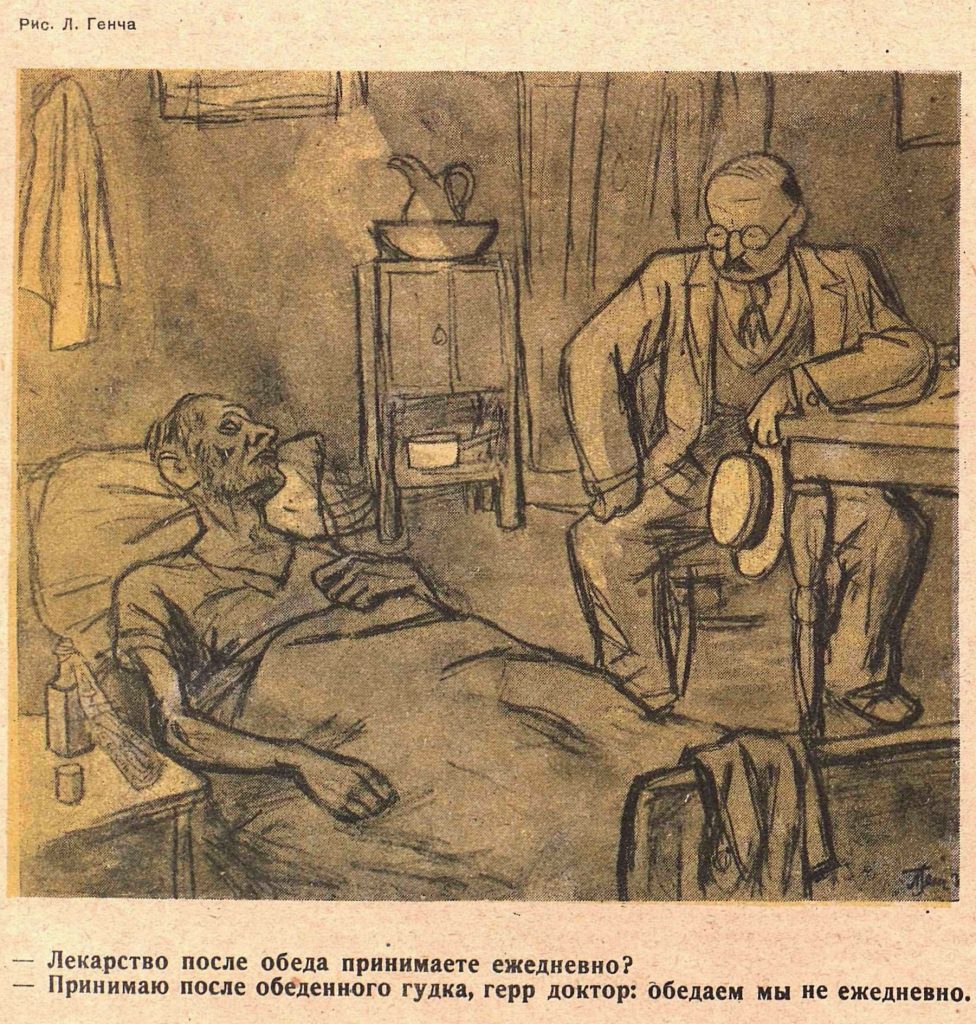
A nearly identical Soviet cartoon aimed at contemporary Germany:
“Are you taking the medicine daily after lunch?”
“I take it after the lunch bell, Herr Doctor: we don’t have lunch every day.”
(Krokokil, Moscow, 1936)
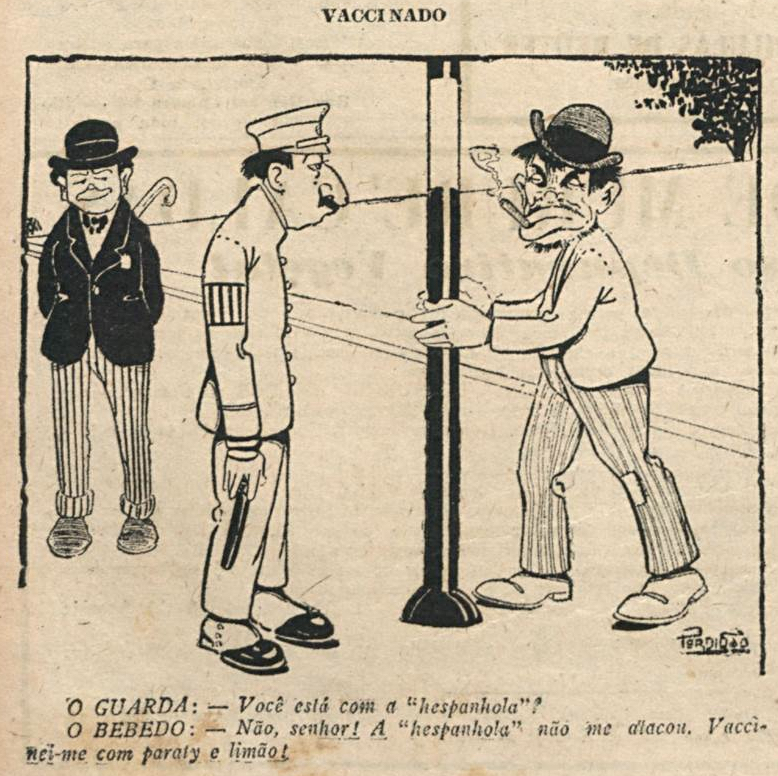
Guard: “Have you had the “Spanish” thing?”
Drunk: “No, sir! The “Spanish” thing does not attack me. Vaccinate me with rum and lemon!”
(O Malho, Rio de Janeiro, 1918)
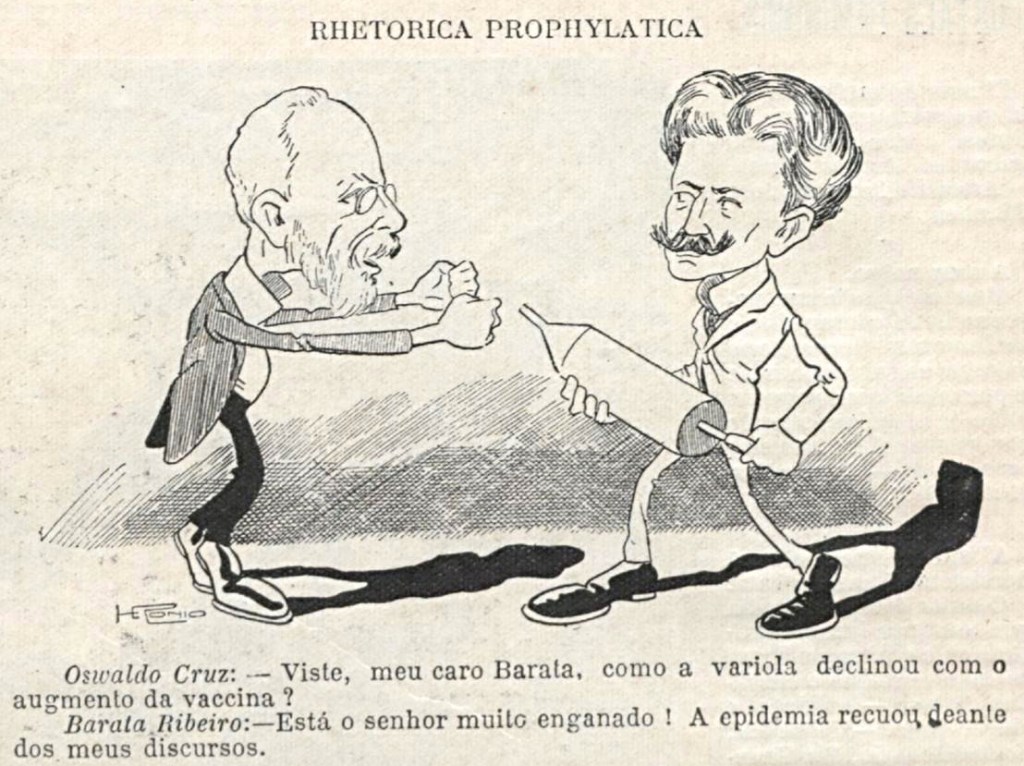
Oswaldo Cruz [famous Brazilian bacteriologist]: “Did you see, my dear Barata, how smallpox declined with the increase in vaccination?”
Barata Ribeiro [mayor of Rio de Janeiro, but as it happened, also trained as a physician]: “You are very mistaken! The epidemic has retreated in the face of my speeches.”
(O Malho, Rio de Janeiro, 1908)
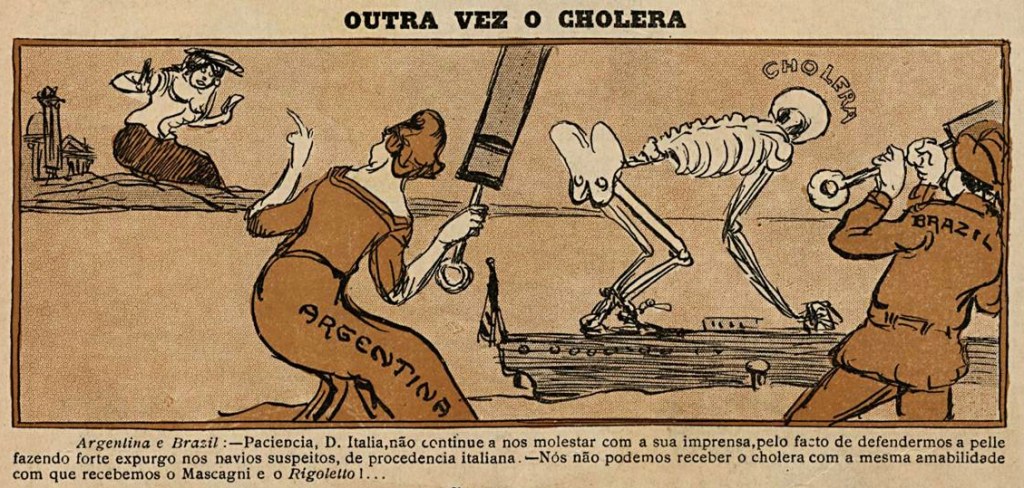
Argentina and Brazil: “Patience, Lady Italy, don’t keep harassing us with your press, because we defend the perimeter by inducing a strong purge on the suspicious ships of Italian origin. We cannot receive cholera as kindly as we received Mascagni and Rigoletto!…” (Argentine and Brazil are preparing to apply clystères to cholera’s rear. Such purging was a recurrent theme during earlier epidemics.)
(O Malho, Rio de Janeiro, 1911)
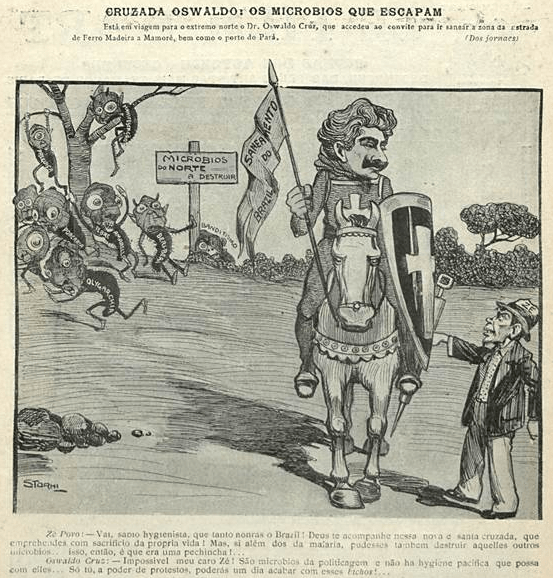
(Brazil’s great public health crusader Oswaldo Cruz intends to spread his measures to the distant provinces.)
Joe Public: “Go, wise hygienist […]! God be with you in this new and holy crusade, which you undertake with the sacrifice of your own life! But, in addition to malaria, you could also destroy those other microbes… [depicted are idleness, filth, oligarchy, yellow fever, demonstrations, beri-beri, and banditry] then that would be a bargain!…”
Oswaldo Cruz: “Impossible, my dear Joe! They are microbes of politics and there is no peaceful hygiene that I can use with them… Only you, with the power of protests, can one day put an end to these beasts!…”
(O Malho, Rio de Janeiro, 1910)
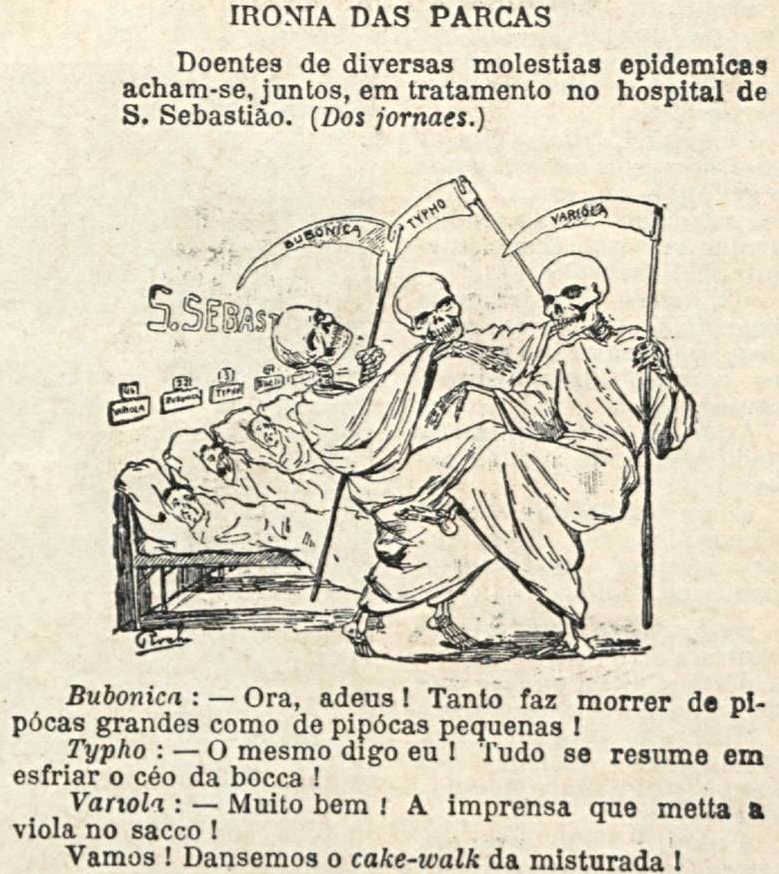
(Patients with different epidemic diseases are being treated together at the St. Sebastian hospital.)
Plague: “Well, goodbye! It doesn’t matter if you die from large pox or small ones!
Typhus: “The same, I say! It all comes down to cooling the roof of the mouth!”
Smallpox: “Very well! It’s the press that got their berries back in the basket!” (Better idiom needed!)
“Let’s go! Let’s dance the cake-walk of mixing!”
(O Malho, Rio de Janeiro, 1908)
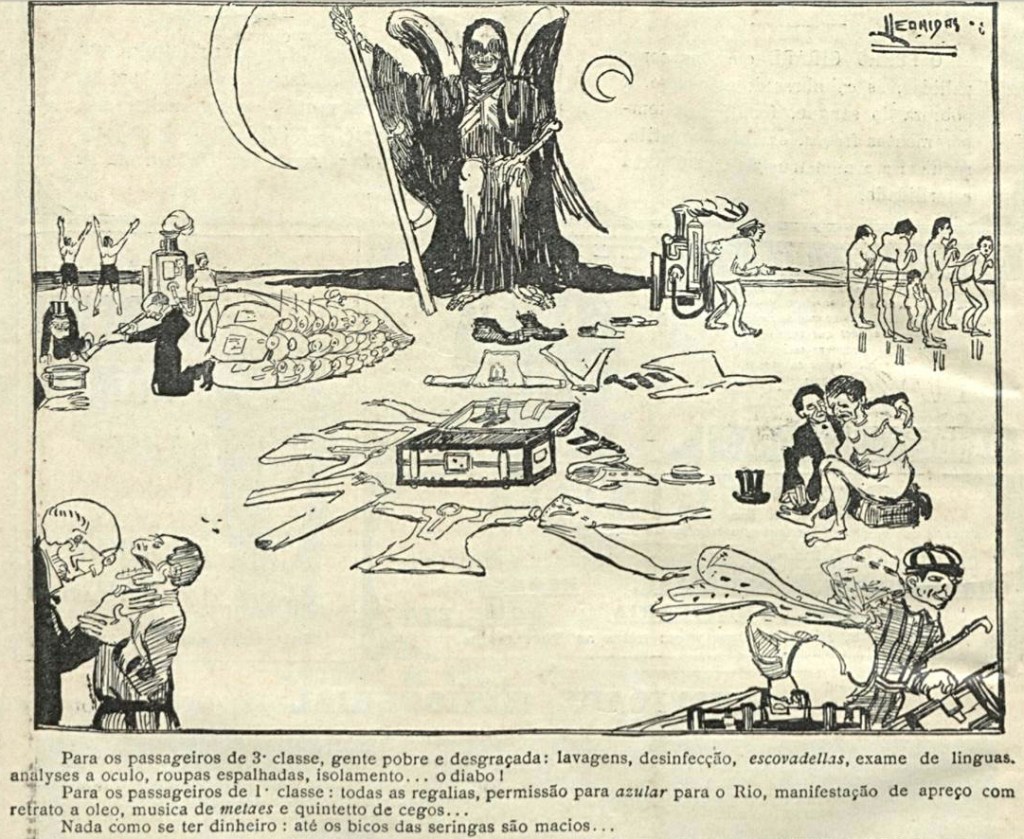
The passengers of the Araguaya and the quarantine on Grand Island.
For third-class passengers, poor and unhappy people: washing, disinfection, grooming, tongue examination, eye testing, clothes spread out to dry, isolation… hell!
For first-class passengers: all the perks, permission to “escape” to Rio, gestures of appreciation with oil portrait, steel-drum music and quintets for the blind…
Nothing like having money: even the tips of the syringes are soft…
(O Malho, Rio de Janeiro, 1910)
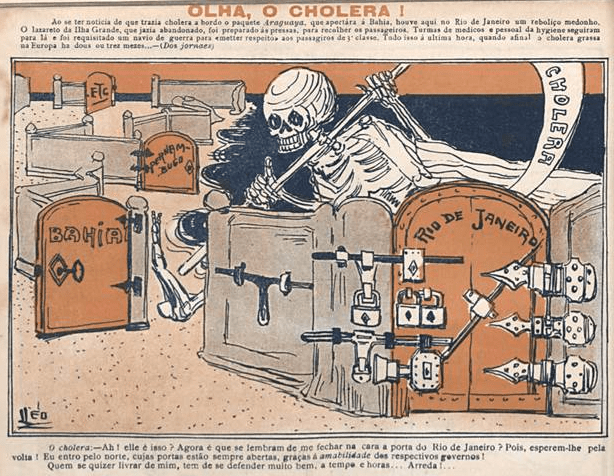
(Commenting on disputes among the Brazilian states about how to deal with cholera, then raging in Europe.)
Cholera: “Ah! That’s it? Now that you remember to close the door to Rio de Janeiro in my face? Well, wait for it to come back! I enter from the north, whose doors are always open, thanks to the kindness of the respective governments!
Whoever wants to get rid of me has to defend himself very well, in a timely fashion… Move along! …”
(O Malho, Rio de Janeiro, 1910)
Dr. Oswaldo Cruz [Brazil’s pioneering bacteriologist, who had recently left the public health service]: “Hello! … I already dealt with you in the war…”
The Typhus: “Whaddaya mean, doc! After you left the Hygiene Department, sir, I was no longer the master of leaving Rio de Janeiro!
I’ve been working for the donkey… Now I’m operating at the Botanical Garden; but I still have a lot to do in other neighborhoods! …”
(O Malho, Rio de Janeiro, 1916) (I surely require correction with the idioms here.)

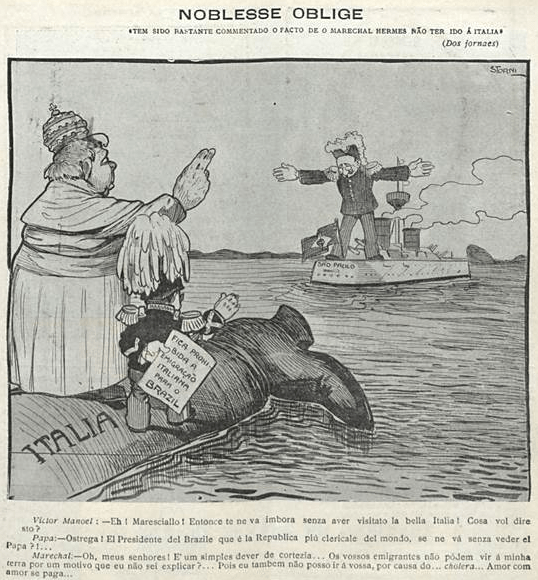
(It has been widely commented that Marshal Hermes [de Fonseca, the president of Brazil] did not go to Italy.)
Italian King Victor Emmanuel (holding document behind his back that reads “Italian emigration to Brazil is prohibited”): “Hey! Marshal, my dear! So you’re embarking without having visited la bella Italia! What does this mean?”
The Pope: “Darn! The President of Brazil, the world’s most clerical republic, doesn’t want to see the Pope?”
The Marshal: “Oh, gentlemen! It is a simple matter of courtesy… Your immigrants cannot come to my land for a reason that I can’t explain? … I can’t go to yours either, because of… cholera… Love is repaid with love.”
(O Malho, Rio de Janeiro, 1910)
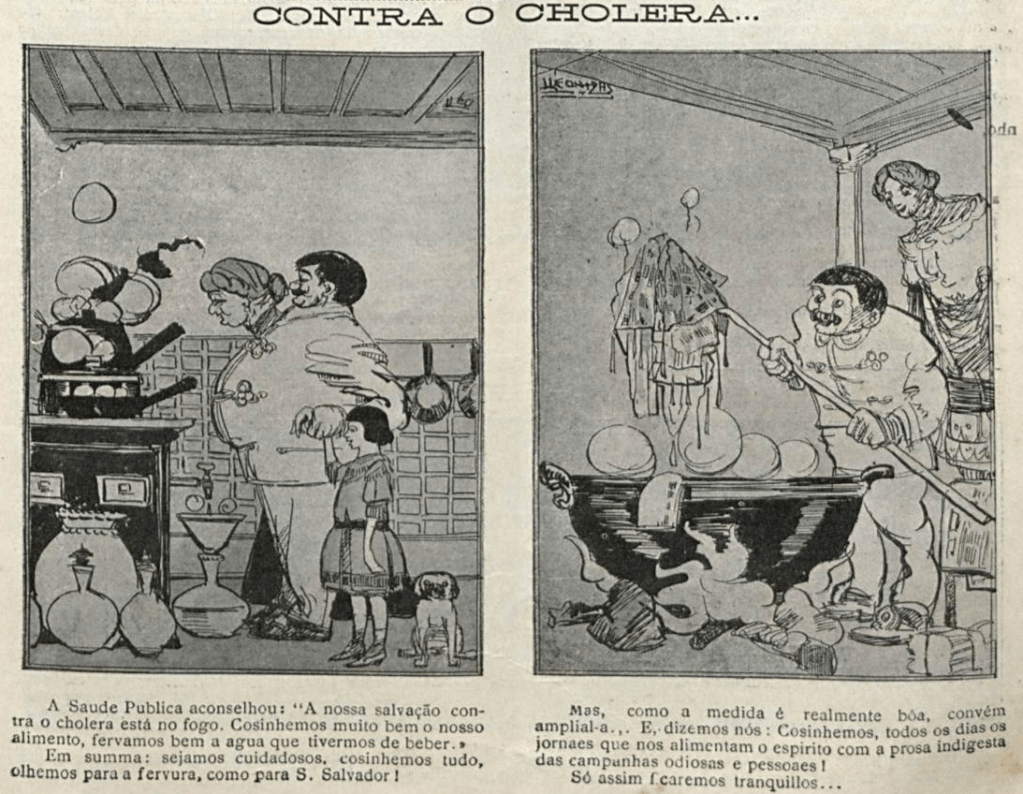
The public health authorities have advised: “Our salvation against cholera lies in fire. Let’s cook our food very well, let’s boil our drinking water well.”
In short: let us be careful, cook everything, watch for the boiling point, like in San Salvador!
(second image) Yet insofar as the measure is really good, it should be expanded… And, we say to ourselves: Let’s cook the newspapers daily that feed our spirit with the indigestible prose of odious and personal campaigns!
Only thus may we fear in tranquillity…
(O Malho, Rio de Janeiro, 1910)
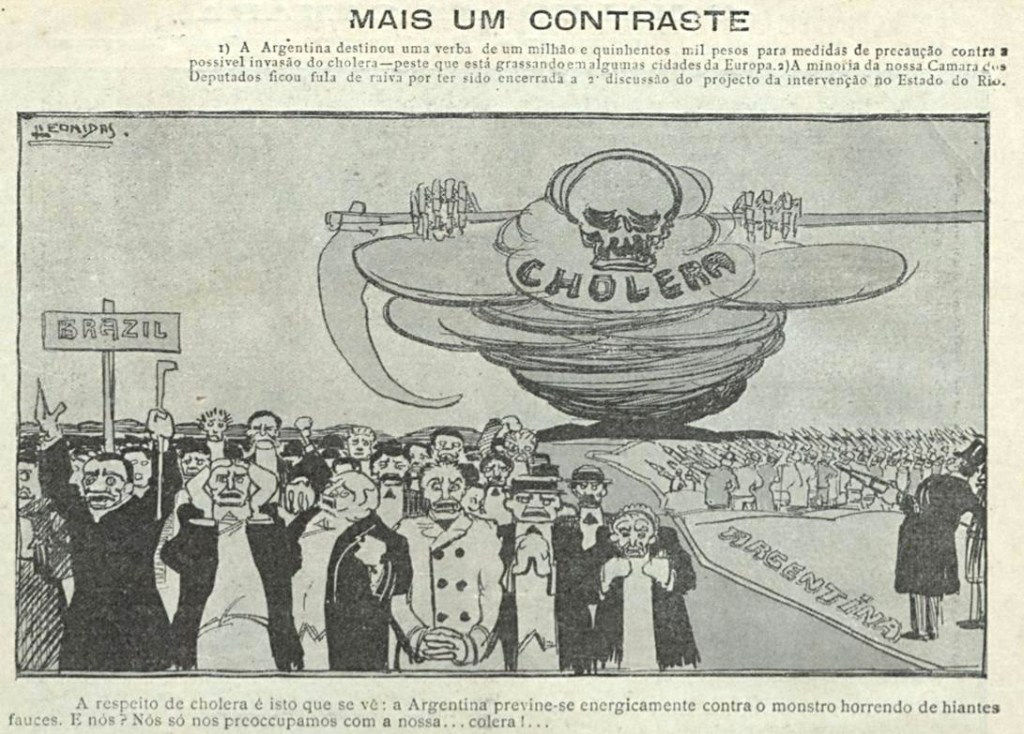
On differences between the Argentinian and Brazilian responses to the cholera epidemic. (The Argentinians appear to be uniformly armed with disinfectant sprayers.) “Regarding cholera and what can be seen: Argentina is energetically preparing for the horrendous monster with its giant maw (?). And us? We are only preoccupied with our… rage!” (I.e., choler)
(O Malho, Rio de Janeiro, 1910)
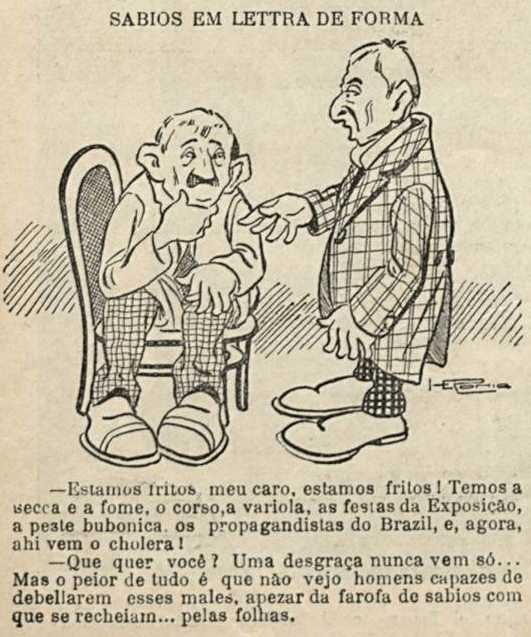
A cartoon set in the year of the Brazilian National Exposition in 1908: “We’re toast, my dear, we are toast! We have drought and famine, parade floats, smallpox, Exposition parties, bubonic plague, propagandists of Brazil, and now here comes cholera!”
“What do you want? Disasters always come in multiples… But the worst of it all is that I don’t see men capable of curbing these ills, despite the [manioc] flour of erudition with which they are stuffed… because of the leaves.” (Meaning that appearance prevailed over substance?)
(O Malho, Rio de Janeiro, 1908)
From an advertisement for a potion produced by Guyot: “Everyone knows that bad microbes are the cause of almost all of our major diseases: tuberculosis, influenza, diphtheria, typhoid fever, meningitis, cholera, plague, tetanus, etc.” (Am I the only one who sees some Miró here?)
(O Malho, Rio de Janeiro, 1919)

 Sic Transit Pestilentia