(sign labeled “Landfill”)
“The fountainhead is leaking, don’t look at that, turn your eyes somewhere else, turn your eyes somewhere else.”
(Tuulispää, Helsinki, 1907)
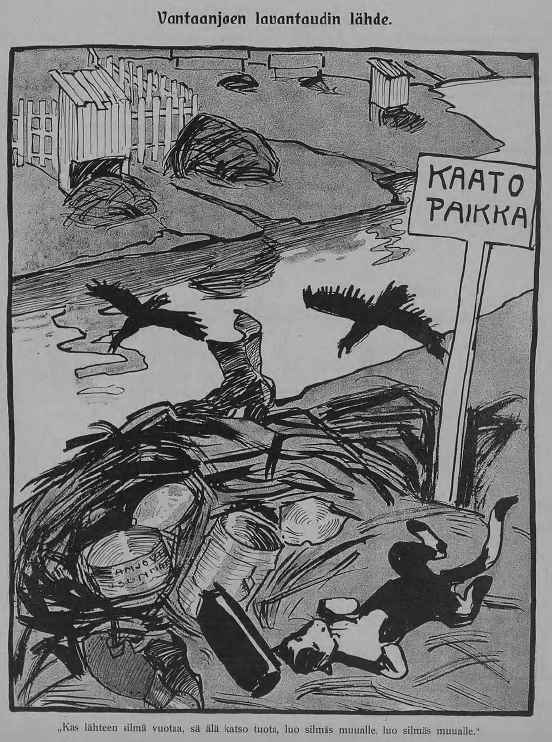
(sign labeled “Landfill”)
“The fountainhead is leaking, don’t look at that, turn your eyes somewhere else, turn your eyes somewhere else.”
(Tuulispää, Helsinki, 1907)
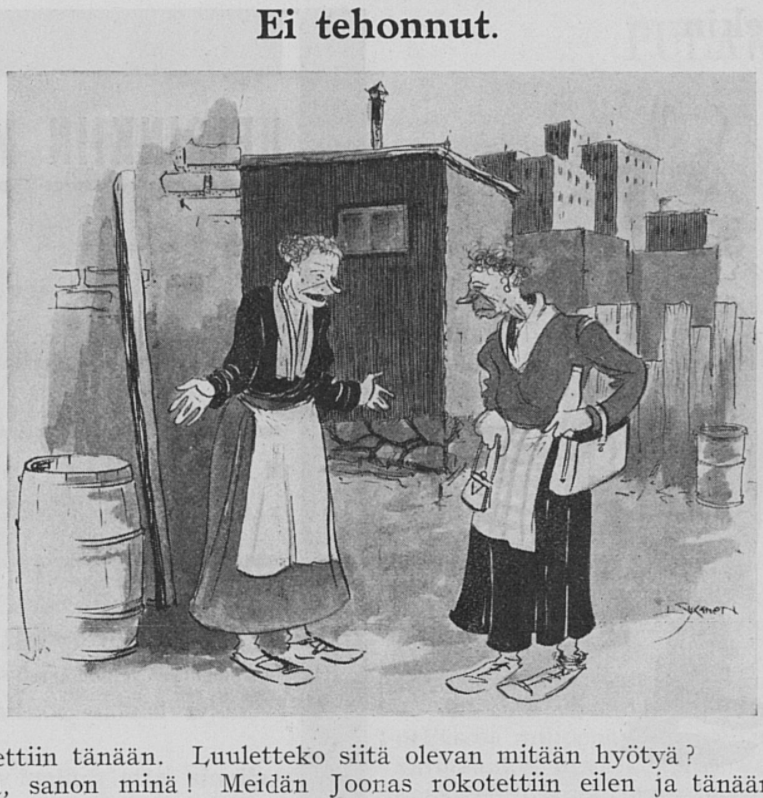
“My son was also vaccinated today. Do you think it will be of any use?”
“Is it useful? What else, I say! Our Jonah was vaccinated yesterday and today he fell down the stairs and broke the very arm that had been vaccinated.”
(Tuulispää, Helsinki, 1931)
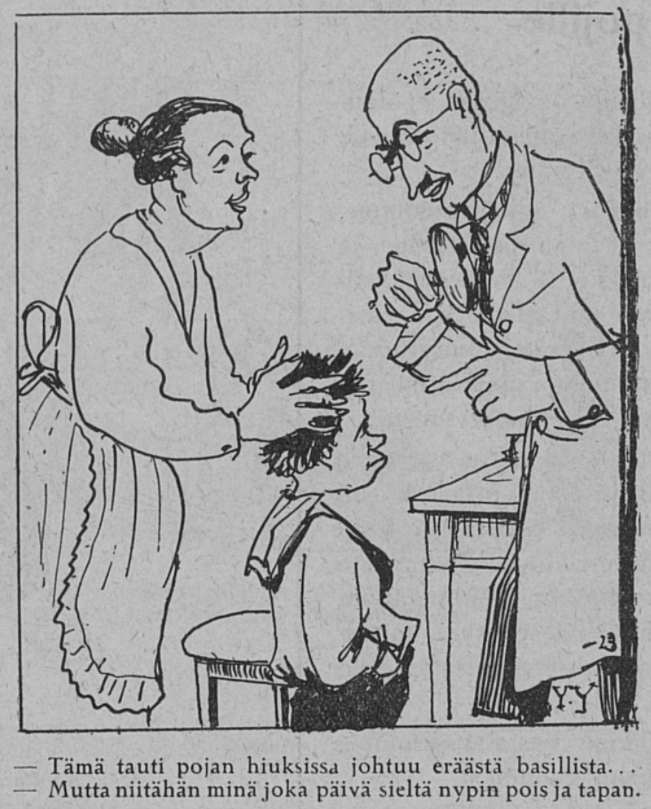
“This disease in the boy’s hair is due to bacteria…”
“But every day I remove them and kill them.”
(Tuulispää, Helsinki, 1923)
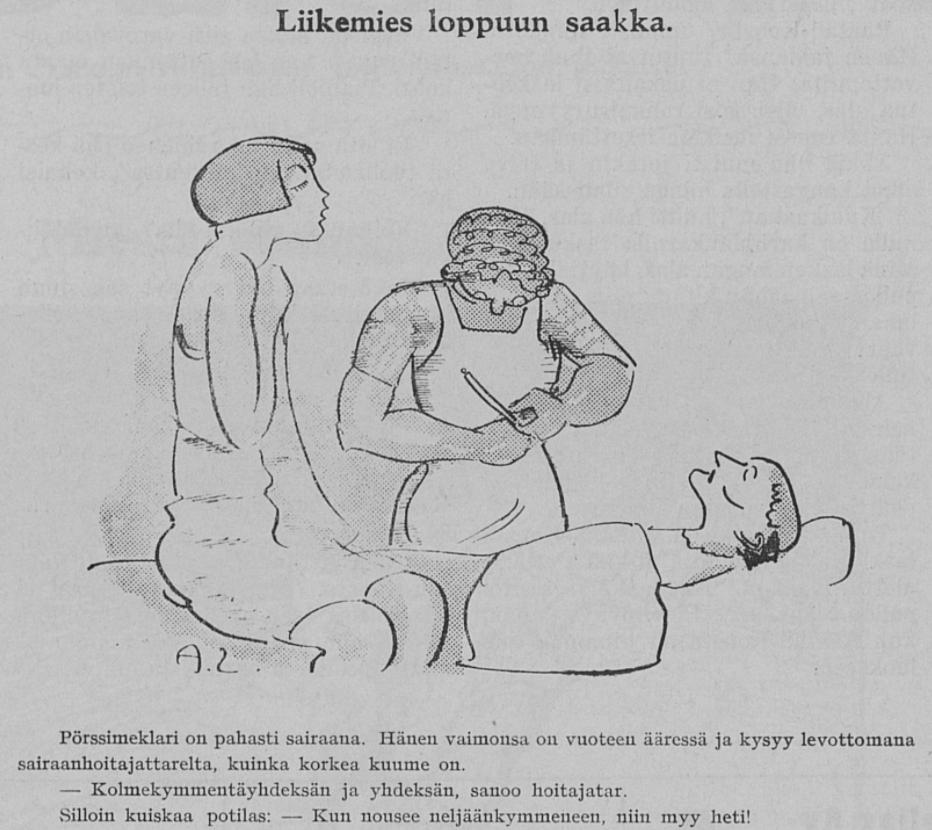
The stockbroker is seriously ill. His wife is at the bedside and anxiously asks the nurse how high the fever is.
“39.9 Celsius,” says the nurse.
Then the patient whispers: “When you get up to 40 C, sell immediately!”
(Tuulispää, Helsinki, 1929) (Not necessarily flu-related, but plausibly so.)
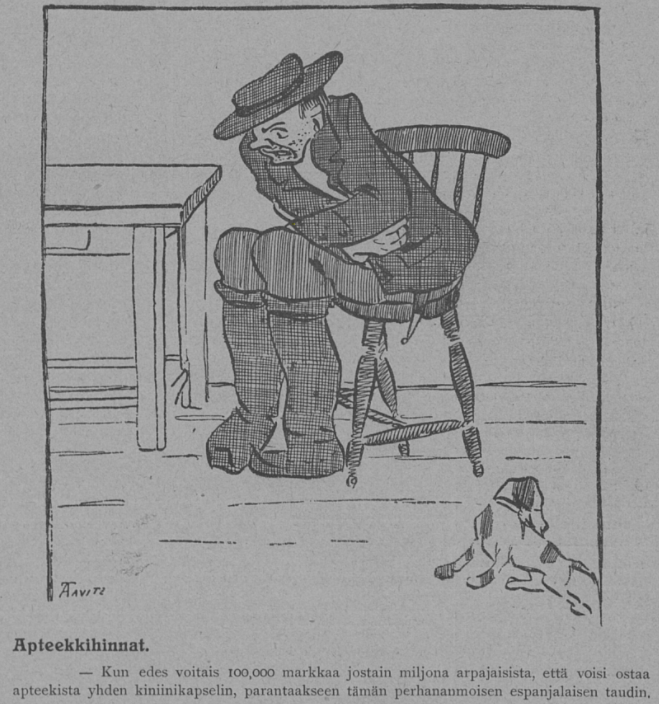
When you could win 100,000 marks from one of a million lotteries so that you could buy one capsule of quinine from a pharmacy to cure this awful Spanish disease.
(Tuulispää, Helsinki, 1918)
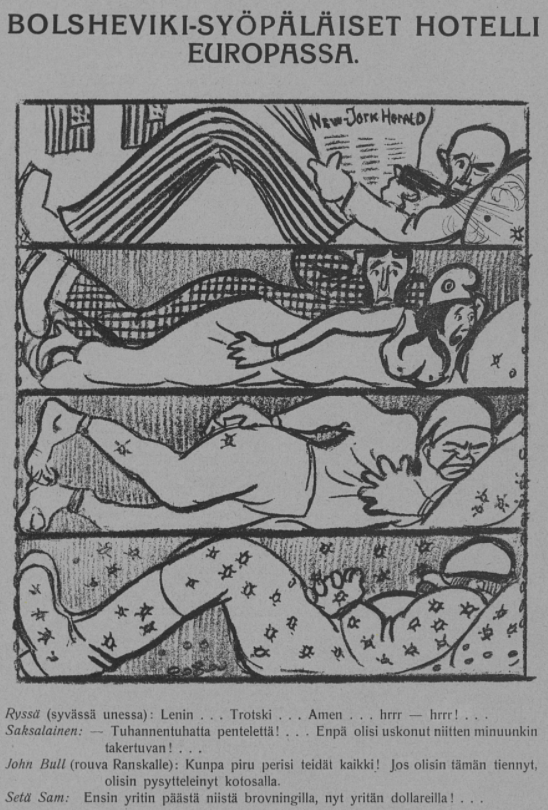
Politics-as-contagion is low-hanging fruit, to be sure, but this Finnish cartoon still warrants preservation.
Russian (fast asleep): “Lenin… Trotsky… Amen… hrrr — hrrr! …”
German: “A million spawn! … I wouldn’t have thought they would cling to me either! …”
John Bull (to Mrs. France): “The devil take you all! If I had known about this, I would have stayed at home.”
Uncle Sam: “First I tried to get rid of them with a Browning, now I’ll try with dollars! …”
(Tuulispää, Helsinki, 1919)
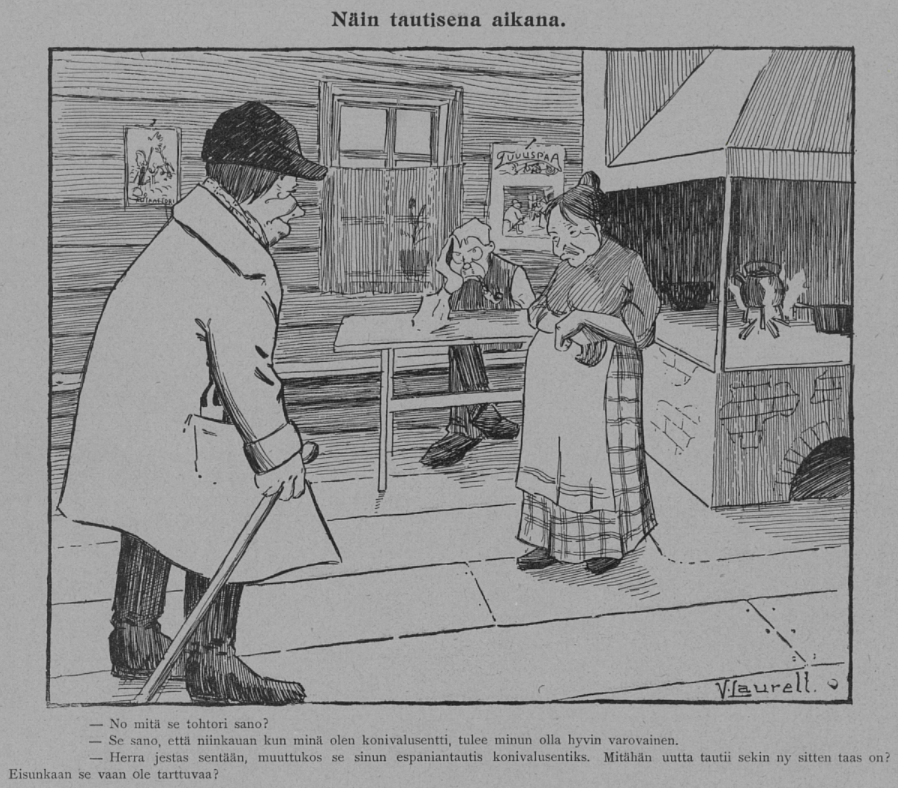
“Well, what does that doctor say?”
“He said that as long as I’m convalescing, I need to be very careful.”
“At least the gentleman said it would turn your Spanish disease into a convalescent. What’s new about the disease then again? Isn’t that contagious?”
(OK, I’ve surely botched the wordplay here, but it’s clearly about “convalescence” as medical neologism.)
(Tuulispää, Helsinki, 1918)
A sickly-looking man enters a bookstore and asks: “Is it here that you sell those stamps that are so good against tuberculosis?”
My colleague Riikkamari Muhonen explains that for much of the twentieth century special charity stamps known as “tuberculosis stamps” were sold around Christmas, and the money raised was used to research cures for tuberculosis and to build special homes for consumptive families.
(Tuulispää, Helsinski, 1911)

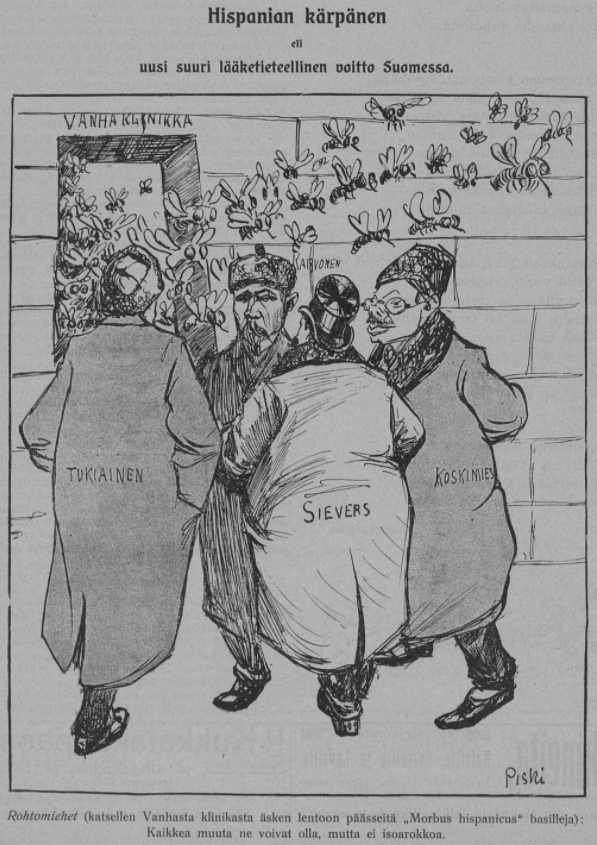
Spanish fly, a great new medical victory in Finland.
Herbalists (watching the Morbus hispanicus bacilli just flown in from the Old Clinic): They could be anything else, but not smallpox.
Among the figures depicted, Richard Sievers was a Finnish-Swedish physician with German roots who was credited with sparing Finland from the cholera epidemic then developing in Russia.
(Tuulispää, Helsinki, 1908)
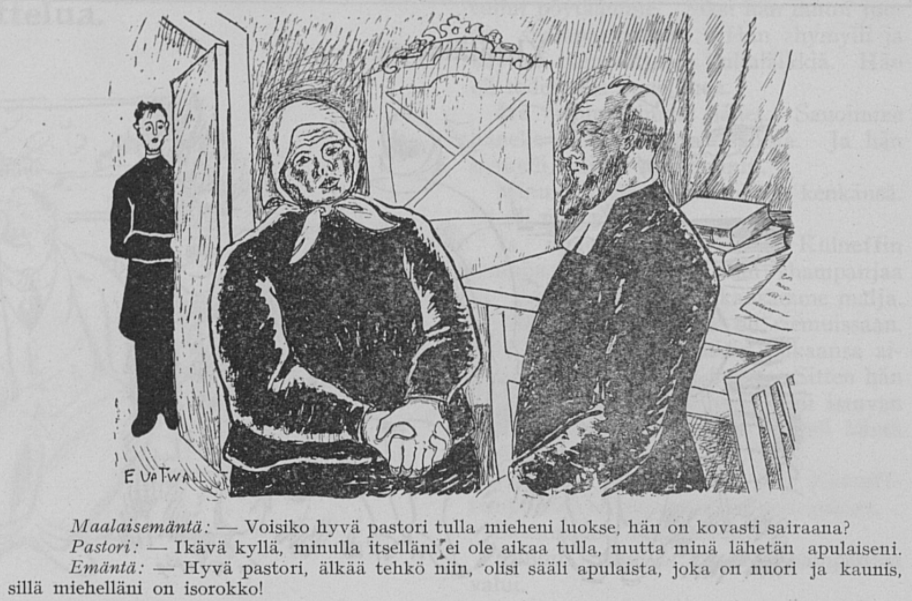
Country lady: “Could the good pastor come to my husband? He is very sick.”
Pastor: “Sadly, I don’t have time to come myself, but I’ll send my assistant.”
Lady: “Dear pastor, don’t do that, it would be a shame to have an assistant who is young and beautiful, because my husband has smallpox!”
(Tuulispää, Helsinki, 1929)
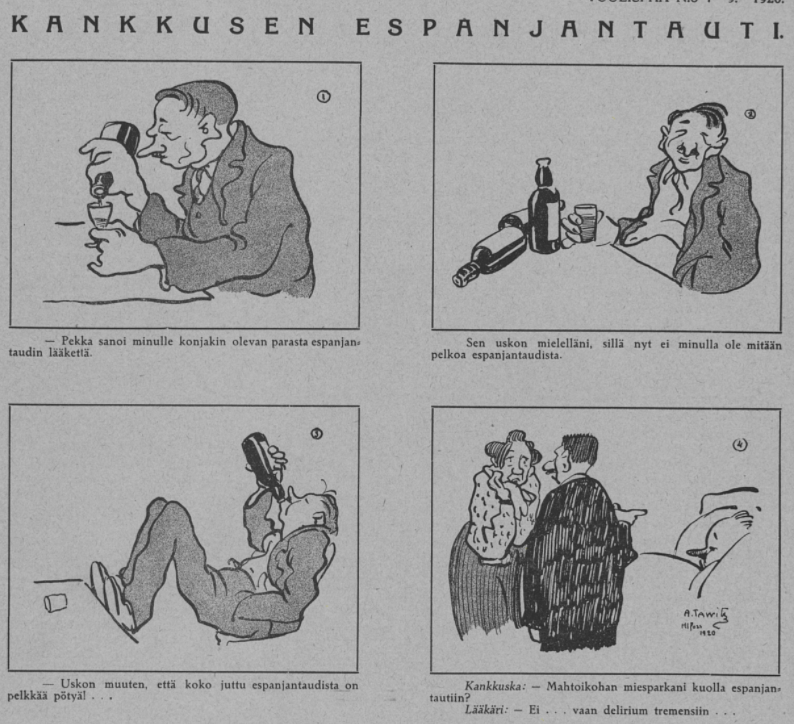
Mr. Kankkus: “Pekka told me that cognac is also the best medicine for Spanish disease. I am happy to believe that, because now I have no fear of Spanish disease.
By the way, I think the whole thing about Spanish disease is just nonsense.”
Mrs. Kankkus: “I wonder if my husband could die of Spanish disease?”
Doctor: “No … but delirium tremens.” (Tuulispää, Finland, 1920)
Finnish satirical magazine Tuulispää, 1908. Note the timely fieldwork by the dedicated bacteriologist.
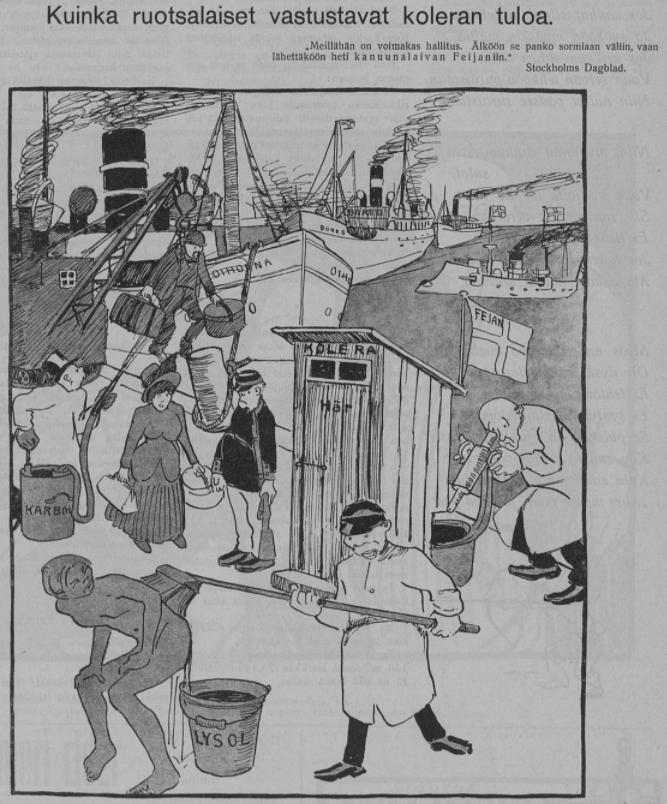
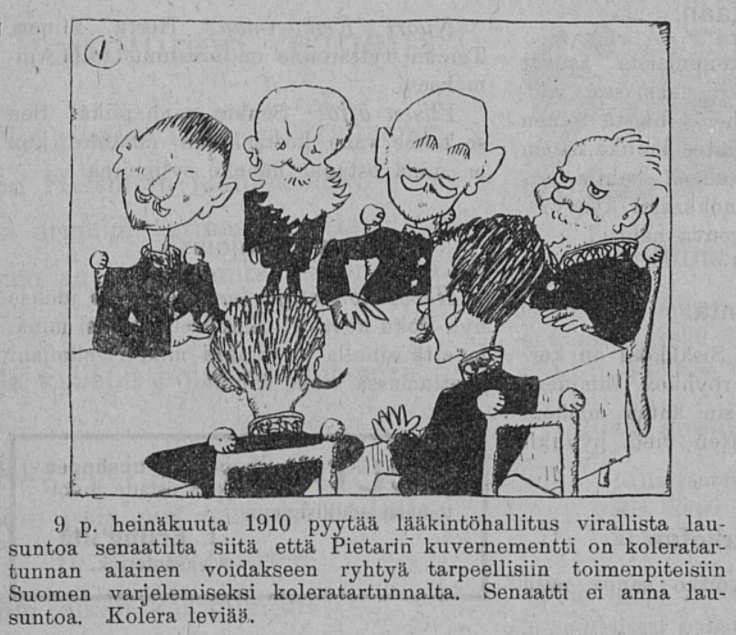
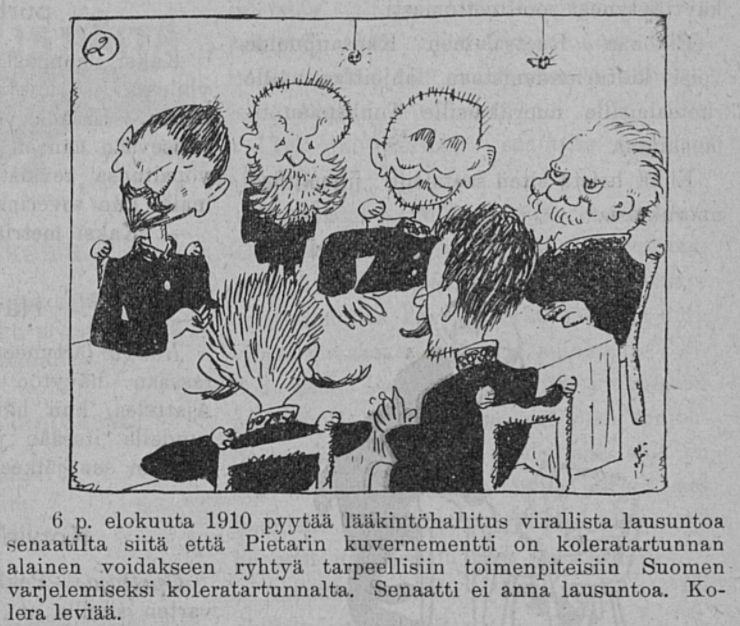
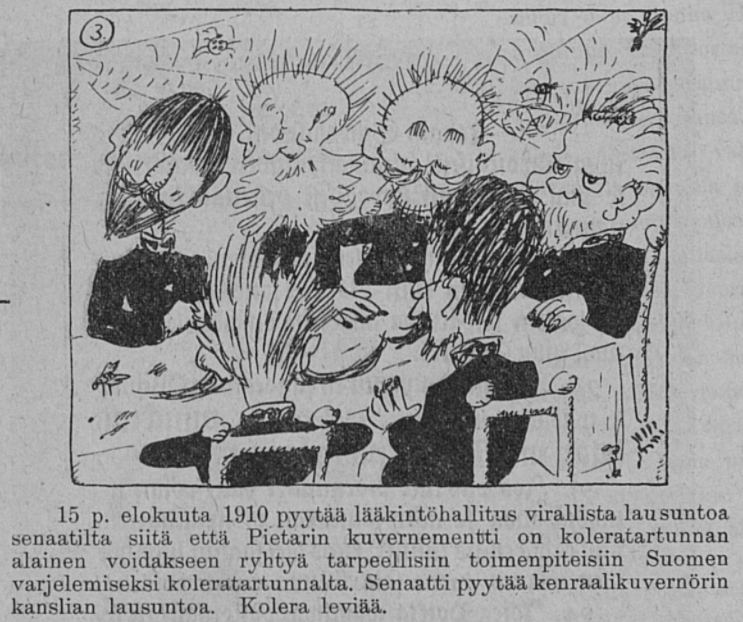
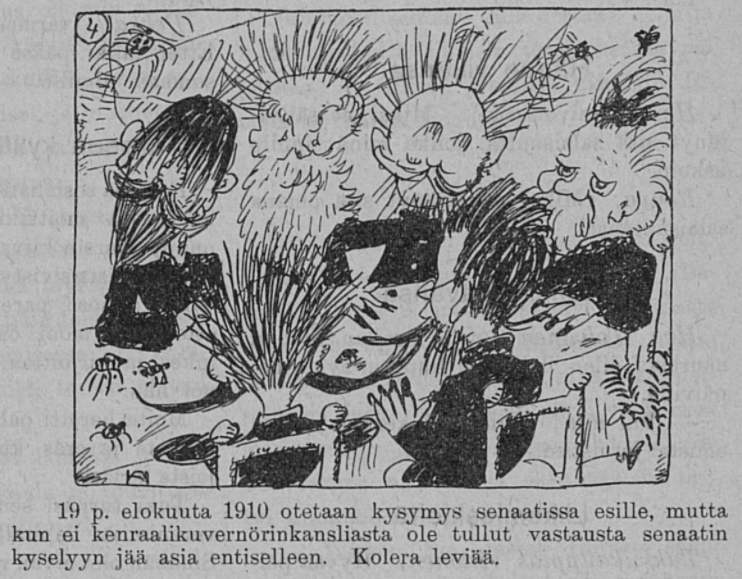
A Finnish cartoon from 1910 mocking the inaction of the Russian Imperial government during a cholera epidemic. (Tuulispää)
First panel: “On July 9, 1910, the Medical Board issued an official statement from the Senate that the St. Petersburg District was under cholera infection, in order to be able to take the necessary measures to protect Finland from cholera infection. The Senate does not issue an opinion. Cholera spreads.”
Fourth panel: “On August 19, 1910, the issue is raised in the Senate, but when the Office of the Governor-General does not receive an answer to the Senate’s inquiry, the matter remains as before. Cholera spreads.”
 Sic Transit Pestilentia