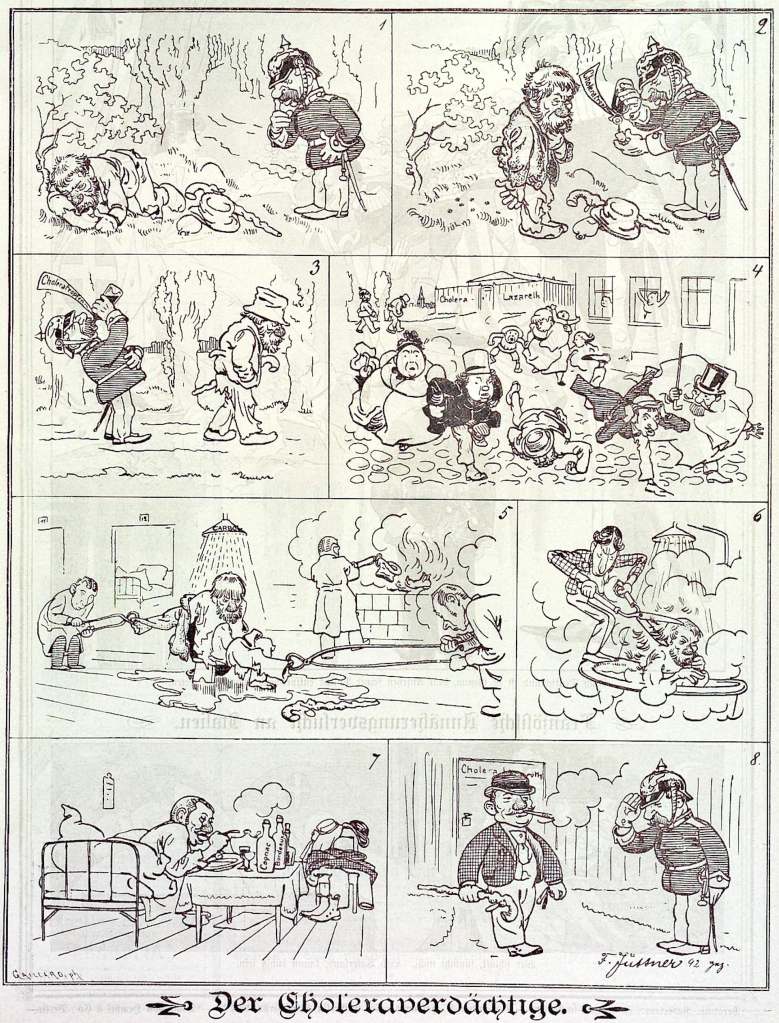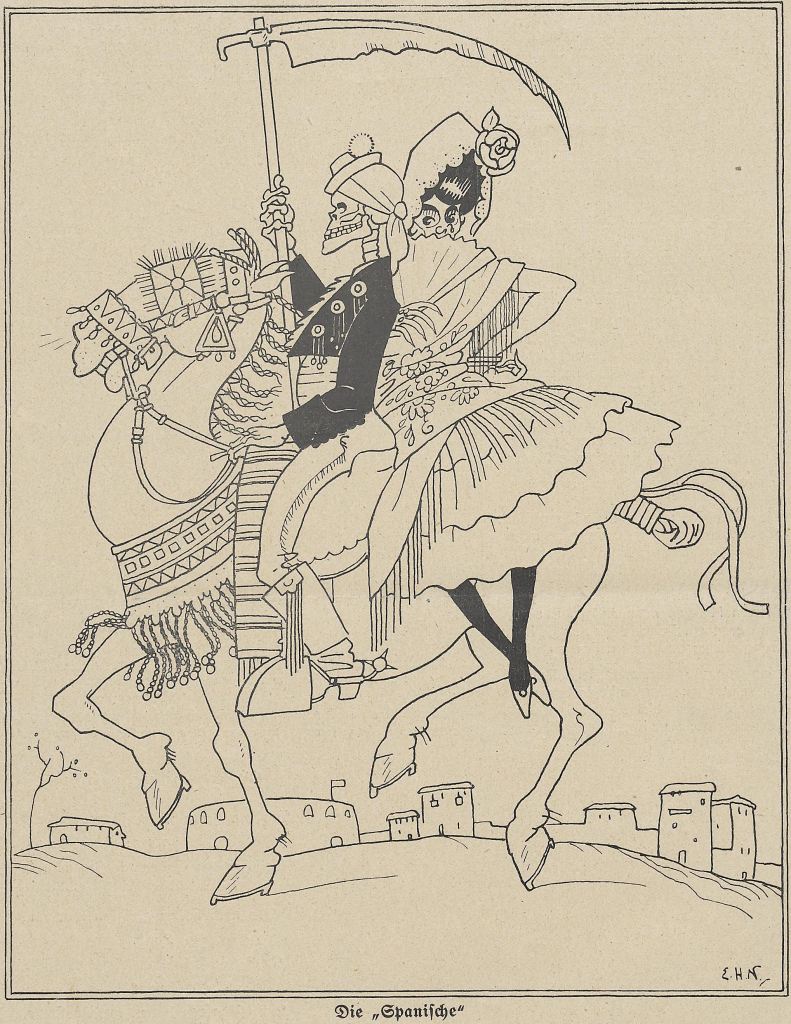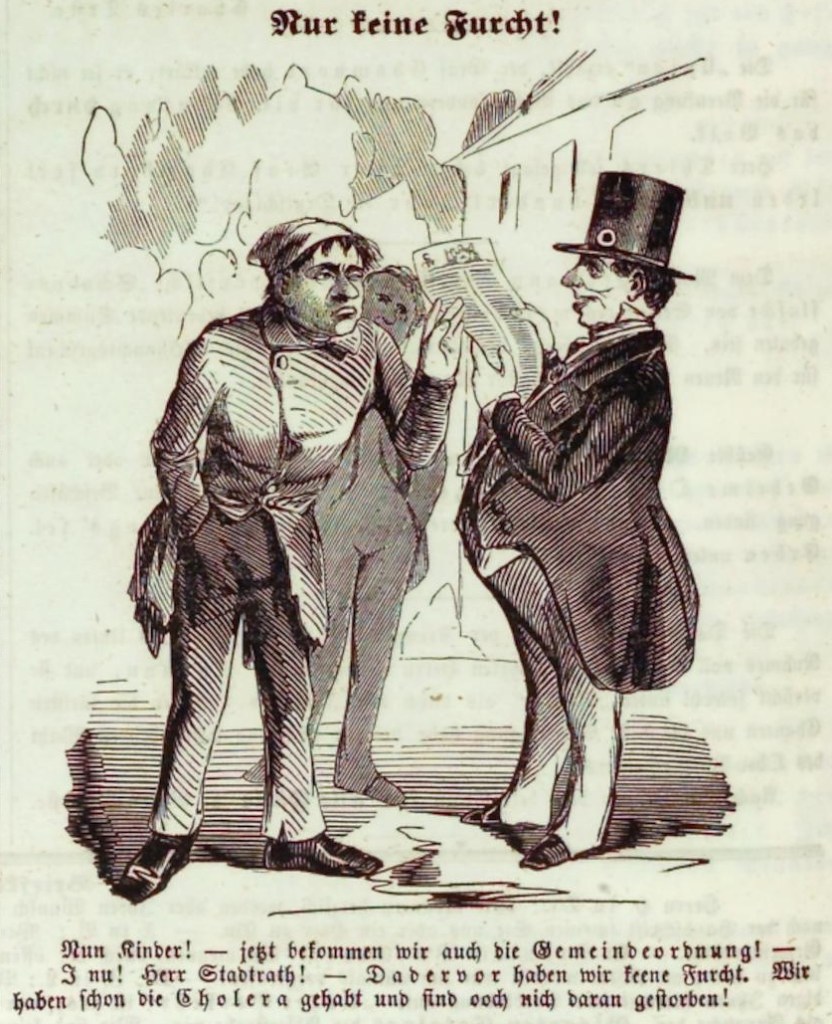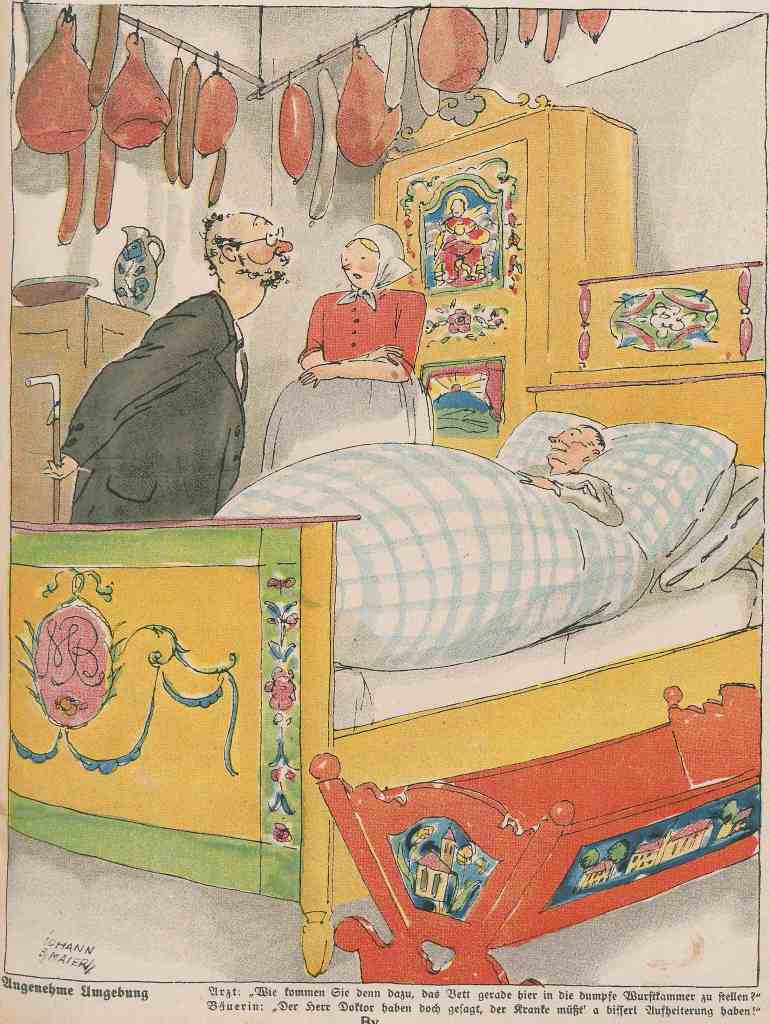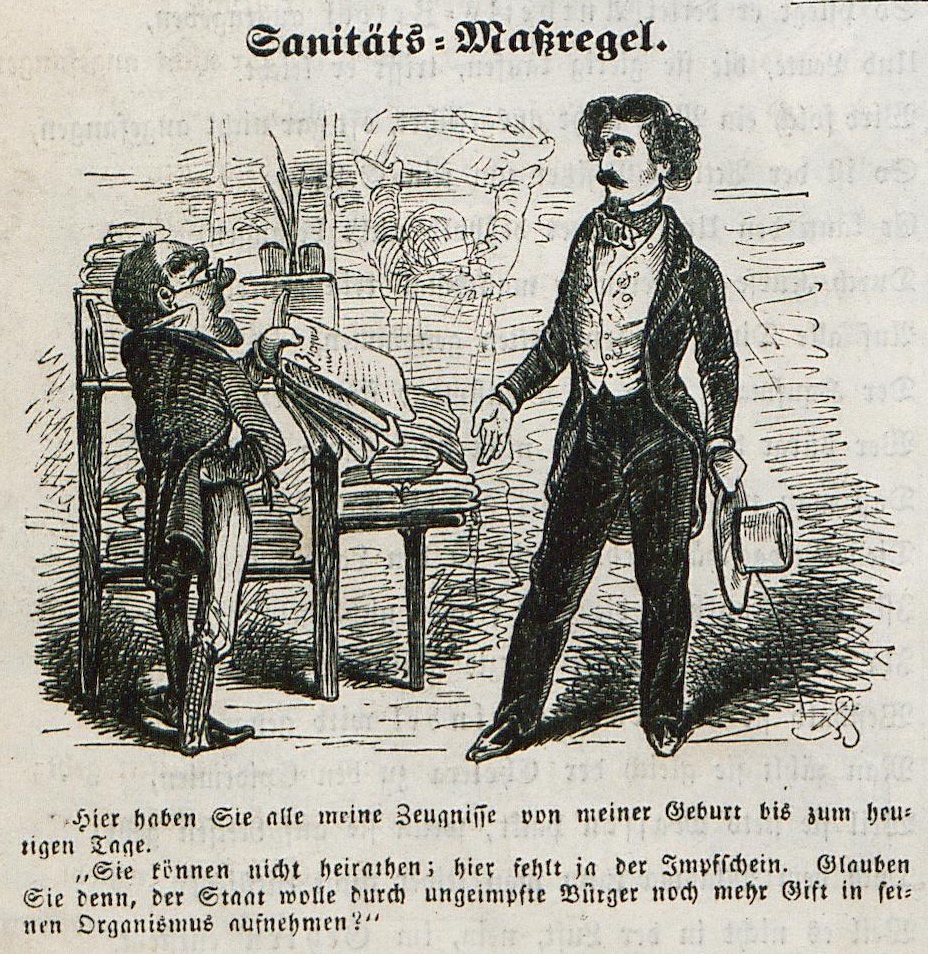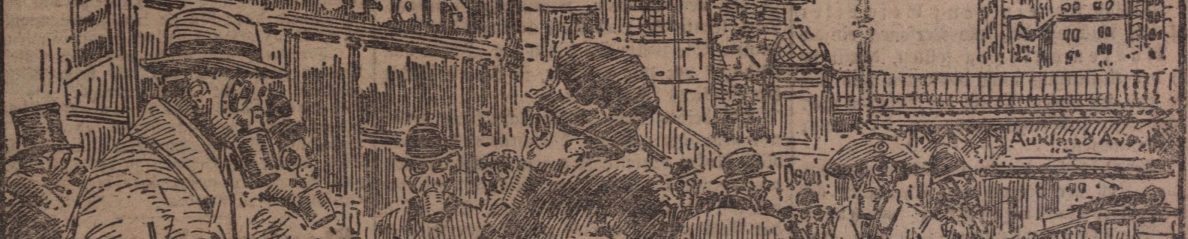
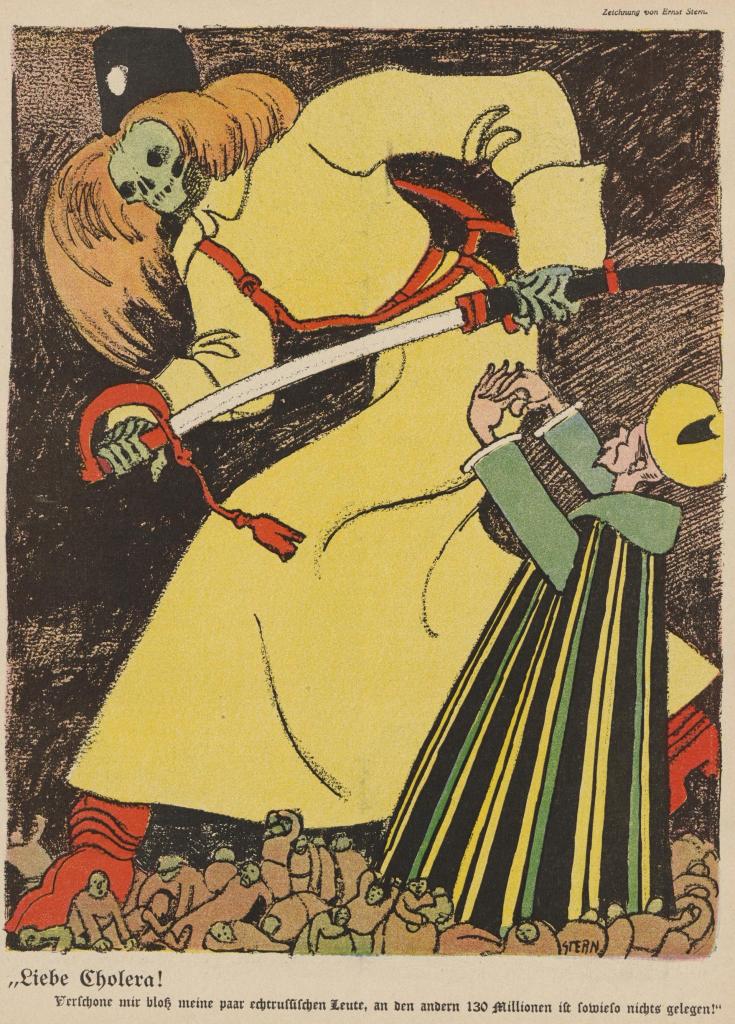
Dear Cholera!

“Just spare my few really Russian people, the others are not important anyway!”
(By the fall of 1908 the last wave of cholera was widespread in the Russian Empire and to a lesser degree in the Ottoman Empire as well. Russia’s entanglements along its southern borders, including a Russian colonel leading a Persian Cossack siege of the Majlis in Teheran in June, but especially the declaration of independence of its client state Bulgaria in October, were cause for concern amid the turmoil of Ottoman politics–when this cartoon appeared, the Young Turks, many from military backgrounds, had upended the Ottoman court. That said, I’m insufficiently informed about the iconography at work here.)
(Lustige Blätter, Berlin, 1908)
German cholera cartoon

Bacteriological investigation

“It’s strange how such a tiny bacillus can keep such a big guy like me in a constant state of agitation…”
(Kladderadatsch, Berlin, 1892)
(My first instinct is that this supposed to be a Russian peasant, but when you look at the “comma bacilli” of cholera, it’s not entirely clear who is being represented. In any event I wouldn’t wager that the figures with crowns are Tsar Nicholas II, and some have top hats.)

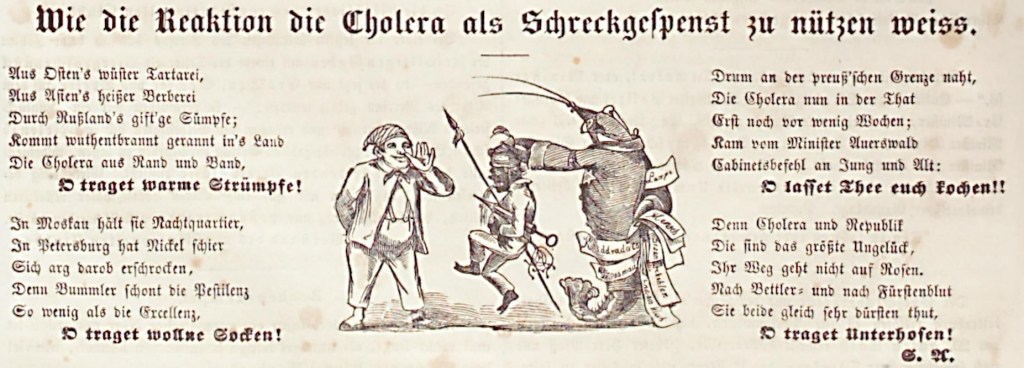
How reactionaries know how to use cholera as a bogeyman

German cholera cartoon

From desert Tartary to the east
From sweltering Berbers of Asia
Through Russia’s poisonous swamps;
Cholera from the wild margin
Comes wrathful into the country,
O wear warm stockings!

In Moscow it has night quarters
In Petersburg, the swampman has nearly
To be hopelessly terrified
Because the pestilence spares drifters
As little as their betters,
O wear woolly socks!

Thence is cholera indeed
Just a few weeks ago
Nearing the Prussian border;
From Minister Auerswald came
To young and old the cabinet order:
O let tea be brewed for you!!

Because cholera and republic
They are the greatest misfortune
Yours is not the primrose path.
Beggarly and princely blood alike
You both feel very thirsty
O wear underpants!

(Kladderadatsch, Berlin, 1848)

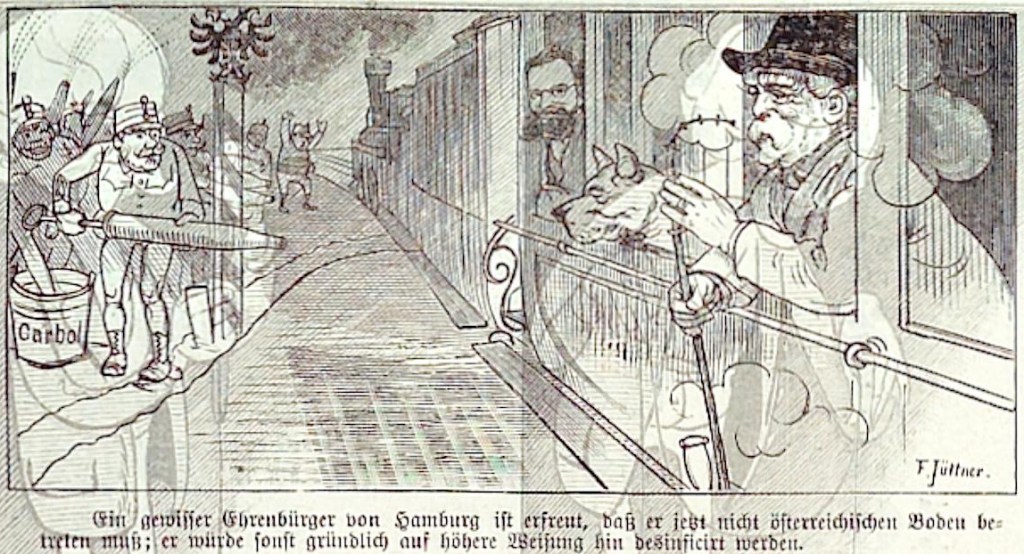
Bismarck

A certain honorary citizen from Hamburg [site of the last major cholera outbreak in Germany] is gratified that he now does not have to set foot on Austrian soil; otherwise he would have been thoroughly disinfected upon instructions from higher up.
(Kladderadatsch, Berlin, 1892)

German cholera cartoon

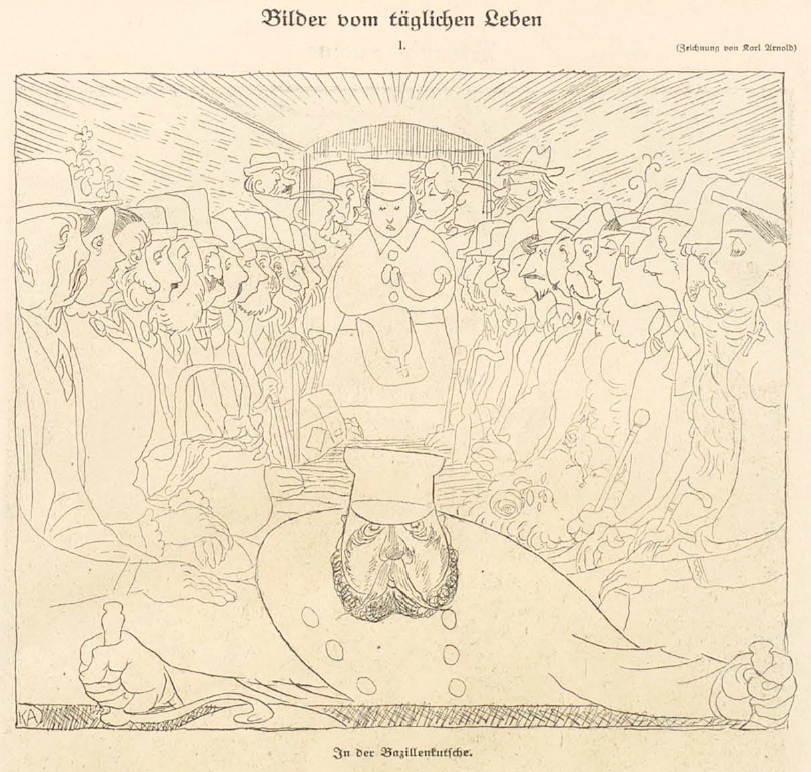
Pictures from daily life

“In the germ car.”
Depicting the close quarters of public transportation during the flu pandemic of 1918. It is worth noting that this may be the only such flu-related image in Simplicissimus that fall. The unusual term “Bazillenkutsch” is sometimes attributed to Robert Koch at the time of the opening of the U-Bahn in working-class Kreuzberg in 1902, perhaps via a 1908 novella by Eduard Goldbeck (not confirmed). Kaiser Wilhelm later gave the term wider notoriety when he visited a new stretch of the U-Bahn and insisted that he would only sit in a brand-new subway car, fearing infection from previous riders. This in turn moved the Berliner Volks-Zeitung to reassure its readers that this perception of germs ran counter to years of medical and scientific efforts to demonstrate otherwise, and the average subway car was not, in fact, the center of an epidemic.
(Simplicissimus no. 33, Munich, 1918)

German hygiene cartoon