“… What, Mr. Brewmaster, you haven’t had influenza yet? Congratulations! … It’s strange that this disease affects the finer people; I’ve had it twice!”
(Fliegende Blätter, Munich, 1891) (redrawn and upped to “thrice” in Haagsche courant, 1898)
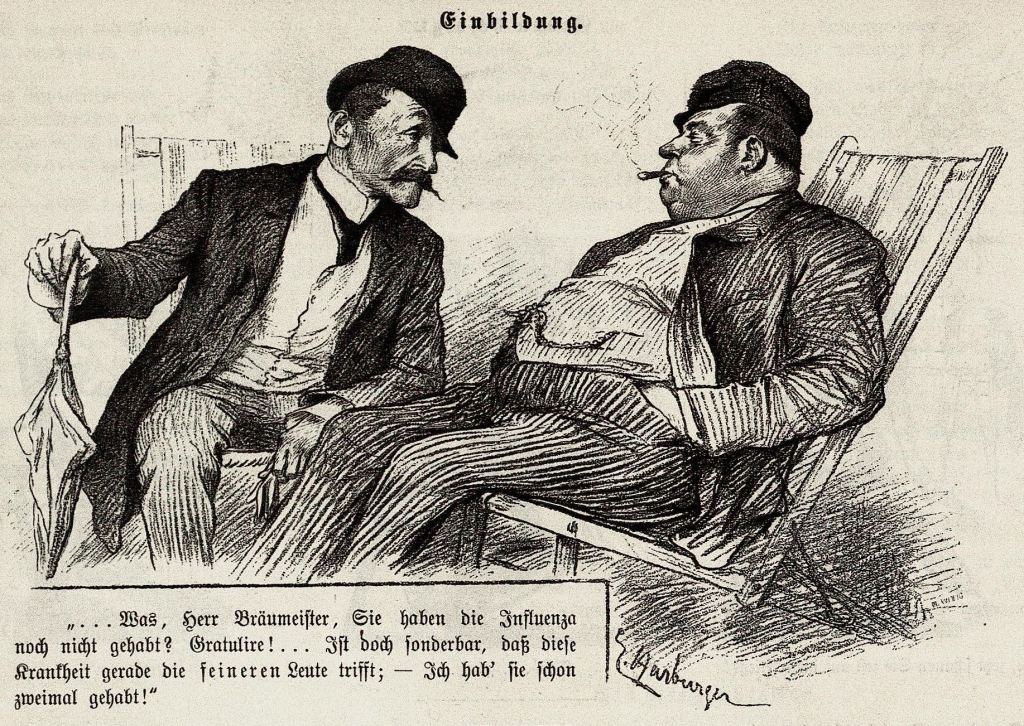
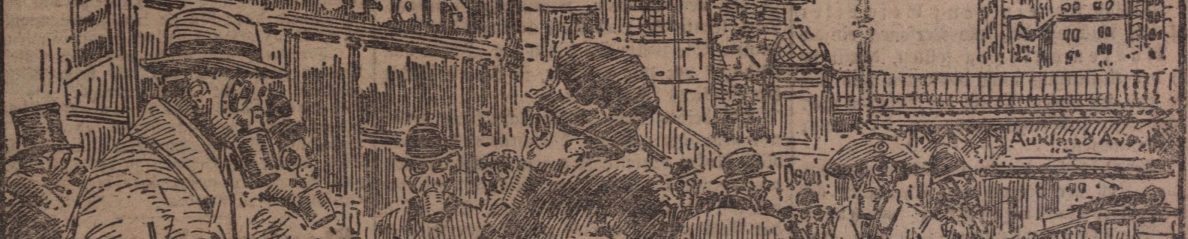
“… What, Mr. Brewmaster, you haven’t had influenza yet? Congratulations! … It’s strange that this disease affects the finer people; I’ve had it twice!”
(Fliegende Blätter, Munich, 1891) (redrawn and upped to “thrice” in Haagsche courant, 1898)
Popular lessons about the occurrence and fight with this contagion.
(text by August Ritter, drawings by Wilhelm Scholz, Kladderadatsch, Germany, 1848)
Symptoms
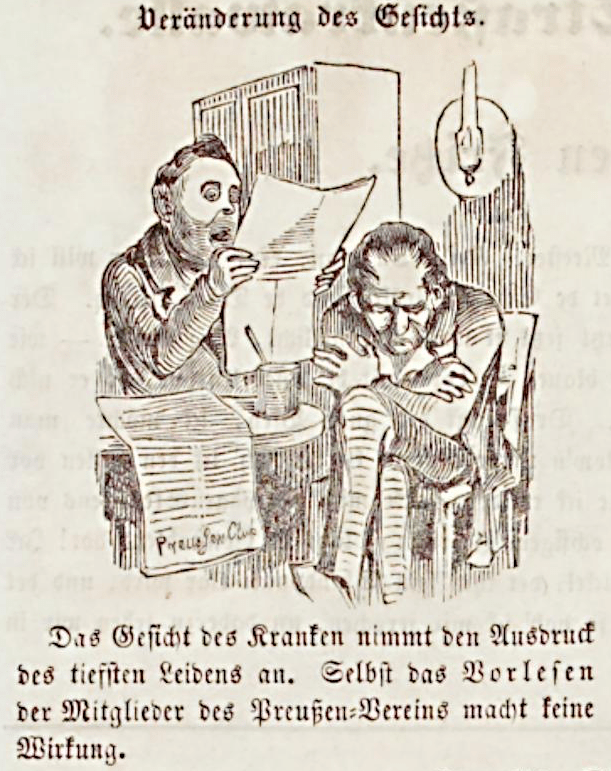
Change of face: The face of the patient assumes an expression of the most profound suffering. Even lectures of members of the Prussian Union have no effect.
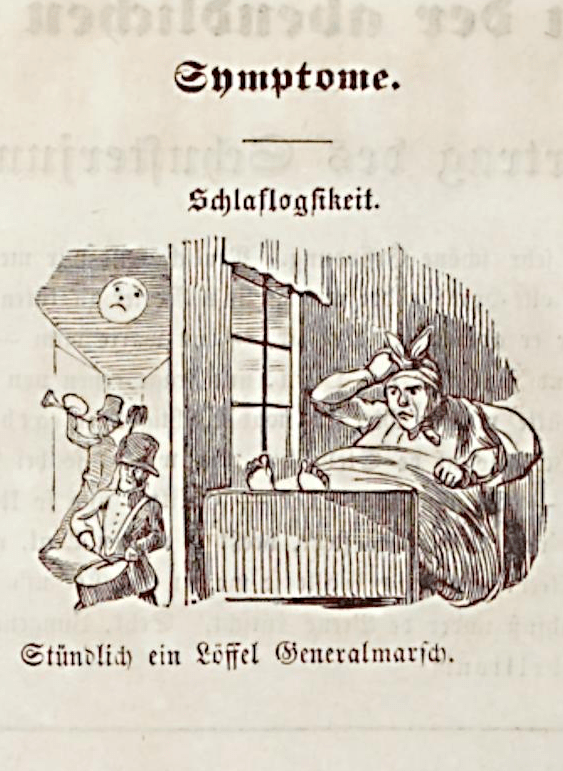
Sleeplessness: A spoonful of marching music hourly.
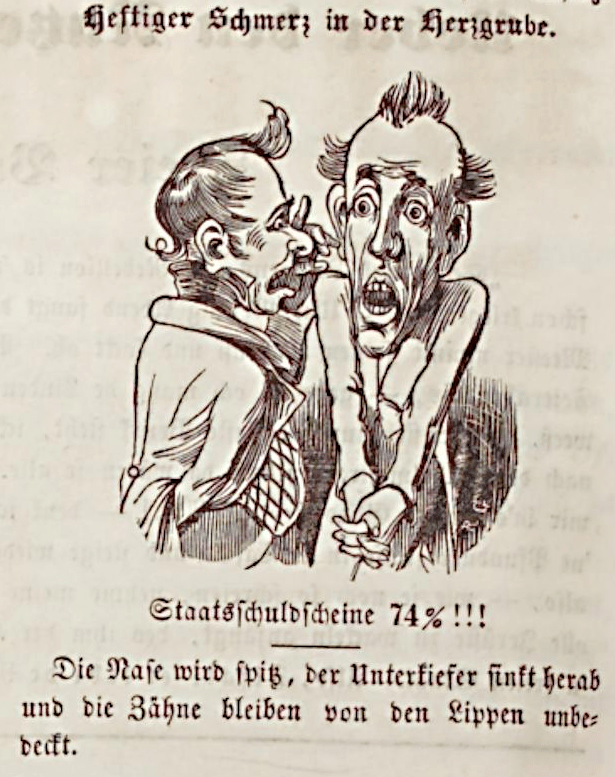
Sharp heartburn: State bonds at 74%!!!
The nose becomes sharp, the jaw drops, and the teeth remain uncovered by the lips.
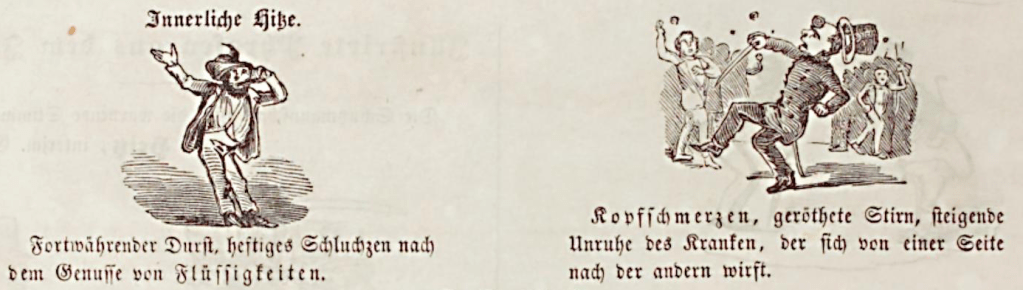
Internal heat: Persistent thirst, powerful sobbing after the pleasure of liquids.
Headache, reddened forehead, increasing agitation of the patient, acting from one side to the other. [vegetables are being lobbed from all sides]
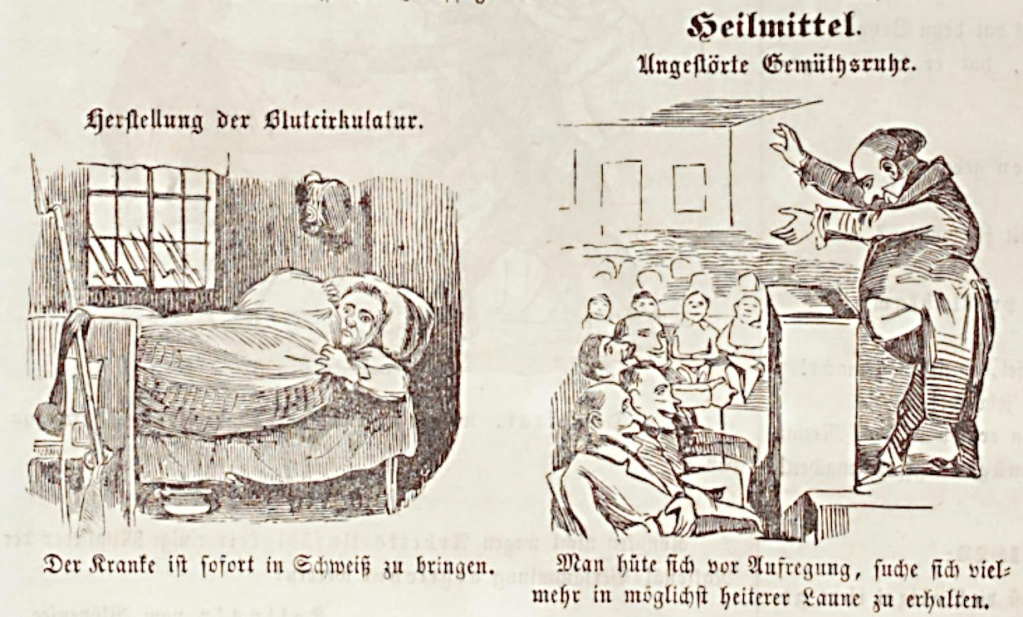
Remedies
Production of blood circulation: The patient easily breaks into a sweat.
Undisturbed calm: Avoid stimulation, seek to maintain a the most cheerful possible mood.
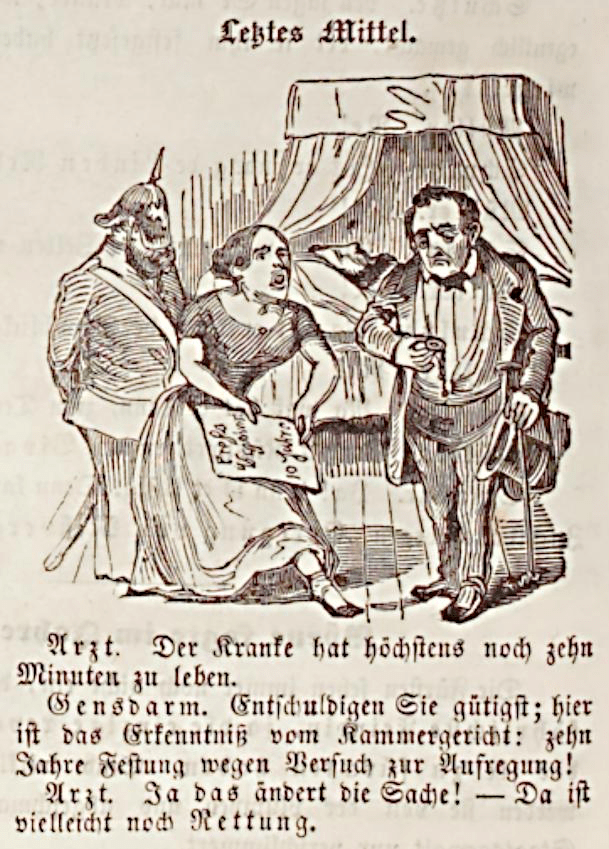
Final remedy
Doctor: The patient has at most ten minutes left to live.
Gendarme: Excuse me, here is the finding of the chamber court: ten years confinement for seeking stimulation.
Doctor: That changes things! Perhaps deliverance lies there.
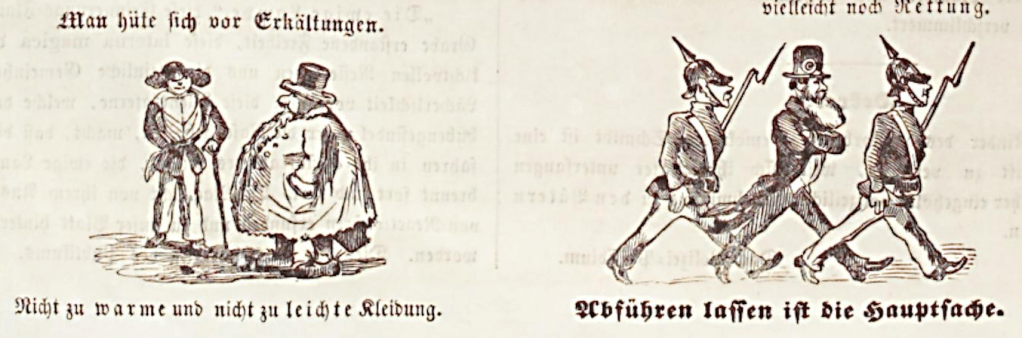
Avoid chills: Do not wear clothing that is too warm or too light.
The main thing is to be led away.
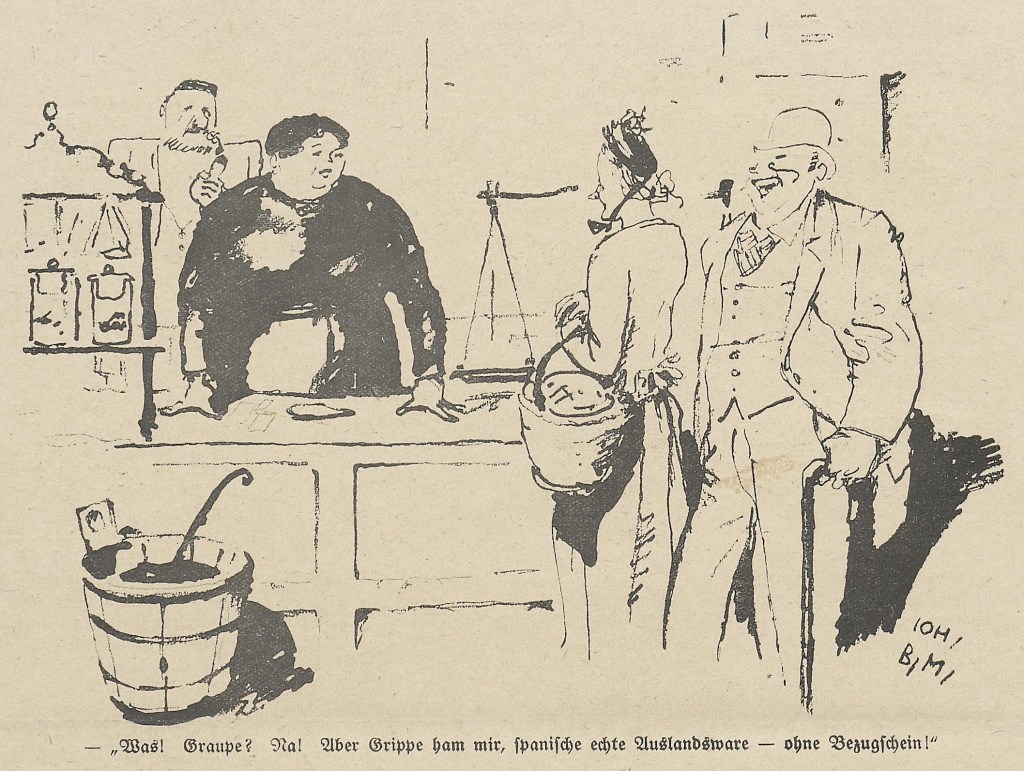
“What? Grappa? Nah! But we have grippe, genuine imported Spanish wares, no ration card required!”
(Guckkasten, Germany, 1918)
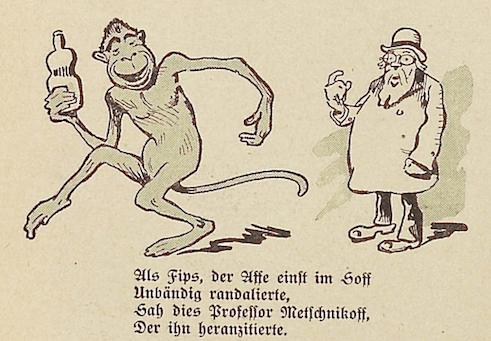
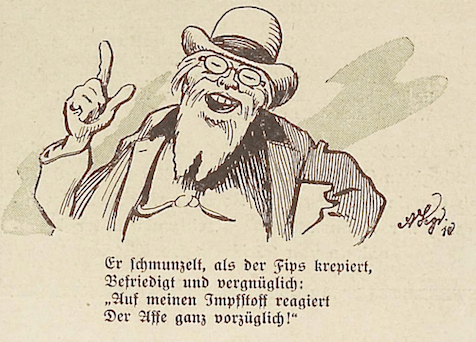
I can’t pass up a multi-panel cartoon about Ilya Mechnikov, the Russian émigré zoologist working in Paris who was awarded the Nobel Prize in 1908 for his research on immunology. (Kladderadatsch, 1910)
(The motive invoked by the cartoonist: news reports that Professor Ilya Mechnikov has vaccinated monkeys with typhoid serum.)
Once while Fips the monkey was in his cups
Wildly rampaging around,
Professor Metchnikoff caught sight of him,
And lured him toward himself.
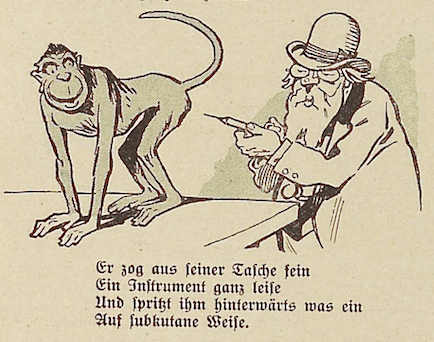
He smoothly pulled out of his pocket
An instrument, ever so quietly,
And injected something in his rear
In a subcutaneous way.
Fips rejoiced like a fool,
How could he really know?
It was a serum for catarrh!
I find that very hideous!
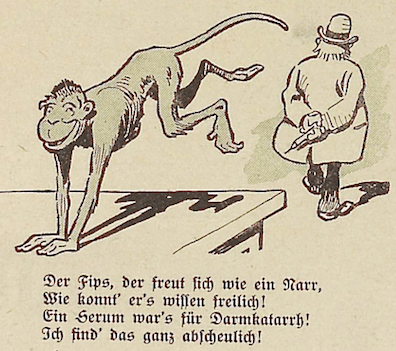
Very soon, however – his breath short! –
He got it good from the lure
To which he had been cunningly drawn.
He headed straight up the trees!

He whirls around shrieking
In outrageous dances,
And harasses the public
Without moderation and bounds!
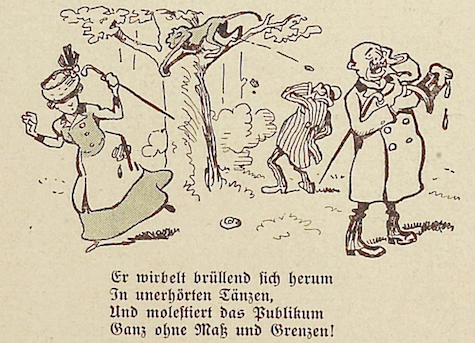
An angry constable came up
And let his revolver crack.
“The street is only for traffic
And not for things like that! “
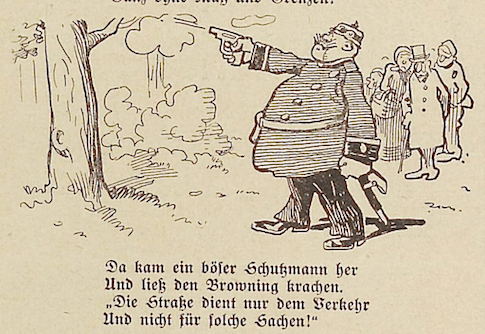
As Flips met this misfortune,
Everyone cried: “Jerum, jerum!”*
In contrast, Mr. Mechnikov sang
A song of praise for his serum!
*(invoking the Latinate refrain of a student song)
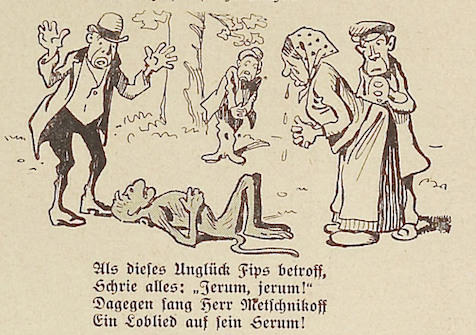
He grins when Fips croaks,
Satisfied and amused:
“The monkey’s response
to my vaccine is excellent!”
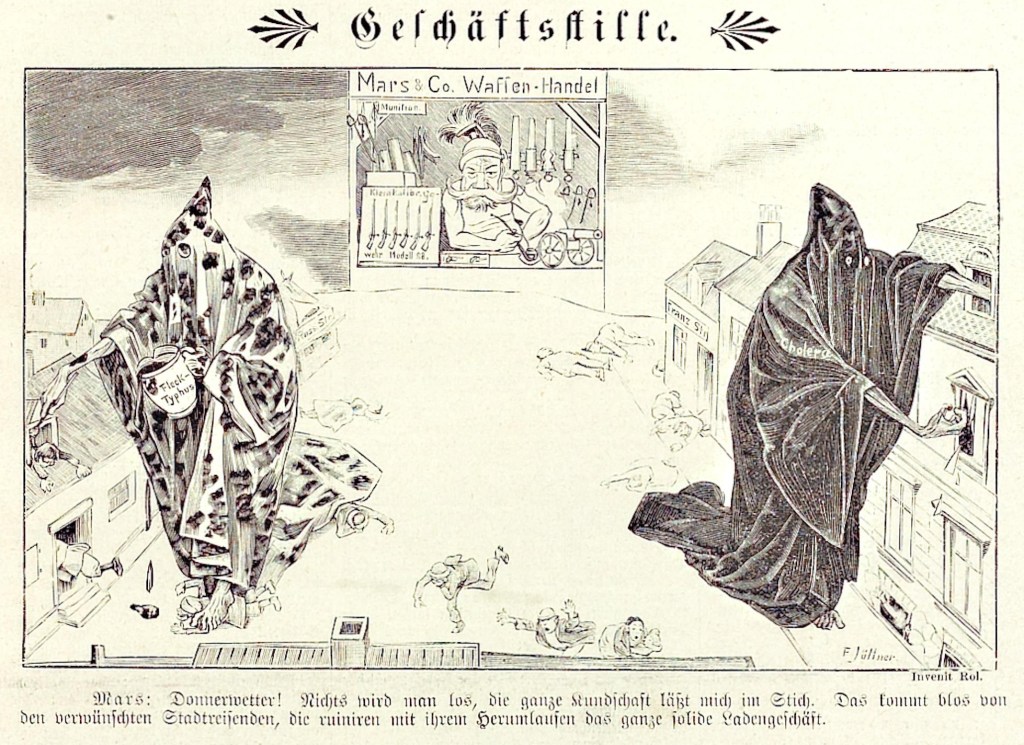
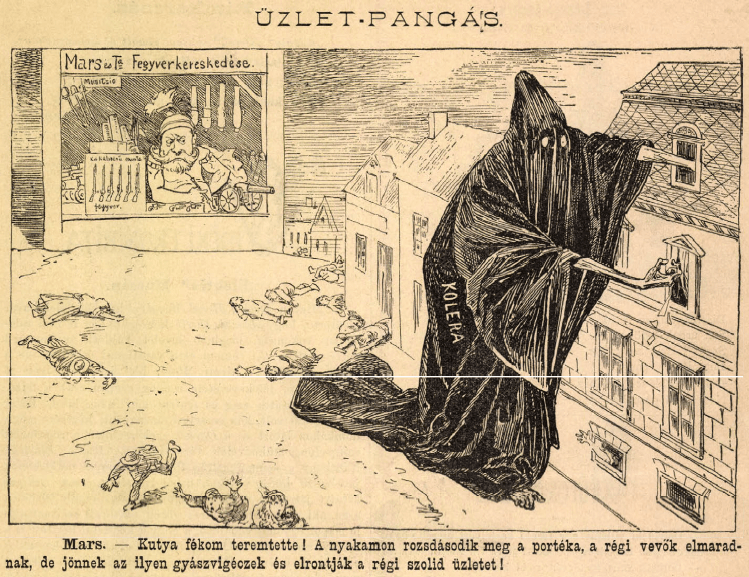
These two cartoons were published in quick succession as the cholera epidemic worsened in 1892, first in May in Germany, then in July in Hungary. Note what the Hungarian version leaves out, though it is nearly a copy of the German original.
Mars & Co. Arms Dealers: “Darn it! Nothing is moving off the shelves, all my customers are leaving me in the lurch. It’s simply because of these accursed city travelers who are ruining a perfectly solid retail enterprise with their running around.”
(Kladderadatsch, Berlin, 1892)
Mars & Co. Arms Dealers: “Well, I declare! My wares are rusting around my neck, old customers are staying away, but these peddlers in mourning clothes come and ruin the old solid business!”
(Borsszem Jankó, Budapest, 1892)
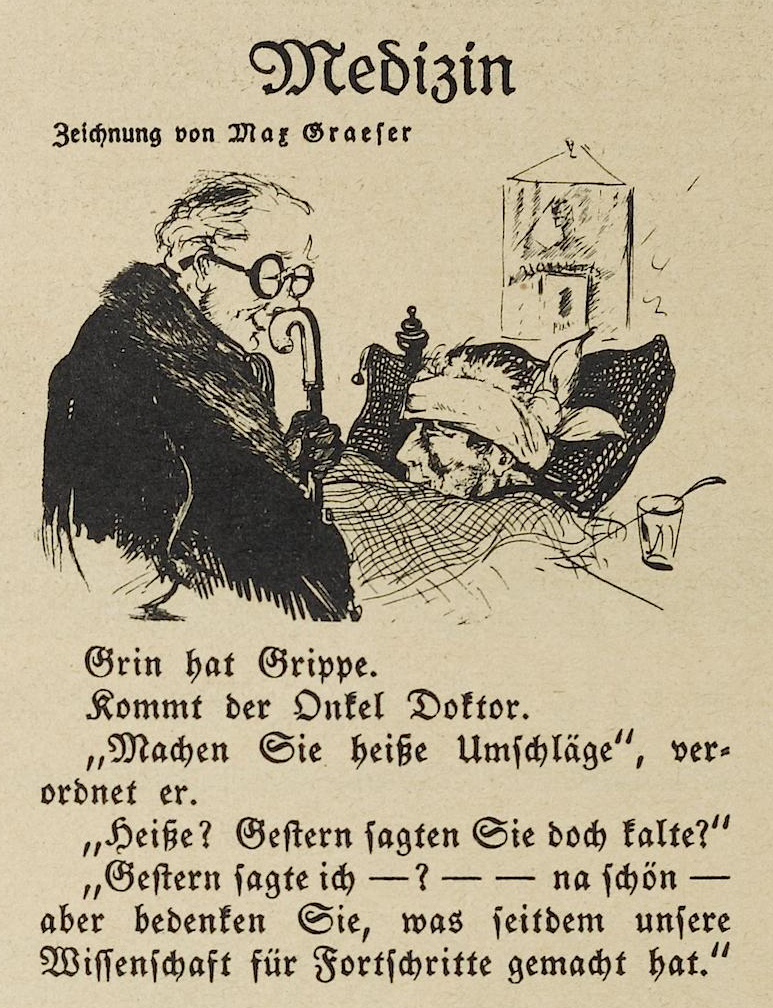
Grin has the flu.
His uncle the doctor arrives.
“Make hot compresses,” he orders.
“Hot? Didn’t you say cold yesterday?”
“Yesterday I said–?–alright–but think about the progress our science has made since then.”
(Lachen links, Germany, 1927)
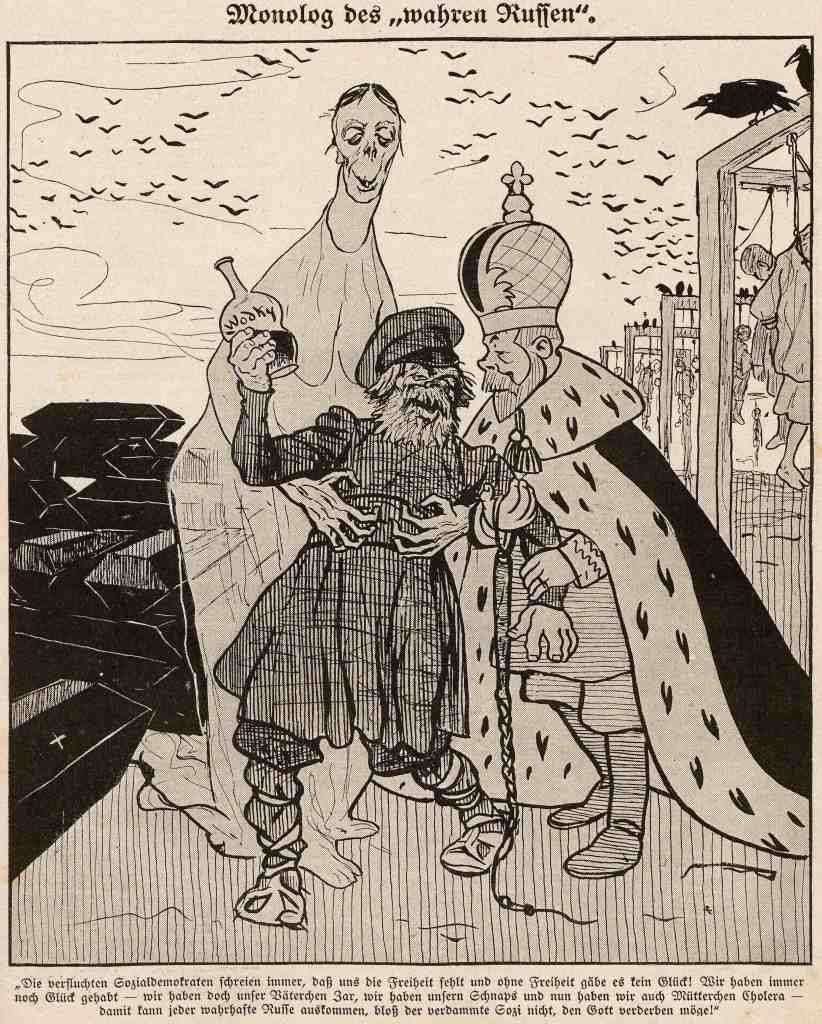
Another bit of Russophobia which I post without additional comment:
“The cursed Social Democrats always shout that we lack freedom and without freedom there would be no happiness! We have always been fortunate, we have our little father Tsar, we have our schnapps, and now we also have mother cholera, so any true Russian can get by, just not the damned socialist, may God ruin him!”
(Der wahre Jacob, Stuttgart, 1908)
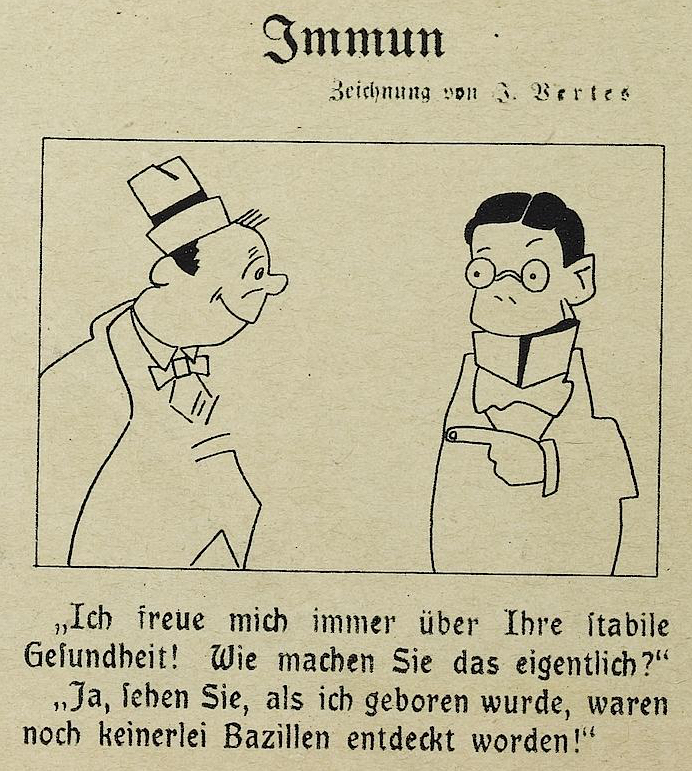
(For devotees of Bruno Latour) “I’m continually pleased by your stable health! How do you actually do it?”
“Yes, you see, when I was born, no bacteria at all had been discovered yet!”
(Der wahre Jacob, Stuttgart, 1929)
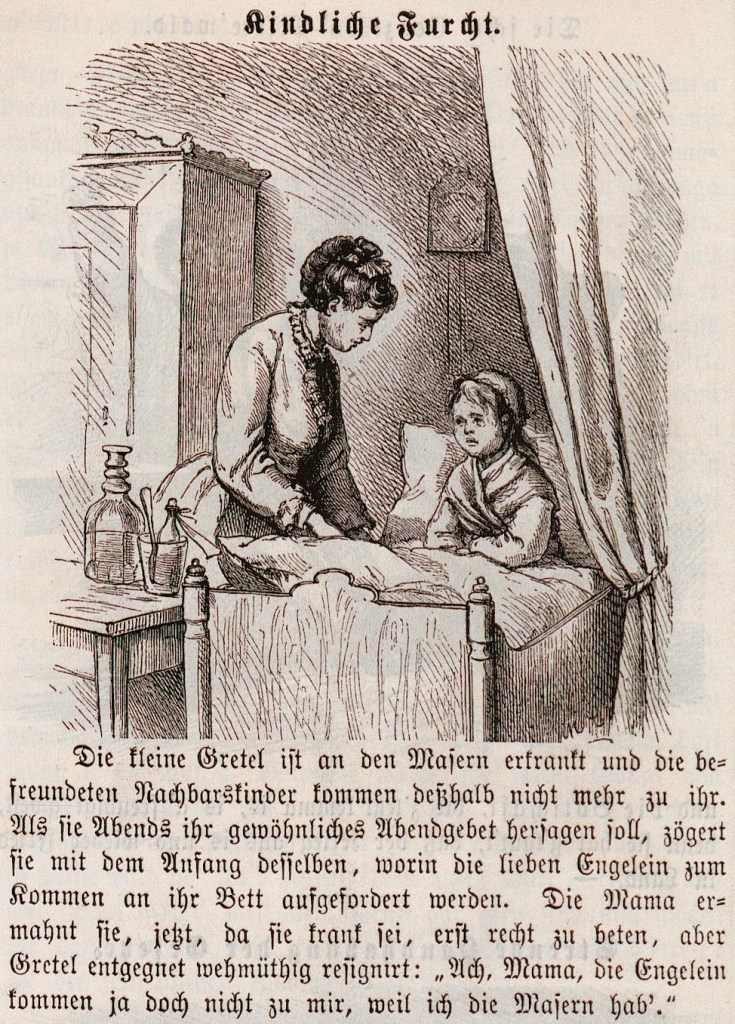
Little Gretel is sick with measles and her neighborhood friends are no longer visiting her because of this. When she is supposed to say her nighttime prayer, she hesitates at its beginning, where the dear little angels are summoned to her bedside. The mother admonishes her, since now that she is sick, she should pray correctly, but Gretel responds in poignant resignation: “Oh, Mama, the little angels won’t come to me, because I have the measles.”
(Fliegende Blätter, Munich, 1872)
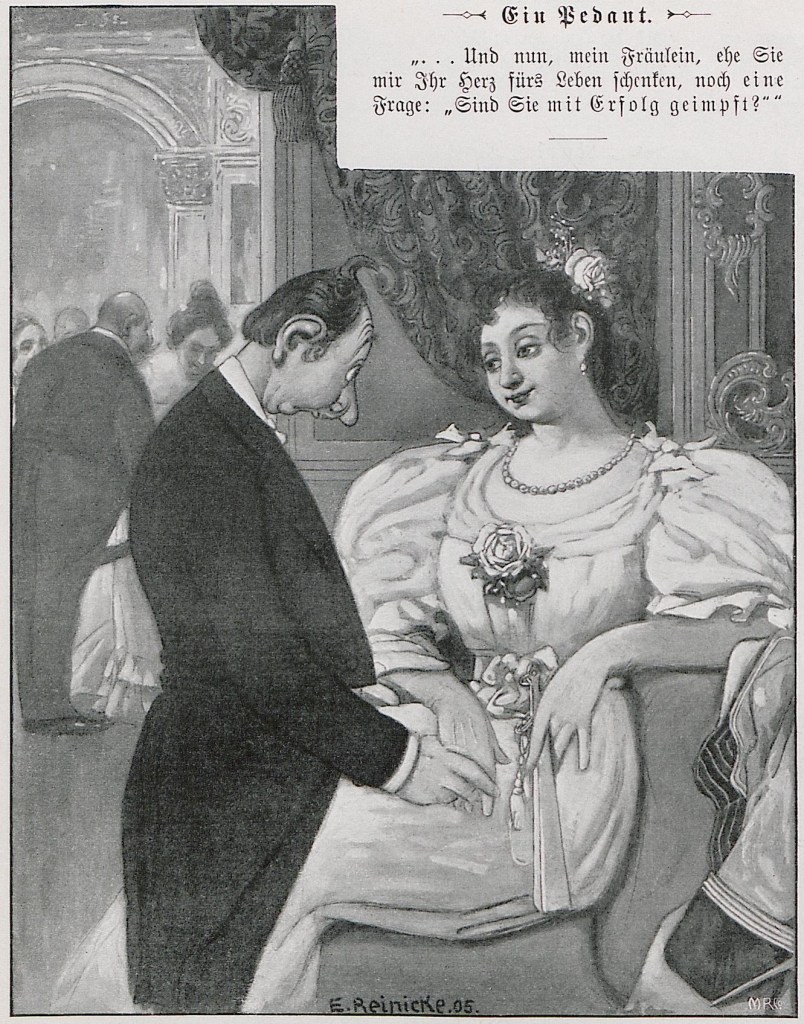
“… And now, mademoiselle, before you grant me your heart for life, one other question: Have you been successfully vaccinated?”
(Fliegende Blätter, Munich, 1905)
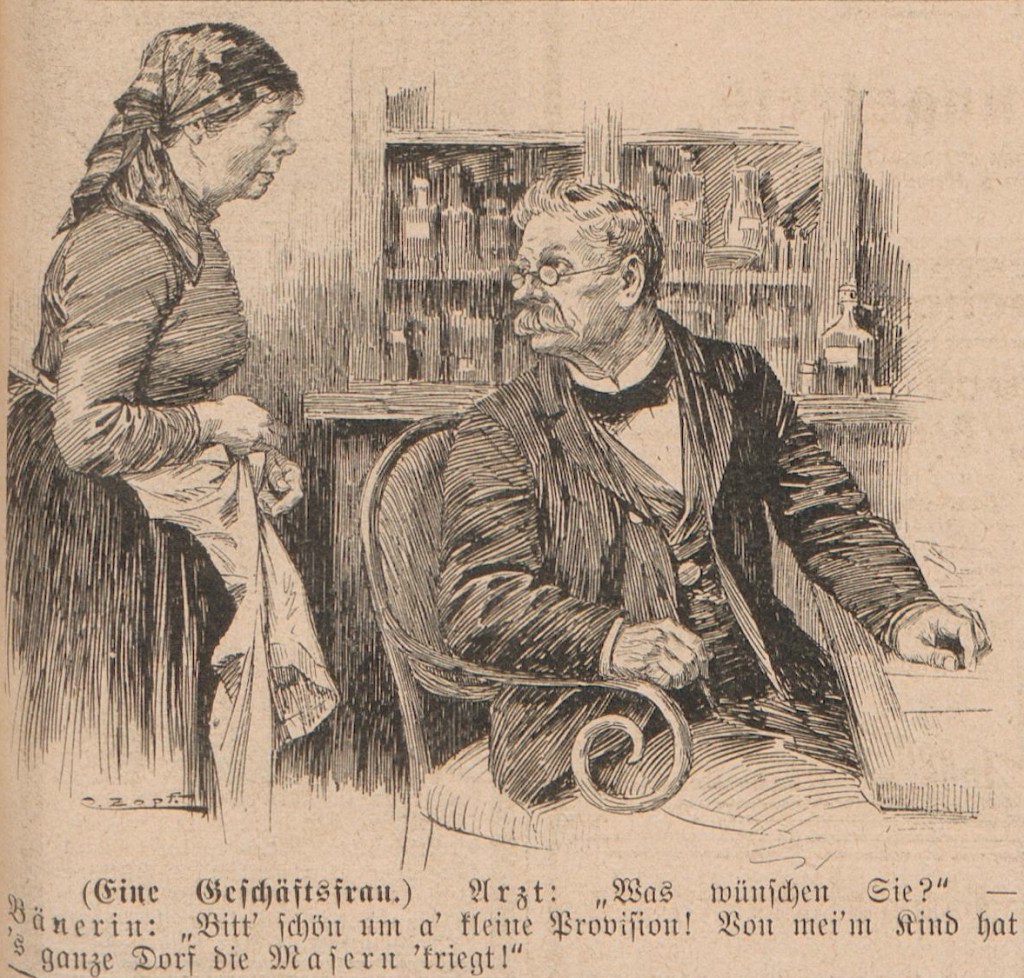
(A businesswoman.) Doctor: “What can I do for you?”
Peasant woman: “Could I have a small kickback? The whole village got measles from my child!”
(Fliegende Blätter, Munich, 1902)
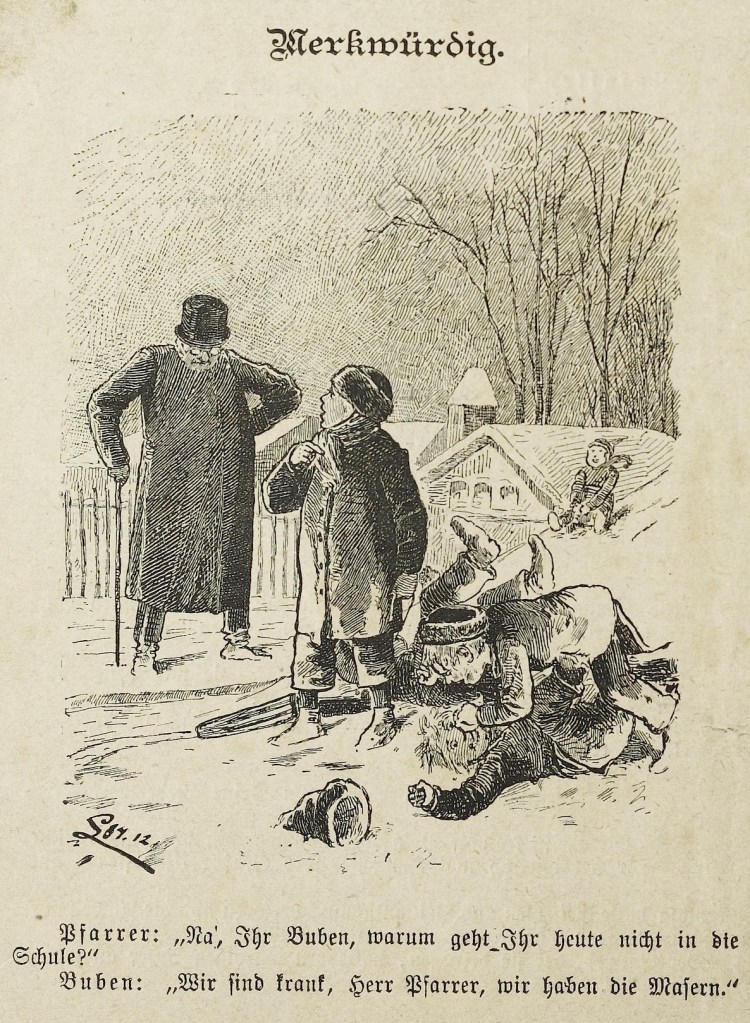
Pastor: “Hey, you kids, why aren’t you going to school today?”
Kids: “We’re sick, Pastor, we have the measles.”
(Fliegende Blätter, Munich, 1884)
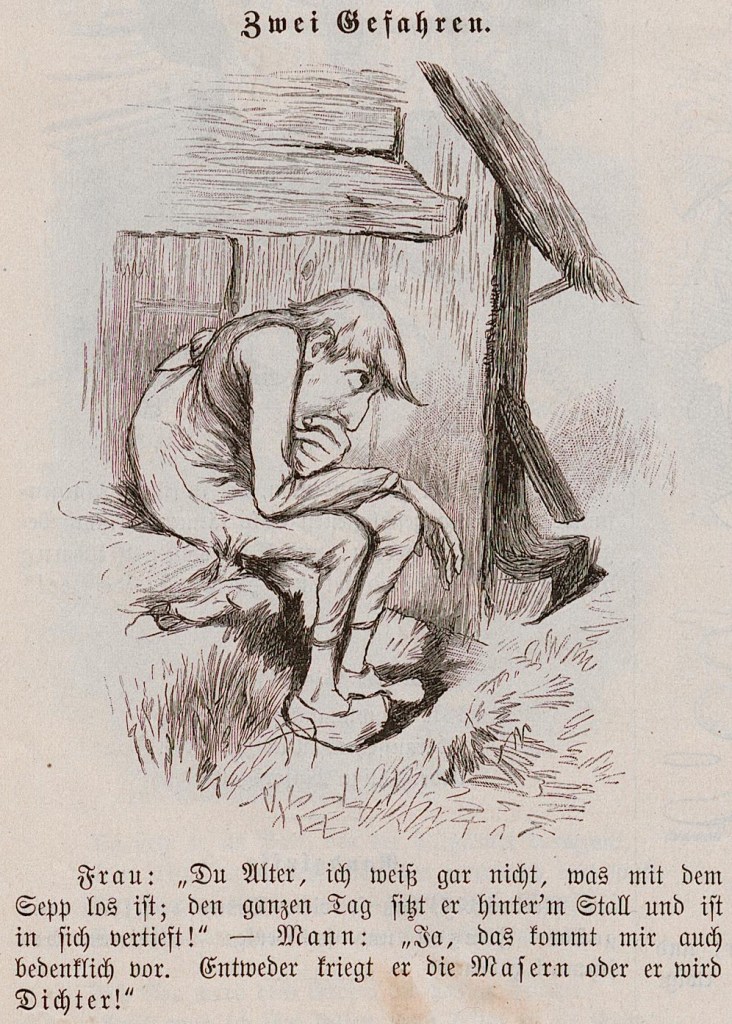
Wife: “Old man, I don’t know what is wrong with Sepp; he sits behind the outhouse all day immersed in himself!!”
Husband: “Yes, this makes me apprehensive. Either he’ll get measles or he’ll become a poet.”
(Fliegende Blätter, Munich, 1887)
Further cholera measures proposed by the health councilor of Die Bremse.
Now that voluntary care for the poor has come to be equipped with the rights of the Council for Care of the Poor, the magistrate has concluded as follows for the general good:
1. The voluntary members caring for the poor will be enclosed by the old Catholic parishioners in public and general prayer.
2. The old Catholics will be disinfected by the voluntary fire department every three days with sulfurous cloths, because it is to be assumed that access to an old Catholic soul has just as many holes and cracks as an old disinfection tube.
3. The mayor commands these disinfections personally and disinfects himself.
4. In this manner the mayor helps himself and the fire department, they in turn help the old Catholics, they in turn help those caring for the poor, while those caring for the poor help cholera.
5. Given the presumed respect of cholera in the face of all these corporations we may fundamentally assume that it will quickly abscond.
6. Should it refuse to cooperate, the police will seize it for violating the authorities and imprison it until further notice.
(Die Bremse, Bavaria, 1873)
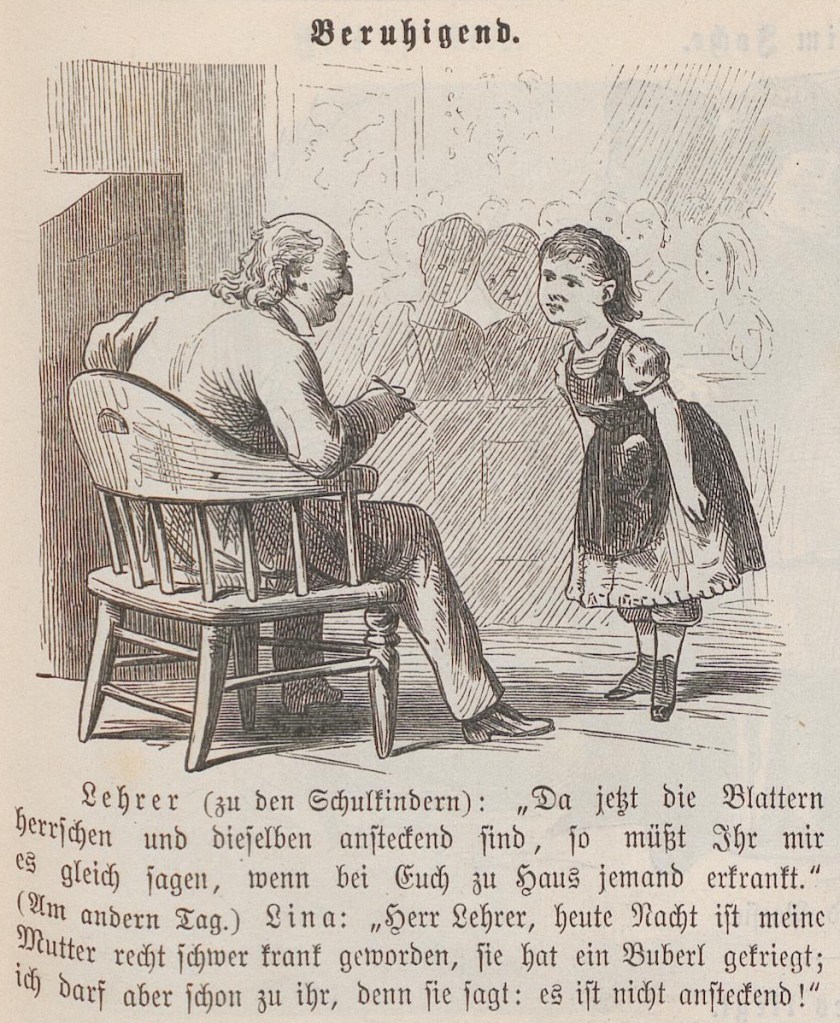
Teacher (to schoolchildren): “Because smallpox is rampant and it is contagious, you must tell me immediately if someone in your home gets sick.”
Lina (the next day): “Mr. Teacher, last night my mother got really sick, she got a little baby; it’s already fine to be around her, because she says that it is not contagious!”
(Fliegende Blätter, Munich, 1874)
 Sic Transit Pestilentia