Office manager: “What! You want three days vacation? Indeed, sir, do you have the cholera?”
(Fliegende Blätter, Munich, 1886)
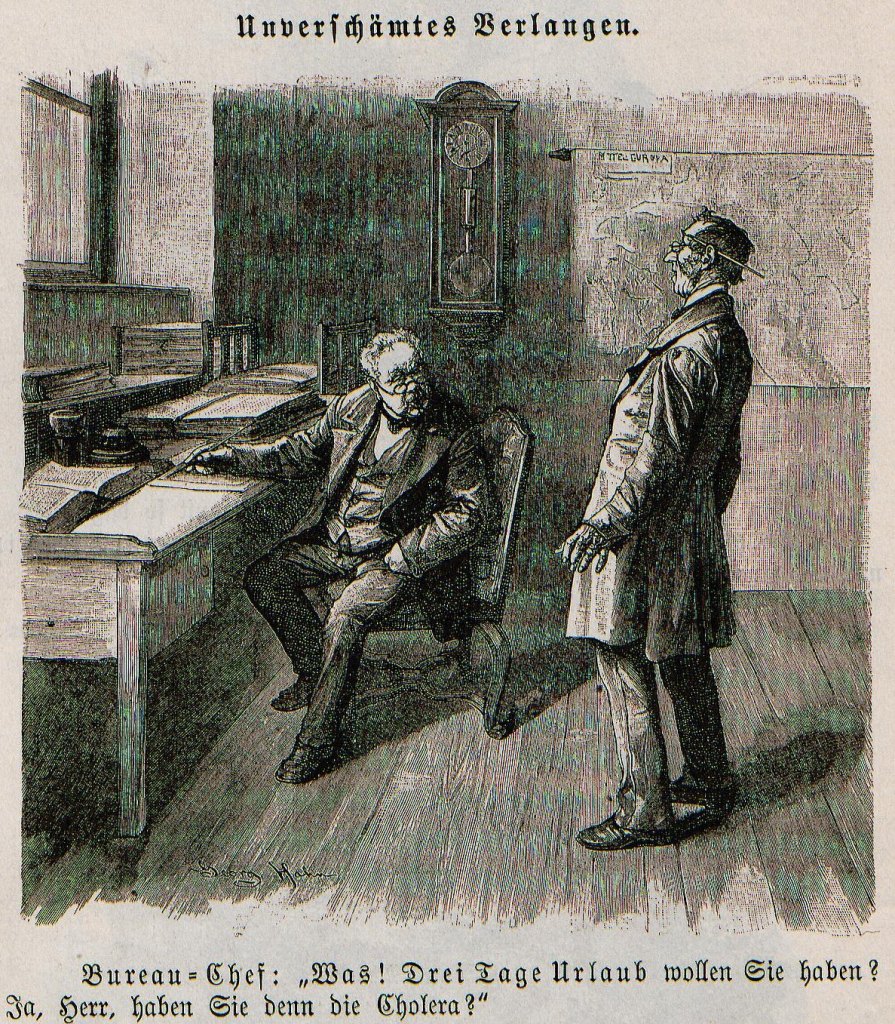
Office manager: “What! You want three days vacation? Indeed, sir, do you have the cholera?”
(Fliegende Blätter, Munich, 1886)
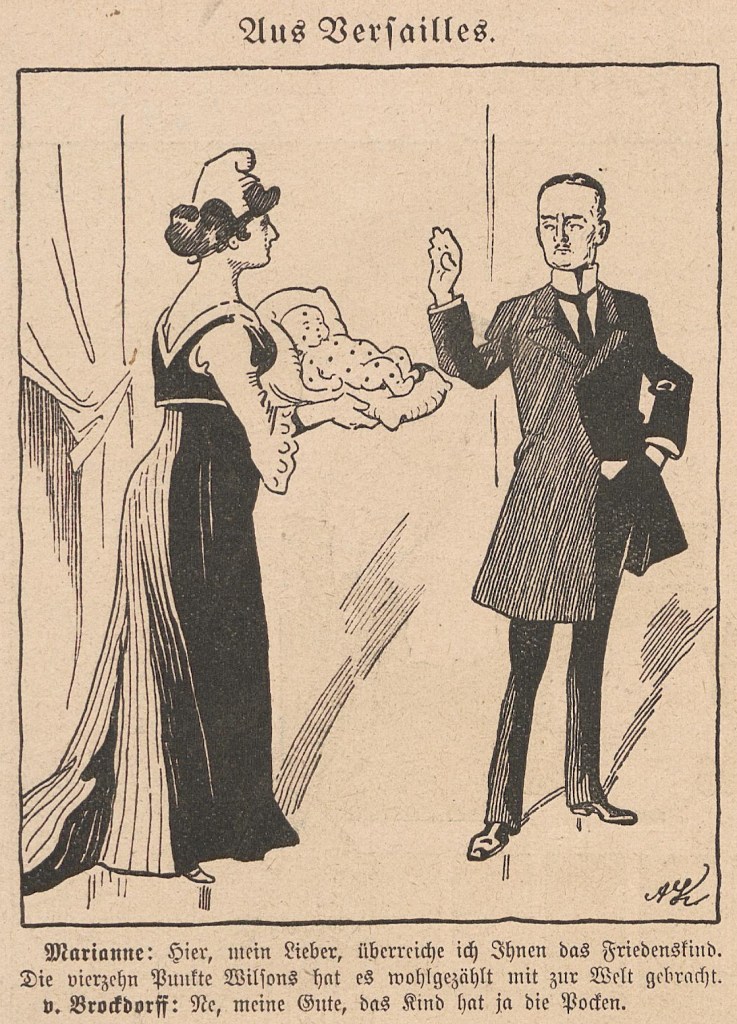
Marianne [the French Republic]: “Here, my dear, may I present you with the peace child. Wilson’s Fourteen Points has brought it well reckoned into the world.”
[Baron] v. Brockdorff [first foreign minister of the Weimer Republic]: “Nope, the child has the pox.”
(Der wahre Jacob, Stuttgart, 1919)
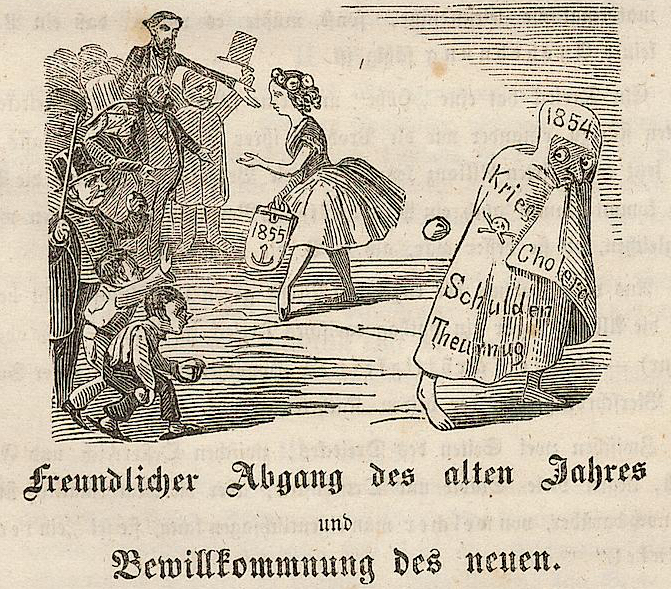
Friendly departure of the old year and welcoming of the new one. (The departing figure is shrouded in War, Cholera, Debts, and Inflation.)
(Punsch, Munich, 1854)
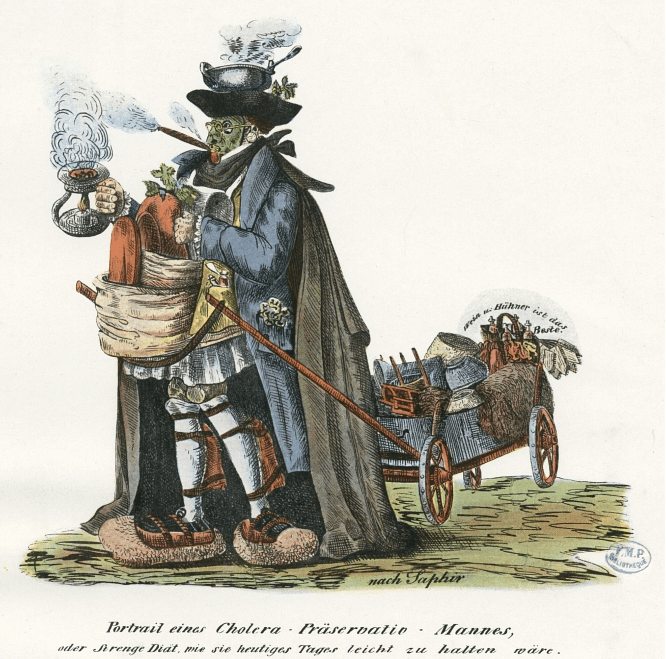
or strict diet as it would be easy to maintain these days.
(Reprinted in Deutsche Medizinische Wochenschrift, 1908; originally 1830s.) (Cf. copy at National Library of Medicine) (And see the female counterpart.) The artist is apparently Peter Carl Geissler.
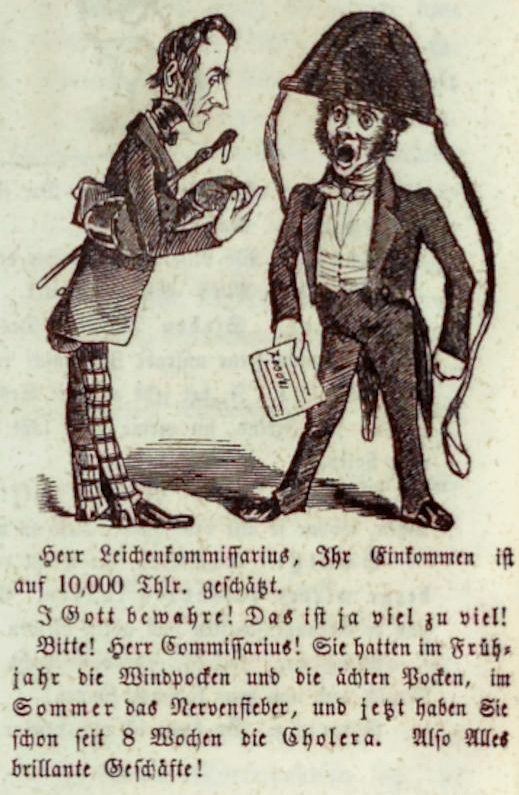
“Mr. Coroner, your income is estimated at 10,000 thaler.”
“God help me! That is far too much!”
“Please, Mr. Coroner! In the spring you had chicken pox and the real smallpox, in the summer you had nervous fever, and now you’ve already had cholera for eight weeks. So it’s all brilliant dealings!”
(Kladderadatsch, Germany, 1850)
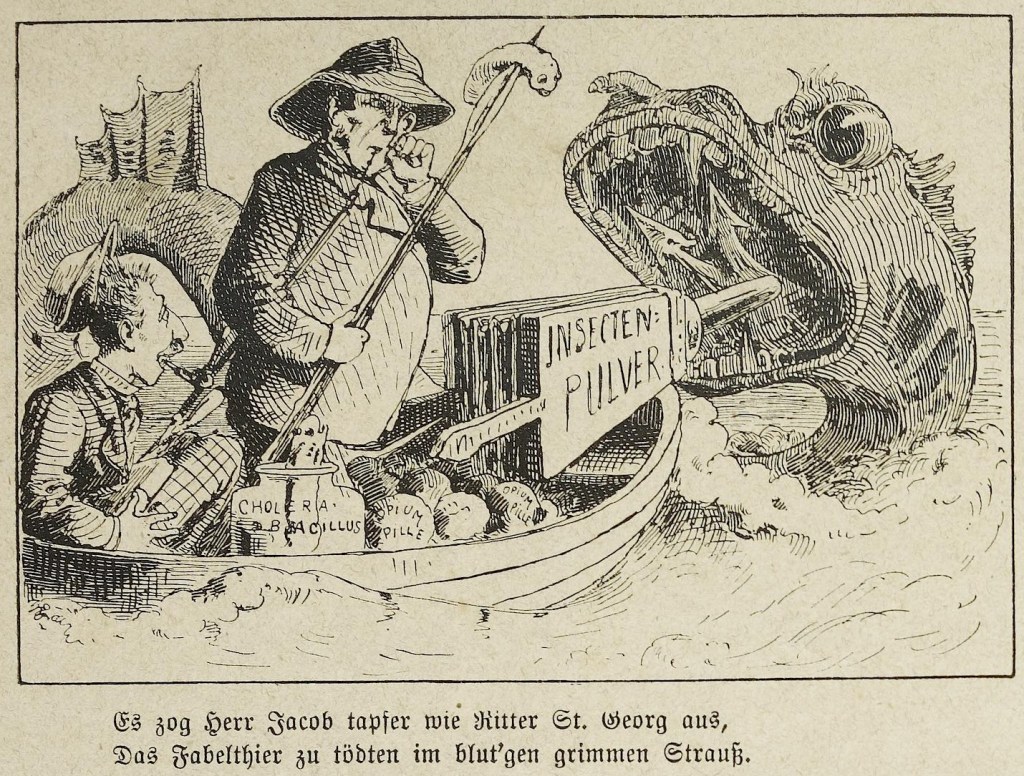
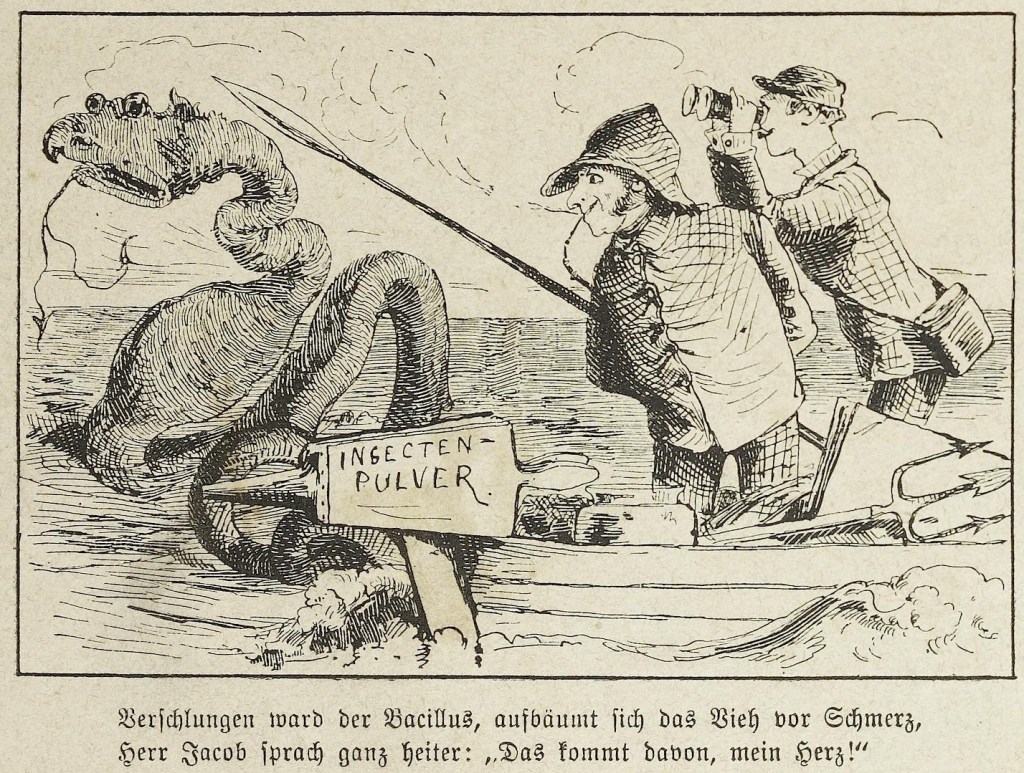
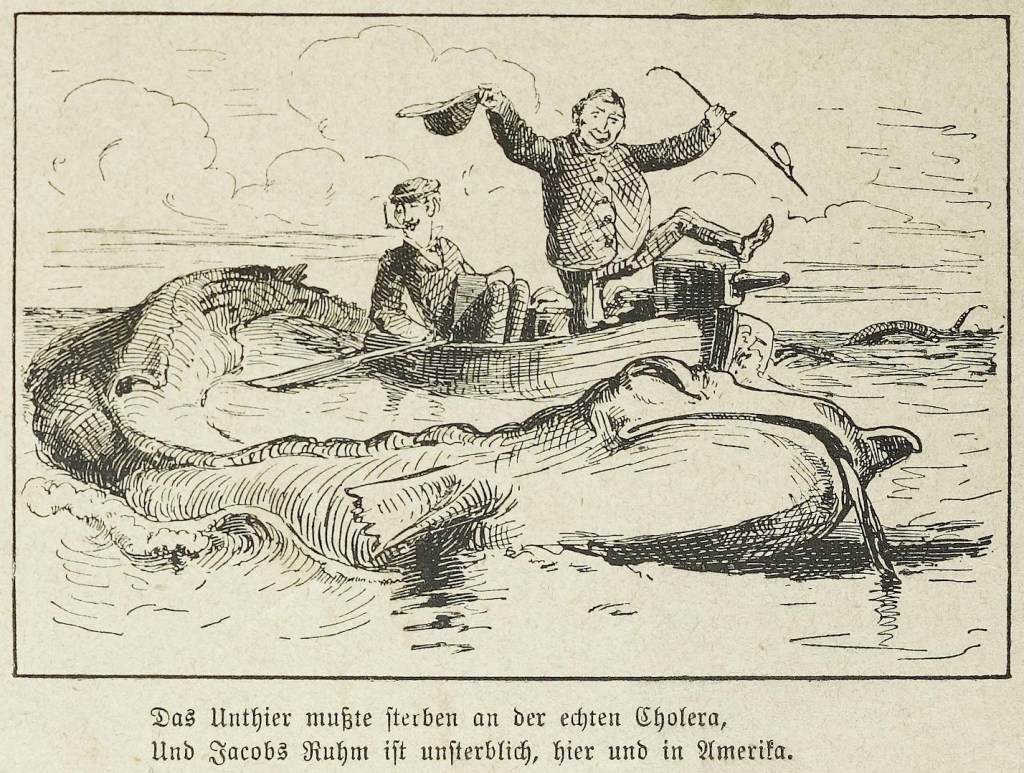
A saga from the early days of germ theory:
Mr. Jacob bravely set forth like St. George the Knight,
To kill the mythical creature in bloody grim spray.
(The boat is laden with cholera bacteria, opium pills, and bellows full of insect dust.)
The sea serpent wanted to snap, Mr. Jacob speedily presented
a Koch bacillus to it, it had enticed the creature.
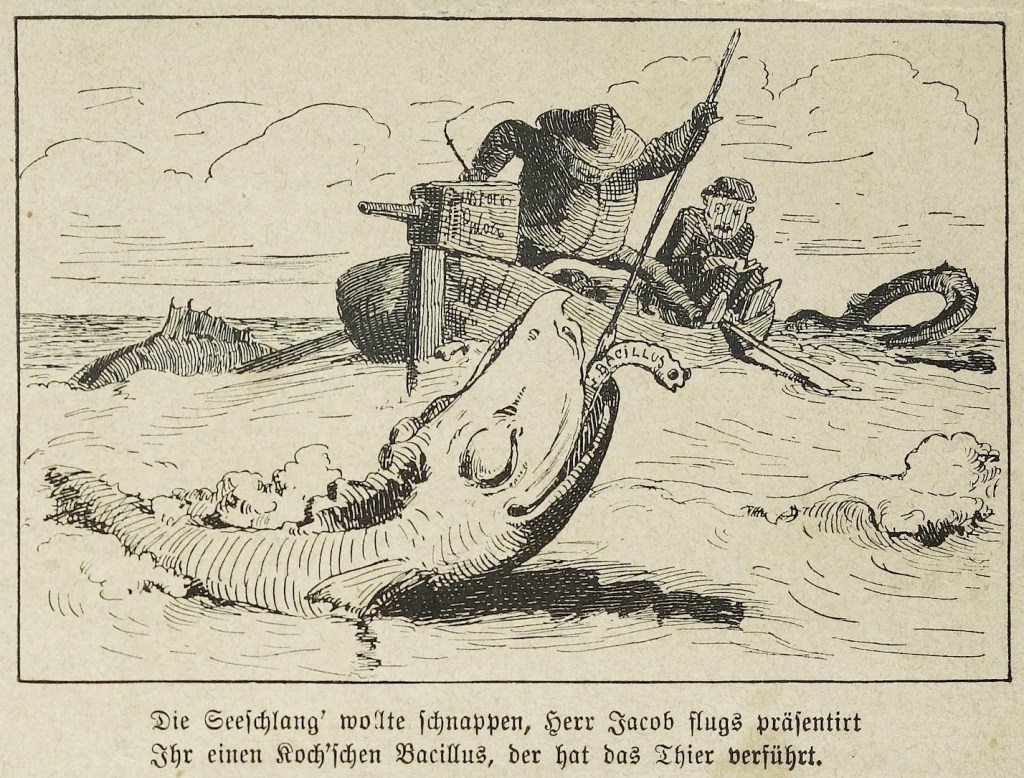
The bacillus was swallowed, the beast reared up in pain,
Mr. Jacob said quite merrily: “It comes from that, my dear!”
The monster had to die from real cholera,
And Jacob’s fame is immortal, here and in America.
(Der wahre Jacob, Stuttgart, 1884)
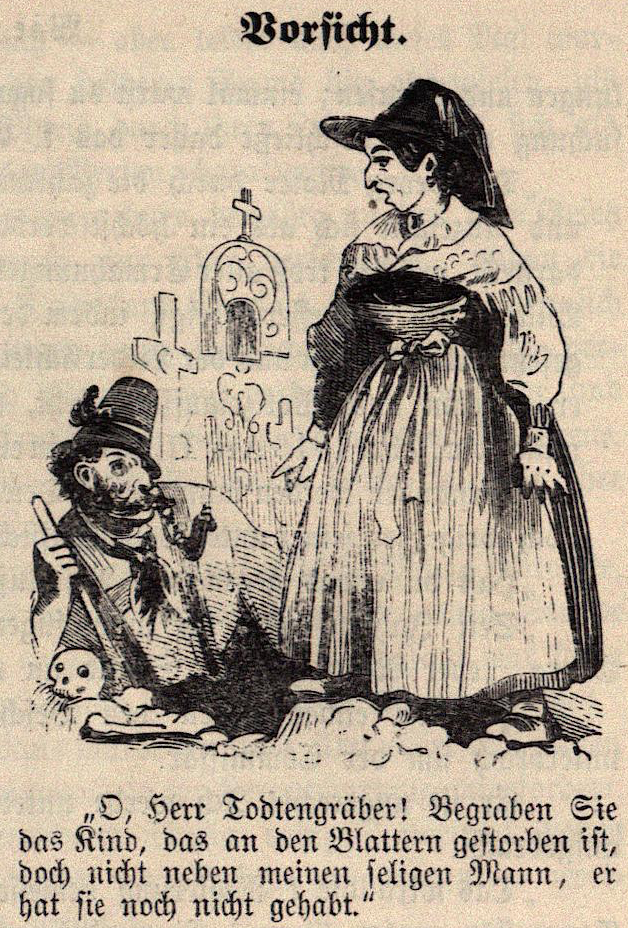
“Oh, Mr. Gravedigger! Don’t bury the child who died of smallpox next to my blessed husband, he hasn’t had them yet.”
(Fliegende Blätter, Munich, 1848)
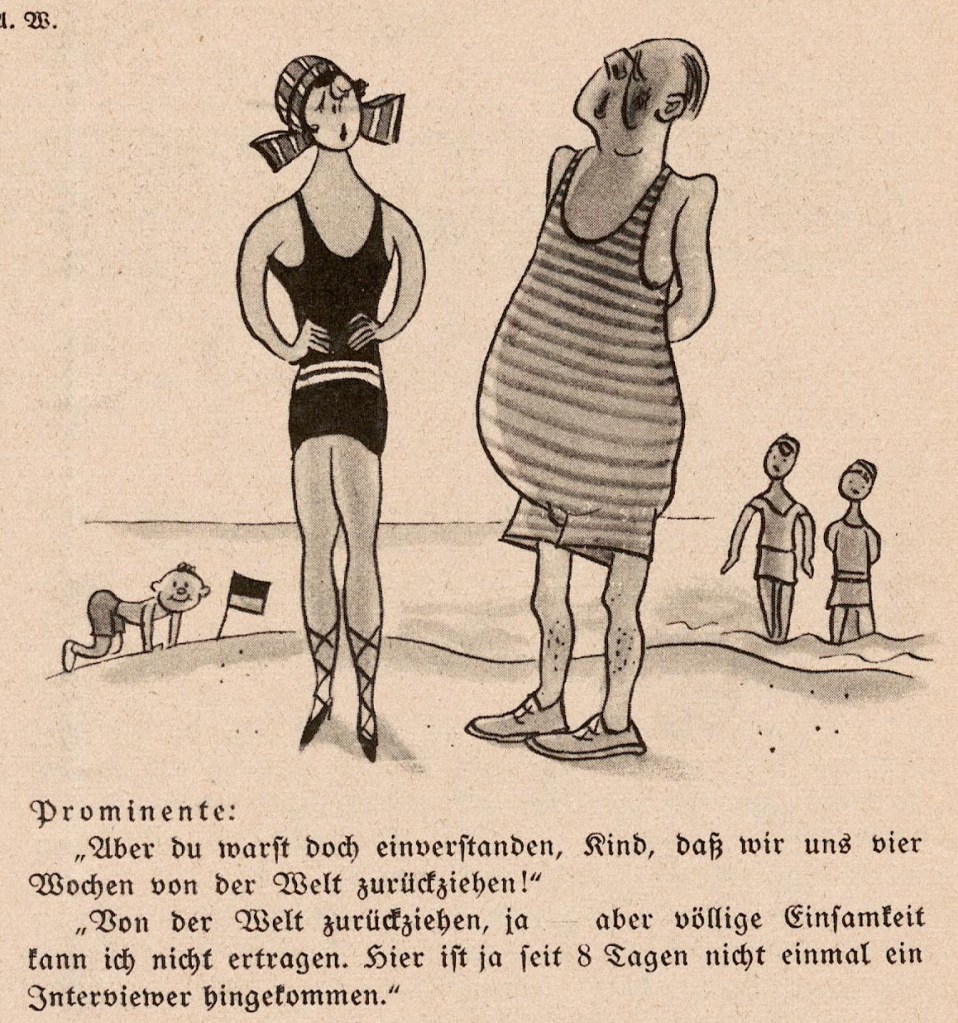
On a lighter note in our time of quarantine:
Man: “But you agreed, my child, that we would retreat from the world for four weeks!”
Woman: “Retreat from the world, sure, but I cannot bear complete solitude. Not a single interviewer has come here for eight days.”
(Fliegende Blätter, Munich, 1931)
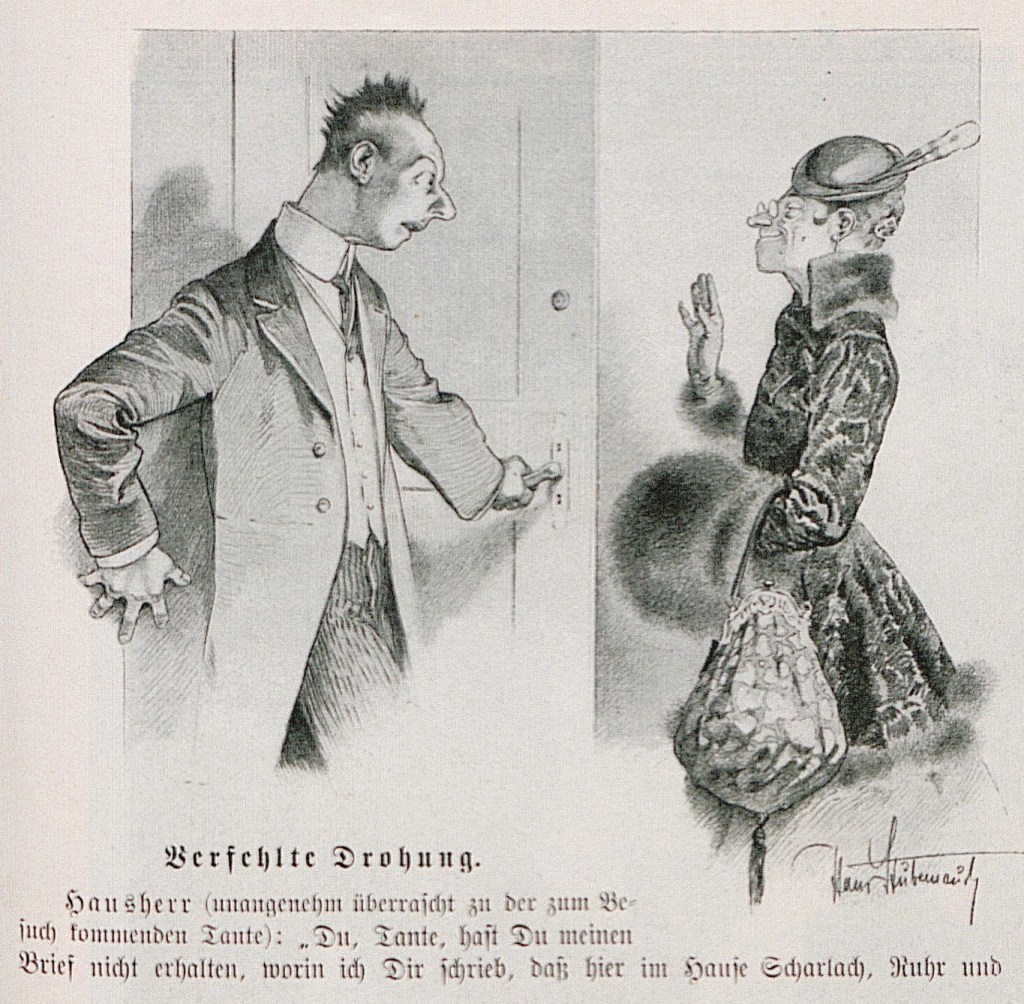
Landlord (unpleasantly surprised by visiting aunt): “Aunt, didn’t you get my letter where I wrote to you that scarlet fever, dysentery, and smallpox are prevalent in the building?”
Aunt: “It’s nothing, dear young man… I had myself vaccinated against all three diseases!”
(Fliegende Blätter, Munich, 1916)
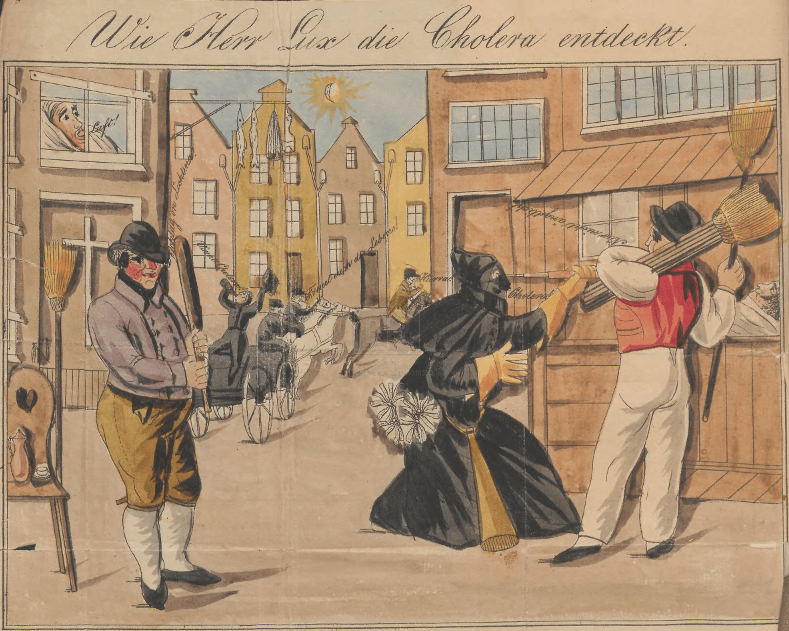
Frontispiece from a booklet published during the 1831 cholera epidemic. The man in the window (upper left) cries “Air!” The man on the street below him wants to beat something that has “light” as the root, but I can’t make out the final letters. (A Dutchism?) The woman in black enjoying her alcohol is crying “Long live cholera!” The men on horses are calling on everyone to enjoy life. The man in the red vest is saying “No need for concern,” while the well-protected Mr. Lux in black hood and gown has identified cholera with his telescope. Despite the didactic title, this is actually a booklet of light verse addressed to cholera: “And should you head off track to us, then you will soon know: We’ll remain strong, but you are weak!”
Wilhelm Schumacher, Most comprehensible and reliable instructions on the dangerous, plague-like disease cholera morbus. Provided with a recipe that teaches the safest means of protection against cholera, and surpasses and makes superfluous all the books that have already appeared and may still appear. According to the main medical results of experiences carefully compiled in India , Persia, Russia and Poland (Danzig, n.d. [1831]).
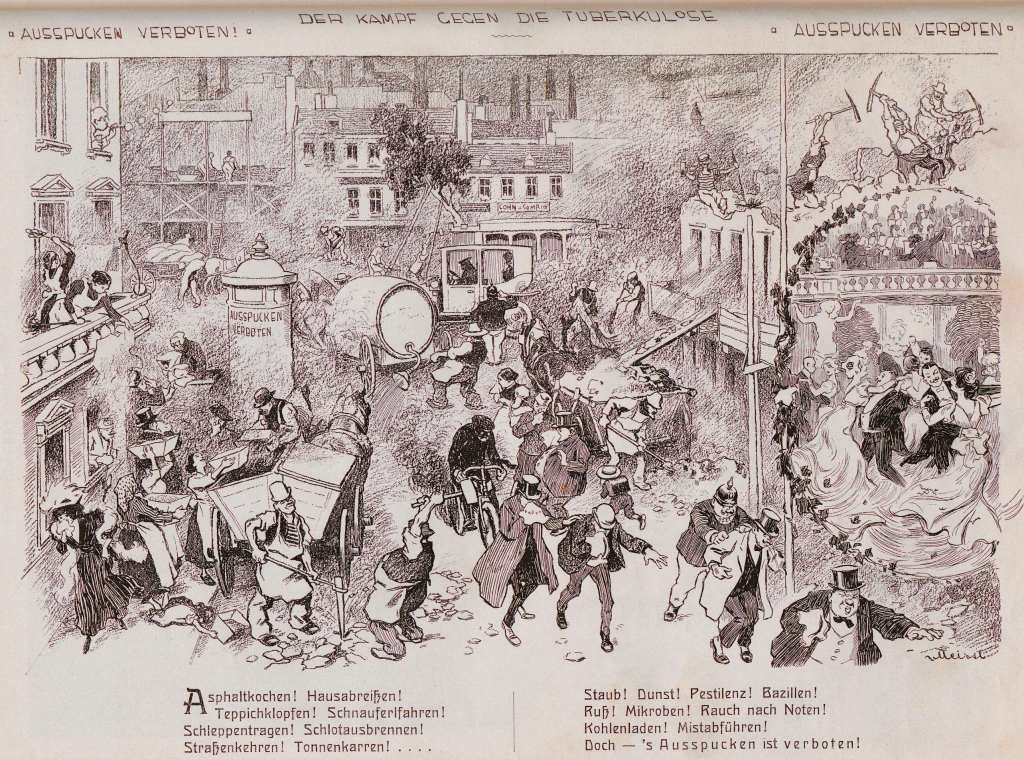
Spitting is not permitted!
Cooking asphalt! Demolishing houses!
Beating carpets! Driving a car!
Dragging a train! Chimney cleaning!
Street sweeping! Barrel carting!
Dust! Fumes! Pestilence! Bacteria!
Rust! Microbes! Smoking at the break!
Loading coal! Carting away manure!
But — spitting is not permitted!
(Fliegende Blätter, Munich, 1908)
Professor: “… It is not rare for diseases to exist in the human body which go entirely unmarked for years at a time.”
(after the lecture)
“Why are you so quiet today, dear Flora?”
“Oh, dear Mama, I will die soon, I just know it, I have consumption!”
“But why would you get such a strange idea, you’ve never complained about any pains!”
Flora (crying): “That’s just it, I don’t feel anything at all!”
(Fliegende Blätter, Munich, 1873)

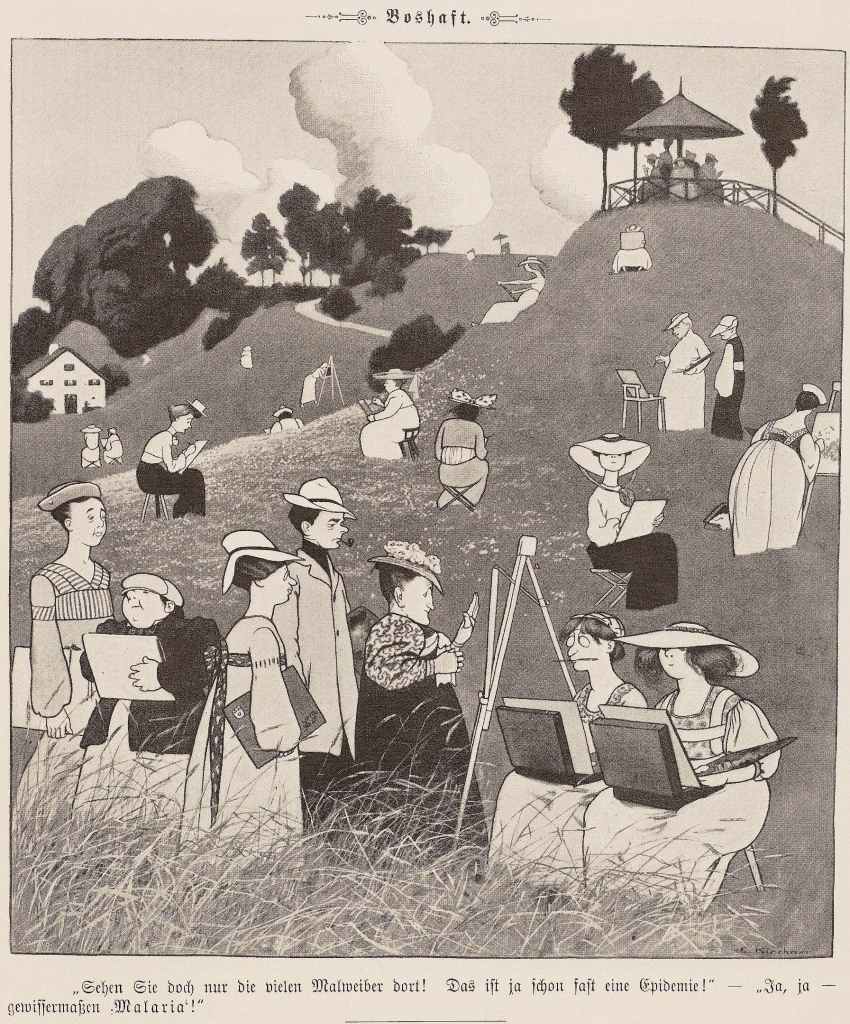
Title: “Malicious.” This image relies on some punning in German, where malen means drawing or painting, and Malweiber is a somewhat derogatory way of referring to women who draw. “Just look at all those women drawing over there! It’s already practically an epidemic!” “Yes, yes, in a way it’s ‘malaria’!”
(Fliegende Blätter, Munich, 1907)
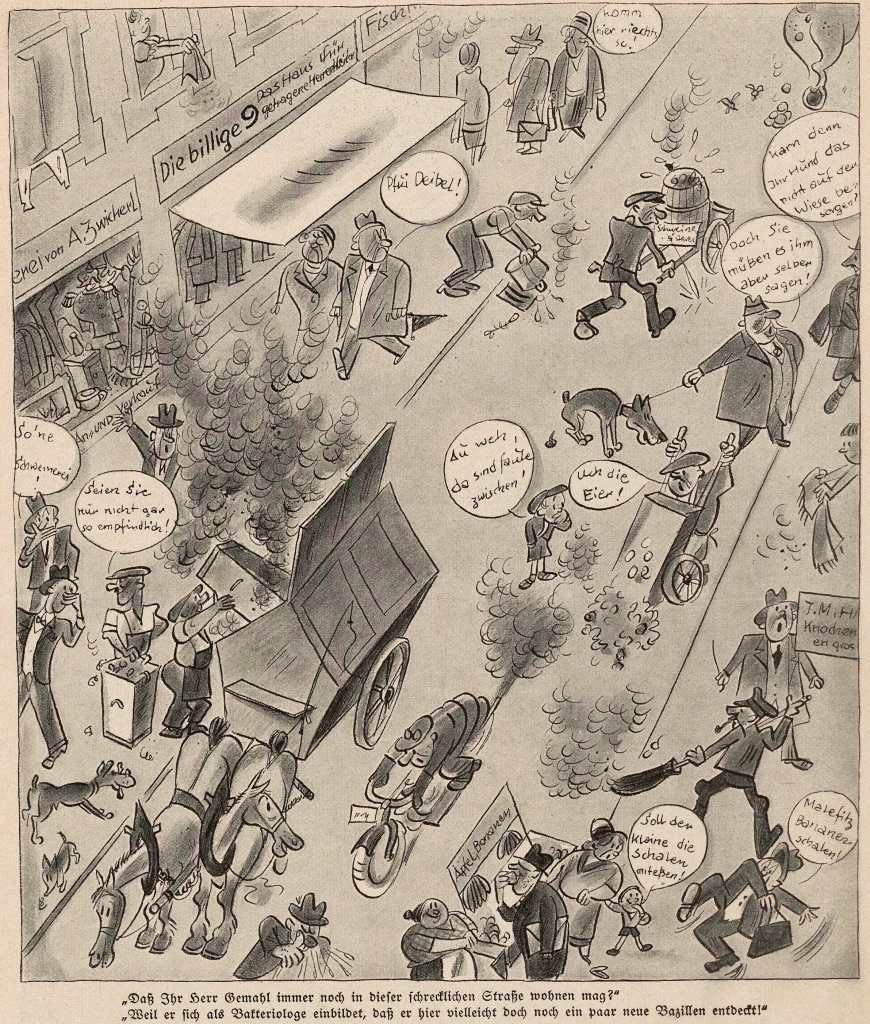
“How can your husband stand to live on this awful street?”
“Because he fancies himself to be a bacteriologist who might be able to discover a few more new bacteria still!”
(Fliegende Blätter, Munich, 1934)
Subtitled “On the vaccination debate.” Three quacks: “Listen, boy, there’s no other way! You have to get inoculated either against the black or the blue or the red pox.” It would be an interesting comparative exercise to study when vaccination is sufficiently widespread that it can be appropriated as a readily understood political metaphor (black conservative, blue centrist, and red social democratic, respectively).
(Kladderadatsch, Germany, 1914)

 Sic Transit Pestilentia