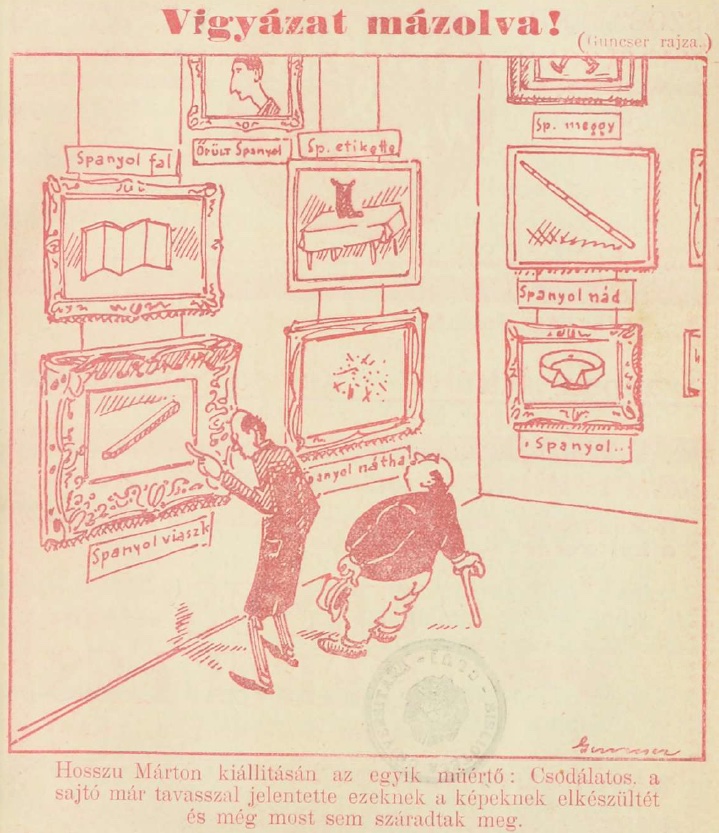
One of the connoisseurs at Márton Hosszu’s exhibition [where various Spanish objects are on display. Hosszu (b. 1894) had recently returned from a pilgrimage to Spain. The picture in front of the rotund man is labeled “Spanish flu.”] “Amazingly, the press already announced the completion of these images in the spring and they still haven’t dried.” (Vágóhíd, Kolozsvár-Cluj, 1926)
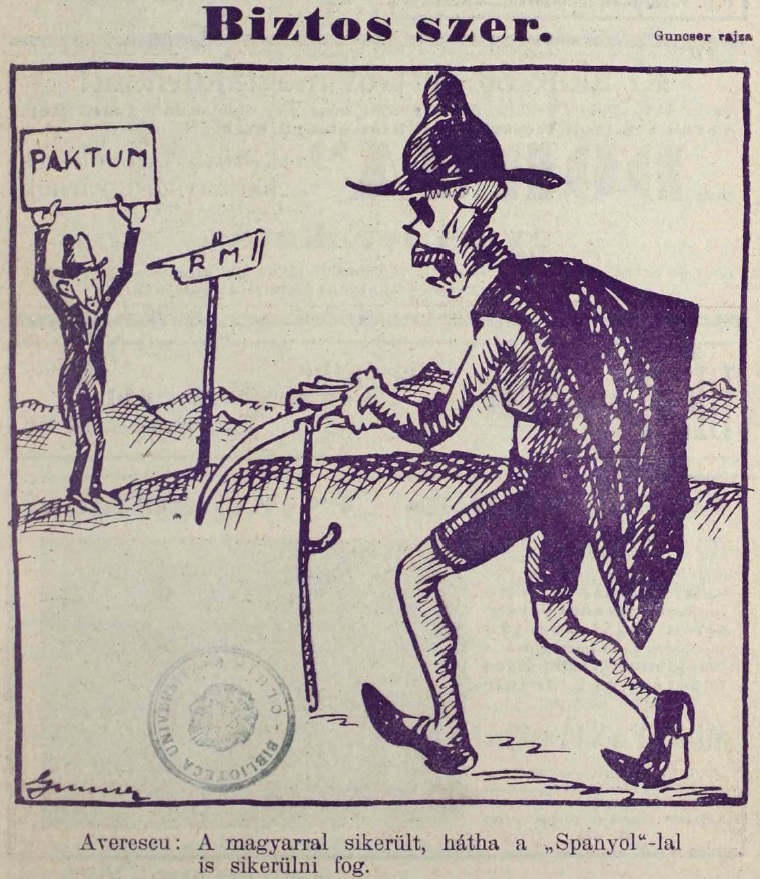
Early in 1927 influenza was resurgent in the Danube region. A young Otto von Habsburg, the nominal king of Hungary then in Spanish exile, contracted pneumonia after a bout of the flu, which was still frequently referred to as the “Spanish epidemic” in Hungarian. King Ferdinand of Romania caught the flu as well, unsettling domestic politics. The previous year, Ferdinand has been instrumental in returning General Alexandru Averescu to the premiership as head of the People’s Party. Averescu proceeded to cozy up with Mussolini’s Fascist Italy. Several months after the appearance of this cartoon, Ferdinand would die from what turned out to be cancer, but not before helping unseat Averescu.
Averescu: “It worked with the Hungarian, maybe it will work with the “Spanish” as well.” (Vágóhid, Kolozsvár-Cluj, 1927)
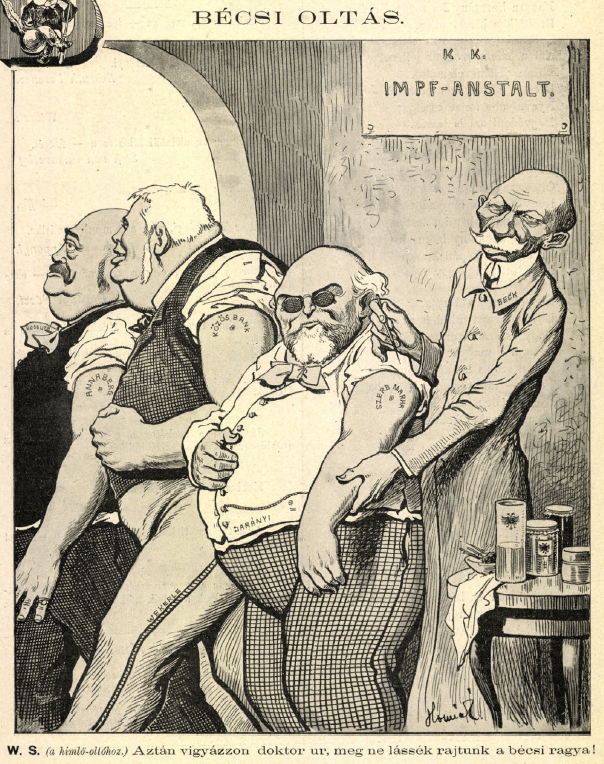
At the Imperial Royal Vaccination Institute [Austrian prime minister Count Max von Beck administering the shots to Hungarian ministers] Hungarian prime minister Sándor Wekerle [second from left] (to the smallpox inoculator) “Take care then, Doctor, we don’t want to be seen with the Viennese pock on us!” (Borsszem Jankó, Budapest, 1907) (The decadal negotiations to renew the 1867 Compromise between the Austrian and Hungarian halves of the Habsburg Empire were exceptionally contentious in 1907. The electoral franchise was broader in Austria than it was in Hungary, and Beck threatened to extend it to the Transleithanian portion of the empire, which would have threatened the ability of Hungarian politicians to control the fractious minorities who slightly outnumbered the Hungarian population. The mark on Minister of Agriculture Ignác Darányi’s shoulder reads “Serbian livestock,” signaling grudging Hungarian accession to a common tariff agreement, while Wekerle’s reads “common bank,” i.e., shared currency.)
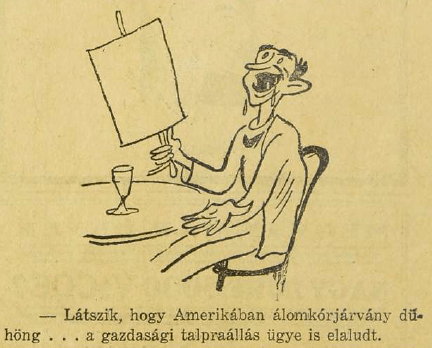
“It seems that a sleeping sickness epidemic is raging in America… the business of economic recovery has also fallen asleep.” (Az Ojság, Budapest, 1933)
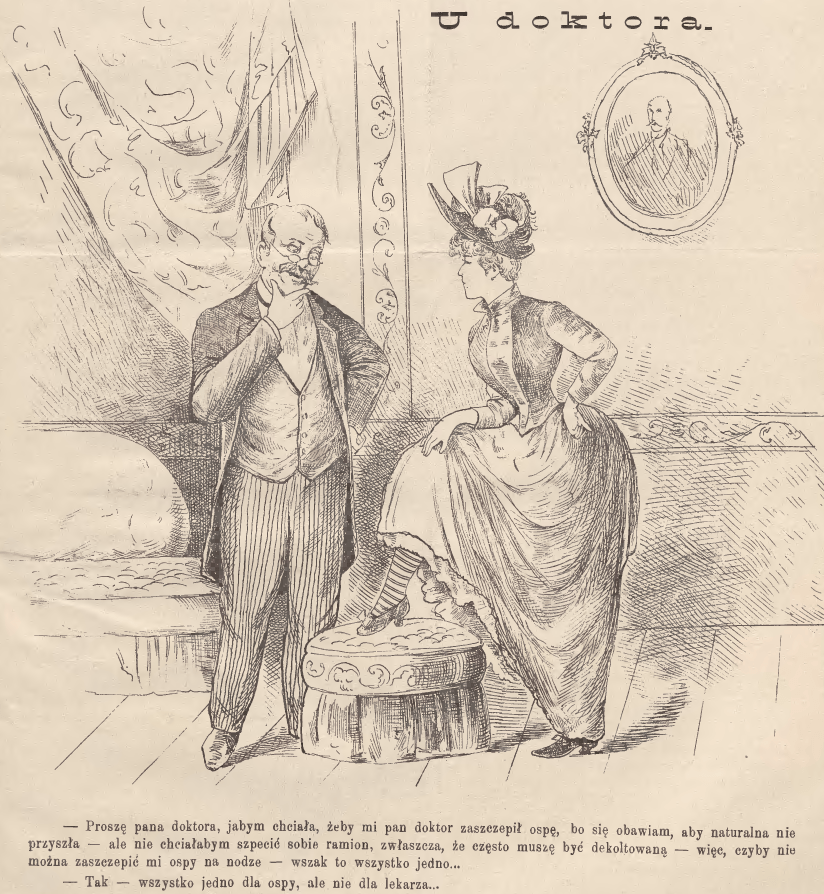
“Please, doctor, I would like you to inoculate me with [attenuated] smallpox, because I am afraid of getting the real thing. But I wouldn’t want to disfigure my shoulders [with a vaccination scar], especially since I often have to show décolletage. So can’t I be inoculated for smallpox on my leg? After all, it is all the same thing…” “Yes, it’s all the same for the smallpox, but not for the doctor…” (Goniec i iskra, Lwów, 1891)
Polish smallpox cartoon
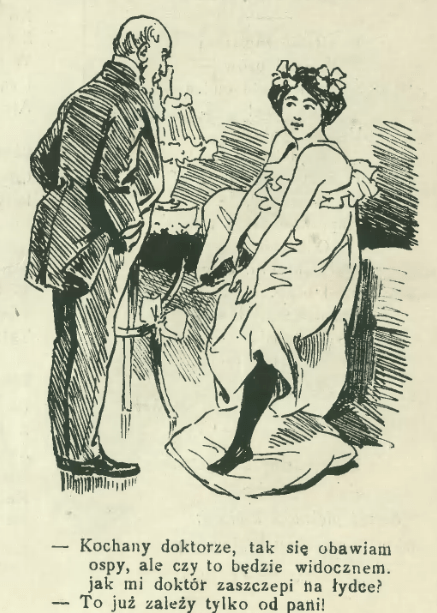
And a similar cartoon some years later: “Dear doctor, I am so afraid of smallpox, but will it be visible when you inoculate on my calf?” “It only depends on you!” (Kolce, Warsaw, 1908)
Polish smallpox cartoon
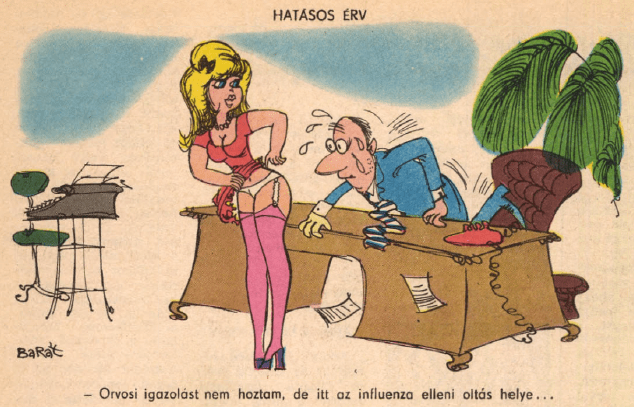
In the same sexist vein, a Hungarian cartoon: Effective argument “I didn’t bring the medical certificate, but here is the location for the flu vaccination…” (Ludas Matyi, Budapest, 1974)
Hungarian flu cartoon
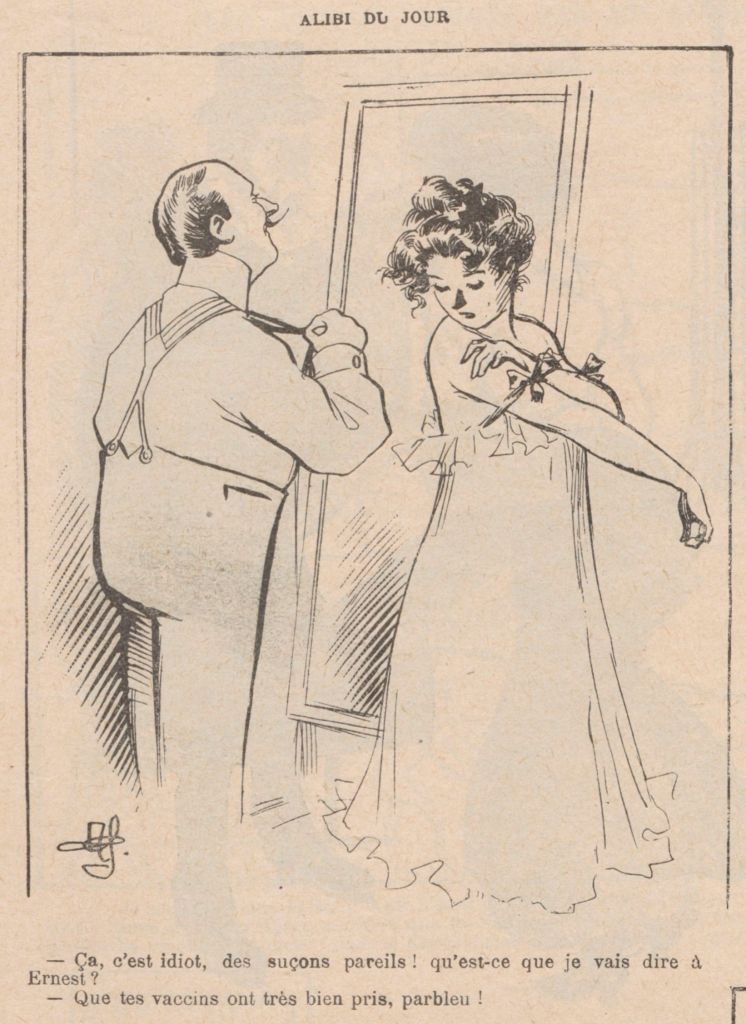
Or another twist: Alibi ju jour “This is silly, hickeys like that! What am I going to tell Ernest?” “That your vaccines have taken very well, by Jove!” (Le Rire, Paris, 1907) (Another French cartoon with related themes. And another from 1920.)
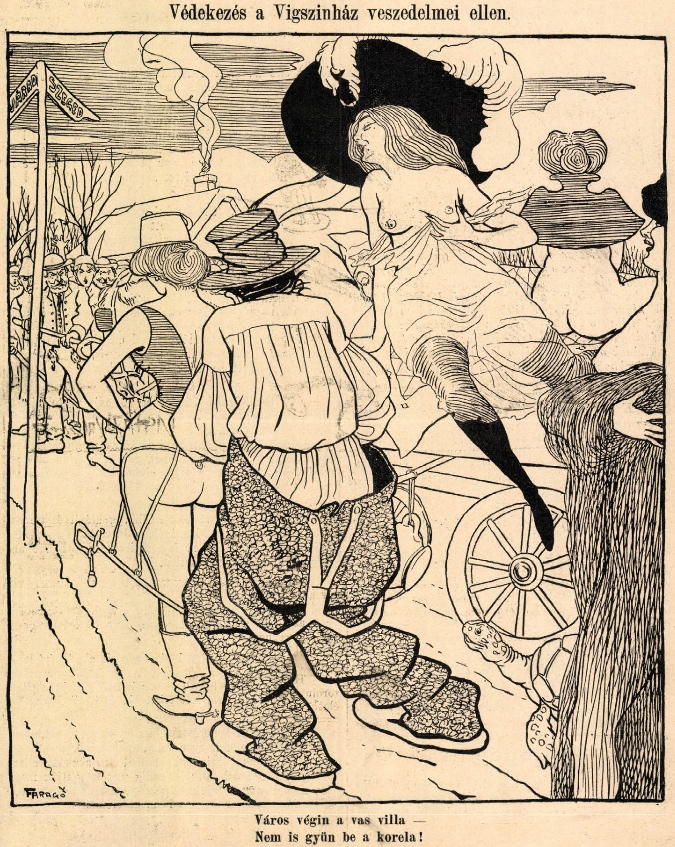
(The Vigszinház or Comedy Theater was generally the most popular in Budapest.) The pitchfork at the city outskirts — Even chorela doesn’t come in! (The orthography signals something other than high diction. Note the phonetic metathesis of “cholera.” Contemporaries would have understood the reference to a folksong lamenting that cholera didn’t affect lords or priests, only the poor peasants.) (Borsszem Jankó, Budapest, 1900)
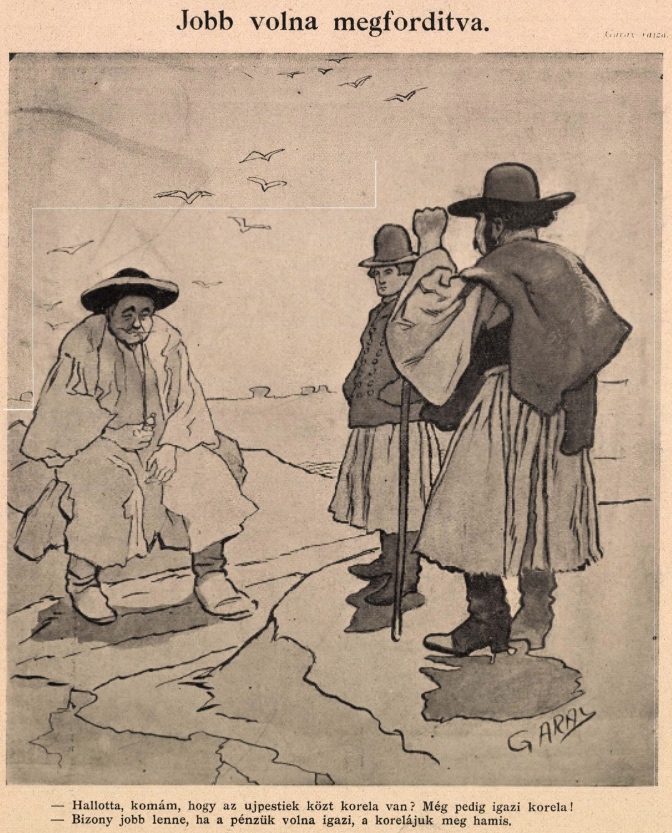
“Pardner, did you hear that there is chorela [cholera] among the people of Újpest? Even real chorela!” “Surely it would be better if their money was real and their chorela fake.” (Újpest, or New Pest, was a recently-incorporated town on the north side of Budapest proper, and a higher proportion of its residents were Jewish, though not from the bourgeois elite.) (Kakas Márton, Budapest, 1911)
Influenza, obstruction, This situation is already appalling! Our nose grew like a tower, We are failing, abbiony! (Bolond Istók, Budapest, 1889) (I hesitate to post this one, since I don’t grasp the context adequately, e.g., the figures blowing wind, or the term “abbiony,” which is not in any dictionary, but shows up multiple times in this journal. It might actually be an informal acronym for its readers.)
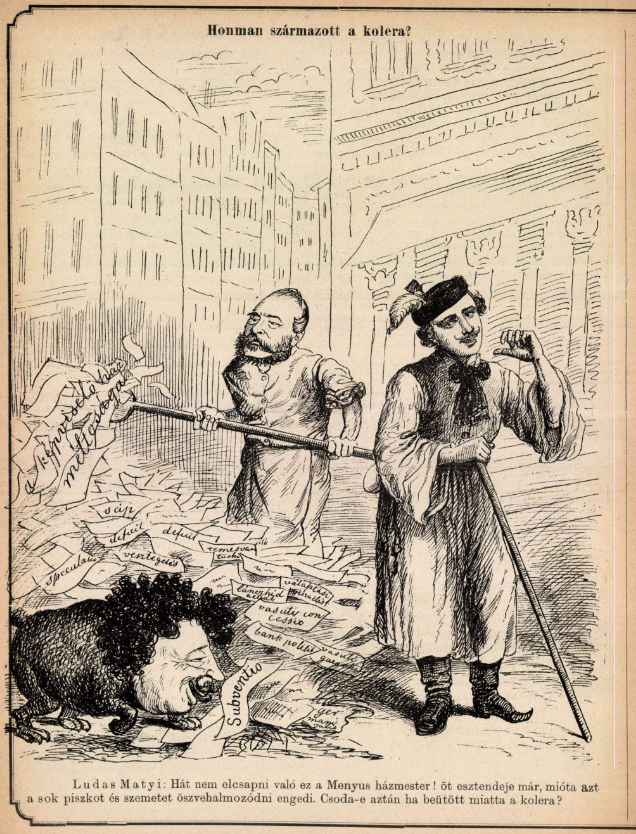
Mattie the goose-boy (mascot of the eponymous Hungarian satirical magazine): “Well, you can’t beat this Menyus housekeeper! He’s been around for years, letting all this dirt and garbage accumulate. Is it any wonder cholera has struck him?” The man (“Menyus”) with the pitchfork tossing out the “dignity of parliament” is Prime Minister Baron Menyhért Lónyay, a frequent object of ridicule in this magazine due to the corruption that plagued his brief tenure. The pieces of paper refer to speculation, deficits, losses, railroad concession, subventions, bank politics, etc. I can’t say anything specific about the anti-semitic caricature in the lower left, though we may presume it is meant to represent stereotypical Jewish banking interests. (Ludas Matyi, Budapest, 1872)
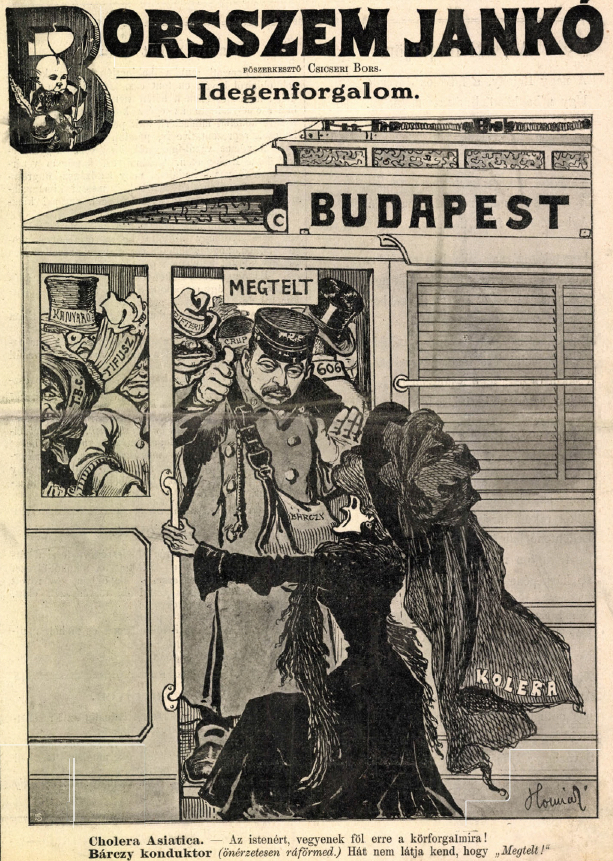
(Riders of the tram include measles, tuberculosis, typhus, diphtheria, croup, and syphilis–the “606” signals Ehrlich’s Salvarsan remedy.) Cholera Asiatica: “For heaven’s sake, let me onto this route!” [Budapest mayor István] Bárczy the Conductor (confidently denigrating her): “Well, don’t you see the sign saying it’s ‘Full!’?” (Borsszem Jankó, Budapest, 1910)
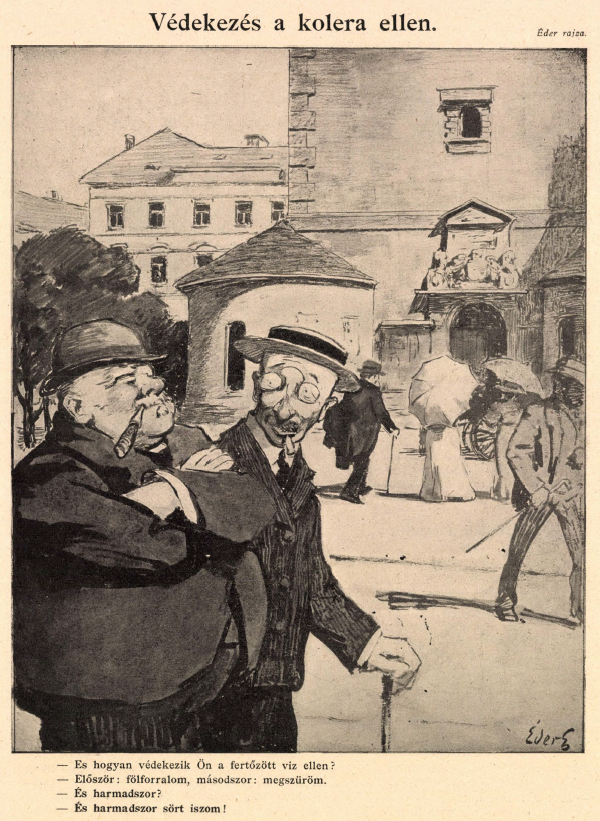
“And how do you protect yourself against contaminated water?” “First of all: I boil everything, second: I sip it.” “And third?” “And third I drink beer!” (Kakas Márton, Budapest, 1910)
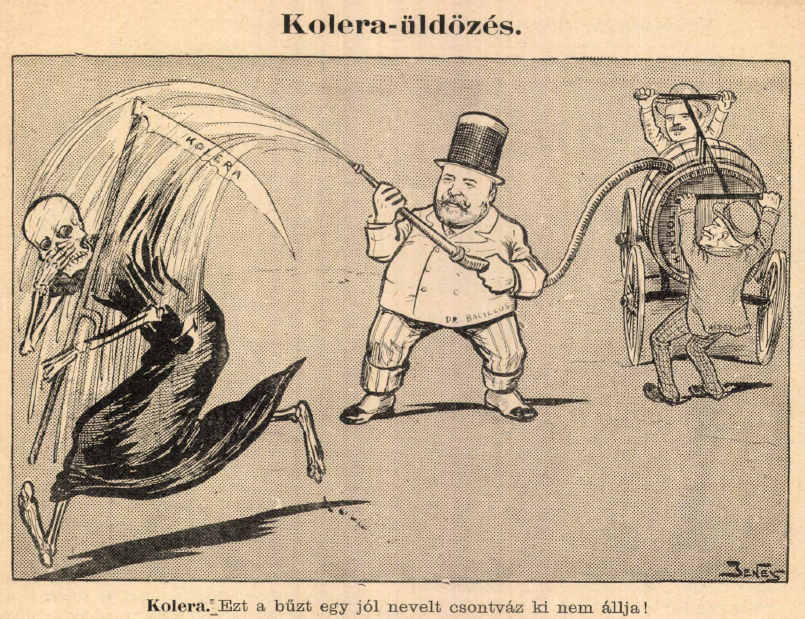
(Dr. Bacillus is spraying carbolic acid solution on the streets of Budapest.) Cholera: “A well-bred skeleton does not tolerate such a stench!” (Bolond Istók, Budapest, 1910)
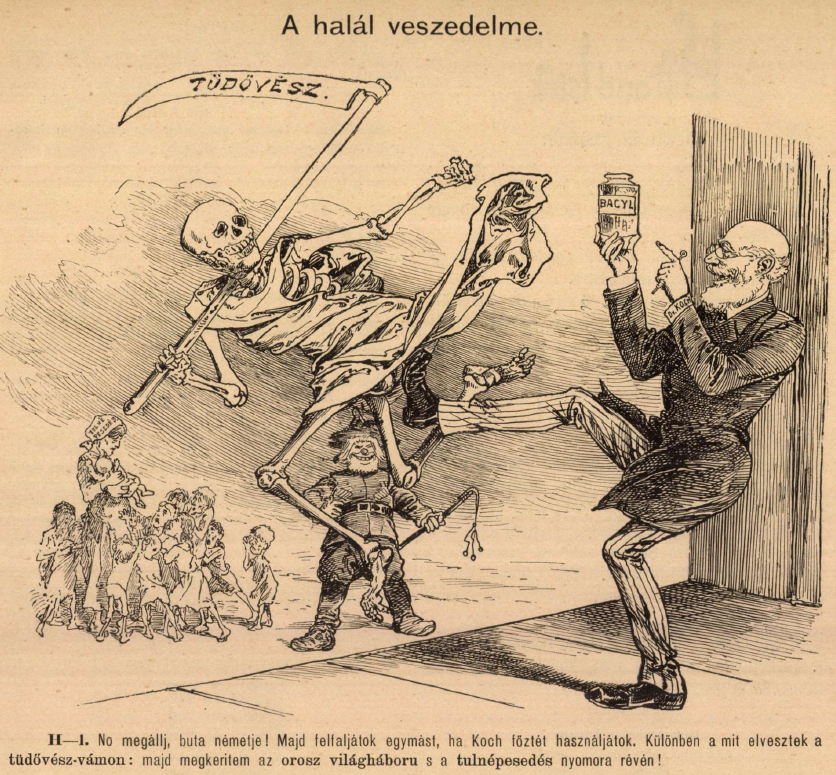
Death: “Well, stop it, silly German! You’re about to devour each other if you use Robert Koch’s concoction. Anyway, whatever I lost in my tuberculosis tariff, I will get hold of through the misery of the Russian world war and overpopulation!” (A reference to the Russian repudiation of alliances with Germany and Austro-Hungary in favor of France, its failed politics in the Balkans, and renewed tensions with imperial Britain in Central Asia.) (Bolond Istók, Budapest, 1890)


 Sic Transit Pestilentia