Waiting for cholera, lurking, Day and Night are keen competitors. There’s no cholera and they moan: lo, All the crooning comes to nothing. (Borsszem Jankó, Budapest, 1910) (French operetta composer Charles Lecocq opened Le jour et la nuit in 1881, featuring a somewhat racy farce of concealed nuptial identities. The Hungarian premier, under the title “Sun and Moon,” came in Debrecen in 1884, while a 1899 Budapest production seems to have become a modest staple of the repertoire for a time, enough so that Budapest readers would have appreciated the rhymed couplets here. The return of cholera in 1910 proved not to be as deadly as the experience of 1892.)
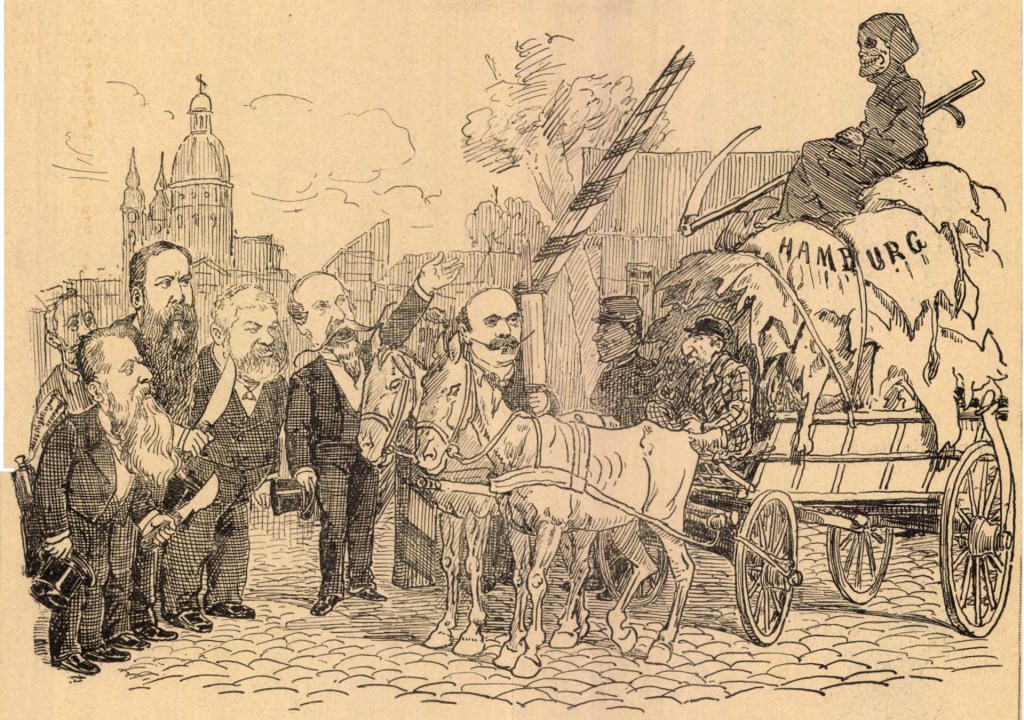
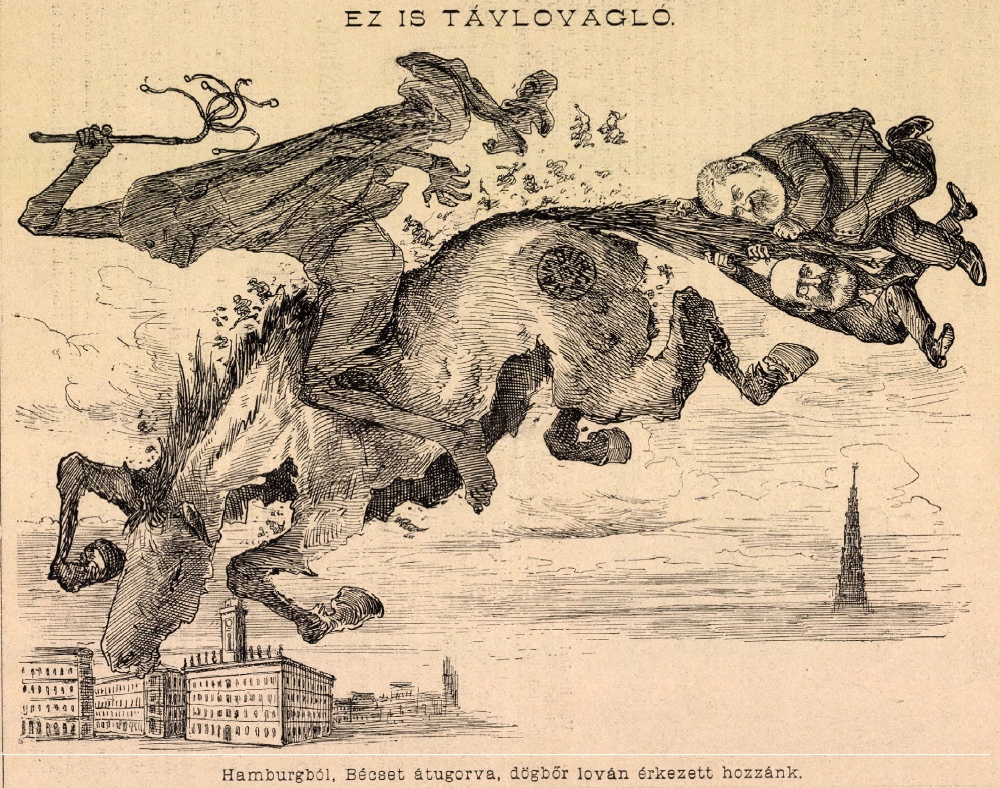
or, Hamburg wines in Budapest, or, the brilliant march of Cholera into the capital city. (This comic exchange is littered with malapropisms that I have doubtless failed to convey properly, but the arrival of cholera from Hamburg in 1892 played into Budapest municipal politics in complex ways. The city was growing extremely rapidly and becoming more Hungarian in the process, but German-speaking burghers still played important mediating roles, and they are the main object of satire here.) Mr. Finances: “Halt! Vere do your horsehides come from, Schlesinger?” Schlesinger [caricatured here as Jewish]: “Vere vould zey come from if not Hamburg?” Mr. Finances: “Then you won’t be held up!… Let him pass!…” Dr. Müller: “St. Roch, in the name of public health! I forbid it!” Dr. Farkas: “They are importing cholera germs. It is forbidden!” Dr. Csatáry: “To battle against cholera! Down with the horsehides! In particular, Dr. Schwimmer will make a declaration next to the horsehides in his capacity as dermatologist!” Dr. Farkas: “Quite so! And Dr. Krebs as the head of the emergency services association will find it desirable to create a situation where he has to save everyone!” Dr. Gebehart: “The question is, is it true that it comes from Asia? Isn’t it just a forged thing, this cholera? It ought to be done here!” District mayor Gerlóczy: “Quite so, it ought to be eaten here! Organize a capital city banquet in honor of cholera!” Monsignor Mayor Ráth: “Deeply respected Madame Cholera! Welcome, we did not expect you! You are most welcome within the visitor-friendly walls of the capital city, you should feel right at home among us, so that you may be our constant good fortune. We also hope that you will be satisfied with the precautionary measures we have taken in receiving your eminence. May the god who is kind feed our high guest to the very limits of the human age!” (Noisy cheering. Harnessing the horses, the eastern guest is solemnly drawn to the town hall.) (Bolond Istók, Budapest, 1892)
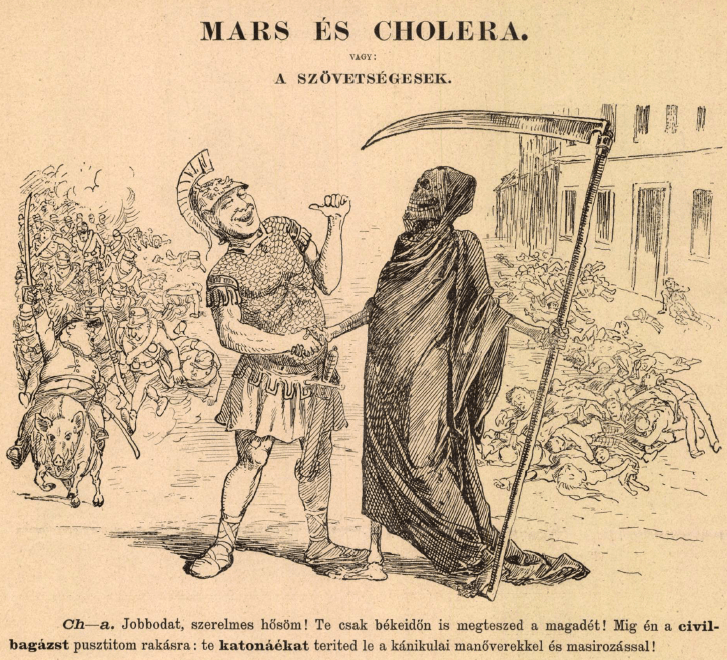
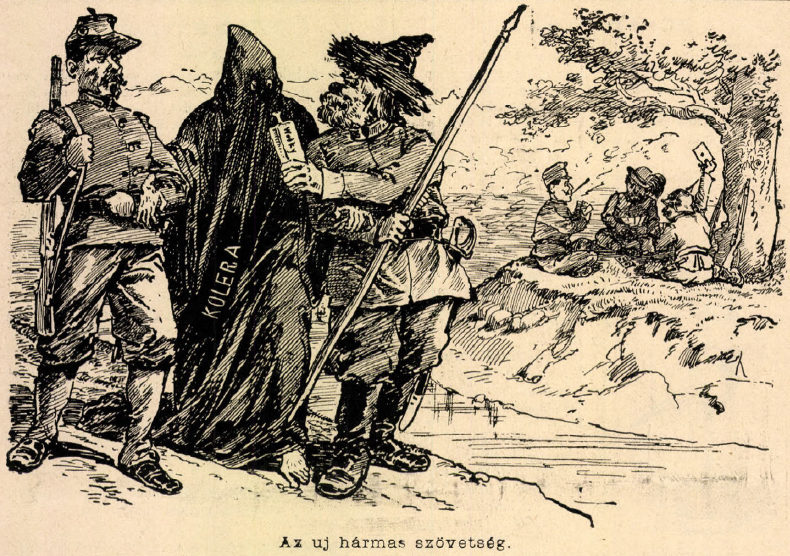
Or: Allies. Cholera. I yield to you, my beloved hero! You only do your thing in peacetime! Whereas I destroy the civilian luggage, you prostrate your soldiers with heatwave maneuvers and marching! (Bolond Istók, Budapest, 1892)
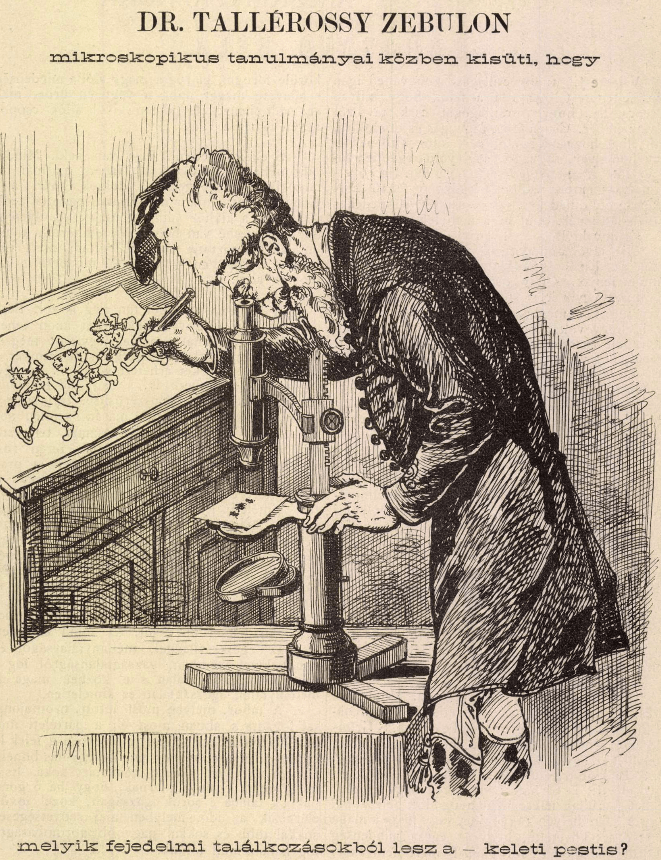
During his microscopic studies Dr. Zebulon Tallérossy renders which princely encounters will become the… eastern plague? (A noble landowner, Tallérossy was the humorous literary invention of Mór Jókai. Clearly I will need to parse this image further…) (Az Üstökös, Budapest, 1880) (Cf. this 1873 “letter” of Tallérossy.)
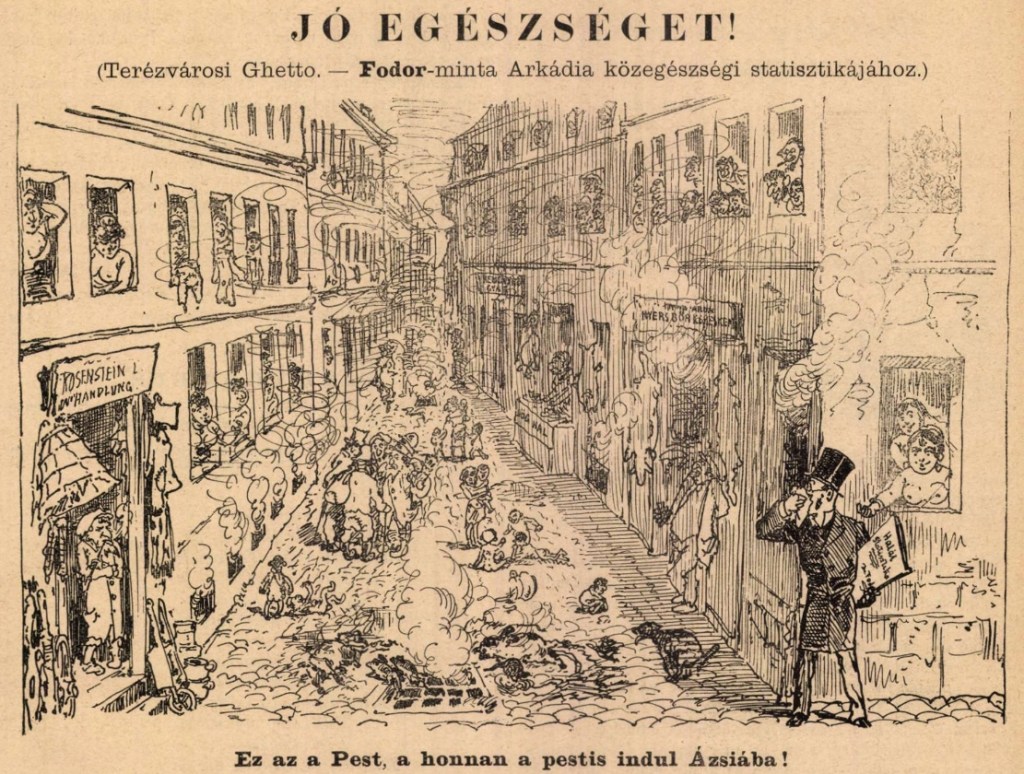
(The Theresatown Ghetto. Toward the public health statistics of Fodor-style Arcadia.) “This is the Pest from which the plague (pestis) heads for Asia!” (Bolond Istók, Budapest, 1882)
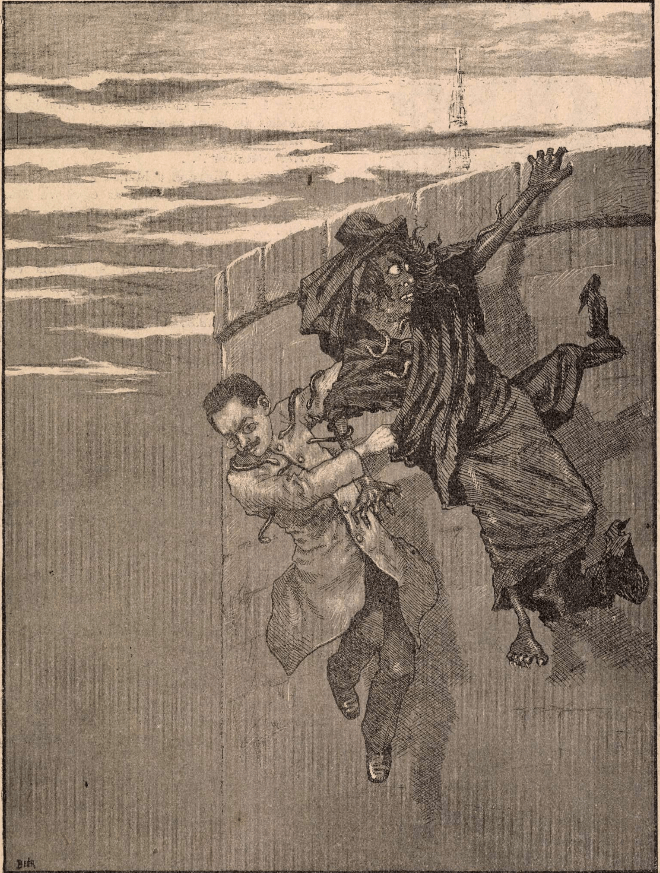
Caption: The one who is pulling the plague off the walls of Vienna on his own. (Following a visit by four staff members to India to study the plague, the Institute of Pathology in Vienna unwittingly developed a pneumonic strain leading to four fatalities, sparking fears of a renewed outbreak in Europe. The man depicted is Dr. Hermann Franz Müller, who treated the first fatality and then died three days later. Titusz Dugovics was a mythical Hungarian soldier who had helped fend off Ottoman invaders in the fifteenth century.) (Kakas Martón, Budapest, 1898)
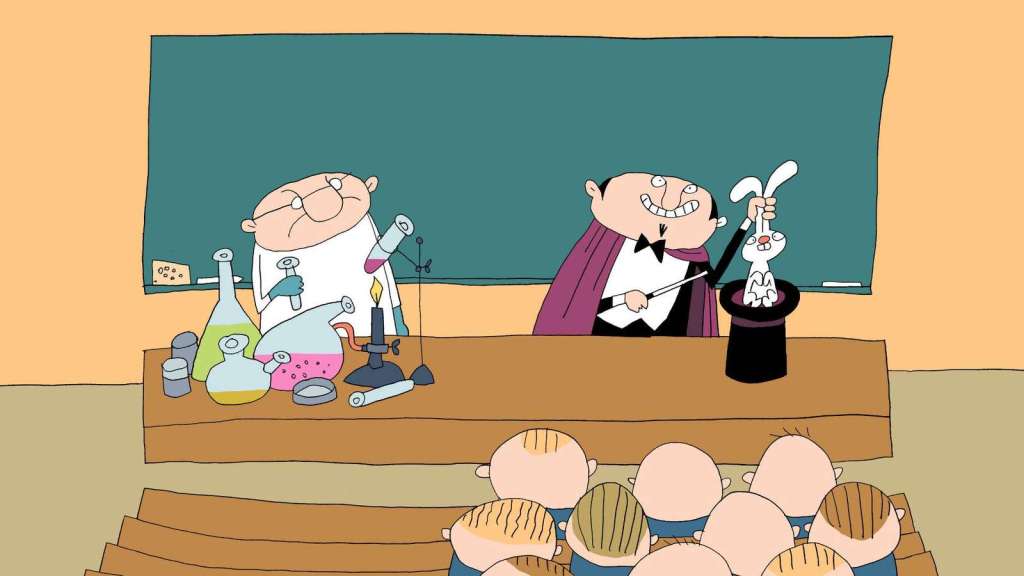
Although this site is largely devoted to archiving obscure historical humor, this amusing illustration by the marvelous Hungarian cartoonist Marabu (aka László Róbert Szabó) accompanies a recent article on hostility to science as a pandemic threat. (Népszava, Budapest, 2020)
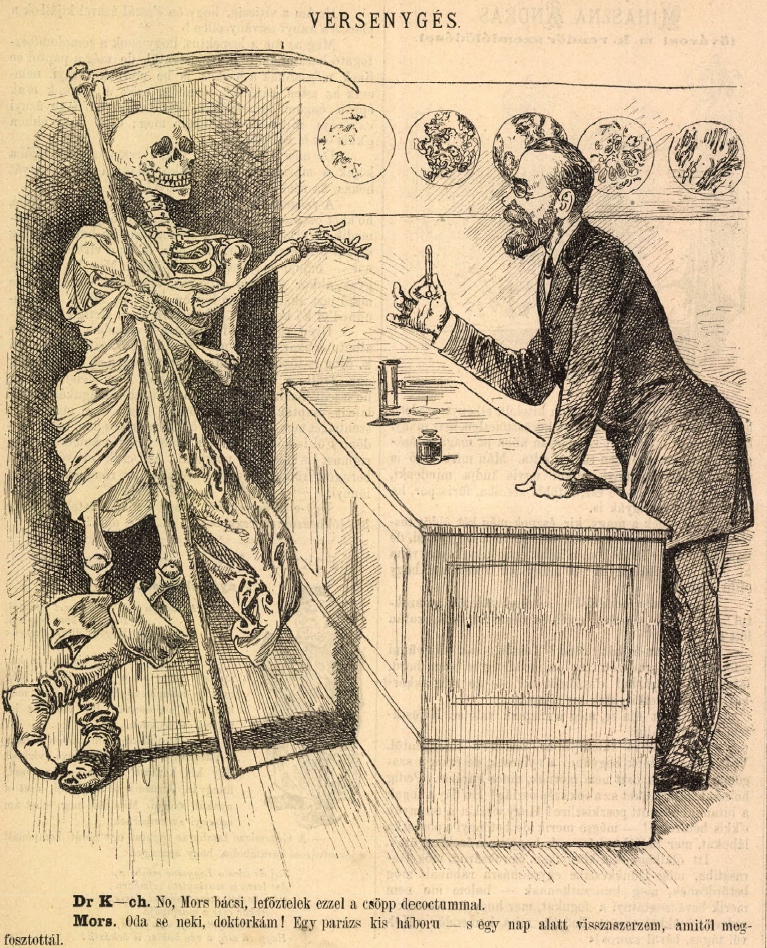
Dr. Koch: “Well, Uncle Morbus, I’ve cooked it down with this little decoction.” Cholera Morbus: “Nothing to it, Doc! It’s a heated little war — and within a day I’ll get back what you deprived me of.” (Borsszem Jankó, Budapest, 1890)
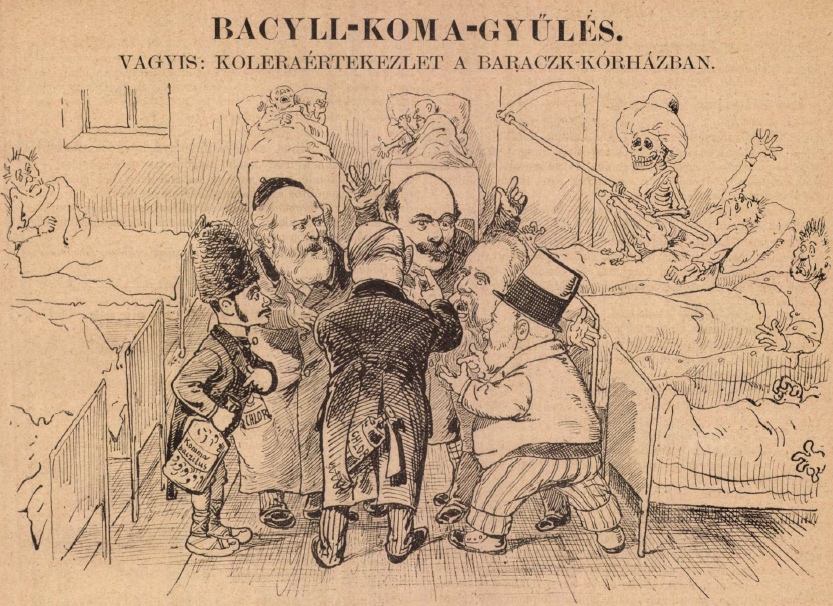
Or: Cholera meeting at the Peach Hospital The image is accompanied by statements from Dr. Cheeseslicer, Dr. Bacillus Bacterius, Dr. Bablesi-Bibasiu (the Hungarian Pasteur), Dr. Striker! (Louis the Great, Cholera King), Dr. Veterinarius Bacterius, and Dr. Lacyllus Lupus. A note at the end indicates, “While the doctors strew about the seeds of the theory, Cholera Asiatica reaps happily, and Dr. Cheeseslicer notes with consolation: Yet this is cholera nostras and not Asian, because they are dying for us!” (Bolond Istók, Budapest, 1886) (Yes, this wants further parsing in the context of domestic politics.) (See also this Dutch variant of cholera nostras.)
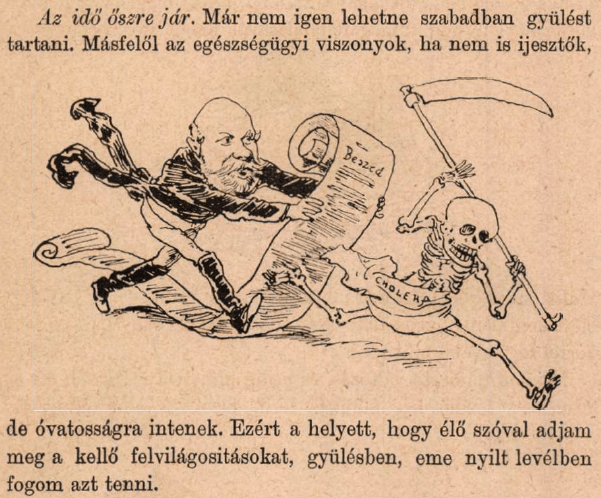
This image is singled out from a series mocking the Hungarian minister of public works and transport, Baron Gábor Kemény. Known as an advocate of Hungarian economic modernization, Kemény seems to be faulted here for raising long-winded written objections to convening the next session of parliament, at a time when cholera was recurring in Hungary. “It is getting on toward autumn,” writes the satirist in his voice. “It would no longer be possible to hold an outdoor session. On the other hand, health conditions, if not frightening, do call for caution. Therefore, instead of giving the appropriate clarifications in person at the session, I will do so in this open letter.” Here even cholera is put off by his stentorian prose. (Bolond Istók, Budapest, 1886)
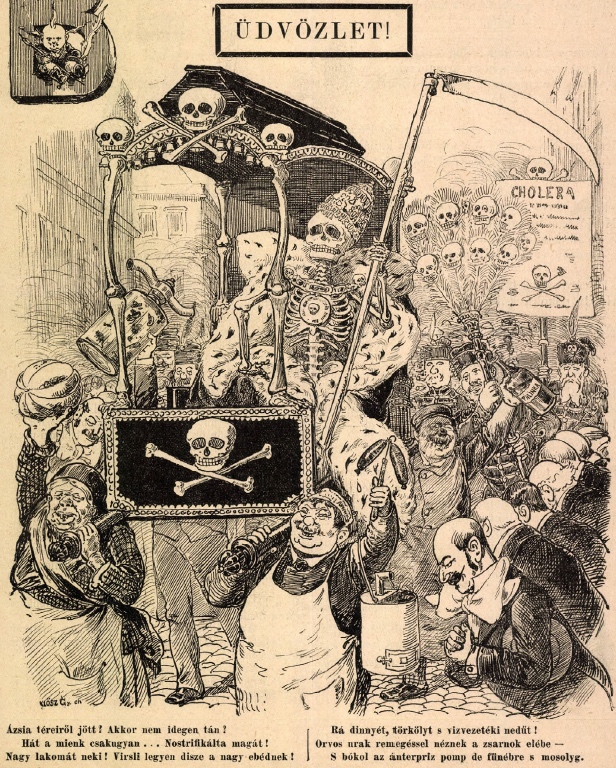
He came from the Asian spaces! Isn’t he a stranger then? Well, indeed he’s ours… He’s certified! A great feast for him! Make sausage centerpiece of the great meal! Put melon and brandy on it, and the nectar of water straight from the tap! Medical gentlemen look at the tyrant with trembling — And smiling he compliments the funereal pomp of the enterprise. (Borsszem Jankó, Budapest, 1884)

 Sic Transit Pestilentia