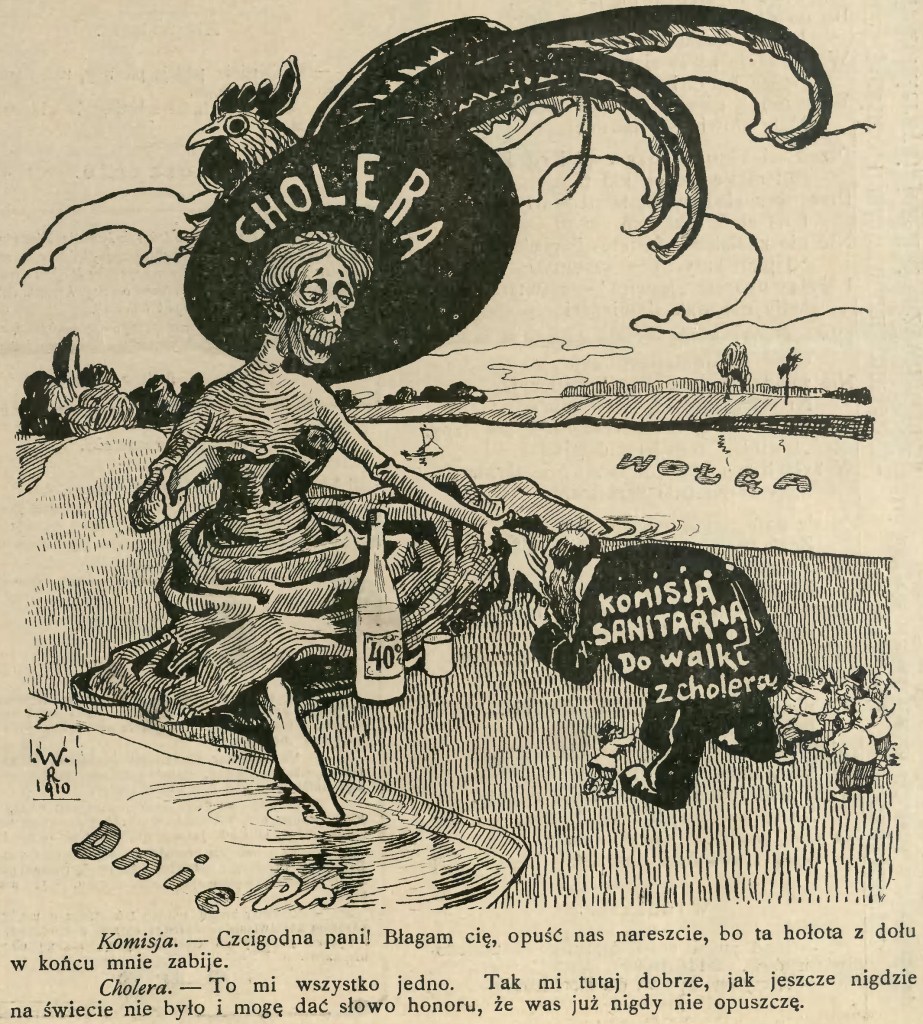
Public Health Commission: “Honorable lady! I am begging you, leave us at long last, because this rabble is going to kill me in the end.” Cholera: “It make no difference to me. It’s better for me here than it’s ever been anywhere in the world, and I can give my word of honor that I will never leave you again.”
“How is father?” “Not great, his hand hurts.” “And Mom?” “Really bad, her leg hurts.” “At least you are well?” “Oh, no, and something hurts. Because you see, our whole family got vaccinated for smallpox, it’s just that it was every person in a different place on the body.” (Mucha, Warsaw, 1900)
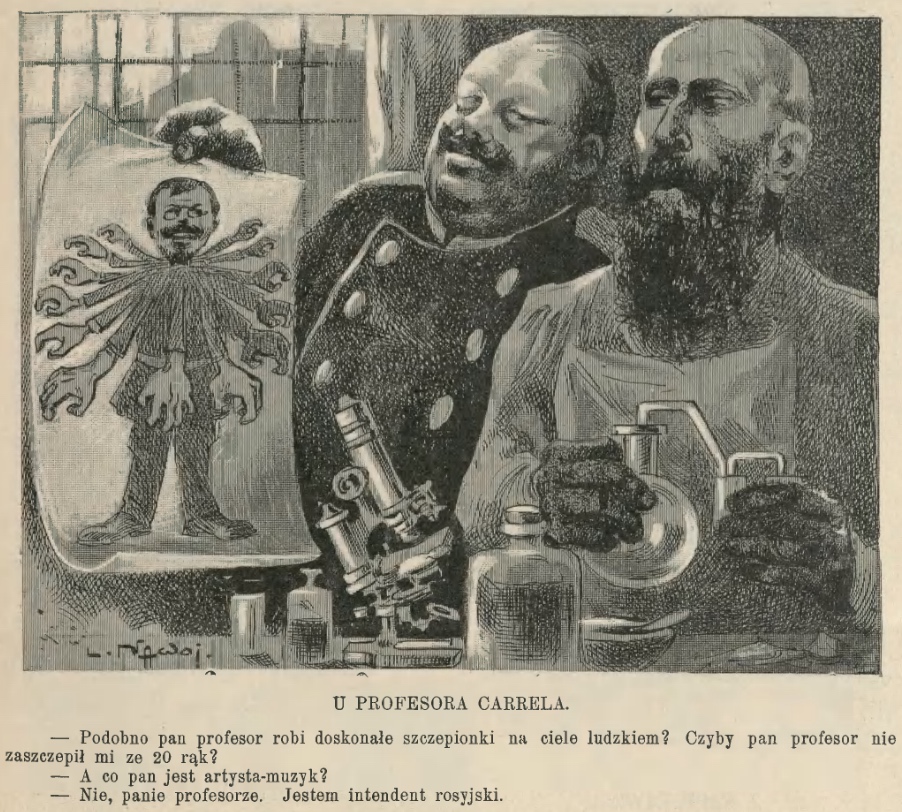
(Early in 1911 the French-American medical researcher Alexis Carrel, then working at Rockefeller University, drew attention in The New York Times for having “succeeded in stimulating the growth of animal tissues outside the body” and “caus[ing] cancer tissues to grow after removal from the human body.” The bearded professor depicted here bears little resemblance to the clean-shaven Carrel, who would soon win the Nobel Prize for Medicine for other work. But the Polish cartoonist in Russian-ruled Warsaw somehow managed to find inspiration for a political jab, so to speak, at his oppressors.) “Professor, apparently you make excellent vaccines [sic] for the human body? Wouldn’t you be able to graft twenty hands onto me?” [a strange pun, since rąk can also mean cancer; the word for “graft” can also mean “inoculate”] “Are you a musical artist?” “No, Professor. I am the Russian quartermaster.” (Mucha, Warsaw, 1911)
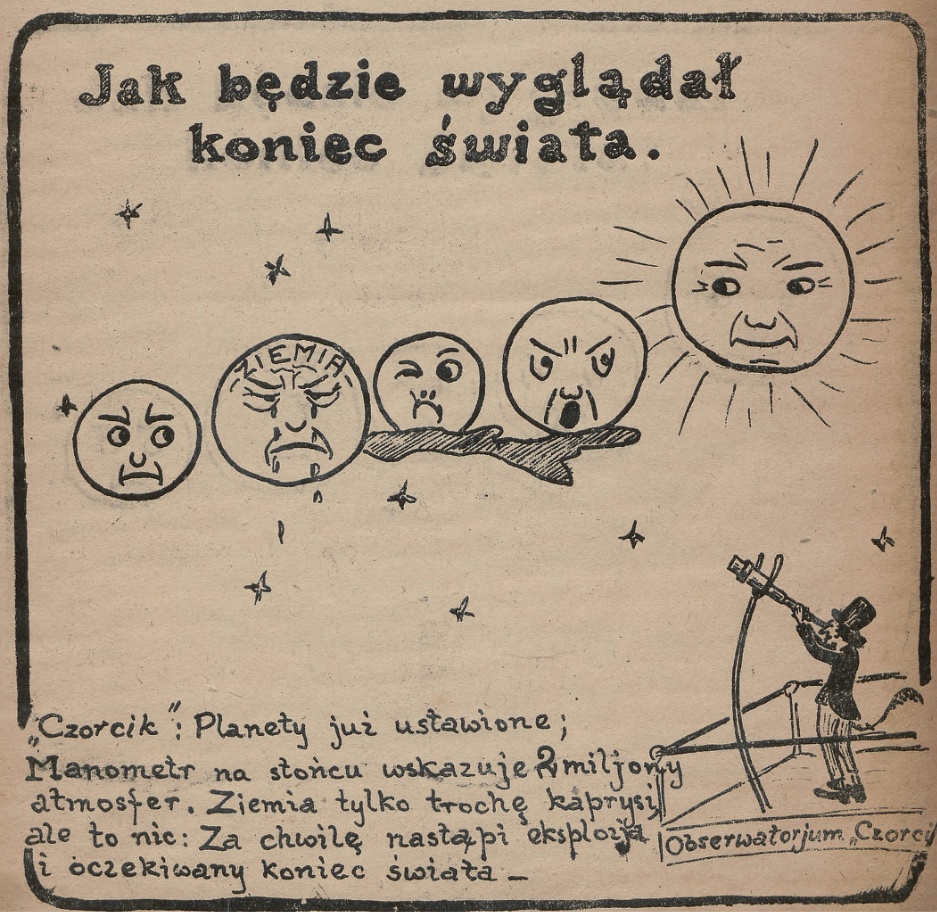
(A sniffly planet earth, as seen from the “Little Devil” Observatory during the second wave of the great flu pandemic.) The planets are already aligned; the solar pressure gauge shows 2 million atmospheres. The earth is just a little capricious, but that’s nothing: In a moment there will be an explosion and the expected end of the world. (Czorcik, Piotrków Trybunalski, 1919)
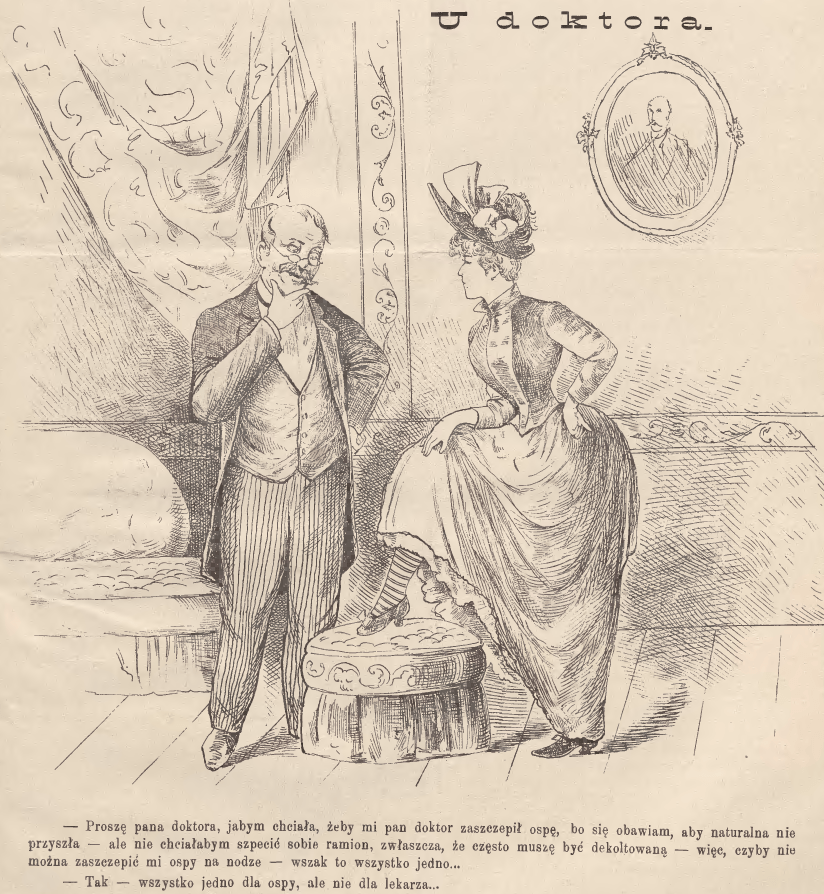
“Please, doctor, I would like you to inoculate me with [attenuated] smallpox, because I am afraid of getting the real thing. But I wouldn’t want to disfigure my shoulders [with a vaccination scar], especially since I often have to show décolletage. So can’t I be inoculated for smallpox on my leg? After all, it is all the same thing…” “Yes, it’s all the same for the smallpox, but not for the doctor…” (Goniec i iskra, Lwów, 1891)
Polish smallpox cartoon
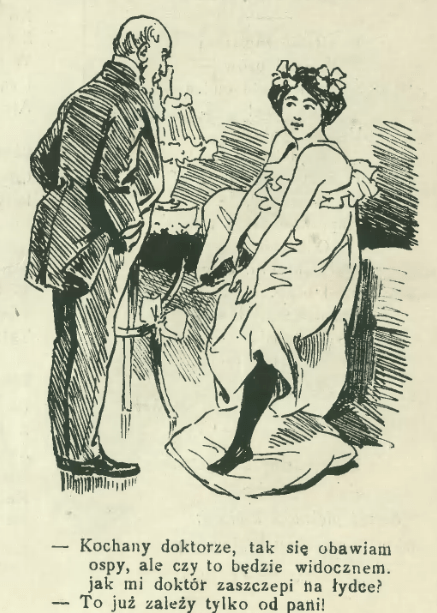
And a similar cartoon some years later: “Dear doctor, I am so afraid of smallpox, but will it be visible when you inoculate on my calf?” “It only depends on you!” (Kolce, Warsaw, 1908)
Polish smallpox cartoon
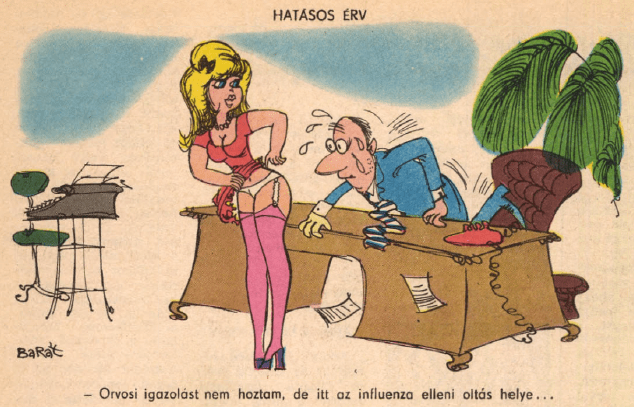
In the same sexist vein, a Hungarian cartoon: Effective argument “I didn’t bring the medical certificate, but here is the location for the flu vaccination…” (Ludas Matyi, Budapest, 1974)
Hungarian flu cartoon
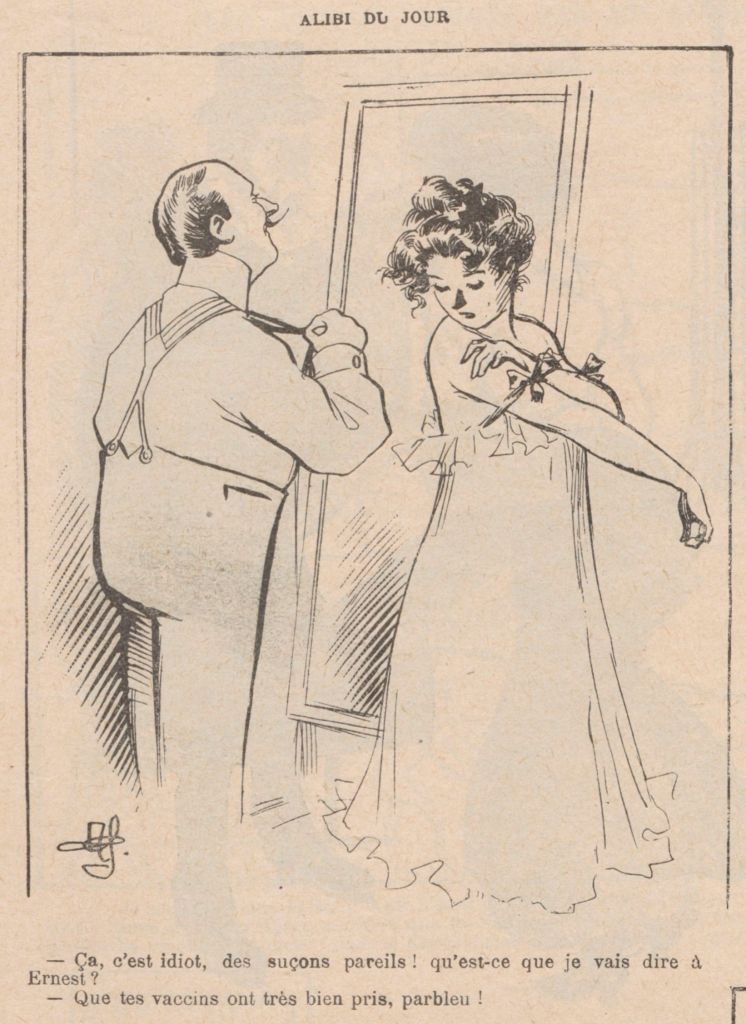
Or another twist: Alibi ju jour “This is silly, hickeys like that! What am I going to tell Ernest?” “That your vaccines have taken very well, by Jove!” (Le Rire, Paris, 1907) (Another French cartoon with related themes. And another from 1920.)
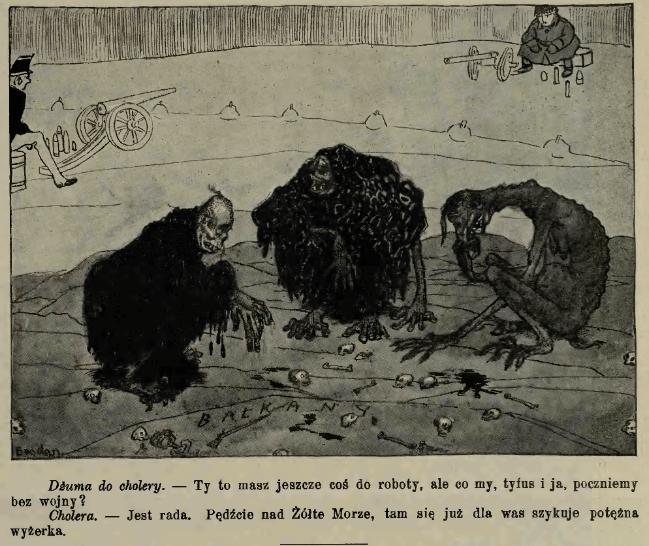
Plague to cholera: “You have something else to do, but what will we, typhus and I, do without war?” Cholera: “Here’s some advice. Rush to the Yellow Sea, there is already a mighty battle preparing for you.” (Mucha, Warsaw, 1913)
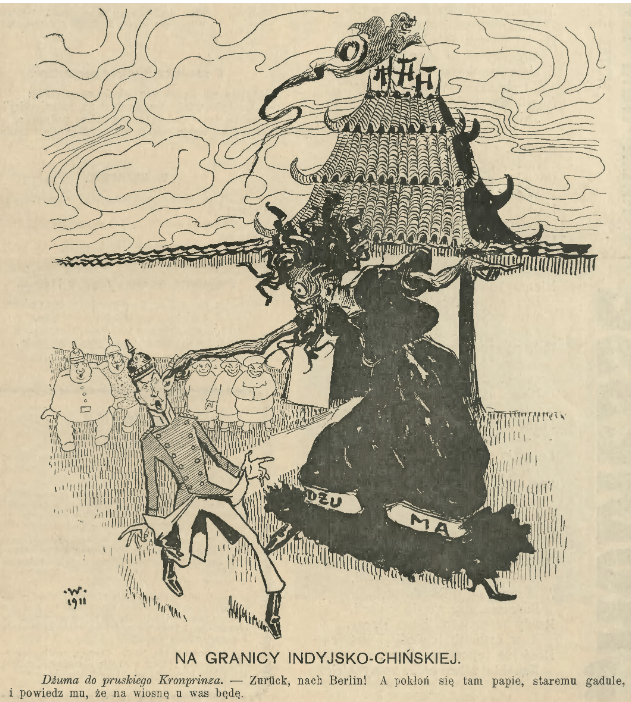
Plague, to the Prussian crown prince: “Back to Berlin! And bow to your papa, the old chatterbox, and tell him that I will be there in the spring.” (Mucha, Warsaw, 1911) (Crown prince Wilhelm, though lacking in foreign diplomatic experience, won approval to embark on a lengthy journey to Asia in November 1910, ostensibly to learn more about German interests in the far east. After much wining and dining with British colonial officials in India, Wilhelm cut short his trip late in February 1911. Originally slated to include Siam, Dutch Indonesia, China, and Japan, it was interrupted by news of an outbreak of plague in Calcutta, as well as reports of bouts in China that were already crossing the Russian border.)
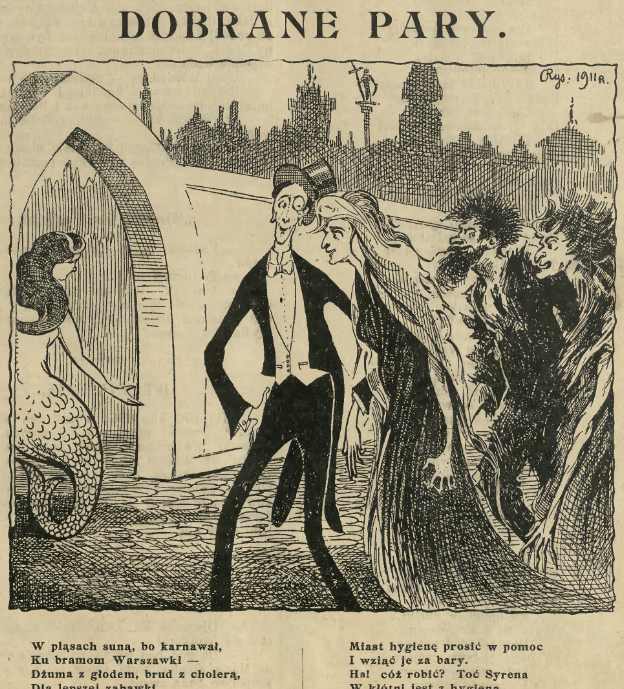
They glide in festive dance, for it is carnival, Towards the gates of Warsaw Plague with hunger, dirt with cholera, For better entertainment. And out of hospitality the Siren Is inviting these couples To ask cities for help with hygiene And take them for bars. Ha! what to do? This Siren Is in a quarrel with hygiene, No wonder she wants to show off Luck as hospitality. (Kogut, Warsaw, 1911) (translation wants improvement)
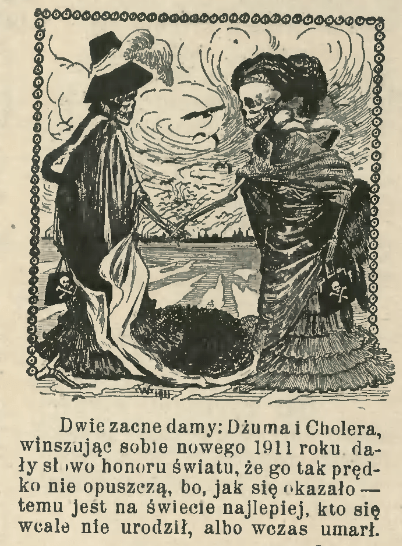
Two respectable ladies: Plague and Cholera, congratulating themselves on the New Year, gave their word of honor to the world that each would not leave it so quickly, because, as it has been said, “he is at his best, who has not even been born or has died on time.” (Mucha, Warsaw, 1912)
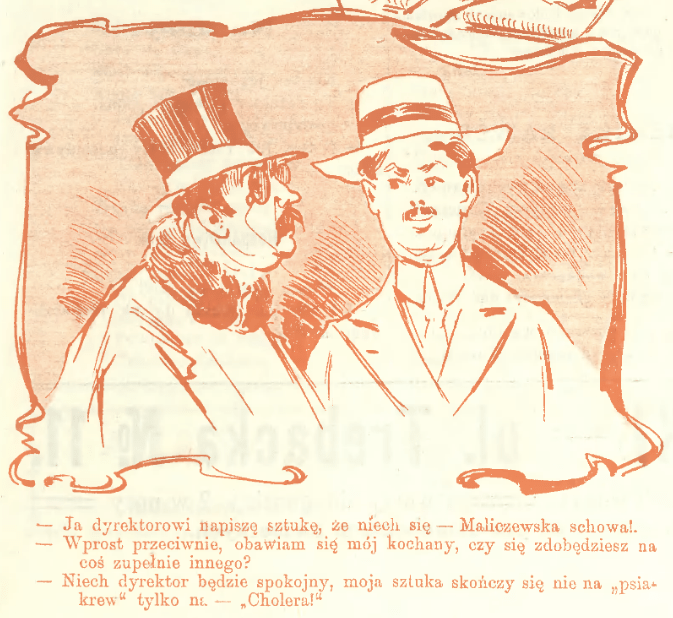
Gabriela Zapolska (b. 1857) was an actor and prolific playwright whose Miss Maliczewskaenjoyed its premier while she was living in Lwów in 1910. Drawn in part on her itinerant life as an aspiring actor after breaking from her gentry family, the play was a conventional moral tale about an impoverished and beautiful young woman named Stefka Maliczewska seeking an acting career, but falling under the malign influence of the lecherous old lawyer Daum, who becomes her patron. After various betrayals, ethical compromises, and debt-ridden dilemmas, the play ends with Stefka stymied and cursing her lot in life. (Her term of choice was “psia krew!” intimating dog’s blood but meaning “damn!”) Though not exactly scandalous in 1910, with one reviewer welcoming the “merciless truth” of her Zolaesque naturalism, such unrefined language from the mouth of a young female character did invite disapproval in some circles, which in turn drew the attention of the satirist.
The caption: “I will write a play for the [female] director so that she lets Maliczewska abscond!” “Quite the contrary, my dear, I am afraid that you will do something completely different?” “Let the director be at ease, my play will end not on ‘damn’ but on ‘cholera!'”
In keeping with its old-fashioned “choleric” association with anger, “cholera” is sometimes employed as a curse (roughly, “damn”). At a time when the last cholera pandemic was gradually coming to an end, this trivial pun would have been especially resonant.
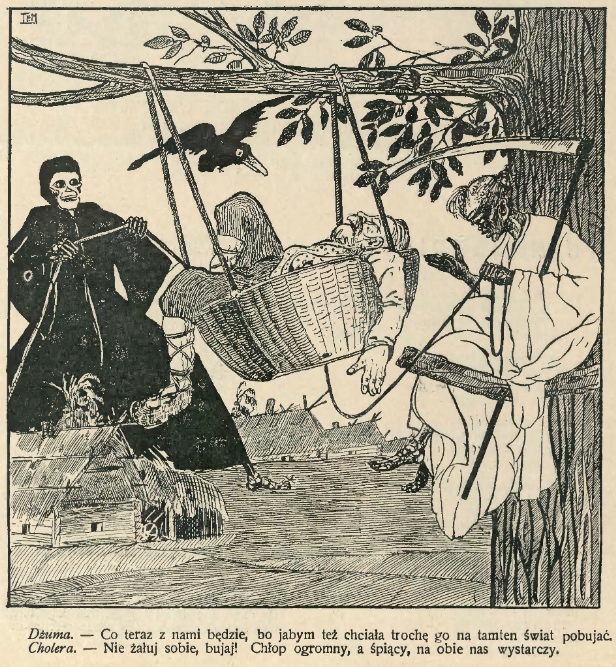
Plague: “What will happen with us now, because I would also like to nudge him a bit to the netherworld.” Cholera: “Don’t feel sorry for yourself, get to it! A huge and sleepy peasant, enough for both of us.” (Mucha, Warsaw, 1910, p. 4)
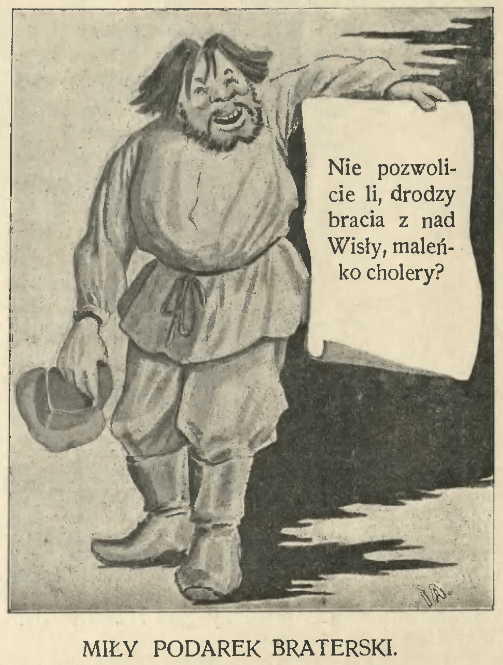
“Won’t you permit me, dear brothers from across the Vistula, a little cholera?” (Mucha, Warsaw, 1908)
Polish cholera cartoon
Some rhyming couplets on the same page offer counsels for Warsaw residents during a cholera epidemic:
Whoever doesn’t want to be infected with the cholera bacillus, Let him not remember that there is martial law.
In these choleric times things are not headed in a healthy direction Think about Filevich or Menshikov. [Russian monarchists hostile to Polish separatist sentiments]
The best epidemic fostered among humans, Where people get irritated by what Rossiya writes. [monarchist newspaper]
Don’t worry about the Swabs in Łódź either, For you will definitely grab the spare hospital.
The nicest thought is still that whether you are a Belgian or a Turk, And you will be healthy, even though you ate a raw cucumber.
For the worst thought in the world is That you bear the heavy lot of the Pole on your neck.
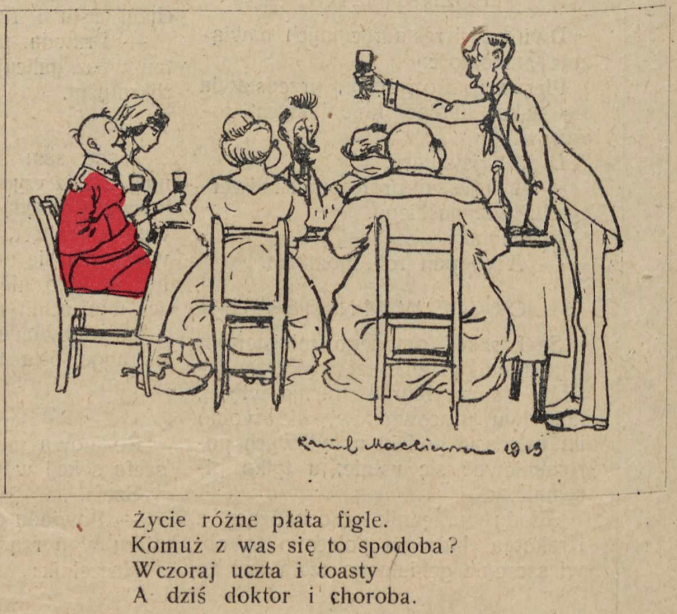
Life diverse is playing tricks. Does any one of you like it? Yesterday it was a feast and toasts And today the doctor and disease. (Szczutek, Lwów, 1919)
In this period soon after the restoration of the Polish Republic, Kamil Mackiewicz produced several dozen multi-panel cartoons under the title “Fire and sword, or the adventures of crazy Greg — a contemporary story.” As one might guess from the title, there is a picaresque quality to Greg’s adventures, but I don’t know enough yet to make any hasty characterizations of the series. What is striking is that influenza and typhus do not figure in the narrative, despite their prevalence at the time. There is only this indirect gesture in the final panel of episode 27, at Greg’s wedding dinner, following their search for a vicar to marry them.

 Sic Transit Pestilentia