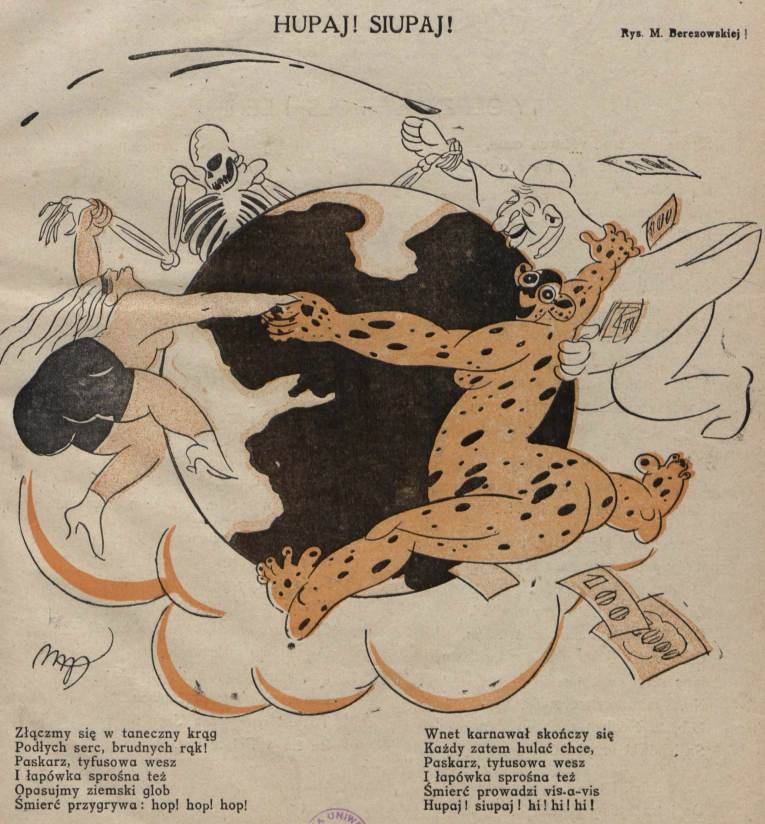
Let’s join in a dance circle Vile hearts, dirty hands! The profiteer, the typhus louse And an obscene bribe, too Let’s wrap around the globe Death accompanies: hop! hop! hop! Soon the carnival will end So everyone wants to romp, The profiteer, the typhus louse And an obscene bribe, too Death plays along Hop to it! hi! hi! hi! (Szczutek, Lwów, 1920) (No bonus points for noting that the profiteer is caricatured as Jewish.)
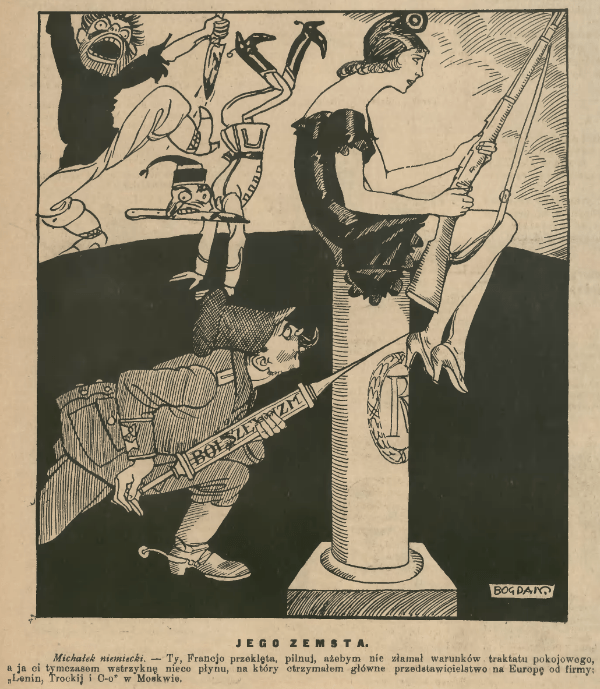
German Michaels: “You, accursed France, make sure I don’t break the terms of the peace treaty, and in the meantime I’ll inject some liquid in you for which I received the sales rights in Europe from the firm, “Lenin, Trotsky & Co.” in Moscow. (This is straightforward politics-as-contagion, but note the clystère, an ongoing theme.) (Mucha, Warsaw, 1920)
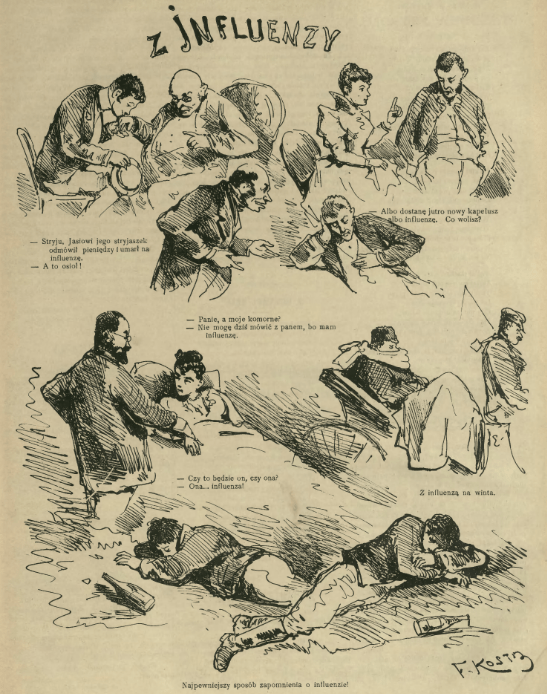
(clockwise from upper left) 1) “Uncle, Jasi’s uncle refused him money and died of influenza.” “And he’s an ass!” 2) “Sir, and my rent?” “I can’t speak with you today because I have influenza.” 3) “Either I’ll get a new hat or influenza tomorrow. What do you prefer?” 4) With influenza to the card game. 5) The surest way to forget about influenza! 6) “Will it be a boy or a girl?” “It is… influenza!”
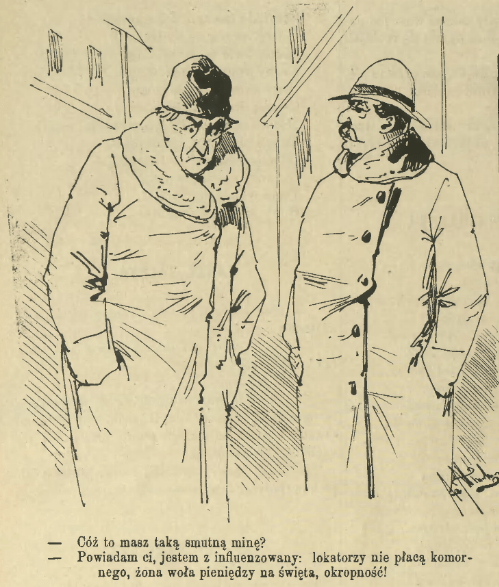
“Why do you have such a sad face?” “I tell you, I’m down with influenza: tenants don’t pay the rent, the wife wants money for the holidays, it’s horrible!”
Polish flu cartoon
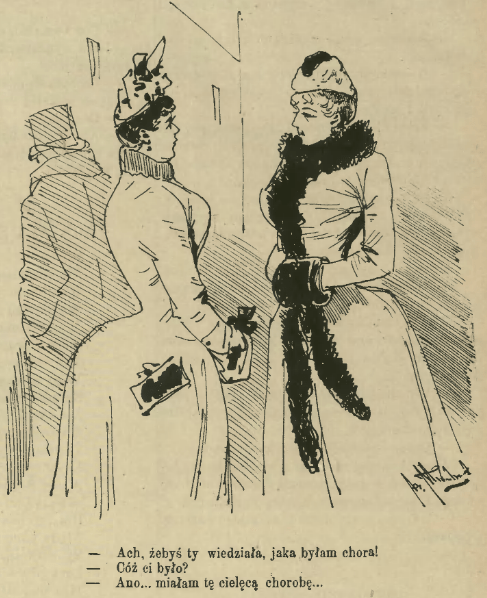
“Oh, if only you knew how sick I was!” “What was wrong with you?” “Well… I had this bovine disease…”
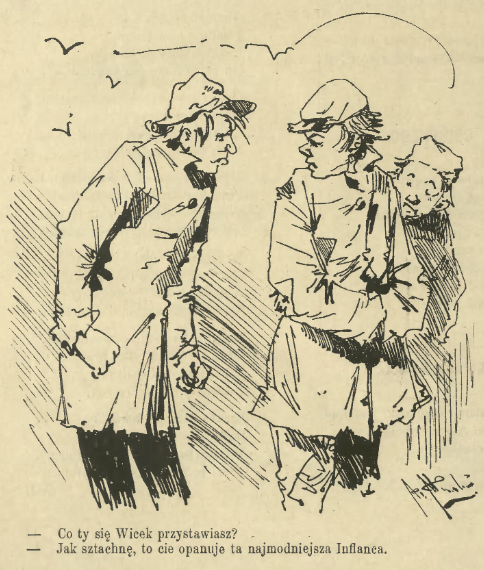
“What are you putting on, Wicek?” “Like a cloud of smoke, you will be overwhelmed by this super fashionable Inflanza.”
“Is the lady at home?” “She is, but she is not receiving anyone, because she has this weakness known as intelligence.”
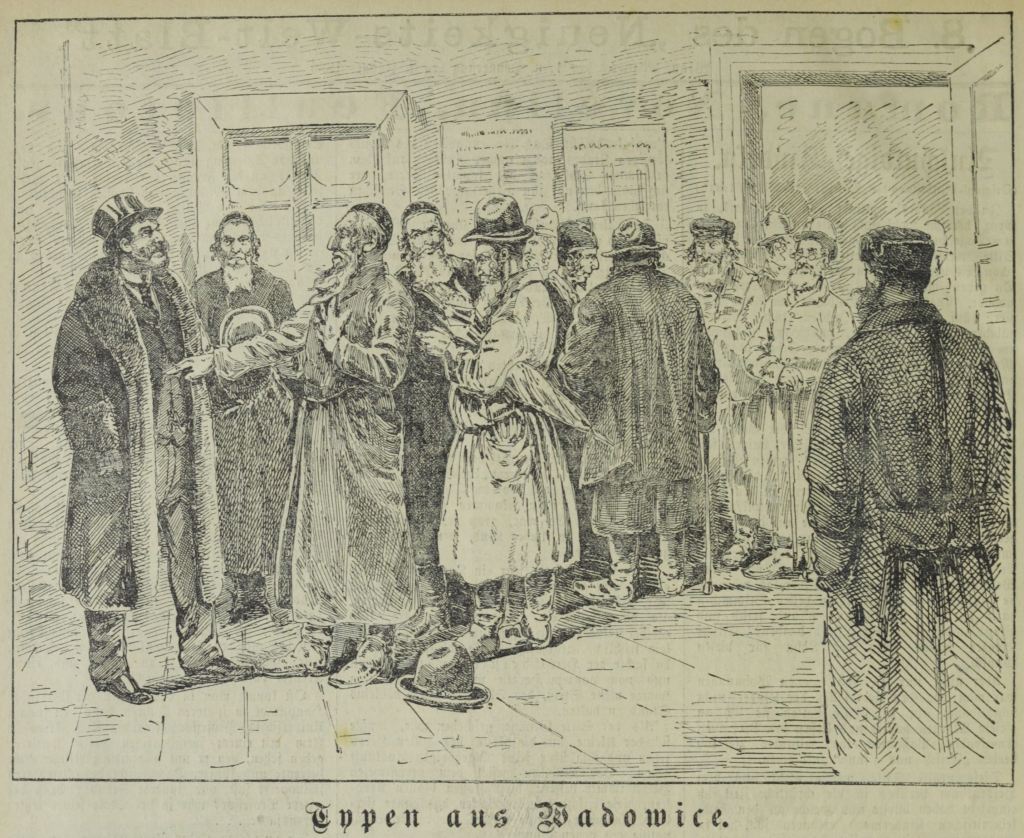
In the fall of 1889 sixty five Galician emigration agents and their associates (including state railway employees) were charged with fraud and other crimes in the course of facilitating emigration to America. At a time when emigration from the Habsburg and Romanov Empires to the United States was beginning its precipitous rise to historic levels after the turn of the century, domestic concerns about what kinds of people were going, under what conditions, and with what potential to maintain financial ties to their homelands all permeated the discussion around the trial, held in Wadowice southwest of Cracow. Many of the middlemen facilitating passage to trans-Atlantic ships out of Hamburg and Bremen came from Jewish backgrounds, while many local opponents of emigration, if not blatantly anti-Semitic, were increasingly fretting about the health of the remaining population (meaning a tangle of both medical-physical and organic-political characteristics). The popular press painted the accused as “humantraffickers,” “vampires,” and “slave traders and bloodhounds,” feeding a strong undercurrent of anti-Semitism. (See the authoritative account by Tara Zahra.) The “echo of the Wadowice trial reverberated across all of Europe,” fostering the conviction among local patriots that “the protection of native land and rational internal colonization should emerge from the fog of fantasies and good intentions and pass as soon as possible into the sphere of accomplished deeds.”
Large-circulation newspapers like Neuigkeits Welt Blatt in Vienna made certain that their readers could not miss the Jewish lineage of many of the shipping agents.
After months of testimony featuring hundreds of witnesses, the lead accused were sentenced to several years in prison. During the prolonged sensation that was the court trial, “Russian influenza” made its epidemic return to Central Europe, traveling quickly by rail and shipping routes from the northeast to the south and west. Though its symptoms were much less dramatic than cholera, influenza hit perhaps 40% of the Hungarian population that winter, for example, and as much as half of the German population, though the associated mortality rates were quite low.
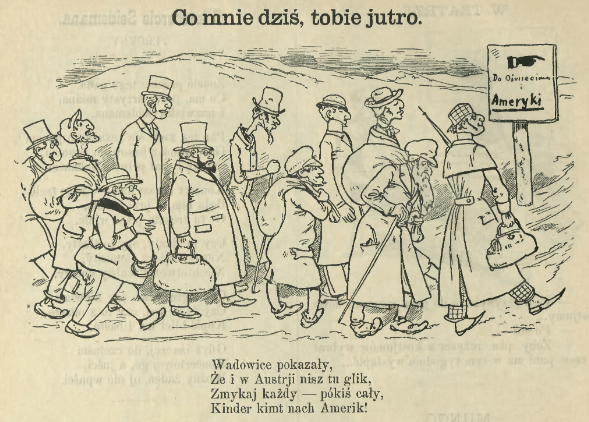
There was a mean-spirited Polish cartoon related to the trial. (The text contains Yiddishisms, so my rendering is surely problematic.)
What’s for me today is for you tomorrow. (sign pointing to the Promised Land of America) Wadowice showed That in Austria, too, good fortune is not here, Each keeps his mouth shut until everyone’s Children come to America! (Mucha, Warsaw, 1890)
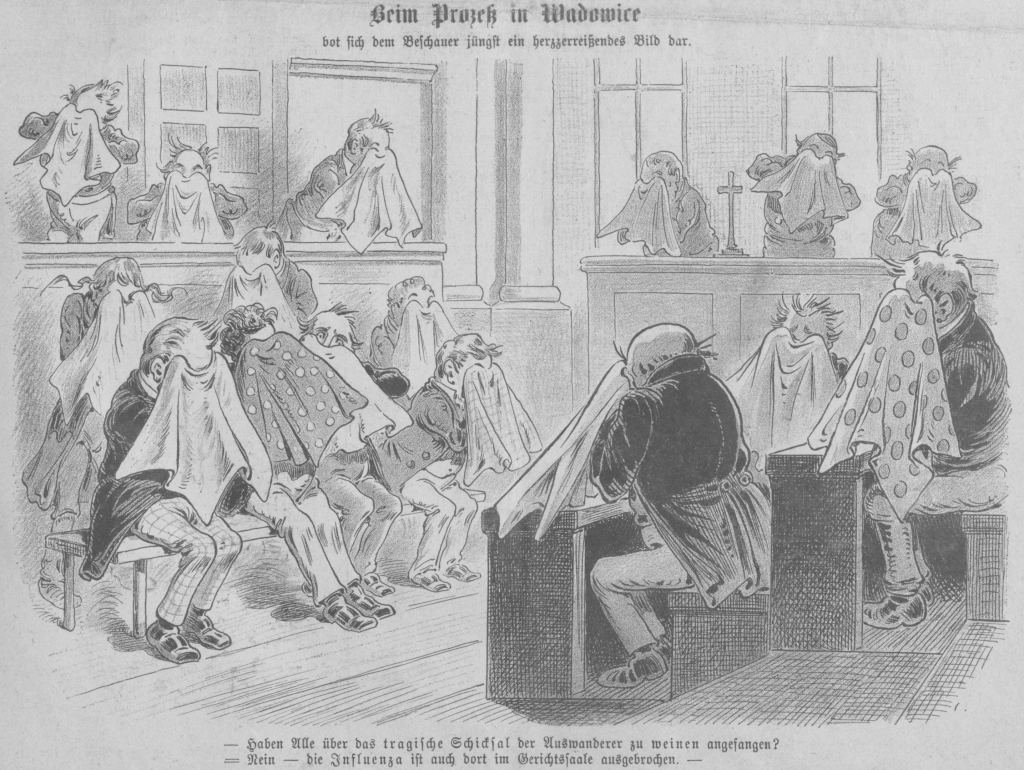
The cartoon below provides an uncomfortable linkage between the trial and the epidemic.
At the trial in Wadowice a heartrending picture presented itself to the onlookers. “Have you started crying about the tragic fate of the emigrants?” “No, influenza has broken out in the courthouse.” (Kikeriki, Vienna, 1890)
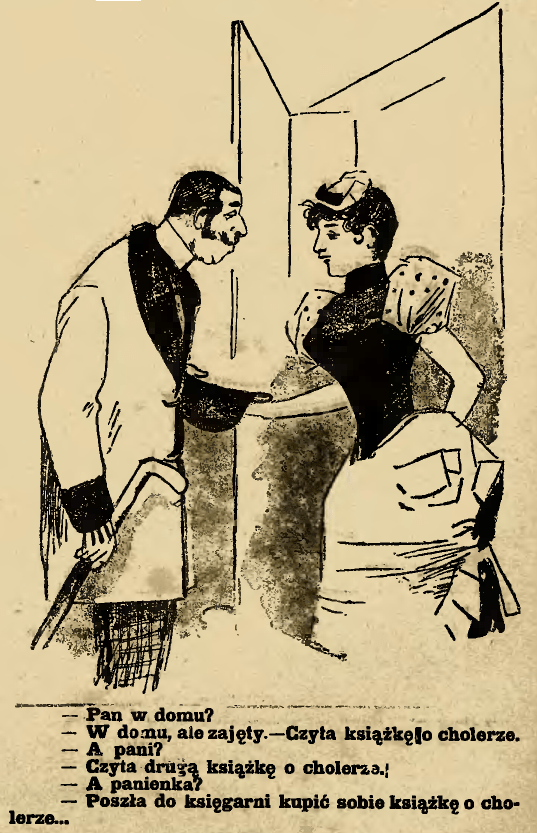
“Is the man of the house at home?” “He’s at home, but he’s busy. He’s reading a book about cholera.” “And the lady?” “She’s reading another book about cholera.” “And mademoiselle?” “I’m off to the bookstore to buy myself a book about cholera…” (Mucha, Warsaw, 1892)
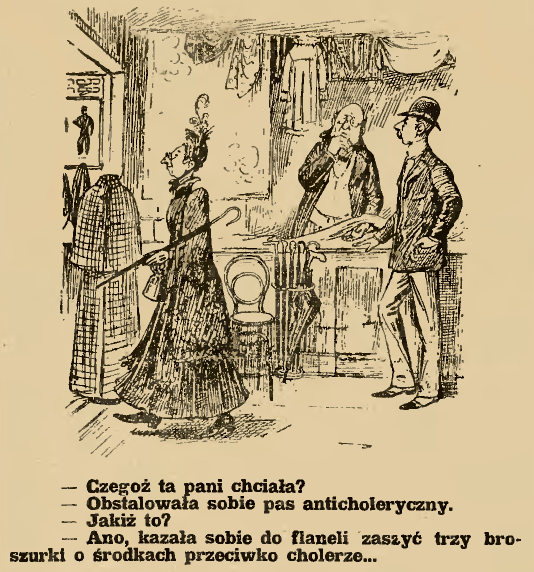
“What did that lady want?” “She arranged for an anti-cholera waistband.” “What is that?” “Well, she ordered three brochures on anti-cholera measures sewn into the fabric…” (Mucha, Warsaw, 1892)
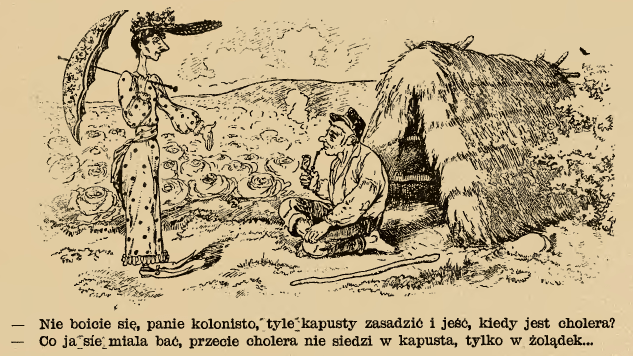
“Mr. Settler, aren’t you afraid to plant and eat so much cabbage when there is cholera?” “What do I have to fear, after all cholera is not in the cabbage, but in the stomach…” (Mucha, Warsaw, 1892)
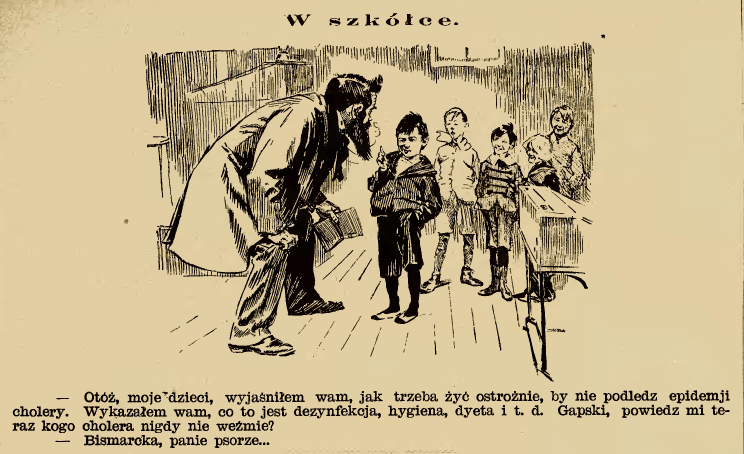
“Well, my children, I explained to you how to live carefully so as not to be subject to the cholera epidemic. I showed you what disinfection, hygiene, diet, and so on are. Gapski, tell me who the cholera will never take?” “Bismarck, sir…” (Mucha, Warsaw, 1892)
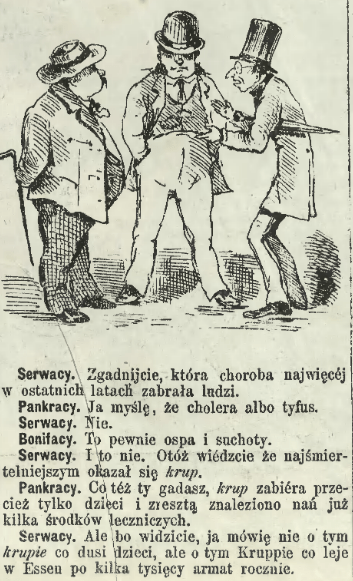
Servatius: Guess which disease has taken the most people in recent years. Pancras. I think it’s cholera or typhus. Servatius. No. Boniface. It’s probably smallpox and consumption. Servatius. Also no. So you should know that the croup was the most lethal. Pancras. What are you talking about, the croup only takes children, and anyway, several medications have already been found. Servatius. But because you see, I’m talking not about this croup that strangles children, but about this Krupp which pours several thousand cannons a year in Essen. (Mucha, Warsaw, 1875)
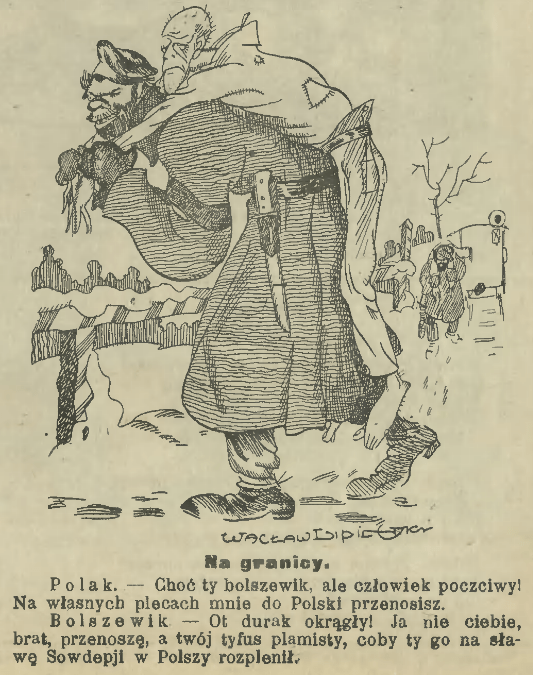
Emaciated Pole: “You may be a Bolshevik, but you are a good man. You are taking me to Poland on your own back.” Bolshevik: “Got it backwards, fool! I’m not carrying you, brother, but your typhoid fever, so that you will spread it to the glory of Soviet power in Poland.” (Mucha, Warsaw, 1922)
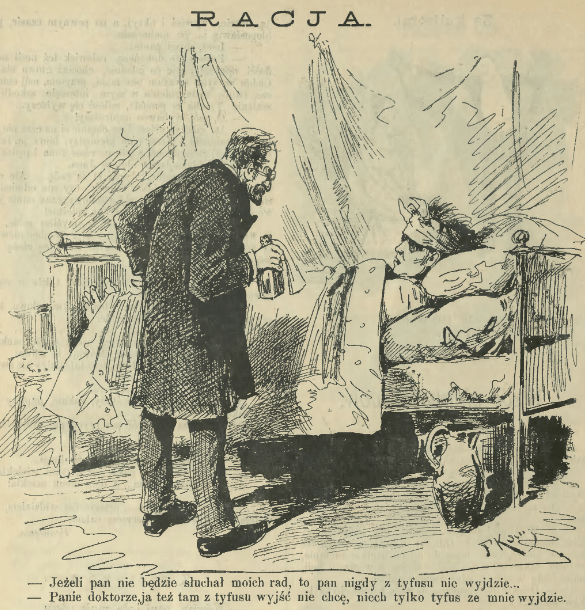
“If you don’t listen to my advice, you will never get over typhus…” “Doctor, I don’t want to get over typhus, just for typhus to get over me.” (Mucha, Warsaw, 1891)
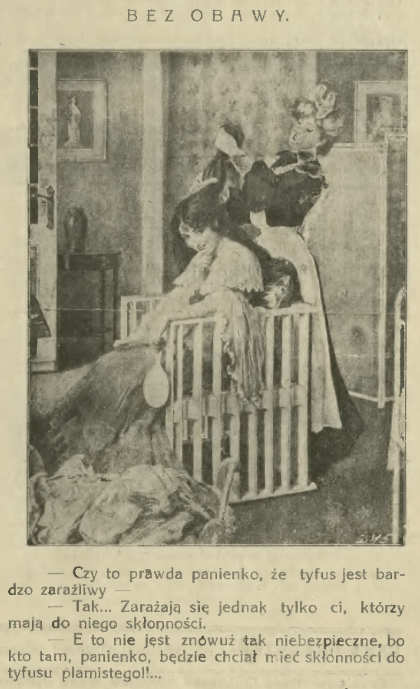
“Is it true, miss, that typhus is contagious?” “Yes… But it infects only those who have a tendency for it.” “And that’s again not so dangerous, because who, miss, would want a tendency for typhus.” (Kogut, Warsaw, 1912)
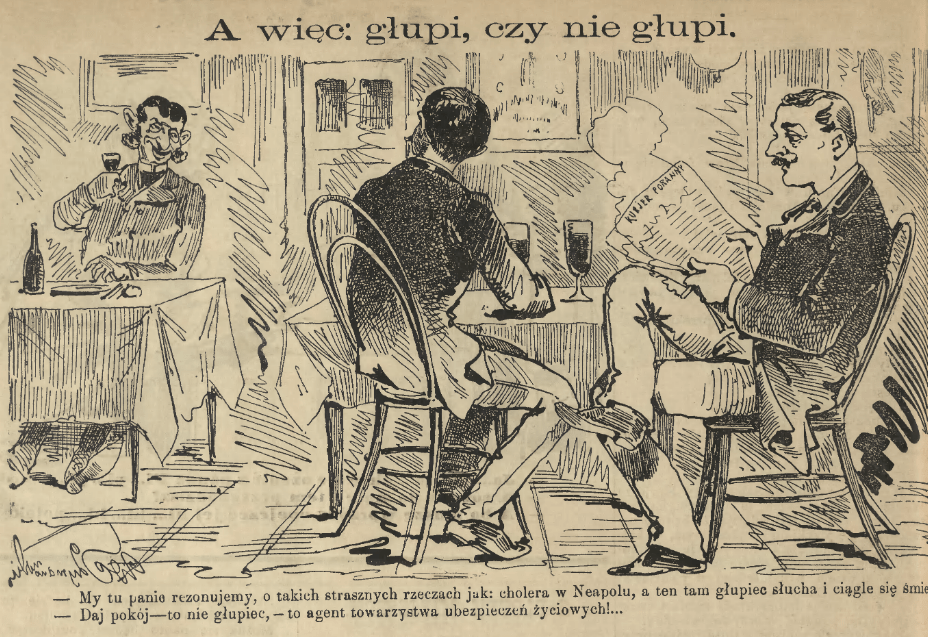
“We’re reasoning to that gentleman about such terrible things as cholera in Naples, and that fool there is listening and constantly laughing.” “Give it a rest, that is no fool, he is a life insurance company agent.” (No bonus points for noticing the anti-Semitic caricature.) (Mucha, Warsaw, 1884)

 Sic Transit Pestilentia