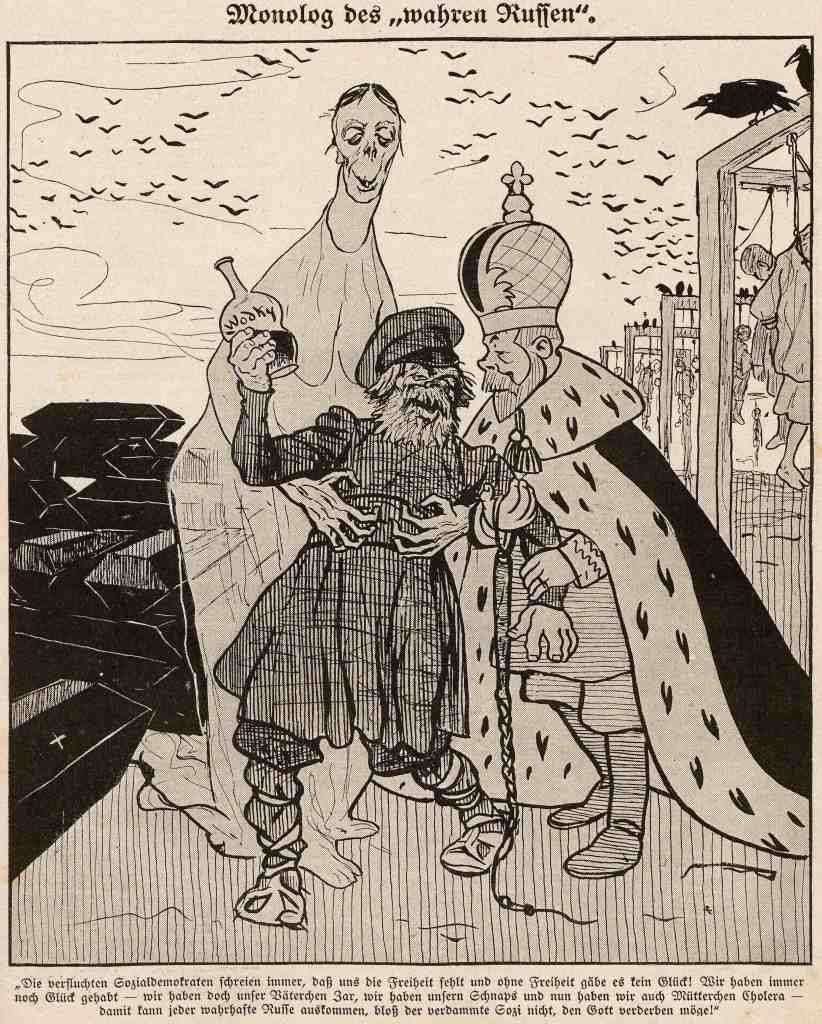
Another bit of Russophobia which I post without additional comment: “The cursed Social Democrats always shout that we lack freedom and without freedom there would be no happiness! We have always been fortunate, we have our little father Tsar, we have our schnapps, and now we also have mother cholera, so any true Russian can get by, just not the damned socialist, may God ruin him!” (Der wahre Jacob, Stuttgart, 1908)
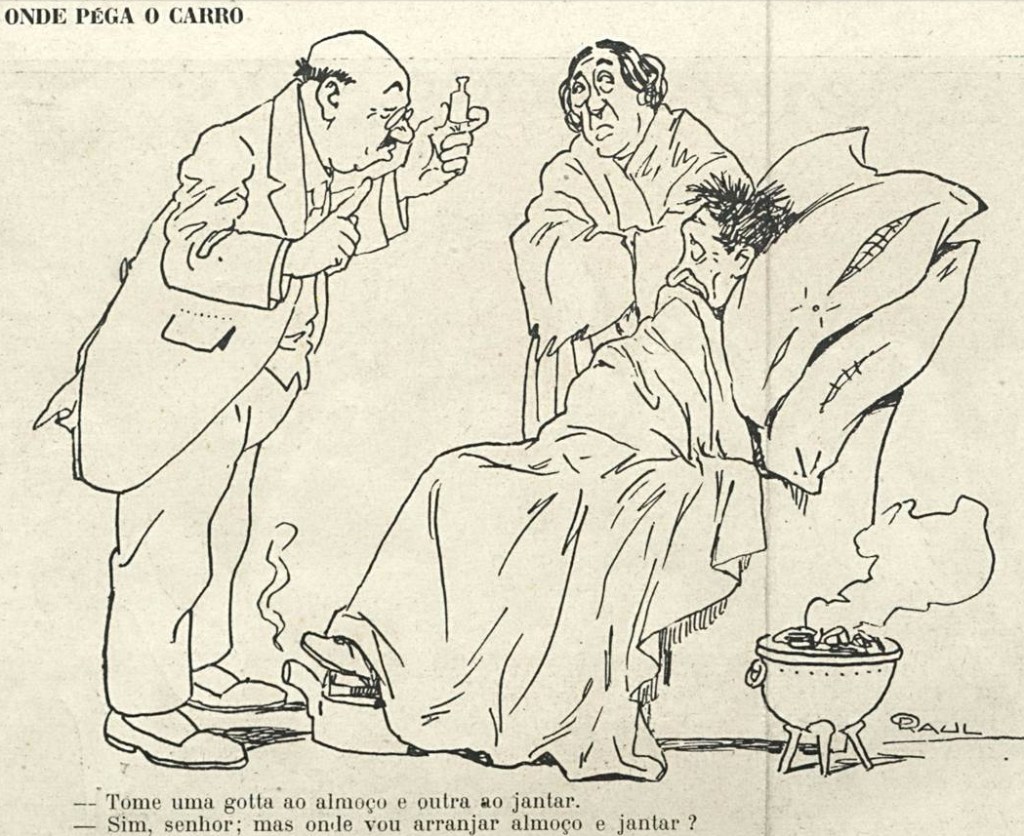
“Take one drop at lunch and another at dinner.” “Yes, sir, but where am I going to get lunch and dinner?” (O Malho, Rio de Janeiro, 1918) (I might have missed the idiom in the title.) (A later German cartoon with a similar motif.)
Brazilian flu cartoon
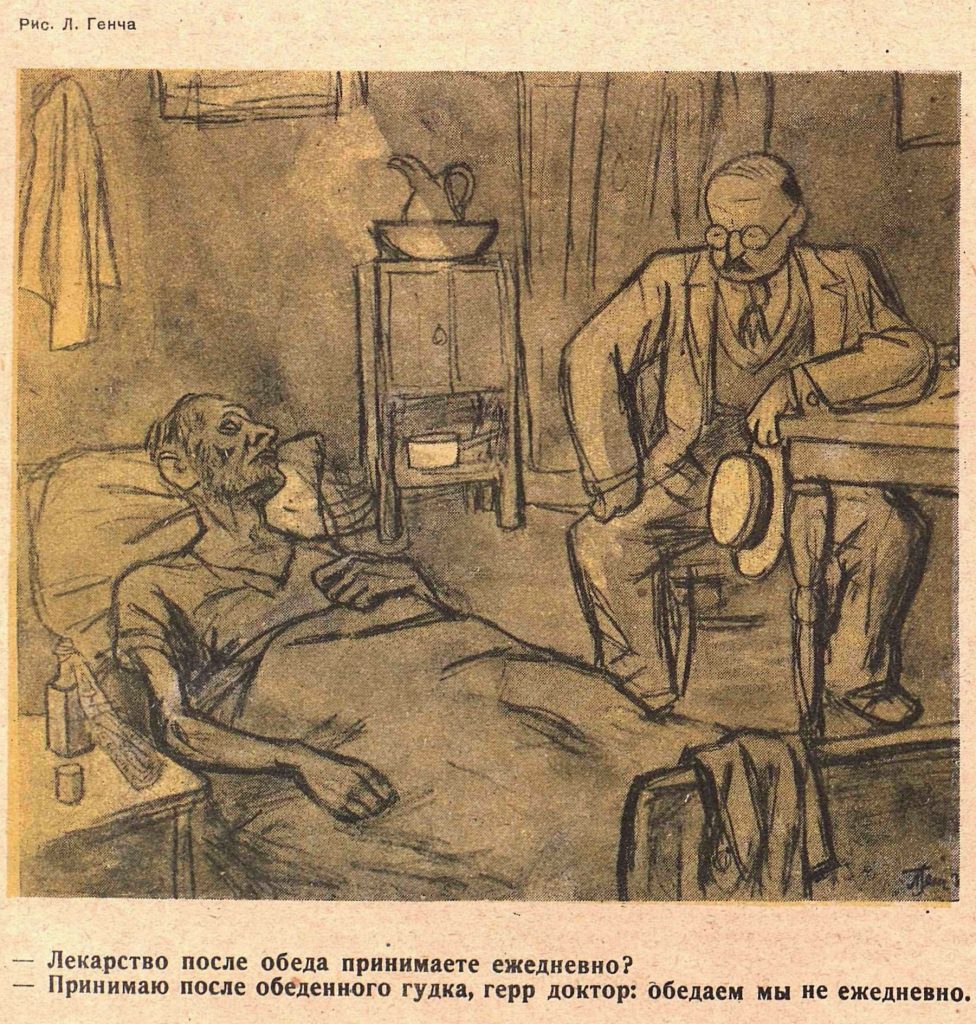
A nearly identical Soviet cartoon aimed at contemporary Germany: “Are you taking the medicine daily after lunch?” “I take it after the lunch bell, Herr Doctor: we don’t have lunch every day.” (Krokokil, Moscow, 1936)
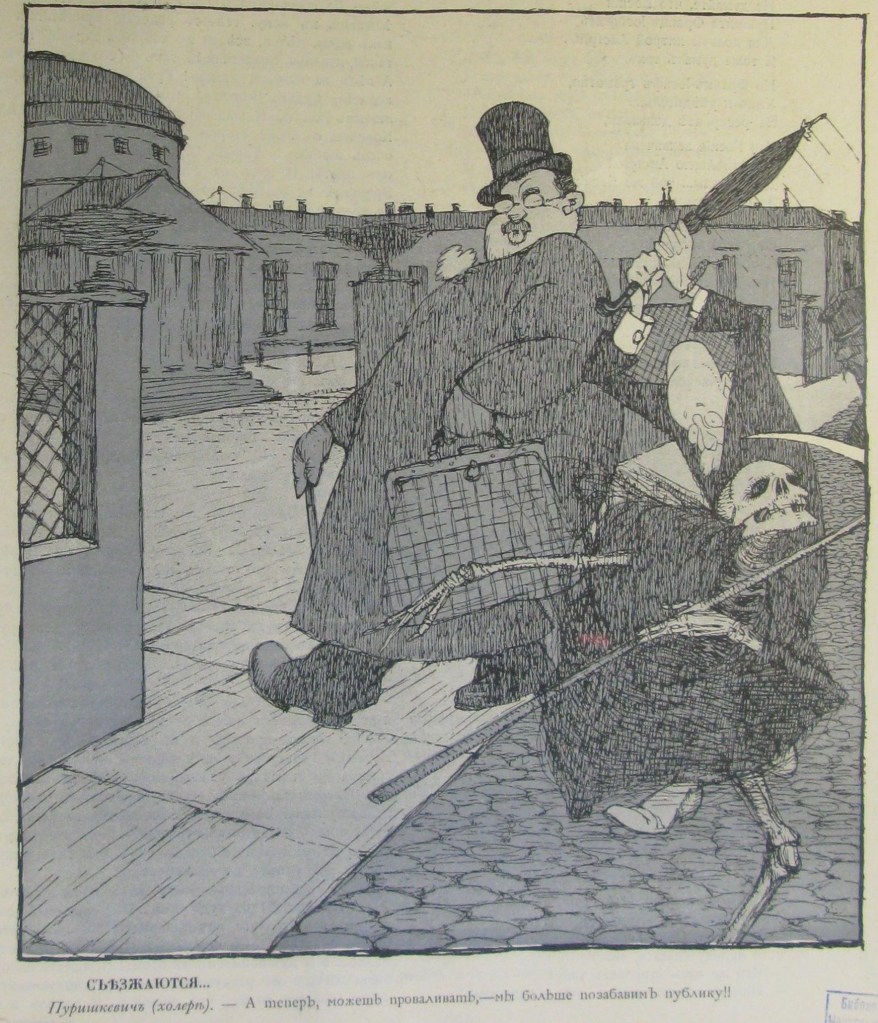
“They are assembling together…” Purishkevich (to cholera while beating it with his umbrella): “It might be failing right now, we’ll have more ways to entertain the public.” (Purishkevich was an ultraconservative and anti-Semitic Russian politician who had recently fallen out with one set of protofascist allies and was cultivating a new group under the name “Russian People’s Union of the Archangel Michael.” Presumably Satirikon regarded neither Purishkevich nor cholera as good for the health of the Russian body politic.) (Satirikon, St. Petersburg, 1908)
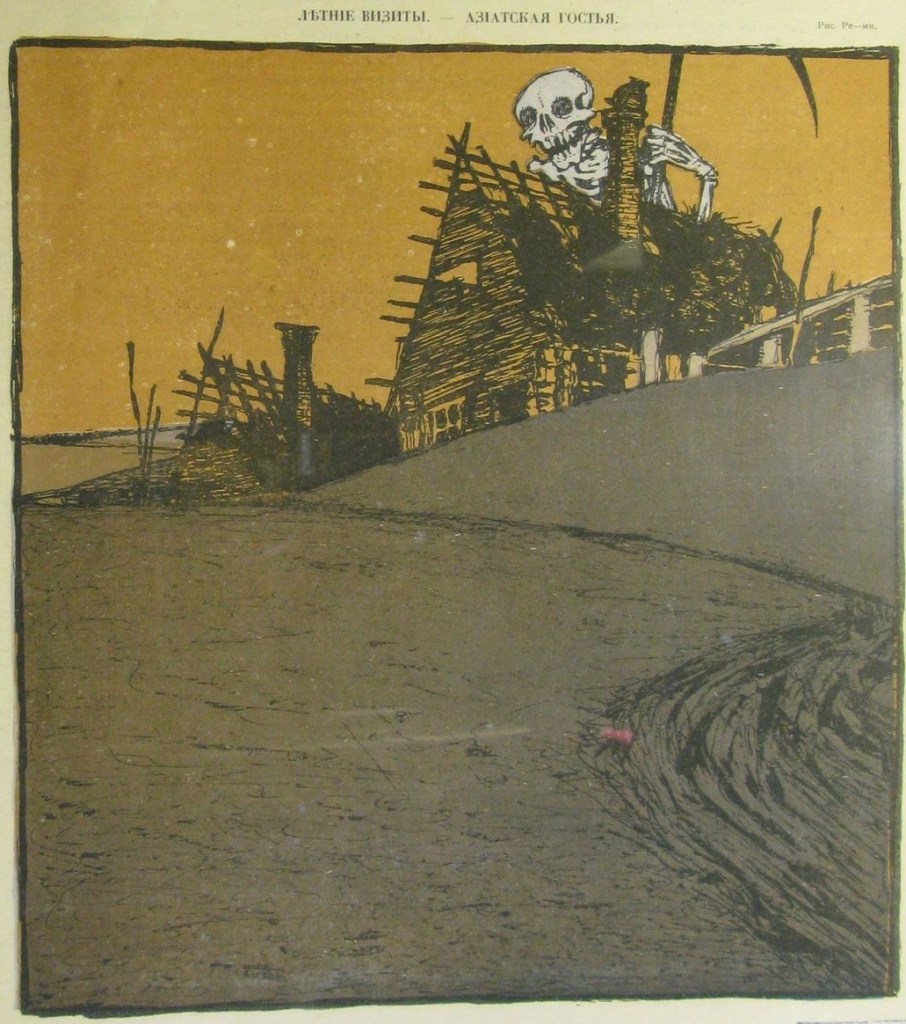
Summer visits — the Asian guest. Cover image of the Russian satirical magazine Satirikon as cholera in the southern provinces of the empire was making itself felt more widely. (Satirikon, St. Petersburg, 1908)
This image of death on wheels is a bit ambiguous for our purposes, but it was published just at the moment when a cholera epidemic in the Caucasus was reaching the Russian capital, so I shall classify it accordingly. (Satirikon, St. Petersburg, 1908)
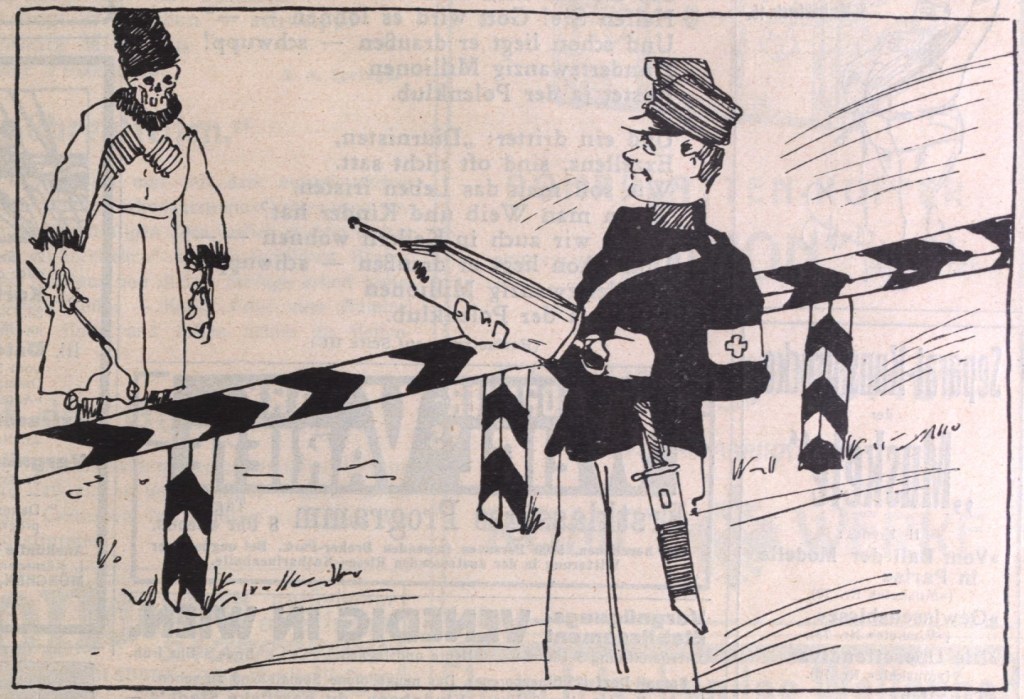
This cartoon set at the Austrian border with the Russian Empire is accompanied by a bit of nasty verse entitled “Cholera Russica” (in my slapdash translation):
The Slavic danger — how should I Just say it? — is not an empty delusion; On the contrary, it swells menacingly In the south and in the east.
Defending against it, cannons are Dispensable and rifles, too; Only from sanitation troops alone Can we make successful use.
In the south, where it is more primitive, Yet still fruitless, It besets us with vermin, In the east with epidemics.
Now due to this realization the eastern one Terrifies us especially clearly, Since its main pathogen is just now Loosing the prohibited heart of the epidemic;
Even though the tightest quarantine, That we usually put in place, Sets hardly more conditions than those, That the Tsar himself always imposes.
And as for the man himself, it was not A plague that instilled fear in him, For whom the greatest of all plagues Hasn’t yet withered him: his regime! (Die Muskete, Vienna, 1910) (Or this bit of German verse in a similar vein.)
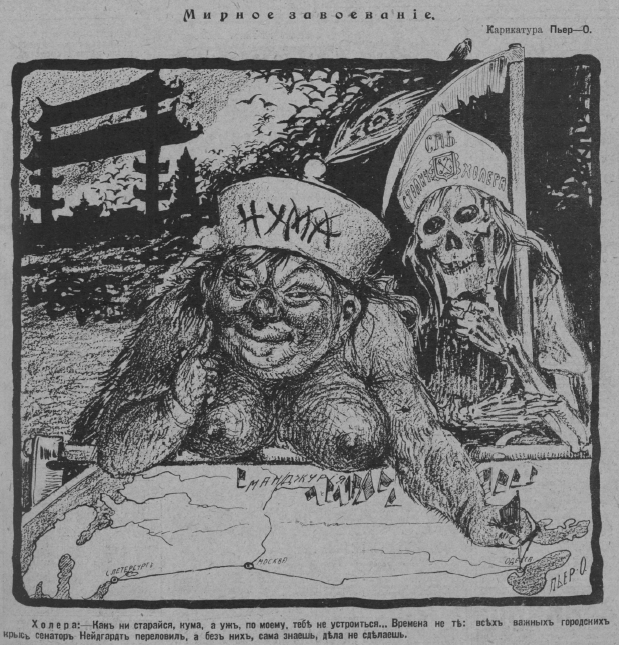
St. Petersburg cholera (to Mother Plague reaching over site markers in Manchuria and points east in the Empire toward Odessa on the Black Sea): “However hard you try, Mother, I think you can no longer get settled there… The times have changed: Senator Neidgardt [Dmitrii Borisovich, who had once served as mayor of Odessa] caught all the important municipal rats, and without them, as you know, you won’t get anywhere in these matters.” (Ogonek, Russia, 1911)
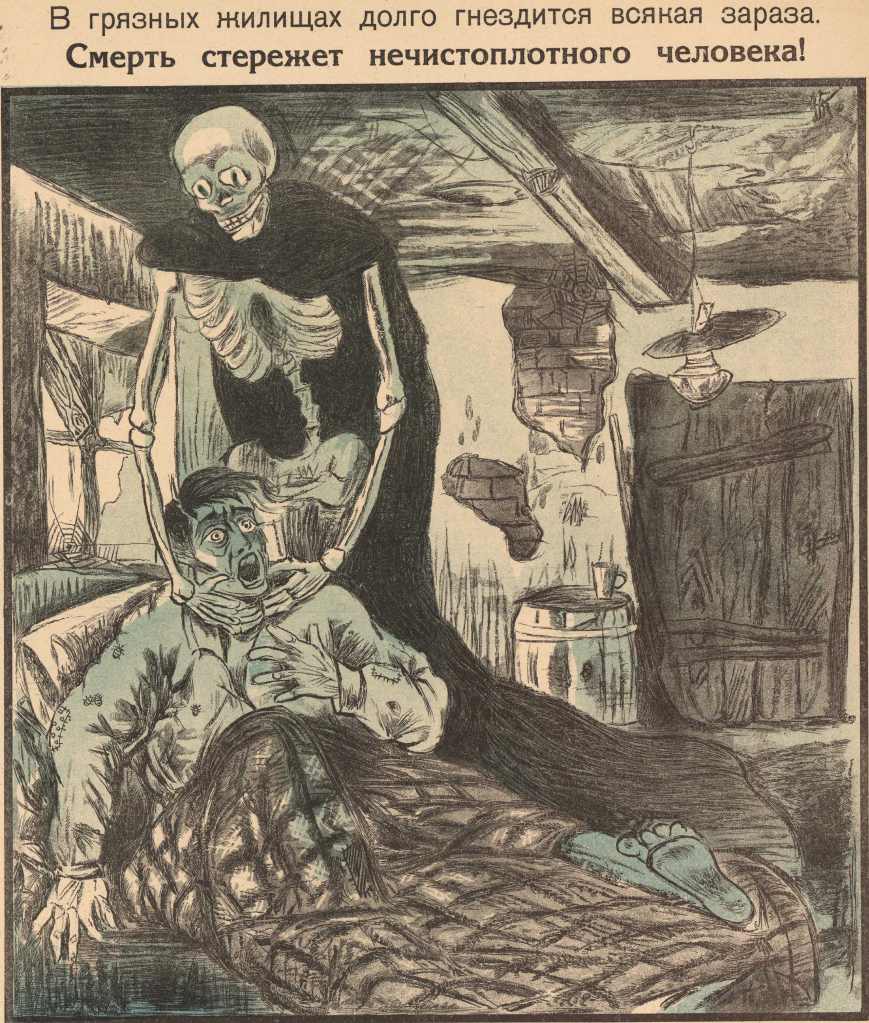
“In filthy residences any contagion can take root for a long time.” “Filth and uncleanliness are one of most important causes of our illnesses.” Detail from an educational poster by the Ukrainian People’s Commissariat of Health, 1920. (Russian State Library)
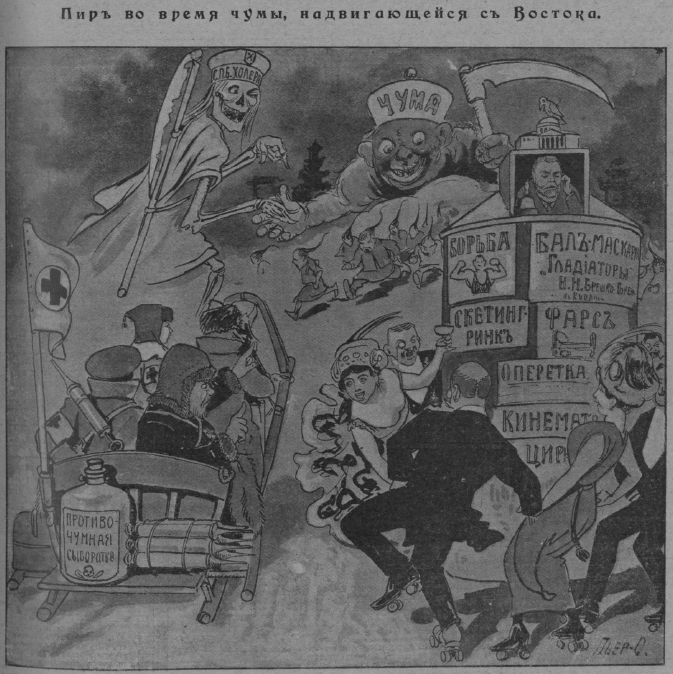
Bony St. Petersburg cholera shakes hands with oriental plague, while Red Cross sled bears anti-plague serum toward invading pigtailed Chinese figures. Oblivious Russian celebrants dance around posters for wrestling, skating, masquerade balls, farces, operettas, movies, and circus performances. (Not sure which Russian politician is depicted at the top, since Pyotr Stolypin–soon to resign–was balding.) (Ogonek, Russia, 1911)
“The Russian regime has initiated an aid campaign against famine, since a radical solution of the problem has been made possible by cholera anyhow.” (Meaning it’s just for show and the weak state won’t have to try very hard.) (Die Glühlichter, Vienna, 1910)
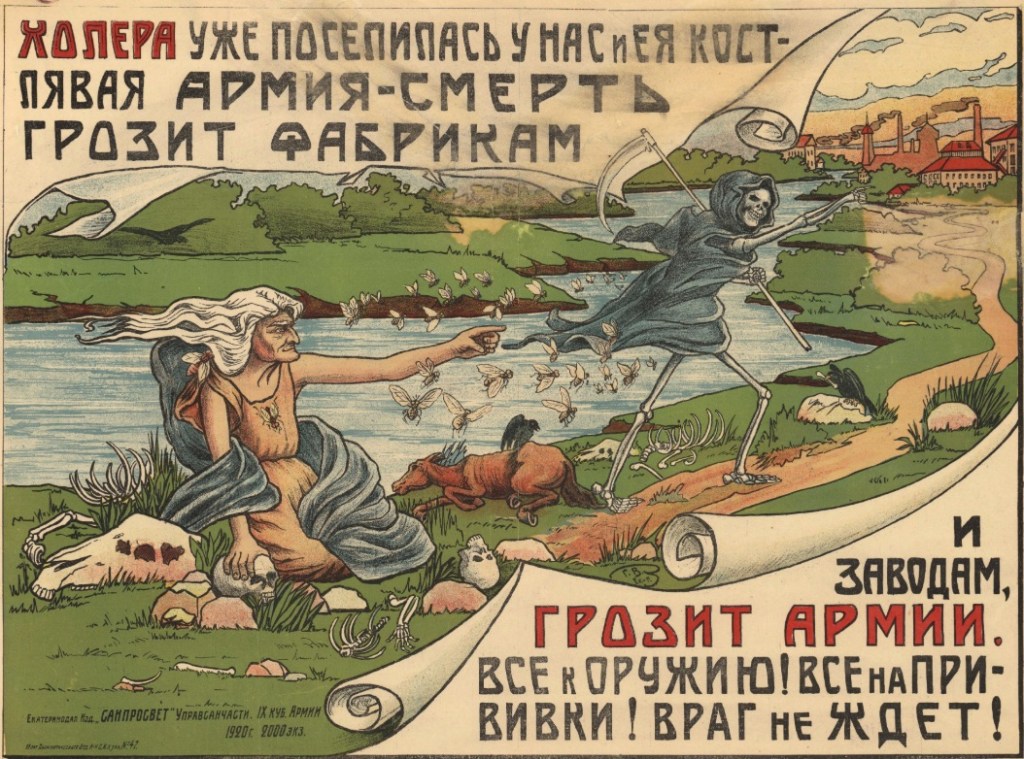
“Cholera has already taken up residence with us and her bony army of death threatens factories and plants, it threatens the army. To arms! Get vaccinated! The enemy does not wait!” (Ekaterinodar, 1920) (Russian State Library)
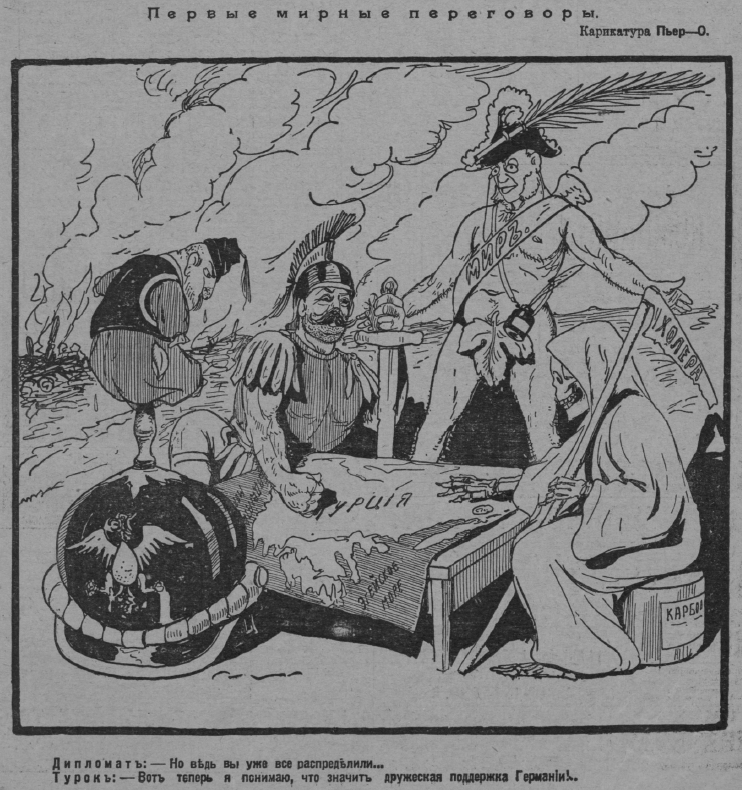
Mars negotiates the breakup of Ottoman Turkey with Cholera, seated on a barrel of carbolic acid. Peace the Diplomat approaches the table. Diplomat: “But you’ve already divided up everything.” Turk (perched on German Pickelhaube): “Well now I understand what the friendly support of Germany means!” Russian satirical magazine Ogonek no. 49, 1910.



 Sic Transit Pestilentia