Mayor. “What good brings you here, madame flu?”
The flu. “I come, like I do every year, to listen to The Song of Forgetting.”
(El Mentidero, Madrid, 1919)
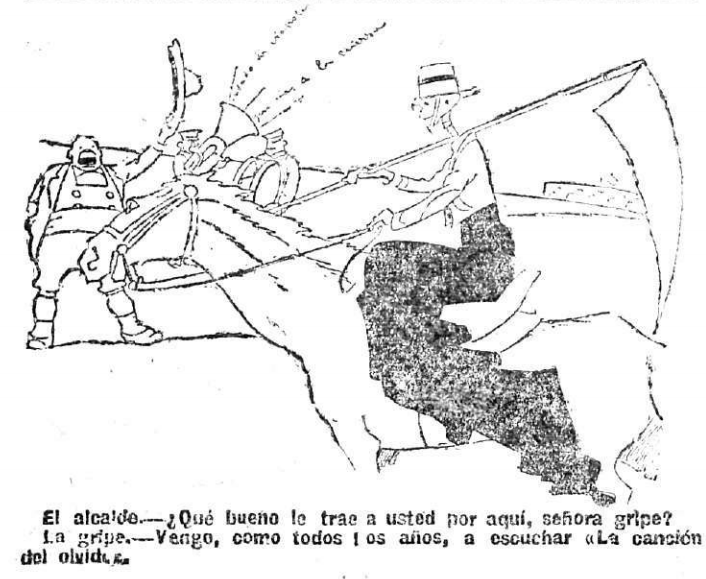
Mayor. “What good brings you here, madame flu?”
The flu. “I come, like I do every year, to listen to The Song of Forgetting.”
(El Mentidero, Madrid, 1919)
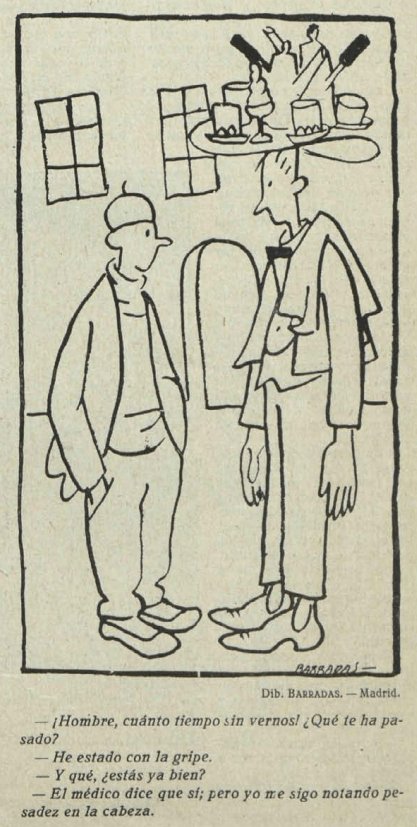
“Man, how long has it been since we saw each other! What’s been happening with you?”
“I’ve been down with the flu.”
“So are you okay?”
“The doctor says yes, but I still feel heaviness in my head.”
(Buen humor, Madrid, 1923)
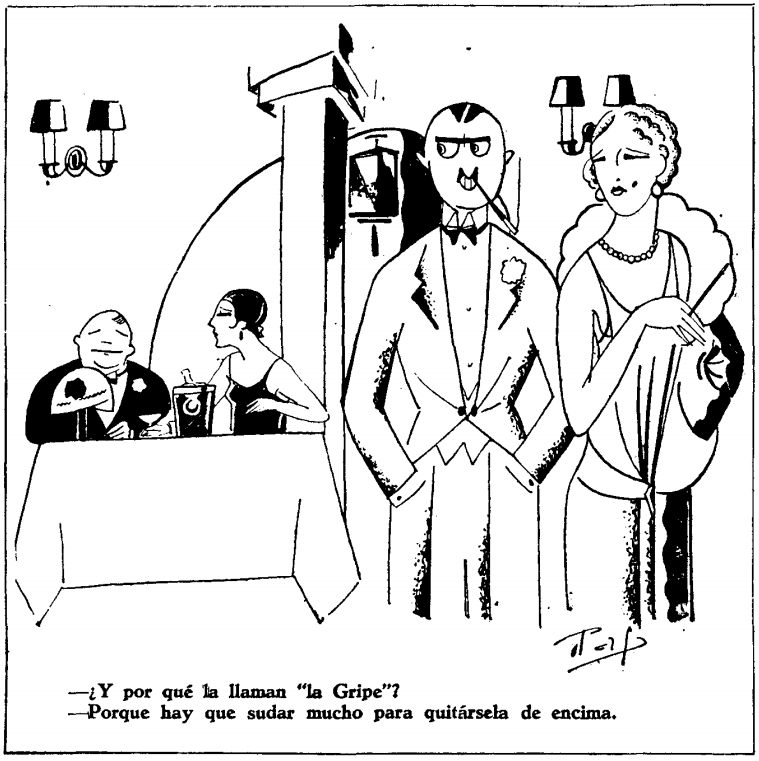
“And why do they call her “the Flu”?”
“Because you have to sweat a lot to get rid of her.”
(Gutiérrez, Madrid, 1931)
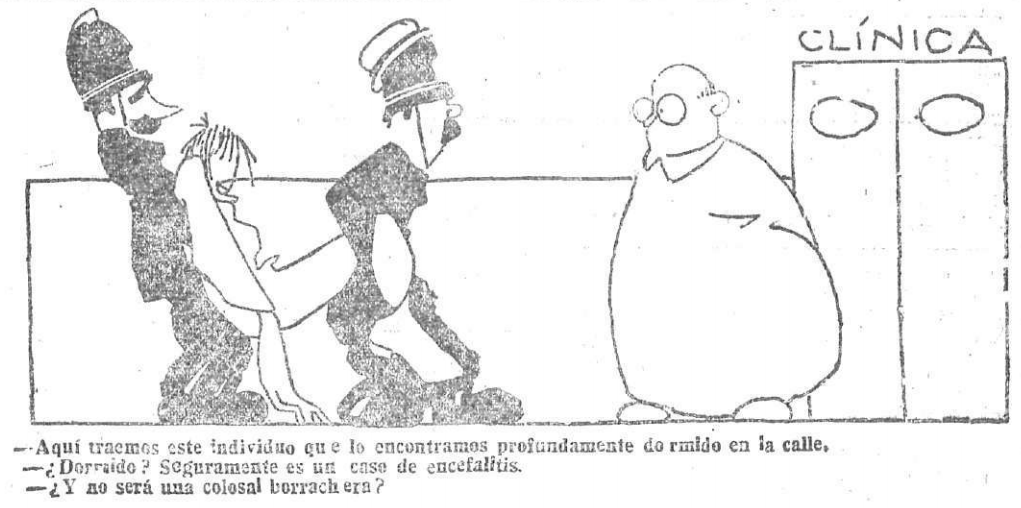
“Here we bring this individual that we found him sound asleep on the street.”
“Asleep? It is surely a case of encephalitis.”
“And it wouldn’t be a colossal drunk, would it?”
(El Mentidero, Madrid, 1920)
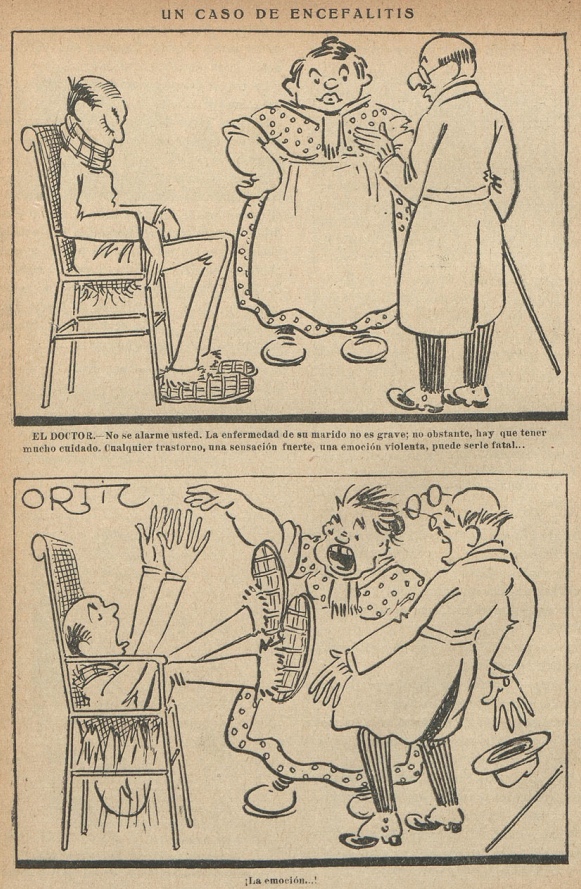
Doctor: “Don’t be alarmed. Your husband’s illness is not serious; however, you have to be very careful. Any disorder, a strong sensation, a violent emotion, can be fatal…”
(second panel) The emotion!
(La Risa, Madrid, 1922)
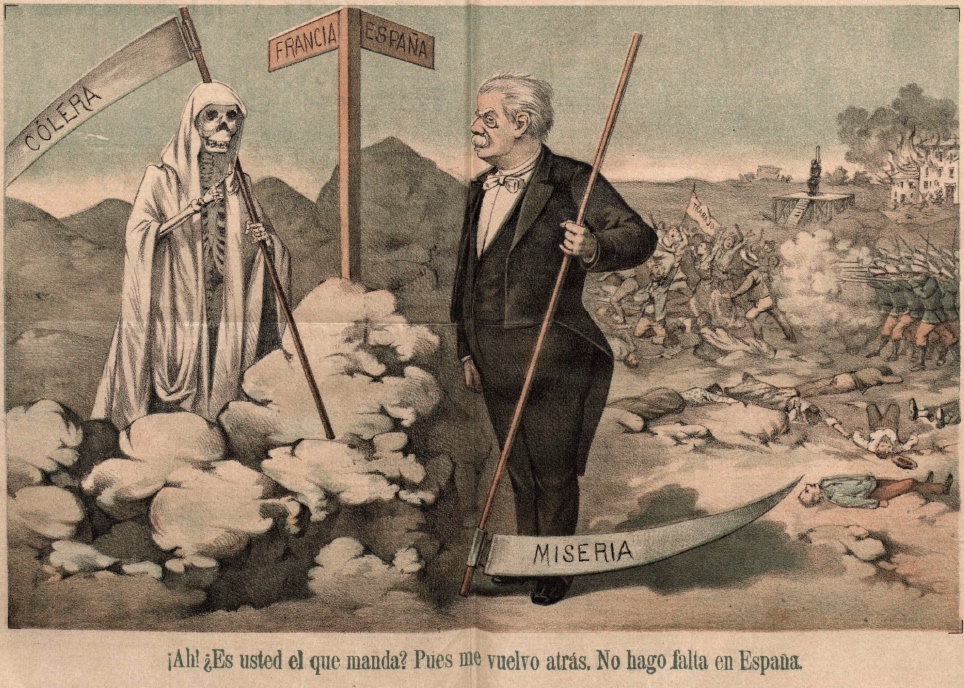
Cholera at the French-Spanish border, to Spanish prime minister Antonio Cánovas del Castillo: “Ah! Are you the boss? Well, I’ll head back. I’m not needed in Spain.”
In January Andalusian anarchist workers associations had tried to take control of Jerez de la Frontera, an action that was violently suppressed by the government. The following month four anarchist workers were executed, but not before a small bomb was set off in the Plaza Real in Barcelona. Just weeks before this image was published, greengrocers in Madrid launched a “mutiny,” a popular revolt in the face of new municipal taxes. The Conservative Cánovas, then serving his fifth turn as prime minister, strongly resisted expanding suffrage to the working class. (See a previous issue for another excellent image; El Motin was unsurprisingly deeply hostile to monarchist politicians.) He also pursued a hard line against Cuban independence. He was eventually assassinated by an Italian anarchist in 1897.
(El Motin, Madrid, 1892)
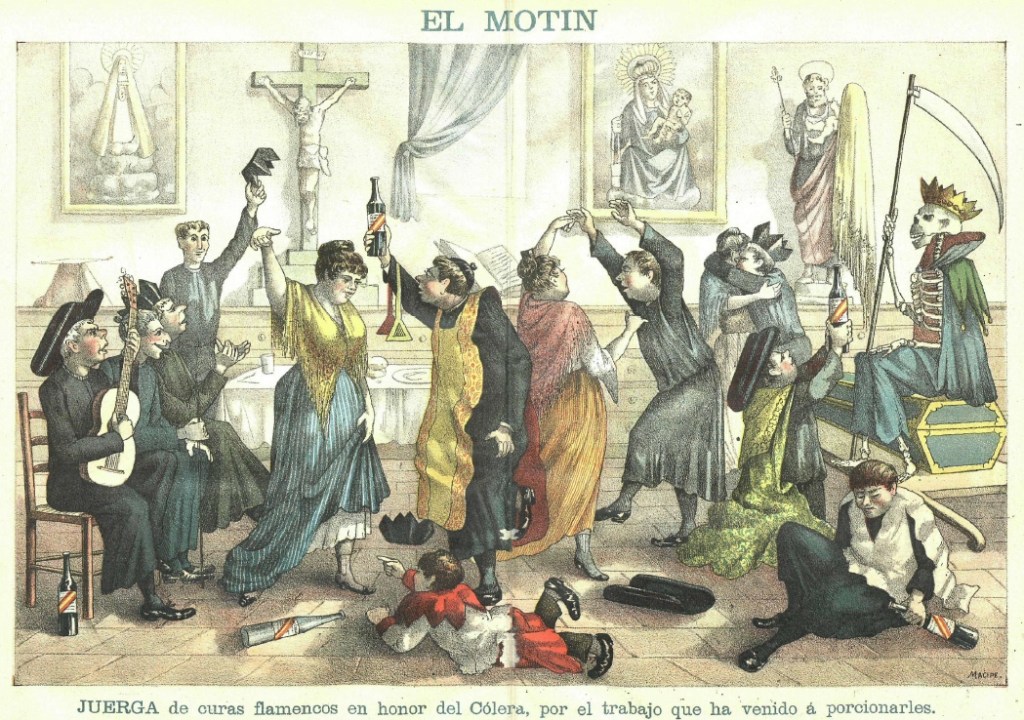
Flamenco priests binge in honor of Cholera, for the work that has come to their provisioning [?].
(El Motin, Madrid, 1885)
Juan Martinez Villergas launched the Spanish satirical magazine El Tío Camorra (Uncle Trouble) in September 1847, and this plate is featured on the front cover of all the early issues of this short-lived venture, which was closed in July 1848. I lack the expertise to comment on his agendas, but I was struck by the opening passage from the 26 January 1848 issue, several weeks before the revolutionary disturbances that broke out elsewhere in Europe.
“Uncle Trouble has not wanted to catch the flu until now, and has had more than one reason for it. The first and foremost of all is that Uncle Trouble has a great commitment contracted with the Spanish public, and he does not want his beatings to suffer interruption [see image], I do not say for something so mean and petty as having the flu, but for all typhus and cholera around the world. So, then, although the prevailing disease has penetrated the home of the citizen of Torrelodones [i.e., JMV’s alter ego] and resolutely attacked Don Juan de la Pilindrica [his worldly mentor] and the Parrot [another prop in his dialogues], and for other instances that the flu has undertaken to meet with Uncle Trouble, this one has categorically refused to receive it, as he is willing to reject any epidemics that arise while the yokel [meaning Uncle Trouble] pursues the noble and holy mission of enlightening the people and unmasking the public villains. And in order for the flu to desist from its reckless endeavor, it was necessary to reach a compromise in the most prudent way possible, which consisted of the yokel signing a promissory note to the flu, contracting a debt that will be paid within eight days after the publication is completed. When Uncle Trouble stops writing, there will be no problem for anyone to get the flu; but meanwhile he says that it does not suit him and he will not get it. Having said that, as Uncle Trouble has the courage to not stop publishing as long as he has subscribers, and these are increasing from day to day, it turns out that the flu will no longer exist when he wants to come to collect the bill, and Uncle Trouble will get away with not getting a plague that even in name [“la grippe”] reveals his French condition.
Another reason that Uncle Trouble has had for ignoring the flu is that the Torrelodones yokel is not very fond of following fashions, and because the trans-Pyrenean disease can be considered in the day as a bad fashion that the elegant types have used to put on airs, the employees not to go to the office, the deputies not to play a sad role in Congress, etc., it would be even embarrassing for Uncle Trouble to stop giving a single beating for paying homage to a fashion as childish and ridiculous as the flu. But although Uncle Trouble has not had the flu, he is so little fond of getting up early that (at least in the cold season) rare is the day that he does not hear the twelve chimes of the clock in bed, time in which the other inhabitants of Torrelodones hurry to empty the cooking pot. For this reason, he usually receives some trustworthy visitors in the bedroom, and nothing is easier than to catch him at home during the time when the ruddy Phoebus walks halfway over our horizon.”
(El Tio Camorra, Madrid, 1848)
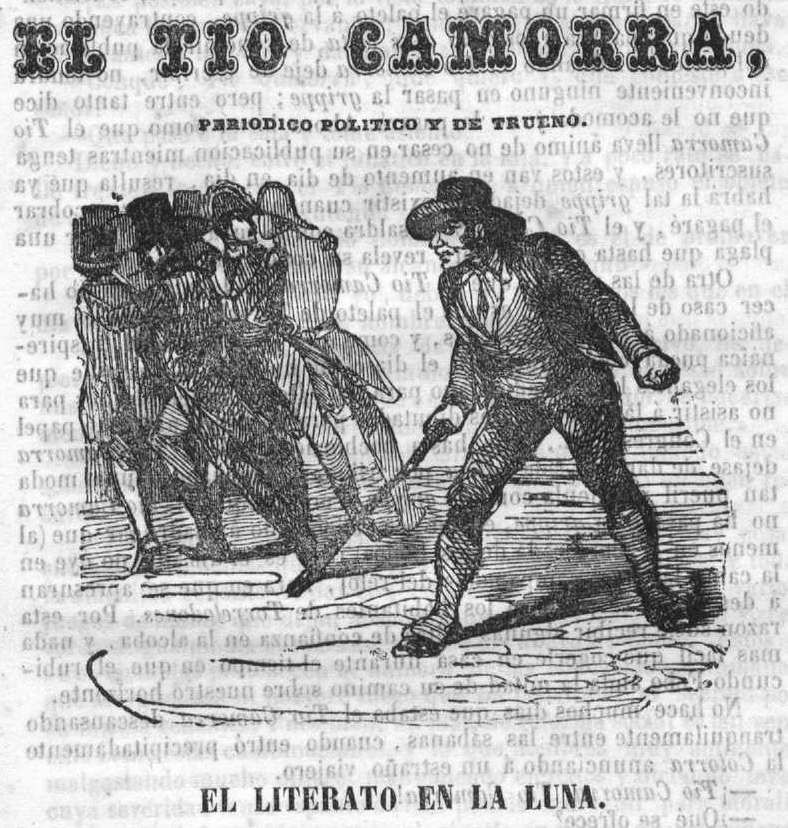
“The Petit Journal reports the appearance of a new vine disease called black rot, which is ravaging the department of Herault.”
“Brave year. The cholera took my wife and my mother-in-law, and now the black rot threatens to rob me of the only affection that remained.”
(La Caricatura, Madrid, 1885)
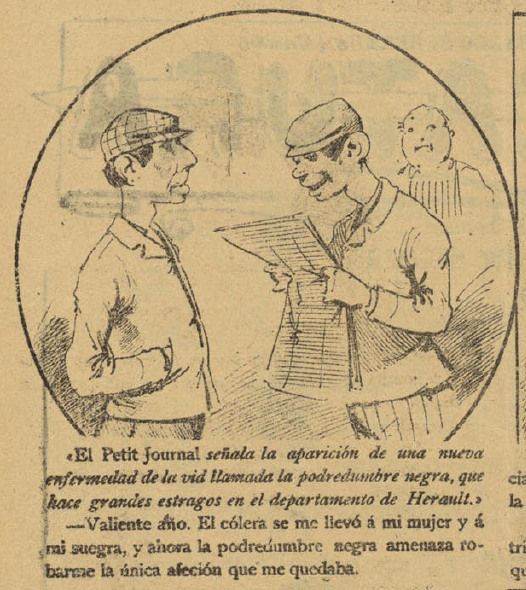
“I have a chronic illness that should be included in the exemption chart.”
“Chronic?”
“Yes, sir, chronic.”
“And what?”
“Cholera morbo-asiatico.”
(Another Mecachis cartoon from La Caricatura, Madrid, 1885)
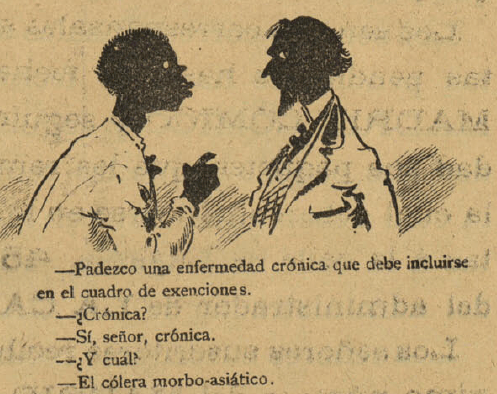
Some out of habit
others because of the cholera
some on a whim
and most for fashion,
everyone is going to bathe
in the blue waves.
Only I who do not have
not a single quarter of an hour,
I stay here by force
because they hang by force.
Stay here…? I’m already crying…!
Why? For one thing
…………………….
I’m afraid to be
alone with the microbe
(La Caricatura, Madrid, 1885) (Sadly I cannot say anything about Nao Ping. This one is rich with possibility.)
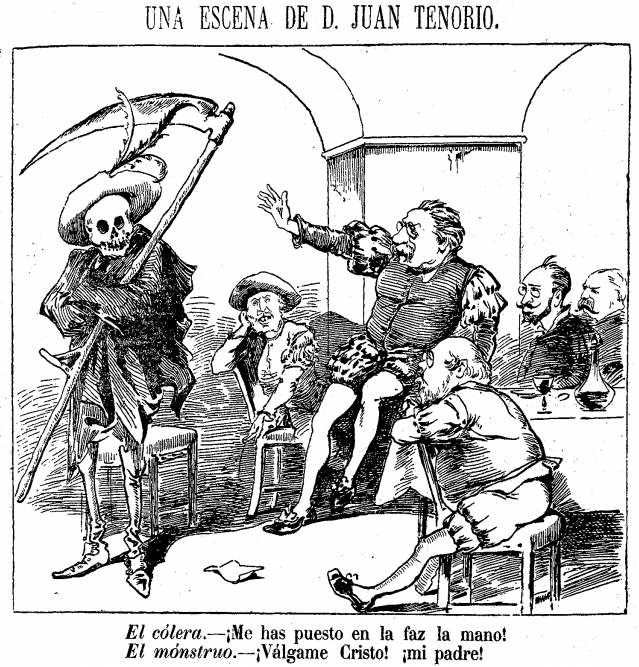
Don Juan Tenorio (the Seducer) was a 1844 play by José Zorrilla that retold the Don Juan legend for modern Spanish audiences. The object of satire here is prime minister Antonio Cánovas del Costillo, sometimes referred to as “the monster” for his curious combination of intellectual hauteur and political brutality.
Cholera: “You have slapped me in the face!” [i.e., “I demand satisfaction!”]
The monster: “Christ almighty! My father!”
(El Busilis, Barcelona, 1884)
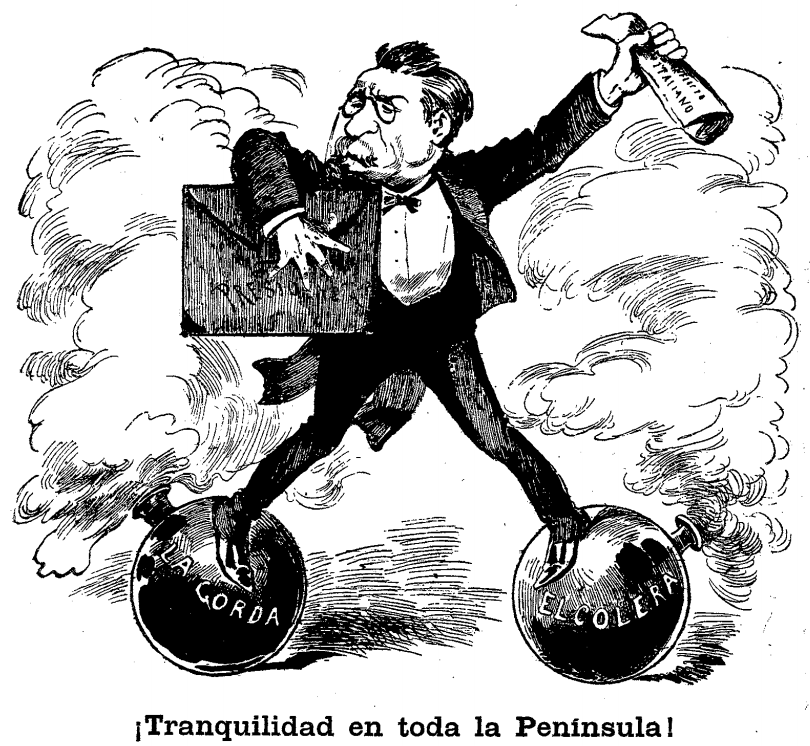
Without the lifesaver of morbid cholera, the ministry would have already drowned, because it was up to its neck in water.
(El Busilis, Madrid, 1884)

(El Busilis, Barcelona, 1884)
(This is not a freestanding cartoon, but one of several small illustrations that accompany an essay by this title. A rather rough translation of a bit of the surrounding text follows. I’m including this item because it is the earliest available Spanish example I have located so far.)
The recent carnival in Madrid has been bountiful in amorous intrigues, very weighty puns, and acts of honor.
As if revolutions, wars, typhus, influenza, morbid cholera, national pneumonia, and doctors who take death as their lackey were not enough, there are men who have such little esteem for their lives, that I must get away from all that chaff pretending to be skewered like veal on a spit. This would be dreadful if, fortunately, there were not charitable souls in the world who would try to convert the fiery impetus of the Matachines [carnivalesque dance troupes] into healthy prudence… [A metaphor or Aesopian tag for revolutionary factions, which did not win the day in 1848? I am out of my depth here.]
(La Linterna mágica, Madrid, 1849)
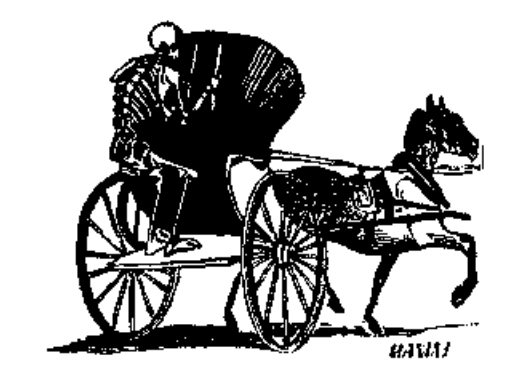
 Sic Transit Pestilentia